9011041155 / 9011031155 
1 
Measurements Physics Physics is a branch of science which deals with study of natural phenomenon of non-living things. Origin “fuses” 
Physical quantities 
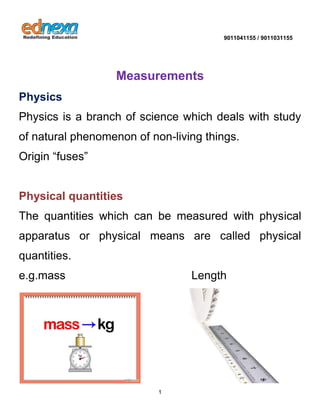
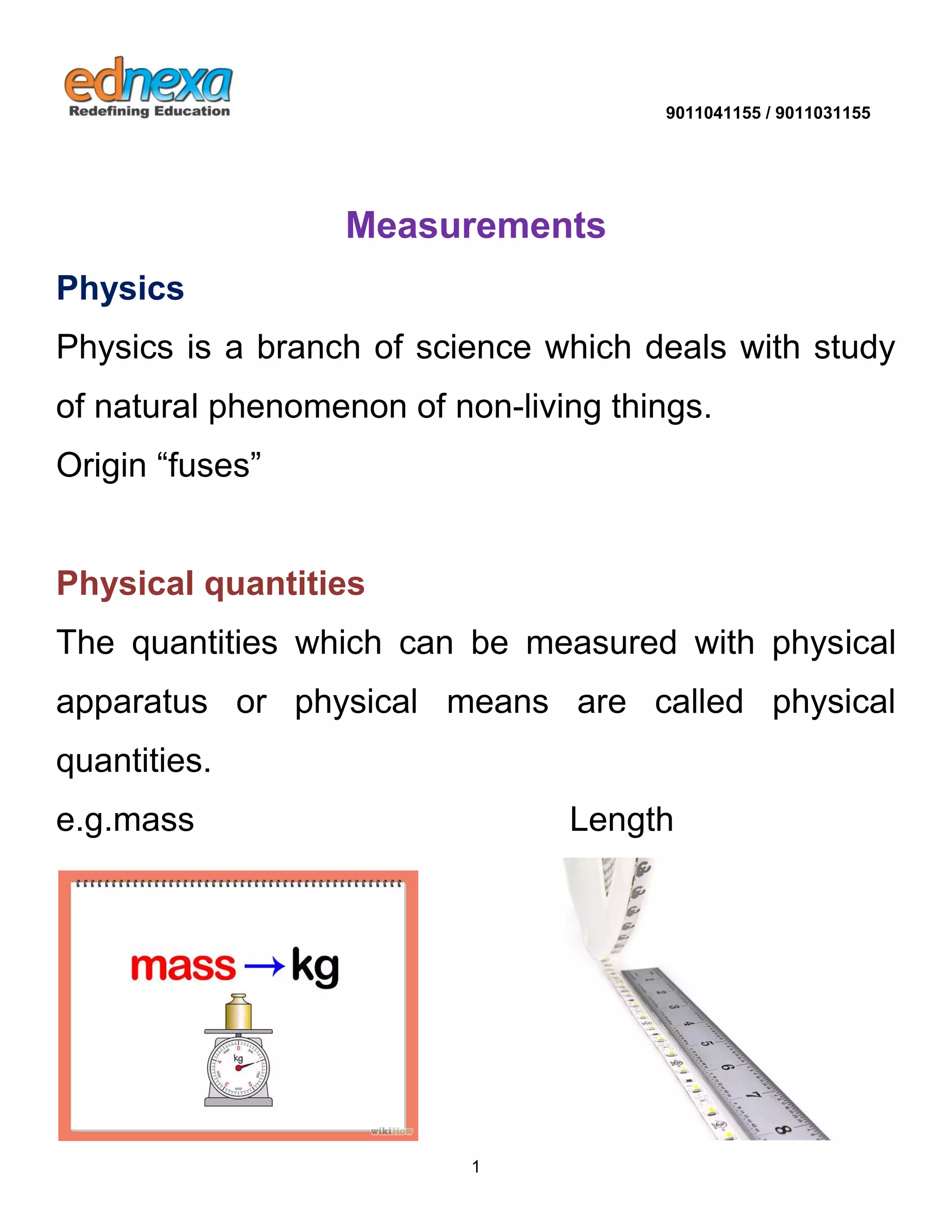
The quantities which can be measured with physical apparatus or physical means are called physical quantities. e.g.mass Length
9011041155 / 9011031155 
2 
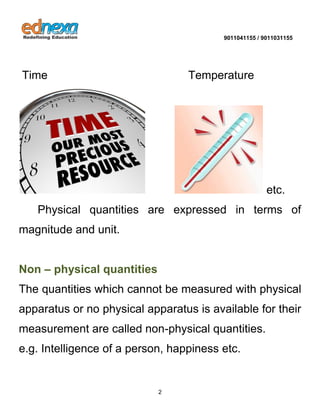
Time Temperature 
etc. 
Physical quantities are expressed in terms of magnitude and unit. Non – physical quantities 
The quantities which cannot be measured with physical apparatus or no physical apparatus is available for their measurement are called non-physical quantities. 
e.g. Intelligence of a person, happiness etc.
9011041155 / 9011031155 
3 
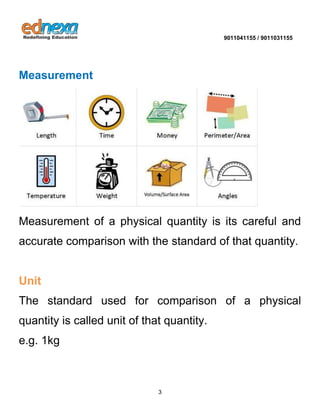
Measurement 
Measurement of a physical quantity is its careful and accurate comparison with the standard of that quantity. Unit 
The standard used for comparison of a physical quantity is called unit of that quantity. e.g. 1kg
9011041155 / 9011031155 
4 
Magnitude 
Magnitude of a physical quantity is the number which indicates how many times the unit is contained in it. e.g. 10 litres 
The physical quantities are classified in to two types 
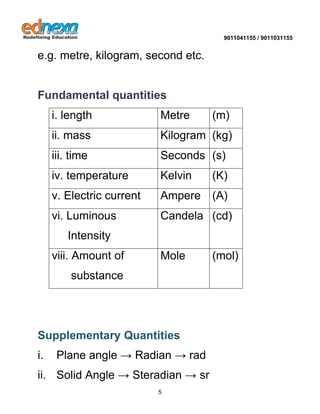
1. Fundamental quantities :- The physical quantities which can be independently measured and expressed are called fundamental quantities. Thus, these quantities can be measured and expressed without taking help of other quantities. e.g. length, mass, time, temperature etc. 
Fundamental units :- The units of the fundamental quantities are called fundamental units.
9011041155 / 9011031155 
5 
e.g. metre, kilogram, second etc. Fundamental quantities 
i. length 
Metre 
(m) 
ii. mass 
Kilogram 
(kg) 
iii. time 
Seconds 
(s) 
iv. temperature 
Kelvin 
(K) 
v. Electric current 
Ampere 
(A) 
vi. Luminous Intensity 
Candela 
(cd) 
viii. Amount of substance 
Mole 
(mol) 
Supplementary Quantities i. Plane angle → Radian → rad ii. Solid Angle → Steradian → sr
9011041155 / 9011031155 
6 
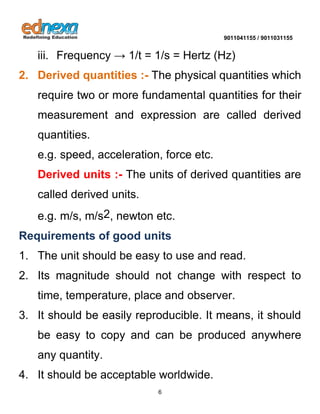
iii. Frequency → 1/t = 1/s = Hertz (Hz) 
2. Derived quantities :- The physical quantities which require two or more fundamental quantities for their measurement and expression are called derived quantities. 
e.g. speed, acceleration, force etc. 
Derived units :- The units of derived quantities are called derived units. 
e.g. m/s, m/s2, newton etc. 
Requirements of good units 
1. The unit should be easy to use and read. 
2. Its magnitude should not change with respect to time, temperature, place and observer. 
3. It should be easily reproducible. It means, it should be easy to copy and can be produced anywhere any quantity. 4. It should be acceptable worldwide.
9011041155 / 9011031155 
7 
(universally acceptable ) System of units 
The fundamental units together with all derived units form a system of units. Formerly there were different unit systems used in different countries. Some of the most common unit systems were as follows :- 1. C.G.S. 2. M.K.S. 3. F.P.S. 
4. S.I.( System International ) :- To avoid difficulties in inter conversions of units and to have uniformity 
in the units used all over the world, General Conference of weights and Measures suggested an 
improved metric system called System International in 1960. It was accepted by I.S.O.( International 
Standards Organization ) in 1962. This includes all the fundamental units from M.K.S. and over 450
9011041155 / 9011031155 
8 
derived units. As far as possible the units are named after renowned scientists to honour them. 
Before the introduction of S.I. exchange of information between the scientists of different 
countries was difficult because of the difference between the unit systems used by them. With the worldwide use of S.I. this difficulty is removed. 
Now in this common language of units, scientists engineers and technicians all over the world can exchange their ideas, criticism easily. So, this system has bridged-up the gap between them. 
Rules of writing S.I. units 
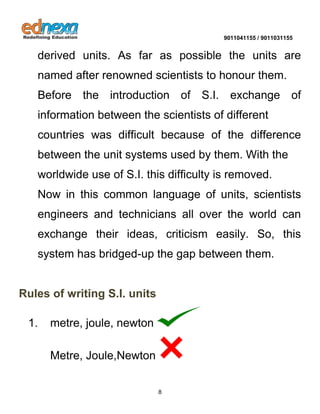
1. metre, joule, newton 
Metre, Joule,Newton
9011041155 / 9011031155 
9 
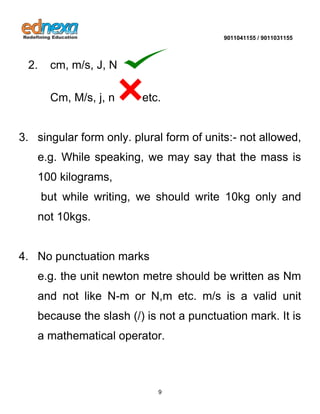
2. cm, m/s, J, N 
Cm, M/s, j, n etc. 3. singular form only. plural form of units:- not allowed, e.g. While speaking, we may say that the mass is 100 kilograms, 
but while writing, we should write 10kg only and not 10kgs. 4. No punctuation marks 
e.g. the unit newton metre should be written as Nm and not like N-m or N,m etc. m/s is a valid unit because the slash (/) is not a punctuation mark. It is a mathematical operator.
9011041155 / 9011031155 
10 
Dimensions 
Increasing the power of fundamental units to find out 
units of derived quantities is known as dimensions. 
1. 
0 1 1 
displacement 
Velocity 
Time 
V 
T 
[ M L T ] m / s  
 
 
  
l 
2. Area = ℓ2 
= [ M0 L2 T0] = m2 
3. Volume = ℓ3 
= [ M0L3T0] = m3
9011041155 / 9011031155 
11 
4. 
2 
0 1 2 2 
V / T 
Acceleration 
T T 
T 
M LT m / s  
  
 
    
l 
l 
5. Force = ma 
= m × ℓ / T2 
= [ M1L1T-2] = kg m / s2 = N 
6. Work = F . ℓ 
= ma . ℓ 
= m . ℓ / T2 . ℓ 
= m . ℓ2 / T2 
= [ M1 L2 T-2] = kg . m / s2 = J
9011041155 / 9011031155 
12 
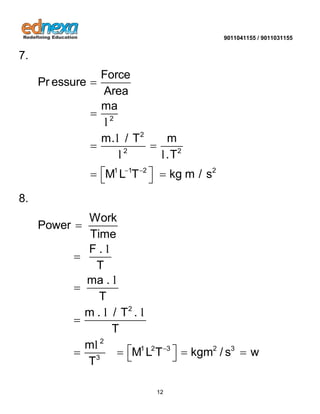
7. 
2 
2 
2 2 
1 1 2 2 
Force 
Pr essure 
Area 
ma 
m. / T m 
.T 
M L T kg m / s   
 
 
  
    
l 
l 
l l 
8. 
2 
2 
1 2 3 2 3 
3 
Work 
Power 
Time 
F . 
T 
ma . 
T 
m . / T . 
T 
m 
M L T kgm / s w 
T 
 
 
 
 
 
      
l 
l 
l l 
l
9011041155 / 9011031155 
13 
9. P.E = mgh 
2 
1 2 2 2 2 
m. / T . 
M L T kgm / s J  
 
     
l l 
10. 
2 
2 2 
1 2 2 2 2 
1 
K.E mv 
2 
1 
m. / t 
2 
[M L T ] kgm / s J  
 
 
   
l 
11. Impulse = F.T 
= ma . T 
= m . ℓ / T2 . T 
2 
1 1 1 
m. . T 
T 
MLT kg m / s Ns  
 
     
l
9011041155 / 9011031155 
14 
12. Momentum = mv 
= m . ℓ / T 
= [ M1 L1T-1 ] 
= kg m / s 
13. 
3 
1 3 0 3 
mass 
Density 
Volume 
m 
ML T kg/m  
 
 
    
l 
M = [ M1L0T0] 
ℓ = [ M0L1T0] 
T = [ M0L0T1]
9011041155 / 9011031155 
15 
Uses of dimensional analysis 
1. To check correctness of equation. 
principle of homogeneity:- It states that dimensions 
towards both sides of equation for each term are 
same. Then the given equation is dimensionally 
correct. 
For e.g. 
1. 2 1 
s ut at 
2 
  
s is displacement 
u = initial velocity 
t = time 
a = acceleration 
L.H.S = ∴ S = [ M0L0T1] ….. (1) 
R.H.S
9011041155 / 9011031155 
16 
∴ ut = [ M0L1T-1] [ M0L0T1] 
= [ M0L1+0T-1+1] 
= [ M0L1T0] …… (2) 
2 1 
at 
2 
= [ M0L1T-2] [ M0L0T1]2 
= [ M0L1T-2] [ M0L0T2] 
= [ M0L1T0] …….. (3) 
From (1), (2) & (3) we can say that the given 
equation is dimensionally correct. 
2. v2 = u2 + 2as 
3. v = u + at 
4. w = w0 + mc2 
w = work 
w0 = work 
m = mass 
c = speed of light
9011041155 / 9011031155 
17 
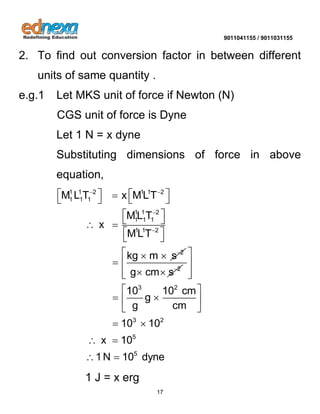
2. To find out conversion factor in between different 
units of same quantity . 
e.g.1 Let MKS unit of force if Newton (N) 
CGS unit of force is Dyne 
Let 1 N = x dyne 
Substituting dimensions of force in above 
equation, 
1 1 2 1 1 2 
1 1 1 
1 1 2 
1 1 1 
1 1 2 
2 
M L T x MLT 
ML T 
x 
MLT 
kg m s 
  
 
 
 
     
    
  
  
 
2 g cm s   
3 2 
3 2 
5 
5 
10 10 cm 
g 
g cm 
10 10 
x 10 
1N 10 dyne 
  
  
  
  
    
  
  
  
  
1 J = x erg
9011041155 / 9011031155 
18 
e.g.2 v = u + at v = final velocity u = initial velocity a = acceleration t = time L.H.S = v ∴ v = [ M0L1T-1] ……… (1) R.H.S = u ∴ u = [ M0L1T-1] ……… (2) R.H.S at = [ M0L1T-2] [ M0L0T1] = [ M0L1T-1] ………… (3) From (1), (2), (3) we can say that the given equation is dimensionally correct.
9011041155 / 9011031155 
19 
e.g. 3 v2 = u2 + 2as v = final velocity u = initial velocity a = acceleration s = displacement L.H.S = v2 ∴ v2 = [ M0L1T-1]2 = [ M0L1T-1] …….. (1) R.H.S = u2 ∴ u2 = [ M0L1T-1] 2 = [ M0L2T-2] …….. (2) as = [ M0L1T-2] [ M0L1T0] = [ M0L1+1 T-2+0] = [ M0L2T-2] …….. (3)
9011041155 / 9011031155 
20 
From (1), (2), & (3) we can say that the given equation is dimensionally correct. e.g.4 w = w0 + mc2 w = work w0 = work m = mass c = speed of light L.H.S = w ∴ w = [ M1L2T-2] ……… (1) R.H.S = w0 + mc2 w0 = [ M1L2T-2] ……… (2) mc2 = [ M1L0T0] [ M0L1T-1]2 = [M1L0T0] [M0L2T-2] = [M1L0+2 T0-2] = [M1L2T-2] 
From (1), (2), & (3) we can say that the given equation is dimensionally correct.
9011041155 / 9011031155 
21 
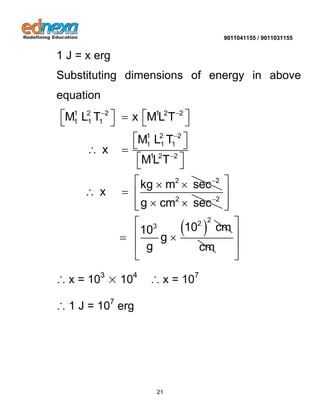
1 J = x erg 
Substituting dimensions of energy in above 
equation 
1 2 2 1 2 2 
1 1 1 
1 2 2 
1 1 1 
1 2 2 
2 2 
M L T x ML T 
M L T 
x 
ML T 
kg m sec 
x 
  
 
 
 
     
    
  
  
  
2 2 g cm sec   
 2 
3 102 cm 10 
g 
g 
  
  
  
  
cm 
  
  
  
  
∴ x = 103 × 104 ∴ x = 107 
∴ 1 J = 107 erg
9011041155 / 9011031155 
22 
• Ask Your Doubts • For inquiry and registration, call 9011041155 / 9011031155.

Physics Measurements Notes for JEE Main 2015

  • 1.
    9011041155 / 9011031155 1 Measurements Physics Physics is a branch of science which deals with study of natural phenomenon of non-living things. Origin “fuses” Physical quantities The quantities which can be measured with physical apparatus or physical means are called physical quantities. e.g.mass Length
  • 2.
    9011041155 / 9011031155 2 Time Temperature etc. Physical quantities are expressed in terms of magnitude and unit. Non – physical quantities The quantities which cannot be measured with physical apparatus or no physical apparatus is available for their measurement are called non-physical quantities. e.g. Intelligence of a person, happiness etc.
  • 3.
    9011041155 / 9011031155 3 Measurement Measurement of a physical quantity is its careful and accurate comparison with the standard of that quantity. Unit The standard used for comparison of a physical quantity is called unit of that quantity. e.g. 1kg
  • 4.
    9011041155 / 9011031155 4 Magnitude Magnitude of a physical quantity is the number which indicates how many times the unit is contained in it. e.g. 10 litres The physical quantities are classified in to two types 1. Fundamental quantities :- The physical quantities which can be independently measured and expressed are called fundamental quantities. Thus, these quantities can be measured and expressed without taking help of other quantities. e.g. length, mass, time, temperature etc. Fundamental units :- The units of the fundamental quantities are called fundamental units.
  • 5.
    9011041155 / 9011031155 5 e.g. metre, kilogram, second etc. Fundamental quantities i. length Metre (m) ii. mass Kilogram (kg) iii. time Seconds (s) iv. temperature Kelvin (K) v. Electric current Ampere (A) vi. Luminous Intensity Candela (cd) viii. Amount of substance Mole (mol) Supplementary Quantities i. Plane angle → Radian → rad ii. Solid Angle → Steradian → sr
  • 6.
    9011041155 / 9011031155 6 iii. Frequency → 1/t = 1/s = Hertz (Hz) 2. Derived quantities :- The physical quantities which require two or more fundamental quantities for their measurement and expression are called derived quantities. e.g. speed, acceleration, force etc. Derived units :- The units of derived quantities are called derived units. e.g. m/s, m/s2, newton etc. Requirements of good units 1. The unit should be easy to use and read. 2. Its magnitude should not change with respect to time, temperature, place and observer. 3. It should be easily reproducible. It means, it should be easy to copy and can be produced anywhere any quantity. 4. It should be acceptable worldwide.
  • 7.
    9011041155 / 9011031155 7 (universally acceptable ) System of units The fundamental units together with all derived units form a system of units. Formerly there were different unit systems used in different countries. Some of the most common unit systems were as follows :- 1. C.G.S. 2. M.K.S. 3. F.P.S. 4. S.I.( System International ) :- To avoid difficulties in inter conversions of units and to have uniformity in the units used all over the world, General Conference of weights and Measures suggested an improved metric system called System International in 1960. It was accepted by I.S.O.( International Standards Organization ) in 1962. This includes all the fundamental units from M.K.S. and over 450
  • 8.
    9011041155 / 9011031155 8 derived units. As far as possible the units are named after renowned scientists to honour them. Before the introduction of S.I. exchange of information between the scientists of different countries was difficult because of the difference between the unit systems used by them. With the worldwide use of S.I. this difficulty is removed. Now in this common language of units, scientists engineers and technicians all over the world can exchange their ideas, criticism easily. So, this system has bridged-up the gap between them. Rules of writing S.I. units 1. metre, joule, newton Metre, Joule,Newton
  • 9.
    9011041155 / 9011031155 9 2. cm, m/s, J, N Cm, M/s, j, n etc. 3. singular form only. plural form of units:- not allowed, e.g. While speaking, we may say that the mass is 100 kilograms, but while writing, we should write 10kg only and not 10kgs. 4. No punctuation marks e.g. the unit newton metre should be written as Nm and not like N-m or N,m etc. m/s is a valid unit because the slash (/) is not a punctuation mark. It is a mathematical operator.
  • 10.
    9011041155 / 9011031155 10 Dimensions Increasing the power of fundamental units to find out units of derived quantities is known as dimensions. 1. 0 1 1 displacement Velocity Time V T [ M L T ] m / s      l 2. Area = ℓ2 = [ M0 L2 T0] = m2 3. Volume = ℓ3 = [ M0L3T0] = m3
  • 11.
    9011041155 / 9011031155 11 4. 2 0 1 2 2 V / T Acceleration T T T M LT m / s         l l 5. Force = ma = m × ℓ / T2 = [ M1L1T-2] = kg m / s2 = N 6. Work = F . ℓ = ma . ℓ = m . ℓ / T2 . ℓ = m . ℓ2 / T2 = [ M1 L2 T-2] = kg . m / s2 = J
  • 12.
    9011041155 / 9011031155 12 7. 2 2 2 2 1 1 2 2 Force Pr essure Area ma m. / T m .T M L T kg m / s           l l l l 8. 2 2 1 2 3 2 3 3 Work Power Time F . T ma . T m . / T . T m M L T kgm / s w T            l l l l l
  • 13.
    9011041155 / 9011031155 13 9. P.E = mgh 2 1 2 2 2 2 m. / T . M L T kgm / s J        l l 10. 2 2 2 1 2 2 2 2 1 K.E mv 2 1 m. / t 2 [M L T ] kgm / s J       l 11. Impulse = F.T = ma . T = m . ℓ / T2 . T 2 1 1 1 m. . T T MLT kg m / s Ns        l
  • 14.
    9011041155 / 9011031155 14 12. Momentum = mv = m . ℓ / T = [ M1 L1T-1 ] = kg m / s 13. 3 1 3 0 3 mass Density Volume m ML T kg/m        l M = [ M1L0T0] ℓ = [ M0L1T0] T = [ M0L0T1]
  • 15.
    9011041155 / 9011031155 15 Uses of dimensional analysis 1. To check correctness of equation. principle of homogeneity:- It states that dimensions towards both sides of equation for each term are same. Then the given equation is dimensionally correct. For e.g. 1. 2 1 s ut at 2   s is displacement u = initial velocity t = time a = acceleration L.H.S = ∴ S = [ M0L0T1] ….. (1) R.H.S
  • 16.
    9011041155 / 9011031155 16 ∴ ut = [ M0L1T-1] [ M0L0T1] = [ M0L1+0T-1+1] = [ M0L1T0] …… (2) 2 1 at 2 = [ M0L1T-2] [ M0L0T1]2 = [ M0L1T-2] [ M0L0T2] = [ M0L1T0] …….. (3) From (1), (2) & (3) we can say that the given equation is dimensionally correct. 2. v2 = u2 + 2as 3. v = u + at 4. w = w0 + mc2 w = work w0 = work m = mass c = speed of light
  • 17.
    9011041155 / 9011031155 17 2. To find out conversion factor in between different units of same quantity . e.g.1 Let MKS unit of force if Newton (N) CGS unit of force is Dyne Let 1 N = x dyne Substituting dimensions of force in above equation, 1 1 2 1 1 2 1 1 1 1 1 2 1 1 1 1 1 2 2 M L T x MLT ML T x MLT kg m s                    2 g cm s   3 2 3 2 5 5 10 10 cm g g cm 10 10 x 10 1N 10 dyne                     1 J = x erg
  • 18.
    9011041155 / 9011031155 18 e.g.2 v = u + at v = final velocity u = initial velocity a = acceleration t = time L.H.S = v ∴ v = [ M0L1T-1] ……… (1) R.H.S = u ∴ u = [ M0L1T-1] ……… (2) R.H.S at = [ M0L1T-2] [ M0L0T1] = [ M0L1T-1] ………… (3) From (1), (2), (3) we can say that the given equation is dimensionally correct.
  • 19.
    9011041155 / 9011031155 19 e.g. 3 v2 = u2 + 2as v = final velocity u = initial velocity a = acceleration s = displacement L.H.S = v2 ∴ v2 = [ M0L1T-1]2 = [ M0L1T-1] …….. (1) R.H.S = u2 ∴ u2 = [ M0L1T-1] 2 = [ M0L2T-2] …….. (2) as = [ M0L1T-2] [ M0L1T0] = [ M0L1+1 T-2+0] = [ M0L2T-2] …….. (3)
  • 20.
    9011041155 / 9011031155 20 From (1), (2), & (3) we can say that the given equation is dimensionally correct. e.g.4 w = w0 + mc2 w = work w0 = work m = mass c = speed of light L.H.S = w ∴ w = [ M1L2T-2] ……… (1) R.H.S = w0 + mc2 w0 = [ M1L2T-2] ……… (2) mc2 = [ M1L0T0] [ M0L1T-1]2 = [M1L0T0] [M0L2T-2] = [M1L0+2 T0-2] = [M1L2T-2] From (1), (2), & (3) we can say that the given equation is dimensionally correct.
  • 21.
    9011041155 / 9011031155 21 1 J = x erg Substituting dimensions of energy in above equation 1 2 2 1 2 2 1 1 1 1 2 2 1 1 1 1 2 2 2 2 M L T x ML T M L T x ML T kg m sec x                     2 2 g cm sec    2 3 102 cm 10 g g         cm         ∴ x = 103 × 104 ∴ x = 107 ∴ 1 J = 107 erg
  • 22.
    9011041155 / 9011031155 22 • Ask Your Doubts • For inquiry and registration, call 9011041155 / 9011031155.