Geometric Optics
Edited by:
Ms. Marie Kate M. Cepeda
MUTE MICROPHONE
ENABLE VIDEO
Table of Contents
• Basics
• Reflection
• Mirrors
• Plane mirrors
• Spherical mirrors
• Concave mirrors
• Convex mirrors
• Refraction
• Lenses
• Concave lenses
• Convex lenses
A ray of light is an extremely narrow
beam of light.
All visible objects emit or reflect
light rays in all directions.
Our eyes detect light rays.
We think we see objects.
We really see images.
converge: come together
Images are formed when
light rays converge.
When light rays go straight into our eyes,
we see an image in the same spot as the object.
object
&
image
Mirrors
object
image
It is possible to
see images
when
converging
light rays reflect
off of mirrors.
Reflection
(bouncing light)
Reflection is when light
changes direction by
bouncing off a surface.
When light is reflected off
a mirror, it hits the mirror
at the same angle (θi, the
incidence angle) as it
reflects off the mirror (θr,
the reflection angle).
The normal is an
imaginary line which lies
at right angles to the
mirror where the ray hits it.
θr θi
Mirror
normal
incident
ray
reflected
ray
Mirrors reflect light rays.
How do we see images in mirrors?
object image
Light from the object
reflects off the mirror
and converges to form an image.
How do we see images in mirrors?
Sight Lines
object image
We perceive all light rays as if they come straight from an object.
The imaginary light rays that we think we see are called sight lines.
Sight Lines
object image
We perceive all light rays as if they come straight from an object.
The imaginary light rays that we think we see are called sight lines.
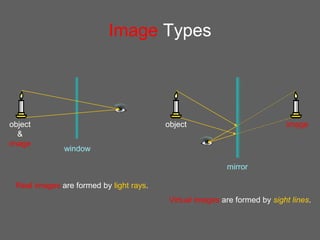
Image Types
object image
Real images are formed by light rays.
Virtual images are formed by sight lines.
mirror
object
&
image
window
Plane (flat) Mirrors
object image
Images are virtual (formed by sight lines) and upright
Objects are not magnified: object height (ho) equals image height (hi).
Object distance (do) equals image distance (di).
do di
hi
ho
Spherical Mirrors
(concave & convex)
Concave & Convex
(just a part of a sphere)
C: the center point of the sphere
r: radius of curvature (just the radius of the sphere)
F: the focal point of the mirror or lens (halfway between C and the sphere)
f: the focal distance, f = r/2
r
f
•
C
•
F
optical axis
Concave Mirrors
(caved in)
•
F
Light rays that come in parallel to the optical axis reflect through the focal point.
optical axis
Concave Mirror
(example)
•
F
optical axis
Concave Mirror
(example)
•
F
The first ray comes in parallel to the optical axis and reflects through the focal point.
optical axis
Concave Mirror
(example)
•
F
The first ray comes in parallel to the optical axis and reflects through the focal point.
The second ray comes through the focal point and reflects parallel to the optical axis.
optical axis
Concave Mirror
(example)
•
F
The first ray comes in parallel to the optical axis and reflects through the focal point.
The second ray comes through the focal point and reflects parallel to the optical axis.
A real image forms where the light rays converge.
optical axis
Concave Mirror
(example 2)
•
F
optical axis
Concave Mirror
(example 2)
•
F
The first ray comes in parallel to the optical axis and reflects through the focal point.
optical axis
Concave Mirror
(example 2)
•
F
The first ray comes in parallel to the optical axis and reflects through the focal point.
The second ray comes through the focal point and reflects parallel to the optical axis.
optical axis
Concave Mirror
(example 2)
•
F
The first ray comes in parallel to the optical axis and reflects through the focal point.
The second ray comes through the focal point and reflects parallel to the optical axis.
The image forms where the rays converge. But they don’t seem to converge.
optical axis
Concave Mirror
(example 2)
•
F
The first ray comes in parallel to the optical axis and reflects through the focal point.
The second ray comes through the focal point and reflects parallel to the optical axis.
A virtual image forms where the sight rays converge.
optical axis
Your Turn
(Concave Mirror)
•
F
object
concave mirror
• Note: mirrors are thin enough that you just draw a line to represent the mirror
• Locate the image of the arrow
optical axis
Your Turn
(Concave Mirror)
•
F
object
concave mirror
• Note: the mirrors and lenses we use are thin enough that you can just draw a line to
represent the mirror or lens
• Locate the image of the arrow
Convex Mirrors
(curved out)
Light rays that come in parallel to the optical axis reflect from the focal point.
optical axis
•
F
The focal point is considered virtual since sight lines, not light rays, go through it.
Convex Mirror
(example)
optical axis
•
F
Convex Mirror
(example)
optical axis
•
F
The first ray comes in parallel to the optical axis and reflects through the focal point.
Convex Mirror
(example)
optical axis
•
F
The first ray comes in parallel to the optical axis and reflects through the focal point.
The second ray comes through the focal point and reflects parallel to the optical axis.
Convex Mirror
(example)
optical axis
•
F
The first ray comes in parallel to the optical axis and reflects through the focal point.
The second ray comes through the focal point and reflects parallel to the optical axis.
The light rays don’t converge, but the sight lines do.
Convex Mirror
(example)
optical axis
•
F
The first ray comes in parallel to the optical axis and reflects through the focal point.
The second ray comes through the focal point and reflects parallel to the optical axis.
The light rays don’t converge, but the sight lines do.
A virtual image forms where the sight lines converge.
optical axis
Your Turn
(Convex Mirror)
•
F
• Note: you just draw a line to represent thin mirrors
• Locate the image of the arrow
object
convex mirror
optical axis
Your Turn
(Convex Mirror)
•
F
• Note: you just draw a line to represent thin mirrors
• Locate the image of the arrow
object
convex mirror
image
Post- Activity: Follow Up
• Do the Follow Up Activity“ on page 162 in
your Science Book.
• You may use a separated sheet of paper
for your drawing (5 points each)
• Turn in the photos of your work in the
Google classroom under the task “Activity
14”.
Lens & Mirror Equation
ƒ = focal length
do = object distance
di = image distance
o
i d
1
d
1
1


f
f is negative for diverging mirrors and lenses
di is negative when the image is behind the lens or mirror
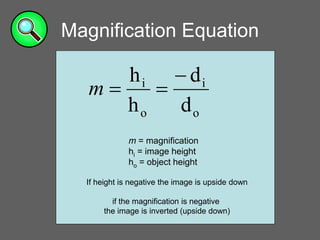
Magnification Equation
o
i
o
i
d
d
h
h 


m
m = magnification
hi = image height
ho = object height
If height is negative the image is upside down
if the magnification is negative
the image is inverted (upside down)
Refraction
(bending light)
Refraction is when light bends as it
passes from one medium into another.
When light traveling through air
passes into the glass block it is
refracted towards the normal.
When light passes back out of the
glass into the air, it is refracted away
from the normal.
Since light refracts when it changes
mediums it can be aimed. Lenses are
shaped so light is aimed at a focal
point.
normal
normal
air
air
θr
θi
θr
θi
glass
block
Lenses
The first telescope, designed and built by Galileo, used lenses to focus light from
faraway objects, into Galileo’s eye. His telescope consisted of a concave lens and a
convex lens.
Light rays are always refracted (bent) towards the thickest part of the lens.
convex
lens
concave
lens
light from
far away
object
Concave Lenses
Concave lenses are thin in the middle and make
light rays diverge (spread out).
If the rays of light are traced back (dotted sight lines),
they all intersect at the focal point (F) behind the lens.
optical axis
•
F
•
F
optical axis
Light rays that come in parallel to the optical axis diverge from the focal point.
Concave Lenses
The light rays behave the same way if we ignore the thickness of the lens.
Concave Lenses
optical axis
•
F
Light rays that come in parallel to the optical axis still diverge from the focal point.
Concave Lens
(example)
The first ray comes in parallel to the optical axis and refracts from the focal point.
optical axis
•
F
Concave Lens
(example)
optical axis
•
F
The first ray comes in parallel to the optical axis and refracts from the focal point.
The second ray goes straight through the center of the lens.
Concave Lens
(example)
optical axis
•
F
The first ray comes in parallel to the optical axis and refracts from the focal point.
The second ray goes straight through the center of the lens.
The light rays don’t converge, but the sight lines do.
Concave Lens
(example)
optical axis
•
F
The first ray comes in parallel to the optical axis and refracts from the focal point.
The second ray goes straight through the center of the lens.
The light rays don’t converge, but the sight lines do.
A virtual image forms where the sight lines converge.
optical axis
Your Turn
(Concave Lens)
•
F
• Note: lenses are thin enough that you just draw a line to represent the lens.
• Locate the image of the arrow.
object
concave lens
optical axis
Your Turn
(Concave Lens)
•
F
• Note: lenses are thin enough that you just draw a line to represent the lens.
• Locate the image of the arrow.
object
concave lens
image
Convex Lenses
Convex lenses are thicker in the middle and focus light rays to a focal point in front of
the lens.
The focal length of the lens is the distance between the center of the lens and the
point where the light rays are focused.
Convex Lenses
optical axis
•
F
Convex Lenses
optical axis
Light rays that come in parallel to the optical axis converge at the focal point.
•
F
Convex Lens
(example)
•
F
The first ray comes in parallel to the optical axis and refracts through the focal point.
optical axis
Convex Lens
(example)
•
F
The first ray comes in parallel to the optical axis and refracts through the focal point.
The second ray goes straight through the center of the lens.
optical axis
Convex Lens
(example)
optical axis
•
F
The first ray comes in parallel to the optical axis and refracts through the focal point.
The second ray goes straight through the center of the lens.
The light rays don’t converge, but the sight lines do.
Convex Lens
(example)
optical axis
•
F
The first ray comes in parallel to the optical axis and refracts through the focal point.
The second ray goes straight through the center of the lens.
The light rays don’t converge, but the sight lines do.
A virtual image forms where the sight lines converge.
optical axis
Your Turn
(Convex Lens)
•
F
• Note: lenses are thin enough that you just draw a line to represent the lens.
• Locate the image of the arrow.
object
convex lens
optical axis
Your Turn
(Convex Lens)
•
F
• Note: lenses are thin enough that you just draw a line to represent the lens.
• Locate the image of the arrow.
object
convex lens
image
Assignment: Image Formation in a Plane Mirror
Deadline: Friday (November 13, 2020)
• Do the activity “Image Formation in a Plane
Mirror “ on pages 155-158 in your Science
Book.
• You may use a separated sheet of paper for
your drawing and upon answering the Guide
Questions, Conclusion and Application.
• Turn in the photos of your work in the Google
classroom under the task “Performance Task
No. 2”.
For References:
• Faulkes Telescope Project: Light & Optics by Sarah
Roberts
• Fundamentals of Optics: An Introduction for Beginners by
Jenny Reinhard
• PHET Geometric Optics (Flash Simulator)
• Thin Lens & Mirror (Java Simulator) by Fu-Kwun Hwang

Geometric-Optics.ppt

  • 1.
    Geometric Optics Edited by: Ms.Marie Kate M. Cepeda MUTE MICROPHONE ENABLE VIDEO
  • 2.
    Table of Contents •Basics • Reflection • Mirrors • Plane mirrors • Spherical mirrors • Concave mirrors • Convex mirrors • Refraction • Lenses • Concave lenses • Convex lenses
  • 3.
    A ray oflight is an extremely narrow beam of light.
  • 4.
    All visible objectsemit or reflect light rays in all directions.
  • 5.
    Our eyes detectlight rays.
  • 6.
    We think wesee objects. We really see images.
  • 7.
    converge: come together Imagesare formed when light rays converge.
  • 8.
    When light raysgo straight into our eyes, we see an image in the same spot as the object. object & image
  • 9.
    Mirrors object image It is possibleto see images when converging light rays reflect off of mirrors.
  • 10.
    Reflection (bouncing light) Reflection iswhen light changes direction by bouncing off a surface. When light is reflected off a mirror, it hits the mirror at the same angle (θi, the incidence angle) as it reflects off the mirror (θr, the reflection angle). The normal is an imaginary line which lies at right angles to the mirror where the ray hits it. θr θi Mirror normal incident ray reflected ray
  • 11.
  • 12.
    How do wesee images in mirrors?
  • 13.
    object image Light fromthe object reflects off the mirror and converges to form an image. How do we see images in mirrors?
  • 14.
    Sight Lines object image Weperceive all light rays as if they come straight from an object. The imaginary light rays that we think we see are called sight lines.
  • 15.
    Sight Lines object image Weperceive all light rays as if they come straight from an object. The imaginary light rays that we think we see are called sight lines.
  • 16.
    Image Types object image Realimages are formed by light rays. Virtual images are formed by sight lines. mirror object & image window
  • 17.
    Plane (flat) Mirrors objectimage Images are virtual (formed by sight lines) and upright Objects are not magnified: object height (ho) equals image height (hi). Object distance (do) equals image distance (di). do di hi ho
  • 18.
  • 19.
    Concave & Convex (justa part of a sphere) C: the center point of the sphere r: radius of curvature (just the radius of the sphere) F: the focal point of the mirror or lens (halfway between C and the sphere) f: the focal distance, f = r/2 r f • C • F
  • 20.
    optical axis Concave Mirrors (cavedin) • F Light rays that come in parallel to the optical axis reflect through the focal point.
  • 21.
  • 22.
    optical axis Concave Mirror (example) • F Thefirst ray comes in parallel to the optical axis and reflects through the focal point.
  • 23.
    optical axis Concave Mirror (example) • F Thefirst ray comes in parallel to the optical axis and reflects through the focal point. The second ray comes through the focal point and reflects parallel to the optical axis.
  • 24.
    optical axis Concave Mirror (example) • F Thefirst ray comes in parallel to the optical axis and reflects through the focal point. The second ray comes through the focal point and reflects parallel to the optical axis. A real image forms where the light rays converge.
  • 25.
  • 26.
    optical axis Concave Mirror (example2) • F The first ray comes in parallel to the optical axis and reflects through the focal point.
  • 27.
    optical axis Concave Mirror (example2) • F The first ray comes in parallel to the optical axis and reflects through the focal point. The second ray comes through the focal point and reflects parallel to the optical axis.
  • 28.
    optical axis Concave Mirror (example2) • F The first ray comes in parallel to the optical axis and reflects through the focal point. The second ray comes through the focal point and reflects parallel to the optical axis. The image forms where the rays converge. But they don’t seem to converge.
  • 29.
    optical axis Concave Mirror (example2) • F The first ray comes in parallel to the optical axis and reflects through the focal point. The second ray comes through the focal point and reflects parallel to the optical axis. A virtual image forms where the sight rays converge.
  • 30.
    optical axis Your Turn (ConcaveMirror) • F object concave mirror • Note: mirrors are thin enough that you just draw a line to represent the mirror • Locate the image of the arrow
  • 31.
    optical axis Your Turn (ConcaveMirror) • F object concave mirror • Note: the mirrors and lenses we use are thin enough that you can just draw a line to represent the mirror or lens • Locate the image of the arrow
  • 32.
    Convex Mirrors (curved out) Lightrays that come in parallel to the optical axis reflect from the focal point. optical axis • F The focal point is considered virtual since sight lines, not light rays, go through it.
  • 33.
  • 34.
    Convex Mirror (example) optical axis • F Thefirst ray comes in parallel to the optical axis and reflects through the focal point.
  • 35.
    Convex Mirror (example) optical axis • F Thefirst ray comes in parallel to the optical axis and reflects through the focal point. The second ray comes through the focal point and reflects parallel to the optical axis.
  • 36.
    Convex Mirror (example) optical axis • F Thefirst ray comes in parallel to the optical axis and reflects through the focal point. The second ray comes through the focal point and reflects parallel to the optical axis. The light rays don’t converge, but the sight lines do.
  • 37.
    Convex Mirror (example) optical axis • F Thefirst ray comes in parallel to the optical axis and reflects through the focal point. The second ray comes through the focal point and reflects parallel to the optical axis. The light rays don’t converge, but the sight lines do. A virtual image forms where the sight lines converge.
  • 38.
    optical axis Your Turn (ConvexMirror) • F • Note: you just draw a line to represent thin mirrors • Locate the image of the arrow object convex mirror
  • 39.
    optical axis Your Turn (ConvexMirror) • F • Note: you just draw a line to represent thin mirrors • Locate the image of the arrow object convex mirror image
  • 40.
    Post- Activity: FollowUp • Do the Follow Up Activity“ on page 162 in your Science Book. • You may use a separated sheet of paper for your drawing (5 points each) • Turn in the photos of your work in the Google classroom under the task “Activity 14”.
  • 41.
    Lens & MirrorEquation ƒ = focal length do = object distance di = image distance o i d 1 d 1 1   f f is negative for diverging mirrors and lenses di is negative when the image is behind the lens or mirror
  • 42.
    Magnification Equation o i o i d d h h    m m= magnification hi = image height ho = object height If height is negative the image is upside down if the magnification is negative the image is inverted (upside down)
  • 43.
    Refraction (bending light) Refraction iswhen light bends as it passes from one medium into another. When light traveling through air passes into the glass block it is refracted towards the normal. When light passes back out of the glass into the air, it is refracted away from the normal. Since light refracts when it changes mediums it can be aimed. Lenses are shaped so light is aimed at a focal point. normal normal air air θr θi θr θi glass block
  • 44.
    Lenses The first telescope,designed and built by Galileo, used lenses to focus light from faraway objects, into Galileo’s eye. His telescope consisted of a concave lens and a convex lens. Light rays are always refracted (bent) towards the thickest part of the lens. convex lens concave lens light from far away object
  • 45.
    Concave Lenses Concave lensesare thin in the middle and make light rays diverge (spread out). If the rays of light are traced back (dotted sight lines), they all intersect at the focal point (F) behind the lens. optical axis • F
  • 46.
    • F optical axis Light raysthat come in parallel to the optical axis diverge from the focal point. Concave Lenses The light rays behave the same way if we ignore the thickness of the lens.
  • 47.
    Concave Lenses optical axis • F Lightrays that come in parallel to the optical axis still diverge from the focal point.
  • 48.
    Concave Lens (example) The firstray comes in parallel to the optical axis and refracts from the focal point. optical axis • F
  • 49.
    Concave Lens (example) optical axis • F Thefirst ray comes in parallel to the optical axis and refracts from the focal point. The second ray goes straight through the center of the lens.
  • 50.
    Concave Lens (example) optical axis • F Thefirst ray comes in parallel to the optical axis and refracts from the focal point. The second ray goes straight through the center of the lens. The light rays don’t converge, but the sight lines do.
  • 51.
    Concave Lens (example) optical axis • F Thefirst ray comes in parallel to the optical axis and refracts from the focal point. The second ray goes straight through the center of the lens. The light rays don’t converge, but the sight lines do. A virtual image forms where the sight lines converge.
  • 52.
    optical axis Your Turn (ConcaveLens) • F • Note: lenses are thin enough that you just draw a line to represent the lens. • Locate the image of the arrow. object concave lens
  • 53.
    optical axis Your Turn (ConcaveLens) • F • Note: lenses are thin enough that you just draw a line to represent the lens. • Locate the image of the arrow. object concave lens image
  • 54.
    Convex Lenses Convex lensesare thicker in the middle and focus light rays to a focal point in front of the lens. The focal length of the lens is the distance between the center of the lens and the point where the light rays are focused.
  • 55.
  • 56.
    Convex Lenses optical axis Lightrays that come in parallel to the optical axis converge at the focal point. • F
  • 57.
    Convex Lens (example) • F The firstray comes in parallel to the optical axis and refracts through the focal point. optical axis
  • 58.
    Convex Lens (example) • F The firstray comes in parallel to the optical axis and refracts through the focal point. The second ray goes straight through the center of the lens. optical axis
  • 59.
    Convex Lens (example) optical axis • F Thefirst ray comes in parallel to the optical axis and refracts through the focal point. The second ray goes straight through the center of the lens. The light rays don’t converge, but the sight lines do.
  • 60.
    Convex Lens (example) optical axis • F Thefirst ray comes in parallel to the optical axis and refracts through the focal point. The second ray goes straight through the center of the lens. The light rays don’t converge, but the sight lines do. A virtual image forms where the sight lines converge.
  • 61.
    optical axis Your Turn (ConvexLens) • F • Note: lenses are thin enough that you just draw a line to represent the lens. • Locate the image of the arrow. object convex lens
  • 62.
    optical axis Your Turn (ConvexLens) • F • Note: lenses are thin enough that you just draw a line to represent the lens. • Locate the image of the arrow. object convex lens image
  • 63.
    Assignment: Image Formationin a Plane Mirror Deadline: Friday (November 13, 2020) • Do the activity “Image Formation in a Plane Mirror “ on pages 155-158 in your Science Book. • You may use a separated sheet of paper for your drawing and upon answering the Guide Questions, Conclusion and Application. • Turn in the photos of your work in the Google classroom under the task “Performance Task No. 2”.
  • 64.
    For References: • FaulkesTelescope Project: Light & Optics by Sarah Roberts • Fundamentals of Optics: An Introduction for Beginners by Jenny Reinhard • PHET Geometric Optics (Flash Simulator) • Thin Lens & Mirror (Java Simulator) by Fu-Kwun Hwang