Downloaded 7,560 times


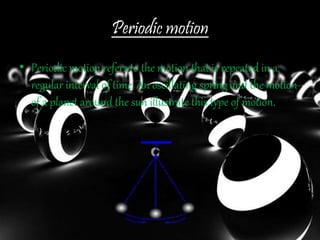
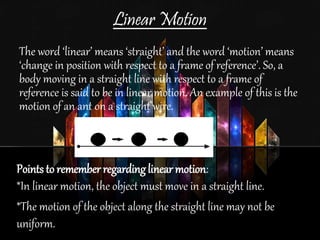
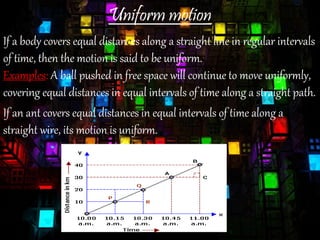
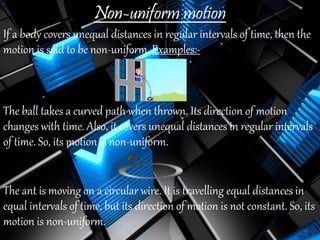

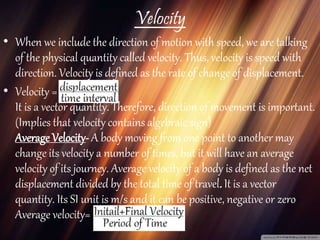
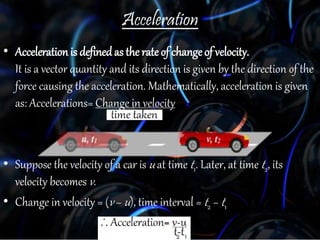
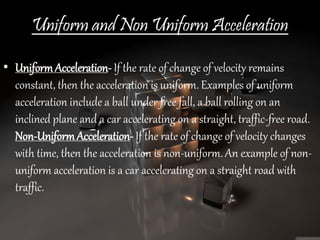
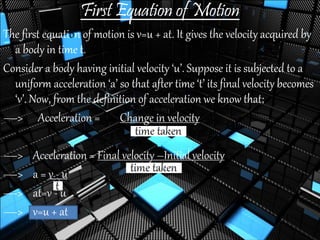
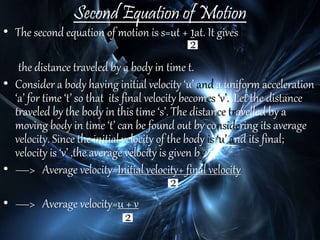
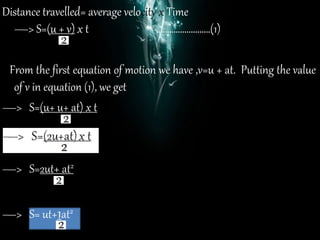
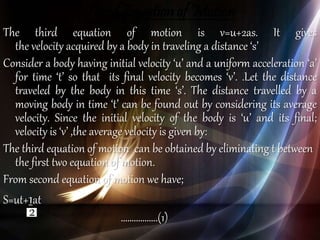
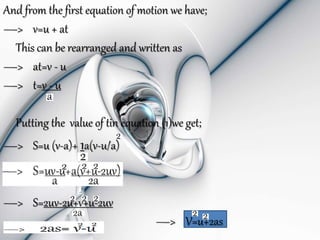


1. Motion is defined as a change in position of an object over time relative to its surroundings. An object is said to be at rest if its position does not change over time relative to its surroundings. 2. Motion can be classified as translatory, rotational, or periodic. Translatory motion involves straight-line motion, rotational motion involves motion around a fixed axis, and periodic motion repeats over regular time intervals. 3. Physical quantities can be scalar or vector. Scalar quantities only require magnitude, while vector quantities require both magnitude and direction. Examples of scalars include mass and time, while examples of vectors include velocity and displacement.


