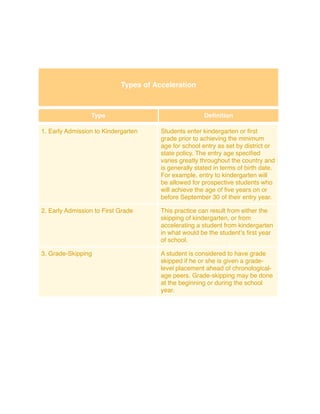
Types of Acceleration


                 Type                                  Definition

1. Early Admission to Kindergarten     Students enter kindergarten or first
                                       grade prior to achieving the minimum
                                       age for school entry as set by district or
                                       state policy. The entry age specified
                                       varies greatly throughout the country and
                                       is generally stated in terms of birth date.
                                       For example, entry to kindergarten will
                                       be allowed for prospective students who
                                       will achieve the age of five years on or
                                       before September 30 of their entry year.

2. Early Admission to First Grade      This practice can result from either the
                                       skipping of kindergarten, or from
                                       accelerating a student from kindergarten
                                       in what would be the studentʼs first year
                                       of school.

3. Grade-Skipping                      A student is considered to have grade
                                       skipped if he or she is given a grade-
                                       level placement ahead of chronological-
                                       age peers. Grade-skipping may be done
                                       at the beginning or during the school
                                       year.
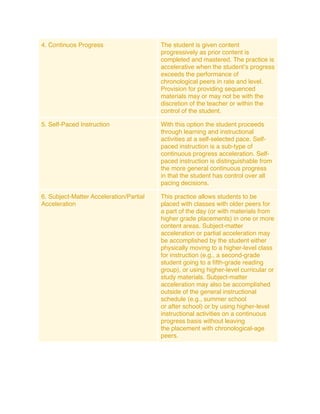
4. Continuos Progress                    The student is given content
                                         progressively as prior content is
                                         completed and mastered. The practice is
                                         accelerative when the studentʼs progress
                                         exceeds the performance of
                                         chronological peers in rate and level.
                                         Provision for providing sequenced
                                         materials may or may not be with the
                                         discretion of the teacher or within the
                                         control of the student.

5. Self-Paced Instruction                With this option the student proceeds
                                         through learning and instructional
                                         activities at a self-selected pace. Self-
                                         paced instruction is a sub-type of
                                         continuous progress acceleration. Self-
                                         paced instruction is distinguishable from
                                         the more general continuous progress
                                         in that the student has control over all
                                         pacing decisions.

6. Subject-Matter Acceleration/Partial   This practice allows students to be
Acceleration                             placed with classes with older peers for
                                         a part of the day (or with materials from
                                         higher grade placements) in one or more
                                         content areas. Subject-matter
                                         acceleration or partial acceleration may
                                         be accomplished by the student either
                                         physically moving to a higher-level class
                                         for instruction (e.g., a second-grade
                                         student going to a fifth-grade reading
                                         group), or using higher-level curricular or
                                         study materials. Subject-matter
                                         acceleration may also be accomplished
                                         outside of the general instructional
                                         schedule (e.g., summer school
                                         or after school) or by using higher-level
                                         instructional activities on a continuous
                                         progress basis without leaving
                                         the placement with chronological-age
                                         peers.
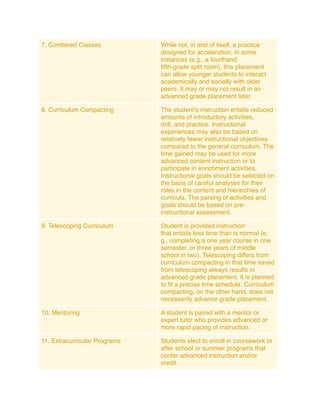
7. Combined Classes            While not, in and of itself, a practice
                               designed for acceleration, in some
                               instances (e.g., a fourthand
                               fifth-grade split room), this placement
                               can allow younger students to interact
                               academically and socially with older
                               peers. It may or may not result in an
                               advanced grade placement later.

8. Curriculum Compacting       The studentʼs instruction entails reduced
                               amounts of introductory activities,
                               drill, and practice. Instructional
                               experiences may also be based on
                               relatively fewer instructional objectives
                               compared to the general curriculum. The
                               time gained may be used for more
                               advanced content instruction or to
                               participate in enrichment activities.
                               Instructional goals should be selected on
                               the basis of careful analyses for their
                               roles in the content and hierarchies of
                               curricula. The parsing of activities and
                               goals should be based on pre-
                               instructional assessment.

9. Telescoping Curriculum      Student is provided instruction
                               that entails less time than is normal (e.
                               g., completing a one year course in one
                               semester, or three years of middle
                               school in two). Telescoping differs from
                               curriculum compacting in that time saved
                               from telescoping always results in
                               advanced grade placement. It is planned
                               to fit a precise time schedule. Curriculum
                               compacting, on the other hand, does not
                               necessarily advance grade placement.

10. Mentoring                  A student is paired with a mentor or
                               expert tutor who provides advanced or
                               more rapid pacing of instruction.

11. Extracurricular Programs   Students elect to enroll in coursework or
                               after school or summer programs that
                               confer advanced instruction and/or
                               credit.
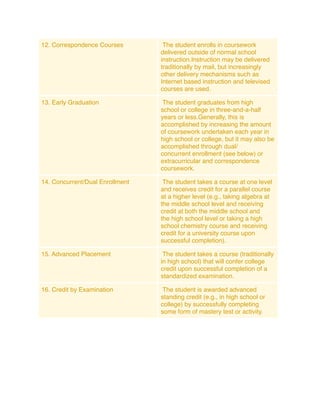
12. Correspondence Courses        The student enrolls in coursework
                                 delivered outside of normal school
                                 instruction.Instruction may be delivered
                                 traditionally by mail, but increasingly
                                 other delivery mechanisms such as
                                 Internet based instruction and televised
                                 courses are used.

13. Early Graduation              The student graduates from high
                                 school or college in three-and-a-half
                                 years or less.Generally, this is
                                 accomplished by increasing the amount
                                 of coursework undertaken each year in
                                 high school or college, but it may also be
                                 accomplished through dual/
                                 concurrent enrollment (see below) or
                                 extracurricular and correspondence
                                 coursework.

14. Concurrent/Dual Enrollment    The student takes a course at one level
                                 and receives credit for a parallel course
                                 at a higher level (e.g., taking algebra at
                                 the middle school level and receiving
                                 credit at both the middle school and
                                 the high school level or taking a high
                                 school chemistry course and receiving
                                 credit for a university course upon
                                 successful completion).

15. Advanced Placement            The student takes a course (traditionally
                                 in high school) that will confer college
                                 credit upon successful completion of a
                                 standardized examination.

16. Credit by Examination         The student is awarded advanced
                                 standing credit (e.g., in high school or
                                 college) by successfully completing
                                 some form of mastery test or activity.
17. Acceleration in College                The student is awarded an advanced
                                          level of instruction at least one year
                                          ahead of normal. This may be achieved
                                          with the employment of other
                                          accelerative techniques such as dual
                                          enrollment and credit by examination or
                                          by determination of college teachers and
                                          administrators.

18. Early Entrance into Middle School,    The student completes two or more
High School, or College                   majors in a total of four years and/or
                                          earns an advanced degree along
                                          with or in lieu of a bachelors degree.


Colangelo, Nicholas, Susan Assouline, and Miraca Gross. "Types of Acceleration:
Dimensions and Issues”, in A Nation Deceived (Iowa City: University of Iowa Press,
2004), accessed March 21, 2013, http://www.accelerationinstitute.org/
Nation_Deceived/ND_v2.pdf

Types of Acceleration

  • 1.
    Types of Acceleration Type Definition 1. Early Admission to Kindergarten Students enter kindergarten or first grade prior to achieving the minimum age for school entry as set by district or state policy. The entry age specified varies greatly throughout the country and is generally stated in terms of birth date. For example, entry to kindergarten will be allowed for prospective students who will achieve the age of five years on or before September 30 of their entry year. 2. Early Admission to First Grade This practice can result from either the skipping of kindergarten, or from accelerating a student from kindergarten in what would be the studentʼs first year of school. 3. Grade-Skipping A student is considered to have grade skipped if he or she is given a grade- level placement ahead of chronological- age peers. Grade-skipping may be done at the beginning or during the school year.
  • 2.
    4. Continuos Progress The student is given content progressively as prior content is completed and mastered. The practice is accelerative when the studentʼs progress exceeds the performance of chronological peers in rate and level. Provision for providing sequenced materials may or may not be with the discretion of the teacher or within the control of the student. 5. Self-Paced Instruction With this option the student proceeds through learning and instructional activities at a self-selected pace. Self- paced instruction is a sub-type of continuous progress acceleration. Self- paced instruction is distinguishable from the more general continuous progress in that the student has control over all pacing decisions. 6. Subject-Matter Acceleration/Partial This practice allows students to be Acceleration placed with classes with older peers for a part of the day (or with materials from higher grade placements) in one or more content areas. Subject-matter acceleration or partial acceleration may be accomplished by the student either physically moving to a higher-level class for instruction (e.g., a second-grade student going to a fifth-grade reading group), or using higher-level curricular or study materials. Subject-matter acceleration may also be accomplished outside of the general instructional schedule (e.g., summer school or after school) or by using higher-level instructional activities on a continuous progress basis without leaving the placement with chronological-age peers.
  • 3.
    7. Combined Classes While not, in and of itself, a practice designed for acceleration, in some instances (e.g., a fourthand fifth-grade split room), this placement can allow younger students to interact academically and socially with older peers. It may or may not result in an advanced grade placement later. 8. Curriculum Compacting The studentʼs instruction entails reduced amounts of introductory activities, drill, and practice. Instructional experiences may also be based on relatively fewer instructional objectives compared to the general curriculum. The time gained may be used for more advanced content instruction or to participate in enrichment activities. Instructional goals should be selected on the basis of careful analyses for their roles in the content and hierarchies of curricula. The parsing of activities and goals should be based on pre- instructional assessment. 9. Telescoping Curriculum Student is provided instruction that entails less time than is normal (e. g., completing a one year course in one semester, or three years of middle school in two). Telescoping differs from curriculum compacting in that time saved from telescoping always results in advanced grade placement. It is planned to fit a precise time schedule. Curriculum compacting, on the other hand, does not necessarily advance grade placement. 10. Mentoring A student is paired with a mentor or expert tutor who provides advanced or more rapid pacing of instruction. 11. Extracurricular Programs Students elect to enroll in coursework or after school or summer programs that confer advanced instruction and/or credit.
  • 4.
    12. Correspondence Courses The student enrolls in coursework delivered outside of normal school instruction.Instruction may be delivered traditionally by mail, but increasingly other delivery mechanisms such as Internet based instruction and televised courses are used. 13. Early Graduation The student graduates from high school or college in three-and-a-half years or less.Generally, this is accomplished by increasing the amount of coursework undertaken each year in high school or college, but it may also be accomplished through dual/ concurrent enrollment (see below) or extracurricular and correspondence coursework. 14. Concurrent/Dual Enrollment The student takes a course at one level and receives credit for a parallel course at a higher level (e.g., taking algebra at the middle school level and receiving credit at both the middle school and the high school level or taking a high school chemistry course and receiving credit for a university course upon successful completion). 15. Advanced Placement The student takes a course (traditionally in high school) that will confer college credit upon successful completion of a standardized examination. 16. Credit by Examination The student is awarded advanced standing credit (e.g., in high school or college) by successfully completing some form of mastery test or activity.
  • 5.
    17. Acceleration inCollege The student is awarded an advanced level of instruction at least one year ahead of normal. This may be achieved with the employment of other accelerative techniques such as dual enrollment and credit by examination or by determination of college teachers and administrators. 18. Early Entrance into Middle School, The student completes two or more High School, or College majors in a total of four years and/or earns an advanced degree along with or in lieu of a bachelors degree. Colangelo, Nicholas, Susan Assouline, and Miraca Gross. "Types of Acceleration: Dimensions and Issues”, in A Nation Deceived (Iowa City: University of Iowa Press, 2004), accessed March 21, 2013, http://www.accelerationinstitute.org/ Nation_Deceived/ND_v2.pdf