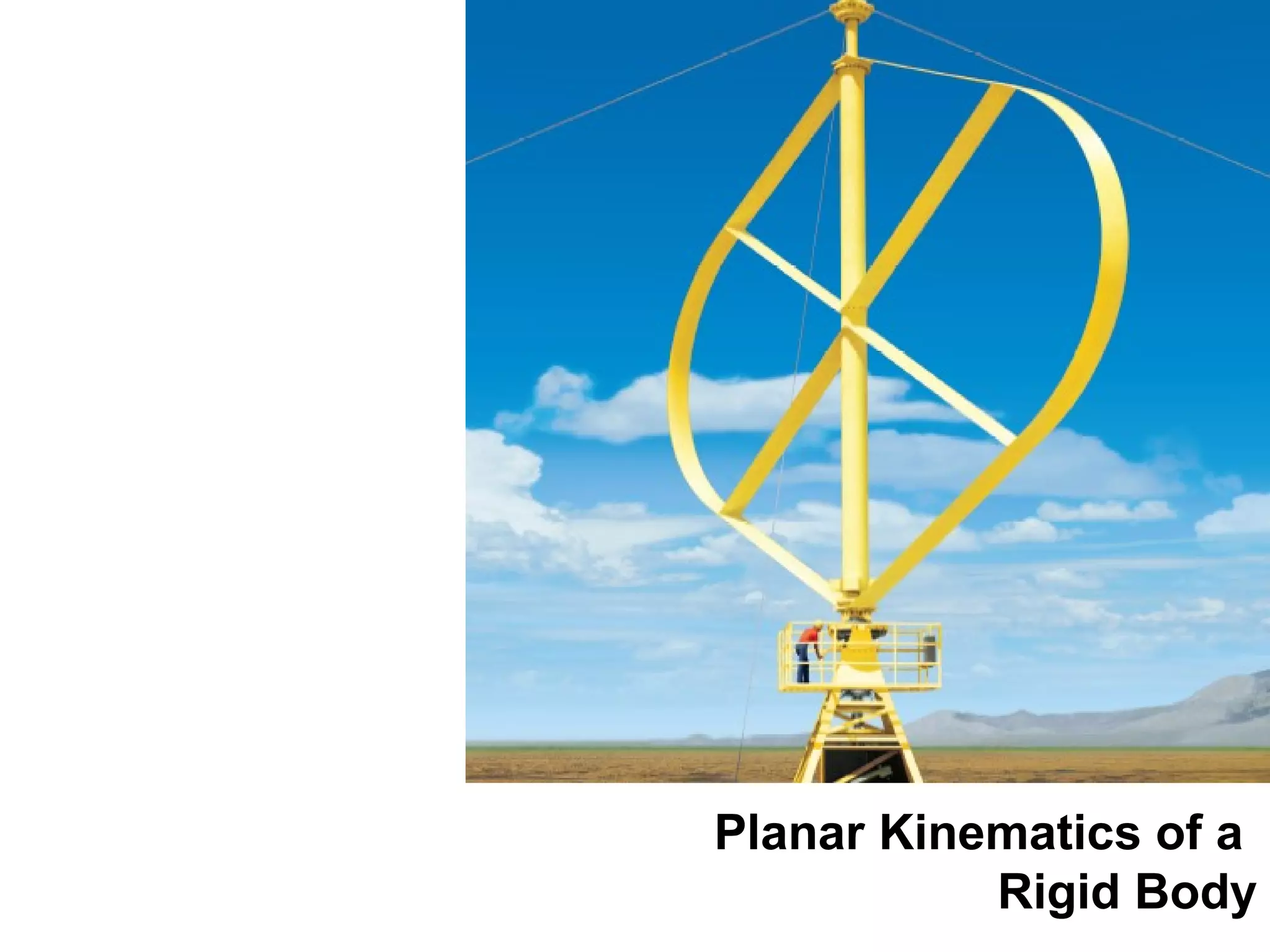
Planar Kinematics of a
Rigid Body
Chapter Objectives
• To classify the various types of rigid-body planar
motion.
• To investigate rigid-body translation and show how
to
analyze motion about a fixed axis.
• To study planar motion using an absolute motion
analysis.
Chapter Objectives
• To provide a relative motion analysis of velocity and
acceleration using a translating frame of reference.
• To show how to find the instantaneous center of zero
velocity and determine the velocity of a point on a
body using this method.
• To provide a relative-motion analysis of velocity and
acceleration using a rotating frame of reference.
• Rigid-Body Motion
• Translation
• Rotation about a Fixed Axis
• Absolute General Plane Motion Analysis
• Relative-Motion Analysis: Velocity
• Instantaneous Center of Zero Velocity
• Relative-Motion Analysis: Acceleration
• Relative-Motion Analysis Using Rotating Axis
Chapter Outline
Rigid Body Motion
• When all the particles of a rigid body move
along paths which are equidistant from a fixed
plane, the body is said to undergo planar motion.
• There are three types of rigid body planar
motion:
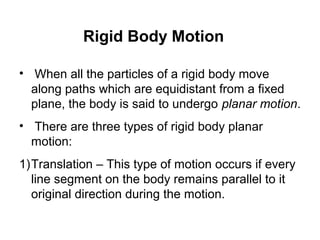
1)Translation – This type of motion occurs if every
line segment on the body remains parallel to it
original direction during the motion.
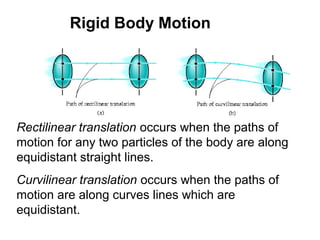
Rectilinear translation occurs when the paths of
motion for any two particles of the body are along
equidistant straight lines.
Curvilinear translation occurs when the paths of
motion are along curves lines which are
equidistant.
Rigid Body Motion
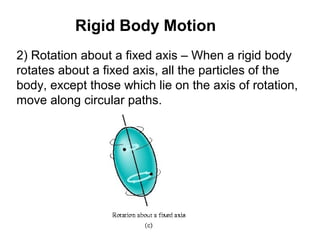
2) Rotation about a fixed axis – When a rigid body
rotates about a fixed axis, all the particles of the
body, except those which lie on the axis of rotation,
move along circular paths.
Rigid Body Motion
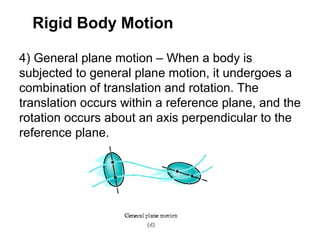
4) General plane motion – When a body is
subjected to general plane motion, it undergoes a
combination of translation and rotation. The
translation occurs within a reference plane, and the
rotation occurs about an axis perpendicular to the
reference plane.
Rigid Body Motion
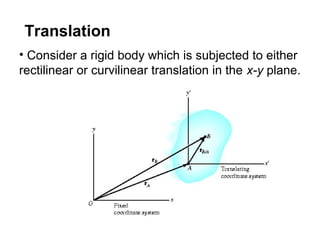
• Consider a rigid body which is subjected to either
rectilinear or curvilinear translation in the x-y plane.
Translation
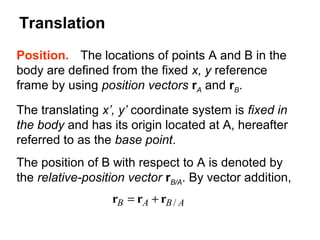
Position. The locations of points A and B in the
body are defined from the fixed x, y reference
frame by using position vectors rA and rB.
The translating x’, y’ coordinate system is fixed in
the body and has its origin located at A, hereafter
referred to as the base point.
The position of B with respect to A is denoted by
the relative-position vector rB/A. By vector addition,
ABAB /rrr +=
Translation
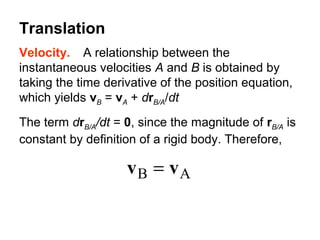
Velocity. A relationship between the
instantaneous velocities A and B is obtained by
taking the time derivative of the position equation,
which yields vB = vA + drB/A/dt
The term drB/A/dt = 0, since the magnitude of rB/A is
constant by definition of a rigid body. Therefore,
AB vv =
Translation
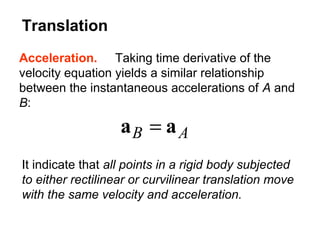
Acceleration. Taking time derivative of the
velocity equation yields a similar relationship
between the instantaneous accelerations of A and
B:
AB aa =
It indicate that all points in a rigid body subjected
to either rectilinear or curvilinear translation move
with the same velocity and acceleration.
Translation
Rotation About a Fixed Axis
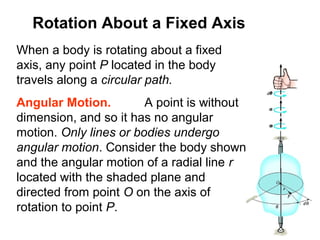
When a body is rotating about a fixed
axis, any point P located in the body
travels along a circular path.
Angular Motion. A point is without
dimension, and so it has no angular
motion. Only lines or bodies undergo
angular motion. Consider the body shown
and the angular motion of a radial line r
located with the shaded plane and
directed from point O on the axis of
rotation to point P.
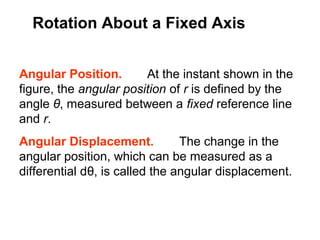
Angular Position. At the instant shown in the
figure, the angular position of r is defined by the
angle θ, measured between a fixed reference line
and r.
Angular Displacement. The change in the
angular position, which can be measured as a
differential dθ, is called the angular displacement.
Rotation About a Fixed Axis
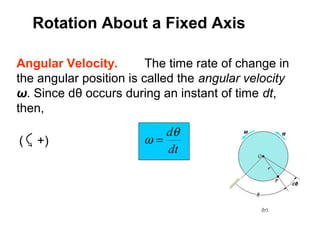
Angular Velocity. The time rate of change in
the angular position is called the angular velocity
ω. Since dθ occurs during an instant of time dt,
then,
dt
dθ
ω =( +)
Rotation About a Fixed Axis
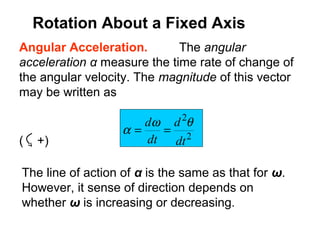
Angular Acceleration. The angular
acceleration α measure the time rate of change of
the angular velocity. The magnitude of this vector
may be written as
( +) 2
2
dt
d
dt
d θω
α ==
The line of action of α is the same as that for ω.
However, it sense of direction depends on
whether ω is increasing or decreasing.
Rotation About a Fixed Axis
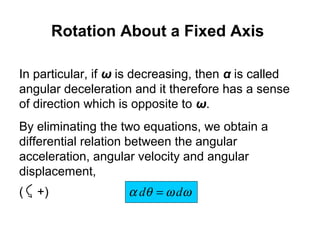
In particular, if ω is decreasing, then α is called
angular deceleration and it therefore has a sense
of direction which is opposite to ω.
By eliminating the two equations, we obtain a
differential relation between the angular
acceleration, angular velocity and angular
displacement,
ωωθα dd =( +)
Rotation About a Fixed Axis
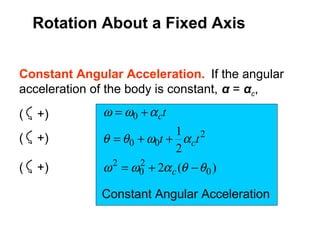
Constant Angular Acceleration. If the angular
acceleration of the body is constant, α = αc,
)(2
2
1
0
2
0
2
2
00
0
θθαωω
αωθθ
αωω
−+=
++=
+=
c
c
c
tt
t
( +)
( +)
( +)
Constant Angular Acceleration
Rotation About a Fixed Axis
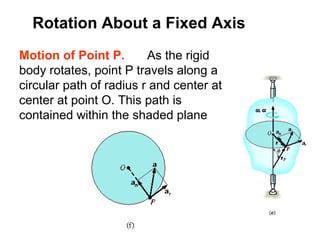
Motion of Point P. As the rigid
body rotates, point P travels along a
circular path of radius r and center at
center at point O. This path is
contained within the shaded plane
Rotation About a Fixed Axis
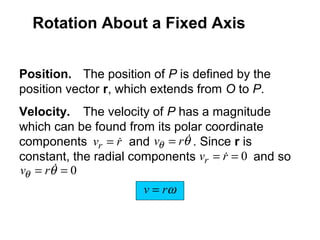
Position. The position of P is defined by the
position vector r, which extends from O to P.
Velocity. The velocity of P has a magnitude
which can be found from its polar coordinate
components and . Since r is
constant, the radial components and so
rvr = θθ
rv =
0== rvr 
0== θθ
rv
ωrv =
Rotation About a Fixed Axis
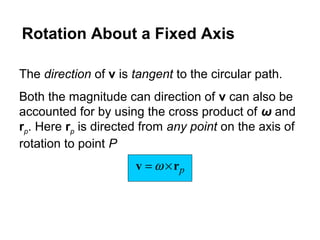
The direction of v is tangent to the circular path.
Both the magnitude can direction of v can also be
accounted for by using the cross product of ω and
rp. Here rp is directed from any point on the axis of
rotation to point P
prv ×= ω
Rotation About a Fixed Axis
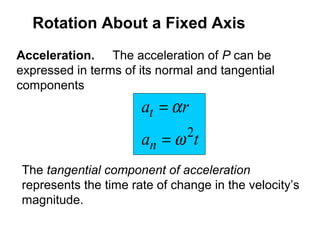
Acceleration. The acceleration of P can be
expressed in terms of its normal and tangential
components
ta
ra
n
t
2
ω
α
=
=
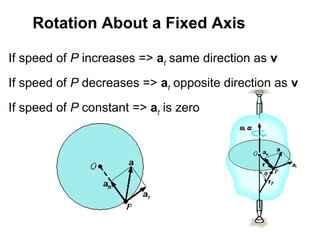
The tangential component of acceleration
represents the time rate of change in the velocity’s
magnitude.
Rotation About a Fixed Axis
If speed of P increases => at same direction as v
If speed of P decreases => at opposite direction as v
If speed of P constant => at is zero
Rotation About a Fixed Axis
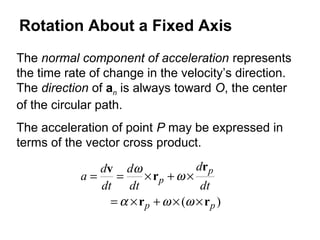
The normal component of acceleration represents
the time rate of change in the velocity’s direction.
The direction of an is always toward O, the center
of the circular path.
The acceleration of point P may be expressed in
terms of the vector cross product.
)( pp
p
p
dt
d
dt
d
dt
d
a
rr
r
r
v
××+×=
×+×==
ωωα
ω
ω
Rotation About a Fixed Axis
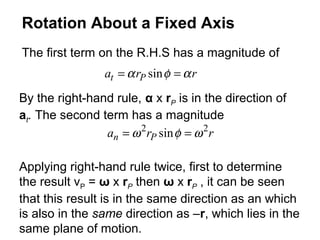
The first term on the R.H.S has a magnitude of
rra Pt αφα == sin
By the right-hand rule, α x rP is in the direction of
at. The second term has a magnitude
rra Pn
22
sin ωφω ==
Applying right-hand rule twice, first to determine
the result vP = ω x rP then ω x rP , it can be seen
that this result is in the same direction as an which
is also in the same direction as –r, which lies in the
same plane of motion.
Rotation About a Fixed Axis
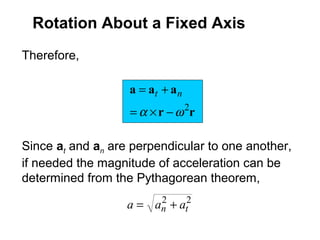
Therefore,
rr
aaa
2
ωα −×=
+= nt
Since at and an are perpendicular to one another,
if needed the magnitude of acceleration can be
determined from the Pythagorean theorem,
22
tn aaa +=
Rotation About a Fixed Axis
PROCEDURE FOR ANALYSIS
Angular Motion.
• Establish the positive sense of direction along the
axis of rotation and show it alongside each
kinematics equation as it is applied.
• If a relationship is known between any two of the
four variables α, ω, θ and t, then a third variable
can be obtained by using one of the following
kinematics equations which relates all three
variables
ωωθα
ω
α
θ
ω dd
dt
d
dt
d
===
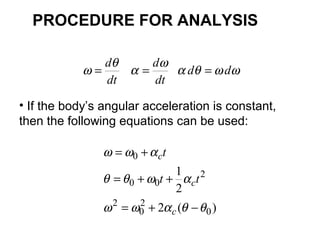
• If the body’s angular acceleration is constant,
then the following equations can be used:
)(2
2
1
0
2
0
2
2
00
0
θθαωω
αωθθ
αωω
−+=
++=
+=
c
c
c
tt
t
PROCEDURE FOR ANALYSIS
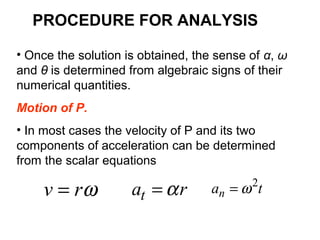
• Once the solution is obtained, the sense of α, ω
and θ is determined from algebraic signs of their
numerical quantities.
Motion of P.
• In most cases the velocity of P and its two
components of acceleration can be determined
from the scalar equations
rat α=ωrv = tan
2
ω=
PROCEDURE FOR ANALYSIS
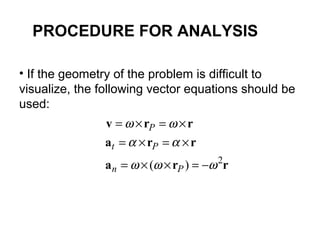
• If the geometry of the problem is difficult to
visualize, the following vector equations should be
used:
rra
rra
rrv
2
)( ωωω
αα
ωω
−=××=
×=×=
×=×=
Pn
Pt
P
PROCEDURE FOR ANALYSIS
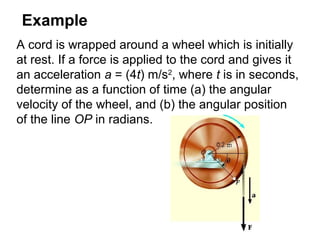
Example
A cord is wrapped around a wheel which is initially
at rest. If a force is applied to the cord and gives it
an acceleration a = (4t) m/s2
, where t is in seconds,
determine as a function of time (a) the angular
velocity of the wheel, and (b) the angular position
of the line OP in radians.
Solution
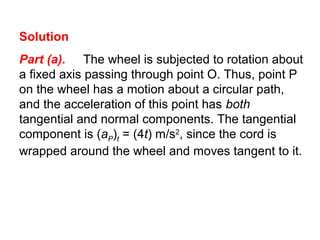
Part (a). The wheel is subjected to rotation about
a fixed axis passing through point O. Thus, point P
on the wheel has a motion about a circular path,
and the acceleration of this point has both
tangential and normal components. The tangential
component is (aP)t = (4t) m/s2
, since the cord is
wrapped around the wheel and moves tangent to it.
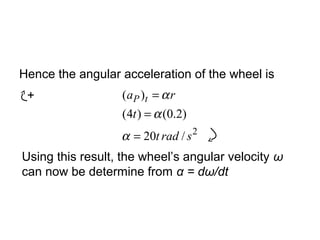
Hence the angular acceleration of the wheel is
2
/20
)2.0()4(
)(
sradt
t
ra tP
=
=
=
α
α
α+
Using this result, the wheel’s angular velocity ω
can now be determine from α = dω/dt
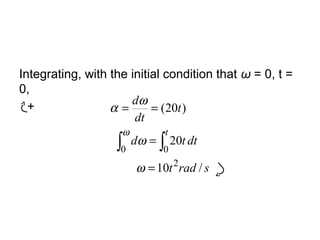
Integrating, with the initial condition that ω = 0, t =
0,
+
sradt
dttd
t
dt
d
t
/10
20
)20(
2
00
=
=
==
∫∫
ω
ω
ω
α
ω
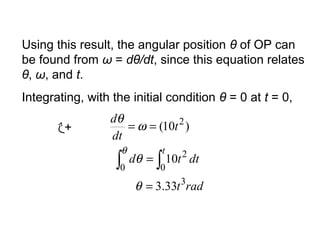
Using this result, the angular position θ of OP can
be found from ω = dθ/dt, since this equation relates
θ, ω, and t.
Integrating, with the initial condition θ = 0 at t = 0,
radt
dttd
t
dt
d
t
3
0
2
0
2
33.3
10
)10(
=
=
==
∫∫
θ
θ
ω
θ
θ
+
Example
The motor is used to turn a wheel and
attached blower contained with the
housing. If the pulley A connected to
the motor begins rotating from rest with
an angular acceleration of αA = 2
rad/s2
, determine the magnitudes of the
velocity and acceleration of point P on
the wheel, after the wheel B has turned
one revolution.
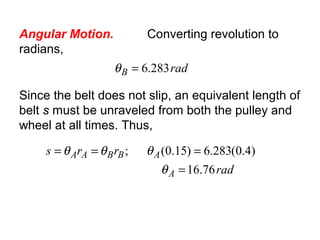
Angular Motion. Converting revolution to
radians,
radB 283.6=θ
Since the belt does not slip, an equivalent length of
belt s must be unraveled from both the pulley and
wheel at all times. Thus,
rad
rrs
A
ABBAA
76.16
)4.0(283.6)15.0(;
=
===
θ
θθθ
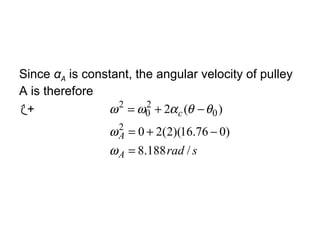
Since αA is constant, the angular velocity of pulley
A is therefore
sradA
A
c
/188.8
)076.16)(2(20
)(2
2
0
2
0
2
=
−+=
−+=
ω
ω
θθαωω+
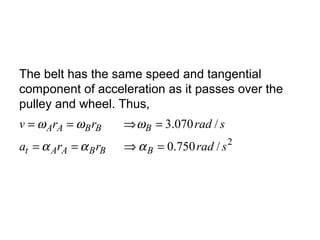
The belt has the same speed and tangential
component of acceleration as it passes over the
pulley and wheel. Thus,
2
/750.0
/070.3
sradrra
sradrrv
BBBAAt
BBBAA
=⇒==
=⇒==
ααα
ωωω
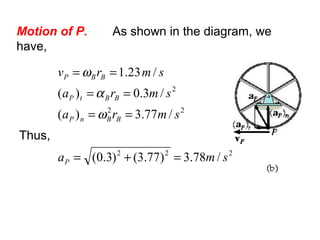
Motion of P. As shown in the diagram, we
have,
222
22
2
/78.3)77.3()3.0(
/77.3)(
/3.0)(
/23.1
sma
smra
smra
smrv
P
BBnP
BBtP
BBP
=+=
==
==
==
ω
α
ω
Thus,
Absolute Motion Analysis
• A body subjected to general plane motion
undergoes a simultaneous translation and rotation.
• One way to define these motions is to use a
rectilinear position coordinate s to locate the point
along its path and an angular position coordinate θ
to specify the orientation of the line.
• By direct application of the time-differential
equations v = ds/dt, a = dv/dt, ω = dθ/dt, α = dω/dt,
the motion of the point and the angular motion of
the line can be related.
Position Coordinate Equation.
• Locate point P using a position coordinate s,
which is measured from a fixed origin and is
directed along the straight-line path of motion of
point P.
• Measure from a fixed reference line the angular
position θ of a line lying in the body.
• From the dimensions of the body, relate s to θ, s
= f(θ), using geometry and/or trigonometry.
Position Coordinate Equation.
• Take the first derivative of s = f(θ) w.r.t time to get
a relationship between v and ω.
• Take the second derivative to get a relationship
between a and α.
• In each case the chain rule of calculus must be
used when taking the derivatives of the position
coordinate equation.
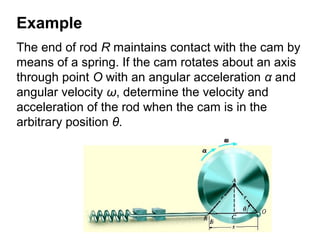
Example
The end of rod R maintains contact with the cam by
means of a spring. If the cam rotates about an axis
through point O with an angular acceleration α and
angular velocity ω, determine the velocity and
acceleration of the rod when the cam is in the
arbitrary position θ.
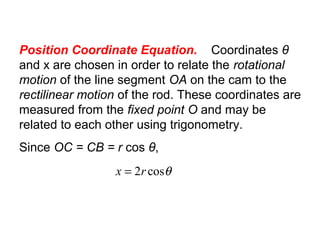
Position Coordinate Equation. Coordinates θ
and x are chosen in order to relate the rotational
motion of the line segment OA on the cam to the
rectilinear motion of the rod. These coordinates are
measured from the fixed point O and may be
related to each other using trigonometry.
Since OC = CB = r cos θ,
θcos2rx =
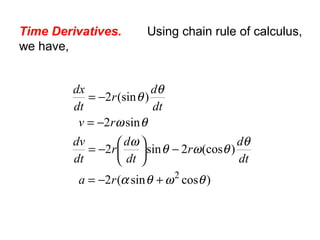
Time Derivatives. Using chain rule of calculus,
we have,
)cossin(2
)(cos2sin2
sin2
)(sin2
2
θωθα
θ
θωθ
ω
θω
θ
θ
+−=
−




−=
−=
−=
ra
dt
d
r
dt
d
r
dt
dv
rv
dt
d
r
dt
dx
Example
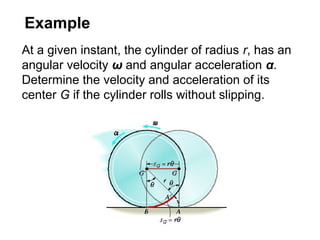
At a given instant, the cylinder of radius r, has an
angular velocity ω and angular acceleration α.
Determine the velocity and acceleration of its
center G if the cylinder rolls without slipping.
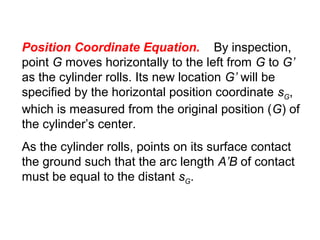
Position Coordinate Equation. By inspection,
point G moves horizontally to the left from G to G’
as the cylinder rolls. Its new location G’ will be
specified by the horizontal position coordinate sG,
which is measured from the original position (G) of
the cylinder’s center.
As the cylinder rolls, points on its surface contact
the ground such that the arc length A’B of contact
must be equal to the distant sG.
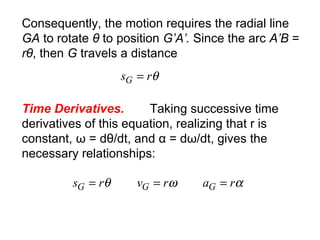
Consequently, the motion requires the radial line
GA to rotate θ to position G’A’. Since the arc A’B =
rθ, then G travels a distance
θrsG =
Time Derivatives. Taking successive time
derivatives of this equation, realizing that r is
constant, ω = dθ/dt, and α = dω/dt, gives the
necessary relationships:
αωθ rarvrs GGG ===
Example
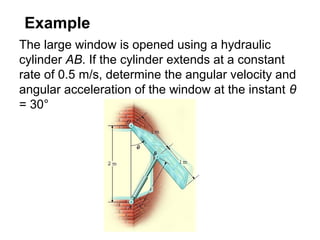
The large window is opened using a hydraulic
cylinder AB. If the cylinder extends at a constant
rate of 0.5 m/s, determine the angular velocity and
angular acceleration of the window at the instant θ
= 30°
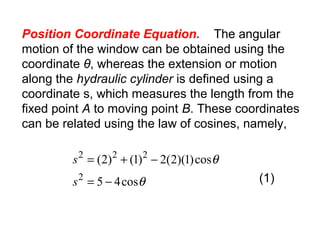
Position Coordinate Equation. The angular
motion of the window can be obtained using the
coordinate θ, whereas the extension or motion
along the hydraulic cylinder is defined using a
coordinate s, which measures the length from the
fixed point A to moving point B. These coordinates
can be related using the law of cosines, namely,
θ
θ
cos45
cos)1)(2(2)1()2(
2
222
−=
−+=
s
s
(1)
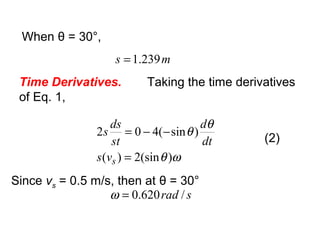
When θ = 30°,
ms 239.1=
Time Derivatives. Taking the time derivatives
of Eq. 1,
srad
vs
dt
d
st
ds
s
s
/620.0
)(sin2)(
)sin(402
=
=
−−=
ω
ωθ
θ
θ
Since vs = 0.5 m/s, then at θ = 30°
(2)
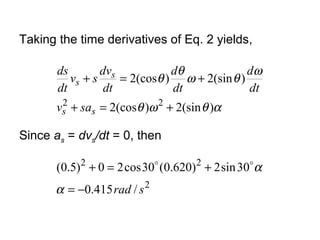
Taking the time derivatives of Eq. 2 yields,
2
22
22
/415.0
30sin2)620.0(30cos20)5.0(
)(sin2)(cos2
)(sin2)(cos2
srad
sav
dt
d
dt
d
dt
dv
sv
dt
ds
ss
s
s
−=
+=+
+=+
+=+
α
α
αθωθ
ω
θω
θ
θ

Since as = dvs/dt = 0, then
Relative–Motion Analysis: Velocity
• The general plane motion of a rigid body can be
described as a combination of translation and
rotation.
• To view these “component” motions separately,
we use a relative-motion analysis involving two
sets of coordinate axes.
• The x, y coordinate system is fixed and measures
the absolute position of two points A and B on the
body.
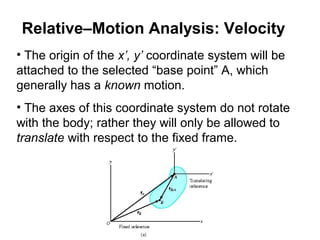
• The origin of the x’, y’ coordinate system will be
attached to the selected “base point” A, which
generally has a known motion.
• The axes of this coordinate system do not rotate
with the body; rather they will only be allowed to
translate with respect to the fixed frame.
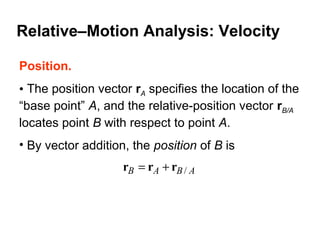
Relative–Motion Analysis: Velocity
Position.
• The position vector rA specifies the location of the
“base point” A, and the relative-position vector rB/A
locates point B with respect to point A.
• By vector addition, the position of B is
ABAB /rrr +=
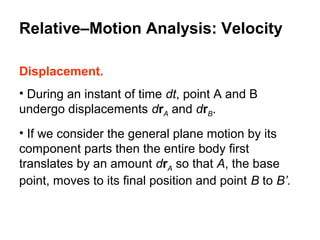
Relative–Motion Analysis: Velocity
Displacement.
• During an instant of time dt, point A and B
undergo displacements drA and drB.
• If we consider the general plane motion by its
component parts then the entire body first
translates by an amount drA so that A, the base
point, moves to its final position and point B to B’.
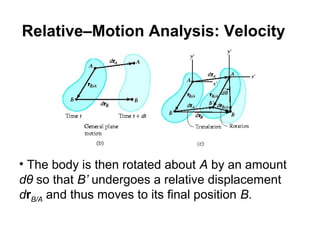
Relative–Motion Analysis: Velocity
• The body is then rotated about A by an amount
dθ so that B’ undergoes a relative displacement
drB/A and thus moves to its final position B.
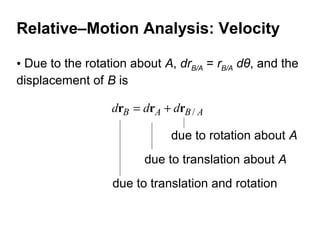
Relative–Motion Analysis: Velocity
• Due to the rotation about A, drB/A = rB/A dθ, and the
displacement of B is
ABAB ddd /rrr +=
due to rotation about A
due to translation about A
due to translation and rotation
Relative–Motion Analysis: Velocity
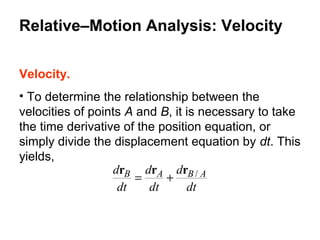
Velocity.
• To determine the relationship between the
velocities of points A and B, it is necessary to take
the time derivative of the position equation, or
simply divide the displacement equation by dt. This
yields,
dt
d
dt
d
dt
d ABAB /rrr
+=
Relative–Motion Analysis: Velocity
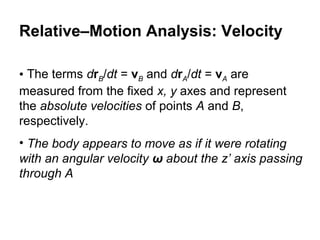
• The terms drB/dt = vB and drA/dt = vA are
measured from the fixed x, y axes and represent
the absolute velocities of points A and B,
respectively.
• The body appears to move as if it were rotating
with an angular velocity ω about the z’ axis passing
through A
Relative–Motion Analysis: Velocity
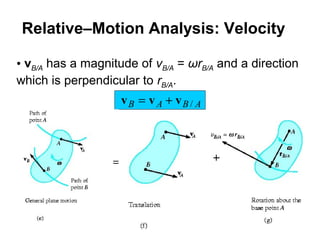
• vB/A has a magnitude of vB/A = ωrB/A and a direction
which is perpendicular to rB/A.
ABAB /vvv +=
Relative–Motion Analysis: Velocity
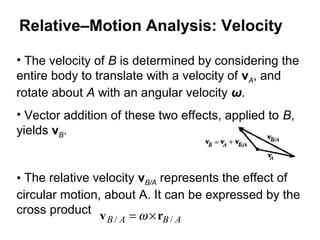
• The velocity of B is determined by considering the
entire body to translate with a velocity of vA, and
rotate about A with an angular velocity ω.
• Vector addition of these two effects, applied to B,
yields vB.
• The relative velocity vB/A represents the effect of
circular motion, about A. It can be expressed by the
cross product
ABAB // rv ×= ω
Relative–Motion Analysis: Velocity
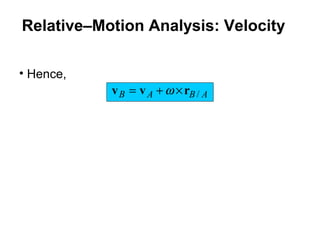
ABAB /rvv ×+= ω
• Hence,
Relative–Motion Analysis: Velocity
PROCEDURE FOR ANALYSIS
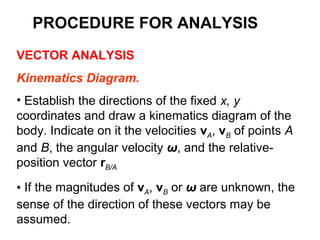
VECTOR ANALYSIS
Kinematics Diagram.
• Establish the directions of the fixed x, y
coordinates and draw a kinematics diagram of the
body. Indicate on it the velocities vA, vB of points A
and B, the angular velocity ω, and the relative-
position vector rB/A
• If the magnitudes of vA, vB or ω are unknown, the
sense of the direction of these vectors may be
assumed.
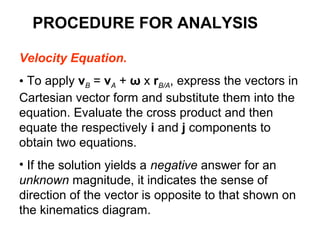
Velocity Equation.
• To apply vB = vA + ω x rB/A, express the vectors in
Cartesian vector form and substitute them into the
equation. Evaluate the cross product and then
equate the respectively i and j components to
obtain two equations.
• If the solution yields a negative answer for an
unknown magnitude, it indicates the sense of
direction of the vector is opposite to that shown on
the kinematics diagram.
PROCEDURE FOR ANALYSIS
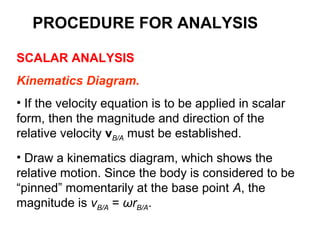
SCALAR ANALYSIS
Kinematics Diagram.
• If the velocity equation is to be applied in scalar
form, then the magnitude and direction of the
relative velocity vB/A must be established.
• Draw a kinematics diagram, which shows the
relative motion. Since the body is considered to be
“pinned” momentarily at the base point A, the
magnitude is vB/A = ωrB/A.
PROCEDURE FOR ANALYSIS
• The sense of the direction of vB/A is established
from the diagram, such that vB/A acts perpendicular
to rB/A in accordance with the rotational motion ω of
the body.
Velocity Equation.
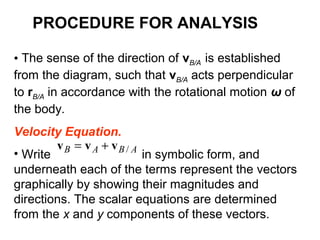
• Write in symbolic form, and
underneath each of the terms represent the vectors
graphically by showing their magnitudes and
directions. The scalar equations are determined
from the x and y components of these vectors.
ABAB /vvv +=
PROCEDURE FOR ANALYSIS
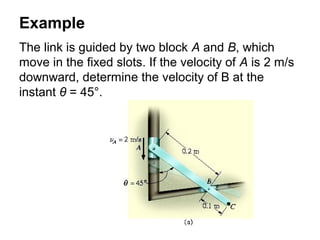
Example
The link is guided by two block A and B, which
move in the fixed slots. If the velocity of A is 2 m/s
downward, determine the velocity of B at the
instant θ = 45°.
Solution (Vector Analysis)
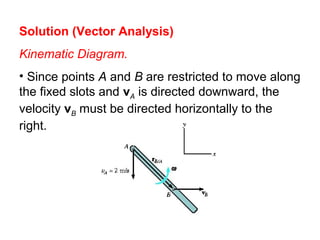
Kinematic Diagram.
• Since points A and B are restricted to move along
the fixed slots and vA is directed downward, the
velocity vB must be directed horizontally to the
right.
• This motion causes the link to rotate CCW; by
right-hand-rule the angular velocity ω is directed
outward, perpendicular to the plane of plane.
• Knowing the magnitude and direction of vA and
the lines of action of vB and ω, it is possible to
apply the velocity equation to
points A and B in order to solve for the two
unknown magnitudes vB and ω.
ABAB /vvv +=
Velocity Equation.
ijji
jikji
rvv


45cos2.045sin2.02
)]45cos2.045sin2.0([2
/
ωω
ω
ω
++−=
−×+−=
×+=
B
B
ABAB
v
v
Equating the i and j components gives
→=
=
+−==
smv
srad
v
B
B
/2
/1.14
45sin2.02045cos2.0
ω
ωω


Example
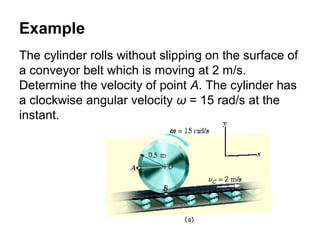
The cylinder rolls without slipping on the surface of
a conveyor belt which is moving at 2 m/s.
Determine the velocity of point A. The cylinder has
a clockwise angular velocity ω = 15 rad/s at the
instant.
Solution (Vector Analysis)
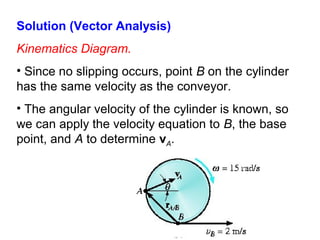
Kinematics Diagram.
• Since no slipping occurs, point B on the cylinder
has the same velocity as the conveyor.
• The angular velocity of the cylinder is known, so
we can apply the velocity equation to B, the base
point, and A to determine vA.
Velocity Equation.
ijiji
jikiji
rvv
50.750.72)()(
)]5.05.0()15(2)()(
/
++=+
+−×−+=+
×+=
yAxA
yAxA
ABBA
vv
vv
ω
So that
smv
smv
yA
xA
/50.7)(
/50.950.72)(
=
=+=
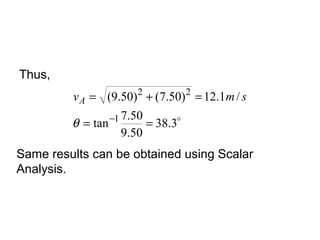
Thus,

3.38
50.9
50.7
tan
/1.12)50.7()50.9(
1
22
==
=+=
−
θ
smvA
Same results can be obtained using Scalar
Analysis.
Example
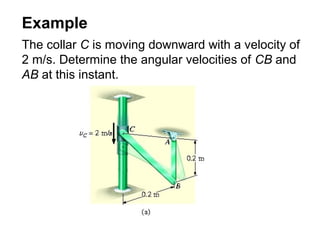
The collar C is moving downward with a velocity of
2 m/s. Determine the angular velocities of CB and
AB at this instant.
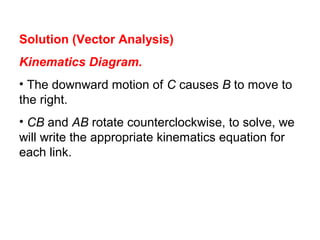
Solution (Vector Analysis)
Kinematics Diagram.
• The downward motion of C causes B to move to
the right.
• CB and AB rotate counterclockwise, to solve, we
will write the appropriate kinematics equation for
each link.
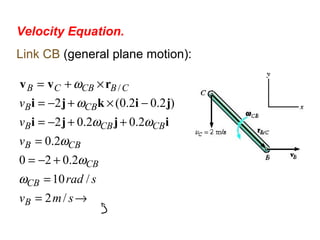
Velocity Equation.
Link CB (general plane motion):
→=
=
+−=
=
++−=
−×+−=
×+=
smv
srad
v
v
v
B
CB
CB
CBB
CBCBB
CBB
CBCBCB
/2
/10
2.020
2.0
2.02.02
)2.02.0(2
/
ω
ω
ω
ωω
ω
ω
ijji
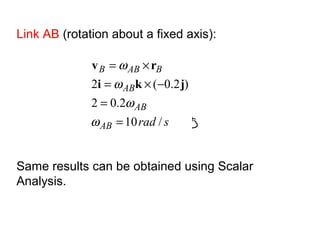
jikji
rvv
Link AB (rotation about a fixed axis):
sradAB
AB
AB
BABB
/10
2.02
)2.0(2
=
=
−×=
×=
ω
ω
ω
ω
jki
rv
Same results can be obtained using Scalar
Analysis.
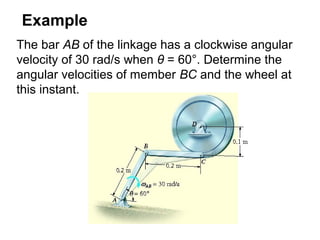
Example
The bar AB of the linkage has a clockwise angular
velocity of 30 rad/s when θ = 60°. Determine the
angular velocities of member BC and the wheel at
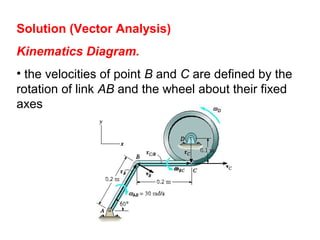
this instant.
Solution (Vector Analysis)
Kinematics Diagram.
• the velocities of point B and C are defined by the
rotation of link AB and the wheel about their fixed
axes
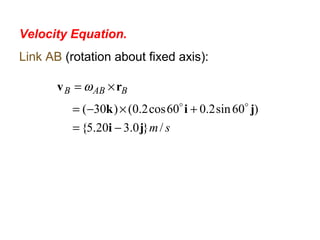
Velocity Equation.
Link AB (rotation about fixed axis):
sm
BABB
/}0.320.5{
)60sin2.060cos2.0()30(
ji
jik
rv
−=
+×−=
×=

ω
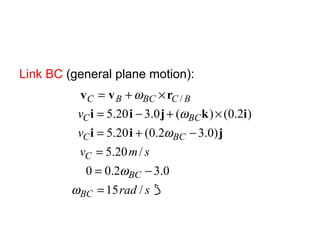
Link BC (general plane motion):
srad
smv
v
v
BC
BC
C
BCC
BCC
BCBCBC
/15
0.32.00
/20.5
)0.32.0(20.5
)2.0()(0.320.5
/
=
−=
=
−+=
×+−=
×+=
ω
ω
ω
ω
ω
jii
ikjii
rvv
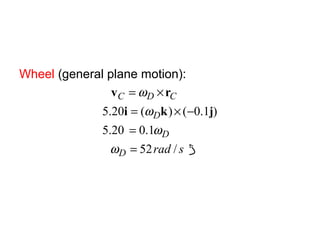
Wheel (general plane motion):
sradD
D
D
CDC
/52
1.020.5
)1.0()(20.5
=
=
−×=
×=
ω
ω
ω
ω
jki
rv
Instantaneous Center of Zero Velocity
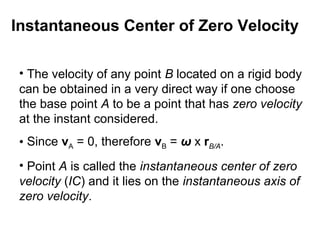
• The velocity of any point B located on a rigid body
can be obtained in a very direct way if one choose
the base point A to be a point that has zero velocity
at the instant considered.
• Since vA = 0, therefore vB = ω x rB/A.
• Point A is called the instantaneous center of zero
velocity (IC) and it lies on the instantaneous axis of
zero velocity.
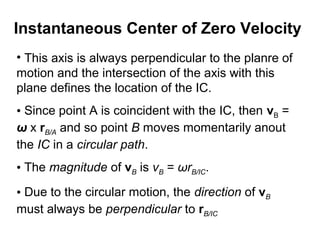
• This axis is always perpendicular to the planre of
motion and the intersection of the axis with this
plane defines the location of the IC.
• Since point A is coincident with the IC, then vB =
ω x rB/A and so point B moves momentarily anout
the IC in a circular path.
• The magnitude of vB is vB = ωrB/IC.
• Due to the circular motion, the direction of vB
must always be perpendicular to rB/IC
Instantaneous Center of Zero Velocity
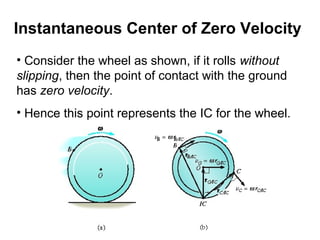
• Consider the wheel as shown, if it rolls without
slipping, then the point of contact with the ground
has zero velocity.
• Hence this point represents the IC for the wheel.
Instantaneous Center of Zero Velocity
• If it is imagined that the wheel is momentarily
pinned at this point, the velocities of points B, C, O
and so on, can be found using v = ωr.
• The radial distance rB/IC, rC/IC and rO/IC must be
determined from the geometry of the wheel.
Location of the IC. To locate the IC, we use the
fact that the velocity of a point on the body is
always perpendicular to the relative-position vector
extending from the IC to the point. Several
possibilities exist:
Instantaneous Center of Zero Velocity
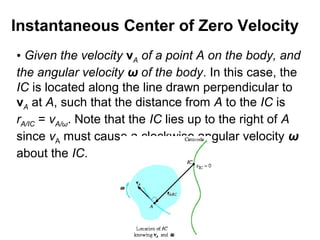
• Given the velocity vA of a point A on the body, and
the angular velocity ω of the body. In this case, the
IC is located along the line drawn perpendicular to
vA at A, such that the distance from A to the IC is
rA/IC = vA/ω. Note that the IC lies up to the right of A
since vA must cause a clockwise angular velocity ω
about the IC.
Instantaneous Center of Zero Velocity
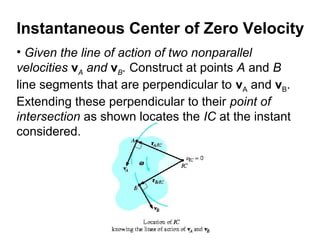
• Given the line of action of two nonparallel
velocities vA and vB. Construct at points A and B
line segments that are perpendicular to vA and vB.
Extending these perpendicular to their point of
intersection as shown locates the IC at the instant
considered.
Instantaneous Center of Zero Velocity
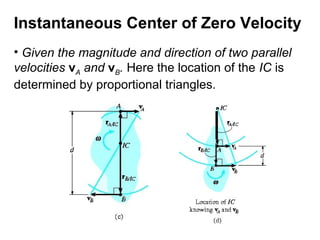
• Given the magnitude and direction of two parallel
velocities vA and vB. Here the location of the IC is
determined by proportional triangles.
Instantaneous Center of Zero Velocity
In both cases rA/IC = vA/ω and rB/IC = vB/ω. If d is a
known distance between point A and B, then rA/IC +
rB/IC = d for first diagram, and rB/IC - rA/IC = d for
second diagram. As a special case, note that if the
body is translating, vA = vB, then the IC would be
located at infinity, in which case rA/IC = rB/IC → ∞.
This being the case, ω = (vA/rA/IC) = (vA/rA/IC) → 0, as
expected.
Instantaneous Center of Zero Velocity
Note:
• the point chosen as the instantaneous center of
zero velocity for the body can only be used for an
instant of time since the body changes its position
from one instant to the next.
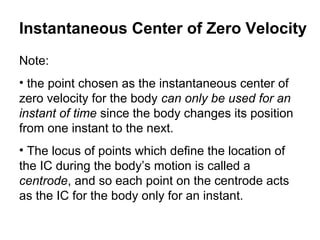
• The locus of points which define the location of
the IC during the body’s motion is called a
centrode, and so each point on the centrode acts
as the IC for the body only for an instant.
Instantaneous Center of Zero Velocity
• Although the IC may be used to determine the
velocity of any point in a body, it generally does not
have zero acceleration and therefore it should not
be used for finding the accelerations of points on a
body
Instantaneous Center of Zero Velocity
PROCEDURE FOR ANALYSIS
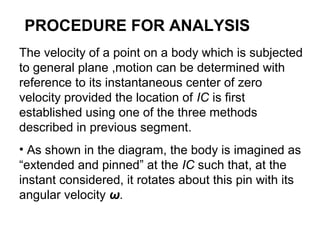
The velocity of a point on a body which is subjected
to general plane ,motion can be determined with
reference to its instantaneous center of zero
velocity provided the location of IC is first
established using one of the three methods
described in previous segment.
• As shown in the diagram, the body is imagined as
“extended and pinned” at the IC such that, at the
instant considered, it rotates about this pin with its
angular velocity ω.
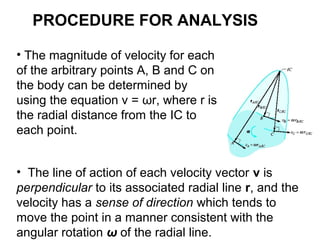
• The magnitude of velocity for each
of the arbitrary points A, B and C on
the body can be determined by
using the equation v = ωr, where r is
the radial distance from the IC to
each point.
• The line of action of each velocity vector v is
perpendicular to its associated radial line r, and the
velocity has a sense of direction which tends to
move the point in a manner consistent with the
angular rotation ω of the radial line.
PROCEDURE FOR ANALYSIS
Example
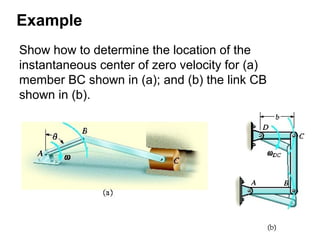
Show how to determine the location of the
instantaneous center of zero velocity for (a)
member BC shown in (a); and (b) the link CB
shown in (b).
Solution
Part (a).
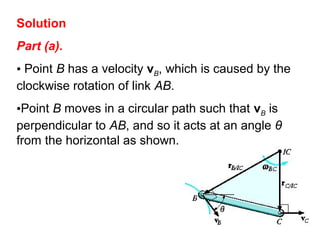
• Point B has a velocity vB, which is caused by the
clockwise rotation of link AB.
•Point B moves in a circular path such that vB is
perpendicular to AB, and so it acts at an angle θ
from the horizontal as shown.
• The motion of point B causes the piston to move
forward horizontally with a velocity vC
• When the line are drawn perpendicular to vB and
vC, the intersect at the IC.
Part (b).
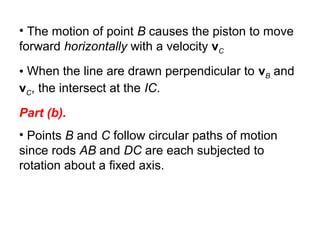
• Points B and C follow circular paths of motion
since rods AB and DC are each subjected to
rotation about a fixed axis.
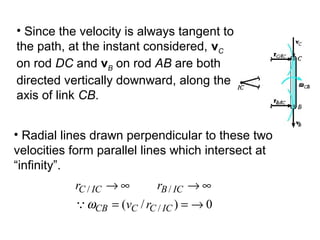
• Since the velocity is always tangent to
the path, at the instant considered, vC
on rod DC and vB on rod AB are both
directed vertically downward, along the
axis of link CB.
• Radial lines drawn perpendicular to these two
velocities form parallel lines which intersect at
“infinity”.
0)/( /
//
→==
∞→∞→
ICCCCB
ICBICC
rv
rr
ω
• As a result, rod CB momentarily translates.
• At an instant later, however, CB will move to a
tilted position, causing the instantaneous center to
move to some finite location.
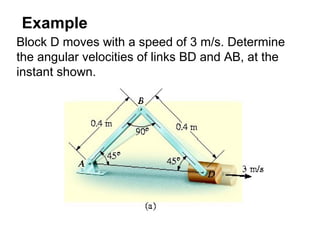
Example
Block D moves with a speed of 3 m/s. Determine
the angular velocities of links BD and AB, at the
instant shown.
Solution
• As D moves to the right, it causes arm AB to
rotate clockwise about point A. Hence vB is directed
perpendicular to AB.
• The instantaneous center of zero velocity for BD
is located at the intersection of the line segments
drawn perpendicular to vB and vD
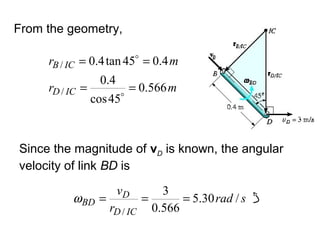
From the geometry,
mr
mr
ICD
ICB
566.0
45cos
4.0
4.045tan4.0
/
/
==
==


Since the magnitude of vD is known, the angular
velocity of link BD is
srad
r
v
ICD
D
BD /30.5
566.0
3
/
===ω
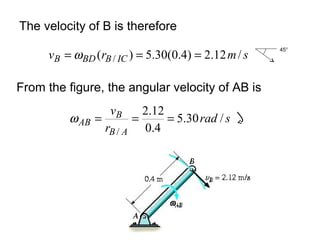
The velocity of B is therefore
smrv ICBBDB /12.2)4.0(30.5)( / === ω
From the figure, the angular velocity of AB is
srad
r
v
AB
B
AB /30.5
4.0
12.2
/
===ω
45°
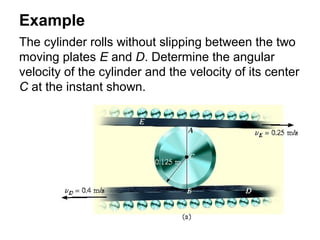
Example
The cylinder rolls without slipping between the two
moving plates E and D. Determine the angular
velocity of the cylinder and the velocity of its center
C at the instant shown.
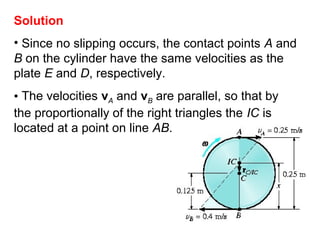
Solution
• Since no slipping occurs, the contact points A and
B on the cylinder have the same velocities as the
plate E and D, respectively.
• The velocities vA and vB are parallel, so that by
the proportionally of the right triangles the IC is
located at a point on line AB.
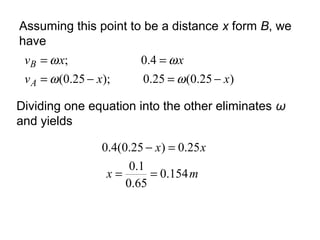
Assuming this point to be a distance x form B, we
have
)25.0(25.0);25.0(
4.0;
xxv
xxv
A
B
−=−=
==
ωω
ωω
Dividing one equation into the other eliminates ω
and yields
mx
xx
154.0
65.0
1.0
25.0)25.0(4.0
==
=−
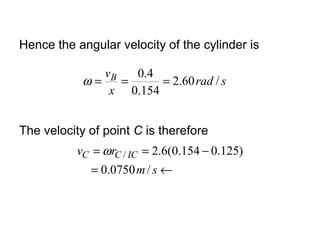
Hence the angular velocity of the cylinder is
srad
x
vB /60.2
154.0
4.0
===ω
The velocity of point C is therefore
←=
−==
sm
rv ICCC
/0750.0
)125.0154.0(6.2/ω
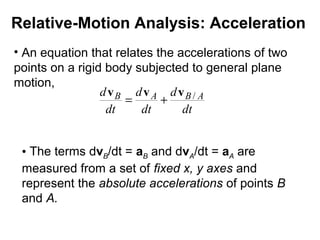
Relative-Motion Analysis: Acceleration
• An equation that relates the accelerations of two
points on a rigid body subjected to general plane
motion,
dt
d
dt
d
dt
d ABAB /vvv
+=
• The terms dvB/dt = aB and dvA/dt = aA are
measured from a set of fixed x, y axes and
represent the absolute accelerations of points B
and A.
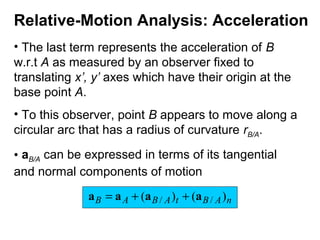
• The last term represents the acceleration of B
w.r.t A as measured by an observer fixed to
translating x’, y’ axes which have their origin at the
base point A.
• To this observer, point B appears to move along a
circular arc that has a radius of curvature rB/A.
• aB/A can be expressed in terms of its tangential
and normal components of motion
nABtABAB )()( // aaaa ++=
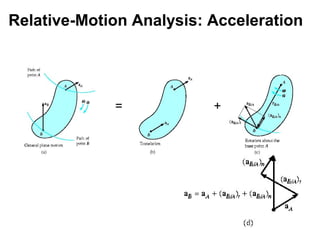
Relative-Motion Analysis: Acceleration
= +
Relative-Motion Analysis: Acceleration
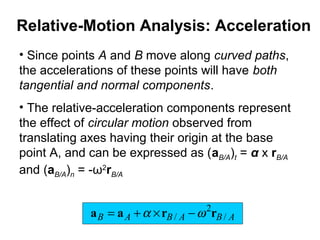
• Since points A and B move along curved paths,
the accelerations of these points will have both
tangential and normal components.
• The relative-acceleration components represent
the effect of circular motion observed from
translating axes having their origin at the base
point A, and can be expressed as (aB/A)t = α x rB/A
and (aB/A)n = -ω2
rB/A
ABABAB /
2
/ rraa ωα −×+=
Relative-Motion Analysis: Acceleration
PROCEDURE FOR ANALYSIS
Velocity Analysis.
• Determine the angular velocity ω of the body by
using a velocity analysis as discuss in previous
section. Also determine the velocities vA and vB of
points A and B if these points moves along curved
paths.
VECTOR ANALYSIS
Kinematics Diagram.
• Establish the directions of the fixed x, y
coordinates and draw the kinematics diagram of
the body. Indicate on it aA, aB, ω, α, rB/A.
• If points A and B move along curved paths, then
their accelerations should be indicated in terms of
their tangential and normal components.
PROCEDURE FOR ANALYSIS
Acceleration Equation.
• To apply aB = aA + α x rB/A – ω2
rB/A express the
vectors in Cartesian vector form and substitutide
them into the equation. Evaluate the cross product
and then equate the respective i and j components
to obtain two scalar equations.
• If the solution yields a negative answer for an
unknown magnitude, it indicates that the sense of
direction of the vector is opposite to that shown on
the kinematics diagram.
PROCEDURE FOR ANALYSIS
SCALAR ANALYSIS
Kinematics Diagram.
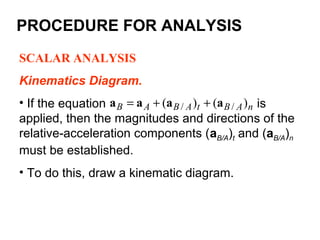
• If the equation is
applied, then the magnitudes and directions of the
relative-acceleration components (aB/A)t and (aB/A)n
must be established.
• To do this, draw a kinematic diagram.
nABtABAB )()( // aaaa ++=
PROCEDURE FOR ANALYSIS
• Since the body is considered to be momentarily
“pinned” at the base point A, the magnitudes are
(aB/A)t = αrB/A and (aB/A)n = ω2
rB/A.
• Their sense of direction is established from the
diagram such that (aB/A)t acts perpendicular to rB/A,
in accordance with the rotational motion α of the
body, and (aB/A)n is directed from B towards A.
PROCEDURE FOR ANALYSIS
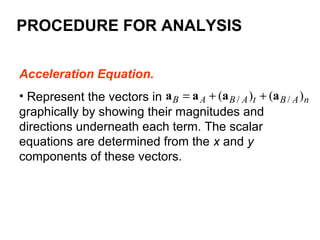
Acceleration Equation.
• Represent the vectors in
graphically by showing their magnitudes and
directions underneath each term. The scalar
equations are determined from the x and y
components of these vectors.
nABtABAB )()( // aaaa ++=
PROCEDURE FOR ANALYSIS
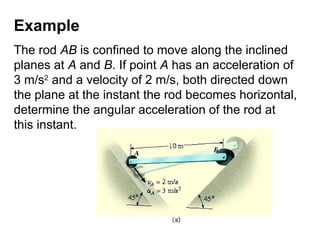
Example
The rod AB is confined to move along the inclined
planes at A and B. If point A has an acceleration of
3 m/s2
and a velocity of 2 m/s, both directed down
the plane at the instant the rod becomes horizontal,
determine the angular acceleration of the rod at
this instant.
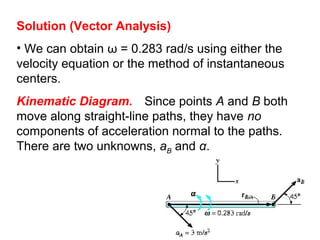
Solution (Vector Analysis)
• We can obtain ω = 0.283 rad/s using either the
velocity equation or the method of instantaneous
centers.
Kinematic Diagram. Since points A and B both
move along straight-line paths, they have no
components of acceleration normal to the paths.
There are two unknowns, aB and α.
Acceleration Equation.
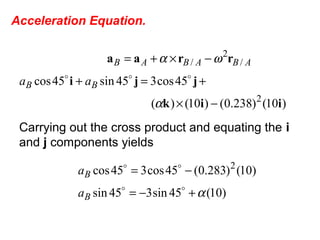
)10()238.0()10()(
45cos345sin45cos
2
/
2
/
iik
jji
rraa
−×
+=+
−×+=
α
ωα

BB
ABABAB
aa
Carrying out the cross product and equating the i
and j components yields
)10(45sin345sin
)10()283.0(45cos345cos 2
α+−=
−=


B
B
a
a
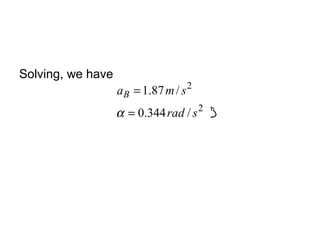
Solving, we have
2
2
/344.0
/87.1
srad
smaB
=
=
α
Example
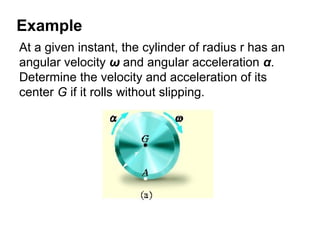
At a given instant, the cylinder of radius r has an
angular velocity ω and angular acceleration α.
Determine the velocity and acceleration of its
center G if it rolls without slipping.
Solution (Vector Analysis)
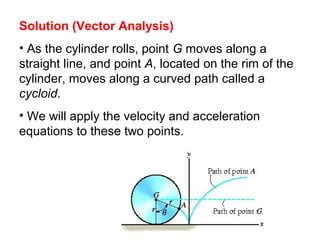
• As the cylinder rolls, point G moves along a
straight line, and point A, located on the rim of the
cylinder, moves along a curved path called a
cycloid.
• We will apply the velocity and acceleration
equations to these two points.
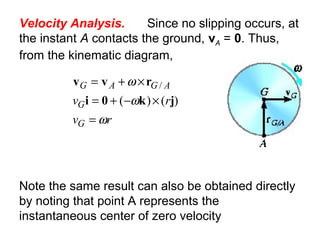
Velocity Analysis. Since no slipping occurs, at
the instant A contacts the ground, vA = 0. Thus,
from the kinematic diagram,
rv
rv
G
G
AGAG
ω
ω
ω
=
×−+=
×+=
)()(
/
jk0i
rvv
Note the same result can also be obtained directly
by noting that point A represents the
instantaneous center of zero velocity
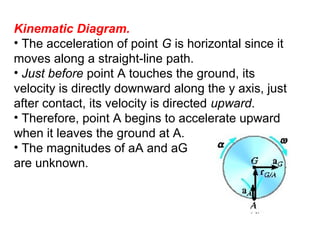
Kinematic Diagram.
• The acceleration of point G is horizontal since it
moves along a straight-line path.
• Just before point A touches the ground, its
velocity is directly downward along the y axis, just
after contact, its velocity is directed upward.
• Therefore, point A begins to accelerate upward
when it leaves the ground at A.
• The magnitudes of aA and aG
are unknown.
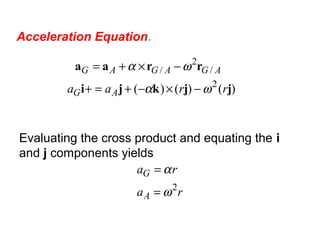
Acceleration Equation.
)()()( 2
/
2
/
jjkji
rraa
rraa AG
AGAGAG
ωα
ωα
−×−+=+
−×+=
Evaluating the cross product and equating the i
and j components yields
ra
ra
A
G
2
ω
α
=
=
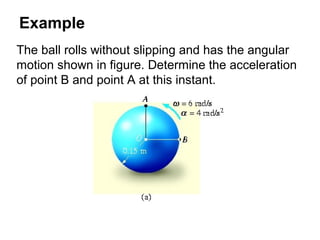
Example
The ball rolls without slipping and has the angular
motion shown in figure. Determine the acceleration
of point B and point A at this instant.
Solution (Vector Analysis)
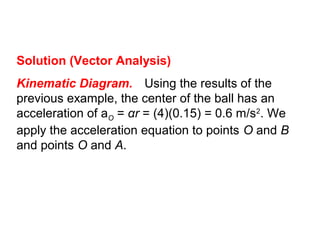
Kinematic Diagram. Using the results of the
previous example, the center of the ball has an
acceleration of aO = αr = (4)(0.15) = 0.6 m/s2
. We
apply the acceleration equation to points O and B
and points O and A.
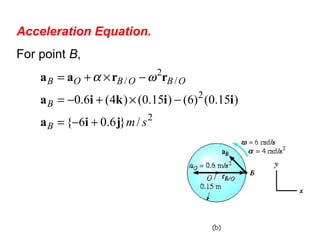
Acceleration Equation.
For point B,
2
2
/
2
/
/}6.06{
)15.0()6()15.0()4(6.0
smB
B
OBOBOB
jia
iikia
rraa
+−=
−×+−=
−×+= ωα
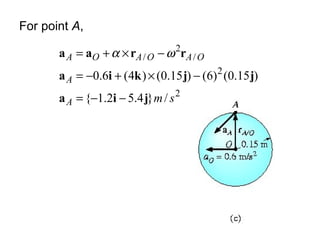
For point A,
2
2
/
2
/
/}4.52.1{
)15.0()6()15.0()4(6.0
smA
A
OAOAOA
jia
jjkia
rraa
−−=
−×+−=
−×+= ωα
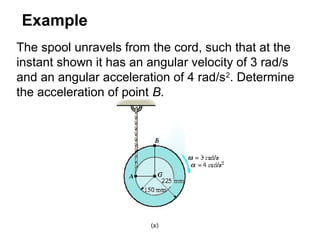
Example
The spool unravels from the cord, such that at the
instant shown it has an angular velocity of 3 rad/s
and an angular acceleration of 4 rad/s2
. Determine
the acceleration of point B.
Solution (Vector Analysis)
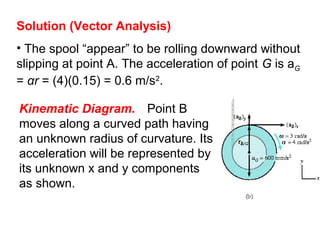
• The spool “appear” to be rolling downward without
slipping at point A. The acceleration of point G is aG
= αr = (4)(0.15) = 0.6 m/s2
.
Kinematic Diagram. Point B
moves along a curved path having
an unknown radius of curvature. Its
acceleration will be represented by
its unknown x and y components
as shown.
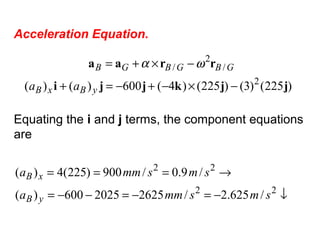
Acceleration Equation.
)225()3()225()4(600)()( 2
/
2
/
jjkjji
rraa
−×−+−=+
−×+=
yBxB
GBGBGB
aa
ωα
Equating the i and j terms, the component equations
are
↓−=−=−−=
→===
22
22
/625.2/26252025600)(
/9.0/900)225(4)(
smsmma
smsmma
yB
xB
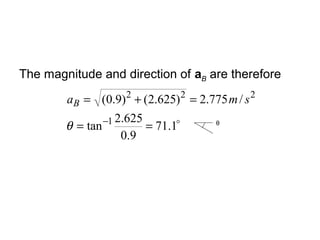
The magnitude and direction of aB are therefore

1.71
9.0
625.2
tan
/775.2)625.2()9.0(
1
222
==
=+=
−
θ
smaB
θ
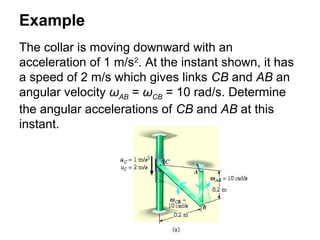
Example
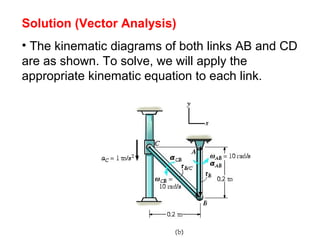
The collar is moving downward with an
acceleration of 1 m/s2
. At the instant shown, it has
a speed of 2 m/s which gives links CB and AB an
angular velocity ωAB = ωCB = 10 rad/s. Determine
the angular accelerations of CB and AB at this
instant.
Solution (Vector Analysis)
• The kinematic diagrams of both links AB and CD
are as shown. To solve, we will apply the
appropriate kinematic equation to each link.
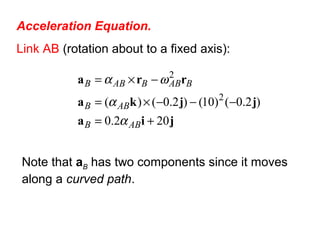
Acceleration Equation.
Link AB (rotation about to a fixed axis):
jia
jjka
rra
202.0
)2.0()10()2.0()( 2
2
+=
−−−×=
−×=
ABB
ABB
BABBABB
α
α
ωα
Note that aB has two components since it moves
along a curved path.
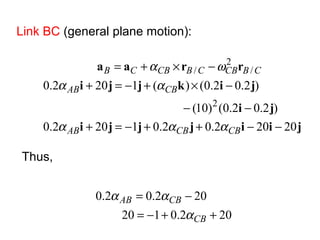
Link BC (general plane motion):
jiijjji
ji
jikjji
rraa
20202.02.01202.0
)2.02.0()10(
)2.02.0()(1202.0
2
/
2
/
−−++−=+
−−
−×+−=+
−×+=
CBCBAB
CBAB
CBCBCBCBCB
ααα
αα
ωα
Thus,
202.0120
202.02.0
++−=
−=
CB
CBAB
α
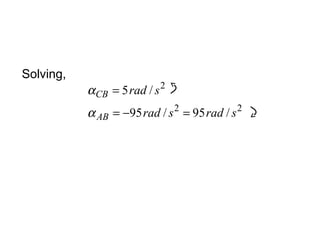
αα
22
2
/95/95
/5
sradsrad
srad
AB
CB
=−=
=
α
α
Solving,
Example
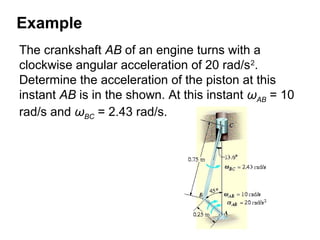
The crankshaft AB of an engine turns with a
clockwise angular acceleration of 20 rad/s2
.
Determine the acceleration of the piston at this
instant AB is in the shown. At this instant ωAB = 10
rad/s and ωBC = 2.43 rad/s.
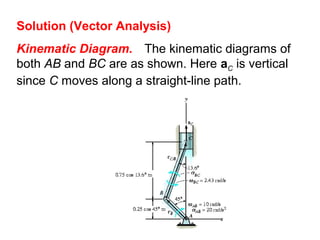
Solution (Vector Analysis)
Kinematic Diagram. The kinematic diagrams of
both AB and BC are as shown. Here aC is vertical
since C moves along a straight-line path.
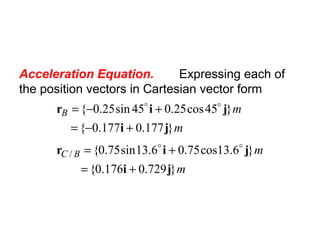
m
m
m
m
BC
B
}729.0176.0{
}6.13cos75.06.13sin75.0{
}177.0177.0{
}45cos25.045sin25.0{
/
ji
jir
ji
jir
+=
+=
+−=
+−=


Acceleration Equation. Expressing each of
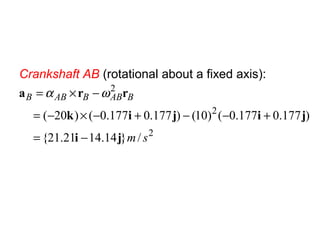
the position vectors in Cartesian vector form
Crankshaft AB (rotational about a fixed axis):
2
2
2
/}14.1421.21{
)177.0177.0()10()177.0177.0()20(
sm
BABBABB
ji
jijik
rra
−=
+−−+−×−=
−×= ωα
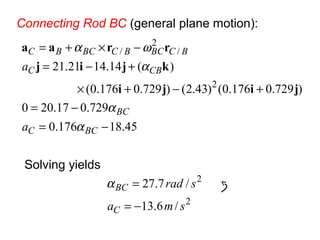
Connecting Rod BC (general plane motion):
45.18176.0
729.017.200
)729.0176.0()43.2()729.0176.0(
)(14.1421.21
2
/
2
/
−=
−=
+−+×
+−=
−×+=
BCC
BC
CBC
BCBCBCBCBC
a
a
α
α
α
ωα
jiji
kjij
rraa
Solving yields
2
2
/6.13
/7.27
sma
srad
C
BC
−=
=α
• Translating coordinate system
 describes relative motion analysis for velocity
and acceleration
 determines the motion of the points on the same
rigid body
 determines the motion of points located on
several pin-connected rigid bodies
• Rigid bodies are constructed such that sliding
occur at their connections
Relative-Motion Analysis Using Rotating
Axes
• Coordinate system
 Use for kinematics analysis
 use for analyzing motion of two points on a
mechanism which are not located in the same rigid
body
 use for specifying kinematics of particle motion
when the particle is moving along a rotating path
Relative-Motion Analysis Using
Rotating Axes
• In the following analysis, 2 equations are
developed to relate the velocity and acceleration of
2 points, one of which is the origin of a moving
frame of reference subjected to both a translation
and rotation in the plane
• The 2 points can represent either 2 points moving
independently of one another or 2 points located on
the same (or different rigid bodies)
Relative-Motion Analysis Using
Rotating Axes
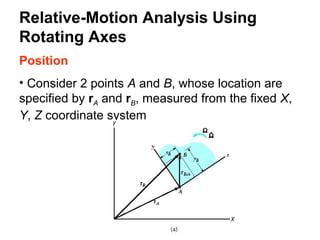
Position
• Consider 2 points A and B, whose location are
specified by rA and rB, measured from the fixed X,
Y, Z coordinate system
Relative-Motion Analysis Using
Rotating Axes
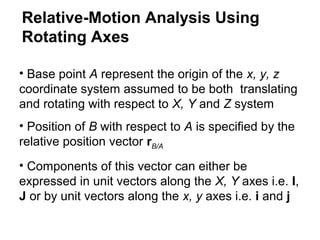
• Base point A represent the origin of the x, y, z
coordinate system assumed to be both translating
and rotating with respect to X, Y and Z system
• Position of B with respect to A is specified by the
relative position vector rB/A
• Components of this vector can either be
expressed in unit vectors along the X, Y axes i.e. I,
J or by unit vectors along the x, y axes i.e. i and j
Relative-Motion Analysis Using
Rotating Axes
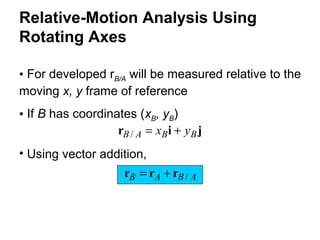
• For developed rB/A will be measured relative to the
moving x, y frame of reference
• If B has coordinates (xB, yB)
jir BBAB yx +=/
• Using vector addition,
ABAB /rrr +=
Relative-Motion Analysis Using
Rotating Axes
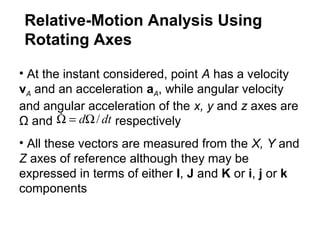
• At the instant considered, point A has a velocity
vA and an acceleration aA, while angular velocity
and angular acceleration of the x, y and z axes are
Ω and respectively
• All these vectors are measured from the X, Y and
Z axes of reference although they may be
expressed in terms of either I, J and K or i, j or k
components
dtd /Ω=Ω
Relative-Motion Analysis Using
Rotating Axes
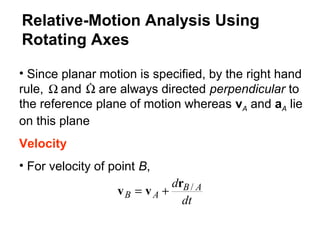
• Since planar motion is specified, by the right hand
rule, and are always directed perpendicular to
the reference plane of motion whereas vA and aA lie
on this plane
Velocity
• For velocity of point B,
Ω Ω
dt
d AB
AB
/r
vv +=
Relative-Motion Analysis Using
Rotating Axes
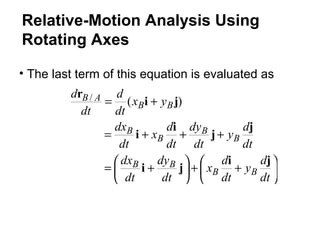
• The last term of this equation is evaluated as





 ++




 +=
+++=
+=
dt
d
y
dt
d
x
dt
dy
dt
dx
dt
d
y
dt
dy
dt
d
x
dt
dx
yx
dt
d
dt
d
BB
BB
B
B
B
B
BB
AB
ji
ji
j
j
i
i
ji
r
)(/
Relative-Motion Analysis Using
Rotating Axes
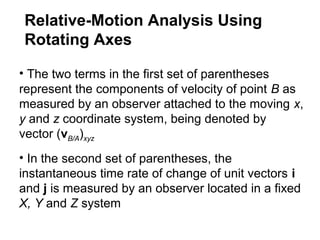
• The two terms in the first set of parentheses
represent the components of velocity of point B as
measured by an observer attached to the moving x,
y and z coordinate system, being denoted by
vector (vB/A)xyz
• In the second set of parentheses, the
instantaneous time rate of change of unit vectors i
and j is measured by an observer located in a fixed
X, Y and Z system
Relative-Motion Analysis Using
Rotating Axes
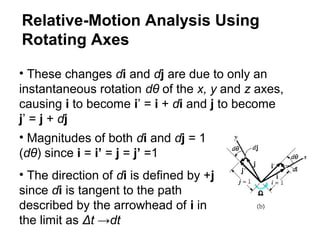
• These changes di and dj are due to only an
instantaneous rotation dθ of the x, y and z axes,
causing i to become i’ = i + di and j to become
j’ = j + dj
• Magnitudes of both di and dj = 1
(dθ) since i = i’ = j = j’ =1
• The direction of di is defined by +j
since di is tangent to the path
described by the arrowhead of i in
the limit as Δt →dt
Relative-Motion Analysis Using
Rotating Axes
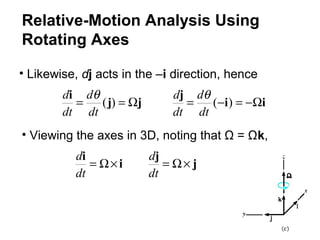
• Likewise, dj acts in the –i direction, hence
ii
j
jj
i
Ω−=−=Ω== )()(
dt
d
dt
d
dt
d
dt
d θθ
• Viewing the axes in 3D, noting that Ω = Ωk,
j
j
i
i
×Ω=×Ω=
dt
d
dt
d
Relative-Motion Analysis Using
Rotating Axes
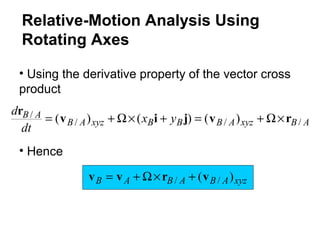
• Using the derivative property of the vector cross
product
ABxyzABBBxyzAB
AB yx
dt
d
///
/ )()()( rvjiv
r
×Ω+=+×Ω+=
• Hence
xyzABABAB )( // vrvv +×Ω+=
Relative-Motion Analysis Using
Rotating Axes
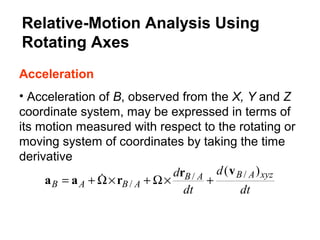
Acceleration
• Acceleration of B, observed from the X, Y and Z
coordinate system, may be expressed in terms of
its motion measured with respect to the rotating or
moving system of coordinates by taking the time
derivative
dt
d
dt
d xyzABAB
ABAB
)( //
/
vr
raa +×Ω+×Ω+= 
Relative-Motion Analysis Using
Rotating Axes
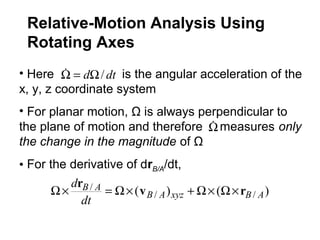
• Here is the angular acceleration of the
x, y, z coordinate system
• For planar motion, Ω is always perpendicular to
the plane of motion and therefore measures only
the change in the magnitude of Ω
• For the derivative of drB/A/dt,
dtd /Ω=Ω
Ω
)()( //
/
ABxyzAB
AB
dt
d
rv
r
×Ω×Ω+×Ω=×Ω
Relative-Motion Analysis Using
Rotating Axes
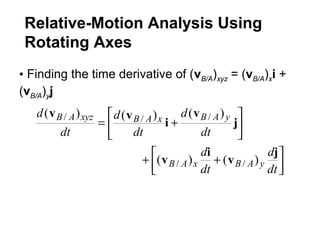
• Finding the time derivative of (vB/A)xyz = (vB/A)xi +
(vB/A)yj



 ++






+=
dt
d
dt
d
dt
d
dt
d
dt
d
yABxAB
yABxABxyzAB
j
v
i
v
j
v
i
vv
)()(
)()()(
//
///
Relative-Motion Analysis Using
Rotating Axes
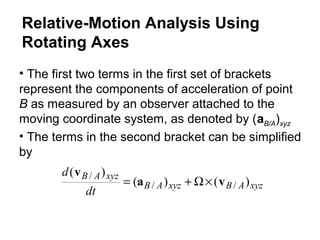
• The first two terms in the first set of brackets
represent the components of acceleration of point
B as measured by an observer attached to the
moving coordinate system, as denoted by (aB/A)xyz
xyzABxyzAB
xyzAB
dt
d
)()(
)(
//
/
va
v
×Ω+=
• The terms in the second bracket can be simplified
by
Relative-Motion Analysis Using
Rotating Axes
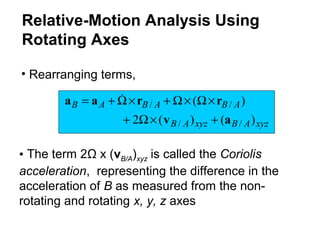
xyzABxyzAB
ABABAB
)()(2
)(
//
//
av
rraa
+×Ω+
×Ω×Ω+×Ω+= 
• Rearranging terms,
• The term 2Ω x (vB/A)xyz is called the Coriolis
acceleration, representing the difference in the
acceleration of B as measured from the non-
rotating and rotating x, y, z axes
Relative-Motion Analysis Using
Rotating Axes
• As indicated by the vector cross-product, the
Coriolis acceleration will always be perpendicular
to both Ω and (vB/A)xyz
Relative-Motion Analysis Using
Rotating Axes
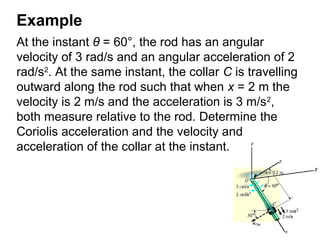
Example
At the instant θ = 60°, the rod has an angular
velocity of 3 rad/s and an angular acceleration of 2
rad/s2
. At the same instant, the collar C is travelling
outward along the rod such that when x = 2 m the
velocity is 2 m/s and the acceleration is 3 m/s2
,
both measure relative to the rod. Determine the
Coriolis acceleration and the velocity and
acceleration of the collar at the instant.
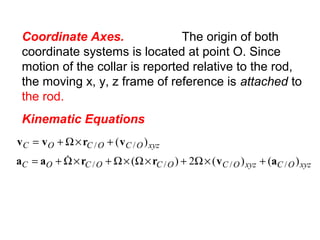
Coordinate Axes. The origin of both
coordinate systems is located at point O. Since
motion of the collar is reported relative to the rod,
the moving x, y, z frame of reference is attached to
the rod.
Kinematic Equations
xyzOCxyzOCOCOCOC
xyzOCOCOC
)()(2)(
)(
////
//
avrraa
vrvv
+×Ω+×Ω×Ω+×Ω+=
+×Ω+=

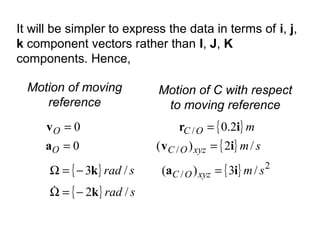
It will be simpler to express the data in terms of i, j,
k component vectors rather than I, J, K
components. Hence,
{ }
{ }
{ } { }
{ } srad
smsrad
sm
m
xyzOC
xyzOCO
OCO
/2
/3)(/3
/2)(0
2.00
2
/
/
/
k
iak
iva
irv
−=Ω
=−=Ω
==
==

Motion of moving
reference
Motion of C with respect
to moving reference
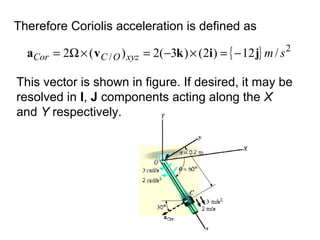
Therefore Coriolis acceleration is defined as
{ } 2
/ /12)2()3(2)(2 smxyzOCCor jikva −=×−=×Ω=
This vector is shown in figure. If desired, it may be
resolved in I, J components acting along the X
and Y respectively.
The velocity and acceleration of the collar are
determined by substituting the data in the previous
2 equations and evaluating the cross products,
which yields,
{ }
[ ]
{ } 2
////
//
/4.1220.1
3)2()3(2)2.0()3()3()2.0()2(0
)()(2)(
/6.02
2)2.0()3(0
)(
sm
sm
xyzOCxyzOCOCOCOC
xyzOCOCOC
ji
iikikkik
avrraa
ji
iik
vrvv
−=
+×−+×−×−+×−+=
+×Ω+×Ω×Ω+×Ω+=
−=
+×−+=
+×Ω+=

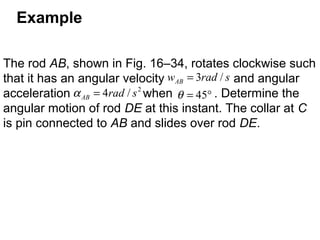
Example
The rod AB, shown in Fig. 16–34, rotates clockwise such
that it has an angular velocity and angular
acceleration when . Determine the
angular motion of rod DE at this instant. The collar at C
is pin connected to AB and slides over rod DE.
sradwAB /3=
2
/4 sradAB =α °= 45θ
Solution
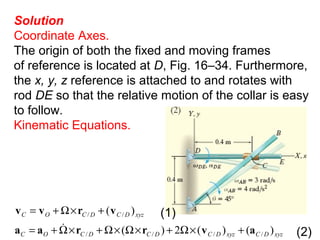
Coordinate Axes.
The origin of both the fixed and moving frames
of reference is located at D, Fig. 16–34. Furthermore,
the x, y, z reference is attached to and rotates with
rod DE so that the relative motion of the collar is easy
to follow.
Kinematic Equations.
xyzDCxyzDCDCDCOC
xyzDCDCOC
)()(2)(
)(
////
//
avrraa
vrvv
+×Ω+×Ω×Ω+×Ω+=
+×Ω+=

(1)
(2)
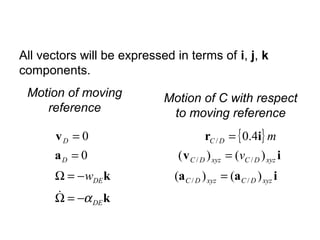
All vectors will be expressed in terms of i, j, k
components.
{ }
k
iaak
iva
irv
DE
xyzDCxyzDCDE
xyzDCxyzDCD
DCD
w
v
m
α−=Ω
=−=Ω
==
==

)()(
)()(0
4.00
//
//
/
Motion of moving
reference
Motion of C with respect
to moving reference
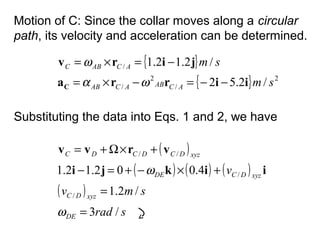
Motion of C: Since the collar moves along a circular
path, its velocity and acceleration can be determined.
{ }
{ } 2
/
2
/
/
/2.52
/2.12.1
sm
sm
ACABACAB
ACABC
iirra
jirv
C −−=−×=
−=×=
ωα
ω
Substituting the data into Eqs. 1 and 2, we have
( )
( ) ( ) ( )
( )
srad
smv
v
DE
xyzDC
xyzDCDE
xyzDCDCDC
/3
/2.1
4.002.12.1
/
/
//
=
=
+×−+=−
+×Ω+=
ω
ω iikji
vrvv
( ) ( ) ( )
( ) ( ) ( ) ( ) ( )[ ]
( ) ( ) ( )
( )
22
2
/
/
////
/5/5
/6.1
2.132
4.0334.002.52
2
sradsrad
sma
DE
xyzDC
xyzDC
DE
xyzDCxyzDCDCDCDC
=−=
=
+×−+
×−×−+×−+=−−
+×Ω+×Ω×Ω+×Ω+=
•
α
α
iaik
ikkikji
avrraa
Example
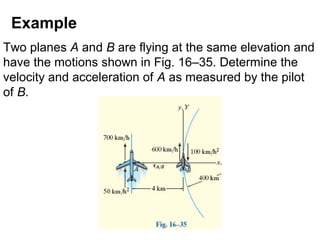
Two planes A and B are flying at the same elevation and
have the motions shown in Fig. 16–35. Determine the
velocity and acceleration of A as measured by the pilot
of B.
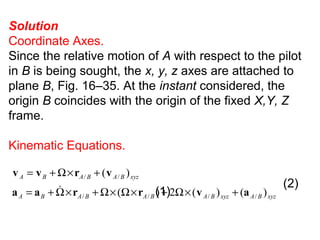
Solution
Coordinate Axes.
Since the relative motion of A with respect to the pilot
in B is being sought, the x, y, z axes are attached to
plane B, Fig. 16–35. At the instant considered, the
origin B coincides with the origin of the fixed X,Y, Z
frame.
Kinematic Equations.
xyzBAxyzBABABABA
xyzBABABA
)()(2)(
)(
////
//
avrraa
vrvv
+×Ω+×Ω×Ω+×Ω+=
+×Ω+=
 (1)
(2)
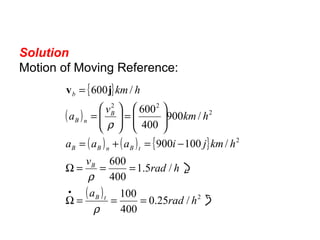
Solution
Motion of Moving Reference:
{ }
( )
( ) ( ) { }
( ) 2
2
2
22
/25.0
400
100
/5.1
400
600
/100900
/900
400
600
/600
hrad
a
hrad
v
hkmjiaaa
hkm
v
a
hkm
tB
B
tBnBB
B
nB
b
===Ω
===Ω
−=+=






=





=
=
•
ρ
ρ
ρ
jv
Rigid-Body Planar Motion
• A rigid body undergoes three types of planar
motion: translation, rotation about a fixed axis and
general plane motion.
Translation
• When a body has rectilinear translation, all the
particles of the body travel along straight-line
paths.
CHAPTER REVIEW
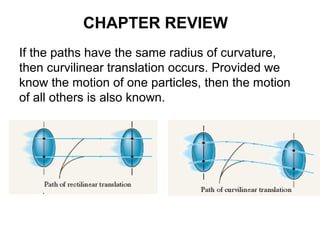
If the paths have the same radius of curvature,
then curvilinear translation occurs. Provided we
know the motion of one particles, then the motion
of all others is also known.
CHAPTER REVIEW
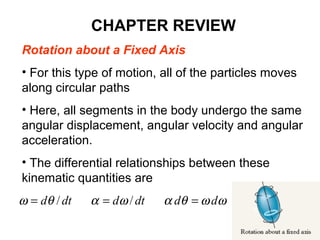
Rotation about a Fixed Axis
• For this type of motion, all of the particles moves
along circular paths
• Here, all segments in the body undergo the same
angular displacement, angular velocity and angular
acceleration.
• The differential relationships between these
kinematic quantities are
ωωθαωαθω dddtddtd === //
CHAPTER REVIEW
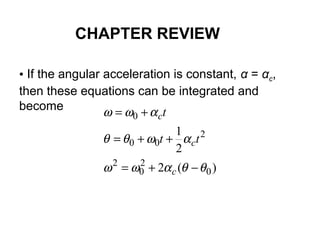
• If the angular acceleration is constant, α = αc,
then these equations can be integrated and
become
)(2
2
1
0
2
0
2
2
00
0
θθαωω
αωθθ
αωω
−+=
++=
+=
c
c
c
tt
t
CHAPTER REVIEW
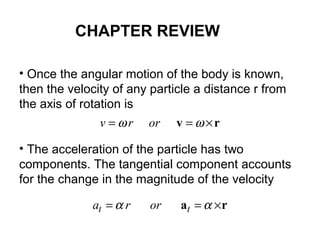
• Once the angular motion of the body is known,
then the velocity of any particle a distance r from
the axis of rotation is
• The acceleration of the particle has two
components. The tangential component accounts
for the change in the magnitude of the velocity
rv ×== ωω orrv
ra ×== αα tt orra
CHAPTER REVIEW
• The normal component accounts for the change
in the velocity direction
General Plane Motion
• When a body undergoes general plane motion, it
simultaneously translates and rotates.
• There are several types of methods for analyzing
this motion:
ra 22
ωω −== nn orra
CHAPTER REVIEW
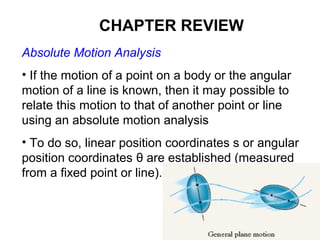
Absolute Motion Analysis
• If the motion of a point on a body or the angular
motion of a line is known, then it may possible to
relate this motion to that of another point or line
using an absolute motion analysis
• To do so, linear position coordinates s or angular
position coordinates θ are established (measured
from a fixed point or line).
CHAPTER REVIEW
• These position coordinates are then related using
the geometry of the body .
• The time derivative of this equation gives the
relationship between the velocities and/or the
angular velocities
• A second time derivative relates the accelerations
and/or the angular accelerations.
CHAPTER REVIEW
Relative Velocity Analysis
• General plane motion can also be analyzed using
a relative-motion analysis between two points A
and B.
• This method considers the motion in parts; first a
translation of the selected base point A, then a
relative “rotation” of the body about point A,
measured from a translating axis.
CHAPTER REVIEW
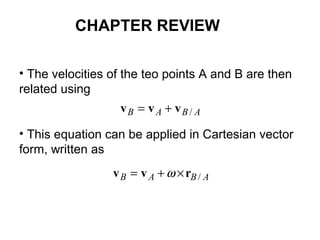
• The velocities of the teo points A and B are then
related using
• This equation can be applied in Cartesian vector
form, written as
ABAB /vvv +=
ABAB /rvv ×+= ω
CHAPTER REVIEW
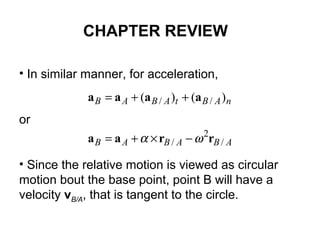
• In similar manner, for acceleration,
or
• Since the relative motion is viewed as circular
motion bout the base point, point B will have a
velocity vB/A, that is tangent to the circle.
ABABAB
nABtABAB
/
2
/
// )()(
rraa
aaaa
ωα −×+=
++=
CHAPTER REVIEW
• It also has two components of acceleration, (aB/A)t,
and (aB/A)n.
• It is important to also realize that aA and aB may
have two components if these points move along
curved paths.
CHAPTER REVIEW
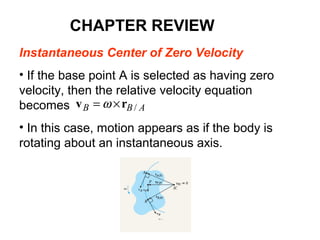
Instantaneous Center of Zero Velocity
• If the base point A is selected as having zero
velocity, then the relative velocity equation
becomes
• In this case, motion appears as if the body is
rotating about an instantaneous axis.
ABB /rv ×= ω
CHAPTER REVIEW
• The instantaneous center of rotation (IC) can be
established provided the directions of the velocities
of any two points on the body are known.
• Since the radial line r will always be perpendicular
to each velocity, then the IC is at the point of
intersection of these two radial lines.
• Its measured location is determined from the
geometry of the body.
CHAPTER REVIEW
• Once it is established, then the velocity of any
point P on the body can be determined from v = ωr,
where r extends from IC to point P.
Relative Motion Using Rotating Axes
• Problems that involve connected members that
slide relative to one another, or points not located
on the same body, can be analysed using a relative
motion analysis referenced from a rotating frame.
CHAPTER REVIEW
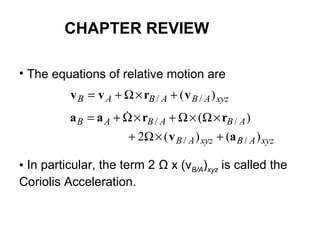
• The equations of relative motion are
• In particular, the term 2 Ω x (vB/A)xyz is called the
Coriolis Acceleration.
xyzABABAB )( // vrvv +×Ω+=
xyzABxyzAB
ABABAB
)()(2
)(
//
//
av
rraa
+×Ω+
×Ω×Ω+×Ω+= 
CHAPTER REVIEW

Dynamics lecture5

  • 1.
  • 2.
    Chapter Objectives • Toclassify the various types of rigid-body planar motion. • To investigate rigid-body translation and show how to analyze motion about a fixed axis. • To study planar motion using an absolute motion analysis.
  • 3.
    Chapter Objectives • Toprovide a relative motion analysis of velocity and acceleration using a translating frame of reference. • To show how to find the instantaneous center of zero velocity and determine the velocity of a point on a body using this method. • To provide a relative-motion analysis of velocity and acceleration using a rotating frame of reference.
  • 4.
    • Rigid-Body Motion •Translation • Rotation about a Fixed Axis • Absolute General Plane Motion Analysis • Relative-Motion Analysis: Velocity • Instantaneous Center of Zero Velocity • Relative-Motion Analysis: Acceleration • Relative-Motion Analysis Using Rotating Axis Chapter Outline
  • 5.
    Rigid Body Motion •When all the particles of a rigid body move along paths which are equidistant from a fixed plane, the body is said to undergo planar motion. • There are three types of rigid body planar motion: 1)Translation – This type of motion occurs if every line segment on the body remains parallel to it original direction during the motion.
  • 6.
    Rectilinear translation occurswhen the paths of motion for any two particles of the body are along equidistant straight lines. Curvilinear translation occurs when the paths of motion are along curves lines which are equidistant. Rigid Body Motion
  • 7.
    2) Rotation abouta fixed axis – When a rigid body rotates about a fixed axis, all the particles of the body, except those which lie on the axis of rotation, move along circular paths. Rigid Body Motion
  • 8.
    4) General planemotion – When a body is subjected to general plane motion, it undergoes a combination of translation and rotation. The translation occurs within a reference plane, and the rotation occurs about an axis perpendicular to the reference plane. Rigid Body Motion
  • 9.
    • Consider arigid body which is subjected to either rectilinear or curvilinear translation in the x-y plane. Translation
  • 10.
    Position. The locationsof points A and B in the body are defined from the fixed x, y reference frame by using position vectors rA and rB. The translating x’, y’ coordinate system is fixed in the body and has its origin located at A, hereafter referred to as the base point. The position of B with respect to A is denoted by the relative-position vector rB/A. By vector addition, ABAB /rrr += Translation
  • 11.
    Velocity. A relationshipbetween the instantaneous velocities A and B is obtained by taking the time derivative of the position equation, which yields vB = vA + drB/A/dt The term drB/A/dt = 0, since the magnitude of rB/A is constant by definition of a rigid body. Therefore, AB vv = Translation
  • 12.
    Acceleration. Taking timederivative of the velocity equation yields a similar relationship between the instantaneous accelerations of A and B: AB aa = It indicate that all points in a rigid body subjected to either rectilinear or curvilinear translation move with the same velocity and acceleration. Translation
  • 13.
    Rotation About aFixed Axis When a body is rotating about a fixed axis, any point P located in the body travels along a circular path. Angular Motion. A point is without dimension, and so it has no angular motion. Only lines or bodies undergo angular motion. Consider the body shown and the angular motion of a radial line r located with the shaded plane and directed from point O on the axis of rotation to point P.
  • 14.
    Angular Position. Atthe instant shown in the figure, the angular position of r is defined by the angle θ, measured between a fixed reference line and r. Angular Displacement. The change in the angular position, which can be measured as a differential dθ, is called the angular displacement. Rotation About a Fixed Axis
  • 15.
    Angular Velocity. Thetime rate of change in the angular position is called the angular velocity ω. Since dθ occurs during an instant of time dt, then, dt dθ ω =( +) Rotation About a Fixed Axis
  • 16.
    Angular Acceleration. Theangular acceleration α measure the time rate of change of the angular velocity. The magnitude of this vector may be written as ( +) 2 2 dt d dt d θω α == The line of action of α is the same as that for ω. However, it sense of direction depends on whether ω is increasing or decreasing. Rotation About a Fixed Axis
  • 17.
    In particular, ifω is decreasing, then α is called angular deceleration and it therefore has a sense of direction which is opposite to ω. By eliminating the two equations, we obtain a differential relation between the angular acceleration, angular velocity and angular displacement, ωωθα dd =( +) Rotation About a Fixed Axis
  • 18.
    Constant Angular Acceleration.If the angular acceleration of the body is constant, α = αc, )(2 2 1 0 2 0 2 2 00 0 θθαωω αωθθ αωω −+= ++= += c c c tt t ( +) ( +) ( +) Constant Angular Acceleration Rotation About a Fixed Axis
  • 19.
    Motion of PointP. As the rigid body rotates, point P travels along a circular path of radius r and center at center at point O. This path is contained within the shaded plane Rotation About a Fixed Axis
  • 20.
    Position. The positionof P is defined by the position vector r, which extends from O to P. Velocity. The velocity of P has a magnitude which can be found from its polar coordinate components and . Since r is constant, the radial components and so rvr = θθ rv = 0== rvr  0== θθ rv ωrv = Rotation About a Fixed Axis
  • 21.
    The direction ofv is tangent to the circular path. Both the magnitude can direction of v can also be accounted for by using the cross product of ω and rp. Here rp is directed from any point on the axis of rotation to point P prv ×= ω Rotation About a Fixed Axis
  • 22.
    Acceleration. The accelerationof P can be expressed in terms of its normal and tangential components ta ra n t 2 ω α = = The tangential component of acceleration represents the time rate of change in the velocity’s magnitude. Rotation About a Fixed Axis
  • 23.
    If speed ofP increases => at same direction as v If speed of P decreases => at opposite direction as v If speed of P constant => at is zero Rotation About a Fixed Axis
  • 24.
    The normal componentof acceleration represents the time rate of change in the velocity’s direction. The direction of an is always toward O, the center of the circular path. The acceleration of point P may be expressed in terms of the vector cross product. )( pp p p dt d dt d dt d a rr r r v ××+×= ×+×== ωωα ω ω Rotation About a Fixed Axis
  • 25.
    The first termon the R.H.S has a magnitude of rra Pt αφα == sin By the right-hand rule, α x rP is in the direction of at. The second term has a magnitude rra Pn 22 sin ωφω == Applying right-hand rule twice, first to determine the result vP = ω x rP then ω x rP , it can be seen that this result is in the same direction as an which is also in the same direction as –r, which lies in the same plane of motion. Rotation About a Fixed Axis
  • 26.
    Therefore, rr aaa 2 ωα −×= += nt Sinceat and an are perpendicular to one another, if needed the magnitude of acceleration can be determined from the Pythagorean theorem, 22 tn aaa += Rotation About a Fixed Axis
  • 27.
    PROCEDURE FOR ANALYSIS AngularMotion. • Establish the positive sense of direction along the axis of rotation and show it alongside each kinematics equation as it is applied. • If a relationship is known between any two of the four variables α, ω, θ and t, then a third variable can be obtained by using one of the following kinematics equations which relates all three variables
  • 28.
    ωωθα ω α θ ω dd dt d dt d === • Ifthe body’s angular acceleration is constant, then the following equations can be used: )(2 2 1 0 2 0 2 2 00 0 θθαωω αωθθ αωω −+= ++= += c c c tt t PROCEDURE FOR ANALYSIS
  • 29.
    • Once thesolution is obtained, the sense of α, ω and θ is determined from algebraic signs of their numerical quantities. Motion of P. • In most cases the velocity of P and its two components of acceleration can be determined from the scalar equations rat α=ωrv = tan 2 ω= PROCEDURE FOR ANALYSIS
  • 30.
    • If thegeometry of the problem is difficult to visualize, the following vector equations should be used: rra rra rrv 2 )( ωωω αα ωω −=××= ×=×= ×=×= Pn Pt P PROCEDURE FOR ANALYSIS
  • 31.
    Example A cord iswrapped around a wheel which is initially at rest. If a force is applied to the cord and gives it an acceleration a = (4t) m/s2 , where t is in seconds, determine as a function of time (a) the angular velocity of the wheel, and (b) the angular position of the line OP in radians.
  • 32.
    Solution Part (a). Thewheel is subjected to rotation about a fixed axis passing through point O. Thus, point P on the wheel has a motion about a circular path, and the acceleration of this point has both tangential and normal components. The tangential component is (aP)t = (4t) m/s2 , since the cord is wrapped around the wheel and moves tangent to it.
  • 33.
    Hence the angularacceleration of the wheel is 2 /20 )2.0()4( )( sradt t ra tP = = = α α α+ Using this result, the wheel’s angular velocity ω can now be determine from α = dω/dt
  • 34.
    Integrating, with theinitial condition that ω = 0, t = 0, + sradt dttd t dt d t /10 20 )20( 2 00 = = == ∫∫ ω ω ω α ω
  • 35.
    Using this result,the angular position θ of OP can be found from ω = dθ/dt, since this equation relates θ, ω, and t. Integrating, with the initial condition θ = 0 at t = 0, radt dttd t dt d t 3 0 2 0 2 33.3 10 )10( = = == ∫∫ θ θ ω θ θ +
  • 36.
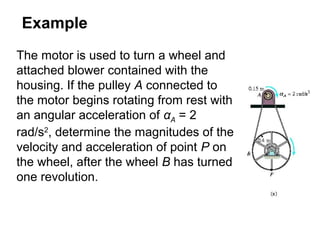
    Example The motor isused to turn a wheel and attached blower contained with the housing. If the pulley A connected to the motor begins rotating from rest with an angular acceleration of αA = 2 rad/s2 , determine the magnitudes of the velocity and acceleration of point P on the wheel, after the wheel B has turned one revolution.
  • 37.
    Angular Motion. Convertingrevolution to radians, radB 283.6=θ Since the belt does not slip, an equivalent length of belt s must be unraveled from both the pulley and wheel at all times. Thus, rad rrs A ABBAA 76.16 )4.0(283.6)15.0(; = === θ θθθ
  • 38.
    Since αA isconstant, the angular velocity of pulley A is therefore sradA A c /188.8 )076.16)(2(20 )(2 2 0 2 0 2 = −+= −+= ω ω θθαωω+
  • 39.
    The belt hasthe same speed and tangential component of acceleration as it passes over the pulley and wheel. Thus, 2 /750.0 /070.3 sradrra sradrrv BBBAAt BBBAA =⇒== =⇒== ααα ωωω
  • 40.
    Motion of P.As shown in the diagram, we have, 222 22 2 /78.3)77.3()3.0( /77.3)( /3.0)( /23.1 sma smra smra smrv P BBnP BBtP BBP =+= == == == ω α ω Thus,
  • 41.
    Absolute Motion Analysis •A body subjected to general plane motion undergoes a simultaneous translation and rotation. • One way to define these motions is to use a rectilinear position coordinate s to locate the point along its path and an angular position coordinate θ to specify the orientation of the line. • By direct application of the time-differential equations v = ds/dt, a = dv/dt, ω = dθ/dt, α = dω/dt, the motion of the point and the angular motion of the line can be related.
  • 42.
    Position Coordinate Equation. •Locate point P using a position coordinate s, which is measured from a fixed origin and is directed along the straight-line path of motion of point P. • Measure from a fixed reference line the angular position θ of a line lying in the body. • From the dimensions of the body, relate s to θ, s = f(θ), using geometry and/or trigonometry.
  • 43.
    Position Coordinate Equation. •Take the first derivative of s = f(θ) w.r.t time to get a relationship between v and ω. • Take the second derivative to get a relationship between a and α. • In each case the chain rule of calculus must be used when taking the derivatives of the position coordinate equation.
  • 44.
    Example The end ofrod R maintains contact with the cam by means of a spring. If the cam rotates about an axis through point O with an angular acceleration α and angular velocity ω, determine the velocity and acceleration of the rod when the cam is in the arbitrary position θ.
  • 45.
    Position Coordinate Equation.Coordinates θ and x are chosen in order to relate the rotational motion of the line segment OA on the cam to the rectilinear motion of the rod. These coordinates are measured from the fixed point O and may be related to each other using trigonometry. Since OC = CB = r cos θ, θcos2rx =
  • 46.
    Time Derivatives. Usingchain rule of calculus, we have, )cossin(2 )(cos2sin2 sin2 )(sin2 2 θωθα θ θωθ ω θω θ θ +−= −     −= −= −= ra dt d r dt d r dt dv rv dt d r dt dx
  • 47.
    Example At a giveninstant, the cylinder of radius r, has an angular velocity ω and angular acceleration α. Determine the velocity and acceleration of its center G if the cylinder rolls without slipping.
  • 48.
    Position Coordinate Equation.By inspection, point G moves horizontally to the left from G to G’ as the cylinder rolls. Its new location G’ will be specified by the horizontal position coordinate sG, which is measured from the original position (G) of the cylinder’s center. As the cylinder rolls, points on its surface contact the ground such that the arc length A’B of contact must be equal to the distant sG.
  • 49.
    Consequently, the motionrequires the radial line GA to rotate θ to position G’A’. Since the arc A’B = rθ, then G travels a distance θrsG = Time Derivatives. Taking successive time derivatives of this equation, realizing that r is constant, ω = dθ/dt, and α = dω/dt, gives the necessary relationships: αωθ rarvrs GGG ===
  • 50.
    Example The large windowis opened using a hydraulic cylinder AB. If the cylinder extends at a constant rate of 0.5 m/s, determine the angular velocity and angular acceleration of the window at the instant θ = 30°
  • 51.
    Position Coordinate Equation.The angular motion of the window can be obtained using the coordinate θ, whereas the extension or motion along the hydraulic cylinder is defined using a coordinate s, which measures the length from the fixed point A to moving point B. These coordinates can be related using the law of cosines, namely, θ θ cos45 cos)1)(2(2)1()2( 2 222 −= −+= s s (1)
  • 52.
    When θ =30°, ms 239.1= Time Derivatives. Taking the time derivatives of Eq. 1, srad vs dt d st ds s s /620.0 )(sin2)( )sin(402 = = −−= ω ωθ θ θ Since vs = 0.5 m/s, then at θ = 30° (2)
  • 53.
    Taking the timederivatives of Eq. 2 yields, 2 22 22 /415.0 30sin2)620.0(30cos20)5.0( )(sin2)(cos2 )(sin2)(cos2 srad sav dt d dt d dt dv sv dt ds ss s s −= +=+ +=+ +=+ α α αθωθ ω θω θ θ  Since as = dvs/dt = 0, then
  • 54.
    Relative–Motion Analysis: Velocity •The general plane motion of a rigid body can be described as a combination of translation and rotation. • To view these “component” motions separately, we use a relative-motion analysis involving two sets of coordinate axes. • The x, y coordinate system is fixed and measures the absolute position of two points A and B on the body.
  • 55.
    • The originof the x’, y’ coordinate system will be attached to the selected “base point” A, which generally has a known motion. • The axes of this coordinate system do not rotate with the body; rather they will only be allowed to translate with respect to the fixed frame. Relative–Motion Analysis: Velocity
  • 56.
    Position. • The positionvector rA specifies the location of the “base point” A, and the relative-position vector rB/A locates point B with respect to point A. • By vector addition, the position of B is ABAB /rrr += Relative–Motion Analysis: Velocity
  • 57.
    Displacement. • During aninstant of time dt, point A and B undergo displacements drA and drB. • If we consider the general plane motion by its component parts then the entire body first translates by an amount drA so that A, the base point, moves to its final position and point B to B’. Relative–Motion Analysis: Velocity
  • 58.
    • The bodyis then rotated about A by an amount dθ so that B’ undergoes a relative displacement drB/A and thus moves to its final position B. Relative–Motion Analysis: Velocity
  • 59.
    • Due tothe rotation about A, drB/A = rB/A dθ, and the displacement of B is ABAB ddd /rrr += due to rotation about A due to translation about A due to translation and rotation Relative–Motion Analysis: Velocity
  • 60.
    Velocity. • To determinethe relationship between the velocities of points A and B, it is necessary to take the time derivative of the position equation, or simply divide the displacement equation by dt. This yields, dt d dt d dt d ABAB /rrr += Relative–Motion Analysis: Velocity
  • 61.
    • The termsdrB/dt = vB and drA/dt = vA are measured from the fixed x, y axes and represent the absolute velocities of points A and B, respectively. • The body appears to move as if it were rotating with an angular velocity ω about the z’ axis passing through A Relative–Motion Analysis: Velocity
  • 62.
    • vB/A hasa magnitude of vB/A = ωrB/A and a direction which is perpendicular to rB/A. ABAB /vvv += Relative–Motion Analysis: Velocity
  • 63.
    • The velocityof B is determined by considering the entire body to translate with a velocity of vA, and rotate about A with an angular velocity ω. • Vector addition of these two effects, applied to B, yields vB. • The relative velocity vB/A represents the effect of circular motion, about A. It can be expressed by the cross product ABAB // rv ×= ω Relative–Motion Analysis: Velocity
  • 64.
    ABAB /rvv ×+=ω • Hence, Relative–Motion Analysis: Velocity
  • 65.
    PROCEDURE FOR ANALYSIS VECTORANALYSIS Kinematics Diagram. • Establish the directions of the fixed x, y coordinates and draw a kinematics diagram of the body. Indicate on it the velocities vA, vB of points A and B, the angular velocity ω, and the relative- position vector rB/A • If the magnitudes of vA, vB or ω are unknown, the sense of the direction of these vectors may be assumed.
  • 66.
    Velocity Equation. • Toapply vB = vA + ω x rB/A, express the vectors in Cartesian vector form and substitute them into the equation. Evaluate the cross product and then equate the respectively i and j components to obtain two equations. • If the solution yields a negative answer for an unknown magnitude, it indicates the sense of direction of the vector is opposite to that shown on the kinematics diagram. PROCEDURE FOR ANALYSIS
  • 67.
    SCALAR ANALYSIS Kinematics Diagram. •If the velocity equation is to be applied in scalar form, then the magnitude and direction of the relative velocity vB/A must be established. • Draw a kinematics diagram, which shows the relative motion. Since the body is considered to be “pinned” momentarily at the base point A, the magnitude is vB/A = ωrB/A. PROCEDURE FOR ANALYSIS
  • 68.
    • The senseof the direction of vB/A is established from the diagram, such that vB/A acts perpendicular to rB/A in accordance with the rotational motion ω of the body. Velocity Equation. • Write in symbolic form, and underneath each of the terms represent the vectors graphically by showing their magnitudes and directions. The scalar equations are determined from the x and y components of these vectors. ABAB /vvv += PROCEDURE FOR ANALYSIS
  • 69.
    Example The link isguided by two block A and B, which move in the fixed slots. If the velocity of A is 2 m/s downward, determine the velocity of B at the instant θ = 45°.
  • 70.
    Solution (Vector Analysis) KinematicDiagram. • Since points A and B are restricted to move along the fixed slots and vA is directed downward, the velocity vB must be directed horizontally to the right.
  • 71.
    • This motioncauses the link to rotate CCW; by right-hand-rule the angular velocity ω is directed outward, perpendicular to the plane of plane. • Knowing the magnitude and direction of vA and the lines of action of vB and ω, it is possible to apply the velocity equation to points A and B in order to solve for the two unknown magnitudes vB and ω. ABAB /vvv +=
  • 72.
    Velocity Equation. ijji jikji rvv   45cos2.045sin2.02 )]45cos2.045sin2.0([2 / ωω ω ω ++−= −×+−= ×+= B B ABAB v v Equating thei and j components gives →= = +−== smv srad v B B /2 /1.14 45sin2.02045cos2.0 ω ωω  
  • 73.
    Example The cylinder rollswithout slipping on the surface of a conveyor belt which is moving at 2 m/s. Determine the velocity of point A. The cylinder has a clockwise angular velocity ω = 15 rad/s at the instant.
  • 74.
    Solution (Vector Analysis) KinematicsDiagram. • Since no slipping occurs, point B on the cylinder has the same velocity as the conveyor. • The angular velocity of the cylinder is known, so we can apply the velocity equation to B, the base point, and A to determine vA.
  • 75.
  • 76.
  • 77.
    Example The collar Cis moving downward with a velocity of 2 m/s. Determine the angular velocities of CB and AB at this instant.
  • 78.
    Solution (Vector Analysis) KinematicsDiagram. • The downward motion of C causes B to move to the right. • CB and AB rotate counterclockwise, to solve, we will write the appropriate kinematics equation for each link.
  • 79.
    Velocity Equation. Link CB(general plane motion): →= = +−= = ++−= −×+−= ×+= smv srad v v v B CB CB CBB CBCBB CBB CBCBCB /2 /10 2.020 2.0 2.02.02 )2.02.0(2 / ω ω ω ωω ω ω ijji jikji rvv
  • 80.
    Link AB (rotationabout a fixed axis): sradAB AB AB BABB /10 2.02 )2.0(2 = = −×= ×= ω ω ω ω jki rv Same results can be obtained using Scalar Analysis.
  • 81.
    Example The bar ABof the linkage has a clockwise angular velocity of 30 rad/s when θ = 60°. Determine the angular velocities of member BC and the wheel at this instant.
  • 82.
    Solution (Vector Analysis) KinematicsDiagram. • the velocities of point B and C are defined by the rotation of link AB and the wheel about their fixed axes
  • 83.
    Velocity Equation. Link AB(rotation about fixed axis): sm BABB /}0.320.5{ )60sin2.060cos2.0()30( ji jik rv −= +×−= ×=  ω
  • 84.
    Link BC (generalplane motion): srad smv v v BC BC C BCC BCC BCBCBC /15 0.32.00 /20.5 )0.32.0(20.5 )2.0()(0.320.5 / = −= = −+= ×+−= ×+= ω ω ω ω ω jii ikjii rvv
  • 85.
    Wheel (general planemotion): sradD D D CDC /52 1.020.5 )1.0()(20.5 = = −×= ×= ω ω ω ω jki rv
  • 86.
    Instantaneous Center ofZero Velocity • The velocity of any point B located on a rigid body can be obtained in a very direct way if one choose the base point A to be a point that has zero velocity at the instant considered. • Since vA = 0, therefore vB = ω x rB/A. • Point A is called the instantaneous center of zero velocity (IC) and it lies on the instantaneous axis of zero velocity.
  • 87.
    • This axisis always perpendicular to the planre of motion and the intersection of the axis with this plane defines the location of the IC. • Since point A is coincident with the IC, then vB = ω x rB/A and so point B moves momentarily anout the IC in a circular path. • The magnitude of vB is vB = ωrB/IC. • Due to the circular motion, the direction of vB must always be perpendicular to rB/IC Instantaneous Center of Zero Velocity
  • 88.
    • Consider thewheel as shown, if it rolls without slipping, then the point of contact with the ground has zero velocity. • Hence this point represents the IC for the wheel. Instantaneous Center of Zero Velocity
  • 89.
    • If itis imagined that the wheel is momentarily pinned at this point, the velocities of points B, C, O and so on, can be found using v = ωr. • The radial distance rB/IC, rC/IC and rO/IC must be determined from the geometry of the wheel. Location of the IC. To locate the IC, we use the fact that the velocity of a point on the body is always perpendicular to the relative-position vector extending from the IC to the point. Several possibilities exist: Instantaneous Center of Zero Velocity
  • 90.
    • Given thevelocity vA of a point A on the body, and the angular velocity ω of the body. In this case, the IC is located along the line drawn perpendicular to vA at A, such that the distance from A to the IC is rA/IC = vA/ω. Note that the IC lies up to the right of A since vA must cause a clockwise angular velocity ω about the IC. Instantaneous Center of Zero Velocity
  • 91.
    • Given theline of action of two nonparallel velocities vA and vB. Construct at points A and B line segments that are perpendicular to vA and vB. Extending these perpendicular to their point of intersection as shown locates the IC at the instant considered. Instantaneous Center of Zero Velocity
  • 92.
    • Given themagnitude and direction of two parallel velocities vA and vB. Here the location of the IC is determined by proportional triangles. Instantaneous Center of Zero Velocity
  • 93.
    In both casesrA/IC = vA/ω and rB/IC = vB/ω. If d is a known distance between point A and B, then rA/IC + rB/IC = d for first diagram, and rB/IC - rA/IC = d for second diagram. As a special case, note that if the body is translating, vA = vB, then the IC would be located at infinity, in which case rA/IC = rB/IC → ∞. This being the case, ω = (vA/rA/IC) = (vA/rA/IC) → 0, as expected. Instantaneous Center of Zero Velocity
  • 94.
    Note: • the pointchosen as the instantaneous center of zero velocity for the body can only be used for an instant of time since the body changes its position from one instant to the next. • The locus of points which define the location of the IC during the body’s motion is called a centrode, and so each point on the centrode acts as the IC for the body only for an instant. Instantaneous Center of Zero Velocity
  • 95.
    • Although theIC may be used to determine the velocity of any point in a body, it generally does not have zero acceleration and therefore it should not be used for finding the accelerations of points on a body Instantaneous Center of Zero Velocity
  • 96.
    PROCEDURE FOR ANALYSIS Thevelocity of a point on a body which is subjected to general plane ,motion can be determined with reference to its instantaneous center of zero velocity provided the location of IC is first established using one of the three methods described in previous segment. • As shown in the diagram, the body is imagined as “extended and pinned” at the IC such that, at the instant considered, it rotates about this pin with its angular velocity ω.
  • 97.
    • The magnitudeof velocity for each of the arbitrary points A, B and C on the body can be determined by using the equation v = ωr, where r is the radial distance from the IC to each point. • The line of action of each velocity vector v is perpendicular to its associated radial line r, and the velocity has a sense of direction which tends to move the point in a manner consistent with the angular rotation ω of the radial line. PROCEDURE FOR ANALYSIS
  • 98.
    Example Show how todetermine the location of the instantaneous center of zero velocity for (a) member BC shown in (a); and (b) the link CB shown in (b).
  • 99.
    Solution Part (a). • PointB has a velocity vB, which is caused by the clockwise rotation of link AB. •Point B moves in a circular path such that vB is perpendicular to AB, and so it acts at an angle θ from the horizontal as shown.
  • 100.
    • The motionof point B causes the piston to move forward horizontally with a velocity vC • When the line are drawn perpendicular to vB and vC, the intersect at the IC. Part (b). • Points B and C follow circular paths of motion since rods AB and DC are each subjected to rotation about a fixed axis.
  • 101.
    • Since thevelocity is always tangent to the path, at the instant considered, vC on rod DC and vB on rod AB are both directed vertically downward, along the axis of link CB. • Radial lines drawn perpendicular to these two velocities form parallel lines which intersect at “infinity”. 0)/( / // →== ∞→∞→ ICCCCB ICBICC rv rr ω
  • 102.
    • As aresult, rod CB momentarily translates. • At an instant later, however, CB will move to a tilted position, causing the instantaneous center to move to some finite location.
  • 103.
    Example Block D moveswith a speed of 3 m/s. Determine the angular velocities of links BD and AB, at the instant shown.
  • 104.
    Solution • As Dmoves to the right, it causes arm AB to rotate clockwise about point A. Hence vB is directed perpendicular to AB. • The instantaneous center of zero velocity for BD is located at the intersection of the line segments drawn perpendicular to vB and vD
  • 105.
    From the geometry, mr mr ICD ICB 566.0 45cos 4.0 4.045tan4.0 / / == ==   Sincethe magnitude of vD is known, the angular velocity of link BD is srad r v ICD D BD /30.5 566.0 3 / ===ω
  • 106.
    The velocity ofB is therefore smrv ICBBDB /12.2)4.0(30.5)( / === ω From the figure, the angular velocity of AB is srad r v AB B AB /30.5 4.0 12.2 / ===ω 45°
  • 107.
    Example The cylinder rollswithout slipping between the two moving plates E and D. Determine the angular velocity of the cylinder and the velocity of its center C at the instant shown.
  • 108.
    Solution • Since noslipping occurs, the contact points A and B on the cylinder have the same velocities as the plate E and D, respectively. • The velocities vA and vB are parallel, so that by the proportionally of the right triangles the IC is located at a point on line AB.
  • 109.
    Assuming this pointto be a distance x form B, we have )25.0(25.0);25.0( 4.0; xxv xxv A B −=−= == ωω ωω Dividing one equation into the other eliminates ω and yields mx xx 154.0 65.0 1.0 25.0)25.0(4.0 == =−
  • 110.
    Hence the angularvelocity of the cylinder is srad x vB /60.2 154.0 4.0 ===ω The velocity of point C is therefore ←= −== sm rv ICCC /0750.0 )125.0154.0(6.2/ω
  • 111.
    Relative-Motion Analysis: Acceleration •An equation that relates the accelerations of two points on a rigid body subjected to general plane motion, dt d dt d dt d ABAB /vvv += • The terms dvB/dt = aB and dvA/dt = aA are measured from a set of fixed x, y axes and represent the absolute accelerations of points B and A.
  • 112.
    • The lastterm represents the acceleration of B w.r.t A as measured by an observer fixed to translating x’, y’ axes which have their origin at the base point A. • To this observer, point B appears to move along a circular arc that has a radius of curvature rB/A. • aB/A can be expressed in terms of its tangential and normal components of motion nABtABAB )()( // aaaa ++= Relative-Motion Analysis: Acceleration
  • 113.
  • 114.
    • Since pointsA and B move along curved paths, the accelerations of these points will have both tangential and normal components. • The relative-acceleration components represent the effect of circular motion observed from translating axes having their origin at the base point A, and can be expressed as (aB/A)t = α x rB/A and (aB/A)n = -ω2 rB/A ABABAB / 2 / rraa ωα −×+= Relative-Motion Analysis: Acceleration
  • 115.
    PROCEDURE FOR ANALYSIS VelocityAnalysis. • Determine the angular velocity ω of the body by using a velocity analysis as discuss in previous section. Also determine the velocities vA and vB of points A and B if these points moves along curved paths.
  • 116.
    VECTOR ANALYSIS Kinematics Diagram. •Establish the directions of the fixed x, y coordinates and draw the kinematics diagram of the body. Indicate on it aA, aB, ω, α, rB/A. • If points A and B move along curved paths, then their accelerations should be indicated in terms of their tangential and normal components. PROCEDURE FOR ANALYSIS
  • 117.
    Acceleration Equation. • Toapply aB = aA + α x rB/A – ω2 rB/A express the vectors in Cartesian vector form and substitutide them into the equation. Evaluate the cross product and then equate the respective i and j components to obtain two scalar equations. • If the solution yields a negative answer for an unknown magnitude, it indicates that the sense of direction of the vector is opposite to that shown on the kinematics diagram. PROCEDURE FOR ANALYSIS
  • 118.
    SCALAR ANALYSIS Kinematics Diagram. •If the equation is applied, then the magnitudes and directions of the relative-acceleration components (aB/A)t and (aB/A)n must be established. • To do this, draw a kinematic diagram. nABtABAB )()( // aaaa ++= PROCEDURE FOR ANALYSIS
  • 119.
    • Since thebody is considered to be momentarily “pinned” at the base point A, the magnitudes are (aB/A)t = αrB/A and (aB/A)n = ω2 rB/A. • Their sense of direction is established from the diagram such that (aB/A)t acts perpendicular to rB/A, in accordance with the rotational motion α of the body, and (aB/A)n is directed from B towards A. PROCEDURE FOR ANALYSIS
  • 120.
    Acceleration Equation. • Representthe vectors in graphically by showing their magnitudes and directions underneath each term. The scalar equations are determined from the x and y components of these vectors. nABtABAB )()( // aaaa ++= PROCEDURE FOR ANALYSIS
  • 121.
    Example The rod ABis confined to move along the inclined planes at A and B. If point A has an acceleration of 3 m/s2 and a velocity of 2 m/s, both directed down the plane at the instant the rod becomes horizontal, determine the angular acceleration of the rod at this instant.
  • 122.
    Solution (Vector Analysis) •We can obtain ω = 0.283 rad/s using either the velocity equation or the method of instantaneous centers. Kinematic Diagram. Since points A and B both move along straight-line paths, they have no components of acceleration normal to the paths. There are two unknowns, aB and α.
  • 123.
    Acceleration Equation. )10()238.0()10()( 45cos345sin45cos 2 / 2 / iik jji rraa −× +=+ −×+= α ωα  BB ABABAB aa Carrying outthe cross product and equating the i and j components yields )10(45sin345sin )10()283.0(45cos345cos 2 α+−= −=   B B a a
  • 124.
  • 125.
    Example At a giveninstant, the cylinder of radius r has an angular velocity ω and angular acceleration α. Determine the velocity and acceleration of its center G if it rolls without slipping.
  • 126.
    Solution (Vector Analysis) •As the cylinder rolls, point G moves along a straight line, and point A, located on the rim of the cylinder, moves along a curved path called a cycloid. • We will apply the velocity and acceleration equations to these two points.
  • 127.
    Velocity Analysis. Sinceno slipping occurs, at the instant A contacts the ground, vA = 0. Thus, from the kinematic diagram, rv rv G G AGAG ω ω ω = ×−+= ×+= )()( / jk0i rvv Note the same result can also be obtained directly by noting that point A represents the instantaneous center of zero velocity
  • 128.
    Kinematic Diagram. • Theacceleration of point G is horizontal since it moves along a straight-line path. • Just before point A touches the ground, its velocity is directly downward along the y axis, just after contact, its velocity is directed upward. • Therefore, point A begins to accelerate upward when it leaves the ground at A. • The magnitudes of aA and aG are unknown.
  • 129.
    Acceleration Equation. )()()( 2 / 2 / jjkji rraa rraaAG AGAGAG ωα ωα −×−+=+ −×+= Evaluating the cross product and equating the i and j components yields ra ra A G 2 ω α = =
  • 130.
    Example The ball rollswithout slipping and has the angular motion shown in figure. Determine the acceleration of point B and point A at this instant.
  • 131.
    Solution (Vector Analysis) KinematicDiagram. Using the results of the previous example, the center of the ball has an acceleration of aO = αr = (4)(0.15) = 0.6 m/s2 . We apply the acceleration equation to points O and B and points O and A.
  • 132.
    Acceleration Equation. For pointB, 2 2 / 2 / /}6.06{ )15.0()6()15.0()4(6.0 smB B OBOBOB jia iikia rraa +−= −×+−= −×+= ωα
  • 133.
  • 134.
    Example The spool unravelsfrom the cord, such that at the instant shown it has an angular velocity of 3 rad/s and an angular acceleration of 4 rad/s2 . Determine the acceleration of point B.
  • 135.
    Solution (Vector Analysis) •The spool “appear” to be rolling downward without slipping at point A. The acceleration of point G is aG = αr = (4)(0.15) = 0.6 m/s2 . Kinematic Diagram. Point B moves along a curved path having an unknown radius of curvature. Its acceleration will be represented by its unknown x and y components as shown.
  • 136.
    Acceleration Equation. )225()3()225()4(600)()( 2 / 2 / jjkjji rraa −×−+−=+ −×+= yBxB GBGBGB aa ωα Equatingthe i and j terms, the component equations are ↓−=−=−−= →=== 22 22 /625.2/26252025600)( /9.0/900)225(4)( smsmma smsmma yB xB
  • 137.
    The magnitude anddirection of aB are therefore  1.71 9.0 625.2 tan /775.2)625.2()9.0( 1 222 == =+= − θ smaB θ
  • 138.
    Example The collar ismoving downward with an acceleration of 1 m/s2 . At the instant shown, it has a speed of 2 m/s which gives links CB and AB an angular velocity ωAB = ωCB = 10 rad/s. Determine the angular accelerations of CB and AB at this instant.
  • 139.
    Solution (Vector Analysis) •The kinematic diagrams of both links AB and CD are as shown. To solve, we will apply the appropriate kinematic equation to each link.
  • 140.
    Acceleration Equation. Link AB(rotation about to a fixed axis): jia jjka rra 202.0 )2.0()10()2.0()( 2 2 += −−−×= −×= ABB ABB BABBABB α α ωα Note that aB has two components since it moves along a curved path.
  • 141.
    Link BC (generalplane motion): jiijjji ji jikjji rraa 20202.02.01202.0 )2.02.0()10( )2.02.0()(1202.0 2 / 2 / −−++−=+ −− −×+−=+ −×+= CBCBAB CBAB CBCBCBCBCB ααα αα ωα Thus, 202.0120 202.02.0 ++−= −= CB CBAB α αα
  • 142.
  • 143.
    Example The crankshaft ABof an engine turns with a clockwise angular acceleration of 20 rad/s2 . Determine the acceleration of the piston at this instant AB is in the shown. At this instant ωAB = 10 rad/s and ωBC = 2.43 rad/s.
  • 144.
    Solution (Vector Analysis) KinematicDiagram. The kinematic diagrams of both AB and BC are as shown. Here aC is vertical since C moves along a straight-line path.
  • 145.
  • 146.
    Crankshaft AB (rotationalabout a fixed axis): 2 2 2 /}14.1421.21{ )177.0177.0()10()177.0177.0()20( sm BABBABB ji jijik rra −= +−−+−×−= −×= ωα
  • 147.
    Connecting Rod BC(general plane motion): 45.18176.0 729.017.200 )729.0176.0()43.2()729.0176.0( )(14.1421.21 2 / 2 / −= −= +−+× +−= −×+= BCC BC CBC BCBCBCBCBC a a α α α ωα jiji kjij rraa Solving yields 2 2 /6.13 /7.27 sma srad C BC −= =α
  • 148.
    • Translating coordinatesystem  describes relative motion analysis for velocity and acceleration  determines the motion of the points on the same rigid body  determines the motion of points located on several pin-connected rigid bodies • Rigid bodies are constructed such that sliding occur at their connections Relative-Motion Analysis Using Rotating Axes
  • 149.
    • Coordinate system Use for kinematics analysis  use for analyzing motion of two points on a mechanism which are not located in the same rigid body  use for specifying kinematics of particle motion when the particle is moving along a rotating path Relative-Motion Analysis Using Rotating Axes
  • 150.
    • In thefollowing analysis, 2 equations are developed to relate the velocity and acceleration of 2 points, one of which is the origin of a moving frame of reference subjected to both a translation and rotation in the plane • The 2 points can represent either 2 points moving independently of one another or 2 points located on the same (or different rigid bodies) Relative-Motion Analysis Using Rotating Axes
  • 151.
    Position • Consider 2points A and B, whose location are specified by rA and rB, measured from the fixed X, Y, Z coordinate system Relative-Motion Analysis Using Rotating Axes
  • 152.
    • Base pointA represent the origin of the x, y, z coordinate system assumed to be both translating and rotating with respect to X, Y and Z system • Position of B with respect to A is specified by the relative position vector rB/A • Components of this vector can either be expressed in unit vectors along the X, Y axes i.e. I, J or by unit vectors along the x, y axes i.e. i and j Relative-Motion Analysis Using Rotating Axes
  • 153.
    • For developedrB/A will be measured relative to the moving x, y frame of reference • If B has coordinates (xB, yB) jir BBAB yx +=/ • Using vector addition, ABAB /rrr += Relative-Motion Analysis Using Rotating Axes
  • 154.
    • At theinstant considered, point A has a velocity vA and an acceleration aA, while angular velocity and angular acceleration of the x, y and z axes are Ω and respectively • All these vectors are measured from the X, Y and Z axes of reference although they may be expressed in terms of either I, J and K or i, j or k components dtd /Ω=Ω Relative-Motion Analysis Using Rotating Axes
  • 155.
    • Since planarmotion is specified, by the right hand rule, and are always directed perpendicular to the reference plane of motion whereas vA and aA lie on this plane Velocity • For velocity of point B, Ω Ω dt d AB AB /r vv += Relative-Motion Analysis Using Rotating Axes
  • 156.
    • The lastterm of this equation is evaluated as       ++      += +++= += dt d y dt d x dt dy dt dx dt d y dt dy dt d x dt dx yx dt d dt d BB BB B B B B BB AB ji ji j j i i ji r )(/ Relative-Motion Analysis Using Rotating Axes
  • 157.
    • The twoterms in the first set of parentheses represent the components of velocity of point B as measured by an observer attached to the moving x, y and z coordinate system, being denoted by vector (vB/A)xyz • In the second set of parentheses, the instantaneous time rate of change of unit vectors i and j is measured by an observer located in a fixed X, Y and Z system Relative-Motion Analysis Using Rotating Axes
  • 158.
    • These changesdi and dj are due to only an instantaneous rotation dθ of the x, y and z axes, causing i to become i’ = i + di and j to become j’ = j + dj • Magnitudes of both di and dj = 1 (dθ) since i = i’ = j = j’ =1 • The direction of di is defined by +j since di is tangent to the path described by the arrowhead of i in the limit as Δt →dt Relative-Motion Analysis Using Rotating Axes
  • 159.
    • Likewise, djacts in the –i direction, hence ii j jj i Ω−=−=Ω== )()( dt d dt d dt d dt d θθ • Viewing the axes in 3D, noting that Ω = Ωk, j j i i ×Ω=×Ω= dt d dt d Relative-Motion Analysis Using Rotating Axes
  • 160.
    • Using thederivative property of the vector cross product ABxyzABBBxyzAB AB yx dt d /// / )()()( rvjiv r ×Ω+=+×Ω+= • Hence xyzABABAB )( // vrvv +×Ω+= Relative-Motion Analysis Using Rotating Axes
  • 161.
    Acceleration • Acceleration ofB, observed from the X, Y and Z coordinate system, may be expressed in terms of its motion measured with respect to the rotating or moving system of coordinates by taking the time derivative dt d dt d xyzABAB ABAB )( // / vr raa +×Ω+×Ω+=  Relative-Motion Analysis Using Rotating Axes
  • 162.
    • Here isthe angular acceleration of the x, y, z coordinate system • For planar motion, Ω is always perpendicular to the plane of motion and therefore measures only the change in the magnitude of Ω • For the derivative of drB/A/dt, dtd /Ω=Ω Ω )()( // / ABxyzAB AB dt d rv r ×Ω×Ω+×Ω=×Ω Relative-Motion Analysis Using Rotating Axes
  • 163.
    • Finding thetime derivative of (vB/A)xyz = (vB/A)xi + (vB/A)yj     ++       += dt d dt d dt d dt d dt d yABxAB yABxABxyzAB j v i v j v i vv )()( )()()( // /// Relative-Motion Analysis Using Rotating Axes
  • 164.
    • The firsttwo terms in the first set of brackets represent the components of acceleration of point B as measured by an observer attached to the moving coordinate system, as denoted by (aB/A)xyz xyzABxyzAB xyzAB dt d )()( )( // / va v ×Ω+= • The terms in the second bracket can be simplified by Relative-Motion Analysis Using Rotating Axes
  • 165.
    xyzABxyzAB ABABAB )()(2 )( // // av rraa +×Ω+ ×Ω×Ω+×Ω+=  • Rearrangingterms, • The term 2Ω x (vB/A)xyz is called the Coriolis acceleration, representing the difference in the acceleration of B as measured from the non- rotating and rotating x, y, z axes Relative-Motion Analysis Using Rotating Axes
  • 166.
    • As indicatedby the vector cross-product, the Coriolis acceleration will always be perpendicular to both Ω and (vB/A)xyz Relative-Motion Analysis Using Rotating Axes
  • 167.
    Example At the instantθ = 60°, the rod has an angular velocity of 3 rad/s and an angular acceleration of 2 rad/s2 . At the same instant, the collar C is travelling outward along the rod such that when x = 2 m the velocity is 2 m/s and the acceleration is 3 m/s2 , both measure relative to the rod. Determine the Coriolis acceleration and the velocity and acceleration of the collar at the instant.
  • 168.
    Coordinate Axes. Theorigin of both coordinate systems is located at point O. Since motion of the collar is reported relative to the rod, the moving x, y, z frame of reference is attached to the rod. Kinematic Equations xyzOCxyzOCOCOCOC xyzOCOCOC )()(2)( )( //// // avrraa vrvv +×Ω+×Ω×Ω+×Ω+= +×Ω+= 
  • 169.
    It will besimpler to express the data in terms of i, j, k component vectors rather than I, J, K components. Hence, { } { } { } { } { } srad smsrad sm m xyzOC xyzOCO OCO /2 /3)(/3 /2)(0 2.00 2 / / / k iak iva irv −=Ω =−=Ω == ==  Motion of moving reference Motion of C with respect to moving reference
  • 170.
    Therefore Coriolis accelerationis defined as { } 2 / /12)2()3(2)(2 smxyzOCCor jikva −=×−=×Ω= This vector is shown in figure. If desired, it may be resolved in I, J components acting along the X and Y respectively.
  • 171.
    The velocity andacceleration of the collar are determined by substituting the data in the previous 2 equations and evaluating the cross products, which yields, { } [ ] { } 2 //// // /4.1220.1 3)2()3(2)2.0()3()3()2.0()2(0 )()(2)( /6.02 2)2.0()3(0 )( sm sm xyzOCxyzOCOCOCOC xyzOCOCOC ji iikikkik avrraa ji iik vrvv −= +×−+×−×−+×−+= +×Ω+×Ω×Ω+×Ω+= −= +×−+= +×Ω+= 
  • 172.
    Example The rod AB,shown in Fig. 16–34, rotates clockwise such that it has an angular velocity and angular acceleration when . Determine the angular motion of rod DE at this instant. The collar at C is pin connected to AB and slides over rod DE. sradwAB /3= 2 /4 sradAB =α °= 45θ
  • 173.
    Solution Coordinate Axes. The originof both the fixed and moving frames of reference is located at D, Fig. 16–34. Furthermore, the x, y, z reference is attached to and rotates with rod DE so that the relative motion of the collar is easy to follow. Kinematic Equations. xyzDCxyzDCDCDCOC xyzDCDCOC )()(2)( )( //// // avrraa vrvv +×Ω+×Ω×Ω+×Ω+= +×Ω+=  (1) (2)
  • 174.
    All vectors willbe expressed in terms of i, j, k components. { } k iaak iva irv DE xyzDCxyzDCDE xyzDCxyzDCD DCD w v m α−=Ω =−=Ω == ==  )()( )()(0 4.00 // // / Motion of moving reference Motion of C with respect to moving reference
  • 175.
    Motion of C:Since the collar moves along a circular path, its velocity and acceleration can be determined. { } { } 2 / 2 / / /2.52 /2.12.1 sm sm ACABACAB ACABC iirra jirv C −−=−×= −=×= ωα ω Substituting the data into Eqs. 1 and 2, we have ( ) ( ) ( ) ( ) ( ) srad smv v DE xyzDC xyzDCDE xyzDCDCDC /3 /2.1 4.002.12.1 / / // = = +×−+=− +×Ω+= ω ω iikji vrvv
  • 176.
    ( ) () ( ) ( ) ( ) ( ) ( ) ( )[ ] ( ) ( ) ( ) ( ) 22 2 / / //// /5/5 /6.1 2.132 4.0334.002.52 2 sradsrad sma DE xyzDC xyzDC DE xyzDCxyzDCDCDCDC =−= = +×−+ ×−×−+×−+=−− +×Ω+×Ω×Ω+×Ω+= • α α iaik ikkikji avrraa
  • 177.
    Example Two planes Aand B are flying at the same elevation and have the motions shown in Fig. 16–35. Determine the velocity and acceleration of A as measured by the pilot of B.
  • 178.
    Solution Coordinate Axes. Since therelative motion of A with respect to the pilot in B is being sought, the x, y, z axes are attached to plane B, Fig. 16–35. At the instant considered, the origin B coincides with the origin of the fixed X,Y, Z frame. Kinematic Equations. xyzBAxyzBABABABA xyzBABABA )()(2)( )( //// // avrraa vrvv +×Ω+×Ω×Ω+×Ω+= +×Ω+=  (1) (2)
  • 179.
    Solution Motion of MovingReference: { } ( ) ( ) ( ) { } ( ) 2 2 2 22 /25.0 400 100 /5.1 400 600 /100900 /900 400 600 /600 hrad a hrad v hkmjiaaa hkm v a hkm tB B tBnBB B nB b ===Ω ===Ω −=+=       =      = = • ρ ρ ρ jv
  • 180.
    Rigid-Body Planar Motion •A rigid body undergoes three types of planar motion: translation, rotation about a fixed axis and general plane motion. Translation • When a body has rectilinear translation, all the particles of the body travel along straight-line paths. CHAPTER REVIEW
  • 181.
    If the pathshave the same radius of curvature, then curvilinear translation occurs. Provided we know the motion of one particles, then the motion of all others is also known. CHAPTER REVIEW
  • 182.
    Rotation about aFixed Axis • For this type of motion, all of the particles moves along circular paths • Here, all segments in the body undergo the same angular displacement, angular velocity and angular acceleration. • The differential relationships between these kinematic quantities are ωωθαωαθω dddtddtd === // CHAPTER REVIEW
  • 183.
    • If theangular acceleration is constant, α = αc, then these equations can be integrated and become )(2 2 1 0 2 0 2 2 00 0 θθαωω αωθθ αωω −+= ++= += c c c tt t CHAPTER REVIEW
  • 184.
    • Once theangular motion of the body is known, then the velocity of any particle a distance r from the axis of rotation is • The acceleration of the particle has two components. The tangential component accounts for the change in the magnitude of the velocity rv ×== ωω orrv ra ×== αα tt orra CHAPTER REVIEW
  • 185.
    • The normalcomponent accounts for the change in the velocity direction General Plane Motion • When a body undergoes general plane motion, it simultaneously translates and rotates. • There are several types of methods for analyzing this motion: ra 22 ωω −== nn orra CHAPTER REVIEW
  • 186.
    Absolute Motion Analysis •If the motion of a point on a body or the angular motion of a line is known, then it may possible to relate this motion to that of another point or line using an absolute motion analysis • To do so, linear position coordinates s or angular position coordinates θ are established (measured from a fixed point or line). CHAPTER REVIEW
  • 187.
    • These positioncoordinates are then related using the geometry of the body . • The time derivative of this equation gives the relationship between the velocities and/or the angular velocities • A second time derivative relates the accelerations and/or the angular accelerations. CHAPTER REVIEW
  • 188.
    Relative Velocity Analysis •General plane motion can also be analyzed using a relative-motion analysis between two points A and B. • This method considers the motion in parts; first a translation of the selected base point A, then a relative “rotation” of the body about point A, measured from a translating axis. CHAPTER REVIEW
  • 189.
    • The velocitiesof the teo points A and B are then related using • This equation can be applied in Cartesian vector form, written as ABAB /vvv += ABAB /rvv ×+= ω CHAPTER REVIEW
  • 190.
    • In similarmanner, for acceleration, or • Since the relative motion is viewed as circular motion bout the base point, point B will have a velocity vB/A, that is tangent to the circle. ABABAB nABtABAB / 2 / // )()( rraa aaaa ωα −×+= ++= CHAPTER REVIEW
  • 191.
    • It alsohas two components of acceleration, (aB/A)t, and (aB/A)n. • It is important to also realize that aA and aB may have two components if these points move along curved paths. CHAPTER REVIEW
  • 192.
    Instantaneous Center ofZero Velocity • If the base point A is selected as having zero velocity, then the relative velocity equation becomes • In this case, motion appears as if the body is rotating about an instantaneous axis. ABB /rv ×= ω CHAPTER REVIEW
  • 193.
    • The instantaneouscenter of rotation (IC) can be established provided the directions of the velocities of any two points on the body are known. • Since the radial line r will always be perpendicular to each velocity, then the IC is at the point of intersection of these two radial lines. • Its measured location is determined from the geometry of the body. CHAPTER REVIEW
  • 194.
    • Once itis established, then the velocity of any point P on the body can be determined from v = ωr, where r extends from IC to point P. Relative Motion Using Rotating Axes • Problems that involve connected members that slide relative to one another, or points not located on the same body, can be analysed using a relative motion analysis referenced from a rotating frame. CHAPTER REVIEW
  • 195.
    • The equationsof relative motion are • In particular, the term 2 Ω x (vB/A)xyz is called the Coriolis Acceleration. xyzABABAB )( // vrvv +×Ω+= xyzABxyzAB ABABAB )()(2 )( // // av rraa +×Ω+ ×Ω×Ω+×Ω+=  CHAPTER REVIEW