• Live Webinars (online lectures) with
recordings.
• Online Query Solving
• Online MCQ tests with detailed
solutions
• Online Notes and Solved Exercises
• Career Counseling
3. Thermal stability of hydrides of group 16
This trend can be explained on the basis of bond
energy Δdiss ( M – H ) kJ mol – 1 .
1. The thermal stability decreases in the order
H2O > H2S > H2Se > H2Te.
2. Water dissociates at 2073 – 2273 K while H2S
dissociates only at 873 K. The extra stability of
water is due to hydrogen bonding.
4. Acidic character of hydrides of group 16
M – H bonds present in these hydrides are polar
and dissociates in aqueous solution to produce H+
ions. It combines with
H2O molecule to form
H3O+ ions.
Hence these hydrides
act as acids.
1. The hydrides of group 16 elements are weakly
acidic and behave as weak diprotic acids. In
aqueous medium, they dissociate as
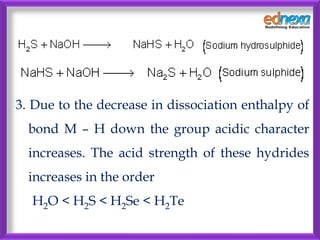
2. The hydrides react with bases to form two types
of salts. For example, H2S reacts with NaOH to
form
2 2 3
2
2 3
H S H O H O HS
HS H O H O S
 
  
 
 
€
€
3. Due to the decrease in dissociation enthalpy of
bond M – H down the group acidic character
increases. The acid strength of these hydrides
increases in the order
H2O < H2S < H2Se < H2Te
5. Reducing character of hydrides of group 16
1. Except H2O, all other hydrides of elements of
group 16 acts as reducing agents.
2. The reducing character depends upon the
thermal stability. Lesser the thermal stability,
greater is the reducing power of the hydride.
Since H2O is very stable. It does not act as
reducing agent.
3. The other hydrides are relatively less stable
and acts as reducing agents. Since the thermal
stability of hydride decreases
on moving down the
group, the reducing power
of hydride increases from
H2S to H2Te.
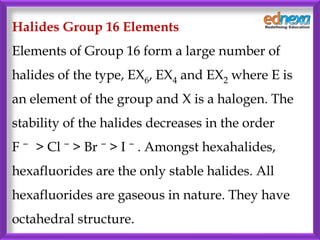
Halides Group 16 Elements
Elements of Group 16 form a large number of
halides of the type, EX6, EX4 and EX2 where E is
an element of the group and X is a halogen. The
stability of the halides decreases in the order
F − > Cl − > Br − > I − . Amongst hexahalides,
hexafluorides are the only stable halides. All
hexafluorides are gaseous in nature. They have
octahedral structure.
1. The compounds of oxygen with fluorine are called
fluorides because fluorine is more electronegative
than oxygen. For example, OF2 is named oxygen
difluoride. Since oxygen is more electronegative
than other halogens ( Cl, Br, I ) the compounds of
chlorine, bromine and iodine with oxygen are
called as halogen oxides. For example, CIO2 is
referred as chlorine dioxide and Cl2O7 as chlorine
heptoxide.
2. Sulphur form monohalides, dihalides,
tetrahalides and hexahalides. Sulphur
hexafluoride SF6 is exceptionally stable for
steric reasons. The central atom S in SF6 has
sp3 d2 hybridization.
3. SF4 is gas, SeF4 is liquid while TeF4 is solid.
These fluorides have sp3 d hybridization and
have trigonal bipyramidal structure in which
one of the equatorial positions is occupied by a
lone pair of electrons. This geometry is also
called see – saw geometry.
4. All elements form dichlorides and dibromides.
These dihalides are formed by sp3
hybridization and have tetrahedral structure.
5. The well known monohalides are dimeric in
nature, for example, S2F2, S2Cl2, S2Br2, Se2Cl2
and Se2Br2. These diametric halides undergo
disproportionation as follows
2 2 42Se Cl SeCl 3Se 
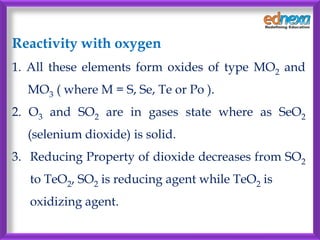
Reactivity with oxygen
1. All these elements form oxides of type MO2 and
MO3 ( where M = S, Se, Te or Po ).
2. O3 and SO2 are in gases state where as SeO2
(selenium dioxide) is solid.
3. Reducing Property of dioxide decreases from SO2
to TeO2, SO2 is reducing agent while TeO2 is
oxidizing agent.
4. Besides MO2 type MO3 type oxides are also
formed by sulphur (SO3), selenium (SeO3) and
tellurium (TeO3).
5. Both MO2 and MO3 type of oxides are acidic in
nature.
Anomalous behavior of oxygen
Oxygen differs considerably from other elements
of group 16 in several properties. The anomalous
behaviour is due to A ] its small size B ] its
high electronegativity C ] the absence of vacant
d – orbitals in valence shell.
Some important points of difference between
oxygen and other elements of group 16 are as
follows.
1. Physical state :
Oxygen is a gas at ordinary temperature while
other members are solids.
2. Atomicity :
Oxygen is diatomic ( O2 ). While molecules of
other elements of group 16 are polyatomic, for
example, sulphur and selenium form octa-atomic
molecules ( S8 and Se8 ) and have puckered ring
structure.
3. Magnetic behaviour :
Molecular oxygen ( O2 ) is paramagnetic while
other elements are diamagnetic
4. Oxidation states :
Oxygen shows an oxidation state of – 2 in most
of its compounds. Due to absence of vacant d
orbitals it cannot exhibit higher oxidation state.
The other elements of the group can exhibit – 2,
+ 2, + 4 and + 6 oxidation states.
5. Hydrogen bonding :
Due to higher value of electronegativity, oxygen is
capable of forming hydrogen bonding in its
compounds like water, alcohols, carboxylic acids etc.
there elements of group being much less
electronegative do not form hydrogen bonds.
6. Nature of compounds :
The compound of oxygen are more ionic than those of
the other elements of the group. Thus O2 – is very
common but S2 –, Se2 – and Te2 – are less common.
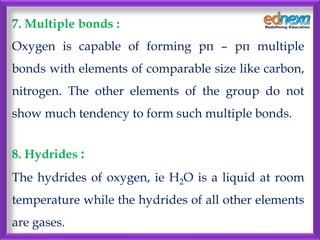
7. Multiple bonds :
Oxygen is capable of forming pπ – pπ multiple
bonds with elements of comparable size like carbon,
nitrogen. The other elements of the group do not
show much tendency to form such multiple bonds.
8. Hydrides :
The hydrides of oxygen, ie H2O is a liquid at room
temperature while the hydrides of all other elements
are gases.
Dioxygen
Oxygen is the most abundant element on the
earth. Oxygen constitutes about 50% by
weight of the earth’s crust. It occurs both in
the free state as well as in the combined state.
In free state, oxygen occurs to an extent of
23.2% by weight ( or 21% by volume ) in
atmospheric air.
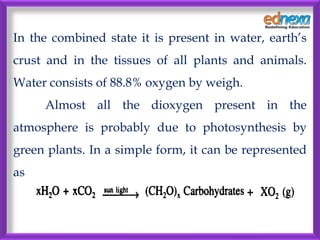
In the combined state it is present in water, earth’s
crust and in the tissues of all plants and animals.
Water consists of 88.8% oxygen by weigh.
Almost all the dioxygen present in the
atmosphere is probably due to photosynthesis by
green plants. In a simple form, it can be represented
as
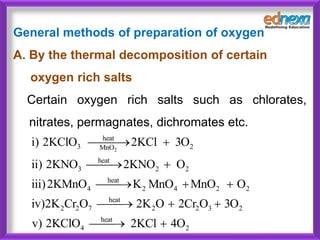
General methods of preparation of oxygen
A. By the thermal decomposition of certain
oxygen rich salts
Certain oxygen rich salts such as chlorates,
nitrates, permagnates, dichromates etc.
2
heat
3 2MnO
heat
3 2 2
heat
4 2 4 2 2
heat
2 2 7 2 2 3 2
heat
4 2
i) 2KClO 2KCl 3O
ii) 2KNO 2KNO O
iii)2KMnO K MnO MnO O
iv)2K Cr O 2K O 2Cr O 3O
v) 2KClO 2KCl 4O
 
 
  
  
 
B. By the thermal decomposition of certain
metallic oxides
The oxides of metals like Hg, Ag, Au, Pb etc.
decompose on heating and give dioxygen.
C. By the action of water
Dioxygen can be prepared by treating sodium
peroxide or acidified potassium permanganate
with water.
2 2 2 2
4 2 2 2 4 2 4 4 2 2
2Na O 2H O 4NaOH O
2KMnO 5Na O 8H So K SO 2MnSo 8H O 5O
  
     
D. Laboratory method
In the laboratory dioxygen can be prepared
very conveniently by heating a mixture of
KCIO3 (4 parts) and MnO2 ( 1 part ) in a
hard glass tube to about 420 K. Oxygen gas
is be collected by downward displacement
of water.
MnO2 acts as catalyst. In the absence of
manganese dioxide, the thermal
decomposition of KClO3 requires
temperature of 670 K – 720 K.MnO2 lowers
it to about 420K.

12th Chemistry P-block elements Notes for JEE Main 2015

  • 1.
    • Live Webinars(online lectures) with recordings. • Online Query Solving • Online MCQ tests with detailed solutions • Online Notes and Solved Exercises • Career Counseling
  • 2.
    3. Thermal stabilityof hydrides of group 16 This trend can be explained on the basis of bond energy Δdiss ( M – H ) kJ mol – 1 . 1. The thermal stability decreases in the order H2O > H2S > H2Se > H2Te. 2. Water dissociates at 2073 – 2273 K while H2S dissociates only at 873 K. The extra stability of water is due to hydrogen bonding.
  • 3.
    4. Acidic characterof hydrides of group 16 M – H bonds present in these hydrides are polar and dissociates in aqueous solution to produce H+ ions. It combines with H2O molecule to form H3O+ ions. Hence these hydrides act as acids.
  • 4.
    1. The hydridesof group 16 elements are weakly acidic and behave as weak diprotic acids. In aqueous medium, they dissociate as 2. The hydrides react with bases to form two types of salts. For example, H2S reacts with NaOH to form 2 2 3 2 2 3 H S H O H O HS HS H O H O S          € €
  • 5.
    3. Due tothe decrease in dissociation enthalpy of bond M – H down the group acidic character increases. The acid strength of these hydrides increases in the order H2O < H2S < H2Se < H2Te
  • 6.
    5. Reducing characterof hydrides of group 16 1. Except H2O, all other hydrides of elements of group 16 acts as reducing agents. 2. The reducing character depends upon the thermal stability. Lesser the thermal stability, greater is the reducing power of the hydride. Since H2O is very stable. It does not act as reducing agent.
  • 7.
    3. The otherhydrides are relatively less stable and acts as reducing agents. Since the thermal stability of hydride decreases on moving down the group, the reducing power of hydride increases from H2S to H2Te.
  • 8.
    Halides Group 16Elements Elements of Group 16 form a large number of halides of the type, EX6, EX4 and EX2 where E is an element of the group and X is a halogen. The stability of the halides decreases in the order F − > Cl − > Br − > I − . Amongst hexahalides, hexafluorides are the only stable halides. All hexafluorides are gaseous in nature. They have octahedral structure.
  • 9.
    1. The compoundsof oxygen with fluorine are called fluorides because fluorine is more electronegative than oxygen. For example, OF2 is named oxygen difluoride. Since oxygen is more electronegative than other halogens ( Cl, Br, I ) the compounds of chlorine, bromine and iodine with oxygen are called as halogen oxides. For example, CIO2 is referred as chlorine dioxide and Cl2O7 as chlorine heptoxide.
  • 10.
    2. Sulphur formmonohalides, dihalides, tetrahalides and hexahalides. Sulphur hexafluoride SF6 is exceptionally stable for steric reasons. The central atom S in SF6 has sp3 d2 hybridization.
  • 11.
    3. SF4 isgas, SeF4 is liquid while TeF4 is solid. These fluorides have sp3 d hybridization and have trigonal bipyramidal structure in which one of the equatorial positions is occupied by a lone pair of electrons. This geometry is also called see – saw geometry.
  • 12.
    4. All elementsform dichlorides and dibromides. These dihalides are formed by sp3 hybridization and have tetrahedral structure. 5. The well known monohalides are dimeric in nature, for example, S2F2, S2Cl2, S2Br2, Se2Cl2 and Se2Br2. These diametric halides undergo disproportionation as follows 2 2 42Se Cl SeCl 3Se 
  • 13.
    Reactivity with oxygen 1.All these elements form oxides of type MO2 and MO3 ( where M = S, Se, Te or Po ). 2. O3 and SO2 are in gases state where as SeO2 (selenium dioxide) is solid. 3. Reducing Property of dioxide decreases from SO2 to TeO2, SO2 is reducing agent while TeO2 is oxidizing agent.
  • 14.
    4. Besides MO2type MO3 type oxides are also formed by sulphur (SO3), selenium (SeO3) and tellurium (TeO3). 5. Both MO2 and MO3 type of oxides are acidic in nature.
  • 15.
    Anomalous behavior ofoxygen Oxygen differs considerably from other elements of group 16 in several properties. The anomalous behaviour is due to A ] its small size B ] its high electronegativity C ] the absence of vacant d – orbitals in valence shell. Some important points of difference between oxygen and other elements of group 16 are as follows.
  • 16.
    1. Physical state: Oxygen is a gas at ordinary temperature while other members are solids. 2. Atomicity : Oxygen is diatomic ( O2 ). While molecules of other elements of group 16 are polyatomic, for example, sulphur and selenium form octa-atomic molecules ( S8 and Se8 ) and have puckered ring structure.
  • 17.
    3. Magnetic behaviour: Molecular oxygen ( O2 ) is paramagnetic while other elements are diamagnetic 4. Oxidation states : Oxygen shows an oxidation state of – 2 in most of its compounds. Due to absence of vacant d orbitals it cannot exhibit higher oxidation state. The other elements of the group can exhibit – 2, + 2, + 4 and + 6 oxidation states.
  • 18.
    5. Hydrogen bonding: Due to higher value of electronegativity, oxygen is capable of forming hydrogen bonding in its compounds like water, alcohols, carboxylic acids etc. there elements of group being much less electronegative do not form hydrogen bonds. 6. Nature of compounds : The compound of oxygen are more ionic than those of the other elements of the group. Thus O2 – is very common but S2 –, Se2 – and Te2 – are less common.
  • 19.
    7. Multiple bonds: Oxygen is capable of forming pπ – pπ multiple bonds with elements of comparable size like carbon, nitrogen. The other elements of the group do not show much tendency to form such multiple bonds. 8. Hydrides : The hydrides of oxygen, ie H2O is a liquid at room temperature while the hydrides of all other elements are gases.
  • 20.
    Dioxygen Oxygen is themost abundant element on the earth. Oxygen constitutes about 50% by weight of the earth’s crust. It occurs both in the free state as well as in the combined state. In free state, oxygen occurs to an extent of 23.2% by weight ( or 21% by volume ) in atmospheric air.
  • 21.
    In the combinedstate it is present in water, earth’s crust and in the tissues of all plants and animals. Water consists of 88.8% oxygen by weigh. Almost all the dioxygen present in the atmosphere is probably due to photosynthesis by green plants. In a simple form, it can be represented as
  • 22.
    General methods ofpreparation of oxygen A. By the thermal decomposition of certain oxygen rich salts Certain oxygen rich salts such as chlorates, nitrates, permagnates, dichromates etc. 2 heat 3 2MnO heat 3 2 2 heat 4 2 4 2 2 heat 2 2 7 2 2 3 2 heat 4 2 i) 2KClO 2KCl 3O ii) 2KNO 2KNO O iii)2KMnO K MnO MnO O iv)2K Cr O 2K O 2Cr O 3O v) 2KClO 2KCl 4O            
  • 23.
    B. By thethermal decomposition of certain metallic oxides The oxides of metals like Hg, Ag, Au, Pb etc. decompose on heating and give dioxygen.
  • 24.
    C. By theaction of water Dioxygen can be prepared by treating sodium peroxide or acidified potassium permanganate with water. 2 2 2 2 4 2 2 2 4 2 4 4 2 2 2Na O 2H O 4NaOH O 2KMnO 5Na O 8H So K SO 2MnSo 8H O 5O         
  • 25.
    D. Laboratory method Inthe laboratory dioxygen can be prepared very conveniently by heating a mixture of KCIO3 (4 parts) and MnO2 ( 1 part ) in a hard glass tube to about 420 K. Oxygen gas is be collected by downward displacement of water.
  • 26.
    MnO2 acts ascatalyst. In the absence of manganese dioxide, the thermal decomposition of KClO3 requires temperature of 670 K – 720 K.MnO2 lowers it to about 420K.