This document provides an overview and review of kinematics concepts including:
1) Defining directions as positive or negative is important to avoid errors in kinematics problems.
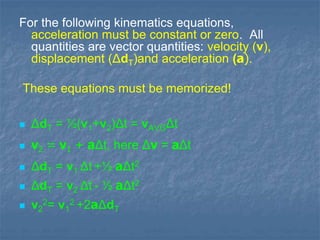
2) Five fundamental kinematics equations are presented that assume constant or zero acceleration and deal with displacement, velocity, acceleration, and time.
3) An example problem is provided and instructions are given for homework practice problems to reinforce kinematics concepts.

![Chalkboard Example
Tony is driving at 130 km/h [W] when he
passes a non-moving police car. It takes
the officer 4.0 s to react, he then starts to
accelerate at 4.0 m/s2 [W] for 10 s and
then he moves with uniform motion until
he catches up to Tony.
Do the following:
Draw a v-t graph. Let t = 0.0 s when Tony
just starts to pass the officer.
Determine the amount of time it takes the
officer to just catch up to Tony. Ans. 92 s](https://image.slidesharecdn.com/u1-l1-kinematics-r-140910193715-phpapp01/85/Grade-12-Unit1-L1-Kinematic-Equations-4-320.jpg)