Dr. Mohd Najmussadiq khan
M S (Ophth) DiSSO (ESASO)
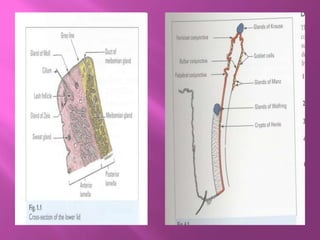
 Eyelids are movable folds attached to orbital
margin covered anterior by skin and posterior by
conjunctiva .The palpebral aperture is 12mm by
30mm.The lateral canthus is about 2 mm higher
than medial canthus.There is a small knob of skin
,the caruncle,and just lateral to it is crescentric
plica semicircularis. Lids are divided into two
parts :-
 palpebral is adjacent to the eyelids margin which
ends at the margin of the tarsus and its involved in
reflex linking .
 orbital is the peripheral portion which merges into
cheek below and brow above .
skin :- the thinnest skin in the body (elastic ).It is smooth,having creases and
without any long hair.The subcutaneous tisseue is loose areolar without
fat.
Muscle layer :-
 orbicularis oculi muscle which close the lids and its supplied by facial
nerve .
 Levator palpebrae superioris muscle which elevates the upper lid only and
supplied by occulomotor n.
 Mullers muscle supplied by cervical sympathetic system & it elevates the
lids.
Tarsal plate is consist of fibers tissue contain Meibomian glands (sebaceous
gland ) which open in the lid margin .Its 30- 40 opening in the upper lid
but its 20 – 30 opening in lower lid .Lid margin is separates skin from
palpebral conjunctiva .Lateral 5/6 is with eyelashes (ciliary portion
).Medial 1/6 is without eyelashes but it contain Lacrimal punctum.
Palpebral conjunctiva :- adherent to tarsal plate and it has four glands which
Meibomian(modified sebaceous glad & oily secretion) , moll (modified
sweat gland and open into the ducts of Zeis gland or into the follicle),
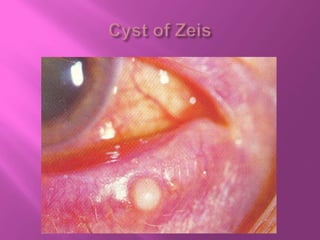
zeis(sebaceous gland & open in the follicle of eye lash), accessory
Lacrimal glands(Krause & Woulfring).
 protect eyes from injury or excessive light.
 distribute & drains tears .
 lubricate eyeball & maintain the precorneal tear
film
 emotional expressions
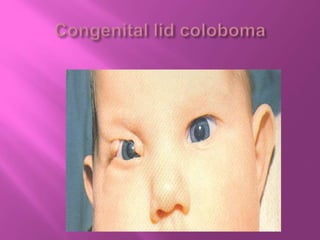
Coloboma palpebral :- failure of development of a portion of the
eyelid which cause a notching defect of the margin it usually upper
eyelid and mostly in the middle part and sometime may be
associated with underlying dermoid cyst.Treated by plastic repair.
Distichiasis :- Meibomian glands are rudimentary and replaced by
extra row of eyelashes directed backward to the cornea (at post
lamella of lid margin ). The lashes may irritate cornea and treated
by cryotherapy & excision with grafting.
Blepharophimosis :-It is a syndrome consists of narrow palpebral
fissure vertically and horizontally,telecanthus,inverse epicanthic
fold,ptosis.Autosomal dominant inheritance.
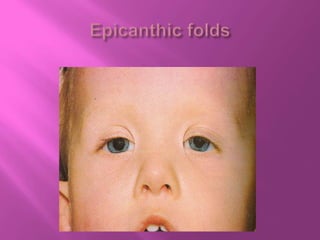
Epicanthus :- smaller folds of skin joint the upper to lower lid at inner
angle.A vertical skin lid which covers the medial canthi and usually
bilateral. It occur in meddle Asian people, Mongolians and it
common in children & decreases by increase in age .Some time the
skin is large to cover part of the nasal sclera if it is bilateral lead to
causing pseudoesotorpia .Its differentiated from esotropia by cover –
uncover test (cornea reflex ).
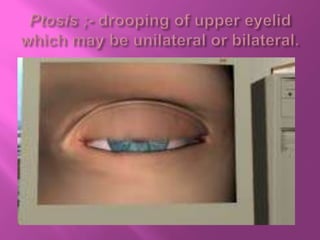
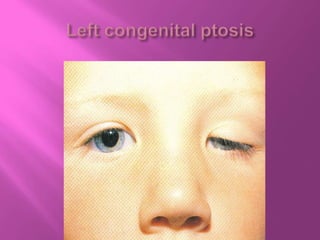
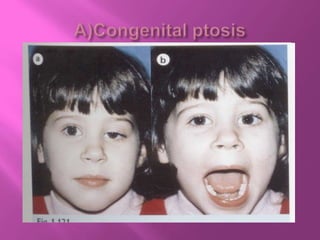
 due to imperfect differentiation of the levetor
muscle
 -often associated with weakness of underlying
superior rectus muscle because LPS & SR are
the last extra osular muscle to develop
 -often hereditary(dominant)
 -may be associated with epicanthus or
blepharophimosis
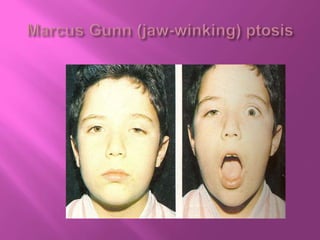
 -macus Gunn jaw winking phenomenon is
retraction of the ptotic eye lid with
ipsilateral pterygoid movement
 Nurogenic sympathetic chain lesions in cases of
syringomylia , trauma , Horner syndrome (Ptosis ,
Miosis , Anhidrosis (no sweating ) Enophthalmos)
Myasthenia gravis , myotonica dystrophica,
occulomotor nerve paralysis .
 hysterical usually young female with emotional
problems .
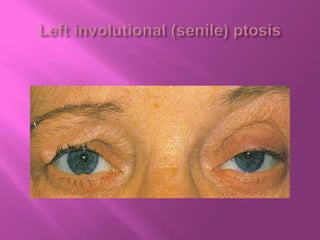
 Myogenic -myasthenia gravis,ocular
myopathy,senile
 Mechanical–edema,tumor,chalazion,conjunctiva
scarring
 Traumatic -trauma to levator muscle,post
surgical(S.R.)
 Anophthalmos
 Microphthalmos
 phthisis bulbi
 Hypotropia
 dermatochalasis
A)history—age of onset,family history,diplopia,variability of
ptosis,any systemic problem
B)examination—
 Amount of ptosis-
 mild —2mm
 moderate—3mm
 severe —4mm
 levator function-
 normal—15mm
 good --8mm or more
 fair --5-7mm
 poor --4mm or less
 ocular motility,bells phenomenon
 jaw winking phenomenon
 corneal sensivity
C)photograph for pre operative record
D)tensilon test to exclude myasthenia gravis,improvement of ptosis
by I/V edrophonium if it is due to myasthenia
E)neurogenic evaluation
 1.fasanella servent operation—resection of
upper tarsal border with its attached muller
muscle and conjunctiva.For mild ptosis with
good levator function
 2.levator resection—usefull in congenital
ptosis with good to fair levator function ann be
done through skin(Everbasch)or conjunctival
approach(Blaskowics)
 3.brow(frontalis) suspension—in bilateral
cases where levator action is poor.
 Patient has many complaints like pain,swelling
redness of eyelid occur with many
inflammations.
 Tearing may occur because of irritation of eyes
 Involvement (infection ) of upper or lower lid --
-- preauricular Lymphadenopathy .
 Infection of medial 2/3 of lower submaxillary
Lymphadenopathy
adhesion of the lid to the glob due to bulbar and
palpebral conjunctiva uniting together.The
types are
 Anterior symblepharon—the bands involving
anterior part and fornix is free
 Posterior symblepharon—bands are
obliterating the fornix only
 Total symblepharon
 Chemical
 thermal burns
 Membranous conjunctivitis
 Ocular pemphigoid
 steven johnsons syndrome
 Trachoma
 post operative
 Pain & rednedd due to exposure
 Watering & diplopia
 Cosmetic disfigurement
 Signs of exposure
 Restricted ocular movemet
 Fibrous band visible with obliterated fornix
 Prevented by sweeping a glass rod coated with
ointmentaround the upper and lower fornix &
csleral contact shells
 Treated by excision,radical excision if
large(scarred conjunctival tissue also excised)
 Mucous membrane grafting
 After surgery therapeutic contact lens,sclera
shell,local and systemic steroids
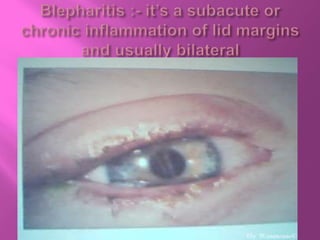
 it is associated with greasy Scales suround the
lashes .Main complaint is redness of lid margin
,no ulcer ,usually associated with seborrheic
dermatitis of scalp and often keratitis .Falling
of eye lashes(madrosis),thickening of lid
margin(tylosis)
 D/D with MP conjunctivitis but here no
congestion
 acute or chronic suppurative inflammation of
follicles of eye lashes and gland of Zeis and Moll
caused by Staphylococcus aureus .
 Red & inflammed lid margins .
 Crusts on eyelashes .
 Dry scales when removed lead to ulceration .
 May cause conjunctivitis ,superficial keratitis
,meibomianitis.
Angular blepharitis :- inflammation at angle of eye
caused by Morax-Axenfeld bacillus ,Diplococcic
 external irritants e.g. dust,mostly in children
 eye strain ,uncorrected refractive error
 error of CHO metabolism,dandruff of scalf
 chronic conjunctivitis,parasitic
infestation(demodex filliculorum,phthiriasis
palpebrum)
 Drug resistant and chronic e.g. conjunctivitis .
 Madarosis loss of eyelashes due to destruction
of hair follicle
 Trichiasis .
 Epiphora .
 Post-inflammatory ectropion .
 Tylosis thickening of eye margin.
 Marginal keratitis(lower third)
 Instability of tear film and dry eye
General one :-
 proper cleaning of eye margins removal of scales
by cotton applicator .
 Treatment of seborrhea of scalp by head and shoulder
shampoo .
 Correction of refractive errors
Specific :-
 local antibiotic (Drops) e.g. sulfonamide or
chloramphenicol .
 Sodium bicarbonate lotion(3%) .
 Local corticosteroids e.d..
 Zinc preparation for angular blepharitis.
 Systemic tetracycline/doxycycline for 2 weeks in
severe cases.
Aetiology—
 Commonly caused by staphylococcal aureus
 Common in children & young adults
 Low general resistance as in debility or diabetes
 Uncorrected refractive errors
 May be associated with boils,acne of face or neck(stye in
crops)
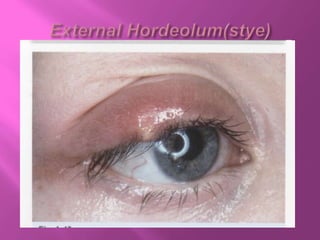
 When it affects Meibomian gland it is known as internal
hordeolum within tarsal plate which is more painful than stye
and may discharge anterior into skin and posterior in
conjunctiva or may be spared and reduced in size leave hard
nodule.Stye always found at the skin side of the lid margin ,
while internal Hordeolum found on skin and conjunctiva of
eyelid
 Acute pain & swelling
 Heaviness & discharge
 Lid redness, tenderness and edema with raised
temperature
 A raised swollen area with pus point
 Matted eye lashes with discharge
 Enlarged preauricular and sub mandibular
lymph nodes
Complications—
 Ulcerative blepharitis,orbital cellulitis(rarely)
 Lid abscess
 Very rarely cavernous sinus thrombosis
TREATMENT :-
 Hot compression 4/day
 Systemic antibiotics and analgesics
 topical antibacterial drops & ointment e.g.
sulphonamide,ciprofloxacin,chloremphenicol
 Epilation of involved eyelashes to evacuate pus in
external hordeolum
 if no relief must do surgical evacuation + local
antibiotic cover.
 If stye in crop then check blood sugar,systemic
tetracycline or doxycycline for 7-14 days
 Correction fo refractive errors,nutrition & hygiene
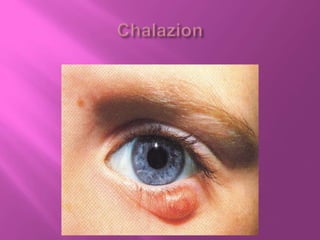
 A chronic non suppurative lipo-granulomatous
inflammation 2ry to retention of sebum caused by
obstruction of Meibomian gland duct of unknown
cause .
 It is manifested by localized painless swelling in
upper or lower lid usually points towards
conjunctival side of lid (to be differentiated from
stye ).
 Histology-centrally cheesy sebaceous material
surrounded by granulation
tissue(lymphocytes,epitheloid cells,giant cells,fine
blood vessels) and covered by a fibrous tissue.
 Painless ,firm,non tender nodular swelling
 Drooping of upper lid if large chalazion
 No sign of inflammation
 Skin over it is free and normal
 Conjunctiva over the Chalazion is valvety red and elevated
 Regional lymph nodes not palpable
Fate of the chalazion—
 Spontaneous resolution if small or may remain as such
 Increase in size leading to mechanical ptosis
 Secondary infection causing internal hordeolum
 Forming marginal chalazion when the granulation tissue
formed in the duct of the gland coming out as reddish grey
nodule on the inter marginal strip
 May brust through the conjunctiva or skin
 Very rarely malignant change to meibomian carcinoma
Complication:-
 Astigmatism : Pressure on eyeball (Blurred vision)
 Secondary infection .
treatment :-
 if asymptomatic small leave it and if 2ry infected
hot compresses + topical antibiotic+systemic
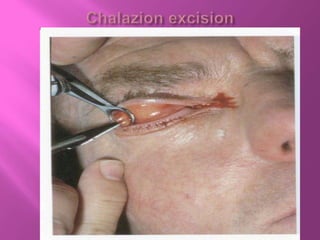
antibiotics and if large surgery excision :- vertical
incision into the tarsal gland from conjunctiva
surface
 injection of steroid inside Chalazion or steroid
ointment application and by injection of
Triamcinolone
 for marginal chalazion press out material with
thumb and index finger or electro-coagulation by
20-30mAmp current
 Uncommon bilateral chronic inflammation of
Meibomian glands.Unknown cause, occur in
middle age and usually associated with
blepharitis .
 Red eyes ,white frothy discharge on lid
margins .
 It is viral infection of lid caused by a large pox
virus and more common in children.
 The typical multiple,pale,waxy,umblicated
swellings scattered over the skin near lid
margin.
 The complications may be chronic follicular
conjunctivitis and superficial keratitis and
treated by incision,expression & interior
cauterisation by iodine or carbolic acid.
 Treatment:-Removal of secretions by cotton
application (no good result)
 The inward misdirection of eye lashes which
irritates the cornea and conjunctiva.
 Pseudo-trichiasis when misdirection is due to
entropion.
 It may be congenital or acquired(stye,
ulcerative blepharitis, membranous
conjunctivitis, trachoma, post traumatic)
Clinical features—
 foreign body sensation,lacrimation pain
 conjunctival & ciliary congestion
 reflex blepharospasm
 recurrent corneal erosions
 superficial corneal opacities
 vascularisation of the cornea
treatment—
 epilation(removal of lashes)if less than 4 lashes and repeated
every 6-8 weeks
 soft bandage contact lens to protect cornea
 electrolysis under local anaesthesia by 2 mAmp current if 4-
7 lashes
 snellen operation if more than 7 lashes
 electrodiathermy
 cryotherapy
 beta irradiation—raely used
 argon laser cilia ablation
 plastic repair
 It is inversion of the eyelid and it usually
causes discomfort due to the rubbing of the
eyelashes on cornea & conjunctiva( it is turning
inward of the lid margin ).
 Lower lid is usually more affected and It is
occurred in man above 40 years old and
complications as trichiasis and cornea opacity .
Types :-
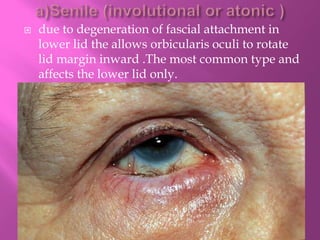
 due to degeneration of fascial attachment in
lower lid the allows orbicularis oculi to rotate
lid margin inward .The most common type and
affects the lower lid only.
 upward movement of preseptal part of
orbicularis oculi of lower lid
 thinning of tarsal plate
 thinning of the orbital septum and weakening
of lower lid retractors
 enophthalmos from atrophy of adipose tissue
 foreign body sensation,pain,lacrimation
 inturning of the lower lid
 conjunctival and ciliary congestion
 discharge with matted lashes
 blepharospasm
 superficial corneal opacities and ulceration
Treatment—
 temporary procedure—adhesive tape,cautery over
skin,transverse lid everting suture,alcohol injection
along the lid edge
 permanent procedure—Weis procedure,horizontal lid
shortening,tuckling of inferior lid retractors,fox
procedure
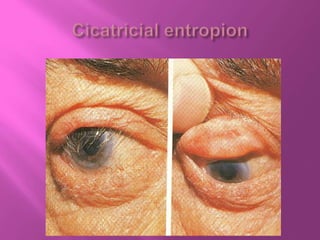
 due to scarring of palpebral conjunctiva and
tarsus .This scar pull lid margin toward the
globe and it occur in ocular cicatrisation
pemphigoid , Steven – Johnson syndrome and
trachoma and burn,trachoma and trauma .
 Management aimed keep lashes away from
cornea .
Treatment :-
 Soft contact lens
 epilation surgery (in sever cases mucus
membrane graft )
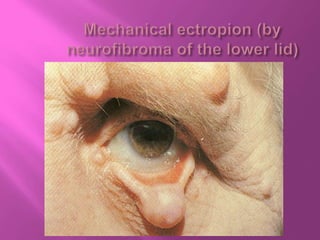
c)Mechanical due to lake of support to lids and
treatment by surgery
d)Acute spastic—It results from excessive
contraction of the orbicularis
oculi9blepharospasm) combined with atrophy of
eye lid retractors mainly affecting lower lid.Causes
are
 chronic conjunctivitis
 keratitis
 post operative
 treatment—remove the cause,lid everting
suture,adhesive tape
 rare usually by the deformity of tarsal plate
and may be associated with microphthalmos or
enophthalmos.
 It dissolved by 1 to 2 years. D/D with
epiblepharon (skin fold medial side ) .
 Treated with resection of abnormal portion of
tarsus and excess skin may be excised if there is
epiblepharon.
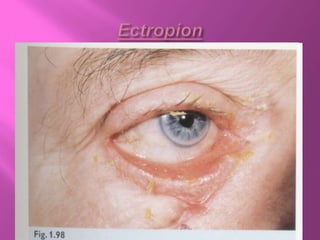
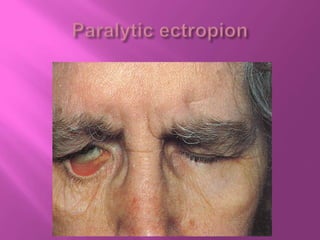
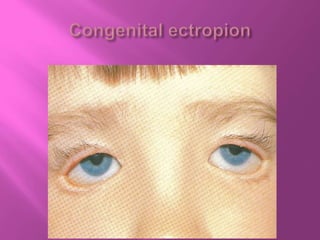
 It is an outward turning of the eyelid away from
the globe
Clinical features
 In case of lower lid the inferior punctum is not in
contact with globe leading to epiphora and
excoriation of the skin around the lid
 Chronic exposure of the conjunctiva causes
secondary infection and keratinisation of the
cornea
Classification-
 involutional
 cicatricial
 paralytic
 congenital
 mechanical
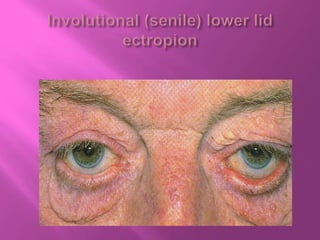
 it is the commonest form affecting lower lid in
elderly.It is due to excessive horizontal lid length
with weakness of pre septal orbicularis.
Treatment—
 zeiglers cautery – to correct medial lid laxity with
punctual eversion
 medial conjunctivoplasty
 horizontal lid shortening
 bicks procedure-excision of full thickness
triangular wedge of lid at the outer cathus
 Byron smith modification of Kuhnt Szymanowski
procedure-pentagonal wedge resection of the lid
magin,along with excision of a triangular skin flap
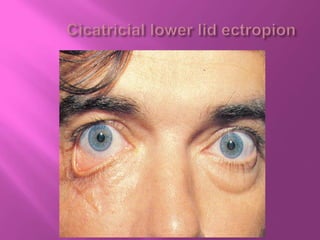
b)cicatricial –due to contracture of skin and underlying
tissues.The cause may be
burn(chemical/thermal),trauma,inflammation and it
affects both lids.
 Treatment—excision of scar with skin grafting and Z
plasty for lengthening.
C)paralytic –due to orbicularis oculi palsy.there is
epiphora and lagophthalmos and the aim of treatment
is to prevent exposure keratitis by artificial tears
drops,tarsorrhaphy,lateral canthoplasty.
Complication :-
 Patient with epiphora
 Chronic conjunctivitis
 Exposure keratitis .
Ectropion associated with ;-Epiphora and chronic
conjunctivitis long standing lead to ;-
 Conjunctiva hypertrophy and keratinization as result
of exposure easily seen lower punctum
 lagophtalmos ( inability to close the lid )
 an involuntary tonic bilateral contraction of orbicularis
oculi with brief eye closures .Occur in older age. They
are of two types
a)essential blepharospasm—in old age
b)reflex blepharospasm—It is abolished by topical
anaesthesia and due to
 irritation to cornea or conjunctiva like Horner's
syndrome or ulcer
 Irritation to facial nerve e.g. tumor .
 Port- encephalitis .
 Iridocyclitis.
 Angular blepharitis .
 Treatment—essential is treated by alcohol
injection to facial nerve or botulinum toxin
injection to orbicularis muscle and treat the cause
for reflex blepharospasm
trauma.
inflammation of :-
 lids (stye , abscess , cellulites ….) .
 conjunctiva (conjunctivitis ). 3- cornea (sever
ulcer ). 4- iris (iridocyclitis). 5-Lacrimal system
(acute dacrocystitis ,dacroadenitis.
non inflammatory (angioneurotic edema) .
systemic (renal or cardiac disease).
 Treatment :- cold compresses and local
cortisone
A- congenital
B- acquired
 post traumatic , post operative .
 inflammatory ( blepharitis , herpes zoster .)
 endocrine disease (pituitary insufficiency ).
 Severe debilitating diseases ( T.B
 Chronic skin disease (psoriasis , alopecia …).
 Sever mal-nutrition.
 intoxication with arsenic , thallium.
 Vit A deficiency 9- Harada syndrome
-Vogt- Koyanagi syndrome
 Papilloma
 Hemangioma
 Melanoma
 basal cell carcinoma (most common )
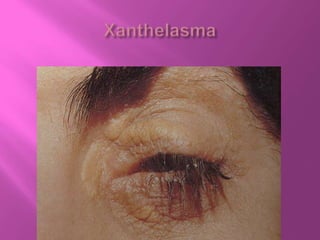
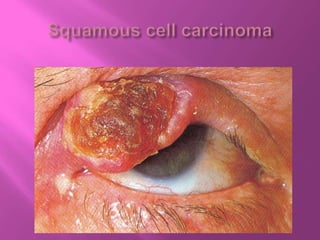
 Squamous cell carcinoma,xanthelasma
 yellow slightly elevated nodule usually at the
inner portion of upper or lower lid.often
symmetrical in the two lids and more in elderly
female & sometime associated with D.M or
hypercholesterolemia
 Grow slowly and produce only cosmetic effect
 Histologically lipid material being engulfed by
histocytes(foam cells)
 Treated by surgical excision,destruction by
TCA,diathermy,photocoagulation
 Recurrence is very rare
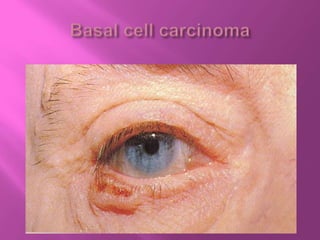
 The most common malignant tumour of the eye lid and
lower lid more commonly involved specially near the
inner canthus.
 The tumour starts from the basal cell of the epidermis
and consists of islands of neoplastic cells(cell nests)
 It starts as a small pimple which ulcerates with raised
and rolled edges
 The ulcer spreads slowly in all directions and
penetrates deeply
 Metastasis does not occur
Treatment—
 Surgical excision with a 3 mm clear margin
 Radiotherapy
 Cryotherapy for small and superficial tumour
 Exentration when globe and orbit involved
 The second most common malignancy of eye
lid
 Usually arising from pre existing senile
keratosis
 It appears as nodule,ulcer or papilloma
 Grow faster and regional lymph node
metastasis present
 Diagnosis confirmed by biopsy and treated by
radical surgery with post operative
radiotherapy
 A rare tumour arising from meibomian glands
 A discreate,yellow,firm nodule and may be
diagnosed as recurrent chalazion
 Wide spread metastasis is common with poor
prognosis
 Treated by radical excision and post operative
radiotherapy

Eyelids

  • 1.
    Dr. Mohd Najmussadiqkhan M S (Ophth) DiSSO (ESASO)
  • 2.
     Eyelids aremovable folds attached to orbital margin covered anterior by skin and posterior by conjunctiva .The palpebral aperture is 12mm by 30mm.The lateral canthus is about 2 mm higher than medial canthus.There is a small knob of skin ,the caruncle,and just lateral to it is crescentric plica semicircularis. Lids are divided into two parts :-  palpebral is adjacent to the eyelids margin which ends at the margin of the tarsus and its involved in reflex linking .  orbital is the peripheral portion which merges into cheek below and brow above .
  • 3.
    skin :- thethinnest skin in the body (elastic ).It is smooth,having creases and without any long hair.The subcutaneous tisseue is loose areolar without fat. Muscle layer :-  orbicularis oculi muscle which close the lids and its supplied by facial nerve .  Levator palpebrae superioris muscle which elevates the upper lid only and supplied by occulomotor n.  Mullers muscle supplied by cervical sympathetic system & it elevates the lids. Tarsal plate is consist of fibers tissue contain Meibomian glands (sebaceous gland ) which open in the lid margin .Its 30- 40 opening in the upper lid but its 20 – 30 opening in lower lid .Lid margin is separates skin from palpebral conjunctiva .Lateral 5/6 is with eyelashes (ciliary portion ).Medial 1/6 is without eyelashes but it contain Lacrimal punctum. Palpebral conjunctiva :- adherent to tarsal plate and it has four glands which Meibomian(modified sebaceous glad & oily secretion) , moll (modified sweat gland and open into the ducts of Zeis gland or into the follicle), zeis(sebaceous gland & open in the follicle of eye lash), accessory Lacrimal glands(Krause & Woulfring).
  • 5.
     protect eyesfrom injury or excessive light.  distribute & drains tears .  lubricate eyeball & maintain the precorneal tear film  emotional expressions
  • 6.
    Coloboma palpebral :-failure of development of a portion of the eyelid which cause a notching defect of the margin it usually upper eyelid and mostly in the middle part and sometime may be associated with underlying dermoid cyst.Treated by plastic repair. Distichiasis :- Meibomian glands are rudimentary and replaced by extra row of eyelashes directed backward to the cornea (at post lamella of lid margin ). The lashes may irritate cornea and treated by cryotherapy & excision with grafting. Blepharophimosis :-It is a syndrome consists of narrow palpebral fissure vertically and horizontally,telecanthus,inverse epicanthic fold,ptosis.Autosomal dominant inheritance. Epicanthus :- smaller folds of skin joint the upper to lower lid at inner angle.A vertical skin lid which covers the medial canthi and usually bilateral. It occur in meddle Asian people, Mongolians and it common in children & decreases by increase in age .Some time the skin is large to cover part of the nasal sclera if it is bilateral lead to causing pseudoesotorpia .Its differentiated from esotropia by cover – uncover test (cornea reflex ).
  • 10.
     due toimperfect differentiation of the levetor muscle  -often associated with weakness of underlying superior rectus muscle because LPS & SR are the last extra osular muscle to develop  -often hereditary(dominant)  -may be associated with epicanthus or blepharophimosis  -macus Gunn jaw winking phenomenon is retraction of the ptotic eye lid with ipsilateral pterygoid movement
  • 14.
     Nurogenic sympatheticchain lesions in cases of syringomylia , trauma , Horner syndrome (Ptosis , Miosis , Anhidrosis (no sweating ) Enophthalmos) Myasthenia gravis , myotonica dystrophica, occulomotor nerve paralysis .  hysterical usually young female with emotional problems .  Myogenic -myasthenia gravis,ocular myopathy,senile  Mechanical–edema,tumor,chalazion,conjunctiva scarring  Traumatic -trauma to levator muscle,post surgical(S.R.)
  • 16.
     Anophthalmos  Microphthalmos phthisis bulbi  Hypotropia  dermatochalasis
  • 17.
    A)history—age of onset,familyhistory,diplopia,variability of ptosis,any systemic problem B)examination—  Amount of ptosis-  mild —2mm  moderate—3mm  severe —4mm  levator function-  normal—15mm  good --8mm or more  fair --5-7mm  poor --4mm or less  ocular motility,bells phenomenon  jaw winking phenomenon  corneal sensivity C)photograph for pre operative record D)tensilon test to exclude myasthenia gravis,improvement of ptosis by I/V edrophonium if it is due to myasthenia E)neurogenic evaluation
  • 18.
     1.fasanella serventoperation—resection of upper tarsal border with its attached muller muscle and conjunctiva.For mild ptosis with good levator function  2.levator resection—usefull in congenital ptosis with good to fair levator function ann be done through skin(Everbasch)or conjunctival approach(Blaskowics)  3.brow(frontalis) suspension—in bilateral cases where levator action is poor.
  • 19.
     Patient hasmany complaints like pain,swelling redness of eyelid occur with many inflammations.  Tearing may occur because of irritation of eyes  Involvement (infection ) of upper or lower lid -- -- preauricular Lymphadenopathy .  Infection of medial 2/3 of lower submaxillary Lymphadenopathy
  • 20.
    adhesion of thelid to the glob due to bulbar and palpebral conjunctiva uniting together.The types are  Anterior symblepharon—the bands involving anterior part and fornix is free  Posterior symblepharon—bands are obliterating the fornix only  Total symblepharon
  • 21.
     Chemical  thermalburns  Membranous conjunctivitis  Ocular pemphigoid  steven johnsons syndrome  Trachoma  post operative
  • 22.
     Pain &rednedd due to exposure  Watering & diplopia  Cosmetic disfigurement  Signs of exposure  Restricted ocular movemet  Fibrous band visible with obliterated fornix
  • 23.
     Prevented bysweeping a glass rod coated with ointmentaround the upper and lower fornix & csleral contact shells  Treated by excision,radical excision if large(scarred conjunctival tissue also excised)  Mucous membrane grafting  After surgery therapeutic contact lens,sclera shell,local and systemic steroids
  • 26.
     it isassociated with greasy Scales suround the lashes .Main complaint is redness of lid margin ,no ulcer ,usually associated with seborrheic dermatitis of scalp and often keratitis .Falling of eye lashes(madrosis),thickening of lid margin(tylosis)  D/D with MP conjunctivitis but here no congestion
  • 27.
     acute orchronic suppurative inflammation of follicles of eye lashes and gland of Zeis and Moll caused by Staphylococcus aureus .  Red & inflammed lid margins .  Crusts on eyelashes .  Dry scales when removed lead to ulceration .  May cause conjunctivitis ,superficial keratitis ,meibomianitis. Angular blepharitis :- inflammation at angle of eye caused by Morax-Axenfeld bacillus ,Diplococcic
  • 28.
     external irritantse.g. dust,mostly in children  eye strain ,uncorrected refractive error  error of CHO metabolism,dandruff of scalf  chronic conjunctivitis,parasitic infestation(demodex filliculorum,phthiriasis palpebrum)
  • 29.
     Drug resistantand chronic e.g. conjunctivitis .  Madarosis loss of eyelashes due to destruction of hair follicle  Trichiasis .  Epiphora .  Post-inflammatory ectropion .  Tylosis thickening of eye margin.  Marginal keratitis(lower third)  Instability of tear film and dry eye
  • 30.
    General one :- proper cleaning of eye margins removal of scales by cotton applicator .  Treatment of seborrhea of scalp by head and shoulder shampoo .  Correction of refractive errors Specific :-  local antibiotic (Drops) e.g. sulfonamide or chloramphenicol .  Sodium bicarbonate lotion(3%) .  Local corticosteroids e.d..  Zinc preparation for angular blepharitis.  Systemic tetracycline/doxycycline for 2 weeks in severe cases.
  • 31.
    Aetiology—  Commonly causedby staphylococcal aureus  Common in children & young adults  Low general resistance as in debility or diabetes  Uncorrected refractive errors  May be associated with boils,acne of face or neck(stye in crops)  When it affects Meibomian gland it is known as internal hordeolum within tarsal plate which is more painful than stye and may discharge anterior into skin and posterior in conjunctiva or may be spared and reduced in size leave hard nodule.Stye always found at the skin side of the lid margin , while internal Hordeolum found on skin and conjunctiva of eyelid
  • 32.
     Acute pain& swelling  Heaviness & discharge  Lid redness, tenderness and edema with raised temperature  A raised swollen area with pus point  Matted eye lashes with discharge  Enlarged preauricular and sub mandibular lymph nodes
  • 34.
    Complications—  Ulcerative blepharitis,orbitalcellulitis(rarely)  Lid abscess  Very rarely cavernous sinus thrombosis TREATMENT :-  Hot compression 4/day  Systemic antibiotics and analgesics  topical antibacterial drops & ointment e.g. sulphonamide,ciprofloxacin,chloremphenicol  Epilation of involved eyelashes to evacuate pus in external hordeolum  if no relief must do surgical evacuation + local antibiotic cover.  If stye in crop then check blood sugar,systemic tetracycline or doxycycline for 7-14 days  Correction fo refractive errors,nutrition & hygiene
  • 35.
     A chronicnon suppurative lipo-granulomatous inflammation 2ry to retention of sebum caused by obstruction of Meibomian gland duct of unknown cause .  It is manifested by localized painless swelling in upper or lower lid usually points towards conjunctival side of lid (to be differentiated from stye ).  Histology-centrally cheesy sebaceous material surrounded by granulation tissue(lymphocytes,epitheloid cells,giant cells,fine blood vessels) and covered by a fibrous tissue.
  • 37.
     Painless ,firm,nontender nodular swelling  Drooping of upper lid if large chalazion  No sign of inflammation  Skin over it is free and normal  Conjunctiva over the Chalazion is valvety red and elevated  Regional lymph nodes not palpable Fate of the chalazion—  Spontaneous resolution if small or may remain as such  Increase in size leading to mechanical ptosis  Secondary infection causing internal hordeolum  Forming marginal chalazion when the granulation tissue formed in the duct of the gland coming out as reddish grey nodule on the inter marginal strip  May brust through the conjunctiva or skin  Very rarely malignant change to meibomian carcinoma
  • 38.
    Complication:-  Astigmatism :Pressure on eyeball (Blurred vision)  Secondary infection . treatment :-  if asymptomatic small leave it and if 2ry infected hot compresses + topical antibiotic+systemic antibiotics and if large surgery excision :- vertical incision into the tarsal gland from conjunctiva surface  injection of steroid inside Chalazion or steroid ointment application and by injection of Triamcinolone  for marginal chalazion press out material with thumb and index finger or electro-coagulation by 20-30mAmp current
  • 40.
     Uncommon bilateralchronic inflammation of Meibomian glands.Unknown cause, occur in middle age and usually associated with blepharitis .  Red eyes ,white frothy discharge on lid margins .
  • 41.
     It isviral infection of lid caused by a large pox virus and more common in children.  The typical multiple,pale,waxy,umblicated swellings scattered over the skin near lid margin.  The complications may be chronic follicular conjunctivitis and superficial keratitis and treated by incision,expression & interior cauterisation by iodine or carbolic acid.  Treatment:-Removal of secretions by cotton application (no good result)
  • 42.
     The inwardmisdirection of eye lashes which irritates the cornea and conjunctiva.  Pseudo-trichiasis when misdirection is due to entropion.  It may be congenital or acquired(stye, ulcerative blepharitis, membranous conjunctivitis, trachoma, post traumatic)
  • 43.
    Clinical features—  foreignbody sensation,lacrimation pain  conjunctival & ciliary congestion  reflex blepharospasm  recurrent corneal erosions  superficial corneal opacities  vascularisation of the cornea treatment—  epilation(removal of lashes)if less than 4 lashes and repeated every 6-8 weeks  soft bandage contact lens to protect cornea  electrolysis under local anaesthesia by 2 mAmp current if 4- 7 lashes  snellen operation if more than 7 lashes  electrodiathermy  cryotherapy  beta irradiation—raely used  argon laser cilia ablation  plastic repair
  • 46.
     It isinversion of the eyelid and it usually causes discomfort due to the rubbing of the eyelashes on cornea & conjunctiva( it is turning inward of the lid margin ).  Lower lid is usually more affected and It is occurred in man above 40 years old and complications as trichiasis and cornea opacity . Types :-
  • 47.
     due todegeneration of fascial attachment in lower lid the allows orbicularis oculi to rotate lid margin inward .The most common type and affects the lower lid only.
  • 48.
     upward movementof preseptal part of orbicularis oculi of lower lid  thinning of tarsal plate  thinning of the orbital septum and weakening of lower lid retractors  enophthalmos from atrophy of adipose tissue
  • 49.
     foreign bodysensation,pain,lacrimation  inturning of the lower lid  conjunctival and ciliary congestion  discharge with matted lashes  blepharospasm  superficial corneal opacities and ulceration Treatment—  temporary procedure—adhesive tape,cautery over skin,transverse lid everting suture,alcohol injection along the lid edge  permanent procedure—Weis procedure,horizontal lid shortening,tuckling of inferior lid retractors,fox procedure
  • 50.
     due toscarring of palpebral conjunctiva and tarsus .This scar pull lid margin toward the globe and it occur in ocular cicatrisation pemphigoid , Steven – Johnson syndrome and trachoma and burn,trachoma and trauma .  Management aimed keep lashes away from cornea . Treatment :-  Soft contact lens  epilation surgery (in sever cases mucus membrane graft )
  • 52.
    c)Mechanical due tolake of support to lids and treatment by surgery d)Acute spastic—It results from excessive contraction of the orbicularis oculi9blepharospasm) combined with atrophy of eye lid retractors mainly affecting lower lid.Causes are  chronic conjunctivitis  keratitis  post operative  treatment—remove the cause,lid everting suture,adhesive tape
  • 53.
     rare usuallyby the deformity of tarsal plate and may be associated with microphthalmos or enophthalmos.  It dissolved by 1 to 2 years. D/D with epiblepharon (skin fold medial side ) .  Treated with resection of abnormal portion of tarsus and excess skin may be excised if there is epiblepharon.
  • 54.
     It isan outward turning of the eyelid away from the globe Clinical features  In case of lower lid the inferior punctum is not in contact with globe leading to epiphora and excoriation of the skin around the lid  Chronic exposure of the conjunctiva causes secondary infection and keratinisation of the cornea Classification-  involutional  cicatricial  paralytic  congenital  mechanical
  • 56.
     it isthe commonest form affecting lower lid in elderly.It is due to excessive horizontal lid length with weakness of pre septal orbicularis. Treatment—  zeiglers cautery – to correct medial lid laxity with punctual eversion  medial conjunctivoplasty  horizontal lid shortening  bicks procedure-excision of full thickness triangular wedge of lid at the outer cathus  Byron smith modification of Kuhnt Szymanowski procedure-pentagonal wedge resection of the lid magin,along with excision of a triangular skin flap
  • 58.
    b)cicatricial –due tocontracture of skin and underlying tissues.The cause may be burn(chemical/thermal),trauma,inflammation and it affects both lids.  Treatment—excision of scar with skin grafting and Z plasty for lengthening. C)paralytic –due to orbicularis oculi palsy.there is epiphora and lagophthalmos and the aim of treatment is to prevent exposure keratitis by artificial tears drops,tarsorrhaphy,lateral canthoplasty. Complication :-  Patient with epiphora  Chronic conjunctivitis  Exposure keratitis . Ectropion associated with ;-Epiphora and chronic conjunctivitis long standing lead to ;-  Conjunctiva hypertrophy and keratinization as result of exposure easily seen lower punctum  lagophtalmos ( inability to close the lid )
  • 63.
     an involuntarytonic bilateral contraction of orbicularis oculi with brief eye closures .Occur in older age. They are of two types a)essential blepharospasm—in old age b)reflex blepharospasm—It is abolished by topical anaesthesia and due to  irritation to cornea or conjunctiva like Horner's syndrome or ulcer  Irritation to facial nerve e.g. tumor .  Port- encephalitis .  Iridocyclitis.  Angular blepharitis .  Treatment—essential is treated by alcohol injection to facial nerve or botulinum toxin injection to orbicularis muscle and treat the cause for reflex blepharospasm
  • 64.
    trauma. inflammation of :- lids (stye , abscess , cellulites ….) .  conjunctiva (conjunctivitis ). 3- cornea (sever ulcer ). 4- iris (iridocyclitis). 5-Lacrimal system (acute dacrocystitis ,dacroadenitis. non inflammatory (angioneurotic edema) . systemic (renal or cardiac disease).  Treatment :- cold compresses and local cortisone
  • 65.
    A- congenital B- acquired post traumatic , post operative .  inflammatory ( blepharitis , herpes zoster .)  endocrine disease (pituitary insufficiency ).  Severe debilitating diseases ( T.B  Chronic skin disease (psoriasis , alopecia …).  Sever mal-nutrition.  intoxication with arsenic , thallium.  Vit A deficiency 9- Harada syndrome -Vogt- Koyanagi syndrome
  • 66.
     Papilloma  Hemangioma Melanoma  basal cell carcinoma (most common )  Squamous cell carcinoma,xanthelasma
  • 67.
     yellow slightlyelevated nodule usually at the inner portion of upper or lower lid.often symmetrical in the two lids and more in elderly female & sometime associated with D.M or hypercholesterolemia  Grow slowly and produce only cosmetic effect  Histologically lipid material being engulfed by histocytes(foam cells)  Treated by surgical excision,destruction by TCA,diathermy,photocoagulation  Recurrence is very rare
  • 69.
     The mostcommon malignant tumour of the eye lid and lower lid more commonly involved specially near the inner canthus.  The tumour starts from the basal cell of the epidermis and consists of islands of neoplastic cells(cell nests)  It starts as a small pimple which ulcerates with raised and rolled edges  The ulcer spreads slowly in all directions and penetrates deeply  Metastasis does not occur Treatment—  Surgical excision with a 3 mm clear margin  Radiotherapy  Cryotherapy for small and superficial tumour  Exentration when globe and orbit involved
  • 71.
     The secondmost common malignancy of eye lid  Usually arising from pre existing senile keratosis  It appears as nodule,ulcer or papilloma  Grow faster and regional lymph node metastasis present  Diagnosis confirmed by biopsy and treated by radical surgery with post operative radiotherapy
  • 73.
     A raretumour arising from meibomian glands  A discreate,yellow,firm nodule and may be diagnosed as recurrent chalazion  Wide spread metastasis is common with poor prognosis  Treated by radical excision and post operative radiotherapy