Complex cases in
Cataract surgery and its
management
Mentor-
Dr Sharat sir
Sharat maxivision eye
hospital
Presenter
Madhumita Prasad
Maxivision eye hospital,
Somajiguda
Table of content
1. Small pupil surgeries
2. Hard cataract and its management
3. Posterior polar cataract
4. Cataract in Fuch’s corneal dystrophy
5. Runaway rhexis
Introduction
In ophthalmology the clinical management of patients is constantly evolving and
complication rate is getting low.
Although routine cataract surgery considered as low-risk surgery for both patients
and the surgeon, some eyes have higher risk of complications.
It is extremely important to recognize when eyes are at greater risk, and manage
accordingly to reduce the complications.
The common goal is to completely remove the cataract while preserving the zonules
and capsular bag for the placement of an IOL.
In the following slides we will discuss some frequently encountered difficult situations
and their solutions.
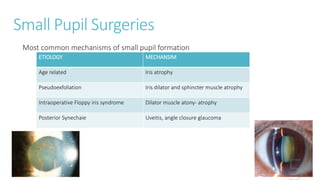
Small Pupil Surgeries
Most common mechanisms of small pupil formation
ETIOLOGY MECHANSIM
Age related Iris atrophy
Pseudoexfoliation Iris dilator and sphincter muscle atrophy
Intraoperative Floppy iris syndrome Dilator muscle atony- atrophy
Posterior Synechaie Uveitis, angle closure glaucoma
Technical challenges of small pupil
surgery
Reduced red reflex
Increased risk of iris damage Iris bleeding
Iris prolapse from wounds
Incomplete evacuation of cortical
material
Problems in ensuring IN-THE-BAG
IOL.
Small anterior capsulorhexis size
Risk of catching pupillary margin
with phaco tip
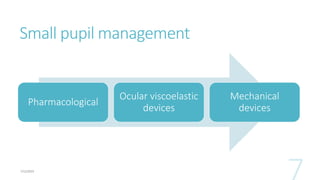
Small pupil management
Pharmacological
Ocular viscoelastic
devices
Mechanical
devices
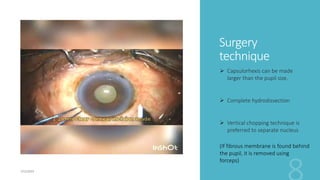
Surgery
technique
 Capsulorhexis can be made
larger than the pupil size.
 Complete hydrodissection
 Vertical chopping technique is
preferred to separate nucleus
(If fibrous membrane is found behind
the pupil, it is removed using
forceps)
PHARMACOLOGICAL MYDRIASIS
•The use of preoperative anti-infl ammatory agents (NSAIDs) decreased
occasions of intraoperative pupillary constrictions greatly.
• 1:1000 preservative free epinephrine intracameral injection (epitrate)
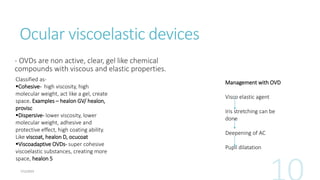
Ocular viscoelastic devices
- OVDs are non active, clear, gel like chemical
compounds with viscous and elastic properties.
Classified as-
Cohesive- high viscosity, high
molecular weight, act like a gel, create
space. Examples – healon GV/ healon,
provisc
Dispersive- lower viscosity, lower
molecular weight, adhesive and
protective effect, high coating ability.
Like viscoat, healon D, ocucoat
Viscoadaptive OVDs- super cohesive
viscoelastic substances, creating more
space, healon 5
Management with OVD
Visco elastic agent
Iris stretching can be
done
Deepening of AC
Pupil dilatation
Mechanical devices
1. Hydroview iris protector ring
2. Malyugin Ring
3. B-HEX pupil expander
4. I-ring pupil expander
5. Iris hooks
Malyugin B. Cataract surgery in small pupils. Indian J Ophthalmol. 2017 Dec;65(12):1323-
1328. doi: 10.4103/ijo.IJO_800_17. PMID: 29208812; PMCID: PMC5742960.
Surgical maneuvers-
1. Synechiolysis
2. Stretch pupilloplasty- 2 instruments
3. Iris cutting with vanas
Management of hard cataract
Problems encountered by surgeons-
Capsular zonular problems
Corneal edema
Wound burn
Post operative inflammations
PC rupture
Main aim is to minimize the endothelial cell loss and protect the PC.
Reason being-
Lens fibre are totally adherent,
making chopping difficult.
There is very little or no cortical
cushion between lens and the
capsule.
Pearls and
strategies to
follow-
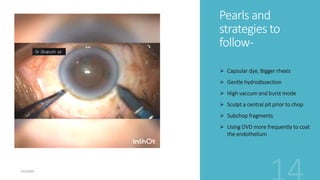
 Capsular dye, Bigger rhexis
 Gentle hydrodissection
 High vaccum and burst mode
 Sculpt a central pit prior to chop
 Subchop fragments
 Using OVD more frequently to coat
the endothelium
Recent advancements are evolving. One of them FLACS.
Major advantage is the potential to decrease intraocular phaco energy time, save the
endothelium, decrease the zonular stress and tackle astigmatism.
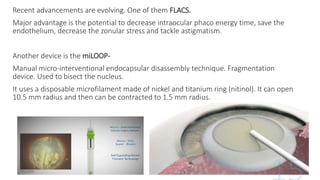
Another device is the miLOOP-
Manual micro-interventional endocapsular disassembly technique. Fragmentation
device. Used to bisect the nucleus.
It uses a disposable microfilament made of nickel and titanium ring (nitinol). It can open
10.5 mm radius and then can be contracted to 1.5 mm radius.
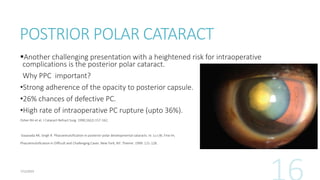
POSTRIOR POLAR CATARACT
Another challenging presentation with a heightened risk for intraoperative
complications is the posterior polar cataract.
Why PPC important?
•Strong adherence of the opacity to posterior capsule.
•26% chances of defective PC.
•High rate of intraoperative PC rupture (upto 36%).
Osher RH et al. J Cataract Refract Surg. 1990;16(2):157-162.
Vasavada AR, Singh R. Phacoemulsification in posterior polar developmental cataracts. In: Lu LW, Fine IH,
Phacoemulsification in Difficult and Challenging Cases. New York, NY: Thieme: 1999: 121-128.
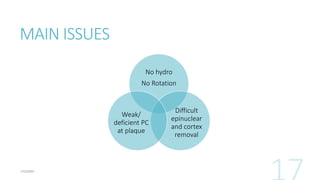
MAIN ISSUES
No hydro
No Rotation
Difficult
epinuclear
and cortex
removal
Weak/
deficient PC
at plaque
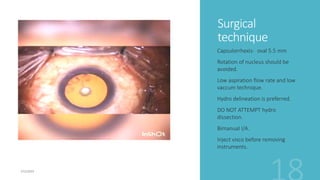
Surgical
technique
Capsulorrhexis- oval 5.5 mm
Rotation of nucleus should be
avoided.
Low aspiration flow rate and low
vaccum technique.
Hydro delineation is preferred.
DO NOT ATTEMPT hydro
dissection.
Bimanual I/A.
Inject visco before removing
instruments.
FEW TIPS
1. Identify PC defect before surgery- fish tail sign
2. Good adequate rhexis- prefer oval shape
3. No hydro-dissection- no rotation
4. Low parameter phaco
5. Avoid shallowing of anterior chamber
6. Cortex and epinuclear plate removal- bimanual I/A
7. No PC polishing
Cataract with Fuch’s endothelial
dystrophy
Fuchs’ endothelial corneal dystrophy (FECD) is a condition that affects the corneal endothelium,
resulting in a reduction in the number of Na+/K+ ATPase pumps [1]. Clinically, this manifests as corneal
edema, which can lead to symptomatic glare and halos, and ultimately decreased visual acuity.
Presentation- blurring of vision (more in the morning hours), glare.
Detection- guttae
External Disease and Cornea, Section 8. Basic Clinical Science Course, American Academy of Ophthalmology. 2018.
Dilemma
Whethertooperateonlycataractorshouldbecombinedwithendothelial
keratoplasty.
Pre-operative considerations-
The surgeon should consider the individual factors
•cataract density, the health and thickness of the cornea, the anterior chamber depth
and the size of the dilated pupil.
The presence of microcystic oedema, pachy >640 microns, stromal thickening and a
low central endothelial cell count (less than 1,000 cells/mm2), indicates an increased
likelihood of corneal decompensation after cataract surgery.
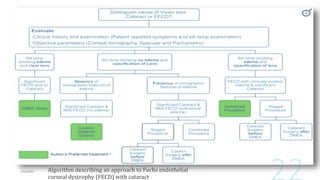
In these patients, cataract surgery should be combined with endothelial keratoplasty.
Algorithm describing an approach to Fuchs endothelial
corneal dystrophy (FECD) with cataract
Patient counselling-
Postoperative recovery time may be longer than usual.
Endothelial keratoplasty may be required in case of corneal decompensation.
Patients may have to come for regular follow-up visits.
Choice of IOL-
standard monofocal IOL is recommended
Surgical technique-
To reduce EC loss such as tri-soft shell technique (TSST), Phaco-Chop technique and low-flow
irrigation may be considered.
Errant Rhexis
Management of the capsulorrhexis is a fundamental step in cataract surgery.
Best capsulorrhexis are round, continuous, well centered, and overlapping the edge
of the IOL around its circumference.
FACTORS PREDISPOSING TO AN ERRANT RHEXIS
Shallow AC
convex anterior lens capsule
poor visualization
small pupil
traumatic cataract with anterior capsular tear
 white mature or Morgagnian cataract are some of the reasons a rhexis may run out.
Run away rhexis
Blind pulling is avoided to avoid posterior capsular
extension.
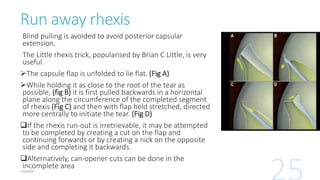
The Little rhexis trick, popularised by Brian C Little, is very
useful.
The capsule flap is unfolded to lie flat. (Fig A)
While holding it as close to the root of the tear as
possible, (fig B) it is first pulled backwards in a horizontal
plane along the circumference of the completed segment
of rhexis (Fig C) and then with flap held stretched, directed
more centrally to initiate the tear. (Fig D)
If the rhexis run-out is irretrievable, it may be attempted
to be completed by creating a cut on the flap and
continuing forwards or by creating a nick on the opposite
side and completing it backwards.
Alternatively, can-opener cuts can be done in the
incomplete area

Complex cases in Cataract surgery and its management.pptx

  • 1.
    Complex cases in Cataractsurgery and its management Mentor- Dr Sharat sir Sharat maxivision eye hospital Presenter Madhumita Prasad Maxivision eye hospital, Somajiguda
  • 2.
    Table of content 1.Small pupil surgeries 2. Hard cataract and its management 3. Posterior polar cataract 4. Cataract in Fuch’s corneal dystrophy 5. Runaway rhexis
  • 3.
    Introduction In ophthalmology theclinical management of patients is constantly evolving and complication rate is getting low. Although routine cataract surgery considered as low-risk surgery for both patients and the surgeon, some eyes have higher risk of complications. It is extremely important to recognize when eyes are at greater risk, and manage accordingly to reduce the complications. The common goal is to completely remove the cataract while preserving the zonules and capsular bag for the placement of an IOL.
  • 4.
    In the followingslides we will discuss some frequently encountered difficult situations and their solutions.
  • 5.
    Small Pupil Surgeries Mostcommon mechanisms of small pupil formation ETIOLOGY MECHANSIM Age related Iris atrophy Pseudoexfoliation Iris dilator and sphincter muscle atrophy Intraoperative Floppy iris syndrome Dilator muscle atony- atrophy Posterior Synechaie Uveitis, angle closure glaucoma
  • 6.
    Technical challenges ofsmall pupil surgery Reduced red reflex Increased risk of iris damage Iris bleeding Iris prolapse from wounds Incomplete evacuation of cortical material Problems in ensuring IN-THE-BAG IOL. Small anterior capsulorhexis size Risk of catching pupillary margin with phaco tip
  • 7.
    Small pupil management Pharmacological Ocularviscoelastic devices Mechanical devices
  • 8.
    Surgery technique  Capsulorhexis canbe made larger than the pupil size.  Complete hydrodissection  Vertical chopping technique is preferred to separate nucleus (If fibrous membrane is found behind the pupil, it is removed using forceps)
  • 9.
    PHARMACOLOGICAL MYDRIASIS •The useof preoperative anti-infl ammatory agents (NSAIDs) decreased occasions of intraoperative pupillary constrictions greatly. • 1:1000 preservative free epinephrine intracameral injection (epitrate)
  • 10.
    Ocular viscoelastic devices -OVDs are non active, clear, gel like chemical compounds with viscous and elastic properties. Classified as- Cohesive- high viscosity, high molecular weight, act like a gel, create space. Examples – healon GV/ healon, provisc Dispersive- lower viscosity, lower molecular weight, adhesive and protective effect, high coating ability. Like viscoat, healon D, ocucoat Viscoadaptive OVDs- super cohesive viscoelastic substances, creating more space, healon 5 Management with OVD Visco elastic agent Iris stretching can be done Deepening of AC Pupil dilatation
  • 11.
    Mechanical devices 1. Hydroviewiris protector ring 2. Malyugin Ring 3. B-HEX pupil expander 4. I-ring pupil expander 5. Iris hooks Malyugin B. Cataract surgery in small pupils. Indian J Ophthalmol. 2017 Dec;65(12):1323- 1328. doi: 10.4103/ijo.IJO_800_17. PMID: 29208812; PMCID: PMC5742960.
  • 12.
    Surgical maneuvers- 1. Synechiolysis 2.Stretch pupilloplasty- 2 instruments 3. Iris cutting with vanas
  • 13.
    Management of hardcataract Problems encountered by surgeons- Capsular zonular problems Corneal edema Wound burn Post operative inflammations PC rupture Main aim is to minimize the endothelial cell loss and protect the PC. Reason being- Lens fibre are totally adherent, making chopping difficult. There is very little or no cortical cushion between lens and the capsule.
  • 14.
    Pearls and strategies to follow- Capsular dye, Bigger rhexis  Gentle hydrodissection  High vaccum and burst mode  Sculpt a central pit prior to chop  Subchop fragments  Using OVD more frequently to coat the endothelium
  • 15.
    Recent advancements areevolving. One of them FLACS. Major advantage is the potential to decrease intraocular phaco energy time, save the endothelium, decrease the zonular stress and tackle astigmatism. Another device is the miLOOP- Manual micro-interventional endocapsular disassembly technique. Fragmentation device. Used to bisect the nucleus. It uses a disposable microfilament made of nickel and titanium ring (nitinol). It can open 10.5 mm radius and then can be contracted to 1.5 mm radius.
  • 16.
    POSTRIOR POLAR CATARACT Anotherchallenging presentation with a heightened risk for intraoperative complications is the posterior polar cataract. Why PPC important? •Strong adherence of the opacity to posterior capsule. •26% chances of defective PC. •High rate of intraoperative PC rupture (upto 36%). Osher RH et al. J Cataract Refract Surg. 1990;16(2):157-162. Vasavada AR, Singh R. Phacoemulsification in posterior polar developmental cataracts. In: Lu LW, Fine IH, Phacoemulsification in Difficult and Challenging Cases. New York, NY: Thieme: 1999: 121-128.
  • 17.
    MAIN ISSUES No hydro NoRotation Difficult epinuclear and cortex removal Weak/ deficient PC at plaque
  • 18.
    Surgical technique Capsulorrhexis- oval 5.5mm Rotation of nucleus should be avoided. Low aspiration flow rate and low vaccum technique. Hydro delineation is preferred. DO NOT ATTEMPT hydro dissection. Bimanual I/A. Inject visco before removing instruments.
  • 19.
    FEW TIPS 1. IdentifyPC defect before surgery- fish tail sign 2. Good adequate rhexis- prefer oval shape 3. No hydro-dissection- no rotation 4. Low parameter phaco 5. Avoid shallowing of anterior chamber 6. Cortex and epinuclear plate removal- bimanual I/A 7. No PC polishing
  • 20.
    Cataract with Fuch’sendothelial dystrophy Fuchs’ endothelial corneal dystrophy (FECD) is a condition that affects the corneal endothelium, resulting in a reduction in the number of Na+/K+ ATPase pumps [1]. Clinically, this manifests as corneal edema, which can lead to symptomatic glare and halos, and ultimately decreased visual acuity. Presentation- blurring of vision (more in the morning hours), glare. Detection- guttae External Disease and Cornea, Section 8. Basic Clinical Science Course, American Academy of Ophthalmology. 2018.
  • 21.
    Dilemma Whethertooperateonlycataractorshouldbecombinedwithendothelial keratoplasty. Pre-operative considerations- The surgeonshould consider the individual factors •cataract density, the health and thickness of the cornea, the anterior chamber depth and the size of the dilated pupil. The presence of microcystic oedema, pachy >640 microns, stromal thickening and a low central endothelial cell count (less than 1,000 cells/mm2), indicates an increased likelihood of corneal decompensation after cataract surgery. In these patients, cataract surgery should be combined with endothelial keratoplasty.
  • 22.
    Algorithm describing anapproach to Fuchs endothelial corneal dystrophy (FECD) with cataract
  • 23.
    Patient counselling- Postoperative recoverytime may be longer than usual. Endothelial keratoplasty may be required in case of corneal decompensation. Patients may have to come for regular follow-up visits. Choice of IOL- standard monofocal IOL is recommended Surgical technique- To reduce EC loss such as tri-soft shell technique (TSST), Phaco-Chop technique and low-flow irrigation may be considered.
  • 24.
    Errant Rhexis Management ofthe capsulorrhexis is a fundamental step in cataract surgery. Best capsulorrhexis are round, continuous, well centered, and overlapping the edge of the IOL around its circumference. FACTORS PREDISPOSING TO AN ERRANT RHEXIS Shallow AC convex anterior lens capsule poor visualization small pupil traumatic cataract with anterior capsular tear  white mature or Morgagnian cataract are some of the reasons a rhexis may run out.
  • 25.
    Run away rhexis Blindpulling is avoided to avoid posterior capsular extension. The Little rhexis trick, popularised by Brian C Little, is very useful. The capsule flap is unfolded to lie flat. (Fig A) While holding it as close to the root of the tear as possible, (fig B) it is first pulled backwards in a horizontal plane along the circumference of the completed segment of rhexis (Fig C) and then with flap held stretched, directed more centrally to initiate the tear. (Fig D) If the rhexis run-out is irretrievable, it may be attempted to be completed by creating a cut on the flap and continuing forwards or by creating a nick on the opposite side and completing it backwards. Alternatively, can-opener cuts can be done in the incomplete area