MOTOR EVALUATION OF
STRABISMUS (part 1)
Samhaa Mohammed Abd Elmoneim
(FRCS Glasgow, Egyptian Fellowship, MSc.)
Zagazig Ophthalmic Hospital
(2021)
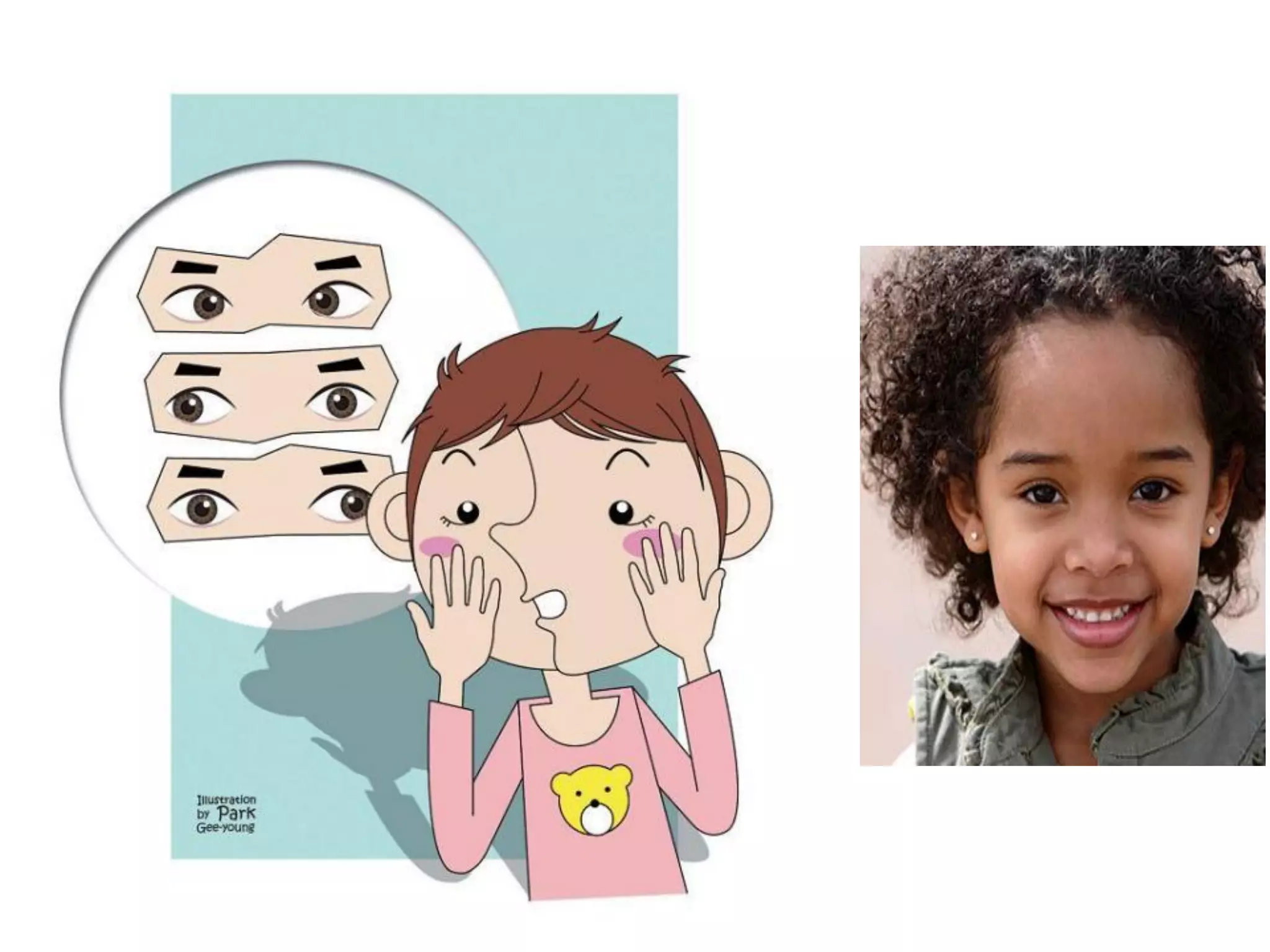
Before asking what is Dx/ type of a squint,
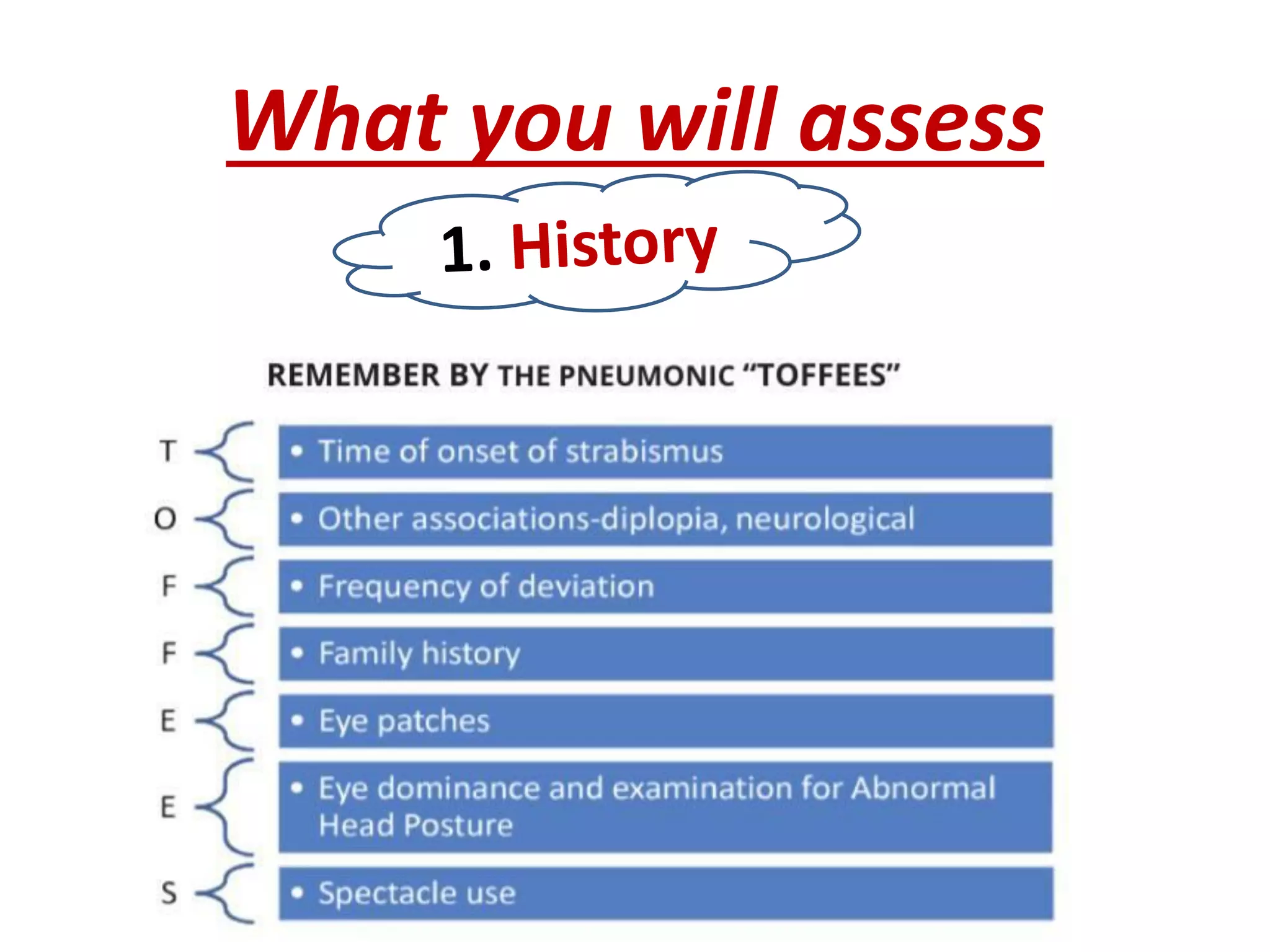
Ask about
How do I examine and assess if patient
has squint or not?
What we learn and practice today:
• How to assess if there is ocular deviation or not
using easy, quick and sensitive, objective clinical
tests .
• Simulate the steps and findings of each test in an
organized, systematic, clear and proper way.
• These tests confirm true squint (manifest/ latent)
and exclude pseudo-strabismus.
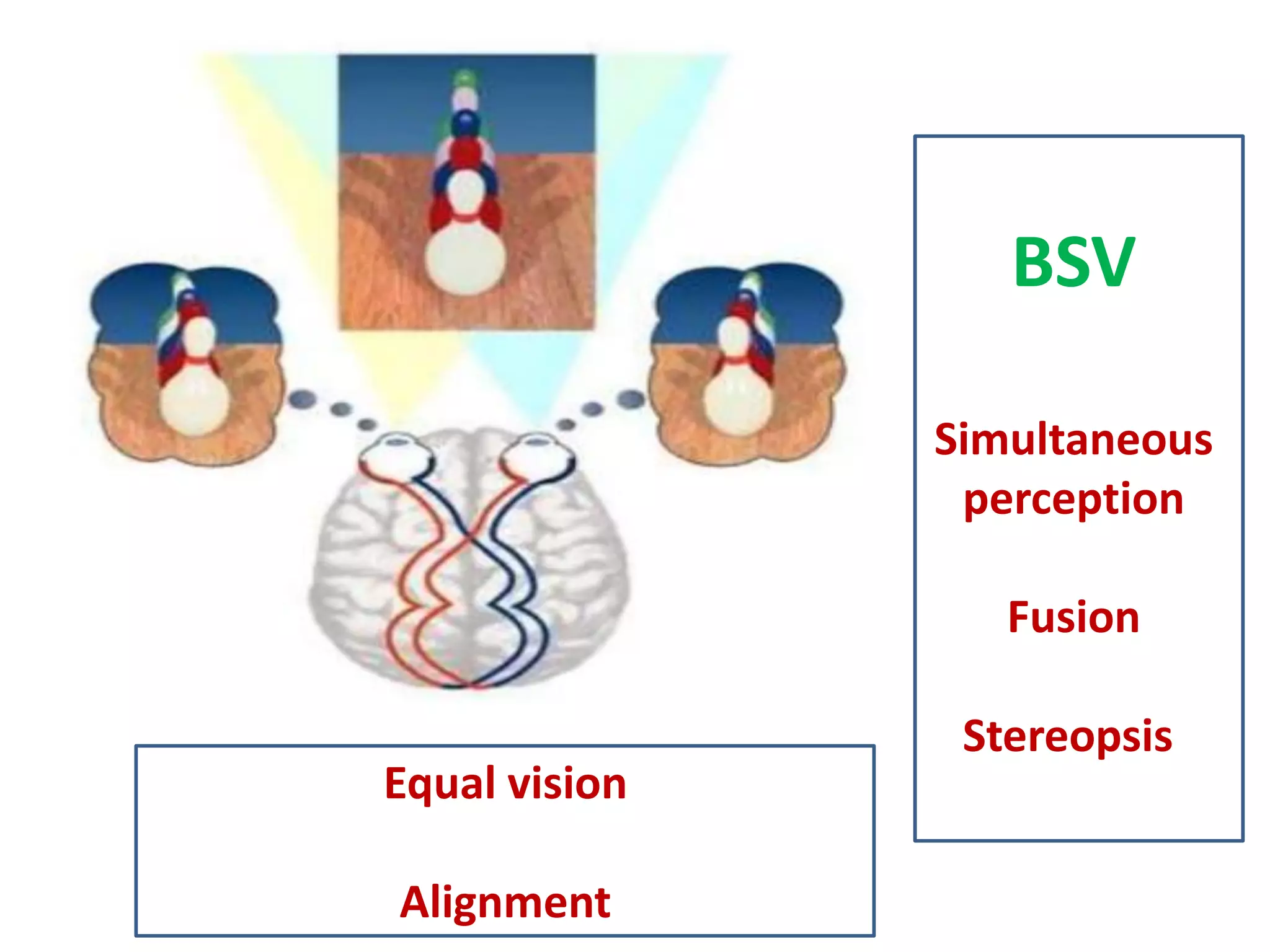
BSV
Simultaneous
perception
Fusion
Stereopsis
Equal vision
Alignment
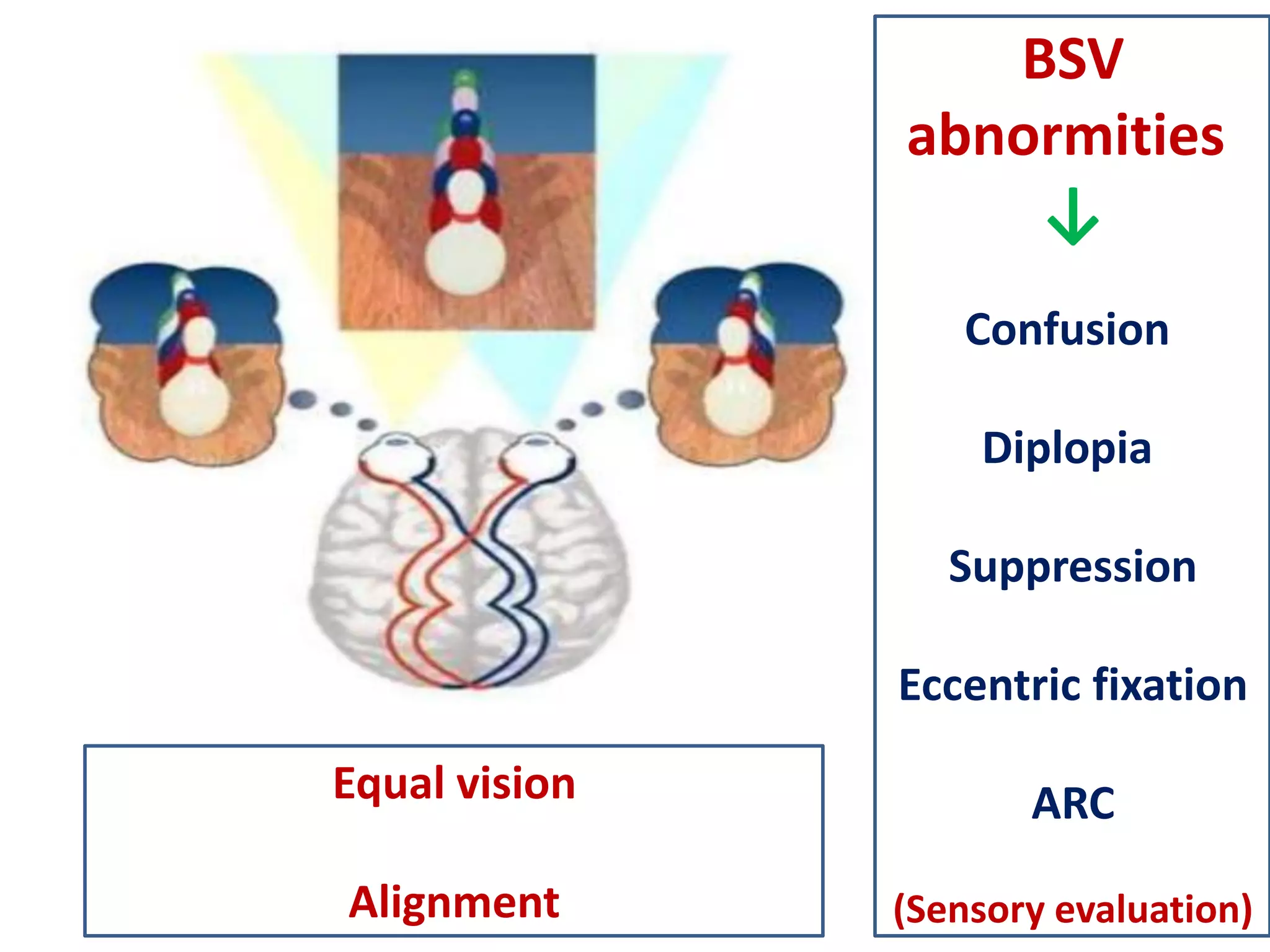
BSV
abnormities
↓
Confusion
Diplopia
Suppression
Eccentric fixation
ARC
(Sensory evaluation)
Equal vision
Alignment
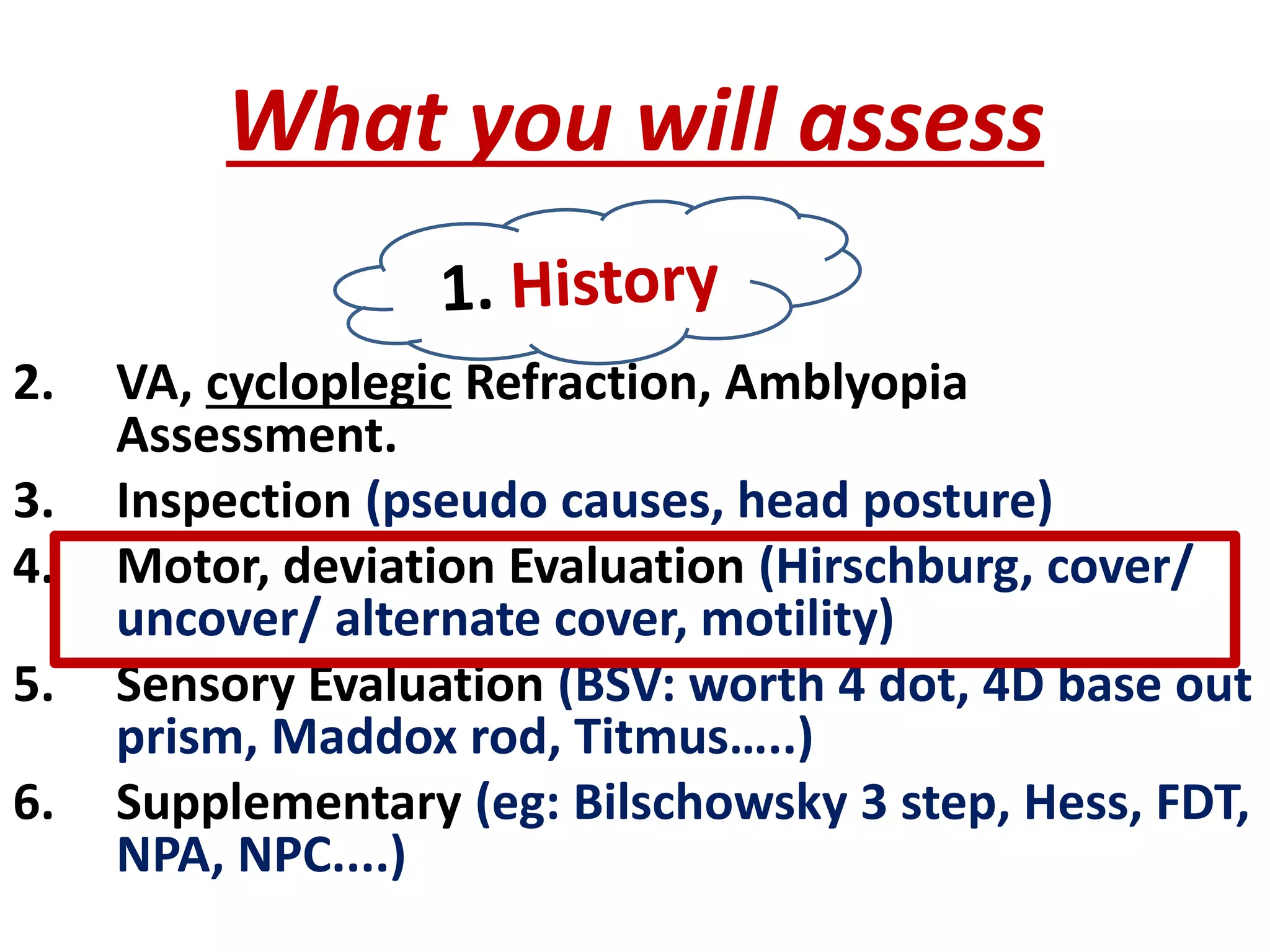
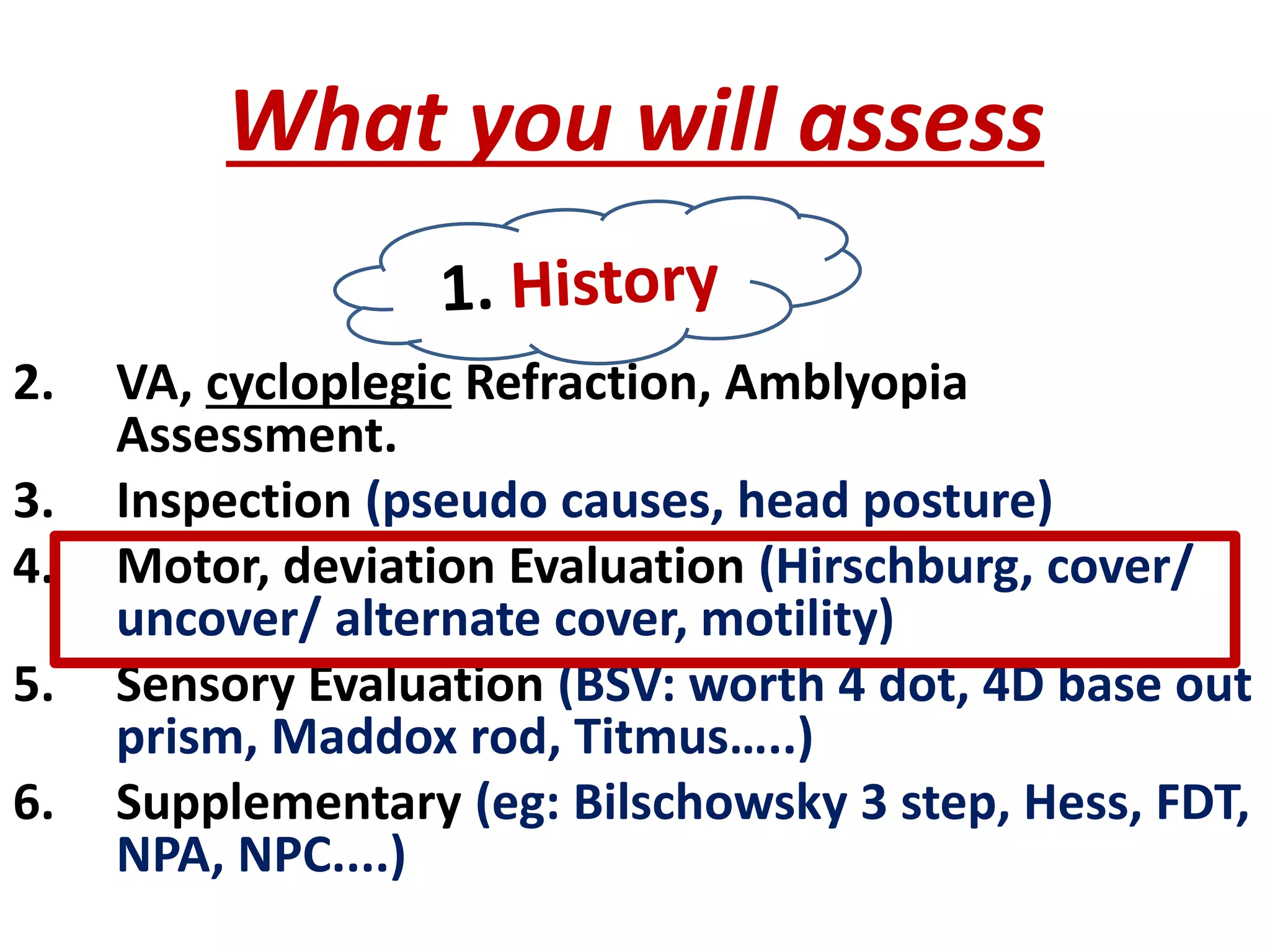
What you will assess
2. VA, cycloplegic Refraction, Amblyopia
Assessment.
3. Inspection (pseudo causes, head posture)
4. Motor, deviation Evaluation (Hirschburg, cover/
uncover/ alternate cover, motility)
5. Sensory Evaluation (BSV: worth 4 dot, 4D base out
prism, Maddox rod, Titmus…..)
6. Supplementary (eg: Bilschowsky 3 step, Hess, FDT,
NPA, NPC....)
What you will assess
2. VA, cycloplegic Refraction, Amblyopia
Assessment.
3. Inspection (pseudo causes, head posture)
4. Motor, deviation Evaluation (Hirschburg, cover/
uncover/ alternate cover, motility)
5. Sensory Evaluation (BSV: worth 4 dot, 4D base out
prism, Maddox rod, Titmus…..)
6. Supplementary (eg: Bilschowsky 3 step, Hess, FDT,
NPA, NPC....)
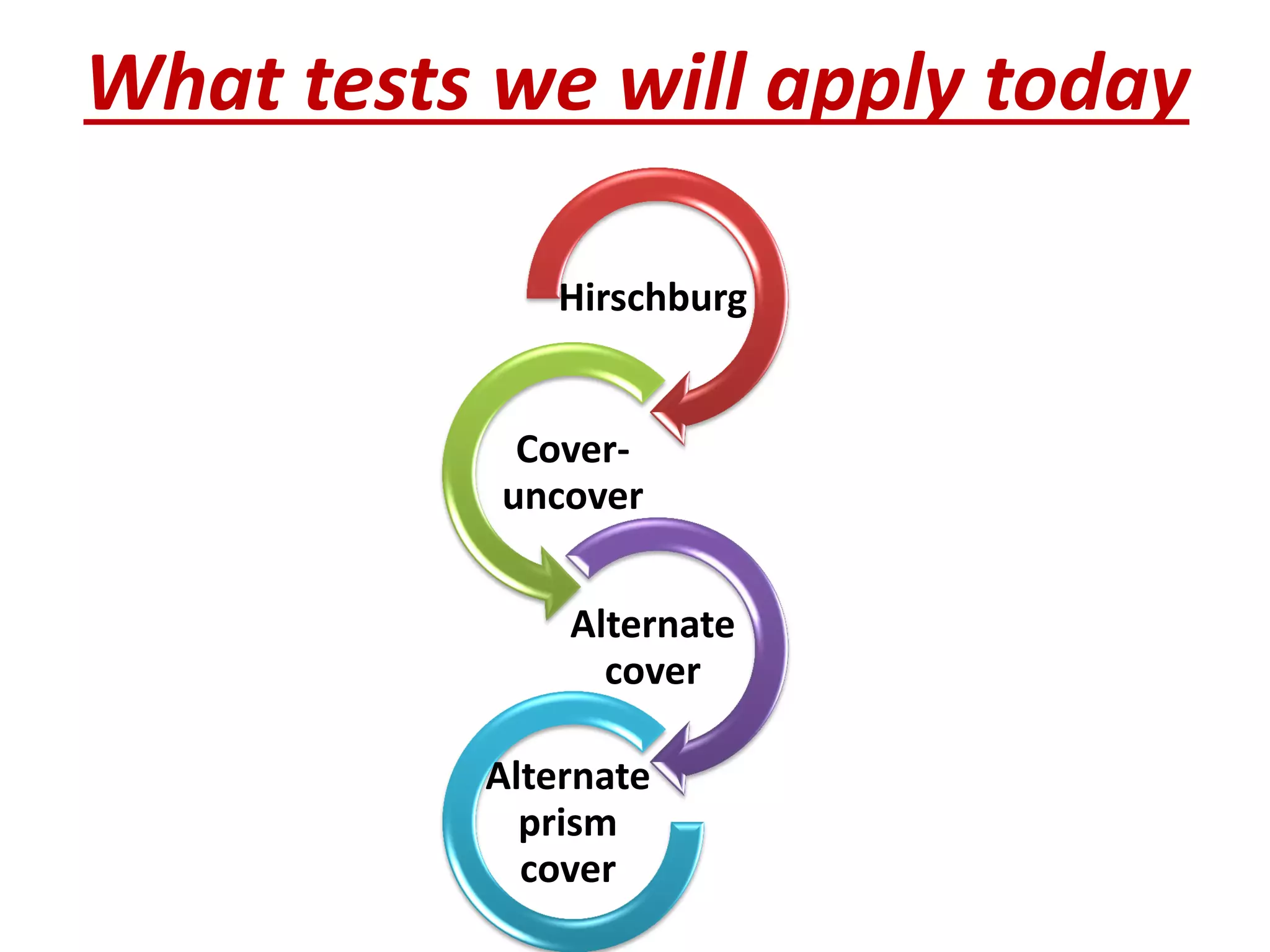
What tests we will apply today
Hirschburg
Cover-
uncover
Alternate
cover
Alternate
prism
cover
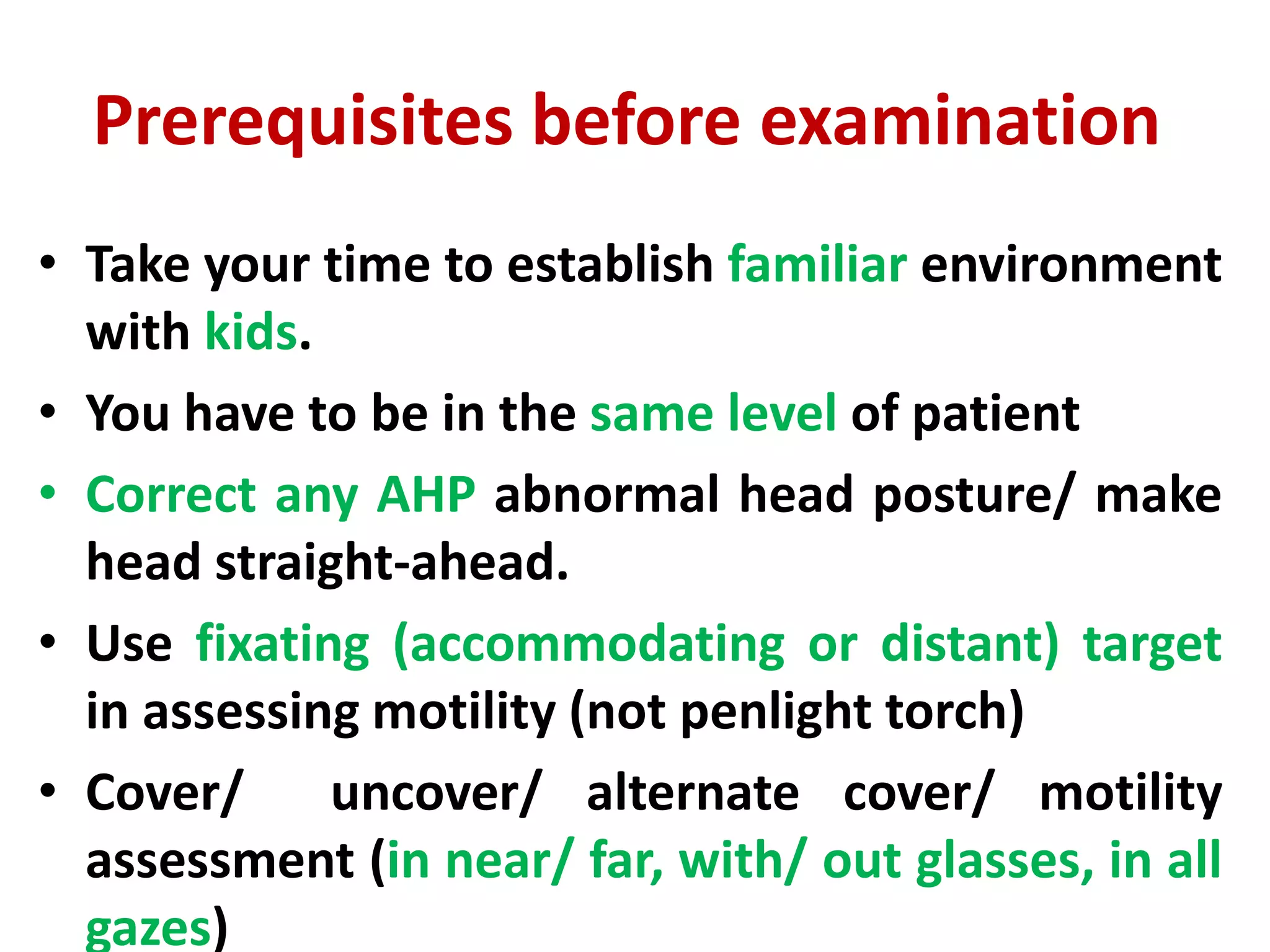
Prerequisites before examination
• Take your time to establish familiar environment
with kids.
• You have to be in the same level of patient
• Correct any AHP abnormal head posture/ make
head straight-ahead.
• Use fixating (accommodating or distant) target
in assessing motility (not penlight torch)
• Cover/ uncover/ alternate cover/ motility
assessment (in near/ far, with/ out glasses, in all
gazes)
What tests we will apply today
Hirschburg
Cover-
uncover
Alternate
cover
Alternate
prism
cover
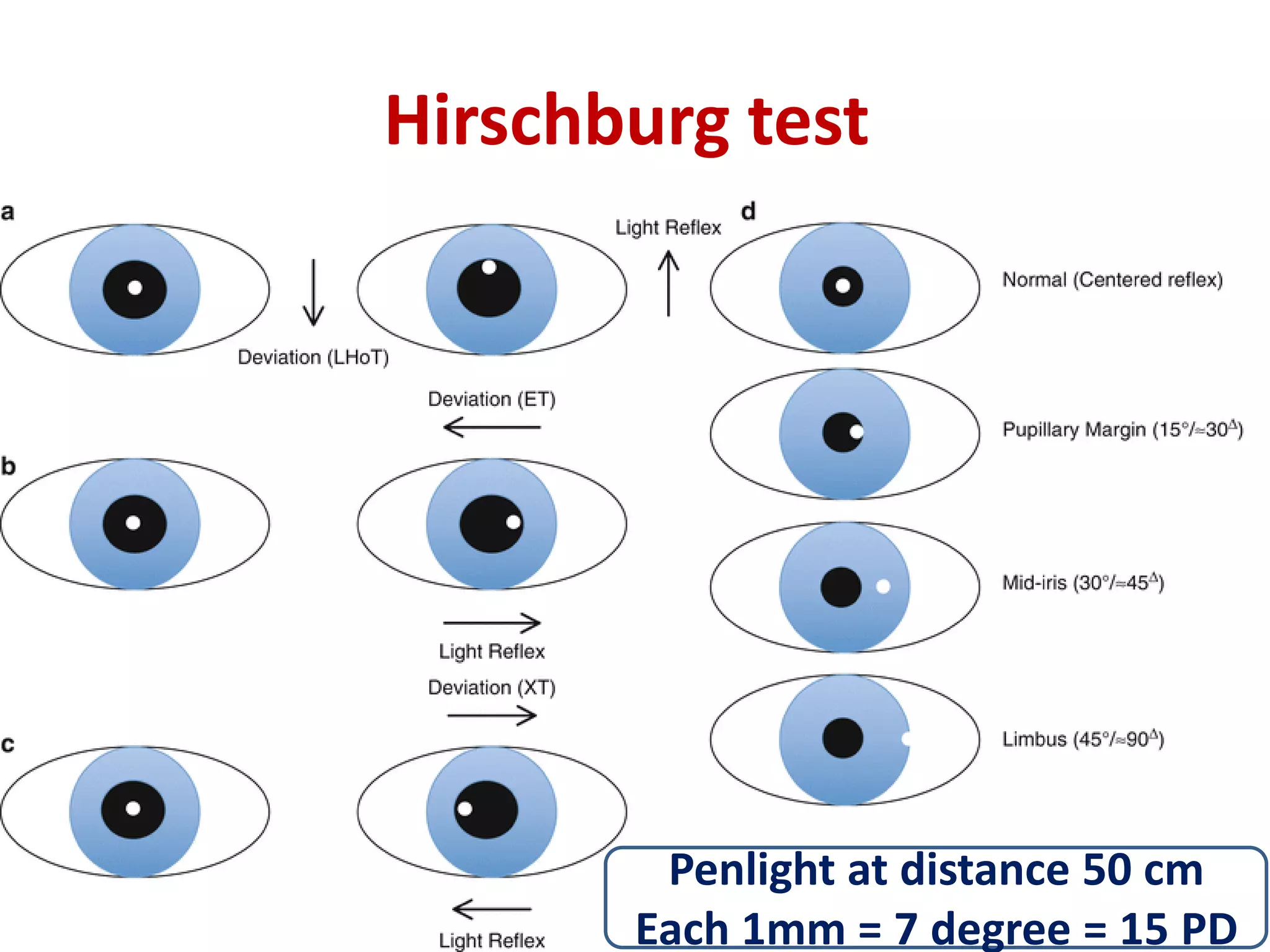
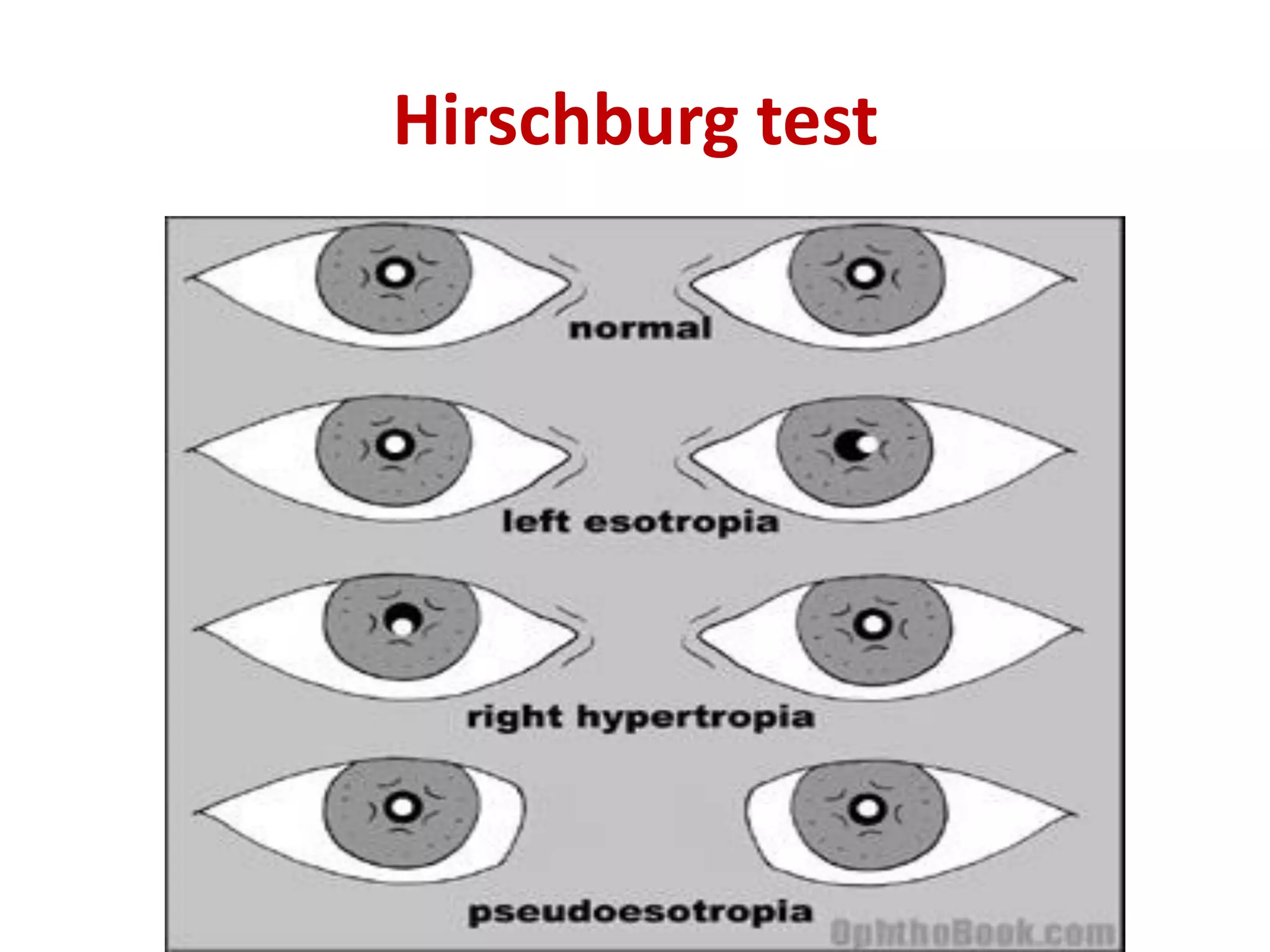
Hirschburg test
Penlight at distance 50 cm
Each 1mm = 7 degree = 15 PD
Hirschburg test
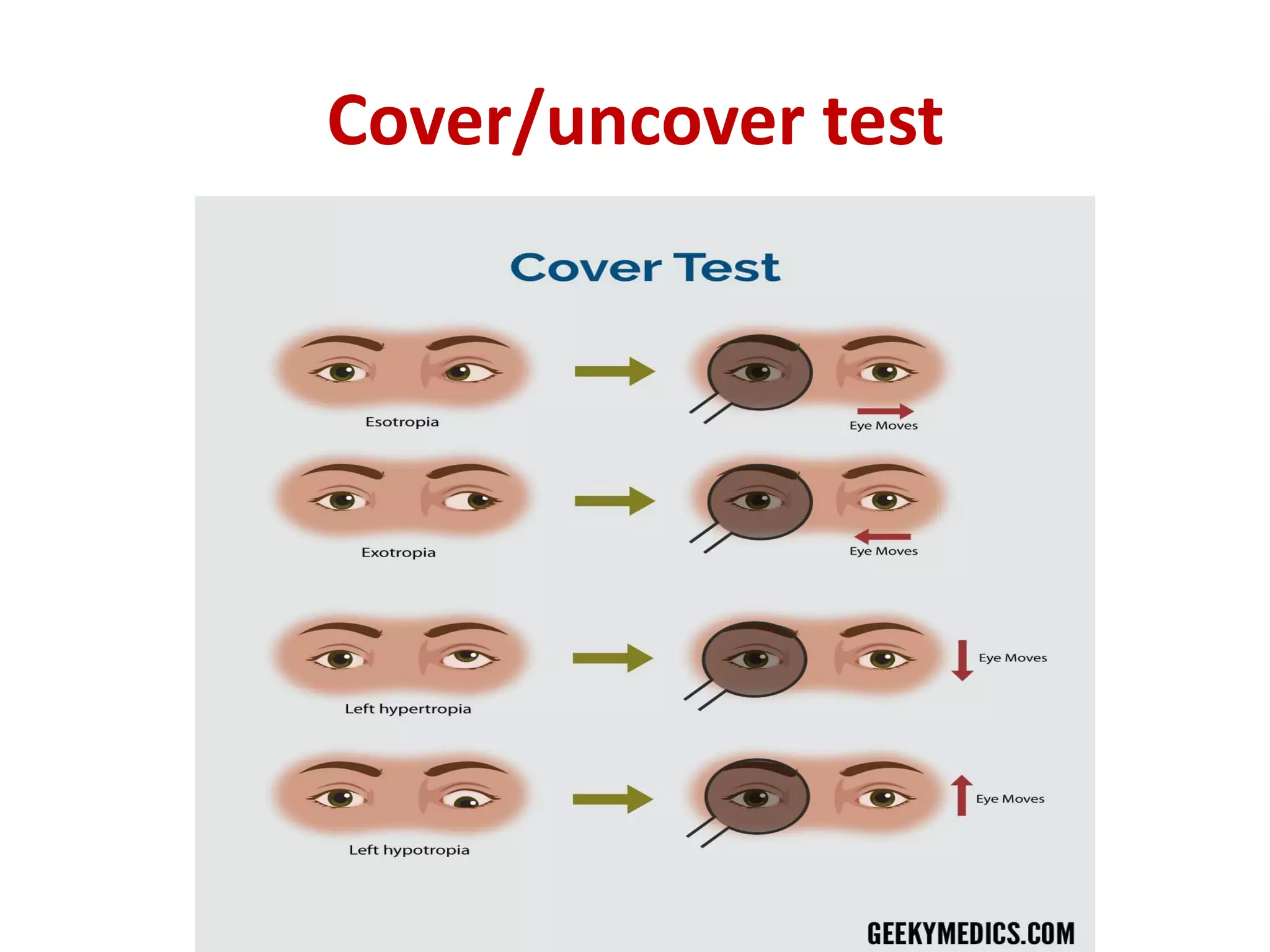
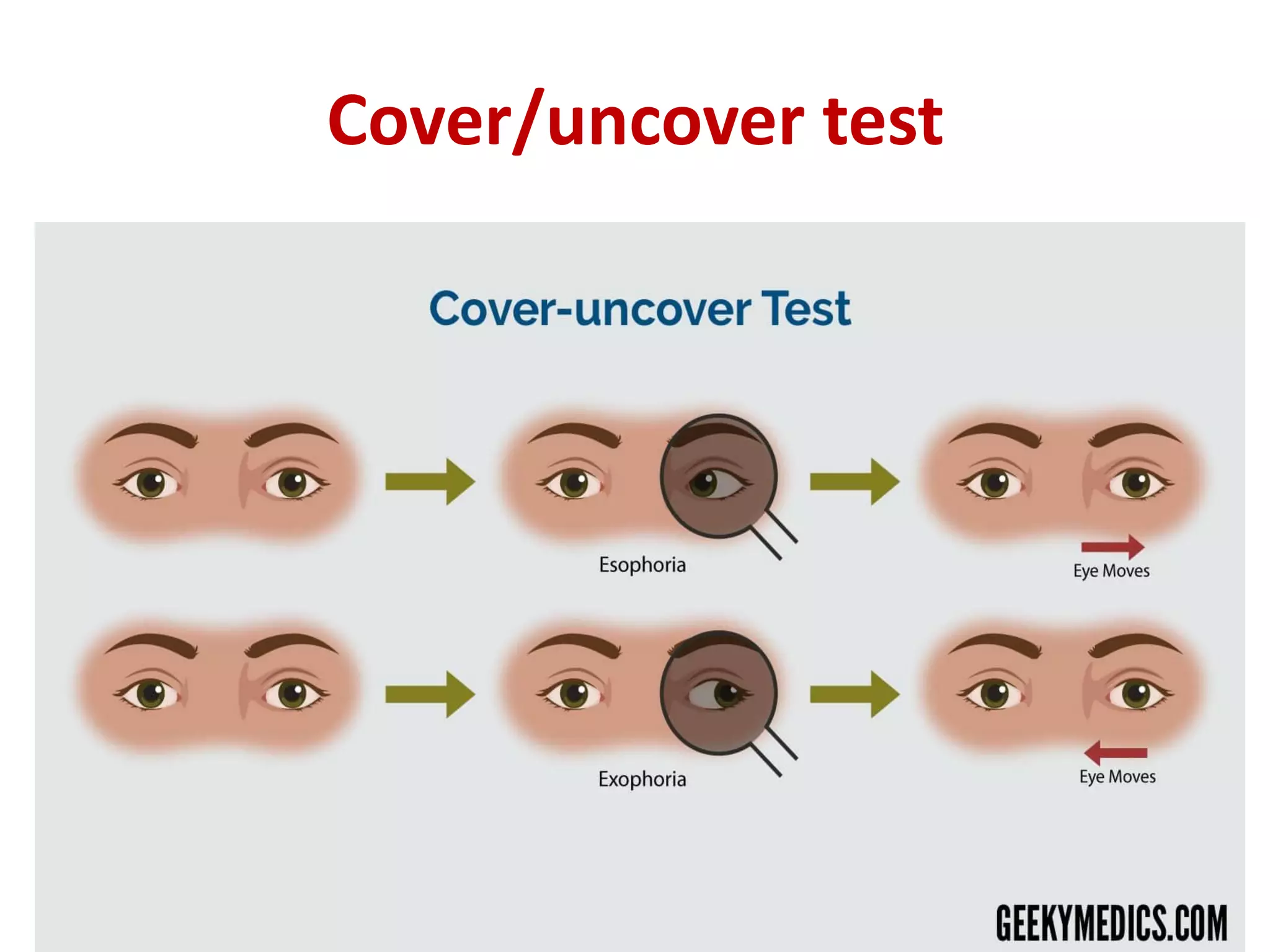
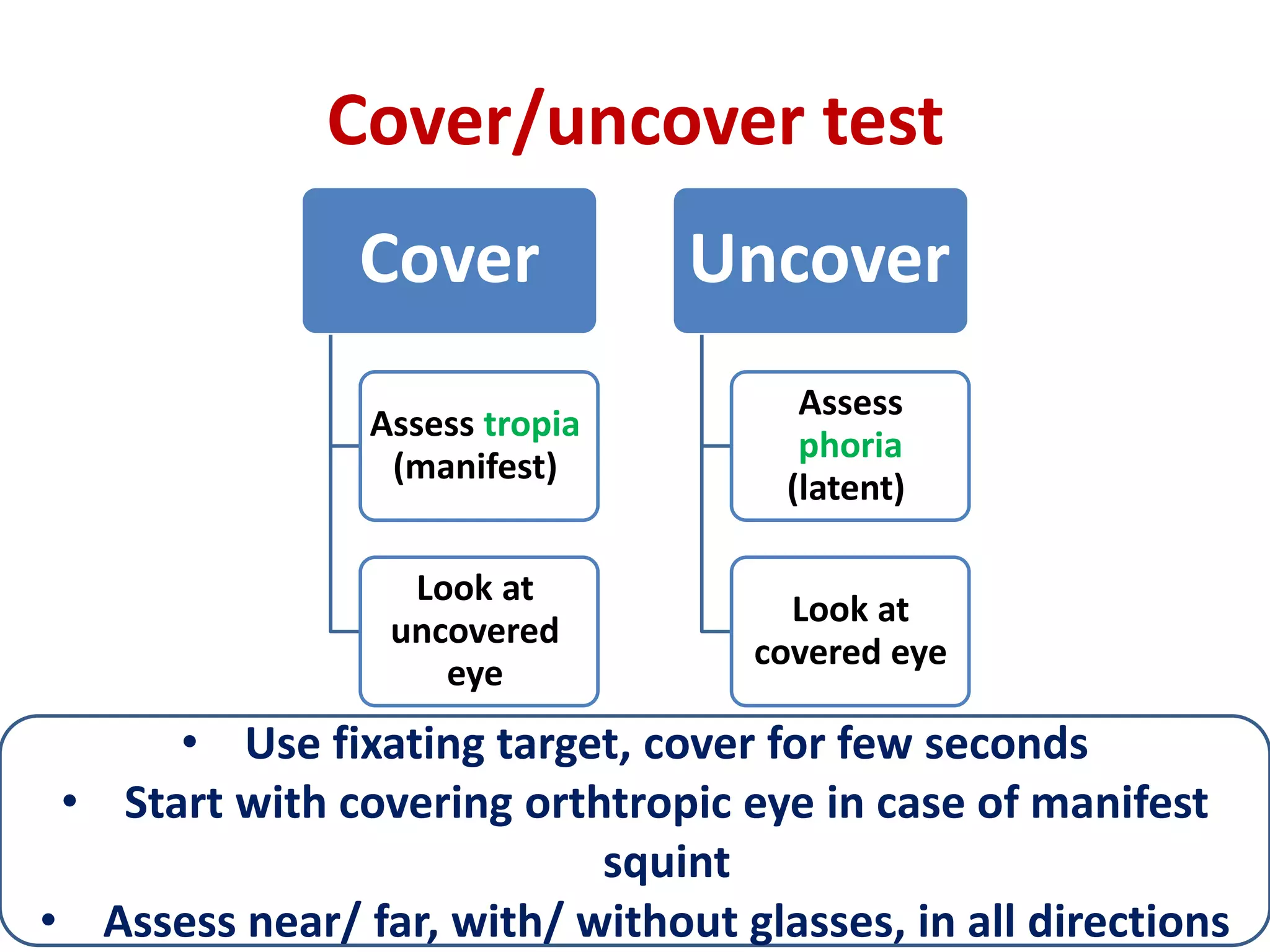
Cover/uncover test
Cover/uncover test
Cover/uncover test
Cover
Assess tropia
(manifest)
Look at
uncovered
eye
Uncover
Assess
phoria
(latent)
Look at
covered eye
• Use fixating target, cover for few seconds
• Start with covering orthtropic eye in case of manifest
squint
• Assess near/ far, with/ without glasses, in all directions
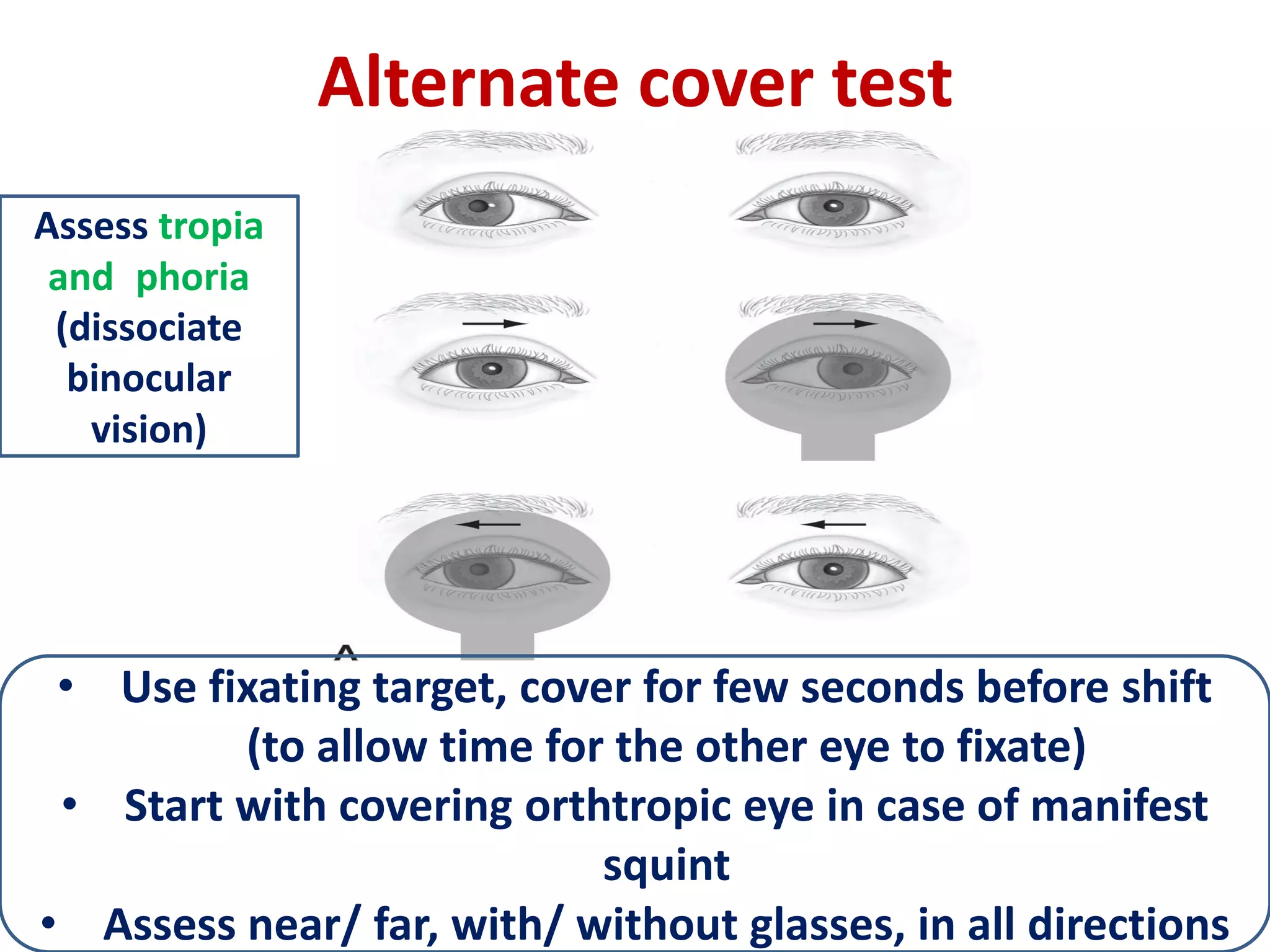
Alternate cover test
• Use fixating target, cover for few seconds before shift
(to allow time for the other eye to fixate)
• Start with covering orthtropic eye in case of manifest
squint
• Assess near/ far, with/ without glasses, in all directions
Assess tropia
and phoria
(dissociate
binocular
vision)
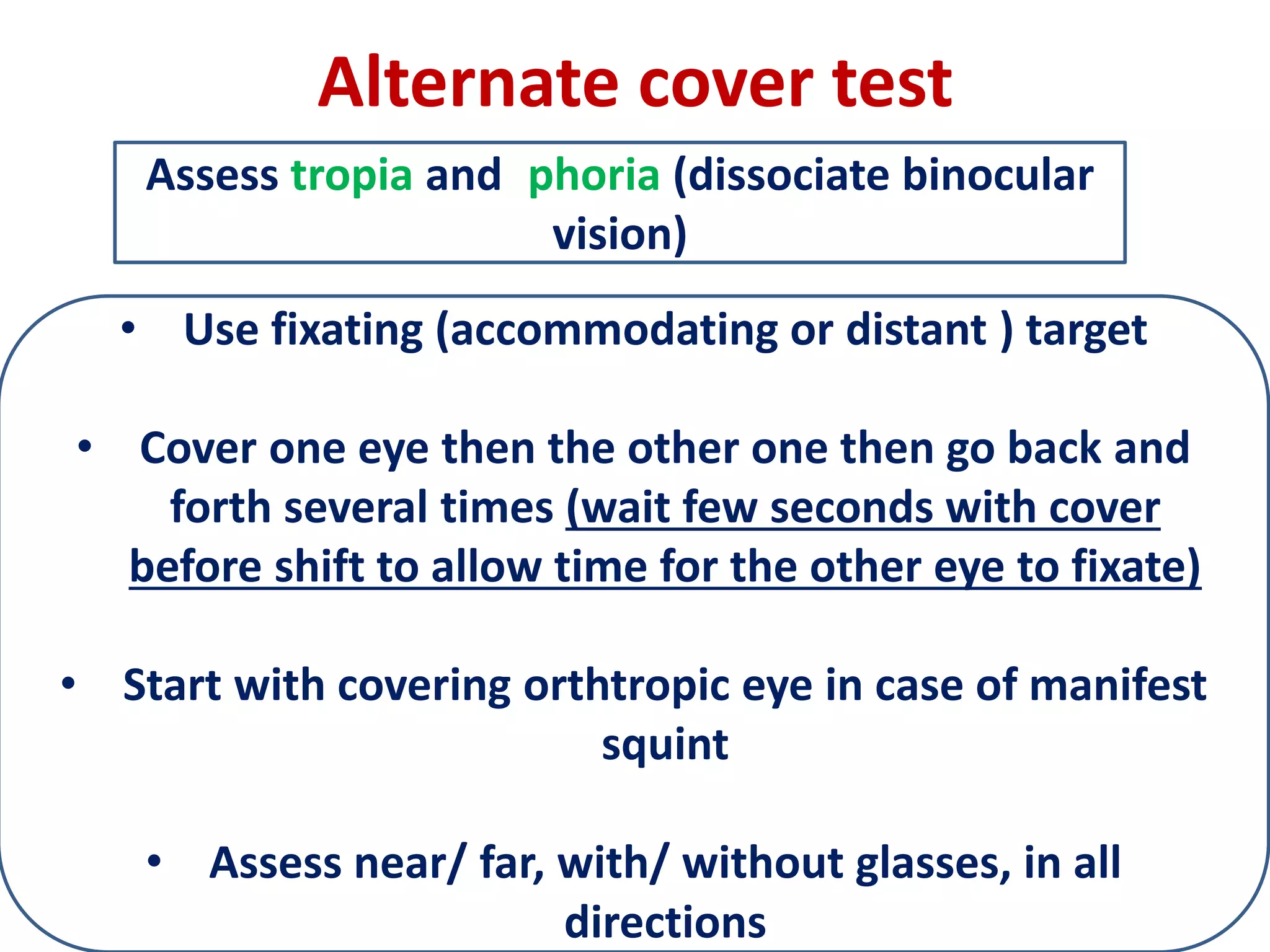
Alternate cover test
• Use fixating (accommodating or distant ) target
• Cover one eye then the other one then go back and
forth several times (wait few seconds with cover
before shift to allow time for the other eye to fixate)
• Start with covering orthtropic eye in case of manifest
squint
• Assess near/ far, with/ without glasses, in all
directions
Assess tropia and phoria (dissociate binocular
vision)
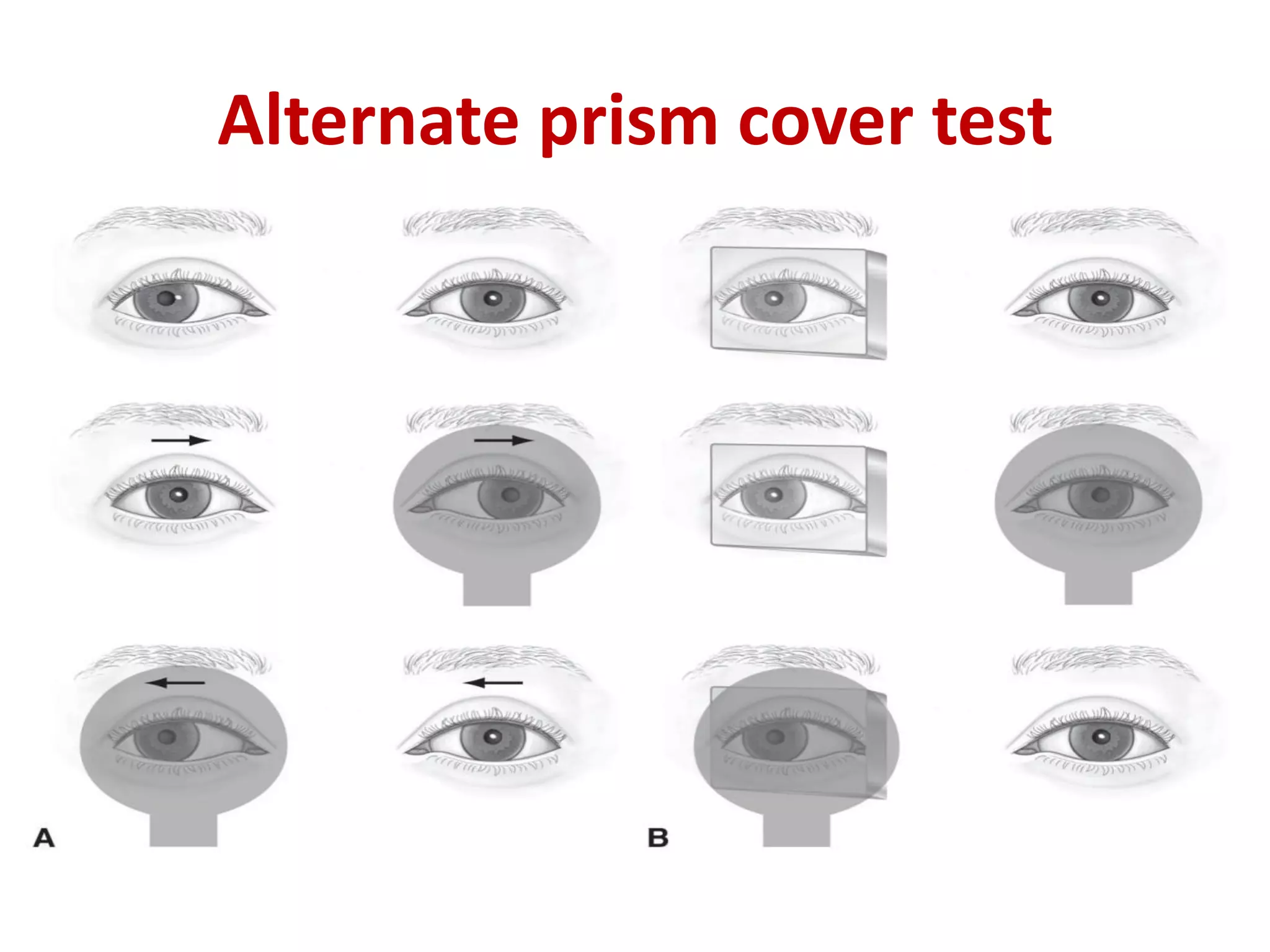
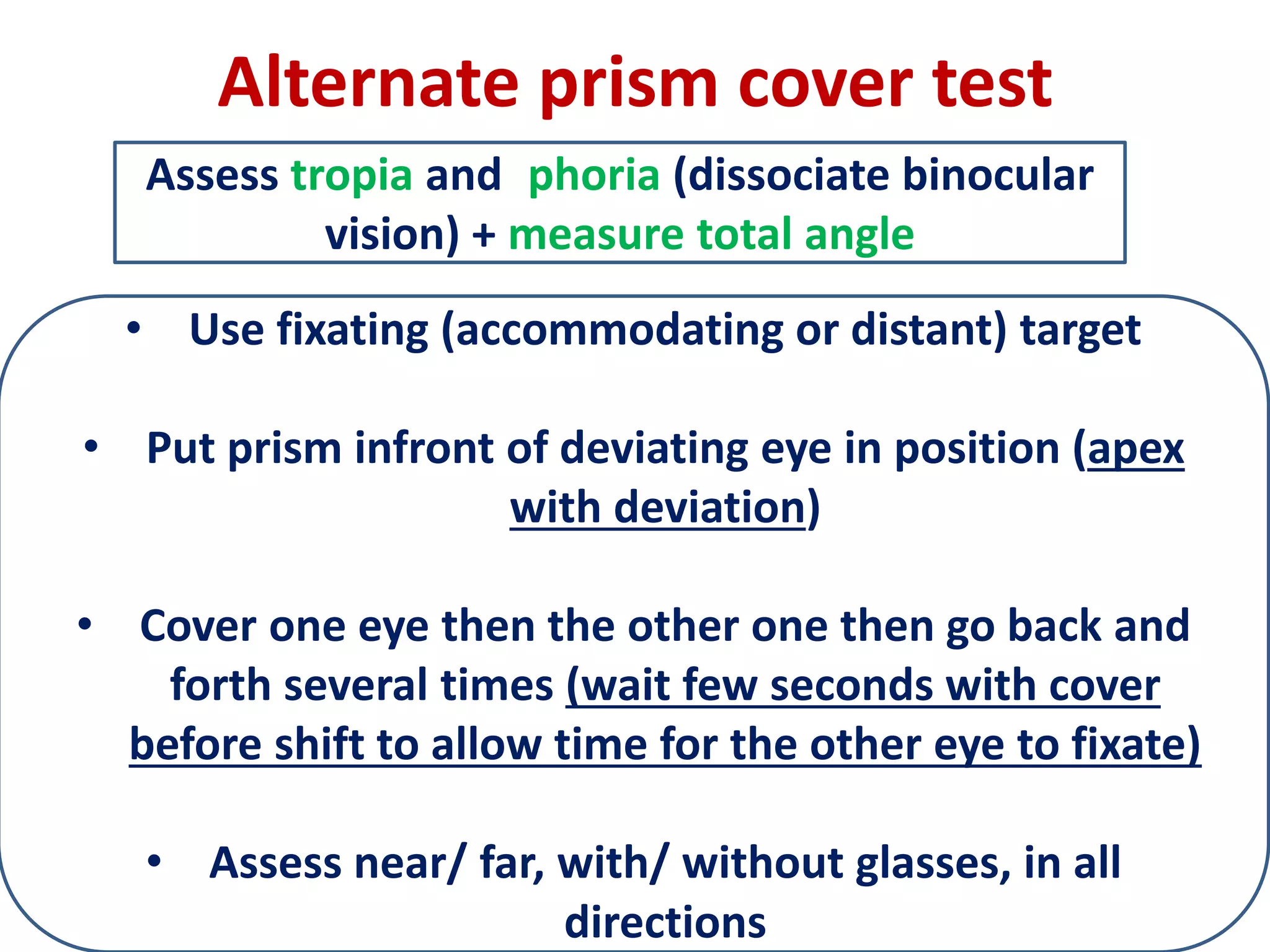
Alternate prism cover test
• Use fixating (accommodating or distant) target
• Put prism infront of deviating eye in position (apex
with deviation)
• Cover one eye then the other one then go back and
forth several times (wait few seconds with cover
before shift to allow time for the other eye to fixate)
• Assess near/ far, with/ without glasses, in all
directions
Assess tropia and phoria (dissociate binocular
vision) + measure total angle
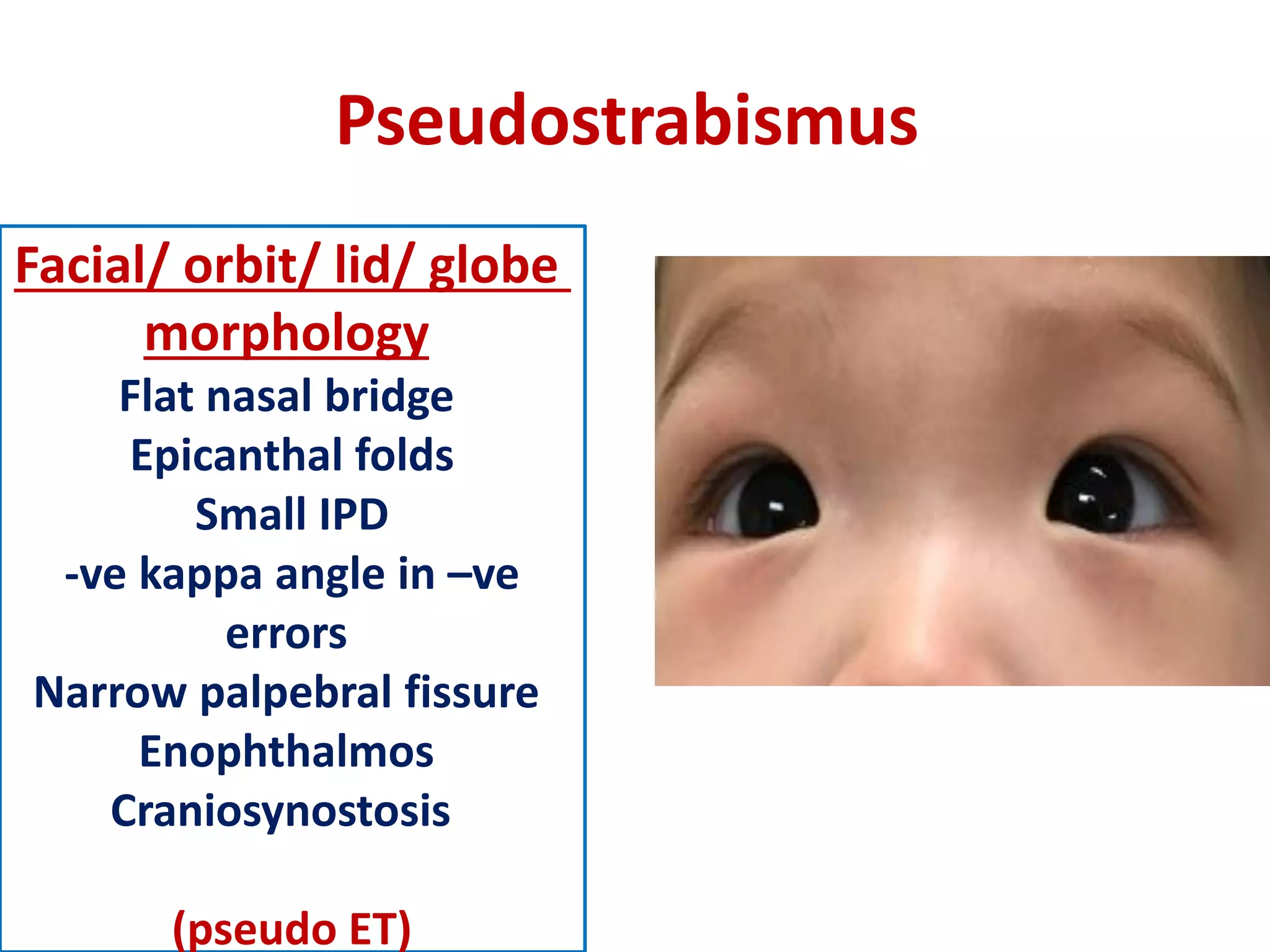
Pseudostrabismus
Facial/ orbit/ lid/ globe
morphology
Flat nasal bridge
Epicanthal folds
Small IPD
-ve kappa angle in –ve
errors
Narrow palpebral fissure
Enophthalmos
Craniosynostosis
(pseudo ET)
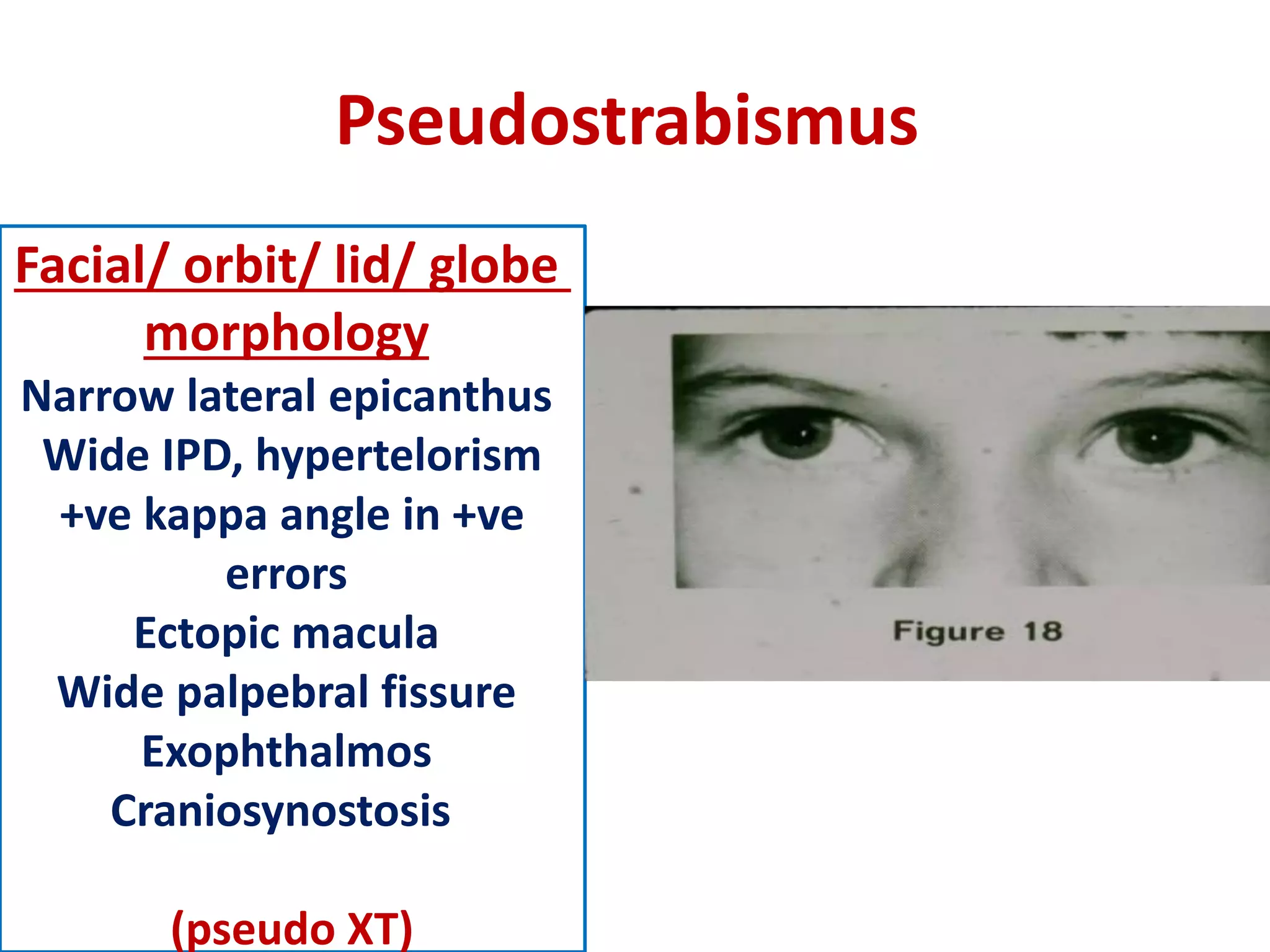
Pseudostrabismus
Facial/ orbit/ lid/ globe
morphology
Narrow lateral epicanthus
Wide IPD, hypertelorism
+ve kappa angle in +ve
errors
Ectopic macula
Wide palpebral fissure
Exophthalmos
Craniosynostosis
(pseudo XT)
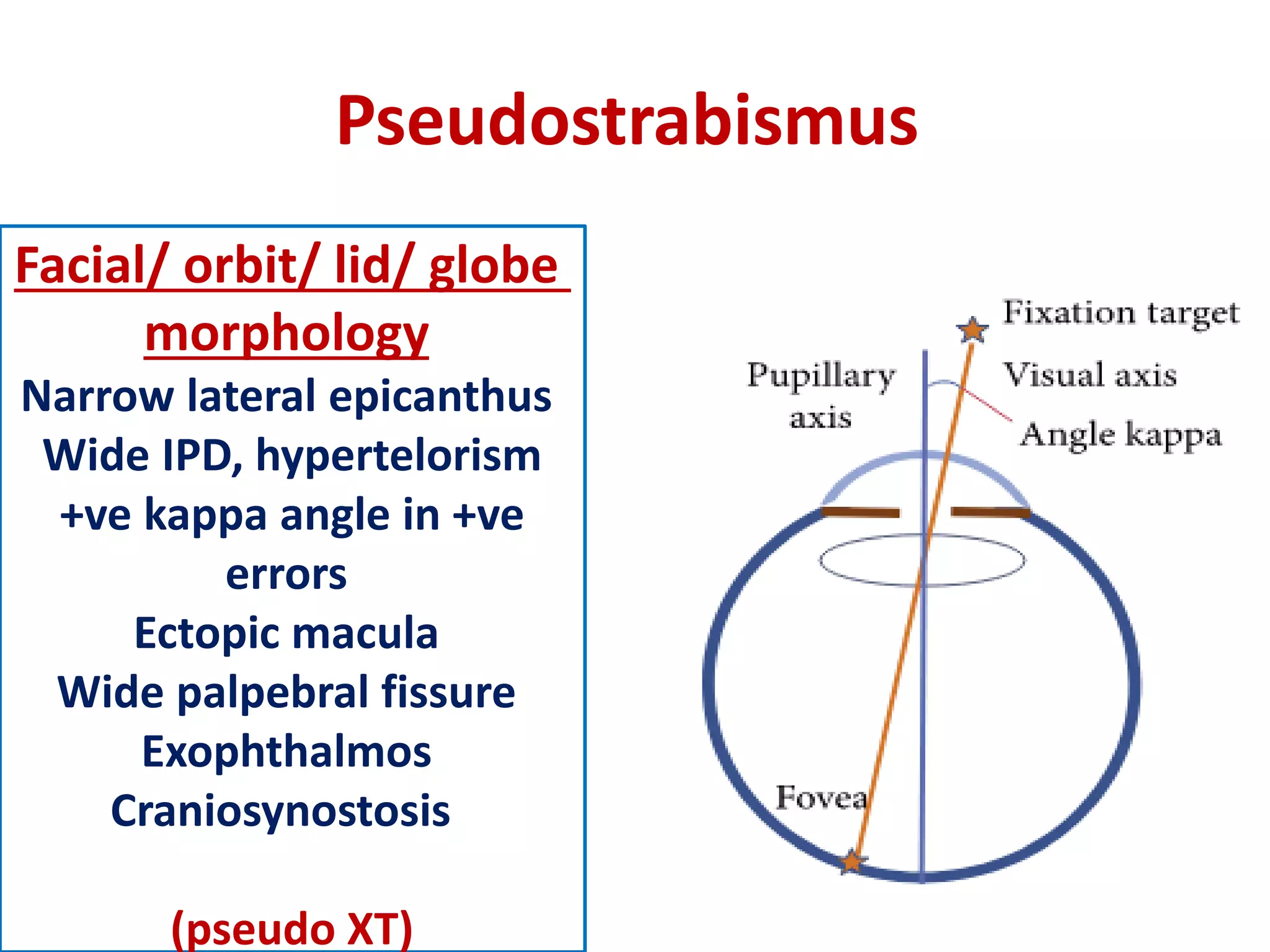
Pseudostrabismus
Facial/ orbit/ lid/ globe
morphology
Narrow lateral epicanthus
Wide IPD, hypertelorism
+ve kappa angle in +ve
errors
Ectopic macula
Wide palpebral fissure
Exophthalmos
Craniosynostosis
(pseudo XT)
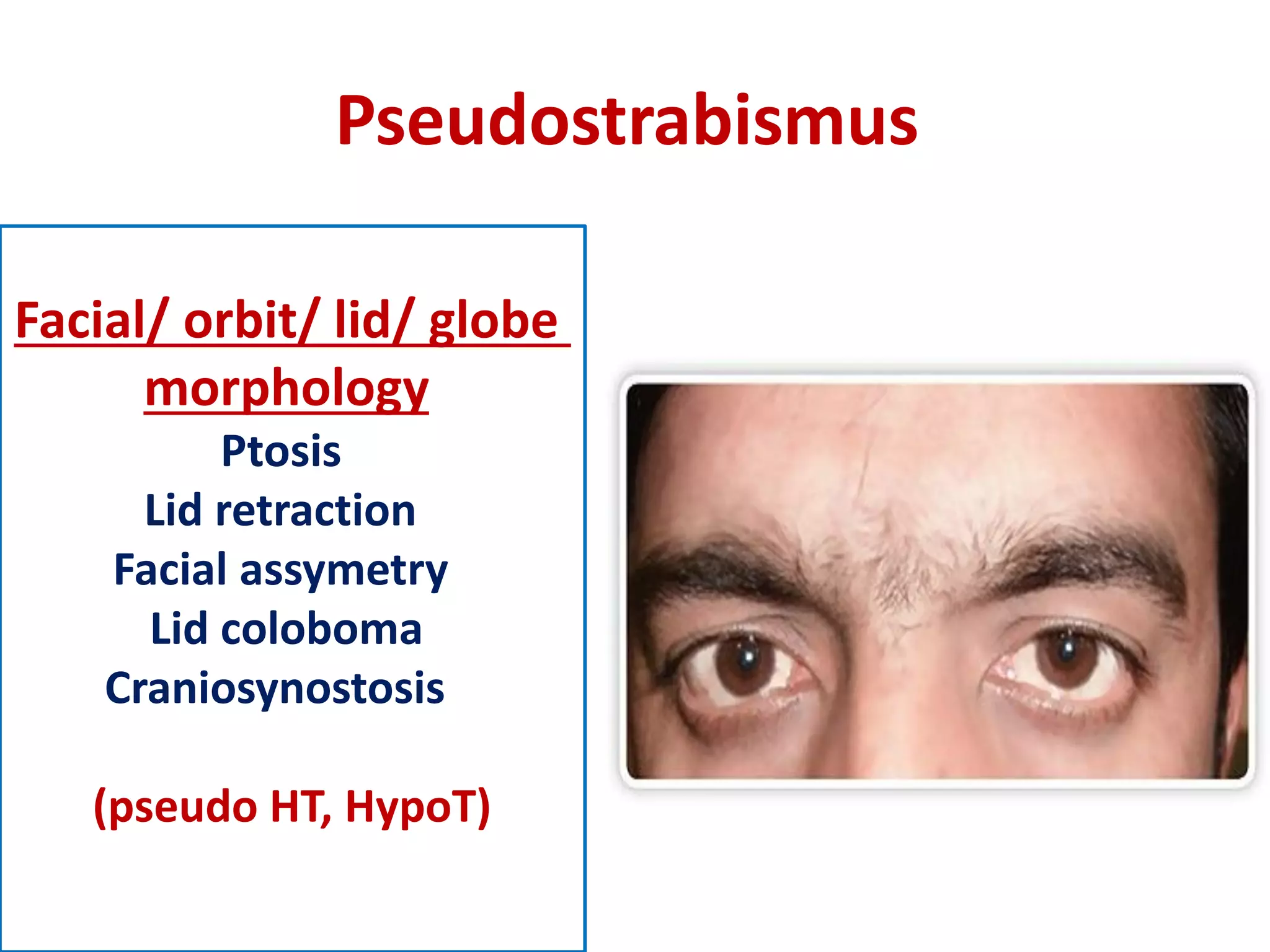
Pseudostrabismus
Facial/ orbit/ lid/ globe
morphology
Ptosis
Lid retraction
Facial assymetry
Lid coloboma
Craniosynostosis
(pseudo HT, HypoT)
Now, Lets Practice
(report which test you miss and what you miss in each
test)
All previous tests are mandatory for comprehensive
squint examination
Links for simulation and readings
• https://www.aao.org/interactive-tool/strabismus-simulator
• https://eyewiki.aao.org/Sensory_and_Motor_Testing
• https://www.researchgate.net/publication/349348910_Bas
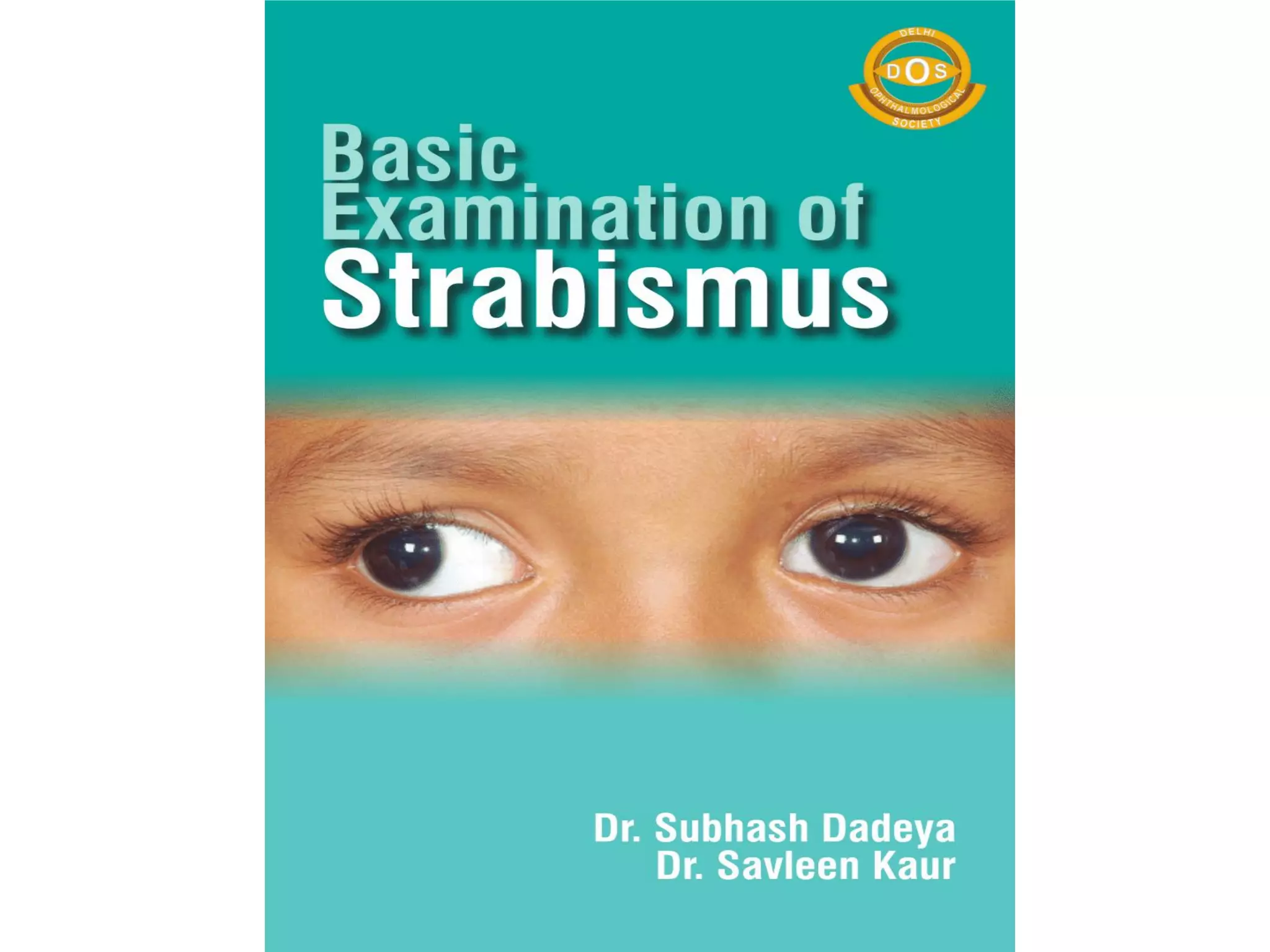
ic_Examination_of_Strabismus
• https://higherlogicdownload.s3.amazonaws.com/AAPOS/1
59c8d7c-f577-4c85-bf77-
ac8e4f0865bd/UploadedImages/Documents/Iowa_Strabis
mus_Notes_v2017c.pdf
Thank you

Motor evaluation of squint part 1

  • 1.
    MOTOR EVALUATION OF STRABISMUS(part 1) Samhaa Mohammed Abd Elmoneim (FRCS Glasgow, Egyptian Fellowship, MSc.) Zagazig Ophthalmic Hospital (2021)
  • 3.
    Before asking whatis Dx/ type of a squint, Ask about How do I examine and assess if patient has squint or not?
  • 4.
    What we learnand practice today: • How to assess if there is ocular deviation or not using easy, quick and sensitive, objective clinical tests . • Simulate the steps and findings of each test in an organized, systematic, clear and proper way. • These tests confirm true squint (manifest/ latent) and exclude pseudo-strabismus.
  • 5.
  • 6.
  • 7.
    What you willassess 2. VA, cycloplegic Refraction, Amblyopia Assessment. 3. Inspection (pseudo causes, head posture) 4. Motor, deviation Evaluation (Hirschburg, cover/ uncover/ alternate cover, motility) 5. Sensory Evaluation (BSV: worth 4 dot, 4D base out prism, Maddox rod, Titmus…..) 6. Supplementary (eg: Bilschowsky 3 step, Hess, FDT, NPA, NPC....)
  • 8.
  • 9.
    What you willassess 2. VA, cycloplegic Refraction, Amblyopia Assessment. 3. Inspection (pseudo causes, head posture) 4. Motor, deviation Evaluation (Hirschburg, cover/ uncover/ alternate cover, motility) 5. Sensory Evaluation (BSV: worth 4 dot, 4D base out prism, Maddox rod, Titmus…..) 6. Supplementary (eg: Bilschowsky 3 step, Hess, FDT, NPA, NPC....)
  • 10.
    What tests wewill apply today Hirschburg Cover- uncover Alternate cover Alternate prism cover
  • 11.
    Prerequisites before examination •Take your time to establish familiar environment with kids. • You have to be in the same level of patient • Correct any AHP abnormal head posture/ make head straight-ahead. • Use fixating (accommodating or distant) target in assessing motility (not penlight torch) • Cover/ uncover/ alternate cover/ motility assessment (in near/ far, with/ out glasses, in all gazes)
  • 12.
    What tests wewill apply today Hirschburg Cover- uncover Alternate cover Alternate prism cover
  • 13.
    Hirschburg test Penlight atdistance 50 cm Each 1mm = 7 degree = 15 PD
  • 14.
  • 15.
  • 16.
  • 17.
    Cover/uncover test Cover Assess tropia (manifest) Lookat uncovered eye Uncover Assess phoria (latent) Look at covered eye • Use fixating target, cover for few seconds • Start with covering orthtropic eye in case of manifest squint • Assess near/ far, with/ without glasses, in all directions
  • 18.
    Alternate cover test •Use fixating target, cover for few seconds before shift (to allow time for the other eye to fixate) • Start with covering orthtropic eye in case of manifest squint • Assess near/ far, with/ without glasses, in all directions Assess tropia and phoria (dissociate binocular vision)
  • 19.
    Alternate cover test •Use fixating (accommodating or distant ) target • Cover one eye then the other one then go back and forth several times (wait few seconds with cover before shift to allow time for the other eye to fixate) • Start with covering orthtropic eye in case of manifest squint • Assess near/ far, with/ without glasses, in all directions Assess tropia and phoria (dissociate binocular vision)
  • 20.
  • 21.
    Alternate prism covertest • Use fixating (accommodating or distant) target • Put prism infront of deviating eye in position (apex with deviation) • Cover one eye then the other one then go back and forth several times (wait few seconds with cover before shift to allow time for the other eye to fixate) • Assess near/ far, with/ without glasses, in all directions Assess tropia and phoria (dissociate binocular vision) + measure total angle
  • 22.
    Pseudostrabismus Facial/ orbit/ lid/globe morphology Flat nasal bridge Epicanthal folds Small IPD -ve kappa angle in –ve errors Narrow palpebral fissure Enophthalmos Craniosynostosis (pseudo ET)
  • 23.
    Pseudostrabismus Facial/ orbit/ lid/globe morphology Narrow lateral epicanthus Wide IPD, hypertelorism +ve kappa angle in +ve errors Ectopic macula Wide palpebral fissure Exophthalmos Craniosynostosis (pseudo XT)
  • 24.
    Pseudostrabismus Facial/ orbit/ lid/globe morphology Narrow lateral epicanthus Wide IPD, hypertelorism +ve kappa angle in +ve errors Ectopic macula Wide palpebral fissure Exophthalmos Craniosynostosis (pseudo XT)
  • 25.
    Pseudostrabismus Facial/ orbit/ lid/globe morphology Ptosis Lid retraction Facial assymetry Lid coloboma Craniosynostosis (pseudo HT, HypoT)
  • 26.
    Now, Lets Practice (reportwhich test you miss and what you miss in each test) All previous tests are mandatory for comprehensive squint examination
  • 27.
    Links for simulationand readings • https://www.aao.org/interactive-tool/strabismus-simulator • https://eyewiki.aao.org/Sensory_and_Motor_Testing • https://www.researchgate.net/publication/349348910_Bas ic_Examination_of_Strabismus • https://higherlogicdownload.s3.amazonaws.com/AAPOS/1 59c8d7c-f577-4c85-bf77- ac8e4f0865bd/UploadedImages/Documents/Iowa_Strabis mus_Notes_v2017c.pdf
  • 29.