WORLD OF STEEL


                 Presented By:-

                 Subhajit Karmakar.
What is HR Coils?

Hot rolling is a hot working metalworking
process where large pieces of metal, such as
slabs or billets, are heated above their re-
crystallization temperature and then
deformed between rollers to form thinner
cross sections.
Process at a Glance:-
           PROCESS AT A GLANCE
Manufacturing Process:-
1. The Hot Rolling Process:-
The starting material is usually large pieces of metal,
like semi-finished casting products, such as slabs, blooms, and
billets.
In continuous casting, rolling mill is mostly integrated to save
energy.
for larger work pieces gas- or oil-fired soaking pit
for smaller work pieces induction heating.
 a finishing temperature is defined (50 to 100 C above the
recrystallization temperature) If the temperature does drop
below this temperature the material must be re-heated before
more hot rolling.
2. Reheating
Critical to the Hot Strip Mill is its walking-beam reheat furnace,
state-of-the art equipment that replaced and now outperforms three
older- (pusher-) style furnaces.

3. Descaling
After exiting the reheat furnace, the slab passes through a descaling
unit, an enclosure employing two pairs of
spray headers that blast the intensely hot slab with 1,500 psi
pressurized water to remove the 1/8-inch thick layer
of oxidized iron that forms at the surface of the slab in the oxygen-
rich atmosphere of the reheat furnace.

4. Roughing
The roughing mill is made up of six independent rolling mill stands,
the last four of which incorporate small
vertical rolling mills called edgers. Slabs heated in the furnace until
they glow bright orange-yellow are rolled
through one stand at a time to produce so-called transfer bars
suitable for finish rolling.
Contd…

Approximately 96% of steel is continuously cast (the
remaining - ingots ).
After hot rolling the cooling should be done uniformly else
residual stress is generated due to shrinkage that affects
the mechanical properties.
Mill scale is the oxide layer formed on the surface due to
reaction with atmosphere at high temperatures.
Pickling is done with HCl to remove this scale.
5. Edging
At the very high temperatures at which the steel is rolled in the
roughing mill, it is very plastic and ‘flows’ easily like cookie dough
beneath a rolling pin. Consequently, as the slab is reduced from
eight to nine inches thick to the final bar thickness of one to one and
one-half inches, bars tend to spread width-wise by a few inches at
their extremities, and by as much as an inch through the body.

6. Descaling
It is Descaled by the low pressure headers. After descaling by the
low-pressure headers, the bar is pinched by a pair of pneumatically-
actuated rolls to mechanically loosen any remaining scale, which, as
the processing temperatures cool off, becomes increasingly sticky
even as it returns ever more slowly to the surfaces of the still red-
hot steel.

7. Cropping
The head- and tail-ends of nearly every transfer bar are cropped by
a pair of large steel drums each with a shear blade extending along
its length.
8. Finishing
Prior to the finish rolling operation, the head- and tail-ends of
the transfer bar will be sheared to square them up, helping to
ensure proper threading and tail-out. A final two-stage
descaling operation is performed to clean off the scale that has
grown on the bar during roughing.


Controlling Factors:-
I. Temperature Control
II. Gauge Control
III.Flatness & Crown
IV.Laminar Cooling
V. Coiling
VI.Coil Handling
Usages Of HR coils:-
Other Applications:-
General structures:-
Simple cross sections, such as rail tracks, storage tanks,
storage bins, tubes & pipes, cold-rolled steel,
Automotive parts:-
High-pressure gas cylinders, oil well pipes, pipelines ,
bearing plates for buildings and other structural
applications.
Application of HR coils in Various product
manufacturing:-
Tube making
Manufacture of Hamilton and other poles, flanging applications
Manufacture of pipes mostly for oil and gas sector
Cold reduction and for manufacture of galvanized sheets
General structural applications
Strapping, cycle chain
Manufacture of electrical equipment
Structural fabrication
Various applications in auto sector
Manufacture of corrosion resistant structural materials
For high tensile structural applications
Manufacture of propeller shaft
Manufacture of fork for two wheelers
Manufacture of wheel disc
Types of HR Coils:-

 Hot-rolled Coil
 Hot-rolled Sheets
 Checkered Plate
Major players :-
Dominated by 6-7 players:-


• Main : SAIL, TISCO, Jindal Steel


• Secondary : Essar Steel, Jindal Vijayanagar Steel Ltd
  (JVSL), Jindal Iron and Steel Company   (JISCO), Uttam
  Steel
• The global market price of HR Coils is regarded as an
  indicator of the market trend of all its downstream
  products in the flat product segment.
• Its downstream products like CR Sheets / Coils, GP/GC
  Sheets, Electrical Steel, Sheets, Tinplate, Pipes etc. play a
  vital role in the industrial development of a country.
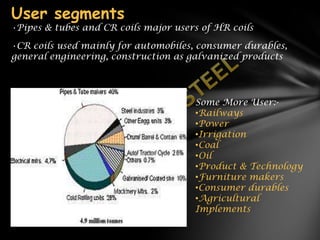
User segments
•Pipes & tubes and CR coils major users of HR coils

•CR coils used mainly for automobiles, consumer durables,
general engineering, construction as galvanized products


                                      Some More User:-
                                      •Railways
                                      •Power
                                      •Irrigation
                                      •Coal
                                      •Oil
                                      •Product & Technology
                                      •Furniture makers
                                      •Consumer durables
                                      •Agricultural
                                      Implements
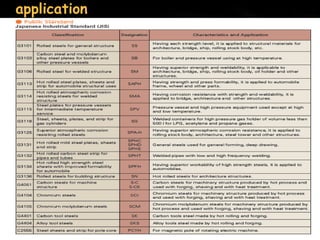
application
Contd…..

HR Coils

  • 1.
    WORLD OF STEEL Presented By:- Subhajit Karmakar.
  • 2.
    What is HRCoils? Hot rolling is a hot working metalworking process where large pieces of metal, such as slabs or billets, are heated above their re- crystallization temperature and then deformed between rollers to form thinner cross sections.
  • 3.
    Process at aGlance:- PROCESS AT A GLANCE
  • 4.
    Manufacturing Process:- 1. TheHot Rolling Process:- The starting material is usually large pieces of metal, like semi-finished casting products, such as slabs, blooms, and billets. In continuous casting, rolling mill is mostly integrated to save energy. for larger work pieces gas- or oil-fired soaking pit for smaller work pieces induction heating. a finishing temperature is defined (50 to 100 C above the recrystallization temperature) If the temperature does drop below this temperature the material must be re-heated before more hot rolling.
  • 5.
    2. Reheating Critical tothe Hot Strip Mill is its walking-beam reheat furnace, state-of-the art equipment that replaced and now outperforms three older- (pusher-) style furnaces. 3. Descaling After exiting the reheat furnace, the slab passes through a descaling unit, an enclosure employing two pairs of spray headers that blast the intensely hot slab with 1,500 psi pressurized water to remove the 1/8-inch thick layer of oxidized iron that forms at the surface of the slab in the oxygen- rich atmosphere of the reheat furnace. 4. Roughing The roughing mill is made up of six independent rolling mill stands, the last four of which incorporate small vertical rolling mills called edgers. Slabs heated in the furnace until they glow bright orange-yellow are rolled through one stand at a time to produce so-called transfer bars suitable for finish rolling.
  • 6.
    Contd… Approximately 96% ofsteel is continuously cast (the remaining - ingots ). After hot rolling the cooling should be done uniformly else residual stress is generated due to shrinkage that affects the mechanical properties. Mill scale is the oxide layer formed on the surface due to reaction with atmosphere at high temperatures. Pickling is done with HCl to remove this scale.
  • 7.
    5. Edging At thevery high temperatures at which the steel is rolled in the roughing mill, it is very plastic and ‘flows’ easily like cookie dough beneath a rolling pin. Consequently, as the slab is reduced from eight to nine inches thick to the final bar thickness of one to one and one-half inches, bars tend to spread width-wise by a few inches at their extremities, and by as much as an inch through the body. 6. Descaling It is Descaled by the low pressure headers. After descaling by the low-pressure headers, the bar is pinched by a pair of pneumatically- actuated rolls to mechanically loosen any remaining scale, which, as the processing temperatures cool off, becomes increasingly sticky even as it returns ever more slowly to the surfaces of the still red- hot steel. 7. Cropping The head- and tail-ends of nearly every transfer bar are cropped by a pair of large steel drums each with a shear blade extending along its length.
  • 8.
    8. Finishing Prior tothe finish rolling operation, the head- and tail-ends of the transfer bar will be sheared to square them up, helping to ensure proper threading and tail-out. A final two-stage descaling operation is performed to clean off the scale that has grown on the bar during roughing. Controlling Factors:- I. Temperature Control II. Gauge Control III.Flatness & Crown IV.Laminar Cooling V. Coiling VI.Coil Handling
  • 9.
    Usages Of HRcoils:-
  • 10.
    Other Applications:- General structures:- Simplecross sections, such as rail tracks, storage tanks, storage bins, tubes & pipes, cold-rolled steel, Automotive parts:- High-pressure gas cylinders, oil well pipes, pipelines , bearing plates for buildings and other structural applications.
  • 11.
    Application of HRcoils in Various product manufacturing:- Tube making Manufacture of Hamilton and other poles, flanging applications Manufacture of pipes mostly for oil and gas sector Cold reduction and for manufacture of galvanized sheets General structural applications Strapping, cycle chain Manufacture of electrical equipment Structural fabrication Various applications in auto sector Manufacture of corrosion resistant structural materials For high tensile structural applications Manufacture of propeller shaft Manufacture of fork for two wheelers Manufacture of wheel disc
  • 12.
    Types of HRCoils:-  Hot-rolled Coil  Hot-rolled Sheets  Checkered Plate
  • 13.
    Major players :- Dominatedby 6-7 players:- • Main : SAIL, TISCO, Jindal Steel • Secondary : Essar Steel, Jindal Vijayanagar Steel Ltd (JVSL), Jindal Iron and Steel Company (JISCO), Uttam Steel • The global market price of HR Coils is regarded as an indicator of the market trend of all its downstream products in the flat product segment. • Its downstream products like CR Sheets / Coils, GP/GC Sheets, Electrical Steel, Sheets, Tinplate, Pipes etc. play a vital role in the industrial development of a country.
  • 14.
    User segments •Pipes &tubes and CR coils major users of HR coils •CR coils used mainly for automobiles, consumer durables, general engineering, construction as galvanized products Some More User:- •Railways •Power •Irrigation •Coal •Oil •Product & Technology •Furniture makers •Consumer durables •Agricultural Implements
  • 15.
  • 16.