Fasteners


            Pawandeep Singh
            Pratyush Srivastava
Introduction
 A fastener is a hardware device that
  mechanically joins or affixes two or more
  objects together.
 They can be made from metals, plastics
  or composites.
 Fasteners types: Threaded and non-
  Threaded.
Thread Definitions
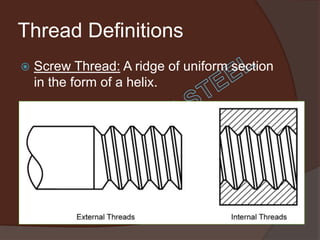
   Screw Thread: A ridge of uniform section
    in the form of a helix.
Thread Definitions
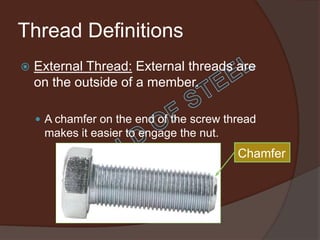
   External Thread: External threads are
    on the outside of a member.

     A chamfer on the end of the screw thread
     makes it easier to engage the nut.
                                          Chamfer
Thread Definitions
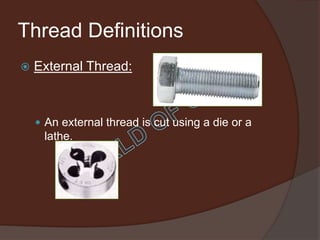
   External Thread:


     An external thread is cut using a die or a
     lathe.
Thread Definitions
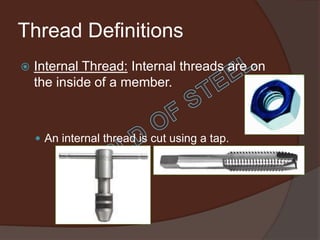
   Internal Thread: Internal threads are on
    the inside of a member.


     An internal thread is cut using a tap.
Thread Definitions
   Major DIA (D): The largest diameter (For
    both internal and external threads).

   Minor DIA (d): The smallest diameter.

   Depth of thread: (D-d)/2

   Pitch DIA (dP): The diameter at which a
    line cuts the spaces and threads equally.
Thread Definitions
   Crest: The top surface.

   Root: The bottom Surface.

   Side: The surface between the crest and
    root.
Thread Definitions
   Pitch (P): The distance from a point on a
    screw thread to a corresponding point
    on the next thread (in/Threads).

   Angle of Thread (A): The angle between
    the threads.
Thread Definitions
   Screw Axis: The longitudinal centerline.

   Lead: The distance a screw thread
    advances axially in one turn.
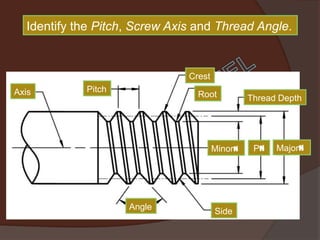
Identify the Pitch, Screw Axis and Thread Angle.


                               Crest
Axis        Pitch
                                 Root           Thread Depth


                                       Minorn    Pn   Majorn
                                                      8


                    Angle              Side
Thread Definitions
   Right Handed Thread: Advances when
    turned CW. (Threads are assumed RH
    unless specified otherwise.)

   Left Handed Thread: Advances when
    turned CCW.
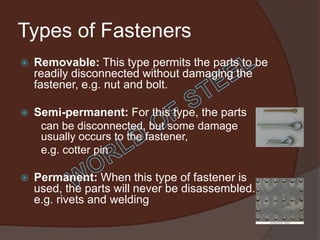
Types of Fasteners
   Removable: This type permits the parts to be
    readily disconnected without damaging the
    fastener, e.g. nut and bolt.

   Semi-permanent: For this type, the parts
     can be disconnected, but some damage
     usually occurs to the fastener,
     e.g. cotter pin

   Permanent: When this type of fastener is
    used, the parts will never be disassembled.
    e.g. rivets and welding
Advantages and disadvantages
of using fasteners
Advantages
   Easy to install
   Wide variety of standard parts
   Reversible up to some extent
   Operational efficiency and speed

Disadvantages
   loosening
   Failure under tensile loading
   Cost is higher than welding.
Threaded Fasteners
Threaded Fastener Issues:
 Types
 Materials/Grades
 Tightening Torque
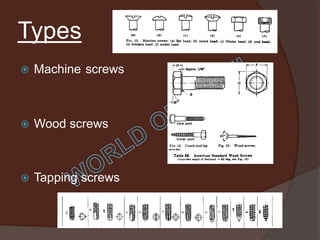
Types
   Machine screws


   Wood screws


   Tapping screws
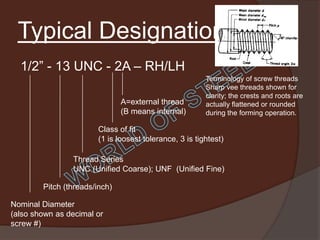
Typical Designation
  1/2” - 13 UNC - 2A – RH/LH
                                                         Terminology of screw threads
                                                         Sharp vee threads shown for
                                                         clarity; the crests and roots are
                               A=external thread         actually flattened or rounded
                               (B means internal)        during the forming operation.

                        Class of fit
                        (1 is loosest tolerance, 3 is tightest)

                Thread Series
                UNC (Unified Coarse); UNF (Unified Fine)

        Pitch (threads/inch)

Nominal Diameter
(also shown as decimal or
screw #)
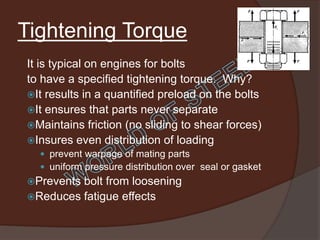
Tightening Torque
It is typical on engines for bolts
to have a specified tightening torque. Why?
It results in a quantified preload on the bolts
It ensures that parts never separate
Maintains friction (no sliding to shear forces)
Insures even distribution of loading
   prevent warpage of mating parts
   uniform pressure distribution over seal or gasket
Preventsbolt from loosening
Reduces fatigue effects
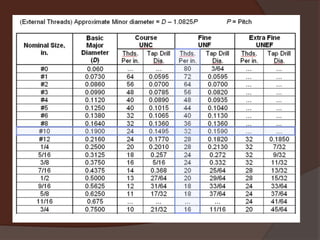
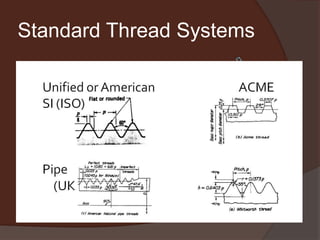
Standard Thread Systems
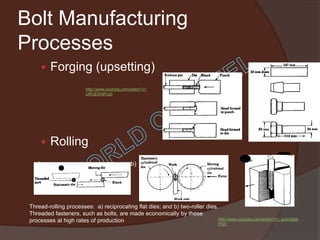
Bolt Manufacturing
Processes
           Forging (upsetting)
                         http://www.youtube.com/watch?v=
                         UIPcEWNFcx0


           Rolling
   a)                                          b)


 Thread-rolling processes: a) reciprocating flat dies; and b) two-roller dies.
 Threaded fasteners, such as bolts, are made economically by these
 processes at high rates of production                                        http://www.youtube.com/watch?v=_azbmSeb
                                                                                  PQ0
Manufacturing Processes -
continued
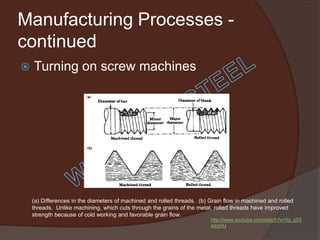
   Turning on screw machines


    (a) Differences in the diameters of machined and rolled threads. (b) Grain flow in machined and rolled
    threads. Unlike machining, which cuts through the grains of the metal, rolled threads have improved
    strength because of cold working and favorable grain flow.
                                                                         http://www.youtube.com/watch?v=0q_q53
                                                                         wsyHU
Advantages of Cut Threading
   Few limitations with regard to diameter and thread length.
   All specifications can be manufactured with cut threads.

Disadvantages of Cut Threading
   Significantly longer labour times means higher costs.


Advantages of Roll Threading
   Significantly shorter labour times means lower costs.
   Cold working makes threads more resistant to damage during handling.
   Rolled threads are often smoother due to the burnishing effect of the rolling operation.

Disadvantages of Roll Threading
   The availability of pitch diameter round bar is limited for certain material grades.
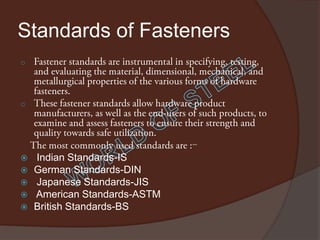
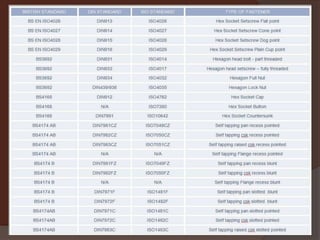
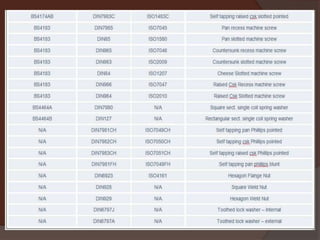
Standards of Fasteners
o


o


                              -
   Indian Standards-IS
   German Standards-DIN
   Japanese Standards-JIS
   American Standards-ASTM
   British Standards-BS
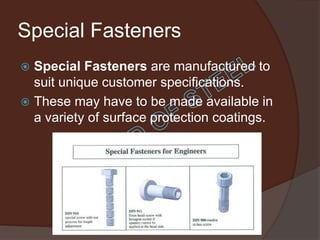
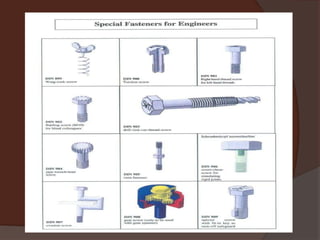
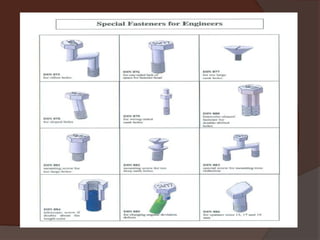
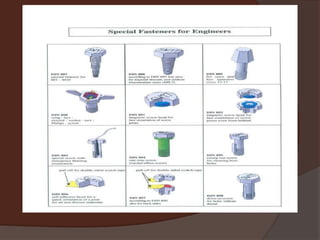
Special Fasteners
 Special Fasteners are manufactured to
  suit unique customer specifications.
 These may have to be made available in
  a variety of surface protection coatings.
oSometimes, fasteners may have to be coated in order to prevent them from corrosion.
oThe main industries which need coated fasteners are viz. Oil & Gas Industry; Food
processing; and Waste Water Treatment Industry.
oThe main types of coatings used these days are:-
Fluoropolymer- resin/lubricant blends that offer excellent
corrosion protection
Molybdenum Disulfide- friction reduction for high pressure loads
Epoxy, thermal cure- excellent impact resistance plus corrosion
and abrasion protection
Inorganic Zinc- corrosion and weathering protection for steel
Phenolic- ideal protection in low pH, high temperature
environments
Phosphate- ferrous metal coating for anti galling and minor
corrosion resistance
http://www.metcoat.com/fastener-coatings.htm
Manufacturing processes mainly include-
   • annealing
   • cold forging(nuts rivets sleeves)
   • inline rolling,
   • heat treatment,
   •    finishing/coating,
   •   CNC turning,
   •   centre less grinding,
   •   circular thread rolling and other secondary operations
   •   Induction hardening of critical fasteners, use of sophisticated in-line
       hardening and tempering furnaces with auto-load, pre-wash and post-
       washers, and the manufacture of special fasteners with very close
       tolerance are key features of our manufacturing process.
Fastener Industry

Chief users :
automobiles, aircraft, appliances, agricultural machinery, commercial
construction, and infrastructure.
• The fastener industry in India may be classified into two segments, namely,
   high tensile and mild steel fasteners, which broadly include nuts, bolts, studs,
   rivets and screws.
• All types of fasteners except high tensile and special type of fasteners are
   reserved for SSI (Small Scale Industries) Sector.
• Total domestic market of fastener industry in India: INR 1500 crore.
• The market size of high-tensile fasteners in the country is around Rs 1,100
   crore.
Fastener Industry
• Automobile industry accounts for 75 % of the total demand of this industry.
  Consumer durables and railways are the other primary users of the high
  tensile fasteners.
• Mild steel fasteners are primarily manufactured by the unorganised sector,
  while high tensile fasteners require superior technology and are dominated by
  companies in the organized sector.
• The fastener industry has been delicensed and is eligible for 100 per cent FDI
  under the automatic route. So there is a scope for growth in the exports.
• The automobile, general engineering, consumer durables, railways and auto
  replacement market account for 95% of the demand of cold forged high tensile
  fasteners industry in India.
Problems

Problems that make fastener industry less competent in the global market :

1)Poor product standardisation : production has never been streamlined

2) Increased input costs : due to indiscriminate hike in raw material costs

3) Low labour output (because the fabrication process of most fasteners is
intricate and complicated and hence the manpower required has to be
skilled and this increases the production cost .

4) Investment in manpower : In India the unskilled manpower is huge but
the skilled segment is small.
Scope
• There is a regular annual growth in the automobile industry which has
  affected a proportional growth in the fastener market.
• The manufacturing cost of mild steel fasteners (which broadly include
  nuts, bolts, studs, rivets and screws) is lower than that of customised
  special purpose fasteners, and tensile fasteners.(but profit margin will be
  low)
• High tensile fasteners are much more profitable but require cutting-edge
  technology to be competent.
• To enter into business of aircraft parts the necessary certifications require
  3-5 yrs. and the only way to access the technology is through acquisition
  of companies.

Fasteners Presentation

  • 1.
    Fasteners Pawandeep Singh Pratyush Srivastava
  • 2.
    Introduction  A fasteneris a hardware device that mechanically joins or affixes two or more objects together.  They can be made from metals, plastics or composites.  Fasteners types: Threaded and non- Threaded.
  • 3.
    Thread Definitions  Screw Thread: A ridge of uniform section in the form of a helix.
  • 4.
    Thread Definitions  External Thread: External threads are on the outside of a member.  A chamfer on the end of the screw thread makes it easier to engage the nut. Chamfer
  • 5.
    Thread Definitions  External Thread:  An external thread is cut using a die or a lathe.
  • 6.
    Thread Definitions  Internal Thread: Internal threads are on the inside of a member.  An internal thread is cut using a tap.
  • 7.
    Thread Definitions  Major DIA (D): The largest diameter (For both internal and external threads).  Minor DIA (d): The smallest diameter.  Depth of thread: (D-d)/2  Pitch DIA (dP): The diameter at which a line cuts the spaces and threads equally.
  • 8.
    Thread Definitions  Crest: The top surface.  Root: The bottom Surface.  Side: The surface between the crest and root.
  • 9.
    Thread Definitions  Pitch (P): The distance from a point on a screw thread to a corresponding point on the next thread (in/Threads).  Angle of Thread (A): The angle between the threads.
  • 10.
    Thread Definitions  Screw Axis: The longitudinal centerline.  Lead: The distance a screw thread advances axially in one turn.
  • 11.
    Identify the Pitch,Screw Axis and Thread Angle. Crest Axis Pitch Root Thread Depth Minorn Pn Majorn 8 Angle Side
  • 12.
    Thread Definitions  Right Handed Thread: Advances when turned CW. (Threads are assumed RH unless specified otherwise.)  Left Handed Thread: Advances when turned CCW.
  • 13.
    Types of Fasteners  Removable: This type permits the parts to be readily disconnected without damaging the fastener, e.g. nut and bolt.  Semi-permanent: For this type, the parts can be disconnected, but some damage usually occurs to the fastener, e.g. cotter pin  Permanent: When this type of fastener is used, the parts will never be disassembled. e.g. rivets and welding
  • 14.
    Advantages and disadvantages ofusing fasteners Advantages  Easy to install  Wide variety of standard parts  Reversible up to some extent  Operational efficiency and speed Disadvantages  loosening  Failure under tensile loading  Cost is higher than welding.
  • 15.
    Threaded Fasteners Threaded FastenerIssues:  Types  Materials/Grades  Tightening Torque
  • 16.
    Types  Machine screws  Wood screws  Tapping screws
  • 17.
    Typical Designation 1/2” - 13 UNC - 2A – RH/LH Terminology of screw threads Sharp vee threads shown for clarity; the crests and roots are A=external thread actually flattened or rounded (B means internal) during the forming operation. Class of fit (1 is loosest tolerance, 3 is tightest) Thread Series UNC (Unified Coarse); UNF (Unified Fine) Pitch (threads/inch) Nominal Diameter (also shown as decimal or screw #)
  • 19.
    Tightening Torque It istypical on engines for bolts to have a specified tightening torque. Why? It results in a quantified preload on the bolts It ensures that parts never separate Maintains friction (no sliding to shear forces) Insures even distribution of loading  prevent warpage of mating parts  uniform pressure distribution over seal or gasket Preventsbolt from loosening Reduces fatigue effects
  • 20.
  • 21.
    Bolt Manufacturing Processes  Forging (upsetting) http://www.youtube.com/watch?v= UIPcEWNFcx0  Rolling a) b) Thread-rolling processes: a) reciprocating flat dies; and b) two-roller dies. Threaded fasteners, such as bolts, are made economically by these processes at high rates of production http://www.youtube.com/watch?v=_azbmSeb PQ0
  • 22.
    Manufacturing Processes - continued  Turning on screw machines (a) Differences in the diameters of machined and rolled threads. (b) Grain flow in machined and rolled threads. Unlike machining, which cuts through the grains of the metal, rolled threads have improved strength because of cold working and favorable grain flow. http://www.youtube.com/watch?v=0q_q53 wsyHU
  • 23.
    Advantages of CutThreading  Few limitations with regard to diameter and thread length.  All specifications can be manufactured with cut threads. Disadvantages of Cut Threading  Significantly longer labour times means higher costs. Advantages of Roll Threading  Significantly shorter labour times means lower costs.  Cold working makes threads more resistant to damage during handling.  Rolled threads are often smoother due to the burnishing effect of the rolling operation. Disadvantages of Roll Threading  The availability of pitch diameter round bar is limited for certain material grades.
  • 24.
    Standards of Fasteners o o -  Indian Standards-IS  German Standards-DIN  Japanese Standards-JIS  American Standards-ASTM  British Standards-BS
  • 27.
    Special Fasteners  SpecialFasteners are manufactured to suit unique customer specifications.  These may have to be made available in a variety of surface protection coatings.
  • 31.
    oSometimes, fasteners mayhave to be coated in order to prevent them from corrosion. oThe main industries which need coated fasteners are viz. Oil & Gas Industry; Food processing; and Waste Water Treatment Industry. oThe main types of coatings used these days are:- Fluoropolymer- resin/lubricant blends that offer excellent corrosion protection Molybdenum Disulfide- friction reduction for high pressure loads Epoxy, thermal cure- excellent impact resistance plus corrosion and abrasion protection Inorganic Zinc- corrosion and weathering protection for steel Phenolic- ideal protection in low pH, high temperature environments Phosphate- ferrous metal coating for anti galling and minor corrosion resistance http://www.metcoat.com/fastener-coatings.htm
  • 32.
    Manufacturing processes mainlyinclude- • annealing • cold forging(nuts rivets sleeves) • inline rolling, • heat treatment, • finishing/coating, • CNC turning, • centre less grinding, • circular thread rolling and other secondary operations • Induction hardening of critical fasteners, use of sophisticated in-line hardening and tempering furnaces with auto-load, pre-wash and post- washers, and the manufacture of special fasteners with very close tolerance are key features of our manufacturing process.
  • 33.
    Fastener Industry Chief users: automobiles, aircraft, appliances, agricultural machinery, commercial construction, and infrastructure. • The fastener industry in India may be classified into two segments, namely, high tensile and mild steel fasteners, which broadly include nuts, bolts, studs, rivets and screws. • All types of fasteners except high tensile and special type of fasteners are reserved for SSI (Small Scale Industries) Sector. • Total domestic market of fastener industry in India: INR 1500 crore. • The market size of high-tensile fasteners in the country is around Rs 1,100 crore.
  • 34.
    Fastener Industry • Automobileindustry accounts for 75 % of the total demand of this industry. Consumer durables and railways are the other primary users of the high tensile fasteners. • Mild steel fasteners are primarily manufactured by the unorganised sector, while high tensile fasteners require superior technology and are dominated by companies in the organized sector. • The fastener industry has been delicensed and is eligible for 100 per cent FDI under the automatic route. So there is a scope for growth in the exports. • The automobile, general engineering, consumer durables, railways and auto replacement market account for 95% of the demand of cold forged high tensile fasteners industry in India.
  • 35.
    Problems Problems that makefastener industry less competent in the global market : 1)Poor product standardisation : production has never been streamlined 2) Increased input costs : due to indiscriminate hike in raw material costs 3) Low labour output (because the fabrication process of most fasteners is intricate and complicated and hence the manpower required has to be skilled and this increases the production cost . 4) Investment in manpower : In India the unskilled manpower is huge but the skilled segment is small.
  • 36.
    Scope • There isa regular annual growth in the automobile industry which has affected a proportional growth in the fastener market. • The manufacturing cost of mild steel fasteners (which broadly include nuts, bolts, studs, rivets and screws) is lower than that of customised special purpose fasteners, and tensile fasteners.(but profit margin will be low) • High tensile fasteners are much more profitable but require cutting-edge technology to be competent. • To enter into business of aircraft parts the necessary certifications require 3-5 yrs. and the only way to access the technology is through acquisition of companies.