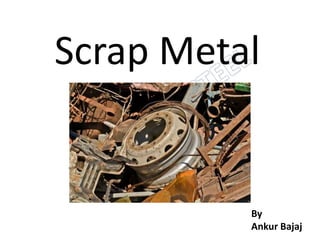
Scrap Metal
By
Ankur Bajaj
Scrap Metal
• Recyclable material left over from product
manufacturing and consumption
• Parts of vehicles, building supplies, and
surplus materials
• Unlike waste, scrap can have significant
monetary value
• Constituent raw materials can be taken out
and reused
Scrap categorization
• No single system exists for scrap metal as
there are for pure metals
• Grades cannot be defined as the scrap metal
does not have a specific given composition
• General terms are defined by ISRI (Institute of
Scrap Recycling Industries) to identify
materials with loosely defined compositions
• Some examples include Apple, Dream, Elias,
Twist, Seal, Indian, Zurik
Scrap processing
• Two main types of scrap processors
• Wrecking yards and Scrap yards
• Wrecking yards sell everything by
item type
• Charge price according to the
usability of the item regardless of the
weight
Scrap processing
• Scrap yards sell metal by weight
irrespective of type or usability of
the metal item
• Primary value of metal comes from
smelters which is by metal weight
• Items useless to wreakers are also
sold to scrap yards by weight
Metal recycling industry
• Metal recycling industry encompasses a wide
range of metals
• Frequently recycled metals are scrap Steel, Iron,
Lead, Aluminium, Copper, Stainless Steel and Zinc
• Precious metals like gold, silver and platinum
group metals
• Cobalt, mercury, titanium, tungsten, arsenic,
beryllium, bismuth and some other rare earth
metals are also recycled
Role in the American economy
• Valued at more than $90 billion in
2012
• Exports of $28 billion in scrap
commodities to 160 countries
• Supports around 5,00,000 workers
• Generates revenue of more than $10
billion per year
Role in the American economy
• Recycled scrap serves as raw
material feedstock for many metal
industries in US
• 60% Steel
• 50% Copper and copper alloys
• 50% Aluminium
Ferrous metal recycling
• Contain an appreciable percentage of iron
• Steel one of the most recycled materials in the
world
• In USA, steel containers, cans, automobiles,
appliances, and construction materials
contribute the greatest weight of re-cycled
materials
• Contain anywhere between 50-80% iron and
steel
Ferrous metal recycling
• Cheaper to recycle steel than to mine iron ore
and manipulate it through the production
process to form new steel
• Steel does not lose any of its inherent physical
properties during the recycling process
• Has drastically reduced energy and material
requirements compared with refinement from
iron ore
Ferrous metal recycling
• Different amount of recycled steel used for
different steelmaking processes
• Basic oxygen steelmaking (BOS) uses between
25 and 35% recycled steel as raw material
• Electric arc furnace (EAF) steelmaking uses
almost 100% recycled steel
• Recycled steal contains some impurities which
cannot be removed
Types of scrap used in steelmaking
• Heavy melting steel - Industrial or commercial scrap
steel greater than 6mm thick, such as plates, beams,
columns, channels
• Old car bodies - Vehicles with or without interiors and
their original wheels
• Cast iron - Cast iron baths, machinery, pipe and engine
blocks
• Pressing steel - Domestic scrap metal up to approx.
6mm thick. Examples - White goods (fridges, washing
machines, etc.), roofing iron, water heaters, water
tanks and sheet metal off-cuts
Types of scrap used in steelmaking
• Reinforcing bars or mesh - Used in the
construction industry within concrete
• Turnings - Remains of drilling or shaping steels
• Manganese steel - Non magnetic, hardened
steel used in the mining industry, cement
mixers, rock crushers, and other high impact
and abrasive environments
• Rails - Rail or tram tracks
Ferrous metal recycling process
• Sorting - Ferrous metal can be easily
separated from other recyclables like paper in
a recycling facility with magnetic belts.
Different kinds of steel do not need to be
separated
• Shredding - Shredders incorporate rotating
magnetic drums to extract iron and steel from
the mixture of metals and other materials
Ferrous metal recycling process
• Media separation - Further separation is
achieved using liquid floating systems
• Shearing - Hydraulic machinery capable of
exerting enormous pressure is used to cut
thick heavy steel recovered from railways and
ships
• Baling - Iron and steel products are
compacted into large blocks to facilitate
handling and transportation
Applications
Products made of recycled steel include -
• Construction materials for roads, railways,
infrastructure and buildings
• Electrical appliances
• Cans and containers
• Automobiles and other vehicles
• Office supplies
• Hardware: bolts, nuts, screws, etc.
Major exporters of steel scrap
Major importers of steel scrap
Countries increasing their scrap steel import
Country Steel scrap imported in 2012
(Million Metric tonnes)
Turkey 22.4
South Korea 10.1
India 8.2
Canada 2.3
Major importers of steel scrap
Countries decreasing their scrap steel import
Country Steel scrap imported in 2012
(Million Metric tonnes)
China 4.97
Taiwan 4.95
USA 3.7
European Union
(EU-27)
3.4
Major Multi-National Scrap Recyclers
Company Country Volume in gross tons (2011)
Sims Metal Management Inc USA 8.7 million
OmniSource Corp. USA 5.9 million
Schnitzer Steel Industries USA 5.3 million
The David J. Joseph Co. USA 5 million
Tube City IMS USA 5 million
Commercial Metals Co. USA 3 million
Ferrous Processing & Trading Co. USA 2.8 million
Alter Trading Corp. USA 2.5 million
Triple M Metal Inc. Canada 2.5 million
Gerdau Ameristeel Recycling Canada 2.1 million
Benefits of recycling scrap metals
Using recycled scrap metal to make steel
in place of virgin iron ore can yield -
• 75% savings in energy
• 90% savings in raw materials used
• 86% reduction in air pollution
• 40% reduction in water use
• 76% reduction in water pollution
• 97% reduction in mining wastes
Benefits of recycling scrap metals
Energy savings from other metals
include -
• Aluminium savings of 95% energy
• Copper savings of 85% energy
• Lead savings of 65% energy
• Zinc savings of 60% energy
Risks
• Hazardous materials present in scrap may
cause death, injury or environmental
damage
• Radioactivity in scrap can contaminate
chemical elements in metal smelters and
can also called radiation poisoning
• Specialized tools used in scrap yards can
also be dangerous to untrained people
Metal theft
• Usually increases when worldwide prices
for scrap metal rise
• Metals most commonly stolen are non-ferrous
metals such as copper, aluminium, brass,
and bronze
• Even cast iron and steel are now being taken
owing to prices as scrap
• Items with metal are stolen for their intrinsic
value as raw material or commodities
Countries where major scrap thefts
have been reported
• Canada
• Czech Republic
• Germany
• Japan
• Russia
• South Africa
• Ukraine
• United Kingdom
• USA
Thank you

Scrap Metal

  • 1.
  • 2.
    Scrap Metal • Recyclablematerial left over from product manufacturing and consumption • Parts of vehicles, building supplies, and surplus materials • Unlike waste, scrap can have significant monetary value • Constituent raw materials can be taken out and reused
  • 3.
    Scrap categorization • Nosingle system exists for scrap metal as there are for pure metals • Grades cannot be defined as the scrap metal does not have a specific given composition • General terms are defined by ISRI (Institute of Scrap Recycling Industries) to identify materials with loosely defined compositions • Some examples include Apple, Dream, Elias, Twist, Seal, Indian, Zurik
  • 4.
    Scrap processing • Twomain types of scrap processors • Wrecking yards and Scrap yards • Wrecking yards sell everything by item type • Charge price according to the usability of the item regardless of the weight
  • 5.
    Scrap processing • Scrapyards sell metal by weight irrespective of type or usability of the metal item • Primary value of metal comes from smelters which is by metal weight • Items useless to wreakers are also sold to scrap yards by weight
  • 6.
    Metal recycling industry •Metal recycling industry encompasses a wide range of metals • Frequently recycled metals are scrap Steel, Iron, Lead, Aluminium, Copper, Stainless Steel and Zinc • Precious metals like gold, silver and platinum group metals • Cobalt, mercury, titanium, tungsten, arsenic, beryllium, bismuth and some other rare earth metals are also recycled
  • 7.
    Role in theAmerican economy • Valued at more than $90 billion in 2012 • Exports of $28 billion in scrap commodities to 160 countries • Supports around 5,00,000 workers • Generates revenue of more than $10 billion per year
  • 8.
    Role in theAmerican economy • Recycled scrap serves as raw material feedstock for many metal industries in US • 60% Steel • 50% Copper and copper alloys • 50% Aluminium
  • 9.
    Ferrous metal recycling •Contain an appreciable percentage of iron • Steel one of the most recycled materials in the world • In USA, steel containers, cans, automobiles, appliances, and construction materials contribute the greatest weight of re-cycled materials • Contain anywhere between 50-80% iron and steel
  • 10.
    Ferrous metal recycling •Cheaper to recycle steel than to mine iron ore and manipulate it through the production process to form new steel • Steel does not lose any of its inherent physical properties during the recycling process • Has drastically reduced energy and material requirements compared with refinement from iron ore
  • 11.
    Ferrous metal recycling •Different amount of recycled steel used for different steelmaking processes • Basic oxygen steelmaking (BOS) uses between 25 and 35% recycled steel as raw material • Electric arc furnace (EAF) steelmaking uses almost 100% recycled steel • Recycled steal contains some impurities which cannot be removed
  • 12.
    Types of scrapused in steelmaking • Heavy melting steel - Industrial or commercial scrap steel greater than 6mm thick, such as plates, beams, columns, channels • Old car bodies - Vehicles with or without interiors and their original wheels • Cast iron - Cast iron baths, machinery, pipe and engine blocks • Pressing steel - Domestic scrap metal up to approx. 6mm thick. Examples - White goods (fridges, washing machines, etc.), roofing iron, water heaters, water tanks and sheet metal off-cuts
  • 13.
    Types of scrapused in steelmaking • Reinforcing bars or mesh - Used in the construction industry within concrete • Turnings - Remains of drilling or shaping steels • Manganese steel - Non magnetic, hardened steel used in the mining industry, cement mixers, rock crushers, and other high impact and abrasive environments • Rails - Rail or tram tracks
  • 14.
    Ferrous metal recyclingprocess • Sorting - Ferrous metal can be easily separated from other recyclables like paper in a recycling facility with magnetic belts. Different kinds of steel do not need to be separated • Shredding - Shredders incorporate rotating magnetic drums to extract iron and steel from the mixture of metals and other materials
  • 15.
    Ferrous metal recyclingprocess • Media separation - Further separation is achieved using liquid floating systems • Shearing - Hydraulic machinery capable of exerting enormous pressure is used to cut thick heavy steel recovered from railways and ships • Baling - Iron and steel products are compacted into large blocks to facilitate handling and transportation
  • 16.
    Applications Products made ofrecycled steel include - • Construction materials for roads, railways, infrastructure and buildings • Electrical appliances • Cans and containers • Automobiles and other vehicles • Office supplies • Hardware: bolts, nuts, screws, etc.
  • 17.
    Major exporters ofsteel scrap
  • 18.
    Major importers ofsteel scrap Countries increasing their scrap steel import Country Steel scrap imported in 2012 (Million Metric tonnes) Turkey 22.4 South Korea 10.1 India 8.2 Canada 2.3
  • 19.
    Major importers ofsteel scrap Countries decreasing their scrap steel import Country Steel scrap imported in 2012 (Million Metric tonnes) China 4.97 Taiwan 4.95 USA 3.7 European Union (EU-27) 3.4
  • 20.
    Major Multi-National ScrapRecyclers Company Country Volume in gross tons (2011) Sims Metal Management Inc USA 8.7 million OmniSource Corp. USA 5.9 million Schnitzer Steel Industries USA 5.3 million The David J. Joseph Co. USA 5 million Tube City IMS USA 5 million Commercial Metals Co. USA 3 million Ferrous Processing & Trading Co. USA 2.8 million Alter Trading Corp. USA 2.5 million Triple M Metal Inc. Canada 2.5 million Gerdau Ameristeel Recycling Canada 2.1 million
  • 21.
    Benefits of recyclingscrap metals Using recycled scrap metal to make steel in place of virgin iron ore can yield - • 75% savings in energy • 90% savings in raw materials used • 86% reduction in air pollution • 40% reduction in water use • 76% reduction in water pollution • 97% reduction in mining wastes
  • 22.
    Benefits of recyclingscrap metals Energy savings from other metals include - • Aluminium savings of 95% energy • Copper savings of 85% energy • Lead savings of 65% energy • Zinc savings of 60% energy
  • 23.
    Risks • Hazardous materialspresent in scrap may cause death, injury or environmental damage • Radioactivity in scrap can contaminate chemical elements in metal smelters and can also called radiation poisoning • Specialized tools used in scrap yards can also be dangerous to untrained people
  • 24.
    Metal theft • Usuallyincreases when worldwide prices for scrap metal rise • Metals most commonly stolen are non-ferrous metals such as copper, aluminium, brass, and bronze • Even cast iron and steel are now being taken owing to prices as scrap • Items with metal are stolen for their intrinsic value as raw material or commodities
  • 25.
    Countries where majorscrap thefts have been reported • Canada • Czech Republic • Germany • Japan • Russia • South Africa • Ukraine • United Kingdom • USA
  • 26.