NAMING CONVENTIONS OF
        STEEL
 AIM: TO HELP GUESS THE END USE FROM GRADES
AVAILABLE GRADING SYSTEMS
• SAE steel grades
• British Standards
• International Organization for
  Standardization ISO/TS 4949:2003          For Steel only

• European standards - EN 10027
• Japanese steel grades : JIS standard
• Germany steel grades : DIN standard
• China steel grades : GB standard

• Unified Numbering System (UNS) of ASTM Int.   For alloys in
                                                general
• The Society of Automotive Engineers (SAE).
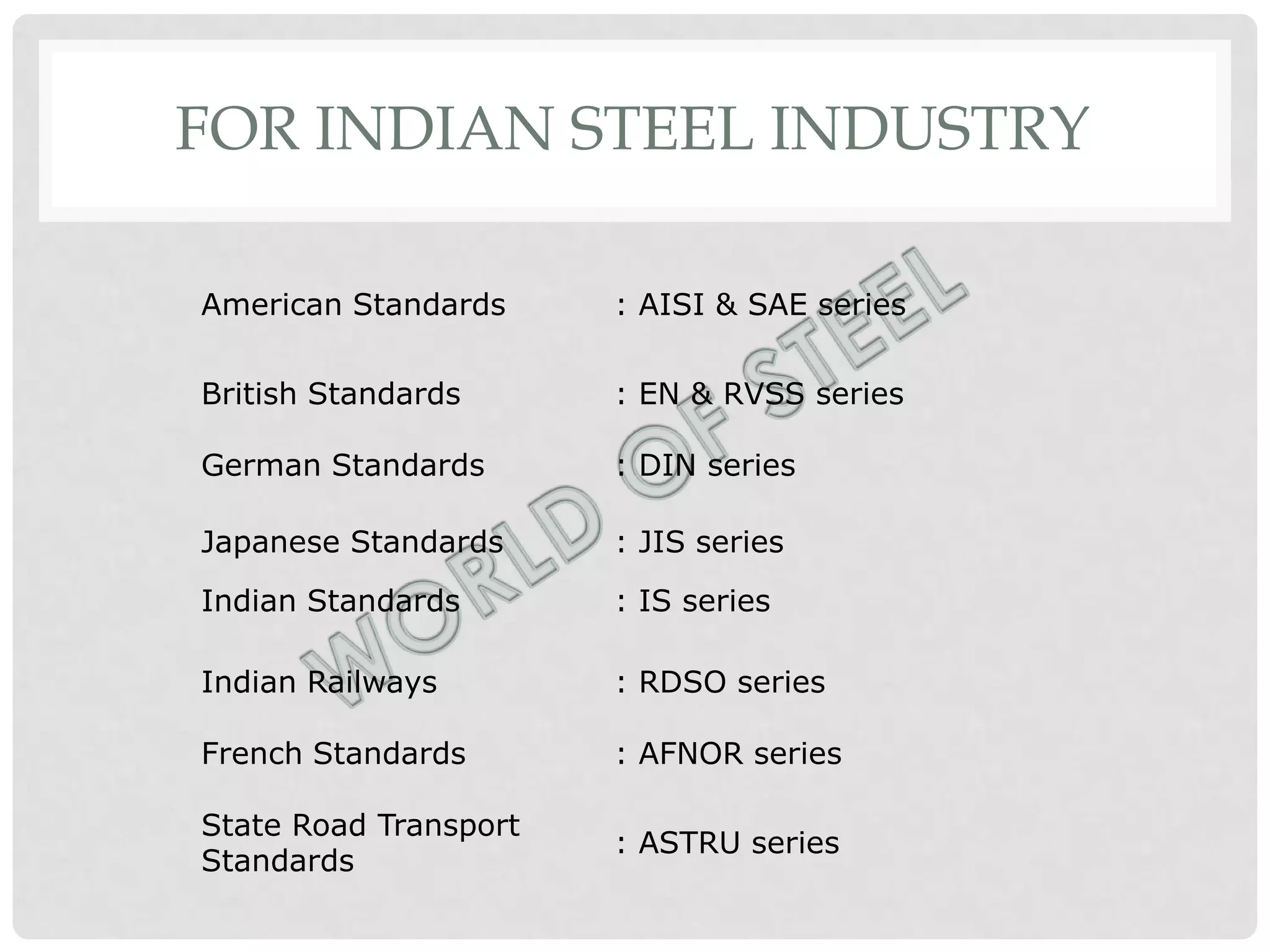
FOR INDIAN STEEL INDUSTRY

American Standards     : AISI & SAE series

British Standards      : EN & RVSS series

German Standards       : DIN series

Japanese Standards     : JIS series
Indian Standards       : IS series

Indian Railways        : RDSO series

French Standards       : AFNOR series

State Road Transport
                       : ASTRU series
Standards
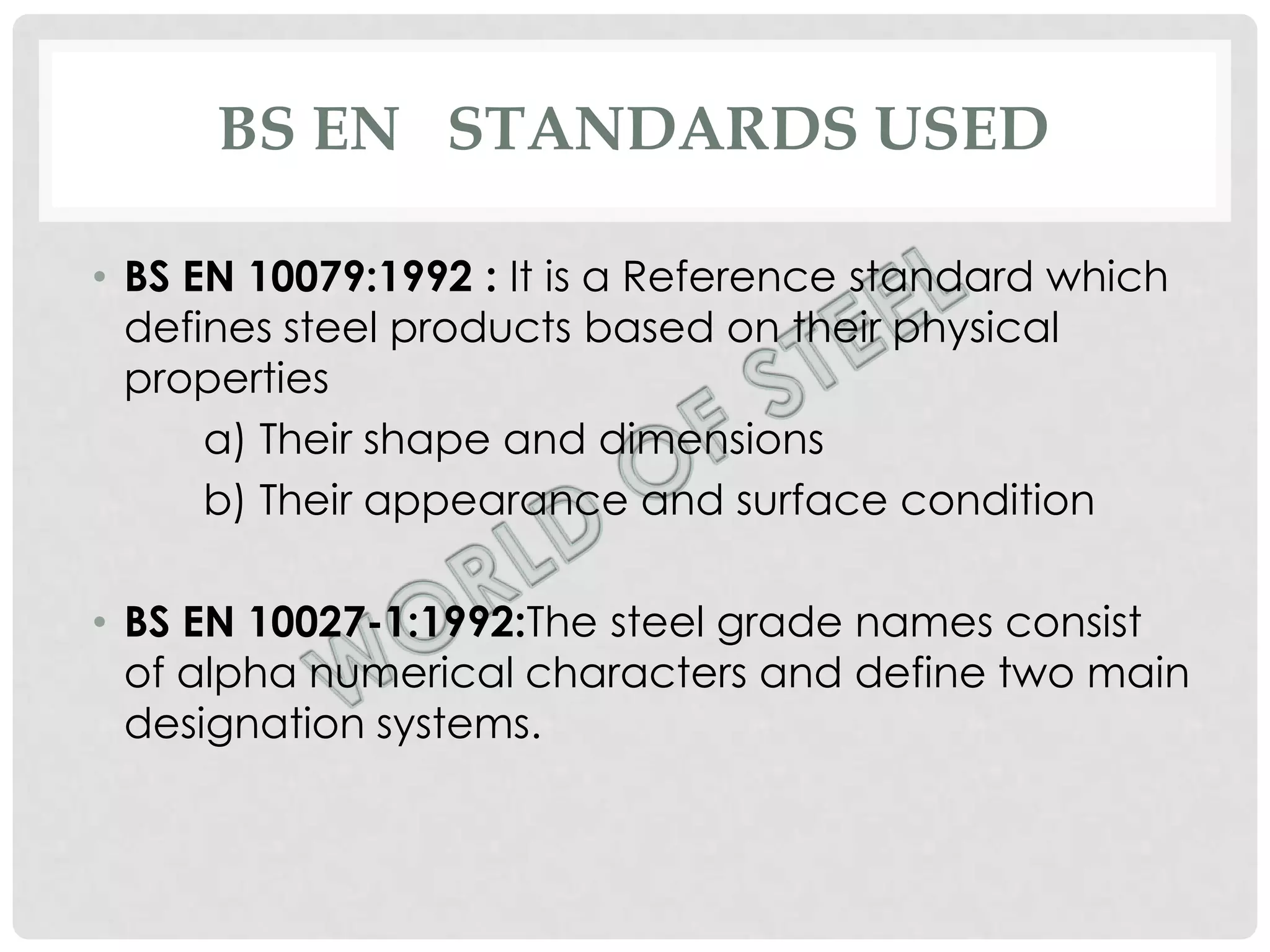
BS EN STANDARDS USED

• BS EN 10079:1992 : It is a Reference standard which
  defines steel products based on their physical
  properties
      a) Their shape and dimensions
      b) Their appearance and surface condition

• BS EN 10027-1:1992:The steel grade names consist
  of alpha numerical characters and define two main
  designation systems.
STEELS DESIGNATION (BS EN 10027-1:1992) ON THE
     BASIS OF THEIR USE AND THEIR MECHANICAL
                    PROPERTIES.

Letter           Application                      Mechanical Property that is indicated

S                Structural Steel                 Minimum Yield Strength

P                Pressure Purposes                Minimum Yield Strength

L                Line Pipe                        Minimum Yield Strength
E                Engineering                      Minimum Yield Strength

B                Reinforcing Steel                Characteristic Yield Case

Y                Pre-stressing Steel              Minimum Yield Case

R                Rails                            Minimum Yield Case

H                High Strength Cold Rolled        Minimum Yield Case

D                Flat Products for Cold Forming   C, D or X followed by two numbers characterising steel

T                Tinmill Products                 Nominal Yield Case

                                                   100 x specific loss in W/kg, "—"
M                Electrical Steel                  100 x nom thick in mm
                                                  Letter for type of steel (A,B,E,N,S or P)


         Eg. S420 designates a structural steel(S) with a specified yield strength of 420MPa
BS EN 10027-1:1992 STEELS DESIGNATION ON THE
    BASIS OF THEIR CHEMICAL COMPOSITION

Carbon Steel : According to AISI (American Iron and Steel
Institute) , a steel can be called carbon steel when no minimum
percentage of other alloying elements is mandatory for
obtaining the desired properties. And the percentage
composition {by weight } does not exceed –
    • 1.65 for Mn
    • 0.6 for Si
    • 0.6 for Cu

BS EN 10027-1:1992 designation : The grade name is „C‟
followed by a number „XX‟ where XX is ( PC of carbon* 100)

Eg: a “C56” steel is essentially a carbon steel with 0.56 weight
percentage of carbon
BS EN 10027-1:1992 STEELS DESIGNATION ON THE
    BASIS OF THEIR CHEMICAL COMPOSITION


Alloy Steel: Steel that does not fall under Carbon steel
criteria and have significant proportions of alloying
elements.

BS EN 10027-1:1992 designation : The name consists of
X followed by (100 x Carbon %age ) then the Symbols
of alloying elements followed by numbers indicating
the associated % contents.

Eg : a “X2CrNi18-9” steel is an alloy steel with average Carbon,
Chromium and Nikel percentages of 0.2%, 18 %, 9% respectively.
BS EN 10027-2:1992

• This system gives a steel number to the grade
• Grade number consists of 1 (denoting steel)
  followed by a point and then 4 figures.

                   Steel Number= 1.YYXX

• YY (2 digit number) represent the steel type
• XX (2 digit number) does not represent anything
    • XX is awarded sequentially by a European Registering Office.
BS EN 10027-2:1992

Carbon Steel :

1.00XX & 1.90XX ..Base Steels
1.01XX& 1.91XX ..Quality Steel , General structural steels
1.02XX& 1.92XX ..Structural Steels (Not intended for heat treatment )
1.03XX& 1.93XX ..Steels with average C< 0,12%
         1.93XX..Steels with average C< 0,12%
1.04XX& 1.94XX ..Steels with average C >= 0,12% < 0,25%
1.05XX & 1.95XX..Steels with average C >= 0,25% < 0,55%
1.06XX& 1.96XX ..Steels with average C > 0,55%
1.07XX & 1.97XX..Steels with higher P or S content
BS EN 10027-2:1992

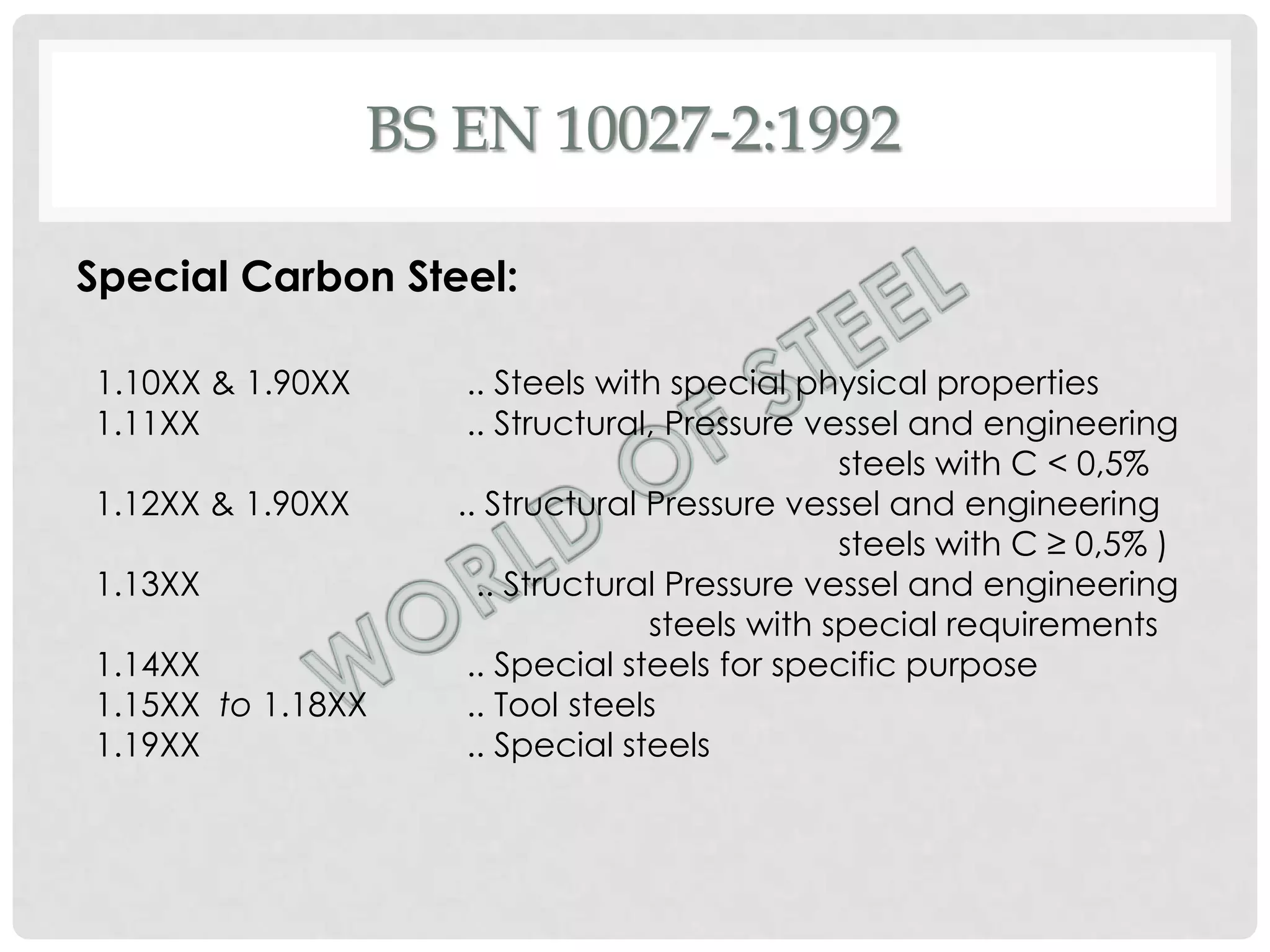
Special Carbon Steel:

1.10XX & 1.90XX       .. Steels with special physical properties
1.11XX                .. Structural, Pressure vessel and engineering
                                                steels with C < 0,5%
1.12XX & 1.90XX      .. Structural Pressure vessel and engineering
                                                steels with C ≥ 0,5% )
1.13XX                 .. Structural Pressure vessel and engineering
                                   steels with special requirements
1.14XX                .. Special steels for specific purpose
1.15XX to 1.18XX      .. Tool steels
1.19XX                .. Special steels
BS EN 10027-2:1992

Alloy Steel :

 1.08XX & 1.98XX ..Steels with special physical properties
 1.09XX & 1.99XX ..Steels for other applications
 1.2000 -1.2999 ..Tool Steels
     1.20XX..Tool Steels-Cr
     1.21XX..Tool Steels-(Cr-Si , Cr-Mn ,Cr-Mn-Si,
     1.22XX..Tool Steels-(Cr-V , Cr-V_Si ,Cr-V-Mn,Cr-V-Mn_Si
     1.23XX..Tool Steels .. (Cr-Mo, Cr-Mo-V, Mo-V )
     1.24XX..Tool Steels .. (W, Cr-W)
     1.25XX..Tool Steels .. (W-V, Cr-W-V)
     1.26XX..Tool Steels .. (other W)
     1.27XX..Tool Steels .. (with Ni)
     1.28XX..Other Tool Steels )
     1.29XX..Other Tool Steels ]
BS EN 10027-2:1992

Alloy Steel :

 1.3000 - 1.3999.. Special Steels
 1.35XX         .. Bearing Steels
 1.39XX         .. Ni Steels with special physical properties
 1.4000 -1.4999 .. Stainless and Heat Resisting
 1.43XX         .. Stainless Steels ( > 2.5% Ni but without Mo & Ti)
 1.44XX         .. Stainless steel ( < 2,5% Ni and Mo, but without
                                             Nb and Ti)
 1.5000 -1.8999 .. Structural, pressure vessel and engineering steels
 1.51XX          .. Structural , Pressure Vessel , Engineering Steels .
                                             (with Mn-Si, Mn-Cr)
 1.61XX          ..Special steels, structural, Pressure Vessel and
                                             Engineering steels
 1.70XX..Cr, Cr-B

                And so on. . . !!!
SAE DESIGNATIONS FOR CARBON
           STEEL AND ALLOY STEEL
• The name consists in 4 digits
• The first digit denotes main alloying element/elements

         SAE designation                           Type
1xxx                             Carbon steels
2xxx                             Nickel steels
3xxx                             Nickel-chromium steels
4xxx                             Molybdenum steels
5xxx                             Chromium steels
6xxx                             Chromium-vanadium steels
7xxx                             Tungsten steels
8xxx                             Nickel-chromium-vanadium steels
9xxx                             Silicon-manganese steels
SAE DESIGNATIONS FOR CARBON
        STEEL AND ALLOY STEEL
• Second digit represents secondary alloying elements
• The last two digits indicate the carbon content in hundredth of
  a percent.
                                     SAE designation                 Type


                                                10xx Plain carbon (Mn 1.00% max)
Eg. “1049 steel” is a
plain carbon steel with                         11xx Resulfurized carbon steel

0.49% carbon
                                                12xx Resulfurized and rephosphorized

                                                15xx Plain carbon (Mn 1.00% to 1.65%)

         Tools and machine                 xxBxx   Boron steels
         manufacturing wear plates
         blades fans etc                   xxLxx   Leaded steels
                                                                                        ductile
END USES OF SAE GRADES
                         (SUPERFICIAL IDEA)

                                              Plain carbon used in
                                              noncritical structural
Cylinders, turbine
                                              fabrications
blades, bolts
                                              High carbon steel used for
forged products ,
                                              making tools
bearings(high
stress conditions)
                                                Spring , bolts
Fabrications for
underground
usage(high corrosion
                                                High temp and high
environment)
                                                corrosion condition
                                                (boilers pipes furnaces)
    Cutting and
    Drilling tools
STAINLESS STEEL GRADES

Usual representation : A three digit number sometimes followed by
a letter.

Series 400 (martensitic) eg. 410 440C
 used in : Fasteners, pump shafts
Series 400 (ferritic) eg. 405 436S
 used in : automotive exhaust systems, catalytic converters, radiator
caps, and chimney liners
200/300 Series (austenitic) eg. 304
 used in : Food equipment, chemical equipment, architectural
applications
Suffixes A,B,C are used to indicate carbon content
„A‟ type will mainly be required where aesthetics is needed as it is
More stain resistant. C type is the hardest and used to make stainless
 steel tools and springs.
A TYPICAL ASTM DESIGNATION

ASTM A 582/A582M-95b (2000),
                        Grade 303Se

            A
Indicates   sequential
ferrous     number
material                              Year of
                                      last
                                      revision
                         Indicates               Year of
                         that the                last re-   Usually
                         standard                approval   written in
                         was                                SAE
                         written in                         standard
                         SI units                           notation
SYMBOLS IN EUROPEAN STANDARDS

                                         Code                     Condition
                                        A            Annealed
                                        QT           Quenched and tempered
         Process Codes                  N            Normalised
                                        SR           Stress relieved
                                        C            Cold worked
                                        U            Untreated
Application
                              Meaning
  symbol
S             Structural steel
P             Steel for pressure lines and vessels
L             Steel for pipe and tube
                                                                       Applications Codes
E             Engineering steels
B             Steel for reinforced concrete
R             Steel for rail use
JIS AND BS STANDARDS

   "JIS X 0208:1997"              • X will be G for ferrous alloys
                                    and H for non-ferrous
                                  • Stainless steels ae named according to AISI
                                    conventions (SUS 304)
                                  • SUH -> Heat resistant alloys
A letter that denotes
the
                                  • SCS and SCH numbers are used for stainless
area of application                 steel castings.
of material


   “BS XXXX[-P]:YYYY”


 Number of the            year
 standard
            Sub-division number
             in the standard

Steel Naming Conventions

  • 1.
    NAMING CONVENTIONS OF STEEL AIM: TO HELP GUESS THE END USE FROM GRADES
  • 2.
    AVAILABLE GRADING SYSTEMS •SAE steel grades • British Standards • International Organization for Standardization ISO/TS 4949:2003 For Steel only • European standards - EN 10027 • Japanese steel grades : JIS standard • Germany steel grades : DIN standard • China steel grades : GB standard • Unified Numbering System (UNS) of ASTM Int. For alloys in general • The Society of Automotive Engineers (SAE).
  • 3.
    FOR INDIAN STEELINDUSTRY American Standards : AISI & SAE series British Standards : EN & RVSS series German Standards : DIN series Japanese Standards : JIS series Indian Standards : IS series Indian Railways : RDSO series French Standards : AFNOR series State Road Transport : ASTRU series Standards
  • 4.
    BS EN STANDARDSUSED • BS EN 10079:1992 : It is a Reference standard which defines steel products based on their physical properties a) Their shape and dimensions b) Their appearance and surface condition • BS EN 10027-1:1992:The steel grade names consist of alpha numerical characters and define two main designation systems.
  • 5.
    STEELS DESIGNATION (BSEN 10027-1:1992) ON THE BASIS OF THEIR USE AND THEIR MECHANICAL PROPERTIES. Letter Application Mechanical Property that is indicated S Structural Steel Minimum Yield Strength P Pressure Purposes Minimum Yield Strength L Line Pipe Minimum Yield Strength E Engineering Minimum Yield Strength B Reinforcing Steel Characteristic Yield Case Y Pre-stressing Steel Minimum Yield Case R Rails Minimum Yield Case H High Strength Cold Rolled Minimum Yield Case D Flat Products for Cold Forming C, D or X followed by two numbers characterising steel T Tinmill Products Nominal Yield Case 100 x specific loss in W/kg, "—" M Electrical Steel 100 x nom thick in mm Letter for type of steel (A,B,E,N,S or P) Eg. S420 designates a structural steel(S) with a specified yield strength of 420MPa
  • 6.
    BS EN 10027-1:1992STEELS DESIGNATION ON THE BASIS OF THEIR CHEMICAL COMPOSITION Carbon Steel : According to AISI (American Iron and Steel Institute) , a steel can be called carbon steel when no minimum percentage of other alloying elements is mandatory for obtaining the desired properties. And the percentage composition {by weight } does not exceed – • 1.65 for Mn • 0.6 for Si • 0.6 for Cu BS EN 10027-1:1992 designation : The grade name is „C‟ followed by a number „XX‟ where XX is ( PC of carbon* 100) Eg: a “C56” steel is essentially a carbon steel with 0.56 weight percentage of carbon
  • 7.
    BS EN 10027-1:1992STEELS DESIGNATION ON THE BASIS OF THEIR CHEMICAL COMPOSITION Alloy Steel: Steel that does not fall under Carbon steel criteria and have significant proportions of alloying elements. BS EN 10027-1:1992 designation : The name consists of X followed by (100 x Carbon %age ) then the Symbols of alloying elements followed by numbers indicating the associated % contents. Eg : a “X2CrNi18-9” steel is an alloy steel with average Carbon, Chromium and Nikel percentages of 0.2%, 18 %, 9% respectively.
  • 8.
    BS EN 10027-2:1992 •This system gives a steel number to the grade • Grade number consists of 1 (denoting steel) followed by a point and then 4 figures. Steel Number= 1.YYXX • YY (2 digit number) represent the steel type • XX (2 digit number) does not represent anything • XX is awarded sequentially by a European Registering Office.
  • 9.
    BS EN 10027-2:1992 CarbonSteel : 1.00XX & 1.90XX ..Base Steels 1.01XX& 1.91XX ..Quality Steel , General structural steels 1.02XX& 1.92XX ..Structural Steels (Not intended for heat treatment ) 1.03XX& 1.93XX ..Steels with average C< 0,12% 1.93XX..Steels with average C< 0,12% 1.04XX& 1.94XX ..Steels with average C >= 0,12% < 0,25% 1.05XX & 1.95XX..Steels with average C >= 0,25% < 0,55% 1.06XX& 1.96XX ..Steels with average C > 0,55% 1.07XX & 1.97XX..Steels with higher P or S content
  • 10.
    BS EN 10027-2:1992 SpecialCarbon Steel: 1.10XX & 1.90XX .. Steels with special physical properties 1.11XX .. Structural, Pressure vessel and engineering steels with C < 0,5% 1.12XX & 1.90XX .. Structural Pressure vessel and engineering steels with C ≥ 0,5% ) 1.13XX .. Structural Pressure vessel and engineering steels with special requirements 1.14XX .. Special steels for specific purpose 1.15XX to 1.18XX .. Tool steels 1.19XX .. Special steels
  • 11.
    BS EN 10027-2:1992 AlloySteel : 1.08XX & 1.98XX ..Steels with special physical properties 1.09XX & 1.99XX ..Steels for other applications 1.2000 -1.2999 ..Tool Steels 1.20XX..Tool Steels-Cr 1.21XX..Tool Steels-(Cr-Si , Cr-Mn ,Cr-Mn-Si, 1.22XX..Tool Steels-(Cr-V , Cr-V_Si ,Cr-V-Mn,Cr-V-Mn_Si 1.23XX..Tool Steels .. (Cr-Mo, Cr-Mo-V, Mo-V ) 1.24XX..Tool Steels .. (W, Cr-W) 1.25XX..Tool Steels .. (W-V, Cr-W-V) 1.26XX..Tool Steels .. (other W) 1.27XX..Tool Steels .. (with Ni) 1.28XX..Other Tool Steels ) 1.29XX..Other Tool Steels ]
  • 12.
    BS EN 10027-2:1992 AlloySteel : 1.3000 - 1.3999.. Special Steels 1.35XX .. Bearing Steels 1.39XX .. Ni Steels with special physical properties 1.4000 -1.4999 .. Stainless and Heat Resisting 1.43XX .. Stainless Steels ( > 2.5% Ni but without Mo & Ti) 1.44XX .. Stainless steel ( < 2,5% Ni and Mo, but without Nb and Ti) 1.5000 -1.8999 .. Structural, pressure vessel and engineering steels 1.51XX .. Structural , Pressure Vessel , Engineering Steels . (with Mn-Si, Mn-Cr) 1.61XX ..Special steels, structural, Pressure Vessel and Engineering steels 1.70XX..Cr, Cr-B And so on. . . !!!
  • 13.
    SAE DESIGNATIONS FORCARBON STEEL AND ALLOY STEEL • The name consists in 4 digits • The first digit denotes main alloying element/elements SAE designation Type 1xxx Carbon steels 2xxx Nickel steels 3xxx Nickel-chromium steels 4xxx Molybdenum steels 5xxx Chromium steels 6xxx Chromium-vanadium steels 7xxx Tungsten steels 8xxx Nickel-chromium-vanadium steels 9xxx Silicon-manganese steels
  • 14.
    SAE DESIGNATIONS FORCARBON STEEL AND ALLOY STEEL • Second digit represents secondary alloying elements • The last two digits indicate the carbon content in hundredth of a percent. SAE designation Type 10xx Plain carbon (Mn 1.00% max) Eg. “1049 steel” is a plain carbon steel with 11xx Resulfurized carbon steel 0.49% carbon 12xx Resulfurized and rephosphorized 15xx Plain carbon (Mn 1.00% to 1.65%) Tools and machine xxBxx Boron steels manufacturing wear plates blades fans etc xxLxx Leaded steels ductile
  • 15.
    END USES OFSAE GRADES (SUPERFICIAL IDEA) Plain carbon used in noncritical structural Cylinders, turbine fabrications blades, bolts High carbon steel used for forged products , making tools bearings(high stress conditions) Spring , bolts Fabrications for underground usage(high corrosion High temp and high environment) corrosion condition (boilers pipes furnaces) Cutting and Drilling tools
  • 16.
    STAINLESS STEEL GRADES Usualrepresentation : A three digit number sometimes followed by a letter. Series 400 (martensitic) eg. 410 440C used in : Fasteners, pump shafts Series 400 (ferritic) eg. 405 436S used in : automotive exhaust systems, catalytic converters, radiator caps, and chimney liners 200/300 Series (austenitic) eg. 304 used in : Food equipment, chemical equipment, architectural applications Suffixes A,B,C are used to indicate carbon content „A‟ type will mainly be required where aesthetics is needed as it is More stain resistant. C type is the hardest and used to make stainless steel tools and springs.
  • 17.
    A TYPICAL ASTMDESIGNATION ASTM A 582/A582M-95b (2000), Grade 303Se A Indicates sequential ferrous number material Year of last revision Indicates Year of that the last re- Usually standard approval written in was SAE written in standard SI units notation
  • 18.
    SYMBOLS IN EUROPEANSTANDARDS Code Condition A Annealed QT Quenched and tempered Process Codes N Normalised SR Stress relieved C Cold worked U Untreated Application Meaning symbol S Structural steel P Steel for pressure lines and vessels L Steel for pipe and tube Applications Codes E Engineering steels B Steel for reinforced concrete R Steel for rail use
  • 19.
    JIS AND BSSTANDARDS "JIS X 0208:1997" • X will be G for ferrous alloys and H for non-ferrous • Stainless steels ae named according to AISI conventions (SUS 304) • SUH -> Heat resistant alloys A letter that denotes the • SCS and SCH numbers are used for stainless area of application steel castings. of material “BS XXXX[-P]:YYYY” Number of the year standard Sub-division number in the standard