- a Raw Material for
Steelmaking


  •Pawandeep Singh
  •Pratyush Srivastava
   Scrap is recyclable and other materials left over from
    every manner of product consumption.
   Scrap has significant monetary value.
   Scrap metal is divided into two types: ferrous and
    nonferrous.
   Ferrous scrap is scrap iron and steel.
   It is key input material that is used in steel making
    process.
   Use of scrap conserves raw material.
   EAFs(Electric Arc Furnace) allows steel to be made
    from a 100% scrap metal feedstock.
   EAFs are better due to flexibility, less energy
    consumption; although there are some issues like
    environmental pollution and low purity production.
   Usage of scrap conserves raw material and
    energy.
   Also, it reduces the burden on landfill disposal
    facilities and prevents the accumulation of
    abandoned steel products in the environment.
   The steel and foundry industries are also highly
    dependent upon scrap.
   Scrap metal is divided into two types: ferrous and
    nonferrous.
   Ferrous scrap is scrap iron and steel.
   This includes scrap from old automobiles, farm
    equipment, household appliances, steel beams,
    railroad tracks, ships, and food packaging and
    other containers.
   Ferrous scrap accounts for the largest volume of
    metal scrapped.
   Ferrous scrap is classified into almost 80 grades;
    additionally, there are another 40 grades of
    railroad ferrous scrap and even more grades of
    alloy scrap.
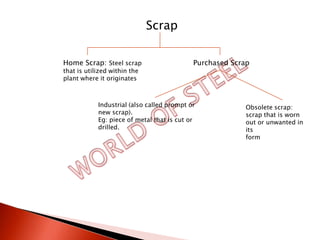
Scrap

Home Scrap: Steel scrap                     Purchased Scrap
that is utilized within the
plant where it originates


            Industrial (also called prompt or             Obsolete scrap:
            new scrap).                                   scrap that is worn
            Eg: piece of metal that is cut or             out or unwanted in
            drilled.                                      its
                                                          form
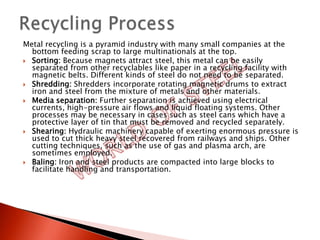
Metal recycling is a pyramid industry with many small companies at the
  bottom feeding scrap to large multinationals at the top.
 Sorting: Because magnets attract steel, this metal can be easily
  separated from other recyclables like paper in a recycling facility with
  magnetic belts. Different kinds of steel do not need to be separated.
 Shredding: Shredders incorporate rotating magnetic drums to extract
  iron and steel from the mixture of metals and other materials.
 Media separation: Further separation is achieved using electrical
  currents, high-pressure air flows and liquid floating systems. Other
  processes may be necessary in cases such as steel cans which have a
  protective layer of tin that must be removed and recycled separately.
 Shearing: Hydraulic machinery capable of exerting enormous pressure is
  used to cut thick heavy steel recovered from railways and ships. Other
  cutting techniques, such as the use of gas and plasma arch, are
  sometimes employed.
 Baling: Iron and steel products are compacted into large blocks to
  facilitate handling and transportation.
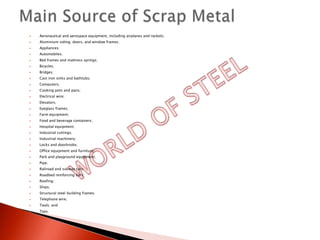
   Aeronautical and aerospace equipment, including airplanes and rockets;
   Aluminium siding, doors, and window frames;
   Appliances;
   Automobiles;
   Bed frames and mattress springs;
   Bicycles;
   Bridges;
   Cast iron sinks and bathtubs;
   Computers;
   Cooking pots and pans;
   Electrical wire;
   Elevators;
   Eyeglass frames;
   Farm equipment;
   Food and beverage containers;
   Hospital equipment;
   Industrial cuttings;
   Industrial machinery;
   Locks and doorknobs;
   Office equipment and furniture;
   Park and playground equipment;
   Pipe;
   Railroad and subway cars;
   Roadbed reinforcing bars;
   Roofing;
   Ships;
   Structural steel building frames;
   Telephone wire;
   Tools; and
   Toys.
Scrap recyclers purchase recyclables from various sources like:
   Manufacturers of metal products
   Airlines and railroad companies
   Apartment complexes
   Automobile dismantlers
   Auto mechanics
   Builders, roofers, and other construction sources
   Demolition contractors
   Factories;
   Mills
   Foundries
   Fabricators
   Farmers
   Municipal government agencies
   hospitals
   Universities
   Schools
   Machinists
   Appliance repair shops
   Municipal curbside collection programs
   Offices
   Stores
   Hotels and restaurants
   Plumbers and electricians
   The general public
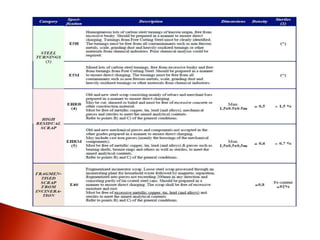
   Heavy melting steel (HMS) or heavy melting scrap, is a
    designation for recyclable steel and wrought iron.
    It is broken up into two major categories: HMS 1 and HMS 2.
   HMS 1 does not contain galvanized and blackened steel,
    whereas HMS 2 does.
   Both HMS 1 and HMS 2 are available in different grades.
   Both HMS 1 & 2 comprise obsolete scrap only.
   This density, sizing and preparation makes for efficient
    furnace operation by minimising the time to charge enough
    scrap for a full melt. In contrast, thin mixed scrap greatly
    increases charging time, cutting furnace productivity.
   HMS is usually traded as a blend of 1 & 2, either a premium
    blend (80:20) or lower grade mixes (70:30) and (60:40).
   Cleanliness: grades shall be free of dirt,
    nonferrous metals,
   or foreign material of any kind, and excessive
    rust and corrosion.
   Off-grade material
   Residual Alloys
   Specifications as per Institute of Scrap Recycling
    Industry

    http://www.seas.columbia.edu/earth/RRC/docu
    ments/scrap-specifications-circular-2007.pdf
    page-16
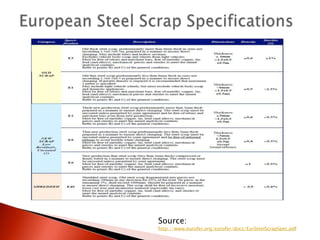
Source:
http://www.eurofer.org/eurofer/docs/EurSteelScrapSpec.pdf
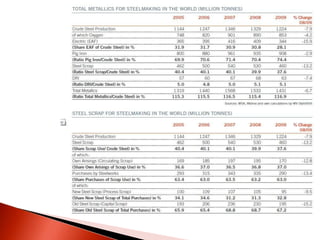
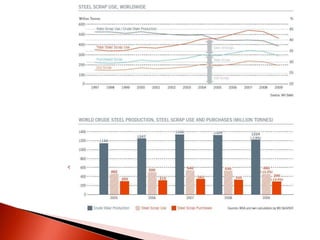
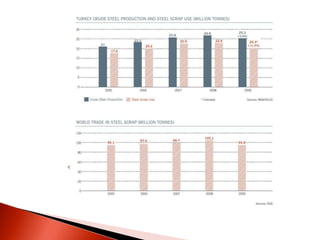
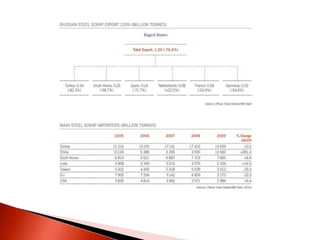
   Almost 40% of the world’s steel production is
    made from scrap
   The recycled steel scrap users in India are
    increasing at a rapid pace.
   India imports around 4-5 million tonnes per
    annum.
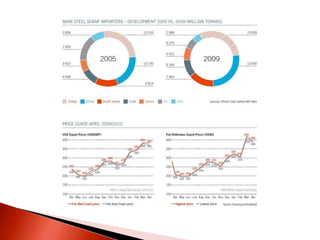
   Steel scrap is one of the most price sensitive
    commodities.
   Overseas seller doubt the credibility of buyer
   Indian mill face issues like quality, pricing,
    logistics, financing, reliability.
   These factors lead to inclusion of traders and
    agents in supply chain.
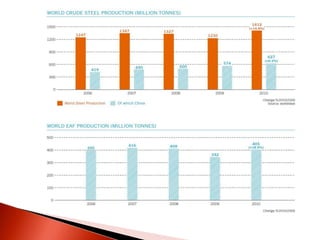
   Annual global scrap use in steelmaking has been
    between 460m and 540m tonnes; while that
    consumed in foundries is 56m and 76m tonnes.
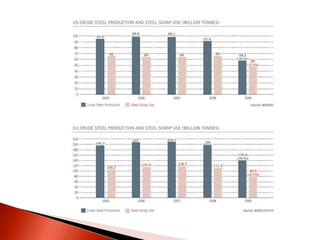
   In the U.S. alone, scrap metal processors handle 56
    million tons of scrap iron and steel yearly out of
    which 10 million tons of scrap is from automobiles.
   According to McKinsey, until 2013 steel scrap
    consumption will increase world-wide by 20%.
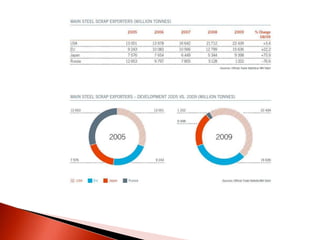
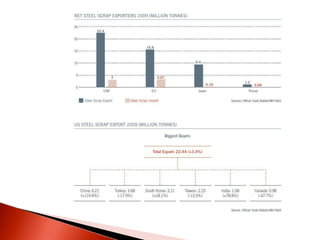
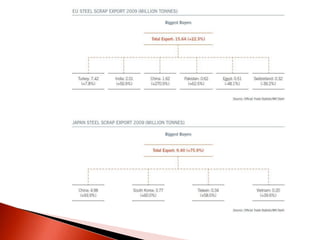
   India imports scrap steel mainly from U.S. and
    Europe.
Steel Scrap
Steel Scrap
Steel Scrap
Steel Scrap
Steel Scrap
Steel Scrap
Steel Scrap
Steel Scrap
Steel Scrap
Steel Scrap
Steel Scrap
Steel Scrap

Steel Scrap

  • 1.
    - a RawMaterial for Steelmaking •Pawandeep Singh •Pratyush Srivastava
  • 2.
    Scrap is recyclable and other materials left over from every manner of product consumption.  Scrap has significant monetary value.  Scrap metal is divided into two types: ferrous and nonferrous.  Ferrous scrap is scrap iron and steel.  It is key input material that is used in steel making process.  Use of scrap conserves raw material.  EAFs(Electric Arc Furnace) allows steel to be made from a 100% scrap metal feedstock.  EAFs are better due to flexibility, less energy consumption; although there are some issues like environmental pollution and low purity production.
  • 3.
    Usage of scrap conserves raw material and energy.  Also, it reduces the burden on landfill disposal facilities and prevents the accumulation of abandoned steel products in the environment.  The steel and foundry industries are also highly dependent upon scrap.
  • 4.
    Scrap metal is divided into two types: ferrous and nonferrous.  Ferrous scrap is scrap iron and steel.  This includes scrap from old automobiles, farm equipment, household appliances, steel beams, railroad tracks, ships, and food packaging and other containers.  Ferrous scrap accounts for the largest volume of metal scrapped.  Ferrous scrap is classified into almost 80 grades; additionally, there are another 40 grades of railroad ferrous scrap and even more grades of alloy scrap.
  • 5.
    Scrap Home Scrap: Steelscrap Purchased Scrap that is utilized within the plant where it originates Industrial (also called prompt or Obsolete scrap: new scrap). scrap that is worn Eg: piece of metal that is cut or out or unwanted in drilled. its form
  • 6.
    Metal recycling isa pyramid industry with many small companies at the bottom feeding scrap to large multinationals at the top.  Sorting: Because magnets attract steel, this metal can be easily separated from other recyclables like paper in a recycling facility with magnetic belts. Different kinds of steel do not need to be separated.  Shredding: Shredders incorporate rotating magnetic drums to extract iron and steel from the mixture of metals and other materials.  Media separation: Further separation is achieved using electrical currents, high-pressure air flows and liquid floating systems. Other processes may be necessary in cases such as steel cans which have a protective layer of tin that must be removed and recycled separately.  Shearing: Hydraulic machinery capable of exerting enormous pressure is used to cut thick heavy steel recovered from railways and ships. Other cutting techniques, such as the use of gas and plasma arch, are sometimes employed.  Baling: Iron and steel products are compacted into large blocks to facilitate handling and transportation.
  • 8.
    Aeronautical and aerospace equipment, including airplanes and rockets;  Aluminium siding, doors, and window frames;  Appliances;  Automobiles;  Bed frames and mattress springs;  Bicycles;  Bridges;  Cast iron sinks and bathtubs;  Computers;  Cooking pots and pans;  Electrical wire;  Elevators;  Eyeglass frames;  Farm equipment;  Food and beverage containers;  Hospital equipment;  Industrial cuttings;  Industrial machinery;  Locks and doorknobs;  Office equipment and furniture;  Park and playground equipment;  Pipe;  Railroad and subway cars;  Roadbed reinforcing bars;  Roofing;  Ships;  Structural steel building frames;  Telephone wire;  Tools; and  Toys.
  • 9.
    Scrap recyclers purchaserecyclables from various sources like:  Manufacturers of metal products  Airlines and railroad companies  Apartment complexes  Automobile dismantlers  Auto mechanics  Builders, roofers, and other construction sources  Demolition contractors  Factories;  Mills  Foundries  Fabricators  Farmers  Municipal government agencies  hospitals  Universities  Schools  Machinists  Appliance repair shops  Municipal curbside collection programs  Offices  Stores  Hotels and restaurants  Plumbers and electricians  The general public
  • 10.
    Heavy melting steel (HMS) or heavy melting scrap, is a designation for recyclable steel and wrought iron.  It is broken up into two major categories: HMS 1 and HMS 2.  HMS 1 does not contain galvanized and blackened steel, whereas HMS 2 does.  Both HMS 1 and HMS 2 are available in different grades.  Both HMS 1 & 2 comprise obsolete scrap only.  This density, sizing and preparation makes for efficient furnace operation by minimising the time to charge enough scrap for a full melt. In contrast, thin mixed scrap greatly increases charging time, cutting furnace productivity.  HMS is usually traded as a blend of 1 & 2, either a premium blend (80:20) or lower grade mixes (70:30) and (60:40).
  • 11.
    Cleanliness: grades shall be free of dirt, nonferrous metals,  or foreign material of any kind, and excessive rust and corrosion.  Off-grade material  Residual Alloys  Specifications as per Institute of Scrap Recycling Industry http://www.seas.columbia.edu/earth/RRC/docu ments/scrap-specifications-circular-2007.pdf page-16
  • 12.
  • 14.
    Almost 40% of the world’s steel production is made from scrap  The recycled steel scrap users in India are increasing at a rapid pace.  India imports around 4-5 million tonnes per annum.  Steel scrap is one of the most price sensitive commodities.  Overseas seller doubt the credibility of buyer  Indian mill face issues like quality, pricing, logistics, financing, reliability.  These factors lead to inclusion of traders and agents in supply chain.
  • 15.
    Annual global scrap use in steelmaking has been between 460m and 540m tonnes; while that consumed in foundries is 56m and 76m tonnes.  In the U.S. alone, scrap metal processors handle 56 million tons of scrap iron and steel yearly out of which 10 million tons of scrap is from automobiles.  According to McKinsey, until 2013 steel scrap consumption will increase world-wide by 20%.  India imports scrap steel mainly from U.S. and Europe.