Continuous
Casting of
Billets
What is Casting
• A manufacturing process
• Types of casting
• Sand casting
• Die casting
• Permanent casting
• Centrifugal casting
• Permanent mold casting
CONTINUES CASTING
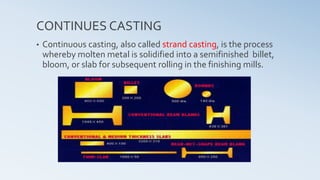
• Continuous casting, also called strand casting, is the process
whereby molten metal is solidified into a semifinished billet,
bloom, or slab for subsequent rolling in the finishing mills.
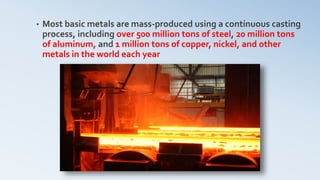
• Most basic metals are mass-produced using a continuous casting
process, including over 500 million tons of steel, 20 million tons
of aluminum, and 1 million tons of copper, nickel, and other
metals in the world each year
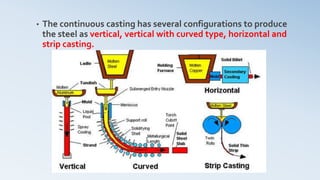
• The continuous casting has several configurations to produce
the steel as vertical, vertical with curved type, horizontal and
strip casting.
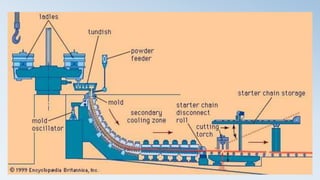
• Curved machines are used for the majority of steel casting and
require bending and / or unbending of the solidifying strand.
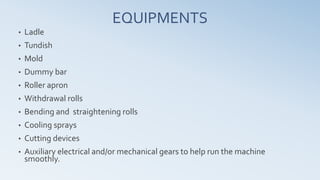
EQUIPMENTS
• Ladle
• Tundish
• Mold
• Dummy bar
• Roller apron
• Withdrawal rolls
• Bending and straightening rolls
• Cooling sprays
• Cutting devices
• Auxiliary electrical and/or mechanical gears to help run the machine
smoothly.
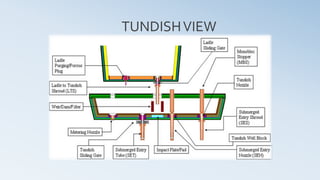
TUNDISHVIEW
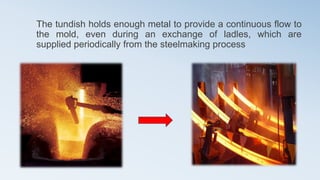
The tundish holds enough metal to provide a continuous flow to
the mold, even during an exchange of ladles, which are
supplied periodically from the steelmaking process
THE IMPORTANCE OFTUNDISH
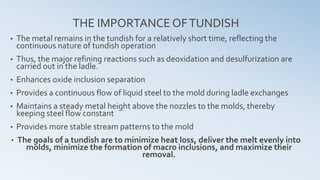
• The metal remains in the tundish for a relatively short time, reflecting the
continuous nature of tundish operation
• Thus, the major refining reactions such as deoxidation and desulfurization are
carried out in the ladle.
• Enhances oxide inclusion separation
• Provides a continuous flow of liquid steel to the mold during ladle exchanges
• Maintains a steady metal height above the nozzles to the molds, thereby
keeping steel flow constant
• Provides more stable stream patterns to the mold
• The goals of a tundish are to minimize heat loss, deliver the melt evenly into
molds, minimize the formation of macro inclusions, and maximize their
removal.
THE PROCESS OF CONTINUOUS CASTING OF
BILLETS
• Continuous casting transforms molten metal into solid on a continuous
basis and includes a variety of important commercial process.
• These processes are the most efficient way to solidify large volumes of
metal into simple shapes for subsequent processing.
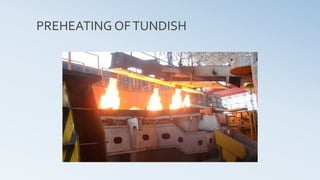
• To preheat the tundish before starting the process is that will contribute
about reducing of the cracks over the working living in the tundish.
PREHEATING OFTUNDISH
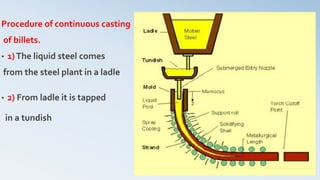
Procedure of continuous casting
of billets.
• 1)The liquid steel comes
from the steel plant in a ladle
• 2) From ladle it is tapped
in a tundish
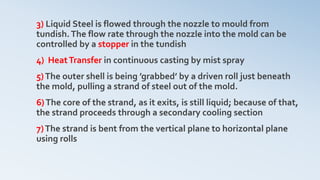
3) Liquid Steel is flowed through the nozzle to mould from
tundish.The flow rate through the nozzle into the mold can be
controlled by a stopper in the tundish
4) HeatTransfer in continuous casting by mist spray
5)The outer shell is being ’grabbed’ by a driven roll just beneath
the mold, pulling a strand of steel out of the mold.
6)The core of the strand, as it exits, is still liquid; because of that,
the strand proceeds through a secondary cooling section
7)The strand is bent from the vertical plane to horizontal plane
using rolls
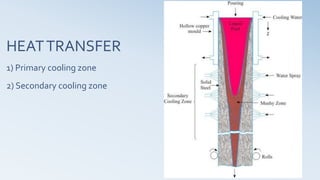
HEATTRANSFER
1) Primary cooling zone
2) Secondary cooling zone
THE BENEFITS OF CONTINOUS CASTING
• Considerable energy savings
• less scrap produced, i.e. improved yield
• Improved labor productivity
• Improved quality of steel
• Reduced pollution
• Reduced capital costs
• increased use of purchased scrap when output is maximized
DISADVANTAGES
• Not suitable for small quantity production.
• Continuous and efficient cooling of mold is required, else, center line
shrinkage develops.
• Requires large floor space.
Conclusion
• Continuous casting has evolved from a batch process into a
sophisticated continuous process.This transformation has occurred
through understanding principle of mechanical design , heat
transfer , steel metallurgical properties and stress strain
relationships, to produce a product with excellent shape and
quality.
• In recent year the process has been optimized through careful
integration of electro-mechanical sensors, computer-controls, &
planning to provide a highly automated system designed for new
millennia.
THANK YOU FOR YOUR
ATTENTION

Continuous casting of billets

  • 1.
  • 2.
    What is Casting •A manufacturing process • Types of casting • Sand casting • Die casting • Permanent casting • Centrifugal casting • Permanent mold casting
  • 3.
    CONTINUES CASTING • Continuouscasting, also called strand casting, is the process whereby molten metal is solidified into a semifinished billet, bloom, or slab for subsequent rolling in the finishing mills.
  • 4.
    • Most basicmetals are mass-produced using a continuous casting process, including over 500 million tons of steel, 20 million tons of aluminum, and 1 million tons of copper, nickel, and other metals in the world each year
  • 5.
    • The continuouscasting has several configurations to produce the steel as vertical, vertical with curved type, horizontal and strip casting.
  • 6.
    • Curved machinesare used for the majority of steel casting and require bending and / or unbending of the solidifying strand.
  • 8.
    EQUIPMENTS • Ladle • Tundish •Mold • Dummy bar • Roller apron • Withdrawal rolls • Bending and straightening rolls • Cooling sprays • Cutting devices • Auxiliary electrical and/or mechanical gears to help run the machine smoothly.
  • 9.
  • 10.
    The tundish holdsenough metal to provide a continuous flow to the mold, even during an exchange of ladles, which are supplied periodically from the steelmaking process
  • 11.
    THE IMPORTANCE OFTUNDISH •The metal remains in the tundish for a relatively short time, reflecting the continuous nature of tundish operation • Thus, the major refining reactions such as deoxidation and desulfurization are carried out in the ladle. • Enhances oxide inclusion separation • Provides a continuous flow of liquid steel to the mold during ladle exchanges • Maintains a steady metal height above the nozzles to the molds, thereby keeping steel flow constant • Provides more stable stream patterns to the mold • The goals of a tundish are to minimize heat loss, deliver the melt evenly into molds, minimize the formation of macro inclusions, and maximize their removal.
  • 12.
    THE PROCESS OFCONTINUOUS CASTING OF BILLETS • Continuous casting transforms molten metal into solid on a continuous basis and includes a variety of important commercial process. • These processes are the most efficient way to solidify large volumes of metal into simple shapes for subsequent processing. • To preheat the tundish before starting the process is that will contribute about reducing of the cracks over the working living in the tundish.
  • 13.
  • 14.
    Procedure of continuouscasting of billets. • 1)The liquid steel comes from the steel plant in a ladle • 2) From ladle it is tapped in a tundish
  • 15.
    3) Liquid Steelis flowed through the nozzle to mould from tundish.The flow rate through the nozzle into the mold can be controlled by a stopper in the tundish 4) HeatTransfer in continuous casting by mist spray 5)The outer shell is being ’grabbed’ by a driven roll just beneath the mold, pulling a strand of steel out of the mold. 6)The core of the strand, as it exits, is still liquid; because of that, the strand proceeds through a secondary cooling section 7)The strand is bent from the vertical plane to horizontal plane using rolls
  • 16.
    HEATTRANSFER 1) Primary coolingzone 2) Secondary cooling zone
  • 18.
    THE BENEFITS OFCONTINOUS CASTING • Considerable energy savings • less scrap produced, i.e. improved yield • Improved labor productivity • Improved quality of steel • Reduced pollution • Reduced capital costs • increased use of purchased scrap when output is maximized
  • 19.
    DISADVANTAGES • Not suitablefor small quantity production. • Continuous and efficient cooling of mold is required, else, center line shrinkage develops. • Requires large floor space.
  • 20.
    Conclusion • Continuous castinghas evolved from a batch process into a sophisticated continuous process.This transformation has occurred through understanding principle of mechanical design , heat transfer , steel metallurgical properties and stress strain relationships, to produce a product with excellent shape and quality. • In recent year the process has been optimized through careful integration of electro-mechanical sensors, computer-controls, & planning to provide a highly automated system designed for new millennia.
  • 21.
    THANK YOU FORYOUR ATTENTION