CONTINUOUS 
CASTING
SO,WHAT IS STEEL? 
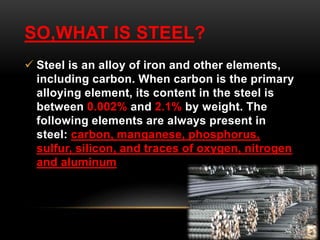
 Steel is an alloy of iron and other elements, 
including carbon. When carbon is the primary 
alloying element, its content in the steel is 
between 0.002% and 2.1% by weight. The 
following elements are always present in 
steel: carbon, manganese, phosphorus, 
sulfur, silicon, and traces of oxygen, nitrogen 
and aluminum
CONTINUOUS CASTING 
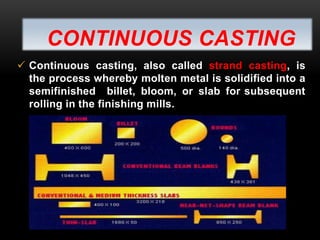
 Continuous casting, also called strand casting, is 
the process whereby molten metal is solidified into a 
semifinished billet, bloom, or slab for subsequent 
rolling in the finishing mills.
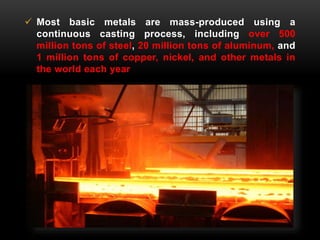
 Most basic metals are mass-produced using a 
continuous casting process, including over 500 
million tons of steel, 20 million tons of aluminum, and 
1 million tons of copper, nickel, and other metals in 
the world each year
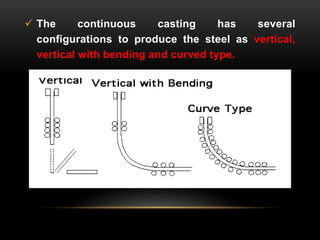
 The continuous casting has several 
configurations to produce the steel as vertical, 
vertical with bending and curved type. 
.
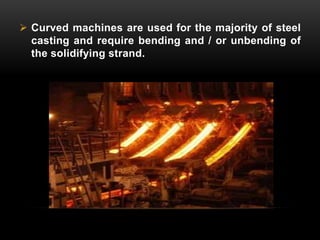
 Curved machines are used for the majority of steel 
casting and require bending and / or unbending of 
the solidifying strand.
WHAT DO WE DO UNTIL CONTINUOUS 
CASTING ? 
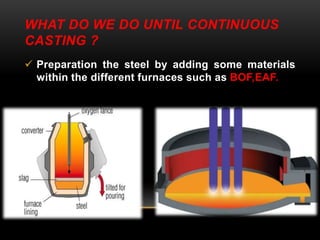
 Preparation the steel by adding some materials 
within the different furnaces such as BOF,EAF.
BOF(BASIC OXYGEN FURNACE) 
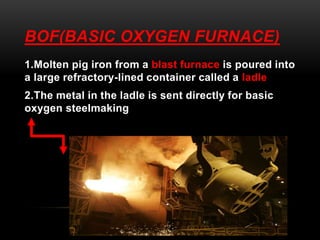
1.Molten pig iron from a blast furnace is poured into 
a large refractory-lined container called a ladle 
2.The metal in the ladle is sent directly for basic 
oxygen steelmaking
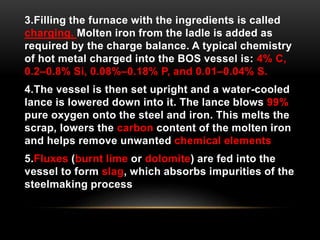
3.Filling the furnace with the ingredients is called 
charging. Molten iron from the ladle is added as 
required by the charge balance. A typical chemistry 
of hot metal charged into the BOS vessel is: 4% C, 
0.2–0.8% Si, 0.08%–0.18% P, and 0.01–0.04% S. 
4.The vessel is then set upright and a water-cooled 
lance is lowered down into it. The lance blows 99% 
pure oxygen onto the steel and iron. This melts the 
scrap, lowers the carbon content of the molten iron 
and helps remove unwanted chemical elements 
5.Fluxes (burnt lime or dolomite) are fed into the 
vessel to form slag, which absorbs impurities of the 
steelmaking process
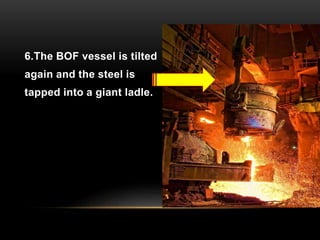
6.The BOF vessel is tilted 
again and the steel is 
tapped into a giant ladle.
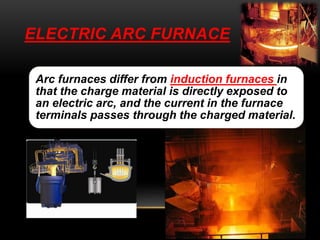
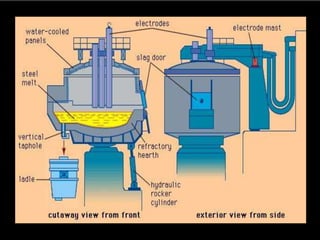
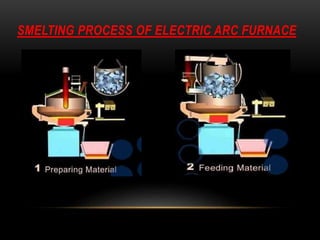
ELECTRIC ARC FURNACE 
Arc furnaces differ from induction furnaces in 
that the charge material is directly exposed to 
an electric arc, and the current in the furnace 
terminals passes through the charged material.
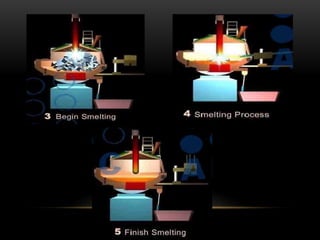
SMELTING PROCESS OF ELECTRIC ARC FURNACE
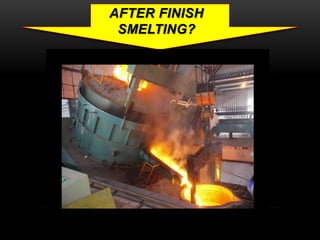
AFTER FINISH 
SMELTING?
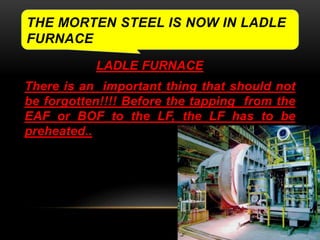
THE MORTEN STEEL IS NOW IN LADLE 
FURNACE 
LADLE FURNACE 
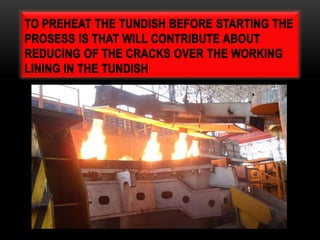
There is an important thing that should not 
be forgotten!!!! Before the tapping from the 
EAF or BOF to the LF, the LF has to be 
preheated..
SO,WE ARE READY TO START TO THE 
CONTINUOUS CASTING
THE BENEFITS OF CONTINUOUS CASTING 
 Considerable energy savings 
 Less scrap produced, i.e. improved yield 
 Improved labor productivity 
 Improved quality of steel 
 Reduced pollution 
 Reduced capital costs 
 Increased use of purchased scrap when 
output is maximized
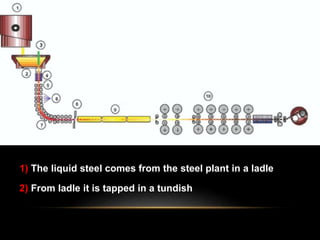
1) The liquid steel comes from the steel plant in a ladle 
2) From ladle it is tapped in a tundish
3) Liquid Steel is flowed through the nozzle to mould 
from tundish. The flow rate through the nozzle into the 
mould can be controlled by a stopper in the tundish 
4) The mould is a rectangular copper box without a top 
and a bottom 
5) The outer shell is being ’grabbed’ by a driven roll just 
beneath the mould, pulling a strand of steel out of the 
mould. 
6) The core of the strand, as it exits, is still liquid; 
because of that, the strand proceeds through a 
secondary cooling section 
7) The strand is bent from the vertical plane to 
horizontal plane using rolls
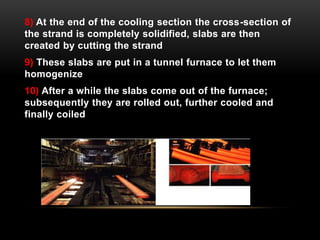
8) At the end of the cooling section the cross-section of 
the strand is completely solidified, slabs are then 
created by cutting the strand 
9) These slabs are put in a tunnel furnace to let them 
homogenize 
10) After a while the slabs come out of the furnace; 
subsequently they are rolled out, further cooled and 
finally coiled
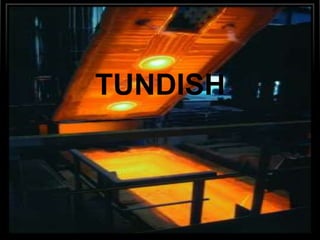
TUNDISH
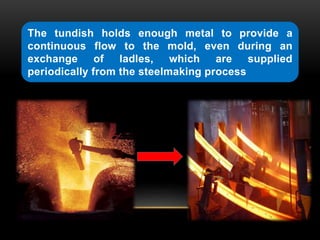
The tundish holds enough metal to provide a 
continuous flow to the mold, even during an 
exchange of ladles, which are supplied 
periodically from the steelmaking process
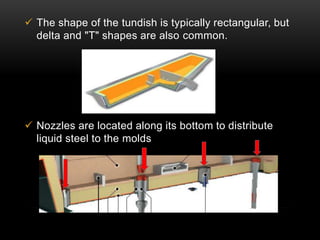
 The shape of the tundish is typically rectangular, but 
delta and "T" shapes are also common. 
 Nozzles are located along its bottom to distribute 
liquid steel to the molds
The tundish also serves several other key functions!!! 
 Enhances oxide inclusion separation 
 Provides a continuous flow of liquid steel to the mold 
during ladle exchanges 
 Maintains a steady metal height above the nozzles to 
the molds, thereby keeping steel flow constant 
 Provides more stable stream patterns to the mold(s)
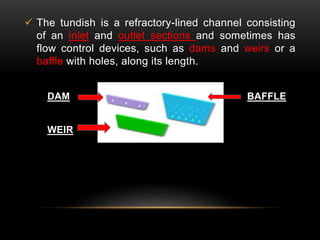
 The tundish is a refractory-lined channel consisting 
of an inlet and outlet sections and sometimes has 
flow control devices, such as dams and weirs or a 
baffle with holes, along its length. 
DAM BAFFLE 
WEIR
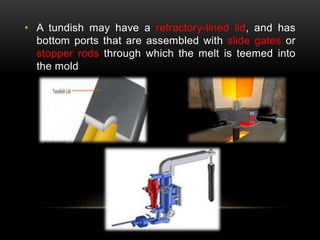
• A tundish may have a refractory-lined lid, and has 
bottom ports that are assembled with slide gates or 
stopper rods through which the melt is teemed into 
the mold
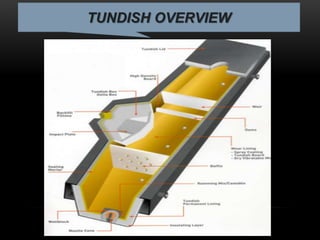
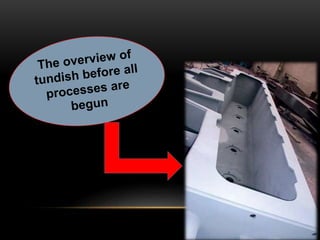
TUNDISH OVERVIEW
THE USED DEVICES IN THE 
TUNDISH 
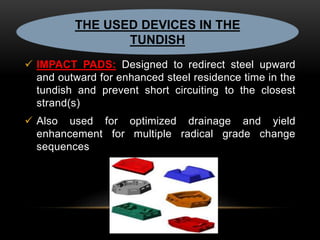
 IMPACT PADS: Designed to redirect steel upward 
and outward for enhanced steel residence time in the 
tundish and prevent short circuiting to the closest 
strand(s) 
 Also used for optimized drainage and yield 
enhancement for multiple radical grade change 
sequences
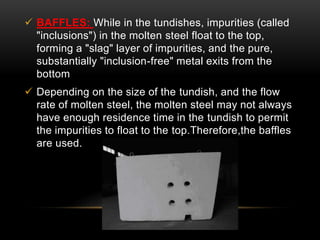
 BAFFLES: While in the tundishes, impurities (called 
"inclusions") in the molten steel float to the top, 
forming a "slag" layer of impurities, and the pure, 
substantially "inclusion-free" metal exits from the 
bottom 
 Depending on the size of the tundish, and the flow 
rate of molten steel, the molten steel may not always 
have enough residence time in the tundish to permit 
the impurities to float to the top.Therefore,the baffles 
are used.
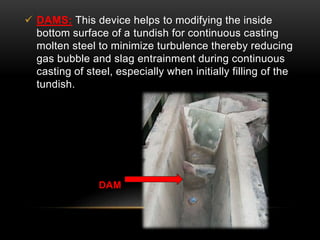
 DAMS: This device helps to modifying the inside 
bottom surface of a tundish for continuous casting 
molten steel to minimize turbulence thereby reducing 
gas bubble and slag entrainment during continuous 
casting of steel, especially when initially filling of the 
tundish. 
DAM
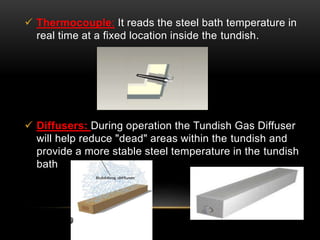
 Thermocouple: It reads the steel bath temperature in 
real time at a fixed location inside the tundish. 
 Diffusers: During operation the Tundish Gas Diffuser 
will help reduce "dead" areas within the tundish and 
provide a more stable steel temperature in the tundish 
bath
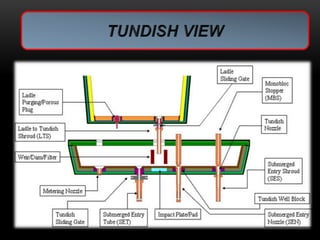
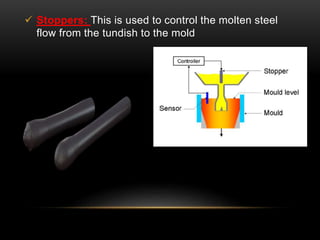
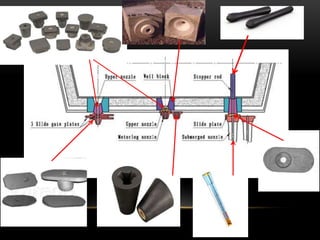
 Stoppers: This is used to control the molten steel 
flow from the tundish to the mold
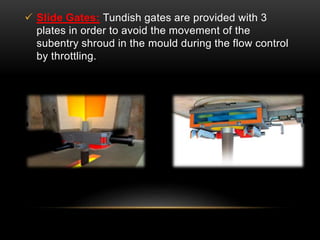
 Slide Gates: Tundish gates are provided with 3 
plates in order to avoid the movement of the 
subentry shroud in the mould during the flow control 
by throttling.
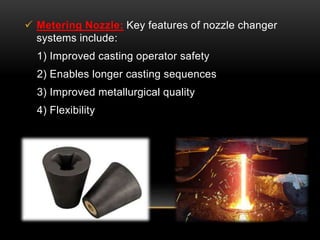
 Metering Nozzle: Key features of nozzle changer 
systems include: 
1) Improved casting operator safety 
2) Enables longer casting sequences 
3) Improved metallurgical quality 
4) Flexibility
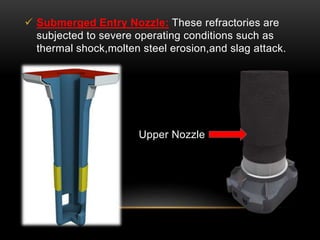
 Submerged Entry Nozzle: These refractories are 
subjected to severe operating conditions such as 
thermal shock,molten steel erosion,and slag attack. 
Upper Nozzle
THE IMPORTANCE OF TUNDISH 
 The melt remains in the tundish for a relatively short 
time, reflecting the continuous nature of tundish 
operation 
 Thus, the major refining reactions such as deoxidation 
and desulfurization are carried out in the ladle. 
The goals of a tundish are to 
minimize heat loss, deliver the 
melt evenly into molds, minimize 
the formation of macro inclusions, 
and 
maximize their removal.
INCLUSIONS AND DEFECTS 
 Non-metallic inclusions are a significant problem in 
cast steels 
 The mechanical behavior of steel is controlled to a 
large degree by the volume fraction, size, 
distribution, composition and morphology of 
inclusions and precipitates, which act as stress 
raisers 
 The inclusion size distribution is particularly 
important, because large macro inclusions are the 
most harmful to mechanical properties.
 The ductility and durability are significantly impaired 
by large-sized, non-metallic inclusions in steel. 
The samples of inclusions are shown above
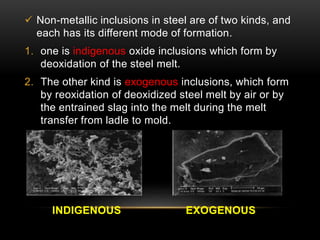
 Non-metallic inclusions in steel are of two kinds, and 
each has its different mode of formation. 
1. one is indigenous oxide inclusions which form by 
deoxidation of the steel melt. 
2. The other kind is exogenous inclusions, which form 
by reoxidation of deoxidized steel melt by air or by 
the entrained slag into the melt during the melt 
transfer from ladle to mold. 
INDIGENOUS EXOGENOUS
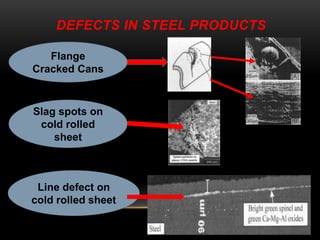
DEFECTS IN STEEL PRODUCTS 
Flange 
Cracked Cans 
Slag spots on 
cold rolled 
sheet 
Line defect on 
cold rolled sheet
THE FOLLOWING FACTORS NEED PARTICULAR 
ATTENTION IN MAKING A TUNDISH EFFECTIVE 
FOR REDUCING MACRO INCLUSIONS: 
#1. Steady state period of casting requires: 
 Melt flow with less turbulence along the tundish 
flux/melt interface 
 No short circuiting of melt flow from the inlet section 
to the exit (tundish nozzle) 
 Minimal dead volume for the melt in the tundish 
 Sufficient residence time for the melt to promote 
flotation 
 An argon gas shrouding pipe or long nozzle for ladle 
melt discharge into the tundish 
 Thermal insulation and protection against reoxidation 
by argon gas injection with lid or a tundish flux cover
#2. Non-steady state period of casting requires: 
 Prevention of slag carry over by vortexing and 
draining from the ladle to the tundish 
 The above slag carry over issue also applies to 
tundish to mold transfer 
 Suppression of turbulence caused by impinging melt 
stream to the tundish at the ladle opening 
 Sustaining an inert atmosphere at ladle opening and 
ladle change 
 Active compensation for temperature drop
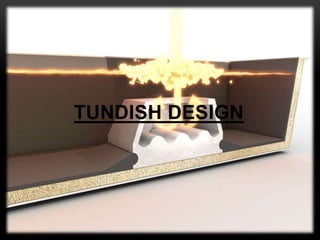
TUNDISH DESIGN
 The tundish can be designed according to the 
following conditions: 
• The amount of the production:The volumes of ladle, 
BOF,EAF 
• The various of the production (bloom, billet, slab) 
• The number of the strands 
• The features should be placed to float the inclusions 
from the morten steel to the slag( dams, baffles,weirs ) 
• The control of melt temperature to an appropriate level 
for feeding into the mold 
• The control of flow rates ( nozzle port(s), slide gates, 
stopper rods ) 
• The adjustment chemical compositions
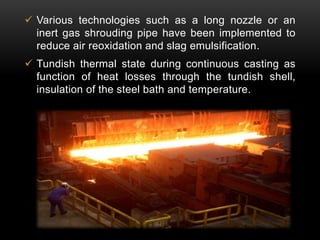
 Various technologies such as a long nozzle or an 
inert gas shrouding pipe have been implemented to 
reduce air reoxidation and slag emulsification. 
 Tundish thermal state during continuous casting as 
function of heat losses through the tundish shell, 
insulation of the steel bath and temperature.
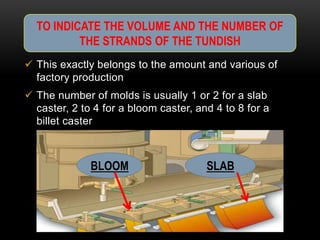
TO INDICATE THE VOLUME AND THE NUMBER OF 
THE STRANDS OF THE TUNDISH 
 This exactly belongs to the amount and various of 
factory production 
 The number of molds is usually 1 or 2 for a slab 
caster, 2 to 4 for a bloom caster, and 4 to 8 for a 
billet caster 
BLOOM SLAB
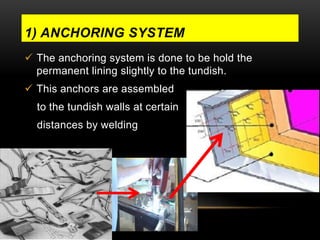
1) ANCHORING SYSTEM 
 The anchoring system is done to be hold the 
permanent lining slightly to the tundish. 
 This anchors are assembled 
to the tundish walls at certain 
distances by welding
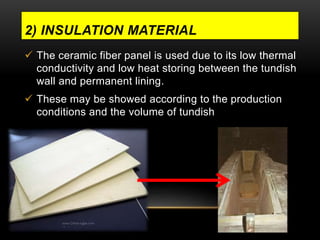
2) INSULATION MATERIAL 
 The ceramic fiber panel is used due to its low thermal 
conductivity and low heat storing between the tundish 
wall and permanent lining. 
 These may be showed according to the production 
conditions and the volume of tundish
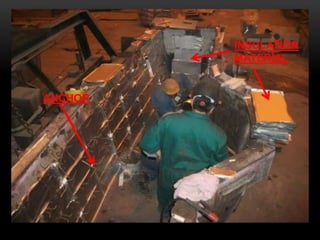
ANCHOR 
INSULATION 
MATERİAL
THE PLACEMENT OF NOZZLES AND STOPPERS 
 Before the permanent lining process is begun, the 
nozzles should be positioned to the outlet points at 
the bottom of the tundish 
 These devices are used to control the fluid flow from 
the tundish to the mold. 
 The used of these may be showed difference 
according to the various of production and the 
production conditions
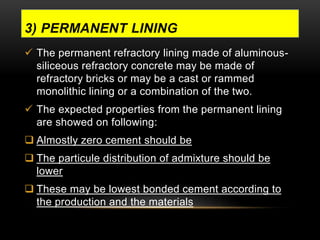
3) PERMANENT LINING 
 The permanent refractory lining made of aluminous-siliceous 
refractory concrete may be made of 
refractory bricks or may be a cast or rammed 
monolithic lining or a combination of the two. 
 The expected properties from the permanent lining 
are showed on following: 
 Almostly zero cement should be 
 The particule distribution of admixture should be 
lower 
 These may be lowest bonded cement according to 
the production and the materials
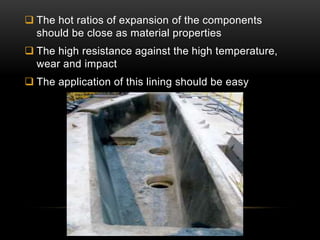
 The hot ratios of expansion of the components 
should be close as material properties 
 The high resistance against the high temperature, 
wear and impact 
 The application of this lining should be easy
 The permanent lining is generally made of high 
alümina refractory(%70-%93) and is the thickest part 
of the tundish lining. This lining has a low reactivity 
with magnesia materials to form a surface working 
layer. 
 Aluminous-siliceous refractory concretes proved the 
best in the second layer. 
 These are the materials that contain cement binder 
usually aluminate cement, which imparts hydraulic 
setting properties when mixed with water 
 The most common binder used in castables is HAC 
(high alumina cement)
 Other binders that are often used include hydratable 
aluminas and colloidal silica 
 When the working temperature is increased,the 
Al2O3 content should be increased.Because of this, 
the thermal conductivity and flexibilty. 
 These monolithic castables should be dried, sintered, 
and preheated before being put in service to prevent 
explosion spalling
• CAC in castables: The refractory concretes are 
divided into 4 main groups: 
1) Conventional Cement Castables,CCC,high cement 
contents(>20% CAC) 
2) Low Cement Castables,LCC (6-15%) 
3) Ultra Low Cement Castables (<6%) 
4) Cement Free Castables/No Cement Castables, 
NCC (<1,5%)
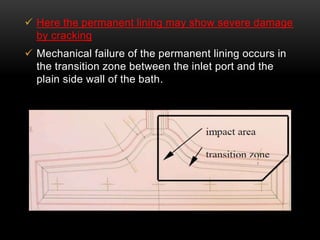
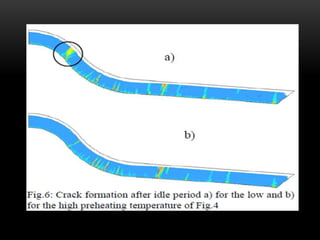
 Here the permanent lining may show severe damage 
by cracking 
 Mechanical failure of the permanent lining occurs in 
the transition zone between the inlet port and the 
plain side wall of the bath.
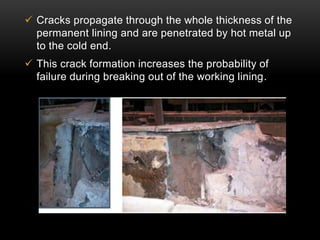
 Cracks propagate through the whole thickness of the 
permanent lining and are penetrated by hot metal up 
to the cold end. 
 This crack formation increases the probability of 
failure during breaking out of the working lining.
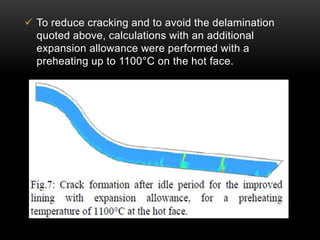
 To reduce cracking and to avoid the delamination 
quoted above, calculations with an additional 
expansion allowance were performed with a 
preheating up to 1100°C on the hot face.
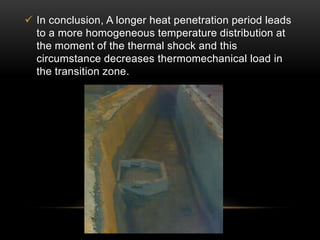
 In conclusion, A longer heat penetration period leads 
to a more homogeneous temperature distribution at 
the moment of the thermal shock and this 
circumstance decreases thermomechanical load in 
the transition zone.
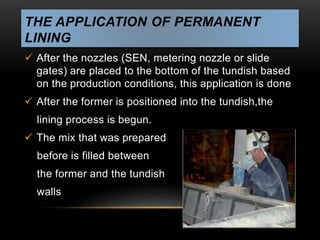
THE APPLICATION OF PERMANENT 
LINING 
 After the nozzles (SEN, metering nozzle or slide 
gates) are placed to the bottom of the tundish based 
on the production conditions, this application is done 
 After the former is positioned into the tundish,the 
lining process is begun. 
 The mix that was prepared 
before is filled between 
the former and the tundish 
walls
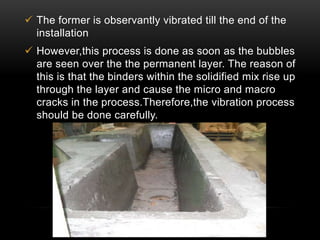
 The former is observantly vibrated till the end of the 
installation 
 However,this process is done as soon as the bubbles 
are seen over the the permanent layer. The reason of 
this is that the binders within the solidified mix rise up 
through the layer and cause the micro and macro 
cracks in the process.Therefore,the vibration process 
should be done carefully.
4) THE PLACEMENT OF TUNDISH 
DEVICES 
 The placement of tundish devices (ımpact pads, 
baffles, weirs, dams) is the most important section 
for tundish design.Because,the non-metallic 
inclusions can be moved away from the liquid steel 
and added to the slag layer with using of this 
devices. 
 In this way, the clean steel can be occured.
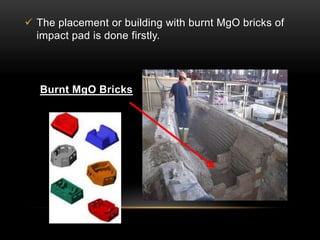
 The placement or building with burnt MgO bricks of 
impact pad is done firstly. 
Burnt MgO Bricks
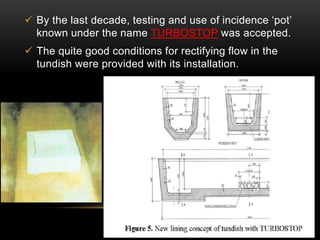
 By the last decade, testing and use of incidence ‘pot’ 
known under the name TURBOSTOP was accepted. 
 The quite good conditions for rectifying flow in the 
tundish were provided with its installation.
THE VARIOUS OF TUNDISH DESIGNS 
 The main points to improve tundish configuration are: 
 increase minimum residence time 
 get similar minimum residence times between all the 
strands 
 increase plug volume fraction 
 increase mixing volume fraction 
 decrease dead volume fraction
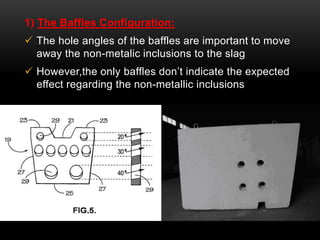
1) The Baffles Configuration: 
 The hole angles of the baffles are important to move 
away the non-metalic inclusions to the slag 
 However,the only baffles don’t indicate the expected 
effect regarding the non-metallic inclusions
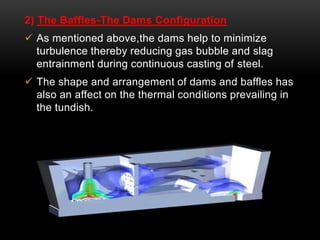
2) The Baffles-The Dams Configuration 
 As mentioned above,the dams help to minimize 
turbulence thereby reducing gas bubble and slag 
entrainment during continuous casting of steel. 
 The shape and arrangement of dams and baffles has 
also an affect on the thermal conditions prevailing in 
the tundish.
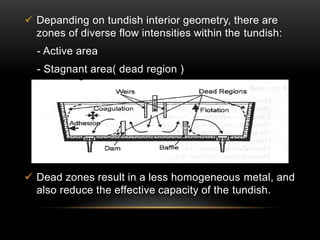
 Depanding on tundish interior geometry, there are 
zones of diverse flow intensities within the tundish: 
- Active area 
- Stagnant area( dead region ) 
 Dead zones result in a less homogeneous metal, and 
also reduce the effective capacity of the tundish.
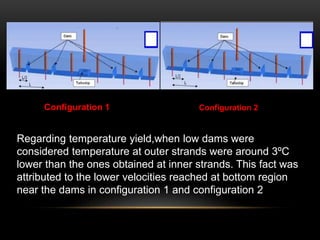
Configuration 1 Configuration 2 
Regarding temperature yield,when low dams were 
considered temperature at outer strands were around 3ºC 
lower than the ones obtained at inner strands. This fact was 
attributed to the lower velocities reached at bottom region 
near the dams in configuration 1 and configuration 2
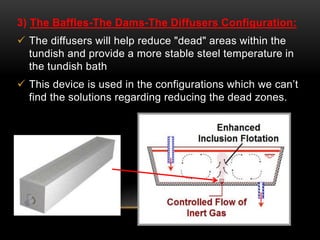
3) The Baffles-The Dams-The Diffusers Configuration: 
 The diffusers will help reduce "dead" areas within the 
tundish and provide a more stable steel temperature in 
the tundish bath 
 This device is used in the configurations which we can’t 
find the solutions regarding reducing the dead zones.
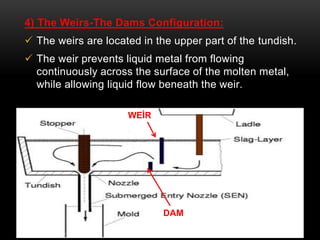
4) The Weirs-The Dams Configuration: 
 The weirs are located in the upper part of the tundish. 
 The weir prevents liquid metal from flowing 
continuously across the surface of the molten metal, 
while allowing liquid flow beneath the weir. 
WEİR 
DAM
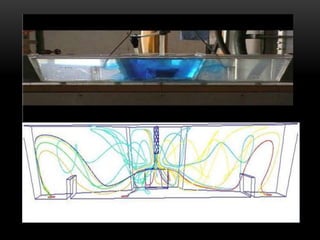
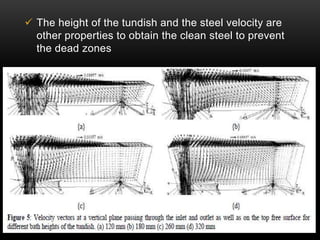
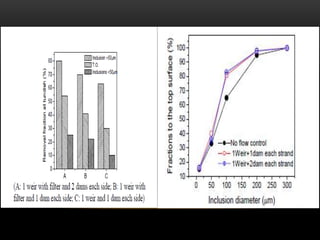
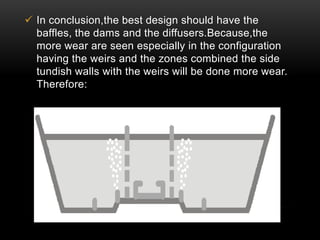
The differences can be seen with water modelling
 The height of the tundish and the steel velocity are 
other properties to obtain the clean steel to prevent 
the dead zones
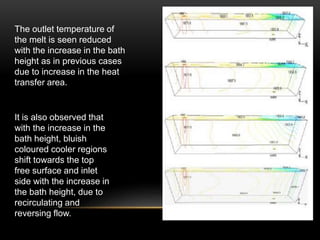
The outlet temperature of 
the melt is seen reduced 
with the increase in the bath 
height as in previous cases 
due to increase in the heat 
transfer area. 
It is also observed that 
with the increase in the 
bath height, bluish 
coloured cooler regions 
shift towards the top 
free surface and inlet 
side with the increase in 
the bath height, due to 
recirculating and 
reversing flow.
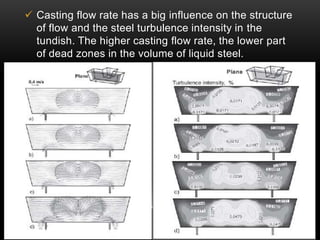
 Casting flow rate has a big influence on the structure 
of flow and the steel turbulence intensity in the 
tundish. The higher casting flow rate, the lower part 
of dead zones in the volume of liquid steel.
 In conclusion,the best design should have the 
baffles, the dams and the diffusers.Because,the 
more wear are seen especially in the configuration 
having the weirs and the zones combined the side 
tundish walls with the weirs will be done more wear. 
Therefore:
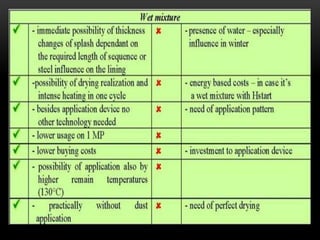
5) THE WORKING LINING 
 A working lining layer is mostly made of magnesia 
mixture that is wet applied through gunning in 
succesive steps by 20mm layers up to requested on 
walls and slag line(60-80 mm thickness) 
 With their usage the use of monolithic isolation mixes 
started to be even more important,because 
compared to brick lining isolated tundish had better 
isolation properties,which bettered the thermal 
balance 
 It has a higher thermal expansion coefficient
 From tundish lining is expected: 
 Decrease of thermal loses by long sequences 
 Better turn of tundish 
 Longer life time and decrease in maintenance costs 
of refractories 
 Simple drying and heating 
 Easy tapping and decrease of waste volume 
 Better lining integrity-increased purity of steel 
 Simple and quick installation 
 Decreased specific consumption upon a ton of steel 
 It shouldn’t include the asbestos
 The working lining is installed over permanent lining 
to provide thermal insulation and keep the steel shell 
temperature below its critical temperature range 
throughout the operating campaigns of a tundish 
The refractory material of the 
working face in contact with 
the steel melt should be high in 
MgO, with a minimum amount 
of reducible binder to prevent 
oxidation of Al in the melt.
 The working tundish lining refractory composition 
further includes a binder based on silicates or 
phosphates; a plasticizer which enhances adherence 
of the composition when applied to the permanent 
lining; a bond stabilizer; a homogenizer; and in 
certain cases, a small amount of a wetting/foaming 
agent 
 The corrosion of the working lining in molten slags 
depends strongly on the viscosity of slag and also 
the basicity gap between the refractories and the 
slags.
 When slag penetrates into pores of common plaster 
with high- MgO content, the phases such as 
monticellite and merwinite develop around MgO 
grains and provide continuous dissolution of MgO 
grains during steel-making process. 
 Replacing part of the magnesia of plaster by 
chromite or olivine is promising for decreasing the 
hot corrosion. 
 This is because the basicity gap between introduced 
plasters and tundish slag decreases and also causes 
the formation of phases with high melting point on 
the surface of primary grains of MgO and decreases 
the dissolution of plaster in the slag. Therefore, the 
life time of these plasters is increased to higher 
sequences.
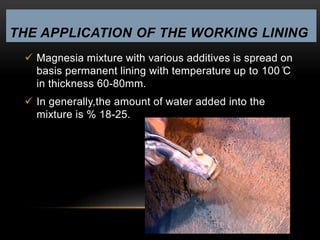
THE APPLICATION OF THE WORKING LINING 
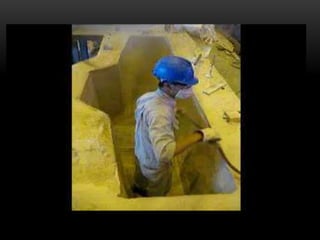
 Magnesia mixture with various additives is spread on 
basis permanent lining with temperature up to 100̊C 
in thickness 60-80mm. 
 In generally,the amount of water added into the 
mixture is % 18-25.
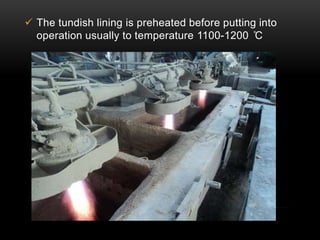
 The tundish lining is preheated before putting into 
operation usually to temperature 1100-1200 ̊C
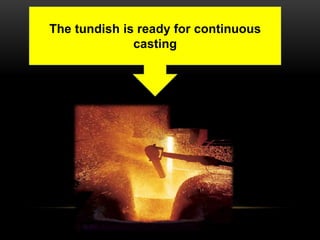
The tundish is ready for continuous 
casting
THANK YOU FOR YOUR 
ATTENTION

Continuous casting-tundish technology

  • 1.
  • 2.
    SO,WHAT IS STEEL?  Steel is an alloy of iron and other elements, including carbon. When carbon is the primary alloying element, its content in the steel is between 0.002% and 2.1% by weight. The following elements are always present in steel: carbon, manganese, phosphorus, sulfur, silicon, and traces of oxygen, nitrogen and aluminum
  • 3.
    CONTINUOUS CASTING Continuous casting, also called strand casting, is the process whereby molten metal is solidified into a semifinished billet, bloom, or slab for subsequent rolling in the finishing mills.
  • 4.
     Most basicmetals are mass-produced using a continuous casting process, including over 500 million tons of steel, 20 million tons of aluminum, and 1 million tons of copper, nickel, and other metals in the world each year
  • 5.
     The continuouscasting has several configurations to produce the steel as vertical, vertical with bending and curved type. .
  • 6.
     Curved machinesare used for the majority of steel casting and require bending and / or unbending of the solidifying strand.
  • 7.
    WHAT DO WEDO UNTIL CONTINUOUS CASTING ?  Preparation the steel by adding some materials within the different furnaces such as BOF,EAF.
  • 8.
    BOF(BASIC OXYGEN FURNACE) 1.Molten pig iron from a blast furnace is poured into a large refractory-lined container called a ladle 2.The metal in the ladle is sent directly for basic oxygen steelmaking
  • 9.
    3.Filling the furnacewith the ingredients is called charging. Molten iron from the ladle is added as required by the charge balance. A typical chemistry of hot metal charged into the BOS vessel is: 4% C, 0.2–0.8% Si, 0.08%–0.18% P, and 0.01–0.04% S. 4.The vessel is then set upright and a water-cooled lance is lowered down into it. The lance blows 99% pure oxygen onto the steel and iron. This melts the scrap, lowers the carbon content of the molten iron and helps remove unwanted chemical elements 5.Fluxes (burnt lime or dolomite) are fed into the vessel to form slag, which absorbs impurities of the steelmaking process
  • 10.
    6.The BOF vesselis tilted again and the steel is tapped into a giant ladle.
  • 11.
    ELECTRIC ARC FURNACE Arc furnaces differ from induction furnaces in that the charge material is directly exposed to an electric arc, and the current in the furnace terminals passes through the charged material.
  • 13.
    SMELTING PROCESS OFELECTRIC ARC FURNACE
  • 15.
  • 16.
    THE MORTEN STEELIS NOW IN LADLE FURNACE LADLE FURNACE There is an important thing that should not be forgotten!!!! Before the tapping from the EAF or BOF to the LF, the LF has to be preheated..
  • 17.
    SO,WE ARE READYTO START TO THE CONTINUOUS CASTING
  • 18.
    THE BENEFITS OFCONTINUOUS CASTING  Considerable energy savings  Less scrap produced, i.e. improved yield  Improved labor productivity  Improved quality of steel  Reduced pollution  Reduced capital costs  Increased use of purchased scrap when output is maximized
  • 21.
    1) The liquidsteel comes from the steel plant in a ladle 2) From ladle it is tapped in a tundish
  • 22.
    3) Liquid Steelis flowed through the nozzle to mould from tundish. The flow rate through the nozzle into the mould can be controlled by a stopper in the tundish 4) The mould is a rectangular copper box without a top and a bottom 5) The outer shell is being ’grabbed’ by a driven roll just beneath the mould, pulling a strand of steel out of the mould. 6) The core of the strand, as it exits, is still liquid; because of that, the strand proceeds through a secondary cooling section 7) The strand is bent from the vertical plane to horizontal plane using rolls
  • 23.
    8) At theend of the cooling section the cross-section of the strand is completely solidified, slabs are then created by cutting the strand 9) These slabs are put in a tunnel furnace to let them homogenize 10) After a while the slabs come out of the furnace; subsequently they are rolled out, further cooled and finally coiled
  • 24.
  • 26.
    The tundish holdsenough metal to provide a continuous flow to the mold, even during an exchange of ladles, which are supplied periodically from the steelmaking process
  • 27.
     The shapeof the tundish is typically rectangular, but delta and "T" shapes are also common.  Nozzles are located along its bottom to distribute liquid steel to the molds
  • 28.
    The tundish alsoserves several other key functions!!!  Enhances oxide inclusion separation  Provides a continuous flow of liquid steel to the mold during ladle exchanges  Maintains a steady metal height above the nozzles to the molds, thereby keeping steel flow constant  Provides more stable stream patterns to the mold(s)
  • 29.
     The tundishis a refractory-lined channel consisting of an inlet and outlet sections and sometimes has flow control devices, such as dams and weirs or a baffle with holes, along its length. DAM BAFFLE WEIR
  • 30.
    • A tundishmay have a refractory-lined lid, and has bottom ports that are assembled with slide gates or stopper rods through which the melt is teemed into the mold
  • 31.
  • 32.
    THE USED DEVICESIN THE TUNDISH  IMPACT PADS: Designed to redirect steel upward and outward for enhanced steel residence time in the tundish and prevent short circuiting to the closest strand(s)  Also used for optimized drainage and yield enhancement for multiple radical grade change sequences
  • 33.
     BAFFLES: Whilein the tundishes, impurities (called "inclusions") in the molten steel float to the top, forming a "slag" layer of impurities, and the pure, substantially "inclusion-free" metal exits from the bottom  Depending on the size of the tundish, and the flow rate of molten steel, the molten steel may not always have enough residence time in the tundish to permit the impurities to float to the top.Therefore,the baffles are used.
  • 34.
     DAMS: Thisdevice helps to modifying the inside bottom surface of a tundish for continuous casting molten steel to minimize turbulence thereby reducing gas bubble and slag entrainment during continuous casting of steel, especially when initially filling of the tundish. DAM
  • 35.
     Thermocouple: Itreads the steel bath temperature in real time at a fixed location inside the tundish.  Diffusers: During operation the Tundish Gas Diffuser will help reduce "dead" areas within the tundish and provide a more stable steel temperature in the tundish bath
  • 36.
     Stoppers: Thisis used to control the molten steel flow from the tundish to the mold
  • 37.
     Slide Gates:Tundish gates are provided with 3 plates in order to avoid the movement of the subentry shroud in the mould during the flow control by throttling.
  • 38.
     Metering Nozzle:Key features of nozzle changer systems include: 1) Improved casting operator safety 2) Enables longer casting sequences 3) Improved metallurgical quality 4) Flexibility
  • 39.
     Submerged EntryNozzle: These refractories are subjected to severe operating conditions such as thermal shock,molten steel erosion,and slag attack. Upper Nozzle
  • 40.
    THE IMPORTANCE OFTUNDISH  The melt remains in the tundish for a relatively short time, reflecting the continuous nature of tundish operation  Thus, the major refining reactions such as deoxidation and desulfurization are carried out in the ladle. The goals of a tundish are to minimize heat loss, deliver the melt evenly into molds, minimize the formation of macro inclusions, and maximize their removal.
  • 41.
    INCLUSIONS AND DEFECTS  Non-metallic inclusions are a significant problem in cast steels  The mechanical behavior of steel is controlled to a large degree by the volume fraction, size, distribution, composition and morphology of inclusions and precipitates, which act as stress raisers  The inclusion size distribution is particularly important, because large macro inclusions are the most harmful to mechanical properties.
  • 42.
     The ductilityand durability are significantly impaired by large-sized, non-metallic inclusions in steel. The samples of inclusions are shown above
  • 43.
     Non-metallic inclusionsin steel are of two kinds, and each has its different mode of formation. 1. one is indigenous oxide inclusions which form by deoxidation of the steel melt. 2. The other kind is exogenous inclusions, which form by reoxidation of deoxidized steel melt by air or by the entrained slag into the melt during the melt transfer from ladle to mold. INDIGENOUS EXOGENOUS
  • 44.
    DEFECTS IN STEELPRODUCTS Flange Cracked Cans Slag spots on cold rolled sheet Line defect on cold rolled sheet
  • 45.
    THE FOLLOWING FACTORSNEED PARTICULAR ATTENTION IN MAKING A TUNDISH EFFECTIVE FOR REDUCING MACRO INCLUSIONS: #1. Steady state period of casting requires:  Melt flow with less turbulence along the tundish flux/melt interface  No short circuiting of melt flow from the inlet section to the exit (tundish nozzle)  Minimal dead volume for the melt in the tundish  Sufficient residence time for the melt to promote flotation  An argon gas shrouding pipe or long nozzle for ladle melt discharge into the tundish  Thermal insulation and protection against reoxidation by argon gas injection with lid or a tundish flux cover
  • 46.
    #2. Non-steady stateperiod of casting requires:  Prevention of slag carry over by vortexing and draining from the ladle to the tundish  The above slag carry over issue also applies to tundish to mold transfer  Suppression of turbulence caused by impinging melt stream to the tundish at the ladle opening  Sustaining an inert atmosphere at ladle opening and ladle change  Active compensation for temperature drop
  • 47.
  • 48.
     The tundishcan be designed according to the following conditions: • The amount of the production:The volumes of ladle, BOF,EAF • The various of the production (bloom, billet, slab) • The number of the strands • The features should be placed to float the inclusions from the morten steel to the slag( dams, baffles,weirs ) • The control of melt temperature to an appropriate level for feeding into the mold • The control of flow rates ( nozzle port(s), slide gates, stopper rods ) • The adjustment chemical compositions
  • 49.
     Various technologiessuch as a long nozzle or an inert gas shrouding pipe have been implemented to reduce air reoxidation and slag emulsification.  Tundish thermal state during continuous casting as function of heat losses through the tundish shell, insulation of the steel bath and temperature.
  • 50.
    TO INDICATE THEVOLUME AND THE NUMBER OF THE STRANDS OF THE TUNDISH  This exactly belongs to the amount and various of factory production  The number of molds is usually 1 or 2 for a slab caster, 2 to 4 for a bloom caster, and 4 to 8 for a billet caster BLOOM SLAB
  • 52.
    1) ANCHORING SYSTEM  The anchoring system is done to be hold the permanent lining slightly to the tundish.  This anchors are assembled to the tundish walls at certain distances by welding
  • 53.
    2) INSULATION MATERIAL  The ceramic fiber panel is used due to its low thermal conductivity and low heat storing between the tundish wall and permanent lining.  These may be showed according to the production conditions and the volume of tundish
  • 54.
  • 55.
    THE PLACEMENT OFNOZZLES AND STOPPERS  Before the permanent lining process is begun, the nozzles should be positioned to the outlet points at the bottom of the tundish  These devices are used to control the fluid flow from the tundish to the mold.  The used of these may be showed difference according to the various of production and the production conditions
  • 57.
    3) PERMANENT LINING  The permanent refractory lining made of aluminous-siliceous refractory concrete may be made of refractory bricks or may be a cast or rammed monolithic lining or a combination of the two.  The expected properties from the permanent lining are showed on following:  Almostly zero cement should be  The particule distribution of admixture should be lower  These may be lowest bonded cement according to the production and the materials
  • 58.
     The hotratios of expansion of the components should be close as material properties  The high resistance against the high temperature, wear and impact  The application of this lining should be easy
  • 59.
     The permanentlining is generally made of high alümina refractory(%70-%93) and is the thickest part of the tundish lining. This lining has a low reactivity with magnesia materials to form a surface working layer.  Aluminous-siliceous refractory concretes proved the best in the second layer.  These are the materials that contain cement binder usually aluminate cement, which imparts hydraulic setting properties when mixed with water  The most common binder used in castables is HAC (high alumina cement)
  • 60.
     Other bindersthat are often used include hydratable aluminas and colloidal silica  When the working temperature is increased,the Al2O3 content should be increased.Because of this, the thermal conductivity and flexibilty.  These monolithic castables should be dried, sintered, and preheated before being put in service to prevent explosion spalling
  • 61.
    • CAC incastables: The refractory concretes are divided into 4 main groups: 1) Conventional Cement Castables,CCC,high cement contents(>20% CAC) 2) Low Cement Castables,LCC (6-15%) 3) Ultra Low Cement Castables (<6%) 4) Cement Free Castables/No Cement Castables, NCC (<1,5%)
  • 62.
     Here thepermanent lining may show severe damage by cracking  Mechanical failure of the permanent lining occurs in the transition zone between the inlet port and the plain side wall of the bath.
  • 63.
     Cracks propagatethrough the whole thickness of the permanent lining and are penetrated by hot metal up to the cold end.  This crack formation increases the probability of failure during breaking out of the working lining.
  • 65.
     To reducecracking and to avoid the delamination quoted above, calculations with an additional expansion allowance were performed with a preheating up to 1100°C on the hot face.
  • 66.
     In conclusion,A longer heat penetration period leads to a more homogeneous temperature distribution at the moment of the thermal shock and this circumstance decreases thermomechanical load in the transition zone.
  • 67.
    THE APPLICATION OFPERMANENT LINING  After the nozzles (SEN, metering nozzle or slide gates) are placed to the bottom of the tundish based on the production conditions, this application is done  After the former is positioned into the tundish,the lining process is begun.  The mix that was prepared before is filled between the former and the tundish walls
  • 68.
     The formeris observantly vibrated till the end of the installation  However,this process is done as soon as the bubbles are seen over the the permanent layer. The reason of this is that the binders within the solidified mix rise up through the layer and cause the micro and macro cracks in the process.Therefore,the vibration process should be done carefully.
  • 69.
    4) THE PLACEMENTOF TUNDISH DEVICES  The placement of tundish devices (ımpact pads, baffles, weirs, dams) is the most important section for tundish design.Because,the non-metallic inclusions can be moved away from the liquid steel and added to the slag layer with using of this devices.  In this way, the clean steel can be occured.
  • 70.
     The placementor building with burnt MgO bricks of impact pad is done firstly. Burnt MgO Bricks
  • 71.
     By thelast decade, testing and use of incidence ‘pot’ known under the name TURBOSTOP was accepted.  The quite good conditions for rectifying flow in the tundish were provided with its installation.
  • 73.
    THE VARIOUS OFTUNDISH DESIGNS  The main points to improve tundish configuration are:  increase minimum residence time  get similar minimum residence times between all the strands  increase plug volume fraction  increase mixing volume fraction  decrease dead volume fraction
  • 74.
    1) The BafflesConfiguration:  The hole angles of the baffles are important to move away the non-metalic inclusions to the slag  However,the only baffles don’t indicate the expected effect regarding the non-metallic inclusions
  • 75.
    2) The Baffles-TheDams Configuration  As mentioned above,the dams help to minimize turbulence thereby reducing gas bubble and slag entrainment during continuous casting of steel.  The shape and arrangement of dams and baffles has also an affect on the thermal conditions prevailing in the tundish.
  • 77.
     Depanding ontundish interior geometry, there are zones of diverse flow intensities within the tundish: - Active area - Stagnant area( dead region )  Dead zones result in a less homogeneous metal, and also reduce the effective capacity of the tundish.
  • 78.
    Configuration 1 Configuration2 Regarding temperature yield,when low dams were considered temperature at outer strands were around 3ºC lower than the ones obtained at inner strands. This fact was attributed to the lower velocities reached at bottom region near the dams in configuration 1 and configuration 2
  • 79.
    3) The Baffles-TheDams-The Diffusers Configuration:  The diffusers will help reduce "dead" areas within the tundish and provide a more stable steel temperature in the tundish bath  This device is used in the configurations which we can’t find the solutions regarding reducing the dead zones.
  • 80.
    4) The Weirs-TheDams Configuration:  The weirs are located in the upper part of the tundish.  The weir prevents liquid metal from flowing continuously across the surface of the molten metal, while allowing liquid flow beneath the weir. WEİR DAM
  • 81.
    The differences canbe seen with water modelling
  • 82.
     The heightof the tundish and the steel velocity are other properties to obtain the clean steel to prevent the dead zones
  • 83.
    The outlet temperatureof the melt is seen reduced with the increase in the bath height as in previous cases due to increase in the heat transfer area. It is also observed that with the increase in the bath height, bluish coloured cooler regions shift towards the top free surface and inlet side with the increase in the bath height, due to recirculating and reversing flow.
  • 84.
     Casting flowrate has a big influence on the structure of flow and the steel turbulence intensity in the tundish. The higher casting flow rate, the lower part of dead zones in the volume of liquid steel.
  • 86.
     In conclusion,thebest design should have the baffles, the dams and the diffusers.Because,the more wear are seen especially in the configuration having the weirs and the zones combined the side tundish walls with the weirs will be done more wear. Therefore:
  • 87.
    5) THE WORKINGLINING  A working lining layer is mostly made of magnesia mixture that is wet applied through gunning in succesive steps by 20mm layers up to requested on walls and slag line(60-80 mm thickness)  With their usage the use of monolithic isolation mixes started to be even more important,because compared to brick lining isolated tundish had better isolation properties,which bettered the thermal balance  It has a higher thermal expansion coefficient
  • 88.
     From tundishlining is expected:  Decrease of thermal loses by long sequences  Better turn of tundish  Longer life time and decrease in maintenance costs of refractories  Simple drying and heating  Easy tapping and decrease of waste volume  Better lining integrity-increased purity of steel  Simple and quick installation  Decreased specific consumption upon a ton of steel  It shouldn’t include the asbestos
  • 90.
     The workinglining is installed over permanent lining to provide thermal insulation and keep the steel shell temperature below its critical temperature range throughout the operating campaigns of a tundish The refractory material of the working face in contact with the steel melt should be high in MgO, with a minimum amount of reducible binder to prevent oxidation of Al in the melt.
  • 91.
     The workingtundish lining refractory composition further includes a binder based on silicates or phosphates; a plasticizer which enhances adherence of the composition when applied to the permanent lining; a bond stabilizer; a homogenizer; and in certain cases, a small amount of a wetting/foaming agent  The corrosion of the working lining in molten slags depends strongly on the viscosity of slag and also the basicity gap between the refractories and the slags.
  • 92.
     When slagpenetrates into pores of common plaster with high- MgO content, the phases such as monticellite and merwinite develop around MgO grains and provide continuous dissolution of MgO grains during steel-making process.  Replacing part of the magnesia of plaster by chromite or olivine is promising for decreasing the hot corrosion.  This is because the basicity gap between introduced plasters and tundish slag decreases and also causes the formation of phases with high melting point on the surface of primary grains of MgO and decreases the dissolution of plaster in the slag. Therefore, the life time of these plasters is increased to higher sequences.
  • 93.
    THE APPLICATION OFTHE WORKING LINING  Magnesia mixture with various additives is spread on basis permanent lining with temperature up to 100̊C in thickness 60-80mm.  In generally,the amount of water added into the mixture is % 18-25.
  • 94.
     The tundishlining is preheated before putting into operation usually to temperature 1100-1200 ̊C
  • 95.
    The tundish isready for continuous casting
  • 96.
    THANK YOU FORYOUR ATTENTION