   Steel plates is a material often used to make
    products.
   Steel Plate is cut and welded together to
    achieve the final product.
   Mainly used for building ships, bridges,
    structure for buildings, pressure vessels,
    industrial machinery and military equipments,
    nuclear reactors, penstock, etc.
An overview of a general manufacturing process :
   Bridges
   Ships
   Buildings
   Offshore Structures
   Power Stations
   Storage Tanks
   Machinery
   Boiler and pressure vessels
   Floor for decks, stairs, bus, etc.
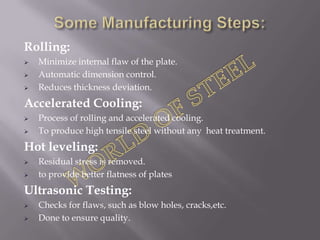
Rolling:
   Minimize internal flaw of the plate.
   Automatic dimension control.
   Reduces thickness deviation.
Accelerated Cooling:
   Process of rolling and accelerated cooling.
   To produce high tensile steel without any heat treatment.
Hot leveling:
   Residual stress is removed.
   to provide better flatness of plates
Ultrasonic Testing:
   Checks for flaws, such as blow holes, cracks,etc.
   Done to ensure quality.
POSCO Specifications
POSTEN              High strength steel for welded structure
PILAC-BT33/36/45    TMCP(Thermo-Mechanically Controlled process)
                    High strength steel for buildings
POSMOLD             Mold Steel
POS AR320/360/400   Abrasion Resistant Steel

API Specifications
 API-2H             Steel Plates for offshore structure
 API-2W             Steel Plates for offshore structure
 API-5L             Steel pipe for pipeline transportation system
ASTM Specifications
A36           Carbon Structure Steel


A131          Structural Steel for Ships/High Strength Structural Steel


A242          HSLA structural Steel


A283          Low and Intermediate Tensile Strength carbon Steel Plates


A285/A285 M   Low and Intermediate Tensile Strength carbon Steel Plates for pressure vessels


A514          High yield strength, quenched and tempered low alloy steel plate for welded structure.


A515/A515 M   Pressure vessel plates, carbon steel, for intermediate and higher temperature service


A516/A516 M   Pressure vessel plates, carbon steel, for moderate and lower temperature service


A537          Pressure vessel plates, heat treated, C-Mn-Si steel


A573          Structure Carbon Steel with improved toughness


A588          High Strength High Alloy Structural Steel with atmospheric corrosion resistance


A633          Normalized HSLA Structural Steel Plate


A709          Structural Steel for bridges
EN specifications
EN 10025      Structural steel
EN 10028      Steel for pressure vessels
EN 10225      Steel for use of ocean structure


JIS specifications
 G 3101       Steel for general Structure use
 G 3103       Carbon Steel and Molybdenum Alloy Steel plate for boiler
              and other pressure vessels.
 G 3106       Steel for welded structure
 G 3114       Temperature resistant steel plate for welded structure
 G 3115       Steel plate for pressure vessel for intermediate temperature
              service
 G 3126       Carbon Steel Sheet for Pressure Vessels for Low
              Temperature Service
 G 3136       Rolled Steel Sheet for building Structure
 G 4051       Carbon steel for machine structure use
A36
     Most widely used.
     Tensile Strength: 400 to 550 Mpa
     Yield Strength: 249 Mpa
     Elongation: 18% min in 8” 21% min in 2” (for plates wider than 24”)
A572
   HSLA steel plate
   produced in Grades 42, 50, 60 & 65—the grades representing the yield
    strength.
   Tensile: 60 - 70 ksi min
   Yield: 42-60 ksi min
   Elongation: 16-18% min in 8” 15-22% min in 2” (for plates wider
    than 24”)
A588 / A606 / A242
   HSLA steel plate
   Better weathering ability than A572.
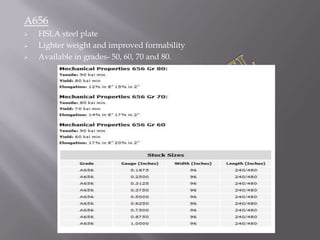
A656
   HSLA steel plate
   Lighter weight and improved formability
   Available in grades- 50, 60, 70 and 80.
AR360/AR400
   quenched & tempered
   Minimum brinell of 360.
T-1 321 / T-1 360
   Quenched and tempered.
   minimum brinell of 321 and 360 respectively.
AR500
   Quenched and tempered.
   minimum brinell of 450.
A514
   Quenched and tempered.
   used in structural applications where high strength and low weight are
    critical
   B, H, F and Q grades available.
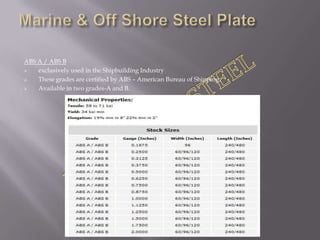
ABS A / ABS B
   exclusively used in the Shipbuilding Industry
   These grades are certified by ABS – American Bureau of Shipping.
   Available in two grades-A and B.
ABS AH36 / DH36 / EH36
   exclusively used in the Shipbuilding Industry
   These grades are certified by ABS – American Bureau of Shipping.
   Higher strength as compared to ABS A and B.
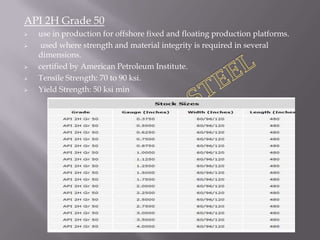
API 2H Grade 50
   use in production for offshore fixed and floating production platforms.
    used where strength and material integrity is required in several
    dimensions.
   certified by American Petroleum Institute.
   Tensile Strength: 70 to 90 ksi.
   Yield Strength: 50 ksi min
A633
   normalized high-strength low-alloy structural steel plate.
   suited for service at low ambient temperatures of –50°F or higher where
    notch toughness better than expected is desired.
SA516
   exclusively used in pressure vessel industry.
   Available in grades 55, 60, 65 & 70.
SA537
   normalized Pressure Vessel Quality grade of steel plate.
   Better strength.
   Used in low temperature conditions
MIL-A 46100
   high-hardness armor plate.
   Approved by Department of Army
   Surface hardness of this material is between 477 and 534 brinell.

MIL-A 12560
   approved by the Material Technology Laboratory, Department of the Army.
   use in combat-vehicles.
   Thickness ranges from 1⁄4” through 6” according to use.
* As per nippon steel specifications
Steel Plates
Steel Plates

Steel Plates

  • 2.
    Steel plates is a material often used to make products.  Steel Plate is cut and welded together to achieve the final product.  Mainly used for building ships, bridges, structure for buildings, pressure vessels, industrial machinery and military equipments, nuclear reactors, penstock, etc.
  • 3.
    An overview ofa general manufacturing process :
  • 4.
    Bridges  Ships  Buildings  Offshore Structures  Power Stations  Storage Tanks  Machinery  Boiler and pressure vessels  Floor for decks, stairs, bus, etc.
  • 5.
    Rolling:  Minimize internal flaw of the plate.  Automatic dimension control.  Reduces thickness deviation. Accelerated Cooling:  Process of rolling and accelerated cooling.  To produce high tensile steel without any heat treatment. Hot leveling:  Residual stress is removed.  to provide better flatness of plates Ultrasonic Testing:  Checks for flaws, such as blow holes, cracks,etc.  Done to ensure quality.
  • 6.
    POSCO Specifications POSTEN High strength steel for welded structure PILAC-BT33/36/45 TMCP(Thermo-Mechanically Controlled process) High strength steel for buildings POSMOLD Mold Steel POS AR320/360/400 Abrasion Resistant Steel API Specifications API-2H Steel Plates for offshore structure API-2W Steel Plates for offshore structure API-5L Steel pipe for pipeline transportation system
  • 7.
    ASTM Specifications A36 Carbon Structure Steel A131 Structural Steel for Ships/High Strength Structural Steel A242 HSLA structural Steel A283 Low and Intermediate Tensile Strength carbon Steel Plates A285/A285 M Low and Intermediate Tensile Strength carbon Steel Plates for pressure vessels A514 High yield strength, quenched and tempered low alloy steel plate for welded structure. A515/A515 M Pressure vessel plates, carbon steel, for intermediate and higher temperature service A516/A516 M Pressure vessel plates, carbon steel, for moderate and lower temperature service A537 Pressure vessel plates, heat treated, C-Mn-Si steel A573 Structure Carbon Steel with improved toughness A588 High Strength High Alloy Structural Steel with atmospheric corrosion resistance A633 Normalized HSLA Structural Steel Plate A709 Structural Steel for bridges
  • 8.
    EN specifications EN 10025 Structural steel EN 10028 Steel for pressure vessels EN 10225 Steel for use of ocean structure JIS specifications G 3101 Steel for general Structure use G 3103 Carbon Steel and Molybdenum Alloy Steel plate for boiler and other pressure vessels. G 3106 Steel for welded structure G 3114 Temperature resistant steel plate for welded structure G 3115 Steel plate for pressure vessel for intermediate temperature service G 3126 Carbon Steel Sheet for Pressure Vessels for Low Temperature Service G 3136 Rolled Steel Sheet for building Structure G 4051 Carbon steel for machine structure use
  • 10.
    A36  Most widely used.  Tensile Strength: 400 to 550 Mpa  Yield Strength: 249 Mpa  Elongation: 18% min in 8” 21% min in 2” (for plates wider than 24”)
  • 11.
    A572  HSLA steel plate  produced in Grades 42, 50, 60 & 65—the grades representing the yield strength.  Tensile: 60 - 70 ksi min  Yield: 42-60 ksi min  Elongation: 16-18% min in 8” 15-22% min in 2” (for plates wider than 24”)
  • 12.
    A588 / A606/ A242  HSLA steel plate  Better weathering ability than A572.
  • 13.
    A656  HSLA steel plate  Lighter weight and improved formability  Available in grades- 50, 60, 70 and 80.
  • 14.
    AR360/AR400  quenched & tempered  Minimum brinell of 360.
  • 15.
    T-1 321 /T-1 360  Quenched and tempered.  minimum brinell of 321 and 360 respectively.
  • 16.
    AR500  Quenched and tempered.  minimum brinell of 450.
  • 17.
    A514  Quenched and tempered.  used in structural applications where high strength and low weight are critical  B, H, F and Q grades available.
  • 18.
    ABS A /ABS B  exclusively used in the Shipbuilding Industry  These grades are certified by ABS – American Bureau of Shipping.  Available in two grades-A and B.
  • 19.
    ABS AH36 /DH36 / EH36  exclusively used in the Shipbuilding Industry  These grades are certified by ABS – American Bureau of Shipping.  Higher strength as compared to ABS A and B.
  • 21.
    API 2H Grade50  use in production for offshore fixed and floating production platforms.  used where strength and material integrity is required in several dimensions.  certified by American Petroleum Institute.  Tensile Strength: 70 to 90 ksi.  Yield Strength: 50 ksi min
  • 22.
    A633  normalized high-strength low-alloy structural steel plate.  suited for service at low ambient temperatures of –50°F or higher where notch toughness better than expected is desired.
  • 23.
    SA516  exclusively used in pressure vessel industry.  Available in grades 55, 60, 65 & 70.
  • 24.
    SA537  normalized Pressure Vessel Quality grade of steel plate.  Better strength.  Used in low temperature conditions
  • 25.
    MIL-A 46100  high-hardness armor plate.  Approved by Department of Army  Surface hardness of this material is between 477 and 534 brinell. MIL-A 12560  approved by the Material Technology Laboratory, Department of the Army.  use in combat-vehicles.  Thickness ranges from 1⁄4” through 6” according to use.
  • 26.
    * As pernippon steel specifications