BEERS LAW DEVIATIONS
A Seminar as a part of Curricular requirement for I year
M.Pharm I Semester
Presented by
P.Naresh
Reg.No.20L81S0701
Under the Guidance/Mentorship of
Dr. P. Ramalingam, M.Pharm., Ph.D., R&D Director
Contents
1. Applications
2. Types of deviation
3. References
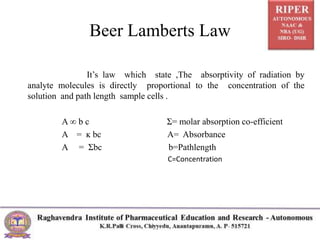
Beer Lamberts Law
It’s law which state ,The absorptivity of radiation by
analyte molecules is directly proportional to the concentration of the
solution and path length sample cells .
A ∞ b c Σ= molar absorption co-efficient
A = ĸ bc A= Absorbance
A = Σbc b=Pathlength
C=Concentration
Applications
• Estimation of the concentration of drug’s.
• Used for qualitative analysis .
• Used for quantitative analysis .
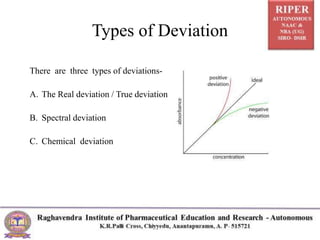
Types of Deviation
There are three types of deviations-
A. The Real deviation / True deviation
B. Spectral deviation
C. Chemical deviation
A)Real Deviation/True Deviation
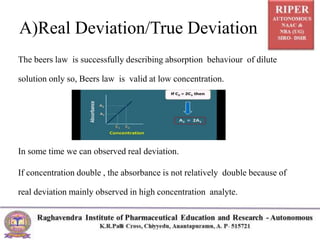
The beers law is successfully describing absorption behaviour of dilute
solution only so, Beers law is valid at low concentration.
In some time we can observed real deviation.
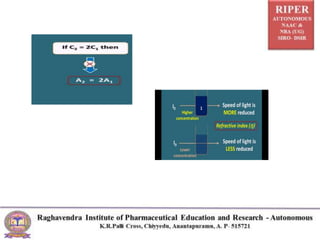
If concentration double , the absorbance is not relatively double because of
real deviation mainly observed in high concentration analyte.
Cntd...
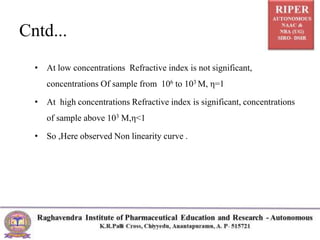
• At low concentrations Refractive index is not significant,
concentrations Of sample from 106 to 103 M, η=1
• At high concentrations Refractive index is significant, concentrations
of sample above 103 M,η<1
• So ,Here observed Non linearity curve .
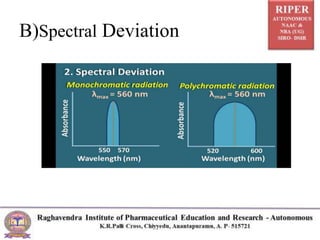
B)Spectral Deviation
Cntd ..
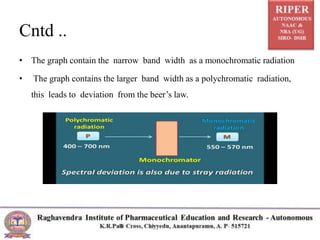
• The graph contain the narrow band width as a monochromatic radiation
• The graph contains the larger band width as a polychromatic radiation,
this leads to deviation from the beer’s law.
Cntd…
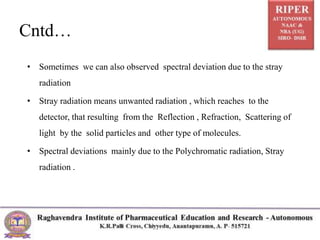
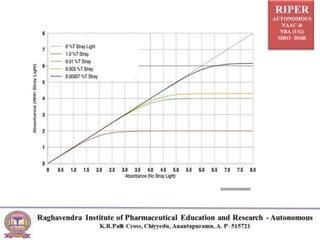
• Sometimes we can also observed spectral deviation due to the stray
radiation
• Stray radiation means unwanted radiation , which reaches to the
detector, that resulting from the Reflection , Refraction, Scattering of
light by the solid particles and other type of molecules.
• Spectral deviations mainly due to the Polychromatic radiation, Stray
radiation .
C)Chemical Deviation
Chemical deviation arise if the absorbing species undergo chemical
changes such as
1. Association molecules
2. Complex formation
3. Dissociation molecules
4. Hydrogen bonding
5. Hydrolysis
6. Ionization(or) polymerization
7. pH changes in sample
Cntd..
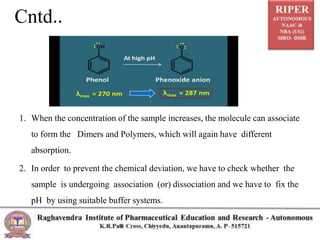
1. When the concentration of the sample increases, the molecule can associate
to form the Dimers and Polymers, which will again have different
absorption.
2. In order to prevent the chemical deviation, we have to check whether the
sample is undergoing association (or) dissociation and we have to fix the
pH by using suitable buffer systems.
References
1. Sharma Y. Elementary organic spectroscopy: principles and chemical
application. Chand and Company Ltd, New Delhi, India. 2009;23.
2. Chatten LG. Pharmaceutical Chemistry: Instrumental Techniques: M.
Dekker; 1966.
3. Fifield FW, Kealey D. Principles and practice of analytical chemistry:
Blackwell Science Hoboken; 2000.
4. Rao NM, Bagyalakshmi J, Ravi T. Development and validation of UV-
Spectroscopic method for estimation of Voglibose in bulk and tablets. J Chem
Pharm Res. 2010;2(2):350-56.
Beers Law deviations.

Beers Law deviations.

  • 1.
    BEERS LAW DEVIATIONS ASeminar as a part of Curricular requirement for I year M.Pharm I Semester Presented by P.Naresh Reg.No.20L81S0701 Under the Guidance/Mentorship of Dr. P. Ramalingam, M.Pharm., Ph.D., R&D Director
  • 2.
    Contents 1. Applications 2. Typesof deviation 3. References
  • 3.
    Beer Lamberts Law It’slaw which state ,The absorptivity of radiation by analyte molecules is directly proportional to the concentration of the solution and path length sample cells . A ∞ b c Σ= molar absorption co-efficient A = ĸ bc A= Absorbance A = Σbc b=Pathlength C=Concentration
  • 4.
    Applications • Estimation ofthe concentration of drug’s. • Used for qualitative analysis . • Used for quantitative analysis .
  • 5.
    Types of Deviation Thereare three types of deviations- A. The Real deviation / True deviation B. Spectral deviation C. Chemical deviation
  • 6.
    A)Real Deviation/True Deviation Thebeers law is successfully describing absorption behaviour of dilute solution only so, Beers law is valid at low concentration. In some time we can observed real deviation. If concentration double , the absorbance is not relatively double because of real deviation mainly observed in high concentration analyte.
  • 8.
    Cntd... • At lowconcentrations Refractive index is not significant, concentrations Of sample from 106 to 103 M, η=1 • At high concentrations Refractive index is significant, concentrations of sample above 103 M,η<1 • So ,Here observed Non linearity curve .
  • 9.
  • 10.
    Cntd .. • Thegraph contain the narrow band width as a monochromatic radiation • The graph contains the larger band width as a polychromatic radiation, this leads to deviation from the beer’s law.
  • 11.
    Cntd… • Sometimes wecan also observed spectral deviation due to the stray radiation • Stray radiation means unwanted radiation , which reaches to the detector, that resulting from the Reflection , Refraction, Scattering of light by the solid particles and other type of molecules. • Spectral deviations mainly due to the Polychromatic radiation, Stray radiation .
  • 13.
    C)Chemical Deviation Chemical deviationarise if the absorbing species undergo chemical changes such as 1. Association molecules 2. Complex formation 3. Dissociation molecules 4. Hydrogen bonding 5. Hydrolysis 6. Ionization(or) polymerization 7. pH changes in sample
  • 14.
    Cntd.. 1. When theconcentration of the sample increases, the molecule can associate to form the Dimers and Polymers, which will again have different absorption. 2. In order to prevent the chemical deviation, we have to check whether the sample is undergoing association (or) dissociation and we have to fix the pH by using suitable buffer systems.
  • 15.
    References 1. Sharma Y.Elementary organic spectroscopy: principles and chemical application. Chand and Company Ltd, New Delhi, India. 2009;23. 2. Chatten LG. Pharmaceutical Chemistry: Instrumental Techniques: M. Dekker; 1966. 3. Fifield FW, Kealey D. Principles and practice of analytical chemistry: Blackwell Science Hoboken; 2000. 4. Rao NM, Bagyalakshmi J, Ravi T. Development and validation of UV- Spectroscopic method for estimation of Voglibose in bulk and tablets. J Chem Pharm Res. 2010;2(2):350-56.