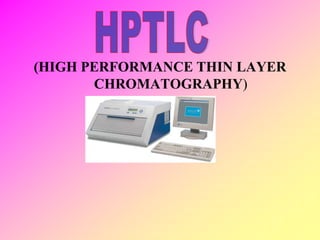
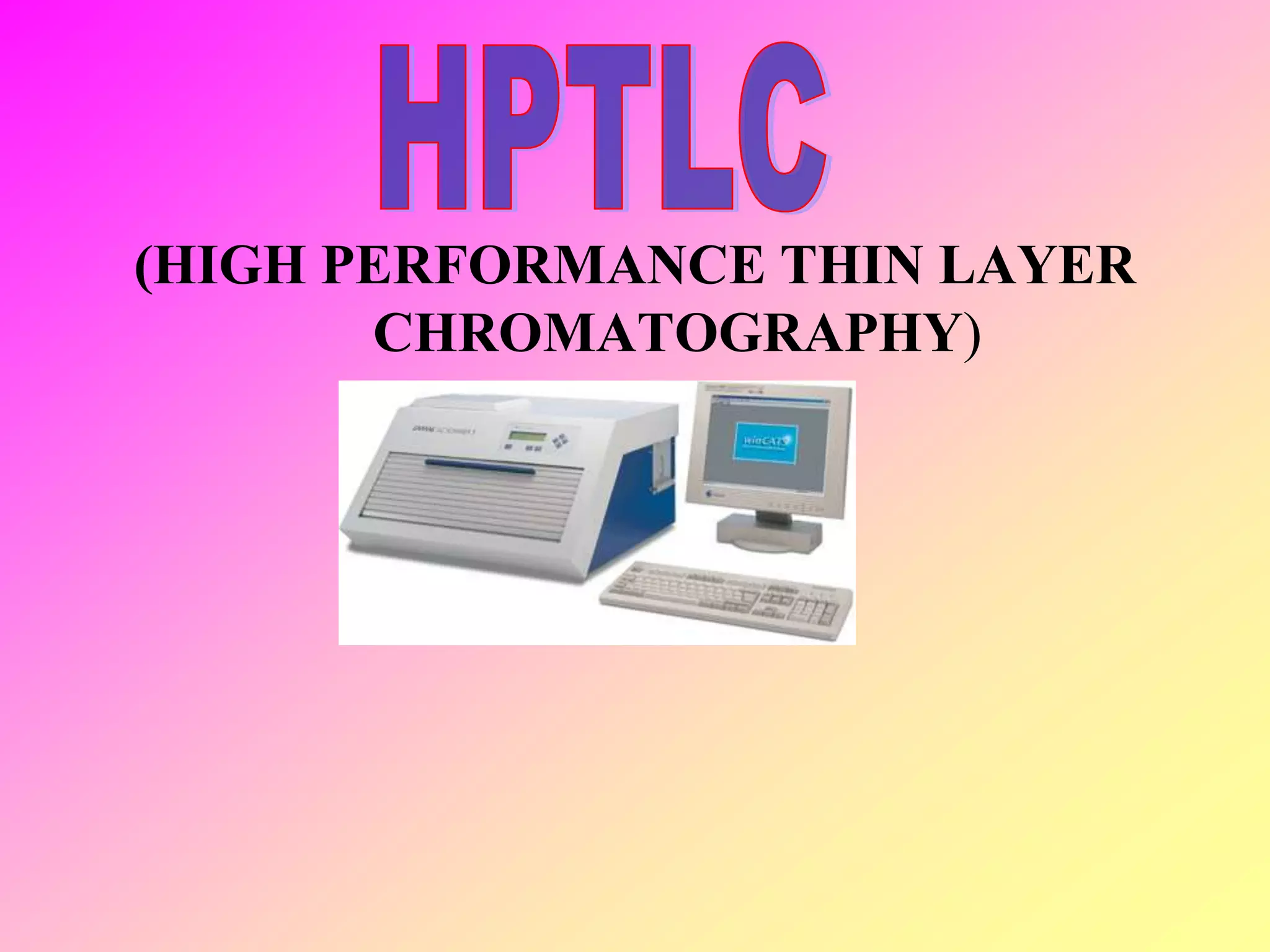
(HIGH PERFORMANCE THIN LAYER
CHROMATOGRAPHY)
Definition:
Chromatography is a physical process of
separation in which the components to be
separated are distributed between 2 immiscible
phases-a stationary phase which has a large
surface area and mobile phase which is in
constant motion through the stationary phase.
Introduction:
• HPTLC is the improved method of TLC
which utilizes the conventional technique of
TLC in more optimized way.
• It is also known as planar chromatography
or Flat-bed chromatography.
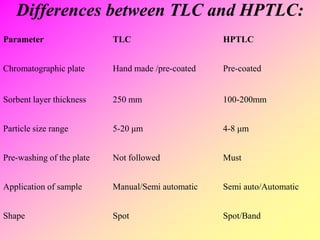
Differences between TLC and HPTLC:
Parameter TLC HPTLC
Chromatographic plate Hand made /pre-coated Pre-coated
Sorbent layer thickness 250 mm 100-200mm
Particle size range 5-20 μm 4-8 μm
Pre-washing of the plate Not followed Must
Application of sample Manual/Semi automatic Semi auto/Automatic
Shape Spot Spot/Band
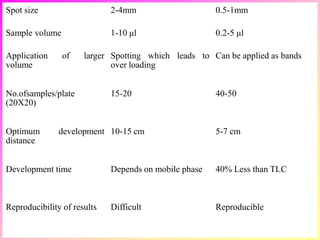
Spot size 2-4mm 0.5-1mm
Sample volume 1-10 μl 0.2-5 μl
Application of larger
volume
Spotting which leads to
over loading
Can be applied as bands
No.ofsamples/plate
(20X20)
15-20 40-50
Optimum development
distance
10-15 cm 5-7 cm
Development time Depends on mobile phase 40% Less than TLC
Reproducibility of results Difficult Reproducible
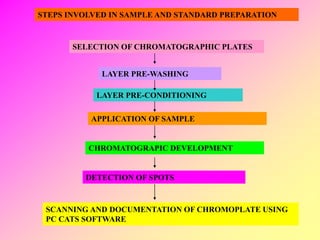
STEPS INVOLVED IN SAMPLE AND STANDARD PREPARATION
SELECTION OF CHROMATOGRAPHIC PLATES
LAYER PRE-WASHING
LAYER PRE-CONDITIONING
APPLICATION OF SAMPLE
CHROMATOGRAPIC DEVELOPMENT
DETECTION OF SPOTS
SCANNING AND DOCUMENTATION OF CHROMOPLATE USING
PC CATS SOFTWARE
Selection of HPTLC plates
• Hand plates were available which are made up
of cellulose and other materials which are not
used much now-a –days.
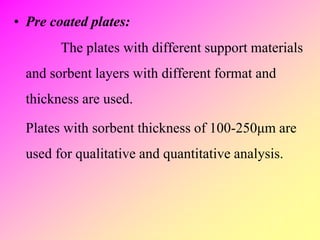
• Pre coated plates:
The plates with different support materials
and sorbent layers with different format and
thickness are used.
Plates with sorbent thickness of 100-250μm are
used for qualitative and quantitative analysis.
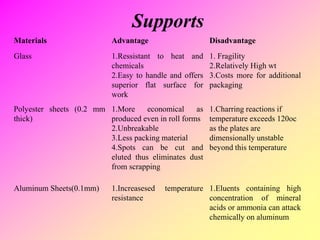
Supports
Materials Advantage Disadvantage
Glass 1.Ressistant to heat and
chemicals
2.Easy to handle and offers
superior flat surface for
work
1. Fragility
2.Relatively High wt
3.Costs more for additional
packaging
Polyester sheets (0.2 mm
thick)
1.More economical as
produced even in roll forms
2.Unbreakable
3.Less packing material
4.Spots can be cut and
eluted thus eliminates dust
from scrapping
1.Charring reactions if
temperature exceeds 120oc
as the plates are
dimensionally unstable
beyond this temperature
Aluminum Sheets(0.1mm) 1.Increasesed temperature
resistance
1.Eluents containing high
concentration of mineral
acids or ammonia can attack
chemically on aluminum
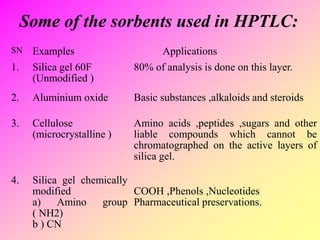
Some of the sorbents used in HPTLC:
SN Examples Applications
1. Silica gel 60F
(Unmodified )
80% of analysis is done on this layer.
2. Aluminium oxide Basic substances ,alkaloids and steroids
3. Cellulose
(microcrystalline )
Amino acids ,peptides ,sugars and other
liable compounds which cannot be
chromatographed on the active layers of
silica gel.
4. Silica gel chemically
modified
a) Amino group
( NH2)
b ) CN
COOH ,Phenols ,Nucleotides
Pharmaceutical preservations.
Some of the binders used:
• Gypsum (G)
• Starch (S)
• Layer containing fluorescent indicator (F)
Plate size:• 20X20cm
• 10X20cm
• 5X10 cm
• 5X7.5 cm
• Good cut edges of sheets is important to obtain constant Rf
values.
Pre washing of pre coated plates
The main purpose of the pre-washing is to
remove impurities which include water vapours and
other volatile substances from the atmosphere when
they get exposed in the lab environment.
Silica gel 60F is most widely used sorbent. The
major disadvantage of this sorbent is that it contain
iron as impurity. This iron is removed by using
Methanol : water in the ratio of 9:1.This is the
major advantage of the step of pre-washing.
:Some common methods involved in pre-
washing
Ascending method:
• In this technique the chromatographic plates
are run blank (i.e. before application of the
sample with suitable solvent / mobile phase.
The solvent/mobile phase carries the
impurities to the top of the plate.
• It takes longer time but cleaning effect is
superior.
• The disadvantage of this technique is active
dirt gets accumulated at the solvent front.
Dipping method:
• In this technique, the chromatographic plate is
dipped in a suitable solvent for specified
period of time ,removed from the chamber
and finally dried.
• Dipping method is quicker and yields uniform
layer but cleaning effect is often not as good
as Ascending method.
• Continuous method:
• In this technique, the plate to be washed is placed
in chamber having an entrance and exit slits.
• The solvent is made to flow continuously through
the chamber that carries the impurities from the
plate.
• The wanted plates should always be stored in a
dust free atmosphere, under ambient conditions.
• Usually desiccators of suitable size are used for
storage of plates.
Solvents used for pre-washing
• 1.Methanol
• 2.Chloroform: methanol ( 1:1 )
• 3.Choloroform: Methanol: Ammonia (90:10:1 )
• 4.Methylene chloride: Methanol ( 1:1 )
• 5.Ammonia solution (1%)
Activation of plates:
• Freshly opened box of HPTLC plates doesn’t
need activation.
• Plates exposed to high humidity or kept in hand
for long time require activation.
• Plates are placed in oven at 110o-120oc for 30 min
prior to the sample application.
• Activation at higher temperature for longer period
is avoided as it may lead to very active layers and
risk of the samples being decomposed.
Sample Preparation:
• Proper sample preparation is an important pre-
requisite for success of TLC separation.
• For normal chromatography: Solvent should be
non-polar and volatile.
• For reversed chromatography: Polar solvent is
used for dissolving the sample
• Sample and reference substances should be
dissolved in the same solvent to ensure
comparable distribution at starting zones.
Application of sample:
The selection of sample application
technique and device to be used depends
primarily on:
• Sample volume
• No. of samples to be applied
• Required precision and degree of
automation.
1.It is the most critical step for obtaining good
resolution for quantification by HPTLC.
2.Some applicators used for spotting are:
a) Capillary tubes
b) Micro bulb pipettes
c) Micro syringes,
d)Automatic sample applicator.
– The major criteria is that they shouldn’t
damage the surface while applying sample.
• The sample should be completely transferred to the
layer.
• Micro syringes are preferred if automatic
application devices are not available.
• Volume recommended for HPTLC-0.5-5μl to keep
the starting zone down to minimum of 0.5-1 mm in
concentration range of 0.1-μg/ml
• Sample spotting should not be excess or not low.
• Problem from overloading can be overcome by
applying the sample as band.
Advantages of application of
sample as band are
• Better separation because of rectangular area.
• Response of densiometer is higher in case of band than
that observed from an equal amount/equal volume of
sample applied as a spot.
• Large quantities of the sample can be handled for
application, thus reducing the need of concentrating
which may be damaging in case of liable substances.
• Position of plate for densitometric scanning is less
critical as composition of the compounds is uniform in
the entire area of band.
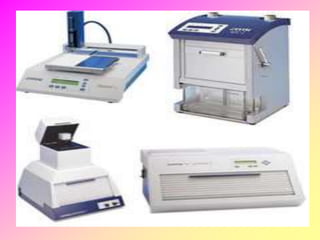
Automatic applicators used:
1) CAMAG Nanomat: Samples applied in
the form of spots. The volume is controlled
by disposable platinum iridium of glass
capillary which has volume of 0.1-0.2μl.
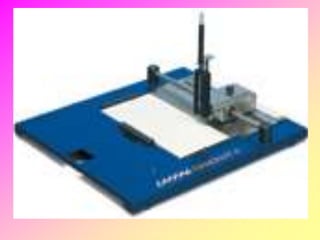
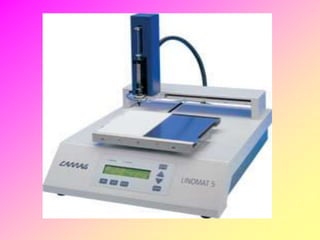
2) CAMAG Linomat
Automated sample application device. Sample is loaded
in micro syringe (Hamilton Syringe) 1μl capacity. Sample
can apply either as spot or band by programming the
instrument with parameters like spotting volume ,band
length etc.
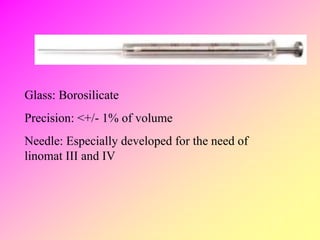
Glass: Borosilicate
Precision: <+/- 1% of volume
Needle: Especially developed for the need of
linomat III and IV
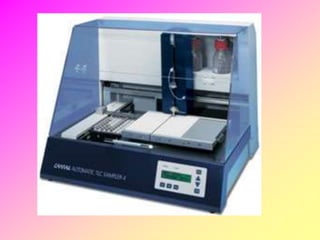
3) CAMAG automatic TLC sampler III :
Applies sample as spot or bands
automatically from the rack of sample vials.
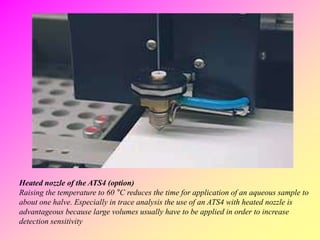
Heated nozzle of the ATS4 (option)
Raising the temperature to 60 °C reduces the time for application of an aqueous sample to
about one halve. Especially in trace analysis the use of an ATS4 with heated nozzle is
advantageous because large volumes usually have to be applied in order to increase
detection sensitivity
Mobile phase
• Mobile phase should be of high graded.
• Chemical properties , analytes and sorbent layer factors

should be considered while selection of mobile phase.
• Use of mobile phase containing more than three or four
components should normally be avoided as it is often
difficult to get reproducible ratios of different components
• Mobile phase optimization is necessary while
performing HPTLC.
• Various components of MP should be measured
separately and then placed in mixing vessel. This prevents
contamination of solvents and also error arising from
volumes expansion or contraction on mixing.
• Trough chambers are used in which smaller volumes
of MP usually 10-15 ml is required.
• Different components of MP are mixed first in mixing vessel
and then transferred to developing chambers.
• Chambers containing multi component MP are not generally
used for re-use for any future development , due to differential
evaporation and adsorption by layer and also once the chamber is
opened , solvents evaporate disproportionally depending on their
volatilities.
Development of chambers:
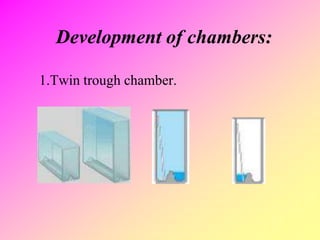
1.Twin trough chamber.
2.Rectangular chambers
3. V-shaped chambers
4.Sandwitch chamber
5.Horizontal development chamber
6.Automatic development chamber
It gives complete control over development process ,
chamber saturation , developing distance and drying step
as well as activity of HPTLC. Plates are controlled and
guarantee the results day in and day out with
documentation system called digistore-2 where images of
HPTLC chromatogram can be captured within seconds
Pre-conditioning : (Chamber Saturation)
• Chamber saturation has a pronounced influence on the
separation profile.
• Time required for the saturation depends on the mobile
phase.
• If plates are introduced into the unsaturated chamber
,during the course of development , the solvent
evaporates from the plate mainly at the solvent front and
it results in increased Rf values.
• If tank is saturated prior to the development , solvent
vapors soon get uniformly distributed through out the
chamber. As soon as the plate is kept in such a saturated
chamber ,it soon gets pre-loaded with solvent vapors
thus less solvent is required to travel a particular
distance ,resulting in lower Rf values.
• But in some cases depending on their polarity saturation
and non-saturation of chambers are required:
• Eg: Pre-equilibrium is often recommended in case of
solvent with high polarity.
• Development in a non-saturation or partially
saturated atmosphere is recommended in solvents used
in a composition leading to phase separation such as
mixture of n-butanol , water and glacial acetic acid.
• Preloading of dry layer with solvent vapors should be
avoided for low polar molecules.
Development and Drying:
• The different methods used for development of chambers are like-
Ascending , descending .2-dimentional, horizontal , multiple
overrun , gradient ,radial ,anti-radial ,multimodal ,forced flow
planar chromatography.
• Plates are spotted with sample and air dried and placed in the
developing chambers.
• After the development plate is removed from chamber and mobile
phase is removed under fume cup-board to avoid contamination of
laboratory atmosphere.
• The plates should be always laid horizontally because when
mobile phase evaporates the separated components will migrate
evenly to the surface where it can be easily detected
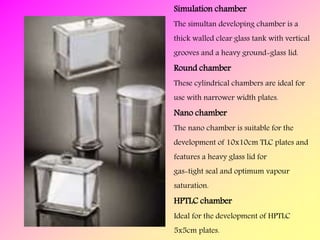
Simulation chamber
The simultan developing chamber is a
thick walled clear glass tank with vertical
grooves and a heavy ground-glass lid.
Round chamber
These cylindrical chambers are ideal for
use with narrower width plates.
Nano chamber
The nano chamber is suitable for the
development of 10x10cm TLC plates and
features a heavy glass lid for
gas-tight seal and optimum vapour
saturation.
HPTLC chamber
Ideal for the development of HPTLC
5x5cm plates.
Drying :
• Drying of chromatogram should be done in vacuum desiccators
with protection from heat and light.
• If hand dryer is used there may be chances of getting contamination
of plates ,evaporation of essential volatile oils if any present in the
spot or compounds sensitive to oxygen may get destroyed due to the
rise in temperature.
Factors influencing separation and
resolution of spots:
• Type of stationary phase
• Type of pre-coated plates
• Layer thickness
• Binder in layer
• Mobile phase
• Solvent purity
• Size of developing chamber
• Sample volume to be spotted
• Size of initial spot
• Solvent level in chamber
• Gradient
• Relative humidity
• Temperature Flow rate in solvent
• Separation distance
• Mode of Derivatization
Greater the difference between two spots and smaller the initial
spot diameter of sample and better will be the resolution
Detection and visualization
One of the characteristic feature of HPTLC is the possibility to
utilize post-chromatographic off line derivatization
Detection are of two types:
• Qualitative
• Quantitative
• Qualitative detection;
HPTLC is routinely used for qualitative analysis of raw materials
, finished products ,plant extracts etc. It involves the identification of
unknown sample mixture by comparing the Rf values of the sample
components with the standards.
• Quantitation Evaluation:
Quantitative of the chromatogram by HPTLC basically involves
direct and indirect methods;
Indirect method; It involves removal of analyte from the
plate followed by quantitation. Eg; Scrapping and elution which is
followed by analysis of eluant by convenient methods like
1) Spectrophotometry
2) Flourimetry
3) Colourimetry
Collection of samples from scrapping will results in the
loss of sample, so vaccum devices and elution chamber are
used.
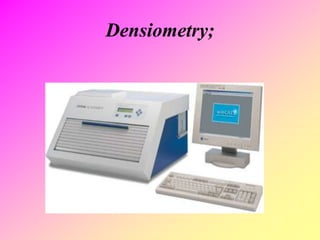
Densiometry;
• It is a instrumental measurement of visible , UV absorbance ,
fluorescence quenching directly on the layer without resorting to
scrapping and elution
• It involves resolving of a compounds on thin layer plate ,
visualizing the spots and measuring the optical density of each spot /
band directly on the plate.
• The amount of material / compound in the unknown are
measured by comparing them to a standard curve from reference
standard chromatographed with the same condition.
• Chromatographic zones remit a lower light intensity than the
environment around it. Absorption spectra can be directly
determined on the plate by comparison with substance free area of
sorbent layer .
• Measurements are usually made by reflection from the plate
using single beam ,double beam or single-beam dual wavelength
operation of scanning instrument.
• the scanner present converts the spot / band on the Layer into
chromatogram consisting peaks
• Position of scanned peaks on recorder chart are related to Rf
values of the spots on the layer and peak height or area is related to
the concentration of the substance on spot.
• Signals which are measure represent the adsorption of
transmitted or reflected light passes through the spot compared to
blank portion of sorbent layer.
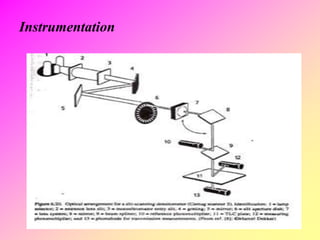
Instrumentation
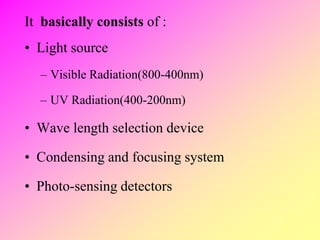
It basically consists of :
• Light source
– Visible Radiation(800-400nm)
– UV Radiation(400-200nm)
• Wave length selection device
• Condensing and focusing system
• Photo-sensing detectors
Theory
The transmission of light in a translucent material can be described by:
Io= Ia +It + Ir + Ix
Where,
Io=Intensity of incident light
Ia=Intensity of absorbed light
Ix=Intensity of transmitted light
Ir=Intensity of reflected light
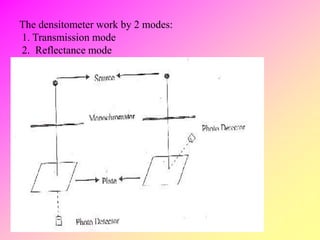
The densitometer work by 2 modes:
1. Transmission mode
2. Reflectance mode
• In transmission mode the ratio of It/Io is measured
and converted in to absorbance values
• In reflectance mode the ratio Ir/Io is measured and
converted in to absorbance values
• But it was found that transmission measurements
are more sensitive than reflectance measurements.
Advantages of densitometer /Scanner
• The purpose of scanner is to convert the spot /band on the layer in
to densitogarm consisting of peaks similar in appearance to
HPLC.
• The position of the scanned peaks on recorder chart is related to
Rf values.
• Peak height/area is related to the concentration of the substance in
the spot.
• Quantitation is faster , reliable ,accurate and reproducible
• Photodocumentation of HPTLC plates is possible.
Documentation:
1. Documentation is important because labeling every single chromatogram
can avoid mistake in respect of order of application.
2. Type of plate, chamber system, composition of mobile phase, running
time and detection method should be recorded.
3. To assist the analysts and researchers E .merck has introduced HPTLC
pre-coated plates with an imprinted identification codes.
4. Suppliers name, item number, batch no. , individual plate no. are
imprinted near upper edge of pre-coated plates. This will not only help in
traceability of analytical data, but will also avoid manipulation of data at any
stage as coding will automatically get recorded using photo-documentation.
Applications of HPTLC:
• Pharmaceutical industry: Quality control, content
uniformity, uniformity test, identity/purity check.
• Food Analysis: Quality control , additives , pesticides
,stability testing ,analysis of sub-micron levels of
aflotoxins, etc.
• Clinical Applications: Metabolism studies , drug
screening ,stability testing etc
• Industrial Applications; Process development and
optimization, In-process check ,validation etc.
• Forensic : Poisoning investigations
• Detection of herbal drugs
References:
• HPTLC- Quantitative analysis of pharmaceutical
Formulations by P.D. Sethi
• www.pharmainfo.net
• http://images.google.co.in/images?q=hptlc+plates
&ie=ISO-8859-1&hl=en
• http://images.google.co.in/images?svnum=10&hl=
en&lr=&ie=ISO-8859-1&q=linomat
• www.camag.com
• http://www.infoexpo.ch/abstract
high performance thin layer chromatography [HPTLC]

high performance thin layer chromatography [HPTLC]

  • 1.
    (HIGH PERFORMANCE THINLAYER CHROMATOGRAPHY)
  • 3.
    Definition: Chromatography is aphysical process of separation in which the components to be separated are distributed between 2 immiscible phases-a stationary phase which has a large surface area and mobile phase which is in constant motion through the stationary phase.
  • 4.
    Introduction: • HPTLC isthe improved method of TLC which utilizes the conventional technique of TLC in more optimized way. • It is also known as planar chromatography or Flat-bed chromatography.
  • 5.
    Differences between TLCand HPTLC: Parameter TLC HPTLC Chromatographic plate Hand made /pre-coated Pre-coated Sorbent layer thickness 250 mm 100-200mm Particle size range 5-20 μm 4-8 μm Pre-washing of the plate Not followed Must Application of sample Manual/Semi automatic Semi auto/Automatic Shape Spot Spot/Band
  • 6.
    Spot size 2-4mm0.5-1mm Sample volume 1-10 μl 0.2-5 μl Application of larger volume Spotting which leads to over loading Can be applied as bands No.ofsamples/plate (20X20) 15-20 40-50 Optimum development distance 10-15 cm 5-7 cm Development time Depends on mobile phase 40% Less than TLC Reproducibility of results Difficult Reproducible
  • 7.
    STEPS INVOLVED INSAMPLE AND STANDARD PREPARATION SELECTION OF CHROMATOGRAPHIC PLATES LAYER PRE-WASHING LAYER PRE-CONDITIONING APPLICATION OF SAMPLE CHROMATOGRAPIC DEVELOPMENT DETECTION OF SPOTS SCANNING AND DOCUMENTATION OF CHROMOPLATE USING PC CATS SOFTWARE
  • 8.
    Selection of HPTLCplates • Hand plates were available which are made up of cellulose and other materials which are not used much now-a –days.
  • 9.
    • Pre coatedplates: The plates with different support materials and sorbent layers with different format and thickness are used. Plates with sorbent thickness of 100-250μm are used for qualitative and quantitative analysis.
  • 10.
    Supports Materials Advantage Disadvantage Glass1.Ressistant to heat and chemicals 2.Easy to handle and offers superior flat surface for work 1. Fragility 2.Relatively High wt 3.Costs more for additional packaging Polyester sheets (0.2 mm thick) 1.More economical as produced even in roll forms 2.Unbreakable 3.Less packing material 4.Spots can be cut and eluted thus eliminates dust from scrapping 1.Charring reactions if temperature exceeds 120oc as the plates are dimensionally unstable beyond this temperature Aluminum Sheets(0.1mm) 1.Increasesed temperature resistance 1.Eluents containing high concentration of mineral acids or ammonia can attack chemically on aluminum
  • 11.
    Some of thesorbents used in HPTLC: SN Examples Applications 1. Silica gel 60F (Unmodified ) 80% of analysis is done on this layer. 2. Aluminium oxide Basic substances ,alkaloids and steroids 3. Cellulose (microcrystalline ) Amino acids ,peptides ,sugars and other liable compounds which cannot be chromatographed on the active layers of silica gel. 4. Silica gel chemically modified a) Amino group ( NH2) b ) CN COOH ,Phenols ,Nucleotides Pharmaceutical preservations.
  • 12.
    Some of thebinders used: • Gypsum (G) • Starch (S) • Layer containing fluorescent indicator (F)
  • 13.
    Plate size:• 20X20cm •10X20cm • 5X10 cm • 5X7.5 cm • Good cut edges of sheets is important to obtain constant Rf values.
  • 14.
    Pre washing ofpre coated plates The main purpose of the pre-washing is to remove impurities which include water vapours and other volatile substances from the atmosphere when they get exposed in the lab environment. Silica gel 60F is most widely used sorbent. The major disadvantage of this sorbent is that it contain iron as impurity. This iron is removed by using Methanol : water in the ratio of 9:1.This is the major advantage of the step of pre-washing.
  • 15.
    :Some common methodsinvolved in pre- washing Ascending method: • In this technique the chromatographic plates are run blank (i.e. before application of the sample with suitable solvent / mobile phase. The solvent/mobile phase carries the impurities to the top of the plate. • It takes longer time but cleaning effect is superior. • The disadvantage of this technique is active dirt gets accumulated at the solvent front.
  • 16.
    Dipping method: • Inthis technique, the chromatographic plate is dipped in a suitable solvent for specified period of time ,removed from the chamber and finally dried. • Dipping method is quicker and yields uniform layer but cleaning effect is often not as good as Ascending method.
  • 17.
    • Continuous method: •In this technique, the plate to be washed is placed in chamber having an entrance and exit slits. • The solvent is made to flow continuously through the chamber that carries the impurities from the plate. • The wanted plates should always be stored in a dust free atmosphere, under ambient conditions. • Usually desiccators of suitable size are used for storage of plates.
  • 18.
    Solvents used forpre-washing • 1.Methanol • 2.Chloroform: methanol ( 1:1 ) • 3.Choloroform: Methanol: Ammonia (90:10:1 ) • 4.Methylene chloride: Methanol ( 1:1 ) • 5.Ammonia solution (1%)
  • 19.
    Activation of plates: •Freshly opened box of HPTLC plates doesn’t need activation. • Plates exposed to high humidity or kept in hand for long time require activation. • Plates are placed in oven at 110o-120oc for 30 min prior to the sample application. • Activation at higher temperature for longer period is avoided as it may lead to very active layers and risk of the samples being decomposed.
  • 20.
    Sample Preparation: • Propersample preparation is an important pre- requisite for success of TLC separation. • For normal chromatography: Solvent should be non-polar and volatile. • For reversed chromatography: Polar solvent is used for dissolving the sample • Sample and reference substances should be dissolved in the same solvent to ensure comparable distribution at starting zones.
  • 21.
    Application of sample: Theselection of sample application technique and device to be used depends primarily on: • Sample volume • No. of samples to be applied • Required precision and degree of automation.
  • 22.
    1.It is themost critical step for obtaining good resolution for quantification by HPTLC. 2.Some applicators used for spotting are: a) Capillary tubes b) Micro bulb pipettes c) Micro syringes, d)Automatic sample applicator. – The major criteria is that they shouldn’t damage the surface while applying sample.
  • 23.
    • The sampleshould be completely transferred to the layer. • Micro syringes are preferred if automatic application devices are not available. • Volume recommended for HPTLC-0.5-5μl to keep the starting zone down to minimum of 0.5-1 mm in concentration range of 0.1-μg/ml • Sample spotting should not be excess or not low. • Problem from overloading can be overcome by applying the sample as band.
  • 24.
    Advantages of applicationof sample as band are • Better separation because of rectangular area. • Response of densiometer is higher in case of band than that observed from an equal amount/equal volume of sample applied as a spot. • Large quantities of the sample can be handled for application, thus reducing the need of concentrating which may be damaging in case of liable substances. • Position of plate for densitometric scanning is less critical as composition of the compounds is uniform in the entire area of band.
  • 26.
    Automatic applicators used: 1)CAMAG Nanomat: Samples applied in the form of spots. The volume is controlled by disposable platinum iridium of glass capillary which has volume of 0.1-0.2μl.
  • 28.
    2) CAMAG Linomat Automatedsample application device. Sample is loaded in micro syringe (Hamilton Syringe) 1μl capacity. Sample can apply either as spot or band by programming the instrument with parameters like spotting volume ,band length etc.
  • 30.
    Glass: Borosilicate Precision: <+/-1% of volume Needle: Especially developed for the need of linomat III and IV
  • 31.
    3) CAMAG automaticTLC sampler III : Applies sample as spot or bands automatically from the rack of sample vials.
  • 33.
    Heated nozzle ofthe ATS4 (option) Raising the temperature to 60 °C reduces the time for application of an aqueous sample to about one halve. Especially in trace analysis the use of an ATS4 with heated nozzle is advantageous because large volumes usually have to be applied in order to increase detection sensitivity
  • 34.
    Mobile phase • Mobilephase should be of high graded. • Chemical properties , analytes and sorbent layer factors should be considered while selection of mobile phase. • Use of mobile phase containing more than three or four components should normally be avoided as it is often difficult to get reproducible ratios of different components
  • 35.
    • Mobile phaseoptimization is necessary while performing HPTLC. • Various components of MP should be measured separately and then placed in mixing vessel. This prevents contamination of solvents and also error arising from volumes expansion or contraction on mixing. • Trough chambers are used in which smaller volumes of MP usually 10-15 ml is required.
  • 36.
    • Different componentsof MP are mixed first in mixing vessel and then transferred to developing chambers. • Chambers containing multi component MP are not generally used for re-use for any future development , due to differential evaporation and adsorption by layer and also once the chamber is opened , solvents evaporate disproportionally depending on their volatilities.
  • 37.
  • 38.
  • 39.
    3. V-shaped chambers 4.Sandwitchchamber 5.Horizontal development chamber 6.Automatic development chamber It gives complete control over development process , chamber saturation , developing distance and drying step as well as activity of HPTLC. Plates are controlled and guarantee the results day in and day out with documentation system called digistore-2 where images of HPTLC chromatogram can be captured within seconds
  • 40.
    Pre-conditioning : (ChamberSaturation) • Chamber saturation has a pronounced influence on the separation profile. • Time required for the saturation depends on the mobile phase. • If plates are introduced into the unsaturated chamber ,during the course of development , the solvent evaporates from the plate mainly at the solvent front and it results in increased Rf values.
  • 41.
    • If tankis saturated prior to the development , solvent vapors soon get uniformly distributed through out the chamber. As soon as the plate is kept in such a saturated chamber ,it soon gets pre-loaded with solvent vapors thus less solvent is required to travel a particular distance ,resulting in lower Rf values. • But in some cases depending on their polarity saturation and non-saturation of chambers are required:
  • 42.
    • Eg: Pre-equilibriumis often recommended in case of solvent with high polarity. • Development in a non-saturation or partially saturated atmosphere is recommended in solvents used in a composition leading to phase separation such as mixture of n-butanol , water and glacial acetic acid. • Preloading of dry layer with solvent vapors should be avoided for low polar molecules.
  • 43.
    Development and Drying: •The different methods used for development of chambers are like- Ascending , descending .2-dimentional, horizontal , multiple overrun , gradient ,radial ,anti-radial ,multimodal ,forced flow planar chromatography. • Plates are spotted with sample and air dried and placed in the developing chambers. • After the development plate is removed from chamber and mobile phase is removed under fume cup-board to avoid contamination of laboratory atmosphere. • The plates should be always laid horizontally because when mobile phase evaporates the separated components will migrate evenly to the surface where it can be easily detected
  • 44.
    Simulation chamber The simultandeveloping chamber is a thick walled clear glass tank with vertical grooves and a heavy ground-glass lid. Round chamber These cylindrical chambers are ideal for use with narrower width plates. Nano chamber The nano chamber is suitable for the development of 10x10cm TLC plates and features a heavy glass lid for gas-tight seal and optimum vapour saturation. HPTLC chamber Ideal for the development of HPTLC 5x5cm plates.
  • 45.
    Drying : • Dryingof chromatogram should be done in vacuum desiccators with protection from heat and light. • If hand dryer is used there may be chances of getting contamination of plates ,evaporation of essential volatile oils if any present in the spot or compounds sensitive to oxygen may get destroyed due to the rise in temperature.
  • 46.
    Factors influencing separationand resolution of spots: • Type of stationary phase • Type of pre-coated plates • Layer thickness • Binder in layer • Mobile phase • Solvent purity • Size of developing chamber • Sample volume to be spotted • Size of initial spot • Solvent level in chamber
  • 47.
    • Gradient • Relativehumidity • Temperature Flow rate in solvent • Separation distance • Mode of Derivatization Greater the difference between two spots and smaller the initial spot diameter of sample and better will be the resolution
  • 48.
    Detection and visualization Oneof the characteristic feature of HPTLC is the possibility to utilize post-chromatographic off line derivatization Detection are of two types: • Qualitative • Quantitative
  • 49.
    • Qualitative detection; HPTLCis routinely used for qualitative analysis of raw materials , finished products ,plant extracts etc. It involves the identification of unknown sample mixture by comparing the Rf values of the sample components with the standards. • Quantitation Evaluation: Quantitative of the chromatogram by HPTLC basically involves direct and indirect methods;
  • 50.
    Indirect method; Itinvolves removal of analyte from the plate followed by quantitation. Eg; Scrapping and elution which is followed by analysis of eluant by convenient methods like 1) Spectrophotometry 2) Flourimetry 3) Colourimetry Collection of samples from scrapping will results in the loss of sample, so vaccum devices and elution chamber are used.
  • 51.
  • 52.
    • It isa instrumental measurement of visible , UV absorbance , fluorescence quenching directly on the layer without resorting to scrapping and elution • It involves resolving of a compounds on thin layer plate , visualizing the spots and measuring the optical density of each spot / band directly on the plate. • The amount of material / compound in the unknown are measured by comparing them to a standard curve from reference standard chromatographed with the same condition. • Chromatographic zones remit a lower light intensity than the environment around it. Absorption spectra can be directly determined on the plate by comparison with substance free area of sorbent layer .
  • 53.
    • Measurements areusually made by reflection from the plate using single beam ,double beam or single-beam dual wavelength operation of scanning instrument. • the scanner present converts the spot / band on the Layer into chromatogram consisting peaks • Position of scanned peaks on recorder chart are related to Rf values of the spots on the layer and peak height or area is related to the concentration of the substance on spot. • Signals which are measure represent the adsorption of transmitted or reflected light passes through the spot compared to blank portion of sorbent layer.
  • 54.
  • 55.
    It basically consistsof : • Light source – Visible Radiation(800-400nm) – UV Radiation(400-200nm) • Wave length selection device • Condensing and focusing system • Photo-sensing detectors
  • 56.
    Theory The transmission oflight in a translucent material can be described by: Io= Ia +It + Ir + Ix Where, Io=Intensity of incident light Ia=Intensity of absorbed light Ix=Intensity of transmitted light Ir=Intensity of reflected light
  • 57.
    The densitometer workby 2 modes: 1. Transmission mode 2. Reflectance mode
  • 58.
    • In transmissionmode the ratio of It/Io is measured and converted in to absorbance values • In reflectance mode the ratio Ir/Io is measured and converted in to absorbance values • But it was found that transmission measurements are more sensitive than reflectance measurements.
  • 59.
    Advantages of densitometer/Scanner • The purpose of scanner is to convert the spot /band on the layer in to densitogarm consisting of peaks similar in appearance to HPLC. • The position of the scanned peaks on recorder chart is related to Rf values. • Peak height/area is related to the concentration of the substance in the spot. • Quantitation is faster , reliable ,accurate and reproducible • Photodocumentation of HPTLC plates is possible.
  • 60.
    Documentation: 1. Documentation isimportant because labeling every single chromatogram can avoid mistake in respect of order of application. 2. Type of plate, chamber system, composition of mobile phase, running time and detection method should be recorded. 3. To assist the analysts and researchers E .merck has introduced HPTLC pre-coated plates with an imprinted identification codes. 4. Suppliers name, item number, batch no. , individual plate no. are imprinted near upper edge of pre-coated plates. This will not only help in traceability of analytical data, but will also avoid manipulation of data at any stage as coding will automatically get recorded using photo-documentation.
  • 61.
    Applications of HPTLC: •Pharmaceutical industry: Quality control, content uniformity, uniformity test, identity/purity check. • Food Analysis: Quality control , additives , pesticides ,stability testing ,analysis of sub-micron levels of aflotoxins, etc. • Clinical Applications: Metabolism studies , drug screening ,stability testing etc • Industrial Applications; Process development and optimization, In-process check ,validation etc. • Forensic : Poisoning investigations • Detection of herbal drugs
  • 62.
    References: • HPTLC- Quantitativeanalysis of pharmaceutical Formulations by P.D. Sethi • www.pharmainfo.net • http://images.google.co.in/images?q=hptlc+plates &ie=ISO-8859-1&hl=en • http://images.google.co.in/images?svnum=10&hl= en&lr=&ie=ISO-8859-1&q=linomat • www.camag.com • http://www.infoexpo.ch/abstract