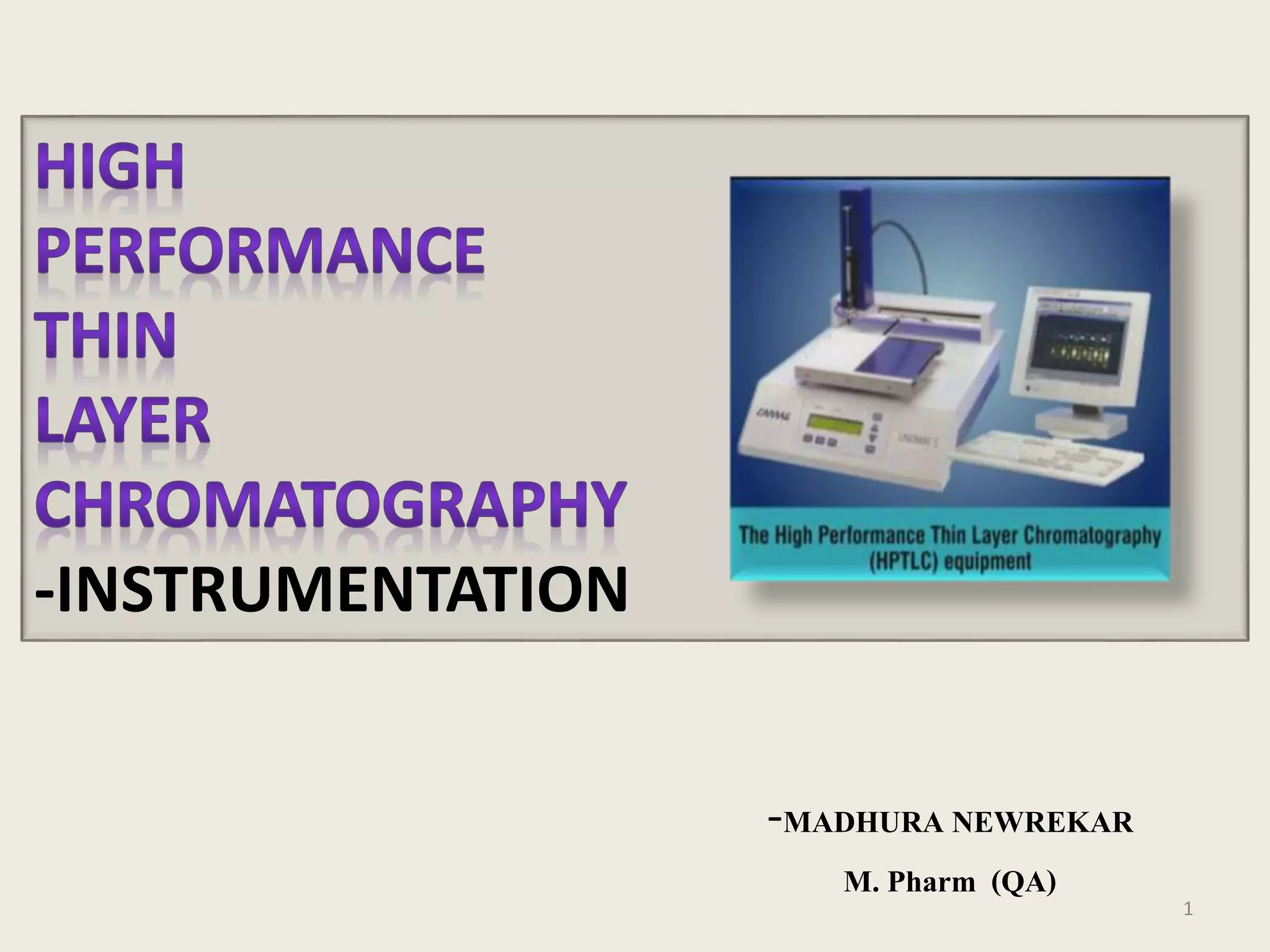
High Performance Thin Layer Chromatography (HPTLC) instrumentation
The document discusses the advancements in High-Performance Thin-Layer Chromatography (HPTLC), highlighting its advantages over traditional Thin-Layer Chromatography (TLC) such as shorter time duration, better resolution, and increased sensitivity. It describes the instrumentation process, sample application, chromatogram development, and evaluation methodologies used in HPTLC, as well as the technology behind scanning densitometers for quantifying compounds. The conclusion emphasizes the importance of automation in enhancing accuracy and is supported by references to various instrumental analysis sources.
INTRODUCTION
• It isthe major advancement of TLC principle.
• The technique is more modernized.
• Advantages over TLC.
• Short time duration.
• Better resolution.
• More sensitivity.
• Ease of quantification.
2
3.
INSTRUMENTATION
• Stepwise procedureinclude:
1.Preparation of plates
2.Sample application
3.Chromatogram development
4.Derivatization
5.Chromatogram evaluation
6.Scanning and documentation
3
4.
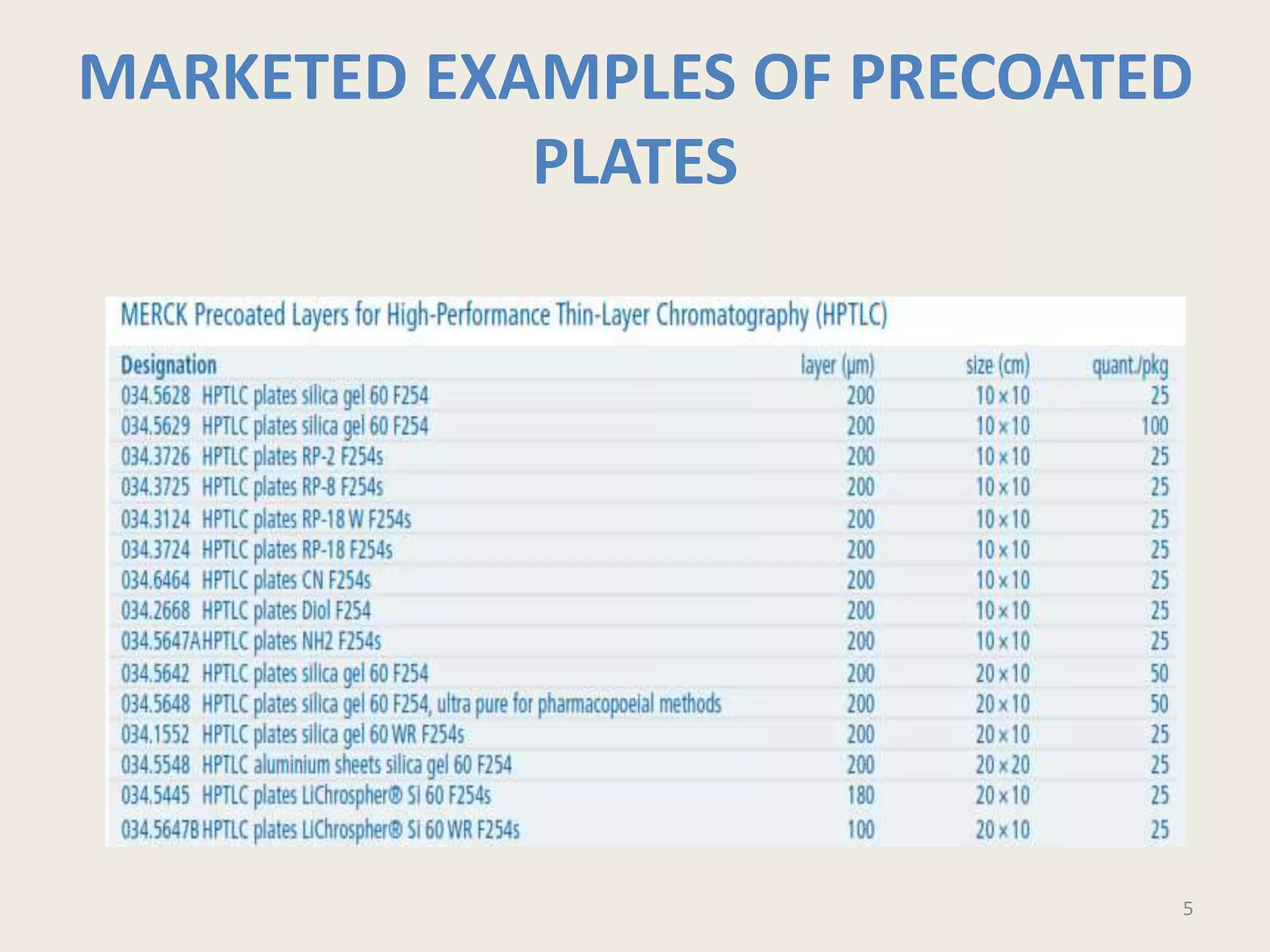
PLATES
• Pre-coated plates:
•Wider choice for stationary phase.eg : Silica ,
alumina , cellulose , C18 , C8.
• Particle size is 2-7 μm.
• Pore size is smaller and more uniform.
• Thickness is 0.2 mm.
• If the plates are stored for longer duration of
time, they need to be activated before use.
4
SAMPLE APPLICATION
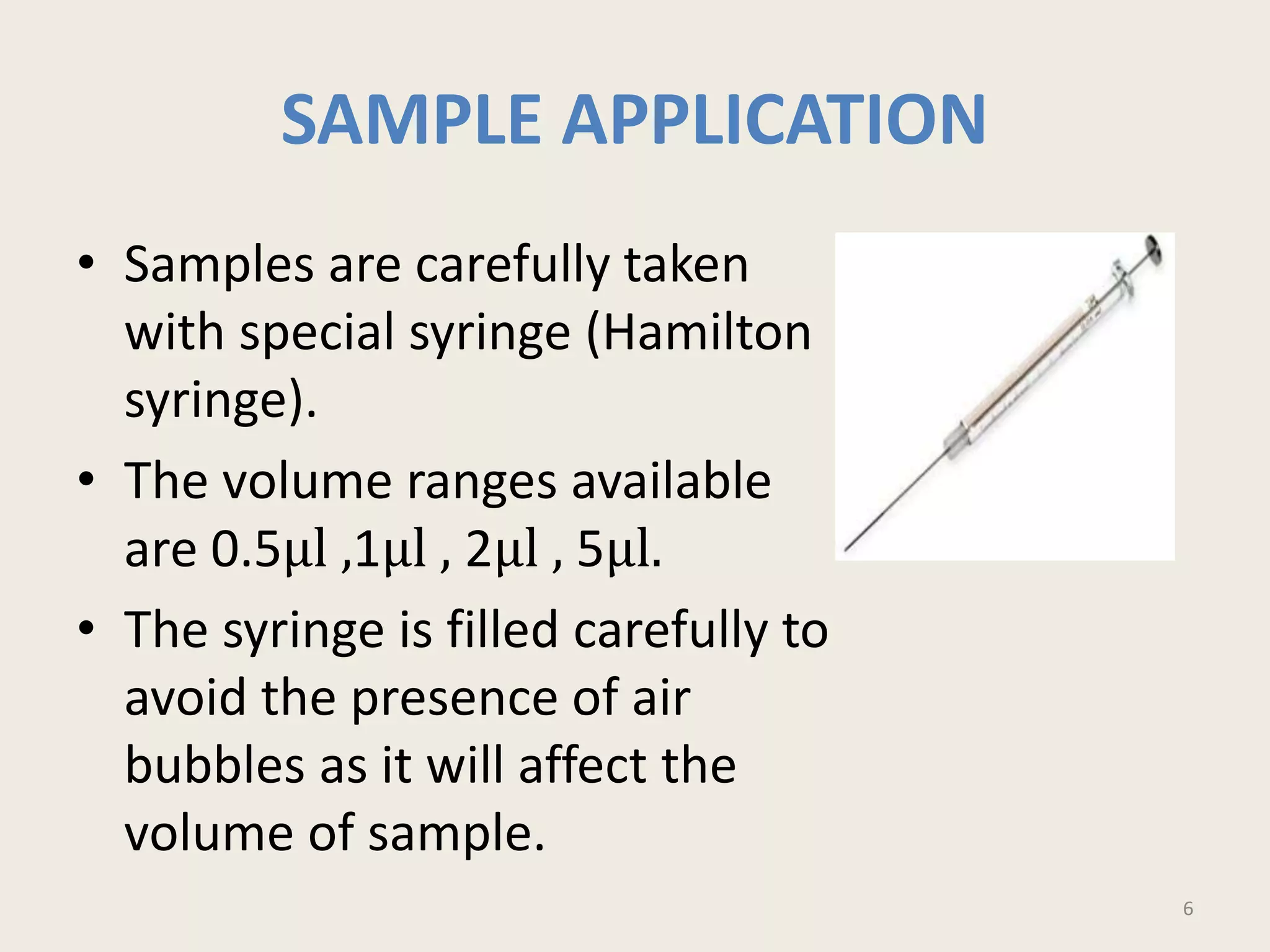
• Samplesare carefully taken
with special syringe (Hamilton
syringe).
• The volume ranges available
are 0.5μl ,1μl , 2μl , 5μl.
• The syringe is filled carefully to
avoid the presence of air
bubbles as it will affect the
volume of sample.
6
7.
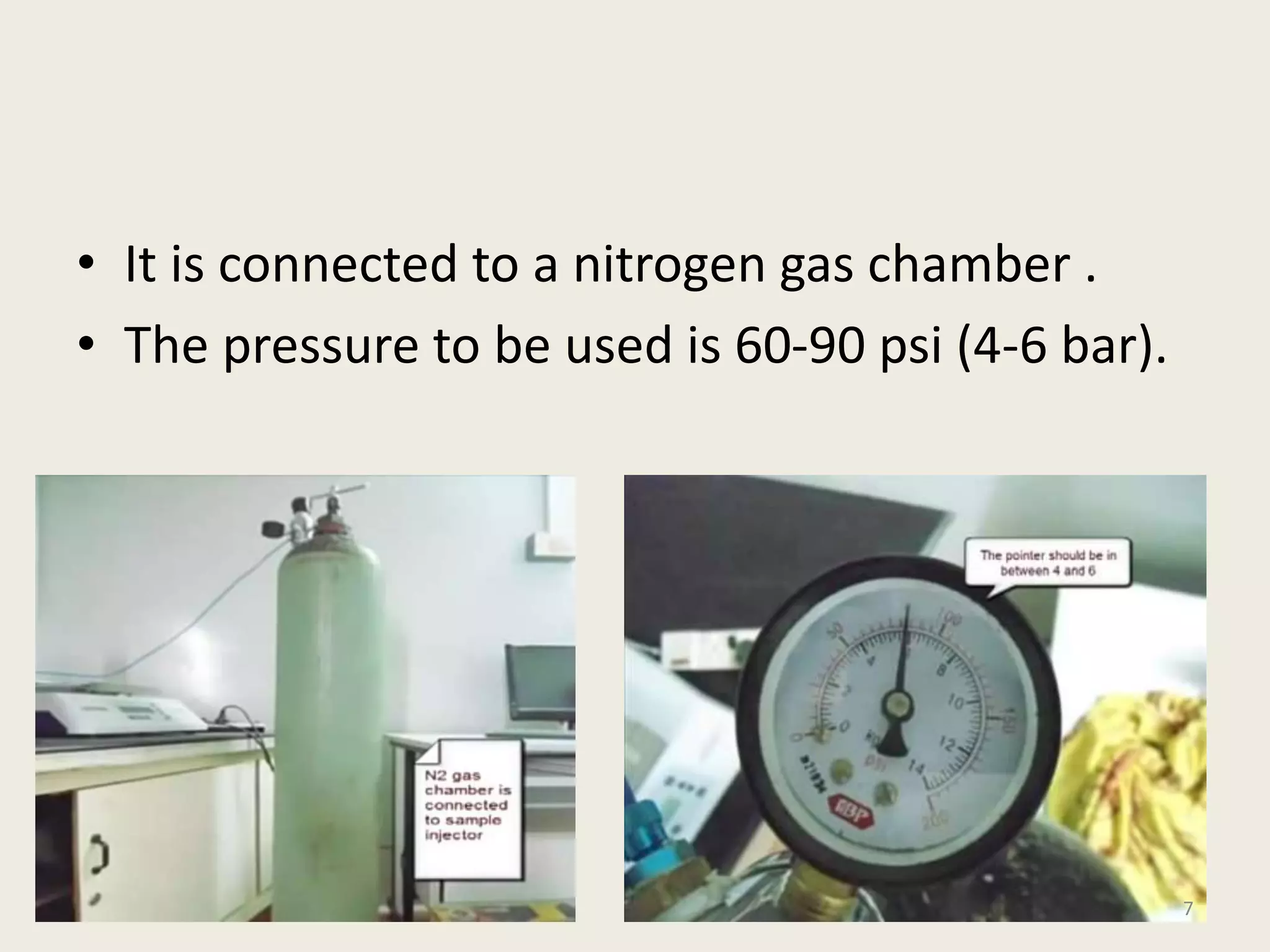
• It isconnected to a nitrogen gas chamber .
• The pressure to be used is 60-90 psi (4-6 bar).
7
8.
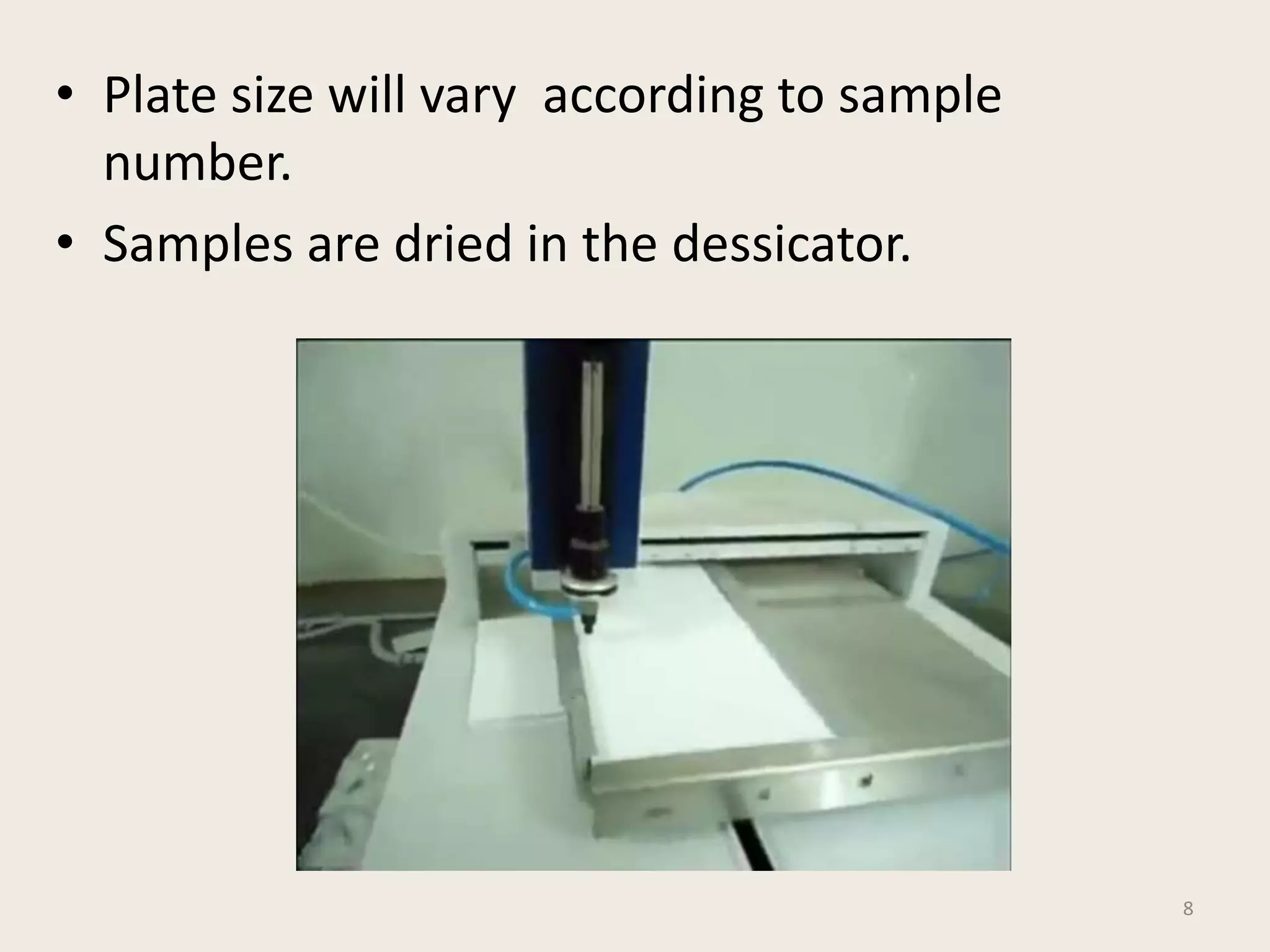
• Plate sizewill vary according to sample
number.
• Samples are dried in the dessicator.
8
9.
CHROMATOGRAM DEVELOPMENT
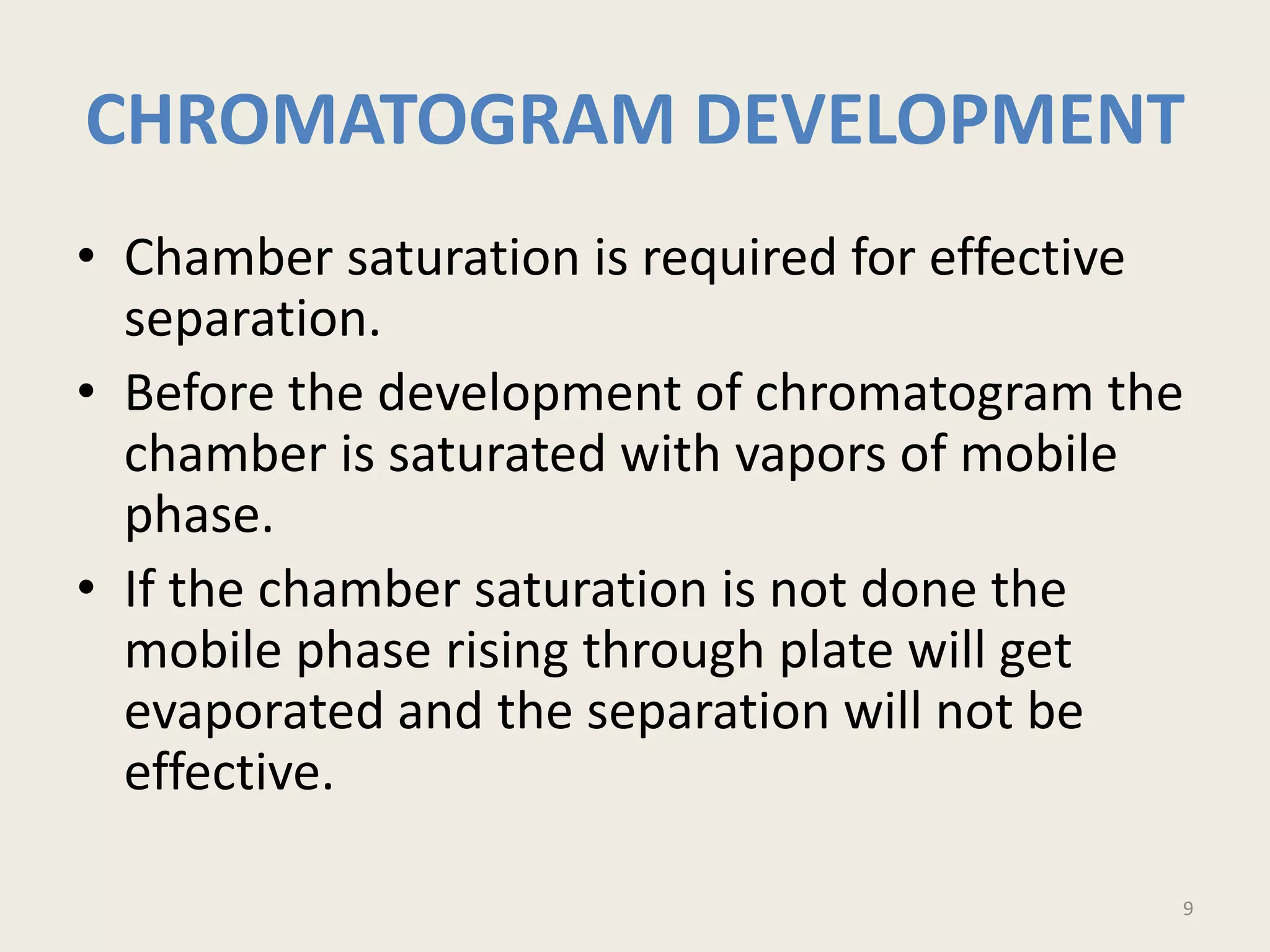
• Chambersaturation is required for effective
separation.
• Before the development of chromatogram the
chamber is saturated with vapors of mobile
phase.
• If the chamber saturation is not done the
mobile phase rising through plate will get
evaporated and the separation will not be
effective.
9
10.
• Flat bottomchamber:
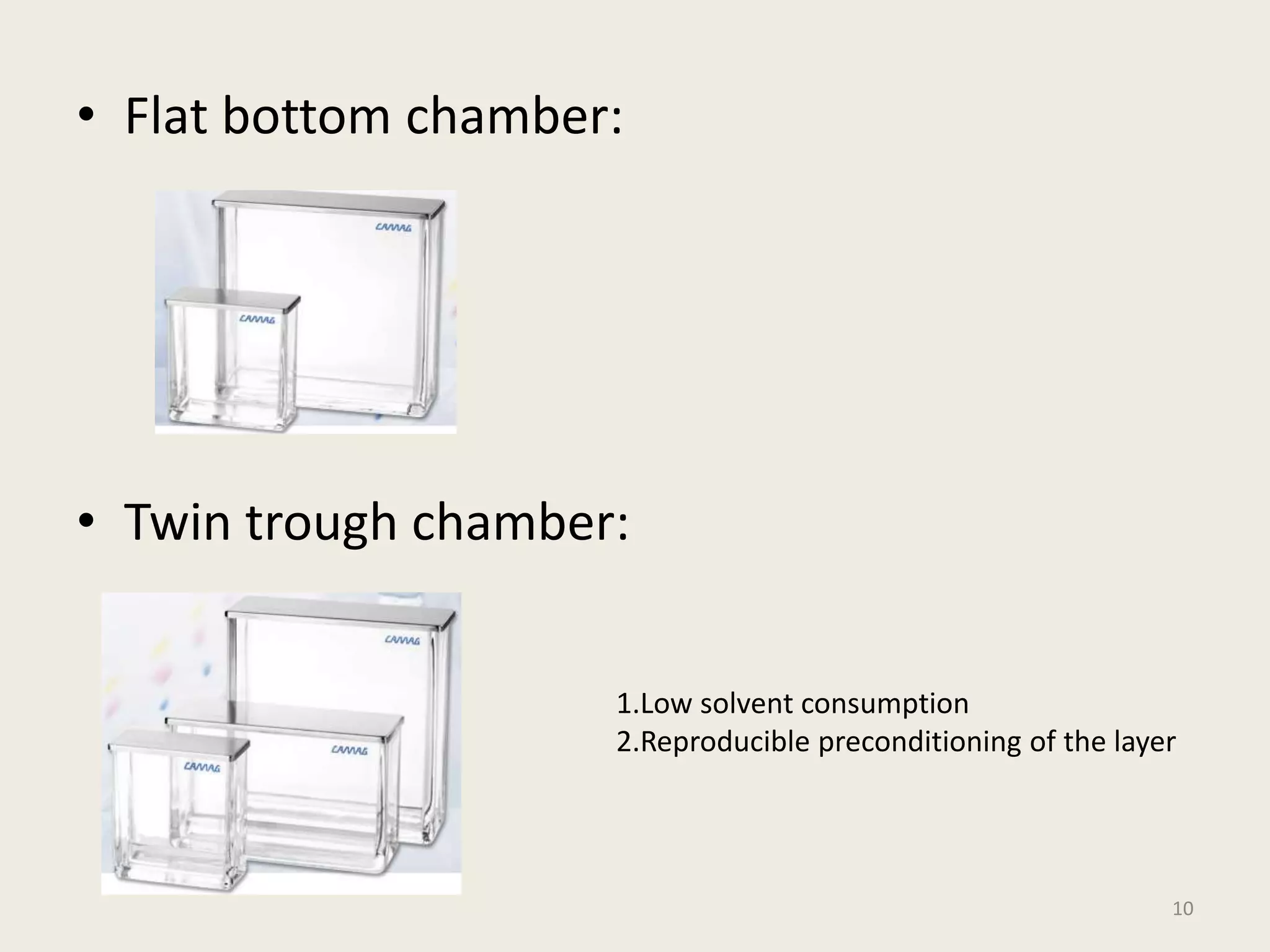
• Twin trough chamber:
1.Low solvent consumption
2.Reproducible preconditioning of the layer
10
11.
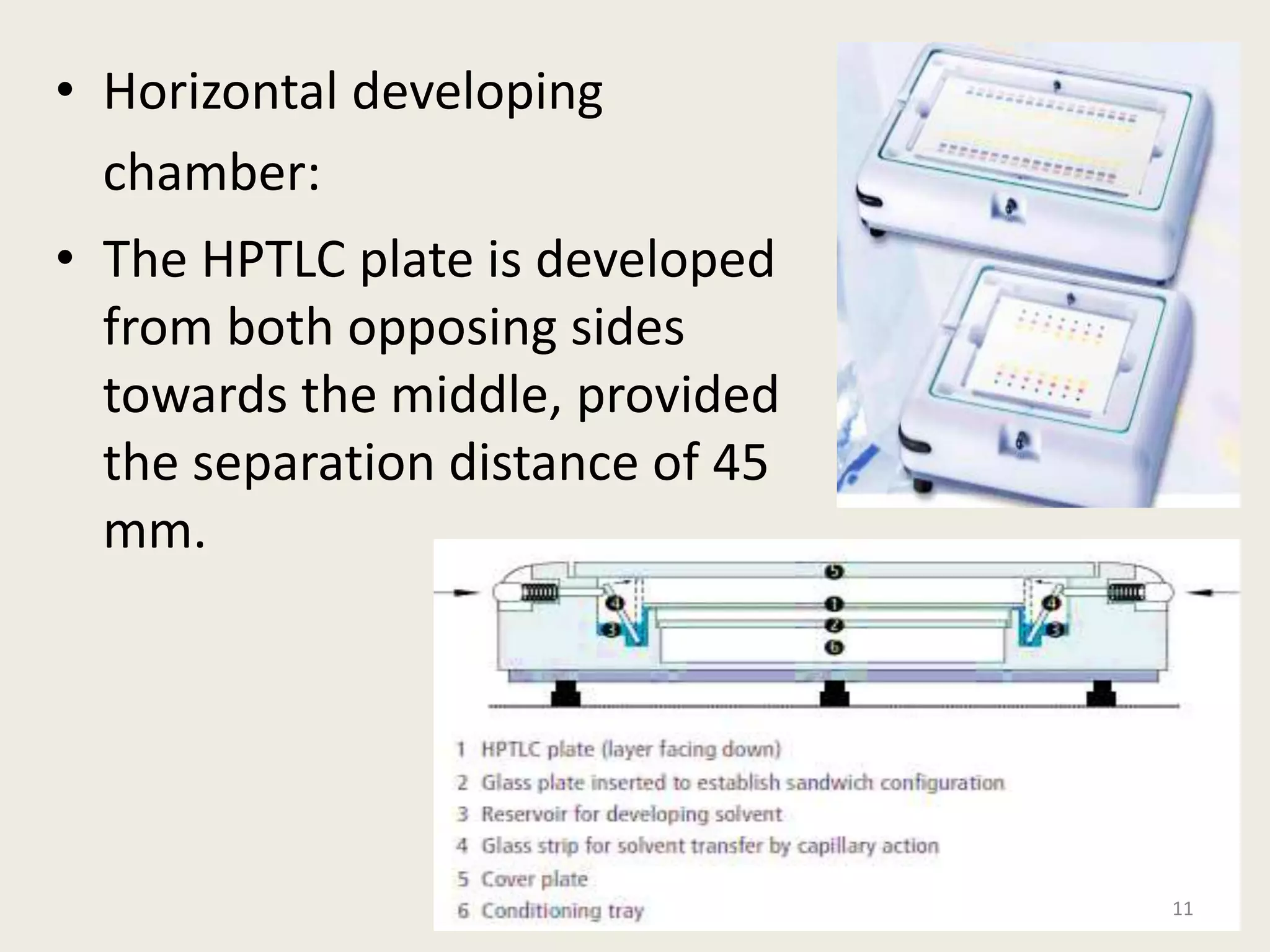
• Horizontal developing
chamber:
•The HPTLC plate is developed
from both opposing sides
towards the middle, provided
the separation distance of 45
mm.
11
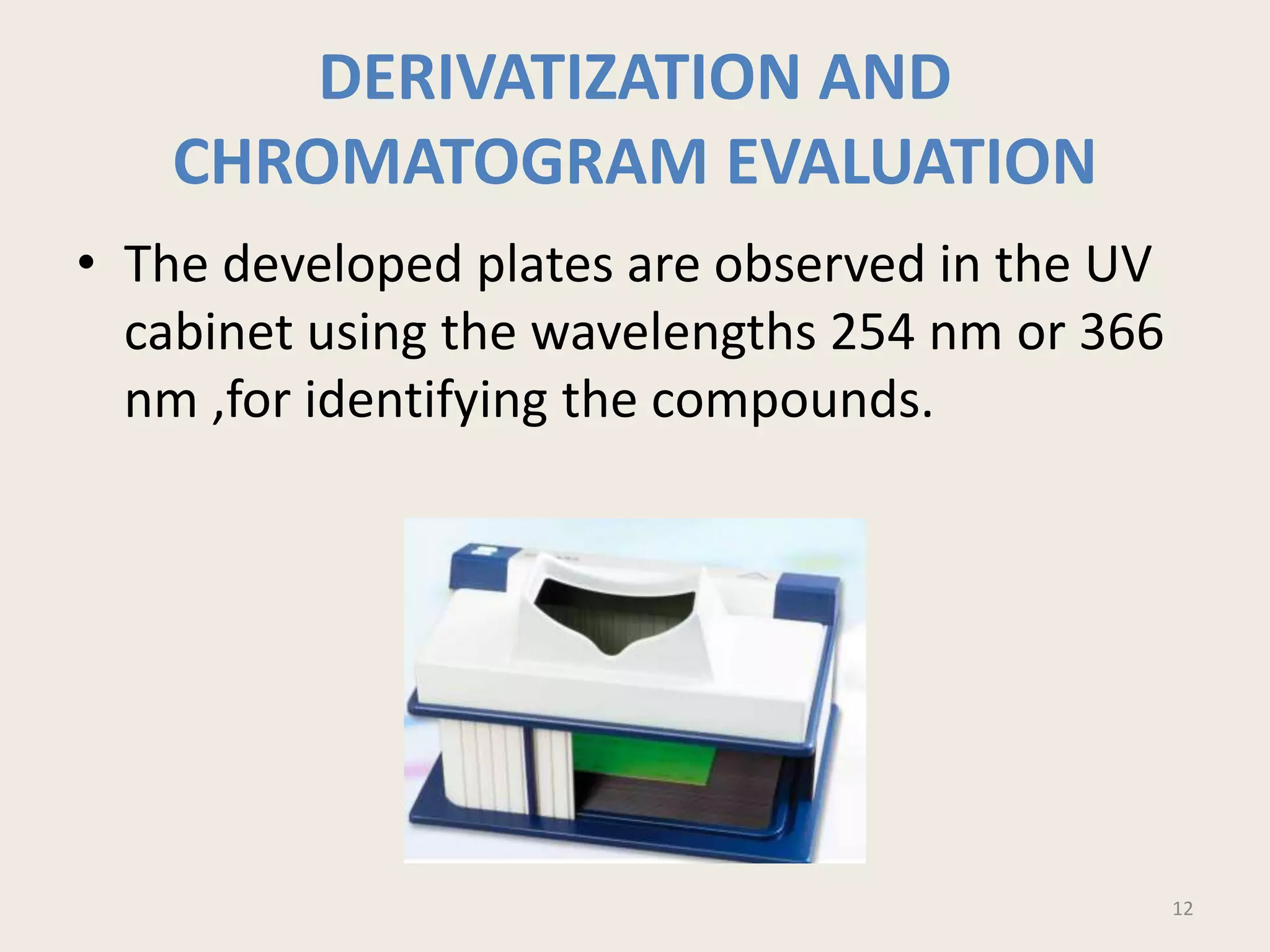
• If theseparated compounds are fluorescent in
nature , they can be detected using UV cabinet, If
the separated compound are not fluorescent ,
then the fluorescent material is incorporated into
stationary phase.
• Post chromatogram derivatization e.g.
concentrated sulfuric acid. Many organic
compound get charred due to sulfuric acid and
produce black or brown spots.
• Other reagents used : Iodine,Ninhydrin reagent.
13
14.
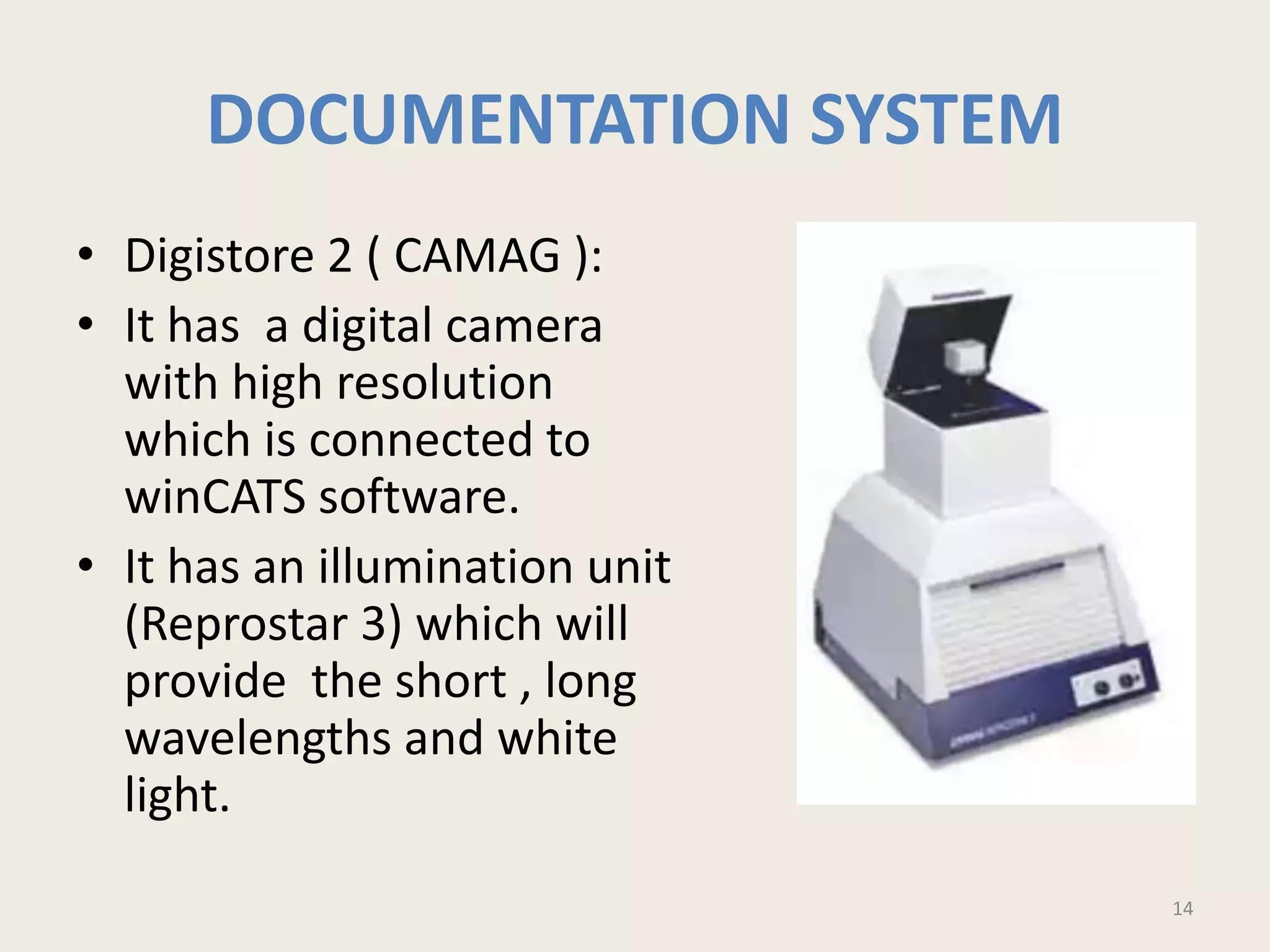
DOCUMENTATION SYSTEM
• Digistore2 ( CAMAG ):
• It has a digital camera
with high resolution
which is connected to
winCATS software.
• It has an illumination unit
(Reprostar 3) which will
provide the short , long
wavelengths and white
light.
14
15.
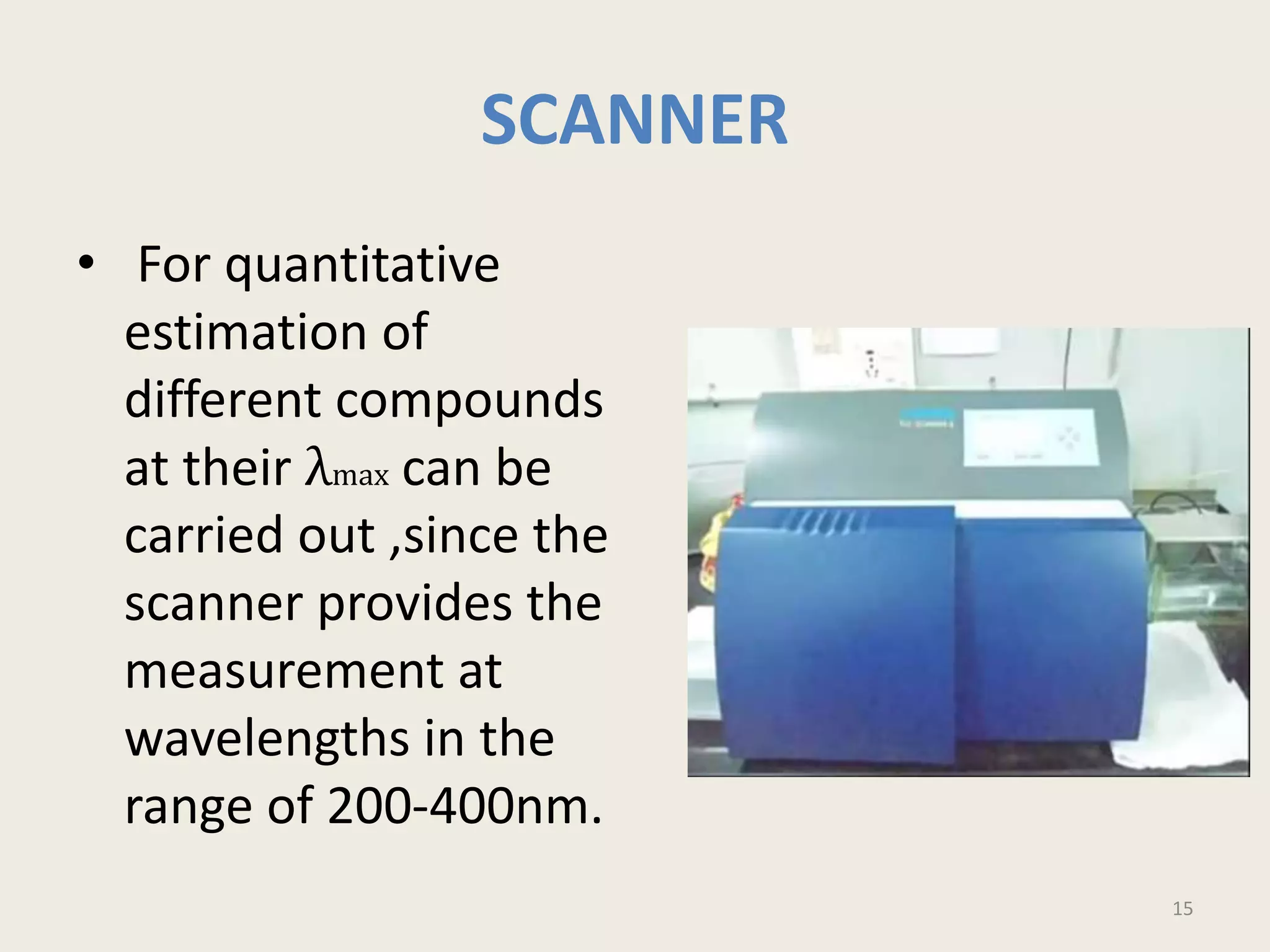
SCANNER
• For quantitative
estimationof
different compounds
at their λmax can be
carried out ,since the
scanner provides the
measurement at
wavelengths in the
range of 200-400nm.
15
16.
• In thescanner , each sample band is brought
in the path of a required wavelength.
• The peaks are recorded and compared with
standard.
• Thus scanner makes in situ and accurate
quantification by HPTLC.
• Advantage : There is no need of removal of
the separated components unlike TLC which
pose the chances for errors.
16
17.
• A scanningdensitometer has the following
components:
• Light source: hydrogen lamp ,mercury vapor
lamp , xenon lamp .
• Collimating lens: It makes the beam parallel
before entering it into monochromator.
• Monochromator: Either a single or double
monochromators are used according to the
type of scanning densitometer.
17
18.
• A converginglens: A beam is converged to
focus on the separated compounds, When it
gets reflected back it falls on the detector.
• Detector : An effective detector such as
photomultiplier tube is employed for
measurement of reflected beam. A signal
produced by the detector indicates the
concentration of compound present in that
band.
18
19.
• A steppingmotor: In order to bring each spot
in the focus of a converged beam of radiation
it is used in densitometers. It moves a plate
under the scanned light beam in order to scan
the plate.
19
20.
CONCLUSION
• The automationat different steps provide
more accuracy , better resolution . Lower limit
of detection in HPTLC.
• One recent approach to automation has been
the use of piezoelectric devices and inkjet
printers for applying sample.
• Being more advanced , the usage of HPTLC is
well appreciated and accepted all over the
world.
20
21.
REFERENCES
• Dr SupriyaS Mahajan;Instrumental methods
of analysis;2010;Page no: 270-274.
• CAMAG; Basic tools for thin layer
chromatography ;Edition 2017;Page no:10-17.
• Skoog , Holller , Nieman; Instrumental
Analysis; 7th edition ;2009;Page no:217-225.
• Dr P D Sethi; HPTLC;1st edition ;1996,Page
no:25,30-48.
21
#12 In case a longer separationDistance is desired, the Horizontal Developing Chamber can be used For development from one side.
In the Horizontal Developing Chamber, a plate can be developed in
the sandwich configuration as well as in the tank configuration.
This permits the number of samples to be doubled as compared with development in A tank,





![high performance thin layer chromatography [HPTLC]](https://cdn.slidesharecdn.com/ss_thumbnails/54-191219130320-thumbnail.jpg?width=640&height=640&fit=bounds)


