
PRESENTED BY MR.AMIT H.KANSE.
(M. PHARM ) RAJGAD DNYANPEETH COLLEGE OF PHARMACY
BHOR,PUNE.
QUALITY ASSURANCE TECHNIQUES
2017-2018 12/9/2017HPTLC
•content
1. introduction
2. Principle
3. Instrumentation
4. Difference between TLC and HPTLC
5. Steps involving in HPTLC
6. Factors influencing separation and
resolution of spots
7. Applications of HPTLC 12/9/2017HPTLC
Introduction
– HPTLC (High performance thin layer chromatography) is
the automated, sophisticated form and improved
method of TLC.
- It is a powerful analytical method equally suitable for
qualitative and quantitative analytical tasks
It is also known as planer or flat bed chromatography
– HPTLC is very popular for many reasons such as-
– Visual chromatogram,
– Multiple sample handling,
– Enables the most complicated separation 12/9/2017HPTLC
– Detection limit in nanogram range with
Uvabsorption detection and in picogram
range with fluorimetric detection.
• Large no of theoretical plates in minimum
area of plates .
• Analysis time is greatly redused in HPTLC due
to shorter migration distant.
• Higher efficiency due to smaller particle size(5
μm).
12/9/2017HPTLC
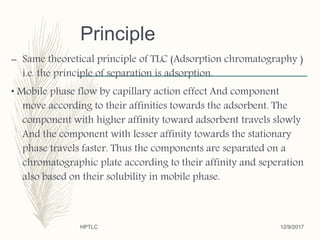
Principle
– Same theoretical principle of TLC (Adsorption chromatography )
i.e. the principle of separation is adsorption.
• Mobile phase flow by capillary action effect And component
move according to their affinities towards the adsorbent. The
component with higher affinity toward adsorbent travels slowly
And the component with lesser affinity towards the stationary
phase travels faster. Thus the components are separated on a
chromatographic plate according to their affinity and seperation
also based on their solubility in mobile phase.
12/9/2017HPTLC
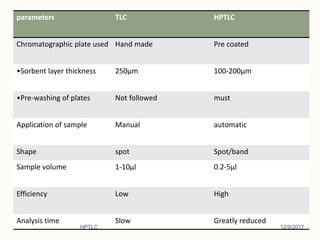
parameters TLC HPTLC
Chromatographic plate used Hand made Pre coated
•Sorbent layer thickness 250μm 100-200μm
•Pre-washing of plates Not followed must
Application of sample Manual automatic
Shape spot Spot/band
Sample volume 1-10μl 0.2-5μl
Efficiency Low High
Analysis time Slow Greatly reduced
12/9/2017HPTLC
Steps involving in
HPTLC-
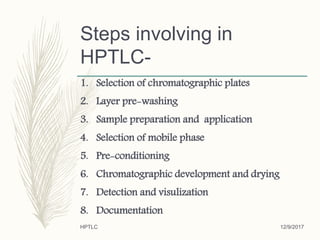
1. Selection of chromatographic plates
2. Layer pre-washing
3. Sample preparation and application
4. Selection of mobile phase
5. Pre-conditioning
6. Chromatographic development and drying
7. Detection and visulization
8. Documentation
12/9/2017HPTLC
Selection of
chromatographic plates
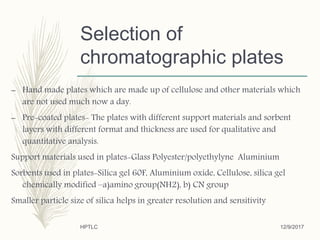
– Hand made plates which are made up of cellulose and other materials which
are not used much now a day.
– Pre-coated plates- The plates with different support materials and sorbent
layers with different format and thickness are used for qualitative and
quantitative analysis.
Support materials used in plates-Glass Polyester/polyethylyne Aluminium
Sorbents used in plates-Silica gel 60F, Aluminium oxide, Cellulose, silica gel
chemically modified –a)amino group(NH2), b) CN group
Smaller particle size of silica helps in greater resolution and sensitivity
12/9/2017HPTLC
Layer pre-washing-
1. It is purification step.
2. The main purpose of the pre-washing is to remove
impurities which include water vapours and other
volatile substances from the atmosphere when they get
exposed in the lab environment
3. In case of silica 60F( most widely used sorbent) the major
disadvantage of this sorbent is that it contain iron as
impurity.
4. This iron is removed by using Methanol : water (9:1),
this is the major advantage of the step of pre-washing.12/9/2017HPTLC
Some common methods are-
1. Asending
2. Dipping
3. Continuous
Solvents used for pre-washing-
1. Methanol
2. Chloroform:Methanol ( 1:1)
3. Choloroform: Methanol: Ammonia (90:10:1 )
12/9/2017HPTLC
Activation of pre coated
plates-
1. Freshly opened box of HPTLC plates doesn’t need activation.
2. If plates exposed to high humidity or kept in hand for longer time
then activation is required and it’s activation results by removing
moisture.
3. The plates are activated by placing in an oven at 110- 1200 C for
30 min, this step will removes water that has been physically
absorbed on surface at solvent layer.
4. Activation at higher temp and for longer time is avoided which
leads to very active layer and there is risk of sample being
decomposed.
12/9/2017HPTLC
Sample application-
– Usual concentration range is 0.1-1μg / μl ,above this causes poor
separation and volume recommended for HPTLC-0.5-5μl .
– The size of sample spot applied must not exceed 1mm in diameter.
– Problem from overloading can be overcome by applying the sample as
band.
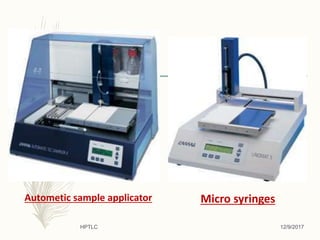
Some applicators used for application of sample-
1. Capillary tubes
2. Micro bulb pipettes.
3. Micro syringes.
4. Automatic sample applicator 12/9/2017HPTLC
Micro syringesAutometic sample applicator
12/9/2017HPTLC
Selection of mobile
phase
 Chemical properties of analytes and sorbent layer factors should be
considered while selection of mobile phase.
 Various components of Mobile Phase should be measured separately and
then placed in mixing vessel.
 The less amount of mobile phase is required then TLC .
 This prevents contamination of solvents and also error arising from
volumes expansion or contraction on mixing.
 Multi component mobile phase once used not recommonded for further
use due to diffirent evaporation and adsorption by layer.
12/9/2017HPTLC
Chromatographic
development and drying-
 Plates are spotted with sample and air dried and placed in the developing
chambers.
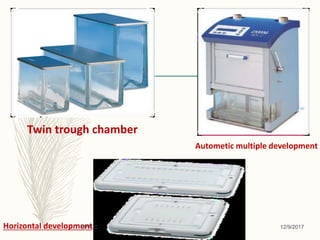
 The different methods used for development of chambers are like-
1. Ascending
2. Descending
3. Horizontal
 Autometic multiple development,Circular, anti-circular device and multiple
developments are some other methods.
 After development, remove the plate and mobile phase is removed from the
plate to avoid contamination of lab atmosphere.
 Dry in vacuum desiccators with protection from heat and light. 12/9/2017HPTLC
Autometic multiple development
Horizontal development
Twin trough chamber
12/9/2017HPTLC
Detection and visulization-
Detection under UV light is first choice.
 Non destructive and spots of fluorescent compounds
can be seen at 254 nm (short wave length) or at 366
nm (long wave length).
 Spots of non fluorescent compounds can be seen
fluorescent stationary phase is used - silica gel Gf.
 Non UV absorbing compounds like ethambutol,
dicylomine dipping the plates in 0.1% iodine solution
12/9/2017HPTLC
• Detector consists of
following-
1. Lamp selector
2. Entrance lens slit
3. Monochromator entrance slit
4. Grating
5. Mirror
6. Slit aperture disc
7. Mirror
8. Beam splitter
9. Reference photo multiplier
10. Measuring photo multiplier
11. Photo diode for transmission measurements. 12/9/2017HPTLC
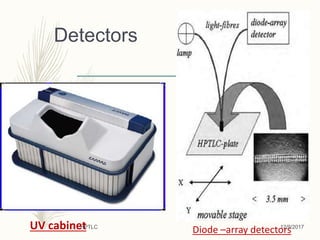
Detectors
UV cabinet Diode –array detectors12/9/2017HPTLC
Scanning and
documentation
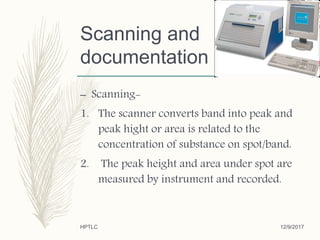
– Scanning-
1. The scanner converts band into peak and
peak hight or area is related to the
concentration of substance on spot/band.
2. The peak height and area under spot are
measured by instrument and recorded.
12/9/2017HPTLC
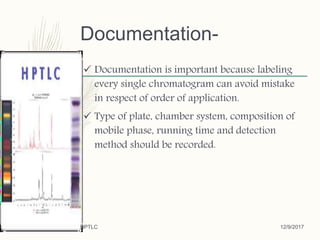
Documentation-
 Documentation is important because labeling
every single chromatogram can avoid mistake
in respect of order of application.
 Type of plate, chamber system, composition of
mobile phase, running time and detection
method should be recorded.
12/9/2017HPTLC
Factor affecting HPTLC
1. Types of stationary phase.
2. Mobile phase
3. Layer thickness
4. Temperature
5. Mode of development
6. Amount of sample 12/9/2017HPTLC
Applications of HPTLC
– Pharmaceutical industry- Quality
control,identity purity test etc.
– Food Analysis- : Quality control , additives
, pesticides ,stability testing
– Clinical Applications- Metabolism studies
, drug screening ,stability testing etc
– •Industrial Applications- Process
development and optimization
12/9/2017HPTLC
1. Forensic- Poisoning investigations
2. • Biomedical Analysis- Seperation of gangliosides
3. • Environment Analysis-Pesticides in drinking water etc.
4. • Cosmetics- Hydrocortisone & cinchocaine in lanolin
ointment etc.
5. • Natural products ,plant ingredients- Glycosides in herbal
drugs,Piperine in piper longum etc.
6. • Finger print Analysis-Finger prints for identification of
liquorice, ginseng etc.
7. • Analysis of drugs in blood-
12/9/2017HPTLC
12/9/2017HPTLC

Hptlc ppt

  • 1.
    PRESENTED BY MR.AMITH.KANSE. (M. PHARM ) RAJGAD DNYANPEETH COLLEGE OF PHARMACY BHOR,PUNE. QUALITY ASSURANCE TECHNIQUES 2017-2018 12/9/2017HPTLC
  • 2.
    •content 1. introduction 2. Principle 3.Instrumentation 4. Difference between TLC and HPTLC 5. Steps involving in HPTLC 6. Factors influencing separation and resolution of spots 7. Applications of HPTLC 12/9/2017HPTLC
  • 3.
    Introduction – HPTLC (Highperformance thin layer chromatography) is the automated, sophisticated form and improved method of TLC. - It is a powerful analytical method equally suitable for qualitative and quantitative analytical tasks It is also known as planer or flat bed chromatography – HPTLC is very popular for many reasons such as- – Visual chromatogram, – Multiple sample handling, – Enables the most complicated separation 12/9/2017HPTLC
  • 4.
    – Detection limitin nanogram range with Uvabsorption detection and in picogram range with fluorimetric detection. • Large no of theoretical plates in minimum area of plates . • Analysis time is greatly redused in HPTLC due to shorter migration distant. • Higher efficiency due to smaller particle size(5 μm). 12/9/2017HPTLC
  • 5.
    Principle – Same theoreticalprinciple of TLC (Adsorption chromatography ) i.e. the principle of separation is adsorption. • Mobile phase flow by capillary action effect And component move according to their affinities towards the adsorbent. The component with higher affinity toward adsorbent travels slowly And the component with lesser affinity towards the stationary phase travels faster. Thus the components are separated on a chromatographic plate according to their affinity and seperation also based on their solubility in mobile phase. 12/9/2017HPTLC
  • 6.
    parameters TLC HPTLC Chromatographicplate used Hand made Pre coated •Sorbent layer thickness 250μm 100-200μm •Pre-washing of plates Not followed must Application of sample Manual automatic Shape spot Spot/band Sample volume 1-10μl 0.2-5μl Efficiency Low High Analysis time Slow Greatly reduced 12/9/2017HPTLC
  • 7.
    Steps involving in HPTLC- 1.Selection of chromatographic plates 2. Layer pre-washing 3. Sample preparation and application 4. Selection of mobile phase 5. Pre-conditioning 6. Chromatographic development and drying 7. Detection and visulization 8. Documentation 12/9/2017HPTLC
  • 8.
    Selection of chromatographic plates –Hand made plates which are made up of cellulose and other materials which are not used much now a day. – Pre-coated plates- The plates with different support materials and sorbent layers with different format and thickness are used for qualitative and quantitative analysis. Support materials used in plates-Glass Polyester/polyethylyne Aluminium Sorbents used in plates-Silica gel 60F, Aluminium oxide, Cellulose, silica gel chemically modified –a)amino group(NH2), b) CN group Smaller particle size of silica helps in greater resolution and sensitivity 12/9/2017HPTLC
  • 9.
    Layer pre-washing- 1. Itis purification step. 2. The main purpose of the pre-washing is to remove impurities which include water vapours and other volatile substances from the atmosphere when they get exposed in the lab environment 3. In case of silica 60F( most widely used sorbent) the major disadvantage of this sorbent is that it contain iron as impurity. 4. This iron is removed by using Methanol : water (9:1), this is the major advantage of the step of pre-washing.12/9/2017HPTLC
  • 10.
    Some common methodsare- 1. Asending 2. Dipping 3. Continuous Solvents used for pre-washing- 1. Methanol 2. Chloroform:Methanol ( 1:1) 3. Choloroform: Methanol: Ammonia (90:10:1 ) 12/9/2017HPTLC
  • 11.
    Activation of precoated plates- 1. Freshly opened box of HPTLC plates doesn’t need activation. 2. If plates exposed to high humidity or kept in hand for longer time then activation is required and it’s activation results by removing moisture. 3. The plates are activated by placing in an oven at 110- 1200 C for 30 min, this step will removes water that has been physically absorbed on surface at solvent layer. 4. Activation at higher temp and for longer time is avoided which leads to very active layer and there is risk of sample being decomposed. 12/9/2017HPTLC
  • 12.
    Sample application- – Usualconcentration range is 0.1-1μg / μl ,above this causes poor separation and volume recommended for HPTLC-0.5-5μl . – The size of sample spot applied must not exceed 1mm in diameter. – Problem from overloading can be overcome by applying the sample as band. Some applicators used for application of sample- 1. Capillary tubes 2. Micro bulb pipettes. 3. Micro syringes. 4. Automatic sample applicator 12/9/2017HPTLC
  • 13.
    Micro syringesAutometic sampleapplicator 12/9/2017HPTLC
  • 14.
    Selection of mobile phase Chemical properties of analytes and sorbent layer factors should be considered while selection of mobile phase.  Various components of Mobile Phase should be measured separately and then placed in mixing vessel.  The less amount of mobile phase is required then TLC .  This prevents contamination of solvents and also error arising from volumes expansion or contraction on mixing.  Multi component mobile phase once used not recommonded for further use due to diffirent evaporation and adsorption by layer. 12/9/2017HPTLC
  • 15.
    Chromatographic development and drying- Plates are spotted with sample and air dried and placed in the developing chambers.  The different methods used for development of chambers are like- 1. Ascending 2. Descending 3. Horizontal  Autometic multiple development,Circular, anti-circular device and multiple developments are some other methods.  After development, remove the plate and mobile phase is removed from the plate to avoid contamination of lab atmosphere.  Dry in vacuum desiccators with protection from heat and light. 12/9/2017HPTLC
  • 16.
    Autometic multiple development Horizontaldevelopment Twin trough chamber 12/9/2017HPTLC
  • 17.
    Detection and visulization- Detectionunder UV light is first choice.  Non destructive and spots of fluorescent compounds can be seen at 254 nm (short wave length) or at 366 nm (long wave length).  Spots of non fluorescent compounds can be seen fluorescent stationary phase is used - silica gel Gf.  Non UV absorbing compounds like ethambutol, dicylomine dipping the plates in 0.1% iodine solution 12/9/2017HPTLC
  • 18.
    • Detector consistsof following- 1. Lamp selector 2. Entrance lens slit 3. Monochromator entrance slit 4. Grating 5. Mirror 6. Slit aperture disc 7. Mirror 8. Beam splitter 9. Reference photo multiplier 10. Measuring photo multiplier 11. Photo diode for transmission measurements. 12/9/2017HPTLC
  • 19.
    Detectors UV cabinet Diode–array detectors12/9/2017HPTLC
  • 20.
    Scanning and documentation – Scanning- 1.The scanner converts band into peak and peak hight or area is related to the concentration of substance on spot/band. 2. The peak height and area under spot are measured by instrument and recorded. 12/9/2017HPTLC
  • 21.
    Documentation-  Documentation isimportant because labeling every single chromatogram can avoid mistake in respect of order of application.  Type of plate, chamber system, composition of mobile phase, running time and detection method should be recorded. 12/9/2017HPTLC
  • 22.
    Factor affecting HPTLC 1.Types of stationary phase. 2. Mobile phase 3. Layer thickness 4. Temperature 5. Mode of development 6. Amount of sample 12/9/2017HPTLC
  • 23.
    Applications of HPTLC –Pharmaceutical industry- Quality control,identity purity test etc. – Food Analysis- : Quality control , additives , pesticides ,stability testing – Clinical Applications- Metabolism studies , drug screening ,stability testing etc – •Industrial Applications- Process development and optimization 12/9/2017HPTLC
  • 24.
    1. Forensic- Poisoninginvestigations 2. • Biomedical Analysis- Seperation of gangliosides 3. • Environment Analysis-Pesticides in drinking water etc. 4. • Cosmetics- Hydrocortisone & cinchocaine in lanolin ointment etc. 5. • Natural products ,plant ingredients- Glycosides in herbal drugs,Piperine in piper longum etc. 6. • Finger print Analysis-Finger prints for identification of liquorice, ginseng etc. 7. • Analysis of drugs in blood- 12/9/2017HPTLC
  • 25.