Instrumentation
of
Thin layer chromatography
Presented By:
Tanmoy Sarkar
ID: 181130
3rd Year 1st Term
Pharmacy Discipline
Khulna University
Khulna
Instruments used in TLC
Stationary Phase
Mobile Phase
TLC plate
Forceps, pencil and ruler
Filter paper
Micropipette
Developing container’
- chamber/ jar/ glass beaker
Analyte
Detecting & visualizing agent
Stationary Phase
Adsorbents Acidic or Basic
Components to be
separated
Silica gel Acidic
Acidic and neutral
substances
Alumina Basic Basic and neutral
Cellulose Powder Neutral Soluble compounds
➢ The phase which the mobile phase passes over
➢ Made of coated with adsorbents.
➢ Used to provide facility for the adsorption of analyte on TLC film.
➢ Some commercially produced thin adsorbents are:
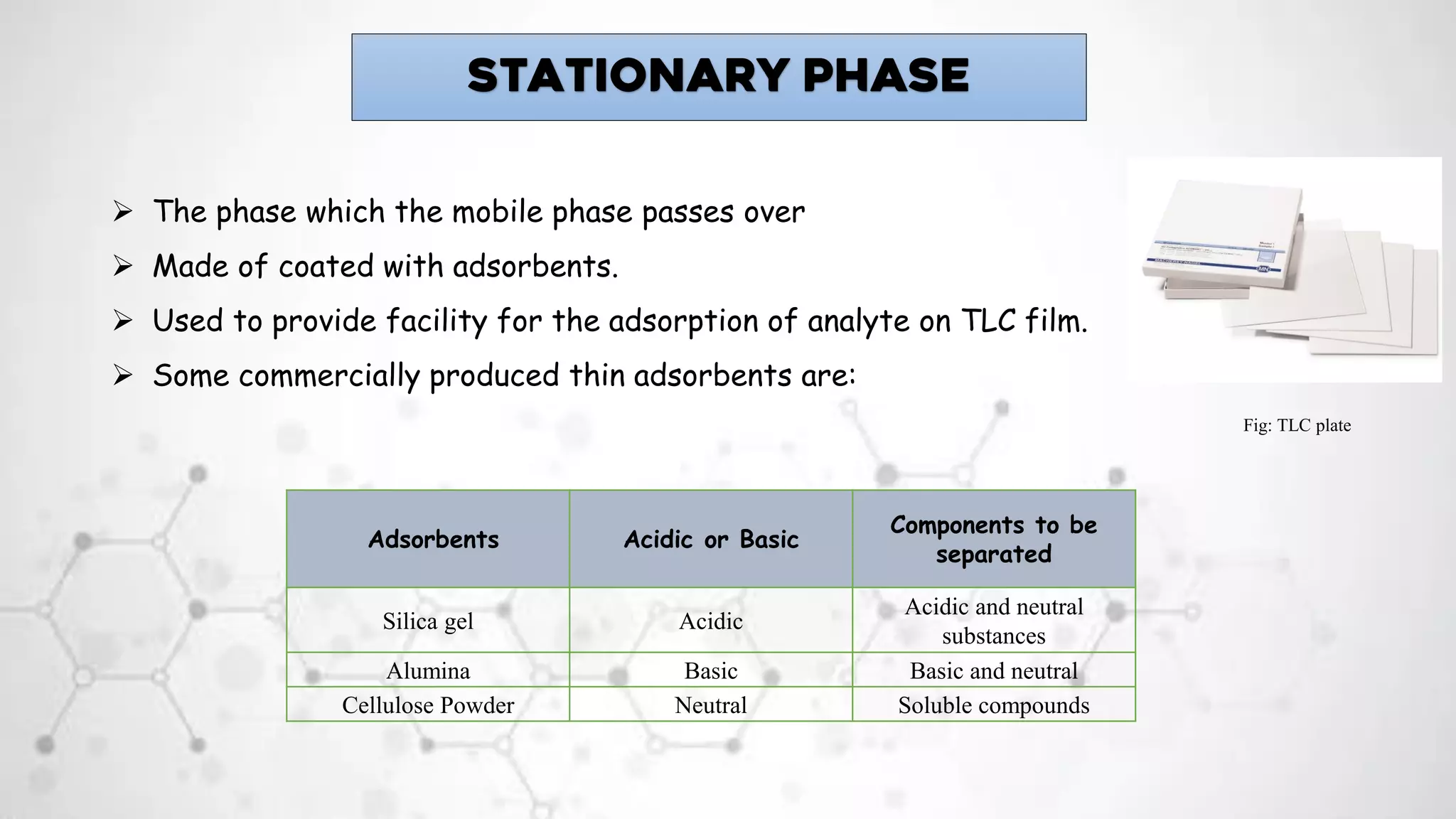
Fig: TLC plate
➢ A solvent or solvent mixture which moves on the stationary phase.
➢ The solvent travels through the stationary phase by capillary action.
➢ The ability of mobile phase to move up is depend on the polarity itself.
➢ Commonly used: Ethyl acetate, Hexane
mobile Phase
Solvent Polarity
Hexane 0.1
Carbon tetrachloride 1.56
Isopropyl ether 1.83
Toluene 2.4
Chloroform 2.7
Diethyl ether 2.8
Isopropanol 3.92
Ethyl Acetate 4.4
Acetone 5.1
Acetonitrile 5.8
Water 10.2
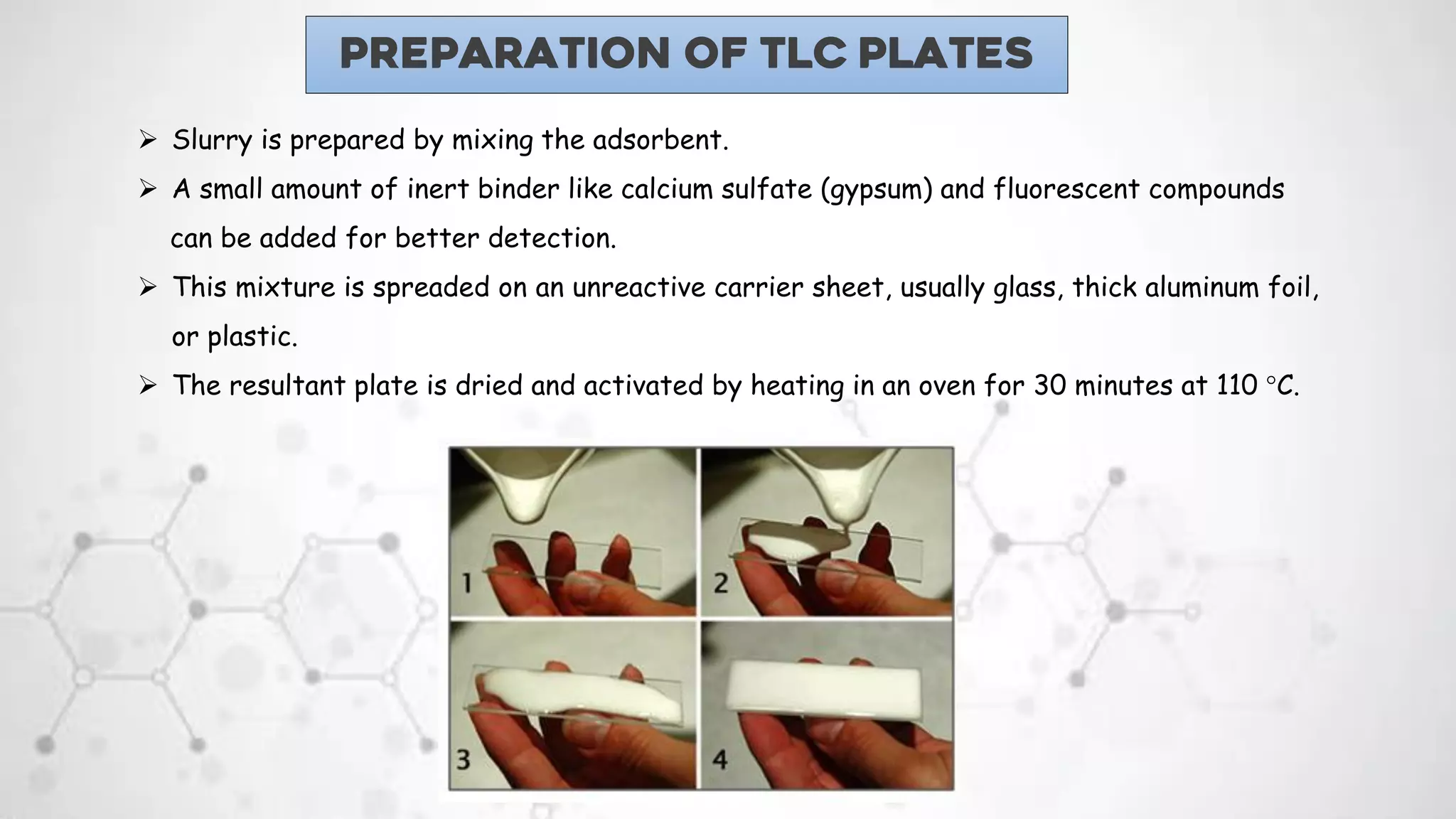
➢ Slurry is prepared by mixing the adsorbent.
➢ A small amount of inert binder like calcium sulfate (gypsum) and fluorescent compounds
can be added for better detection.
➢ This mixture is spreaded on an unreactive carrier sheet, usually glass, thick aluminum foil,
or plastic.
➢ The resultant plate is dried and activated by heating in an oven for 30 minutes at 110 °C.
Preparation of TLC Plates
➢ A line is marked about 1 cm above the bottom of the plate with the help of a pencil.
➢ Solution of sample or standard is spotted using a capillary tube or micropipette.
➢ The spot must be as narrow as possible for better separation and minimum tailing.
Marking & spotting on TLC Plates
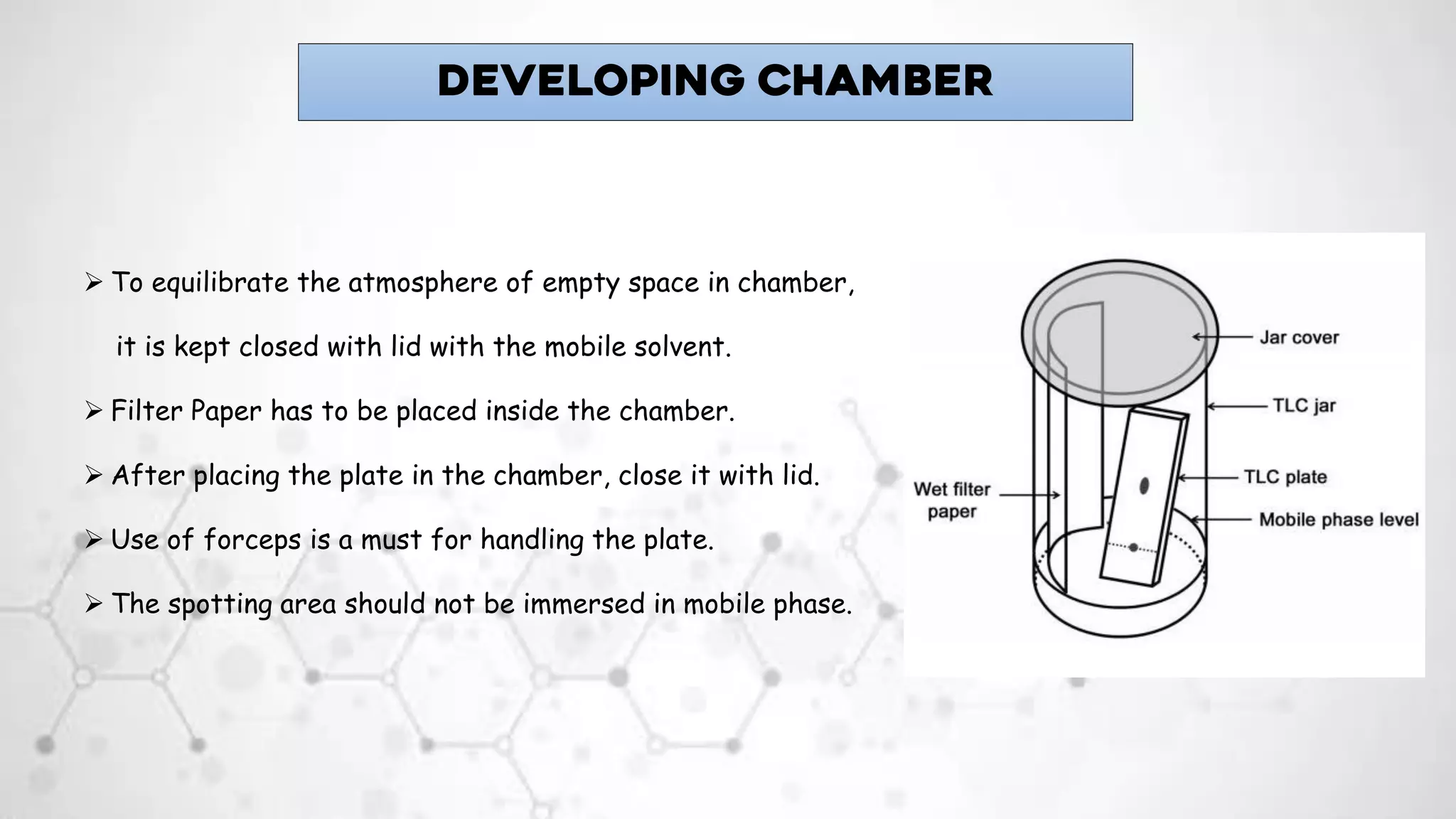
➢ To equilibrate the atmosphere of empty space in chamber,
it is kept closed with lid with the mobile solvent.
➢ Filter Paper has to be placed inside the chamber.
➢ After placing the plate in the chamber, close it with lid.
➢ Use of forceps is a must for handling the plate.
➢ The spotting area should not be immersed in mobile phase.
DEVELOPING CHAMBER
➢ For colorless solutes, visualization or detection techniques are required, such as:
❑Non-specific:
✓ UV Chamber for fluorescent compounds
✓ Iodine Chamber Method
DETECTING AGENTS
❑Specific:
✓ Ninhydrin: method for amino acids.
✓ Bromocresol Green: method for carboxylic acids.
✓ Iodine vapor: method for hydrocarbons
✓Dragendorff’s reagent: method for alkaloids, nitrogen-
containing compounds and lipids.
✓Antimony trichloride: method for cardiac glycosides
✓Aniline phthalate: method for Sugar
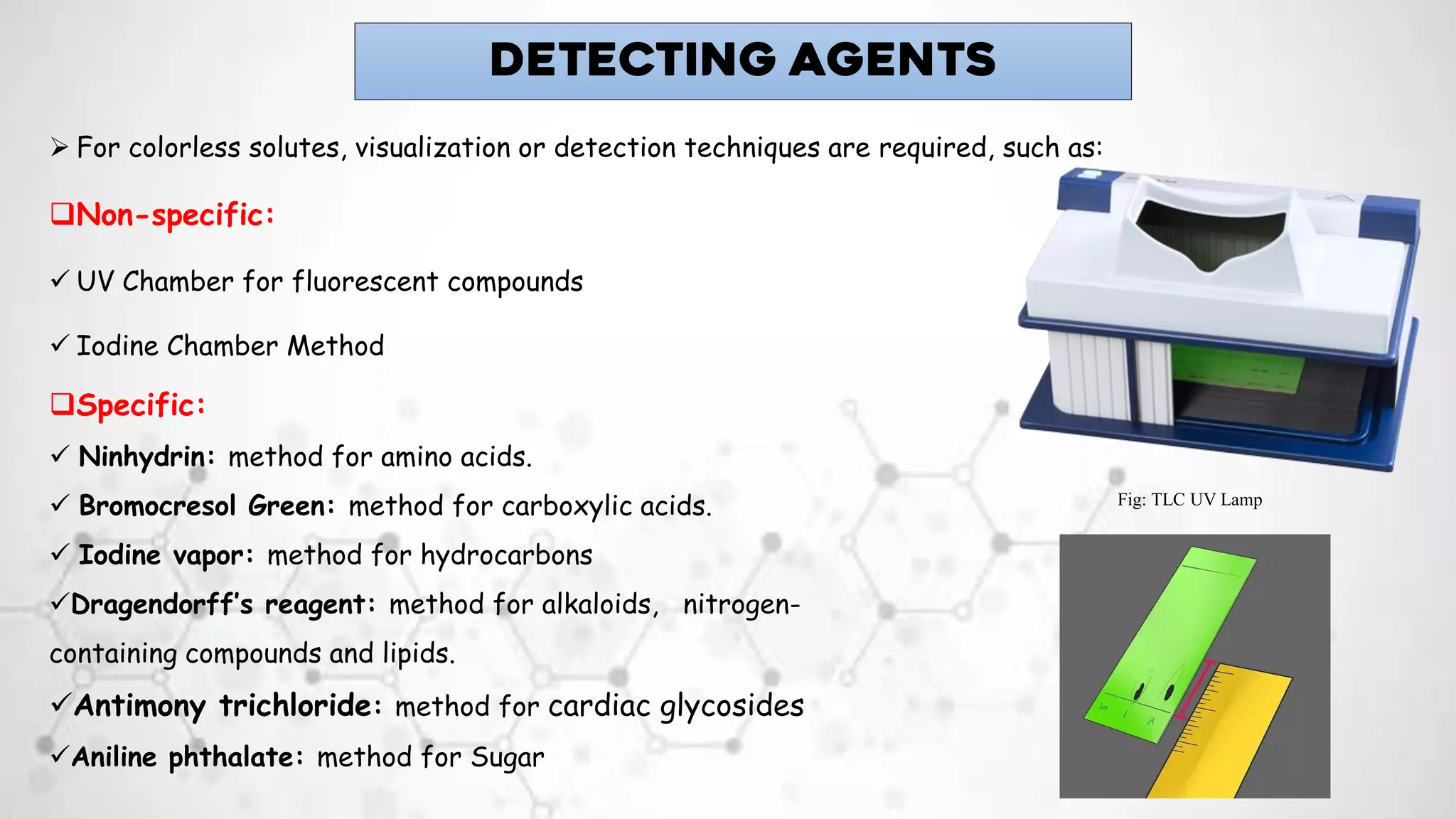
Fig: TLC UV Lamp
Some precaution
A. Handle with forceps
B. Do not immerse the
spotting line in solvent
C. Spotting should be as
narrow as possible
D. Carefully choose the
solvent
A B
D
C
Instrumentation of Thin Layer Chromatography

Instrumentation of Thin Layer Chromatography

  • 1.
    Instrumentation of Thin layer chromatography PresentedBy: Tanmoy Sarkar ID: 181130 3rd Year 1st Term Pharmacy Discipline Khulna University Khulna
  • 2.
    Instruments used inTLC Stationary Phase Mobile Phase TLC plate Forceps, pencil and ruler Filter paper Micropipette Developing container’ - chamber/ jar/ glass beaker Analyte Detecting & visualizing agent
  • 3.
    Stationary Phase Adsorbents Acidicor Basic Components to be separated Silica gel Acidic Acidic and neutral substances Alumina Basic Basic and neutral Cellulose Powder Neutral Soluble compounds ➢ The phase which the mobile phase passes over ➢ Made of coated with adsorbents. ➢ Used to provide facility for the adsorption of analyte on TLC film. ➢ Some commercially produced thin adsorbents are: Fig: TLC plate
  • 4.
    ➢ A solventor solvent mixture which moves on the stationary phase. ➢ The solvent travels through the stationary phase by capillary action. ➢ The ability of mobile phase to move up is depend on the polarity itself. ➢ Commonly used: Ethyl acetate, Hexane mobile Phase Solvent Polarity Hexane 0.1 Carbon tetrachloride 1.56 Isopropyl ether 1.83 Toluene 2.4 Chloroform 2.7 Diethyl ether 2.8 Isopropanol 3.92 Ethyl Acetate 4.4 Acetone 5.1 Acetonitrile 5.8 Water 10.2
  • 5.
    ➢ Slurry isprepared by mixing the adsorbent. ➢ A small amount of inert binder like calcium sulfate (gypsum) and fluorescent compounds can be added for better detection. ➢ This mixture is spreaded on an unreactive carrier sheet, usually glass, thick aluminum foil, or plastic. ➢ The resultant plate is dried and activated by heating in an oven for 30 minutes at 110 °C. Preparation of TLC Plates
  • 6.
    ➢ A lineis marked about 1 cm above the bottom of the plate with the help of a pencil. ➢ Solution of sample or standard is spotted using a capillary tube or micropipette. ➢ The spot must be as narrow as possible for better separation and minimum tailing. Marking & spotting on TLC Plates
  • 7.
    ➢ To equilibratethe atmosphere of empty space in chamber, it is kept closed with lid with the mobile solvent. ➢ Filter Paper has to be placed inside the chamber. ➢ After placing the plate in the chamber, close it with lid. ➢ Use of forceps is a must for handling the plate. ➢ The spotting area should not be immersed in mobile phase. DEVELOPING CHAMBER
  • 8.
    ➢ For colorlesssolutes, visualization or detection techniques are required, such as: ❑Non-specific: ✓ UV Chamber for fluorescent compounds ✓ Iodine Chamber Method DETECTING AGENTS ❑Specific: ✓ Ninhydrin: method for amino acids. ✓ Bromocresol Green: method for carboxylic acids. ✓ Iodine vapor: method for hydrocarbons ✓Dragendorff’s reagent: method for alkaloids, nitrogen- containing compounds and lipids. ✓Antimony trichloride: method for cardiac glycosides ✓Aniline phthalate: method for Sugar Fig: TLC UV Lamp
  • 9.
    Some precaution A. Handlewith forceps B. Do not immerse the spotting line in solvent C. Spotting should be as narrow as possible D. Carefully choose the solvent A B D C