Aamir Ali Khan
M.Phil Biochemistry
Head of pathology department
Northwest institute of health sciences
HORMONE
MECHANISM & ACTION
 A hormone is a chemical Natural organic substance that is produces in
minute quantity by glands to regulate growth, metabolism and other
functions of an organism
 They are simply biochemical messengers
 They can be classified according to the chemical composition, organs
where they work e.g. reproductive hormones in the reproductive organs,
and if they either act on the same cell producing them i.e. autocrine or
paracrine
HORMONES
 Trophic hormone: A hormone that has its primary function the regulation of
hormone secretion by another endocrine gland.
 Synergism: When different hormones work together and have a greater effect
than individual hormone action
 Permissiveness: A small amount of one hormone allows a second hormone
to have its full effect on a target cell; i.e. first hormone ‘permits’ the full
action of the second hormone.
 Antagonism : One hormone produces the opposite effect of the other
GENERAL PRINCIPLES OF HORMONE
ACTION
MECHANISM OF HORMONE ACTION
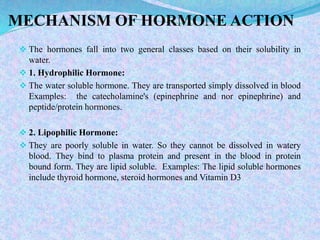
 The hormones fall into two general classes based on their solubility in
water.
 1. Hydrophilic Hormone:
 The water soluble hormone. They are transported simply dissolved in blood
Examples: the catecholamine's (epinephrine and nor epinephrine) and
peptide/protein hormones.
 2. Lipophilic Hormone:
 They are poorly soluble in water. So they cannot be dissolved in watery
blood. They bind to plasma protein and present in the blood in protein
bound form. They are lipid soluble. Examples: The lipid soluble hormones
include thyroid hormone, steroid hormones and Vitamin D3
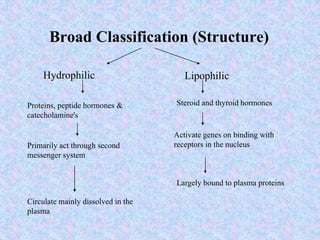
Broad Classification (Structure)
Hydrophilic Lipophilic
Proteins, peptide hormones &
catecholamine's
Steroid and thyroid hormones
Primarily act through second
messenger system
Activate genes on binding with
receptors in the nucleus
Circulate mainly dissolved in the
plasma
Largely bound to plasma proteins
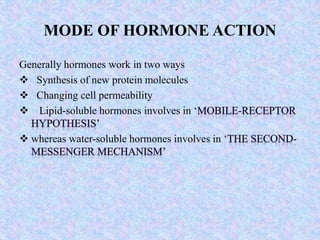
Generally hormones work in two ways
 Synthesis of new protein molecules
 Changing cell permeability
 Lipid-soluble hormones involves in ‘
 whereas water-soluble hormones involves in ‘
MODE OF HORMONE ACTION
RECEPTOR
INTERNAL
NUCLEAR
CYTOPLASMIC
EXTERNAL
CELL
MEMBRANE
TYPES OF RECEPTOR
 Receptors present in or on the surface of the cell membrane.
Types
 Ion channel-linked receptor
 G –protein couple receptor
 Enzyme –linked receptor
 E.g., Proteins, peptides, & catecholamines
MEMBRANE RECEPTOR
 Receptors present in cell cytoplasm
 E.g., Steroid hormones.
CYTOPLASMIC RECEPTOR
 Receptors present in nucleus & there is direct association
with one or more chromosomes.
 E.g., Thyroid hormones, Retinoid hormones, Vitamin-D.
NUCLEAR RECEPTOR
 Binding to specific cell receptor in the cell membrane and
form hormone-cell receptor complex, which diffuses to
nucleus
 The receptor is eventually released for re-use
 Steroid activates a specific gene to produce mRNA
 mRNA pass out into the cytoplasm and initiates protein
[enzyme] synthesis
 The whole process is called mobile-receptor hypothesis in
which a steroid hormone is not attached to the plasma
membrane, but seem to move freely in the nucleoplasm
HOW LIPID-SOLUBLE HORMONES
WORK?
 Step1: Free lipophilic hormone (hormone not bound with its plasma protein
carrier) diffuses through the plasma membrane of the target cell and binds
with the receptor which is intracellular located inside the cytosol/or in the
nucleus.
 Step2. Each receptor has specific binding region with hormone and another
region with binding with DNA. Receptor alone cannot bind to DNA unless
it binds to hormone. Once the hormone is bound to receptor, the hormone
receptor complex binds to specific region of DNA known as Hormone
response element(HRE).
 Step3: Transcription of gene
 Step4: m RNA transported out of nucleus into the cytoplasm
 Step5: Translation at Ribosome
 Step6: Protein/enzyme released from ribosome
 Step7: protein/enzyme mediate ultimate response
HOW LIPID-SOLUBLE HORMONES WORK?
STEROID HORMONES: MOLECULAR
ACTION
 1 A water-soluble hormone (the first messenger) diffuses from the
blood through interstitial fluid and then binds to its receptor at the
exterior surface of a target cell’s plasma membrane. The hormone–
receptor complex activates a membrane protein called a G protein.
The activated G protein in turn activates adenylate cyclase.
 2 Adenylate cyclase converts ATP into cyclic AMP (cAMP).
Because the enzyme’s active site is on the inner surface of the
plasma membrane, this reaction occurs in the cytosol of the cell.
 3 Cyclic AMP (the second messenger) activates one or more protein
kinase, which may be free in the cytosol or bound to the plasma
membrane. A protein kinase is an enzyme that phosphorylates (adds
a phosphate group to) other cellular proteins (such as enzymes). The
donor of the phosphate group is ATP, which is converted to ADP.
HOW WATER-SOLUBLE
HORMONES WORK?
 4 Activated protein kinases phosphorylate one or more cellular proteins.
Phosphorylation activates some of these proteins and inactivates others,
rather like turning a switch on or off.
 5 Phosphorylated proteins in turn cause reactions that produce
physiological responses. Different protein kinases exist within different
target cells and within different organelles of the same target cell. Thus,
one protein kinase might trigger glycogen synthesis, a second might
cause the breakdown of triglyceride, a third may promote protein
synthesis, and so on.
 6 After a brief period, an enzyme called phosphodiesterase inactivates
cAMP. Thus, the cell’s response is turned off unless new hormone
molecules continue to bind to their receptors in the plasma membrane
HOW WATER-SOLUBLE
HORMONES WORK?
• The whole process above is called
also called
.
• In this instance, the first messenger delivers message to fixed
receptors in the target cell’s plasma membrane.
• The message then is passed to the cell where second
messenger triggers appropriate cellular changes
HOW WATER-SOLUBLE HORMONES
WORK?
Hormone action

Hormone action

  • 1.
    Aamir Ali Khan M.PhilBiochemistry Head of pathology department Northwest institute of health sciences HORMONE MECHANISM & ACTION
  • 2.
     A hormoneis a chemical Natural organic substance that is produces in minute quantity by glands to regulate growth, metabolism and other functions of an organism  They are simply biochemical messengers  They can be classified according to the chemical composition, organs where they work e.g. reproductive hormones in the reproductive organs, and if they either act on the same cell producing them i.e. autocrine or paracrine HORMONES
  • 3.
     Trophic hormone:A hormone that has its primary function the regulation of hormone secretion by another endocrine gland.  Synergism: When different hormones work together and have a greater effect than individual hormone action  Permissiveness: A small amount of one hormone allows a second hormone to have its full effect on a target cell; i.e. first hormone ‘permits’ the full action of the second hormone.  Antagonism : One hormone produces the opposite effect of the other GENERAL PRINCIPLES OF HORMONE ACTION
  • 4.
    MECHANISM OF HORMONEACTION  The hormones fall into two general classes based on their solubility in water.  1. Hydrophilic Hormone:  The water soluble hormone. They are transported simply dissolved in blood Examples: the catecholamine's (epinephrine and nor epinephrine) and peptide/protein hormones.  2. Lipophilic Hormone:  They are poorly soluble in water. So they cannot be dissolved in watery blood. They bind to plasma protein and present in the blood in protein bound form. They are lipid soluble. Examples: The lipid soluble hormones include thyroid hormone, steroid hormones and Vitamin D3
  • 5.
    Broad Classification (Structure) HydrophilicLipophilic Proteins, peptide hormones & catecholamine's Steroid and thyroid hormones Primarily act through second messenger system Activate genes on binding with receptors in the nucleus Circulate mainly dissolved in the plasma Largely bound to plasma proteins
  • 6.
    Generally hormones workin two ways  Synthesis of new protein molecules  Changing cell permeability  Lipid-soluble hormones involves in ‘  whereas water-soluble hormones involves in ‘ MODE OF HORMONE ACTION
  • 7.
  • 8.
     Receptors presentin or on the surface of the cell membrane. Types  Ion channel-linked receptor  G –protein couple receptor  Enzyme –linked receptor  E.g., Proteins, peptides, & catecholamines MEMBRANE RECEPTOR
  • 9.
     Receptors presentin cell cytoplasm  E.g., Steroid hormones. CYTOPLASMIC RECEPTOR
  • 10.
     Receptors presentin nucleus & there is direct association with one or more chromosomes.  E.g., Thyroid hormones, Retinoid hormones, Vitamin-D. NUCLEAR RECEPTOR
  • 12.
     Binding tospecific cell receptor in the cell membrane and form hormone-cell receptor complex, which diffuses to nucleus  The receptor is eventually released for re-use  Steroid activates a specific gene to produce mRNA  mRNA pass out into the cytoplasm and initiates protein [enzyme] synthesis  The whole process is called mobile-receptor hypothesis in which a steroid hormone is not attached to the plasma membrane, but seem to move freely in the nucleoplasm HOW LIPID-SOLUBLE HORMONES WORK?
  • 13.
     Step1: Freelipophilic hormone (hormone not bound with its plasma protein carrier) diffuses through the plasma membrane of the target cell and binds with the receptor which is intracellular located inside the cytosol/or in the nucleus.  Step2. Each receptor has specific binding region with hormone and another region with binding with DNA. Receptor alone cannot bind to DNA unless it binds to hormone. Once the hormone is bound to receptor, the hormone receptor complex binds to specific region of DNA known as Hormone response element(HRE).  Step3: Transcription of gene  Step4: m RNA transported out of nucleus into the cytoplasm  Step5: Translation at Ribosome  Step6: Protein/enzyme released from ribosome  Step7: protein/enzyme mediate ultimate response HOW LIPID-SOLUBLE HORMONES WORK?
  • 14.
  • 15.
     1 Awater-soluble hormone (the first messenger) diffuses from the blood through interstitial fluid and then binds to its receptor at the exterior surface of a target cell’s plasma membrane. The hormone– receptor complex activates a membrane protein called a G protein. The activated G protein in turn activates adenylate cyclase.  2 Adenylate cyclase converts ATP into cyclic AMP (cAMP). Because the enzyme’s active site is on the inner surface of the plasma membrane, this reaction occurs in the cytosol of the cell.  3 Cyclic AMP (the second messenger) activates one or more protein kinase, which may be free in the cytosol or bound to the plasma membrane. A protein kinase is an enzyme that phosphorylates (adds a phosphate group to) other cellular proteins (such as enzymes). The donor of the phosphate group is ATP, which is converted to ADP. HOW WATER-SOLUBLE HORMONES WORK?
  • 16.
     4 Activatedprotein kinases phosphorylate one or more cellular proteins. Phosphorylation activates some of these proteins and inactivates others, rather like turning a switch on or off.  5 Phosphorylated proteins in turn cause reactions that produce physiological responses. Different protein kinases exist within different target cells and within different organelles of the same target cell. Thus, one protein kinase might trigger glycogen synthesis, a second might cause the breakdown of triglyceride, a third may promote protein synthesis, and so on.  6 After a brief period, an enzyme called phosphodiesterase inactivates cAMP. Thus, the cell’s response is turned off unless new hormone molecules continue to bind to their receptors in the plasma membrane HOW WATER-SOLUBLE HORMONES WORK?
  • 17.
    • The wholeprocess above is called also called . • In this instance, the first messenger delivers message to fixed receptors in the target cell’s plasma membrane. • The message then is passed to the cell where second messenger triggers appropriate cellular changes HOW WATER-SOLUBLE HORMONES WORK?