CARDIOVASCULAR DISEASES
Introduction
 CVD’s comprises of a group of diseases of the heart
and vascular system.
 The major conditions are :
IHD
HT
CVD (Stroke)
CHD
RHD
Non Communicable
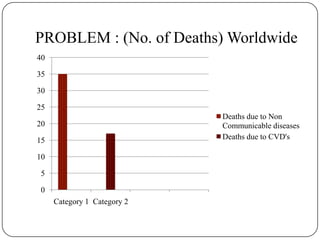
PROBLEM : (No. of Deaths) Worldwide
0
5
10
15
20
25
30
35
40
Category 1 Category 2
Deaths due to Non
Communicable diseases
Deaths due to CVD's
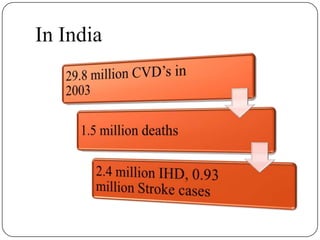
In India
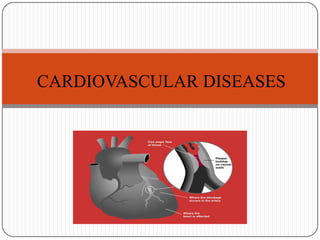
CORONARY HEART DISEASE
 Impairment of heart function due to inadequate blood
flow to the heart compared to its needs, caused by
obstructive changes in the coronary circulation to the
heart.
Manifestations of Coronary Heart
Disease
 Angina pectoris
 Myocardial infarction
 Cardiac failure
EPIDEMICITY
 In USA, 1920’s, 1930’s in Britain.
 MONICA………………
MONICA
 WHO has completed a project known as MONICA.
 Multinational Monitoring of Trends and Determinants
in Cardiovascular Diseases.
 Is to elucidate CHD issue.
 41 centres in 26 countries were participating in this
issue.
 Ended in 1994.
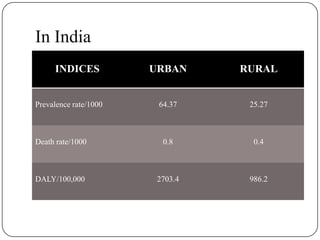
In India
INDICES URBAN RURAL
Prevalence rate/1000 64.37 25.27
Death rate/1000 0.8 0.4
DALY/100,000 2703.4 986.2
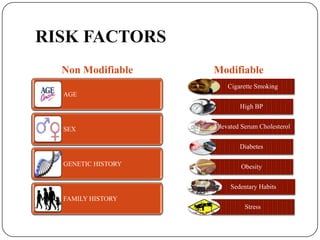
RISK FACTORS
Non Modifiable Modifiable
AGE
SEX
GENETIC HISTORY
FAMILY HISTORY
Cigarette Smoking
High BP
Elevated Serum Cholesterol
Diabetes
Obesity
Sedentary Habits
Stress
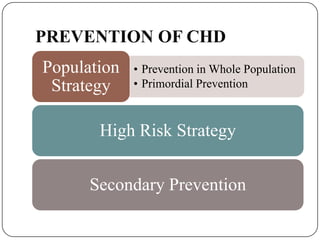
PREVENTION OF CHD
• Prevention in Whole Population
• Primordial Prevention
Population
Strategy
High Risk Strategy
Secondary Prevention
POPULATION
STRATEGY
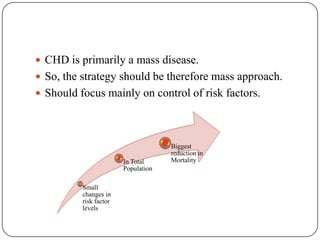
 CHD is primarily a mass disease.
 So, the strategy should be therefore mass approach.
 Should focus mainly on control of risk factors.
Small
changes in
risk factor
levels
In Total
Population
Biggest
reduction in
Mortality
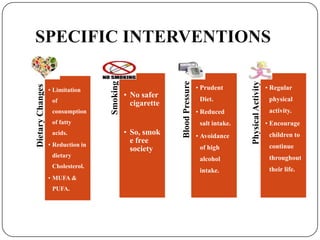
SPECIFIC INTERVENTIONSDietaryChanges
• Limitation
of
consumption
of fatty
acids.
• Reduction in
dietary
Cholesterol.
• MUFA &
PUFA.
Smoking
• No safer
cigarette
• So, smok
e free
society
BloodPressure
• Prudent
Diet.
• Reduced
salt intake.
• Avoidance
of high
alcohol
intake.
PhysicalActivity
• Regular
physical
activity.
• Encourage
children to
continue
throughout
their life.
PRIMORDIAL PREVENTION
 It involves preventing the emergence and spread of
CHD risk factors and life styles that have not yet
appeared or become endemic.
 Prevention should be multifactorial because the
aetiology is multifactorial.
 The aim should be to change the community as a
whole, not the individual subjects living in it.
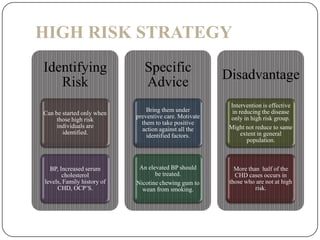
HIGH RISK STRATEGY
HIGH RISK STRATEGY
Identifying
Risk
Can be started only when
those high risk
individuals are
identified.
BP, Increased serum
cholesterol
levels, Family history of
CHD, OCP’S.
Specific
Advice
Bring them under
preventive care. Motivate
them to take positive
action against all the
identified factors.
An elevated BP should
be treated.
Nicotine chewing gum to
wean from smoking.
Disadvantage
Intervention is effective
in reducing the disease
only in high risk group.
Might not reduce to same
extent in general
population.
More than half of the
CHD cases occurs in
those who are not at high
risk.
SECONDAY PREVENTION
 Forms an important part of an overall strategy.
 Aim is to prevent the recurrence and progression of
CHD.
 Rapidly expanding field with much of research in
progress. [ E.g. drug trials, coronary surgery, pace
makers ]
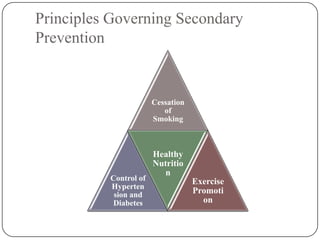
Principles Governing Secondary
Prevention
Cessation
of
Smoking
Control of
Hyperten
sion and
Diabetes
Healthy
Nutritio
n
Exercise
Promoti
on
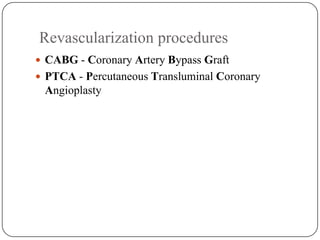
Revascularization procedures
 CABG - Coronary Artery Bypass Graft
 PTCA - Percutaneous Transluminal Coronary
Angioplasty
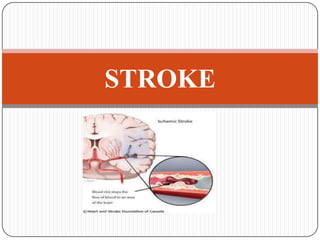
STROKE
WHO Definition
 Rapidly developed clinical signs of focal disturbance
of cerebral function ; lasting more than 24 hours or
leading to death, with no apparent cause other than
vascular origin.
 Excludes TIA.
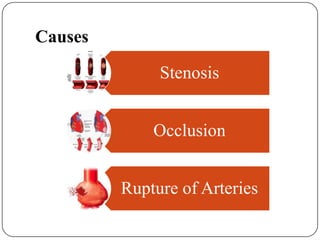
Causes
Stenosis
Occlusion
Rupture of Arteries
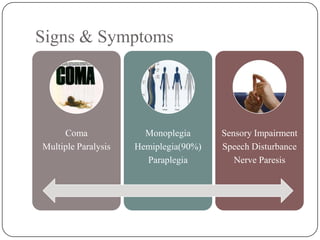
Signs & Symptoms
Coma
Multiple Paralysis
Monoplegia
Hemiplegia(90%)
Paraplegia
Sensory Impairment
Speech Disturbance
Nerve Paresis
WHO’S INTERNATIONAL
CLASSIFICATION
 Subarachnoid Haemorrhage
 Cerebral Haemorrhage
 Cerebral Thrombosis or Embolism
 Occlusion of Pre-Cerebral arteries
 TIA ( more than 24 hrs )
 Ill defined cardiovascular disease.
In India
 Prevalence rate of Stroke : 1.54/1000
 Death Rate : 0.6/1000
 DALY’s lost : 597.6/1,00,000
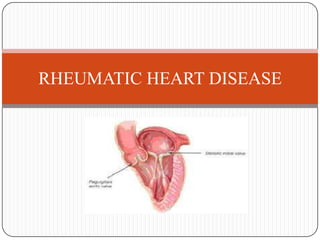
RHEUMATIC HEART DISEASE
 Rheumatic fever (RH) and RHD cannot be separated
from an epidemiological point of view.
 Lancefield Group A β Haemolytic Streptococci.
 Starts as a pharyngitis.
 Not a communicable disease.
In India
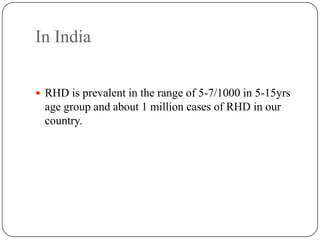
 RHD is prevalent in the range of 5-7/1000 in 5-15yrs
age group and about 1 million cases of RHD in our
country.
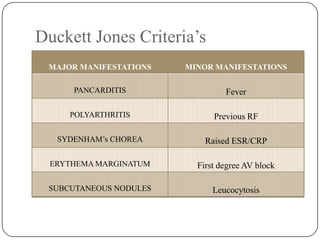
Duckett Jones Criteria’s
MAJOR MANIFESTATIONS MINOR MANIFESTATIONS
PANCARDITIS Fever
POLYARTHRITIS Previous RF
SYDENHAM’s CHOREA Raised ESR/CRP
ERYTHEMA MARGINATUM First degree AV block
SUBCUTANEOUS NODULES Leucocytosis
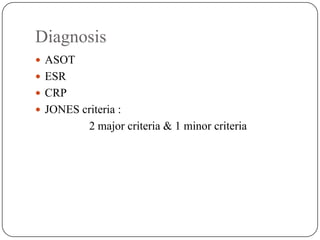
Diagnosis
 ASOT
 ESR
 CRP
 JONES criteria :
2 major criteria & 1 minor criteria
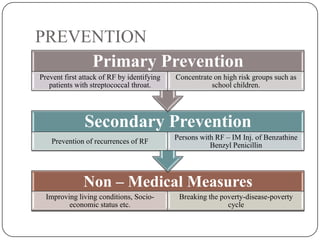
PREVENTION
Non – Medical Measures
Improving living conditions, Socio-
economic status etc.
Breaking the poverty-disease-poverty
cycle
Secondary Prevention
Prevention of recurrences of RF
Persons with RF – IM Inj. of Benzathine
Benzyl Penicillin
Primary Prevention
Prevent first attack of RF by identifying
patients with streptococcal throat.
Concentrate on high risk groups such as
school children.
NATIONAL PROGRAMME FOR PREVENTION
AND CONTROL OF
DIABETES, CARDIOVASCULAR DISESES AND
STROKE
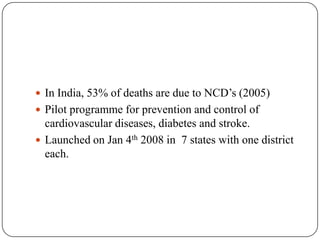
 In India, 53% of deaths are due to NCD’s (2005)
 Pilot programme for prevention and control of
cardiovascular diseases, diabetes and stroke.
 Launched on Jan 4th 2008 in 7 states with one district
each.
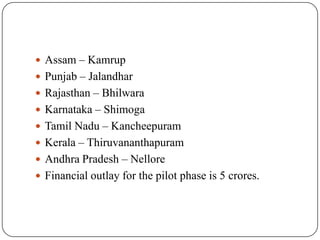
 Assam – Kamrup
 Punjab – Jalandhar
 Rajasthan – Bhilwara
 Karnataka – Shimoga
 Tamil Nadu – Kancheepuram
 Kerala – Thiruvananthapuram
 Andhra Pradesh – Nellore
 Financial outlay for the pilot phase is 5 crores.
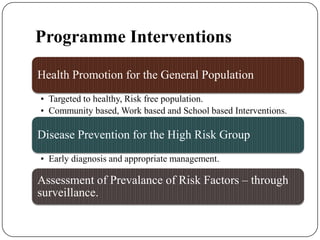
Programme Interventions
Health Promotion for the General Population
• Targeted to healthy, Risk free population.
• Community based, Work based and School based Interventions.
Disease Prevention for the High Risk Group
• Early diagnosis and appropriate management.
Assessment of Prevalance of Risk Factors – through
surveillance.
Cardio vascular diseases

Cardio vascular diseases

  • 1.
  • 2.
    Introduction  CVD’s comprisesof a group of diseases of the heart and vascular system.  The major conditions are : IHD HT CVD (Stroke) CHD RHD Non Communicable
  • 3.
    PROBLEM : (No.of Deaths) Worldwide 0 5 10 15 20 25 30 35 40 Category 1 Category 2 Deaths due to Non Communicable diseases Deaths due to CVD's
  • 4.
  • 5.
    CORONARY HEART DISEASE Impairment of heart function due to inadequate blood flow to the heart compared to its needs, caused by obstructive changes in the coronary circulation to the heart.
  • 6.
    Manifestations of CoronaryHeart Disease  Angina pectoris  Myocardial infarction  Cardiac failure
  • 7.
    EPIDEMICITY  In USA,1920’s, 1930’s in Britain.  MONICA………………
  • 8.
    MONICA  WHO hascompleted a project known as MONICA.  Multinational Monitoring of Trends and Determinants in Cardiovascular Diseases.  Is to elucidate CHD issue.  41 centres in 26 countries were participating in this issue.  Ended in 1994.
  • 9.
    In India INDICES URBANRURAL Prevalence rate/1000 64.37 25.27 Death rate/1000 0.8 0.4 DALY/100,000 2703.4 986.2
  • 10.
    RISK FACTORS Non ModifiableModifiable AGE SEX GENETIC HISTORY FAMILY HISTORY Cigarette Smoking High BP Elevated Serum Cholesterol Diabetes Obesity Sedentary Habits Stress
  • 11.
    PREVENTION OF CHD •Prevention in Whole Population • Primordial Prevention Population Strategy High Risk Strategy Secondary Prevention
  • 12.
  • 13.
     CHD isprimarily a mass disease.  So, the strategy should be therefore mass approach.  Should focus mainly on control of risk factors. Small changes in risk factor levels In Total Population Biggest reduction in Mortality
  • 14.
    SPECIFIC INTERVENTIONSDietaryChanges • Limitation of consumption offatty acids. • Reduction in dietary Cholesterol. • MUFA & PUFA. Smoking • No safer cigarette • So, smok e free society BloodPressure • Prudent Diet. • Reduced salt intake. • Avoidance of high alcohol intake. PhysicalActivity • Regular physical activity. • Encourage children to continue throughout their life.
  • 15.
    PRIMORDIAL PREVENTION  Itinvolves preventing the emergence and spread of CHD risk factors and life styles that have not yet appeared or become endemic.  Prevention should be multifactorial because the aetiology is multifactorial.  The aim should be to change the community as a whole, not the individual subjects living in it.
  • 16.
  • 17.
    HIGH RISK STRATEGY Identifying Risk Canbe started only when those high risk individuals are identified. BP, Increased serum cholesterol levels, Family history of CHD, OCP’S. Specific Advice Bring them under preventive care. Motivate them to take positive action against all the identified factors. An elevated BP should be treated. Nicotine chewing gum to wean from smoking. Disadvantage Intervention is effective in reducing the disease only in high risk group. Might not reduce to same extent in general population. More than half of the CHD cases occurs in those who are not at high risk.
  • 18.
  • 19.
     Forms animportant part of an overall strategy.  Aim is to prevent the recurrence and progression of CHD.  Rapidly expanding field with much of research in progress. [ E.g. drug trials, coronary surgery, pace makers ]
  • 20.
    Principles Governing Secondary Prevention Cessation of Smoking Controlof Hyperten sion and Diabetes Healthy Nutritio n Exercise Promoti on
  • 21.
    Revascularization procedures  CABG- Coronary Artery Bypass Graft  PTCA - Percutaneous Transluminal Coronary Angioplasty
  • 22.
  • 23.
    WHO Definition  Rapidlydeveloped clinical signs of focal disturbance of cerebral function ; lasting more than 24 hours or leading to death, with no apparent cause other than vascular origin.  Excludes TIA.
  • 24.
  • 25.
    Signs & Symptoms Coma MultipleParalysis Monoplegia Hemiplegia(90%) Paraplegia Sensory Impairment Speech Disturbance Nerve Paresis
  • 26.
    WHO’S INTERNATIONAL CLASSIFICATION  SubarachnoidHaemorrhage  Cerebral Haemorrhage  Cerebral Thrombosis or Embolism  Occlusion of Pre-Cerebral arteries  TIA ( more than 24 hrs )  Ill defined cardiovascular disease.
  • 27.
    In India  Prevalencerate of Stroke : 1.54/1000  Death Rate : 0.6/1000  DALY’s lost : 597.6/1,00,000
  • 28.
  • 29.
    RHEUMATIC HEART DISEASE Rheumatic fever (RH) and RHD cannot be separated from an epidemiological point of view.  Lancefield Group A β Haemolytic Streptococci.  Starts as a pharyngitis.  Not a communicable disease.
  • 30.
    In India  RHDis prevalent in the range of 5-7/1000 in 5-15yrs age group and about 1 million cases of RHD in our country.
  • 31.
    Duckett Jones Criteria’s MAJORMANIFESTATIONS MINOR MANIFESTATIONS PANCARDITIS Fever POLYARTHRITIS Previous RF SYDENHAM’s CHOREA Raised ESR/CRP ERYTHEMA MARGINATUM First degree AV block SUBCUTANEOUS NODULES Leucocytosis
  • 32.
    Diagnosis  ASOT  ESR CRP  JONES criteria : 2 major criteria & 1 minor criteria
  • 33.
    PREVENTION Non – MedicalMeasures Improving living conditions, Socio- economic status etc. Breaking the poverty-disease-poverty cycle Secondary Prevention Prevention of recurrences of RF Persons with RF – IM Inj. of Benzathine Benzyl Penicillin Primary Prevention Prevent first attack of RF by identifying patients with streptococcal throat. Concentrate on high risk groups such as school children.
  • 34.
    NATIONAL PROGRAMME FORPREVENTION AND CONTROL OF DIABETES, CARDIOVASCULAR DISESES AND STROKE
  • 35.
     In India,53% of deaths are due to NCD’s (2005)  Pilot programme for prevention and control of cardiovascular diseases, diabetes and stroke.  Launched on Jan 4th 2008 in 7 states with one district each.
  • 36.
     Assam –Kamrup  Punjab – Jalandhar  Rajasthan – Bhilwara  Karnataka – Shimoga  Tamil Nadu – Kancheepuram  Kerala – Thiruvananthapuram  Andhra Pradesh – Nellore  Financial outlay for the pilot phase is 5 crores.
  • 37.
    Programme Interventions Health Promotionfor the General Population • Targeted to healthy, Risk free population. • Community based, Work based and School based Interventions. Disease Prevention for the High Risk Group • Early diagnosis and appropriate management. Assessment of Prevalance of Risk Factors – through surveillance.