Examination of Blood Stains
Toxicology & Forensic
Serology
1
Dr. Aamir Ali Khan
Assistant Professor MLT
PhD Biochemistry
Blood Stains
Toxicology & Forensic
Serology
1
• The points to bedeterminedregardingblood stains are:
– The natureof stain
– Ifblood stainseither human/animal
– Ifhumanblood ,to whichgroup it belong(A,B,AB,O)
The method used to determinethesefactsareas follows
PhysicalExamination:
Thevalueablecluescanbe achievedbyvisitingcrime
scenes
Toxicology & Forensic
Serology
3
– Clothing andstainson it
– Size,shape&directionofblood spot
– Character of stain
– Age of stain
– Condition of body
– Other causesof stain
Chemical Examination of Blood
• Benzidine Test:
• The benzidine test is most commonly used for the detection of
blood in the feces, and was therefore singled out for investigation.
• whenbenzidinesolution isadded to thesuspectedsolutionagreenish
bluecolor is obtainedifblood is present
– Benzidinesolution iscombinationof10% benzidine in
glacialaceticacidandhydrogen peroxide
• Testcanremainpositiveif1:500,000dilutionof blood is made
• Benzidineiscarcinogenicinnaturethat’swhysome labs
preferother tests
Chemical Examination of Blood
5
• Phenolphthalien(Kastle-Meyer Test):
• The Kastle-Meyer colour test works on a similar principle to Luminol, with an
activecompoundwhichreactswithhydrogenperoxideinthepresenceofblood.
In this case the chemical involved is phenolphthalein. This will react with
hydrogenperoxideinthepresenceofhaemoglobintoproduceapinkcolour.
• Phenolphthalien is reducedby zinc dust in a strongly
alkaline medium, which is oxidized by
nascentoxygenlibratedbyperoxidaseon H2O2, give pinkor purplecolor
ifblood present
– Phenolphthalien reagent: 2 g phenolphthalein, 25g KOH dissolve in 100 g H2O, add
15 gpowderedzincandheat untilpinkcolor disappear
Physicochemical Examination
6
• The most testfor confirmation ofblood stains are
• Thin Layer Chromatography (TLC):
– An appropriatequantityofsampleextract,standard haematin
chloride andcontrol sampleplacedon prepared gel
• Electrophoresis:
– Agar plateis use andblood sample,standard&other body
secretionsrun on the plate
Microscopic Examination
Toxicology & Forensic
Serology
7
• The hemoglobin of the RBCs under various staining methods give important
information
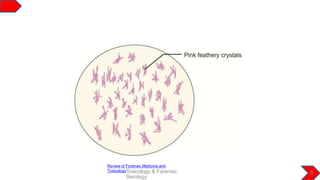
• Takayama’sHaemochromogen CrystalTest:
• Takayama test is a confirmation test used to detect blood spots. Based on
the research results this test can still be used to identify dried blood spots
on clothing aged 20 years, and able to detect positively the presence of
blood with the formation of pink crystals.
• The dried powdered from stain extract placed on the slide and cover with cover slip,
then two drops of takayama’s reagent are added on slide and examine under
microscope after5 minutes.Ifblood presentpink featherycrystalof haemochromogen
are formed
Review of Forensic Medicine and
ToxicologyToxicology & Forensic
Serology
8
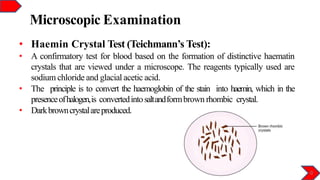
• Haemin Crystal Test (Teichmann’s Test):
• A confirmatory test for blood based on the formation of distinctive haematin
crystals that are viewed under a microscope. The reagents typically used are
sodium chloride and glacial acetic acid.
• The principle is to convert the haemoglobin of the stain into haemin, which in the
presenceofhalogen,is convertedintosaltandformbrown rhombic crystal.
• Darkbrowncrystalareproduced.
9
Microscopic Examination
Spectroscopic Examination
1
0
Toxicology & Forensic
Serology
• The spectroscopic testis one oftheconfirmatory test
for blood, itssensitivity 1:5,000
• Ifthesamplecontainsfreshoxygenatedblood i.e
oxyhaemoglobin,two dark absorption bandswillbe seen
• If stain is old or has been exposed to any extent,
methaemoglobin will have been formed, a darker
pigmentformed when blood is decomposing
• Carboxyhaemoglobin:
• It has a spectrum so much like that of oxyhaemoglobin that
the scaled spectroscope is necessary to define the degree of
shiftto theright
1
1
Toxicology & Forensic
Serology
Review of Forensic Medicine and Toxicology
1
2
Toxicology & Forensic
Serology
Detection of specie Origin
1
3
Toxicology & Forensic
Serology
• Blood is thoroughly examinedto confirmitshuman
origin to rule out
– The claimthatblood is animal blood
– Torule out animalblood havingsameblood group antigen
to human blood
– In caseofprohibitedanimalspeciesshooting andidentify the
blood ofendangered species
Method for detection of blood origin
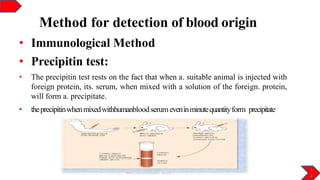
• Immunological Method
• Precipitin test:
• The precipitin test rests on the fact that when a. suitable animal is injected with
foreign protein, its. serum, when mixed with a solution of the foreign. protein,
will form a. precipitate.
• theprecipitinwhenmixedwithhumanbloodserum eveninminutequantityform precipitate
1
4
Immunological Method
– Haemagglutination-inhibition test: Ifanti-humanglobulin is
mixedwithextractofahumanblood stainandsubsequently tested
againstsensitizedred cells,theagglutinationreaction willbe inhibited
1
5
Immunological Method
– LatexTest: A salineextractofblood stainwhen react with
dilutedlatexparticlesensitizedwithantiserum,clump willform
showing positive reaction.
1
6
Enzymological Method
• Blood stains of human and several other species gives
specificisoenzyme
• Electrophoretic pattern of which enables differentiation
betweenhumananddifferentanimal Species
• The most common enzymes are peroxidase, lactate
dehydrogenase (LDH), malate dehydrogenase (MDH)
and esterase.
Toxicology & Forensic
Serology
1
1
8
Toxicology & Forensic
Serology
Summary
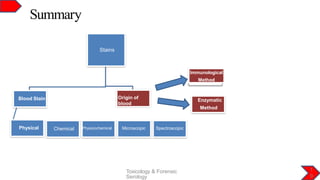
Stains
Blood Stain
Physical
Origin of
blood
Chemical Physicochemical Microscopic Spectroscopic
Immunological
Method
Enzymatic
Method
1
9
Toxicology & Forensic
Serology
Reference
Toxicology & Forensic
Serology
2
• Text book of Medical Jurisprudence,Forensic medicineandToxicology, BV Subrahmanym Seventh edition

Blood Stains.pptx

  • 1.
    Examination of BloodStains Toxicology & Forensic Serology 1 Dr. Aamir Ali Khan Assistant Professor MLT PhD Biochemistry
  • 2.
    Blood Stains Toxicology &Forensic Serology 1 • The points to bedeterminedregardingblood stains are: – The natureof stain – Ifblood stainseither human/animal – Ifhumanblood ,to whichgroup it belong(A,B,AB,O) The method used to determinethesefactsareas follows
  • 3.
    PhysicalExamination: Thevalueablecluescanbe achievedbyvisitingcrime scenes Toxicology &Forensic Serology 3 – Clothing andstainson it – Size,shape&directionofblood spot – Character of stain – Age of stain – Condition of body – Other causesof stain
  • 4.
    Chemical Examination ofBlood • Benzidine Test: • The benzidine test is most commonly used for the detection of blood in the feces, and was therefore singled out for investigation. • whenbenzidinesolution isadded to thesuspectedsolutionagreenish bluecolor is obtainedifblood is present – Benzidinesolution iscombinationof10% benzidine in glacialaceticacidandhydrogen peroxide • Testcanremainpositiveif1:500,000dilutionof blood is made • Benzidineiscarcinogenicinnaturethat’swhysome labs preferother tests
  • 5.
    Chemical Examination ofBlood 5 • Phenolphthalien(Kastle-Meyer Test): • The Kastle-Meyer colour test works on a similar principle to Luminol, with an activecompoundwhichreactswithhydrogenperoxideinthepresenceofblood. In this case the chemical involved is phenolphthalein. This will react with hydrogenperoxideinthepresenceofhaemoglobintoproduceapinkcolour. • Phenolphthalien is reducedby zinc dust in a strongly alkaline medium, which is oxidized by nascentoxygenlibratedbyperoxidaseon H2O2, give pinkor purplecolor ifblood present – Phenolphthalien reagent: 2 g phenolphthalein, 25g KOH dissolve in 100 g H2O, add 15 gpowderedzincandheat untilpinkcolor disappear
  • 6.
    Physicochemical Examination 6 • Themost testfor confirmation ofblood stains are • Thin Layer Chromatography (TLC): – An appropriatequantityofsampleextract,standard haematin chloride andcontrol sampleplacedon prepared gel • Electrophoresis: – Agar plateis use andblood sample,standard&other body secretionsrun on the plate
  • 7.
    Microscopic Examination Toxicology &Forensic Serology 7 • The hemoglobin of the RBCs under various staining methods give important information • Takayama’sHaemochromogen CrystalTest: • Takayama test is a confirmation test used to detect blood spots. Based on the research results this test can still be used to identify dried blood spots on clothing aged 20 years, and able to detect positively the presence of blood with the formation of pink crystals. • The dried powdered from stain extract placed on the slide and cover with cover slip, then two drops of takayama’s reagent are added on slide and examine under microscope after5 minutes.Ifblood presentpink featherycrystalof haemochromogen are formed
  • 8.
    Review of ForensicMedicine and ToxicologyToxicology & Forensic Serology 8
  • 9.
    • Haemin CrystalTest (Teichmann’s Test): • A confirmatory test for blood based on the formation of distinctive haematin crystals that are viewed under a microscope. The reagents typically used are sodium chloride and glacial acetic acid. • The principle is to convert the haemoglobin of the stain into haemin, which in the presenceofhalogen,is convertedintosaltandformbrown rhombic crystal. • Darkbrowncrystalareproduced. 9 Microscopic Examination
  • 10.
    Spectroscopic Examination 1 0 Toxicology &Forensic Serology • The spectroscopic testis one oftheconfirmatory test for blood, itssensitivity 1:5,000 • Ifthesamplecontainsfreshoxygenatedblood i.e oxyhaemoglobin,two dark absorption bandswillbe seen • If stain is old or has been exposed to any extent, methaemoglobin will have been formed, a darker pigmentformed when blood is decomposing
  • 11.
    • Carboxyhaemoglobin: • Ithas a spectrum so much like that of oxyhaemoglobin that the scaled spectroscope is necessary to define the degree of shiftto theright 1 1 Toxicology & Forensic Serology
  • 12.
    Review of ForensicMedicine and Toxicology 1 2 Toxicology & Forensic Serology
  • 13.
    Detection of specieOrigin 1 3 Toxicology & Forensic Serology • Blood is thoroughly examinedto confirmitshuman origin to rule out – The claimthatblood is animal blood – Torule out animalblood havingsameblood group antigen to human blood – In caseofprohibitedanimalspeciesshooting andidentify the blood ofendangered species
  • 14.
    Method for detectionof blood origin • Immunological Method • Precipitin test: • The precipitin test rests on the fact that when a. suitable animal is injected with foreign protein, its. serum, when mixed with a solution of the foreign. protein, will form a. precipitate. • theprecipitinwhenmixedwithhumanbloodserum eveninminutequantityform precipitate 1 4
  • 15.
    Immunological Method – Haemagglutination-inhibitiontest: Ifanti-humanglobulin is mixedwithextractofahumanblood stainandsubsequently tested againstsensitizedred cells,theagglutinationreaction willbe inhibited 1 5
  • 16.
    Immunological Method – LatexTest:A salineextractofblood stainwhen react with dilutedlatexparticlesensitizedwithantiserum,clump willform showing positive reaction. 1 6
  • 17.
    Enzymological Method • Bloodstains of human and several other species gives specificisoenzyme • Electrophoretic pattern of which enables differentiation betweenhumananddifferentanimal Species • The most common enzymes are peroxidase, lactate dehydrogenase (LDH), malate dehydrogenase (MDH) and esterase. Toxicology & Forensic Serology 1
  • 18.
  • 20.
    Summary Stains Blood Stain Physical Origin of blood ChemicalPhysicochemical Microscopic Spectroscopic Immunological Method Enzymatic Method 1 9 Toxicology & Forensic Serology
  • 21.
    Reference Toxicology & Forensic Serology 2 •Text book of Medical Jurisprudence,Forensic medicineandToxicology, BV Subrahmanym Seventh edition