Dr Aamir Ali Khan
Assistant Professor
 Toxicology is the branch of medicine that deals with
properties, action, toxicity and lethal dose, estimation of,
treatment and autopsy findings of poisons.
 Forensic toxicology deals with medical and legal aspects of
the harmful effects of the chemicals on the human body.
 Clinical toxicology refers to human diseases caused by or
associated with abnormal exposure to chemical substances.
 Toxinology, refers to toxins produced by living organisms,
which are dangerous to man, e.g. venom of snakes, spiders
and bees, bacterial and fungal toxins, poisonous plants, etc
 Drugs are natural or synthetic substances, which are used to
exert physiological or psychological effect on the consumer.
 Poison :According to Webster’s Dictionary, ‘poison’ means a
substance, which through its chemical action usually kills,
injures or impairs an organism. Poison is defined as any
substance which when administered by any route can cause
disease, deformity or death.
 Overdose: The terminology overdose in general implies an
intentional toxic exposure
 According to the main symptoms produced, poisons are basically classified
into four groups, namely: corrosives, irritants, systemic poisons and other
poisons.
ACTION OF POISONS
Poisons act usually by three ways: locally, remotely and both
locally and remotely.
 Locally acting: These act only at the site of application such
as skin/mucosa, e.g. corrosive poisons.
 Remotely acting: These act only after being absorbed into the
circulatory system, e.g. narcotic poisons, cardiac poisons, etc.
 Both locally and remotely acting: These act by local and
remote actions, synergistically, e.g. carbolic acid, etc.
 Several factors influence the action of poison and they are:
 Route of Administration
 Addiction
 Age
 Dose
 Health of Individual
 Concentration of Poison
 Idiosyncrasy: Idiosyncrasy means unexpected allergy or
intolerance. It brings about untoward effects or ill health or
death, e.g. allergy to certain drugs like penicillin, certain
foodstuffs like eggs, shellfish, etc.
Enumerated below are certain conditions observed in living persons, which should arouse
suspicion of poisoning to a physician:
• Appearance of symptoms suddenly in a healthy person or several people at a time.
• Sudden worsening of symptoms in a sick person, who was receiving correct treatment and
showing significant improvements or progress.
• Appearance of symptoms soon after ingestion of food or medicine.
• Manner and course of symptoms, e.g. symptoms that run steadily, a downhill course to death or
an uphill course to total recovery.
• Detection of poison in remnants of food or vomitus.
• Even on reporting of “no poison” on analysis of the suspected materials, the suspicion of
poisoning cannot be ruled out for the reasons such as:
– Poison may already be eliminated from the body by vomiting or metabolized and excreted
through natural
channels, leaving no evidence.
– The analysis technique might be faulty.
– The case may be a real case of disease and not a poisoning case at all.
• Advances of Synthetic Chemistry Diversify the
Poison in modern era:
– People take medication & chemical then ever before
– Combination of drugs and its side effect complicate
poisoning detection
– Poison detection need collaborative approach among
practitioner, pathologist,,forensic scientist
 Toxicological evidence forensic aspect:
 Medicine in toxic dose; Poison & Poison in small dose;
medicine
 For Example ; Chloral Hydrate 300 mg is hypnotic &
3gm act knock out drop (poison) use for robbery, rape
cases
 Barbiturates small dose treat insomnia, but coma &
death in normal person
• Proof of poisoning can be assist by following factors
– Sign & Symptoms ,suggesting toxic exposure
– Autopsy findings
– Evidence of pathological lesions
– Conclusive evidence;absorption of toxic substance in tissue
• Detection of poisons in biological/non biological
material in low concentration
• The proof to find, absorbed toxic substance in tissue
of visceral organ/blood/urine
• If specific substance suspected, direct analysis
can be made
• As rule general systematic toxicological
examination preferred even if particular poison
suspected
• Poisoning as a possible cause of death,facilitated by
– Scene Investigation ( Prescription,medications etc)
– History of case
– Autopsy findings
– Gross/Microscopic findings
• Addition histopathological,biochemical & serological
forensic examination helpful
• Putrefaction &ToxicologicalAnalysis: it
complicates toxicological analysis, problem in
interpretation of results
– Chemical changes in tissue , toxic substance hard to identify
e.g parathion, aconite
– Putrefaction produce toxic substance from normal tissue,
interfere in result
– Volatile substance lost due to putrefaction
– Ethy alcohal may produced from normal tissue in
advance putrefaction
• Apart from detection , concentration of poison
required in some cases
• Interpretation of quantitative data, i.e. fatal dose of
poison
• Record of poison & knowledge of toxicokinetics is
important
• During reporting extreme care should be taken
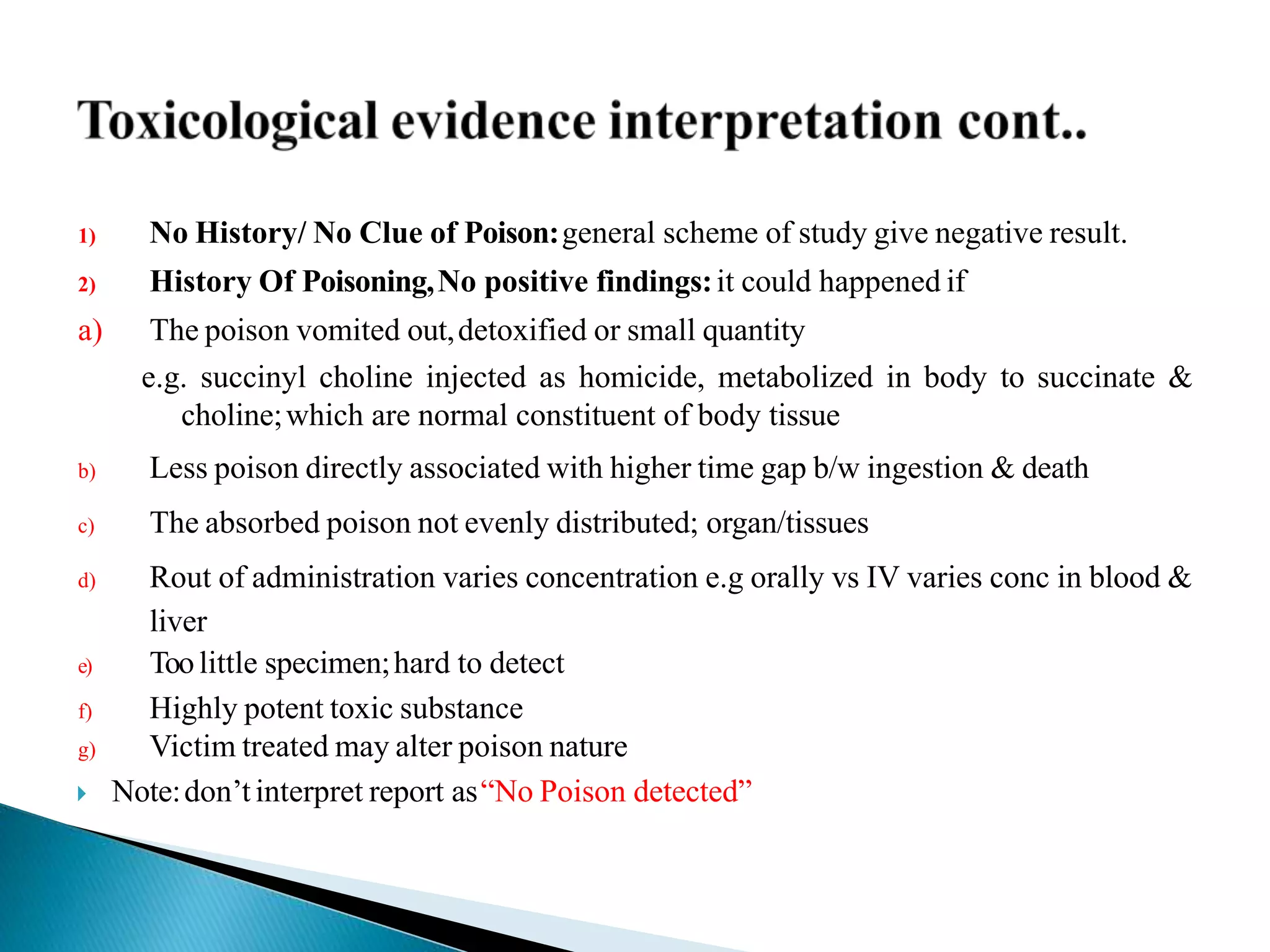
1) No History/ No Clue of Poison:general scheme of study give negative result.
2) History Of Poisoning,No positive findings:it could happened if
a) The poison vomited out,detoxified or small quantity
e.g. succinyl choline injected as homicide, metabolized in body to succinate &
choline;which are normal constituent of body tissue
b) Less poison directly associated with higher time gap b/w ingestion & death
c) The absorbed poison not evenly distributed; organ/tissues
d) Rout of administration varies concentration e.g orally vs IV varies conc in blood &
liver
e) Toolittle specimen;hard to detect
f) Highly potent toxic substance
g) Victim treated may alter poison nature
 Note:don’tinterpret report as“No Poison detected”
3) Alteration by Biochemical Process: isolated material may not identical due to
alteration by biochemical process such as
– Finding phenobarbitone when primidone has been taken
– Finding oxazepam when diazepam has been taken
– Finding Morphine if heroin is involved
4) Lethal/therapeutic Dose varies: a substance may varies from slight effect to over
dosage,lethal dose cant be fixed
 – Happened due to personal variation e.g age,sex,weight
5) Degree of Uncertainty: in quantitative measurement the reasonable range of
probable error would be around 2 +SD.
6) Normal vs Observed Concentration of Poison: toxic substance may or may not
present normally in body
-If present such as insecticides due to environmental pollution its magnitude may
be determined
-E.g average arsenic content of 1/2ppm but up to 4ppm may be considered
normal, chronic long term arsenic poisoning may result in 70 ppm of arsenic in
hairs & nails
• Text book of Medical Jurisprudence,Forensic medicine andToxicology, BV Subrahmanym
Seventh edition

Toxicology and Toxicological Evidence.pptx

  • 1.
    Dr Aamir AliKhan Assistant Professor
  • 2.
     Toxicology isthe branch of medicine that deals with properties, action, toxicity and lethal dose, estimation of, treatment and autopsy findings of poisons.  Forensic toxicology deals with medical and legal aspects of the harmful effects of the chemicals on the human body.  Clinical toxicology refers to human diseases caused by or associated with abnormal exposure to chemical substances.  Toxinology, refers to toxins produced by living organisms, which are dangerous to man, e.g. venom of snakes, spiders and bees, bacterial and fungal toxins, poisonous plants, etc
  • 3.
     Drugs arenatural or synthetic substances, which are used to exert physiological or psychological effect on the consumer.  Poison :According to Webster’s Dictionary, ‘poison’ means a substance, which through its chemical action usually kills, injures or impairs an organism. Poison is defined as any substance which when administered by any route can cause disease, deformity or death.  Overdose: The terminology overdose in general implies an intentional toxic exposure
  • 4.
     According tothe main symptoms produced, poisons are basically classified into four groups, namely: corrosives, irritants, systemic poisons and other poisons. ACTION OF POISONS Poisons act usually by three ways: locally, remotely and both locally and remotely.  Locally acting: These act only at the site of application such as skin/mucosa, e.g. corrosive poisons.  Remotely acting: These act only after being absorbed into the circulatory system, e.g. narcotic poisons, cardiac poisons, etc.  Both locally and remotely acting: These act by local and remote actions, synergistically, e.g. carbolic acid, etc.
  • 7.
     Several factorsinfluence the action of poison and they are:  Route of Administration  Addiction  Age  Dose  Health of Individual  Concentration of Poison  Idiosyncrasy: Idiosyncrasy means unexpected allergy or intolerance. It brings about untoward effects or ill health or death, e.g. allergy to certain drugs like penicillin, certain foodstuffs like eggs, shellfish, etc.
  • 8.
    Enumerated below arecertain conditions observed in living persons, which should arouse suspicion of poisoning to a physician: • Appearance of symptoms suddenly in a healthy person or several people at a time. • Sudden worsening of symptoms in a sick person, who was receiving correct treatment and showing significant improvements or progress. • Appearance of symptoms soon after ingestion of food or medicine. • Manner and course of symptoms, e.g. symptoms that run steadily, a downhill course to death or an uphill course to total recovery. • Detection of poison in remnants of food or vomitus. • Even on reporting of “no poison” on analysis of the suspected materials, the suspicion of poisoning cannot be ruled out for the reasons such as: – Poison may already be eliminated from the body by vomiting or metabolized and excreted through natural channels, leaving no evidence. – The analysis technique might be faulty. – The case may be a real case of disease and not a poisoning case at all.
  • 9.
    • Advances ofSynthetic Chemistry Diversify the Poison in modern era: – People take medication & chemical then ever before – Combination of drugs and its side effect complicate poisoning detection – Poison detection need collaborative approach among practitioner, pathologist,,forensic scientist
  • 10.
     Toxicological evidenceforensic aspect:  Medicine in toxic dose; Poison & Poison in small dose; medicine  For Example ; Chloral Hydrate 300 mg is hypnotic & 3gm act knock out drop (poison) use for robbery, rape cases  Barbiturates small dose treat insomnia, but coma & death in normal person
  • 11.
    • Proof ofpoisoning can be assist by following factors – Sign & Symptoms ,suggesting toxic exposure – Autopsy findings – Evidence of pathological lesions – Conclusive evidence;absorption of toxic substance in tissue
  • 12.
    • Detection ofpoisons in biological/non biological material in low concentration • The proof to find, absorbed toxic substance in tissue of visceral organ/blood/urine • If specific substance suspected, direct analysis can be made • As rule general systematic toxicological examination preferred even if particular poison suspected
  • 13.
    • Poisoning asa possible cause of death,facilitated by – Scene Investigation ( Prescription,medications etc) – History of case – Autopsy findings – Gross/Microscopic findings • Addition histopathological,biochemical & serological forensic examination helpful
  • 14.
    • Putrefaction &ToxicologicalAnalysis:it complicates toxicological analysis, problem in interpretation of results – Chemical changes in tissue , toxic substance hard to identify e.g parathion, aconite – Putrefaction produce toxic substance from normal tissue, interfere in result – Volatile substance lost due to putrefaction – Ethy alcohal may produced from normal tissue in advance putrefaction
  • 15.
    • Apart fromdetection , concentration of poison required in some cases • Interpretation of quantitative data, i.e. fatal dose of poison • Record of poison & knowledge of toxicokinetics is important • During reporting extreme care should be taken
  • 16.
    1) No History/No Clue of Poison:general scheme of study give negative result. 2) History Of Poisoning,No positive findings:it could happened if a) The poison vomited out,detoxified or small quantity e.g. succinyl choline injected as homicide, metabolized in body to succinate & choline;which are normal constituent of body tissue b) Less poison directly associated with higher time gap b/w ingestion & death c) The absorbed poison not evenly distributed; organ/tissues d) Rout of administration varies concentration e.g orally vs IV varies conc in blood & liver e) Toolittle specimen;hard to detect f) Highly potent toxic substance g) Victim treated may alter poison nature  Note:don’tinterpret report as“No Poison detected”
  • 17.
    3) Alteration byBiochemical Process: isolated material may not identical due to alteration by biochemical process such as – Finding phenobarbitone when primidone has been taken – Finding oxazepam when diazepam has been taken – Finding Morphine if heroin is involved 4) Lethal/therapeutic Dose varies: a substance may varies from slight effect to over dosage,lethal dose cant be fixed  – Happened due to personal variation e.g age,sex,weight 5) Degree of Uncertainty: in quantitative measurement the reasonable range of probable error would be around 2 +SD. 6) Normal vs Observed Concentration of Poison: toxic substance may or may not present normally in body -If present such as insecticides due to environmental pollution its magnitude may be determined -E.g average arsenic content of 1/2ppm but up to 4ppm may be considered normal, chronic long term arsenic poisoning may result in 70 ppm of arsenic in hairs & nails
  • 18.
    • Text bookof Medical Jurisprudence,Forensic medicine andToxicology, BV Subrahmanym Seventh edition