Dr. Aamir Ali Khan
Assistant Professor
1
 Forensic Science is the application of scientific analysis to
law enforcement- Forensic Toxicology, Document
examination, Forensic Entomology, etc
 Every Forensic process starts from the crime scene
 Branch of forensic science that deals with the
identification and analysis of bodily fluids - Forensic
Serology
 Serology precedes DNAAnalysis in a Forensic Lab
2
 Around 1900, Karl Landsteiner discovered that there
are four different types of human blood based on the
presence or absence of specific antigens found on the
surface of the red blood cells. This lead to the blood
groups A,B,AB and O
 In 1940, Landsteiner and Weiner reported the discovery
of the Rh factor by studying the blood of the Rhesus
monkey
3
 To know how suspected bodily fluids are identified and
analyzed in Forensic investigations
4
 Bodily fluids are liquids that originate from inside the
body of humans
 Blood, Semen ,Saliva
 Blood is the most common
 Biological stains in the dried state are
reasonably stable and can be detected months
or years after being deposited
5
 Is the fluid or stain blood ,semen ,saliva ,etc?
 Is it of animal or human source?
 Can it be linked to a particular species or individual?
6
 Visual/Physical examination- Normally based on the
experience of the Analyst. This isn't admissible in a
court of law. It can only give a clue to the analyst
 Presumptive test: This test tells the presence or absence
of a suspected fluid. Cannot confirm whether it’s from
animal or human. Eg. Blood
 Confirmatory test: This test gives a high degree of
specificity for the body fluid in question. Eg. Human
blood
7
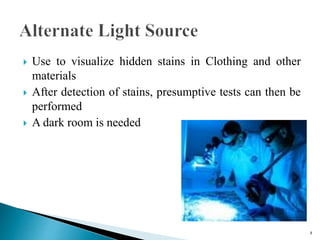
 Use to visualize hidden stains in Clothing and other
materials
 After detection of stains, presumptive tests can then be
performed
 A dark room is needed
8
 Some presumptive and confirmatory tests can react to
the presence of other substances aside the suspected
fluid to give a positive result- False positive
 Some presumptive and confirmatory tests can give a
negative result as a result of the suspected fluid being
insufficient for the test- False negative
 Reagent or kit failure can also give false positive or
false negative results to serological tests. This problem
can be avoided with testing the reagent or kit on a
known bodily fluid (+ve Control) and a reagent blank (-
ve control)
9
 Benzidine Colour Test - Benzidine is carcinogenic
so not used as often. Benzidine + Blood Stain +
Hydrogen peroxide = pink color
 Kastle-Meyer Colour Test -Phenolphthalein +
Bloodstain + Hydrogen peroxide = pink color
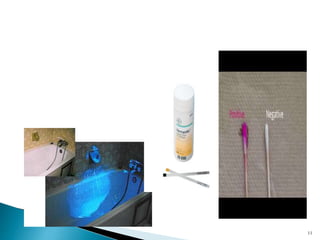
 Luminol Test - Reacts with blood to produce
luminescence (glow)
 Hemastix: use to detect blood in urine but is now
widely use to detect blood at the crime scene and
in the lab. Reagent strips with TMB
(Tetramethylbenzadine) ends.TMB changes from
orange to green when it comes into contact with
blood
10
11
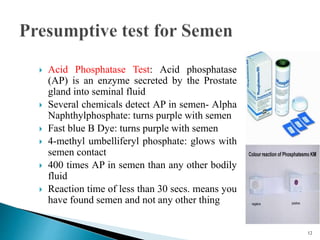
 Acid Phosphatase Test: Acid phosphatase
(AP) is an enzyme secreted by the Prostate
gland into seminal fluid
 Several chemicals detect AP in semen- Alpha
Naphthylphosphate: turns purple with semen
 Fast blue B Dye: turns purple with semen
 4-methyl umbelliferyl phosphate: glows with
semen contact
 400 times AP in semen than any other bodily
fluid
 Reaction time of less than 30 secs. means you
have found semen and not any other thing
12
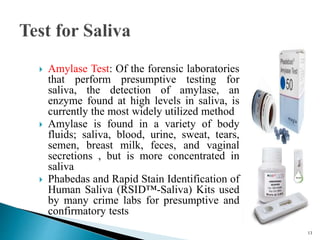
 Amylase Test: Of the forensic laboratories
that perform presumptive testing for
saliva, the detection of amylase, an
enzyme found at high levels in saliva, is
currently the most widely utilized method
 Amylase is found in a variety of body
fluids; saliva, blood, urine, sweat, tears,
semen, breast milk, feces, and vaginal
secretions , but is more concentrated in
saliva
 Phabedas and Rapid Stain Identification of
Human Saliva (RSID™-Saliva) Kits used
by many crime labs for presumptive and
confirmatory tests
13
 Jaffe test: Creatinine can serve as a screening test for
urine
 To a drop of stain extract on filter paper, add one drop
of Picric acid followed by one drop of 5% Sodium
hydroxide. Brown/orange color shows presence of
Creatinine
14
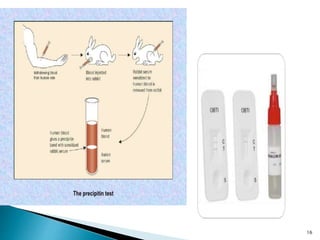
 Precipitin Test: Combining Human antiserum and
human blood gives agglutination
 This principle has been employed in the production of
many commercial kits Eg. Hexagon OBTI Kit
 Requires only small amount of blood
 Dried blood stains as old as 10 - 15 years work
15
16
 Electrophoretic Method: Human antibodies and
bloodstain are placed in wells on electrophoresis plate
 Electrical current is used to move antibodies and
antigens towards each other
 If antibodies and antigens move towards each other and
form a line of precipitation, it is human blood
17
 Prostate Specific Antigen (PSA or p30) Test: Prostate-
specific antigen, or PSA, is a protein produced by cells
of the prostate gland
 PSA is produced for the ejaculate, where it
liquefies semen and allows sperm to swim freely
 PSA is present in small quantities in the serum of men
with healthy prostates
18
 When PSA is isolated and injected into rabbits, an
immune response is triggered which produces
antibodies for the PSA (anti-PSA)
 Serum is then collected from the rabbit
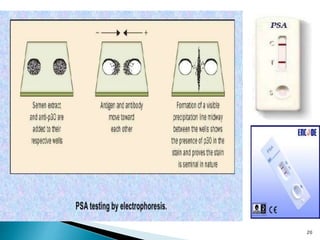
 Suspected human semen is placed in one well of an
electrophoretic plate and anti-PSA is placed in the
opposite well
 When an electric potential is applied, the antigens and
antibodies move toward each other
 Formation of a visible line midway between the two
wells shows the presence of human semen.
19
20
 Identification and analysis of various bodily fluids is
paramount in the investigation of many crimes
 Presumptive and confirmatory tests can be performed
at the crime scene with the advent of simple-to-use
commercial kits
21
 http://www.bluestar-forensic.com/
 https://www.salimetrics.com/
 https://en.wikipedia.org/wiki/Prostate-
specific_antigen
 http://www.cancer.gov/types/prostate/psa-
fact-sheet
22

Analysis of Bodily Fluids.pptx

  • 1.
    Dr. Aamir AliKhan Assistant Professor 1
  • 2.
     Forensic Scienceis the application of scientific analysis to law enforcement- Forensic Toxicology, Document examination, Forensic Entomology, etc  Every Forensic process starts from the crime scene  Branch of forensic science that deals with the identification and analysis of bodily fluids - Forensic Serology  Serology precedes DNAAnalysis in a Forensic Lab 2
  • 3.
     Around 1900,Karl Landsteiner discovered that there are four different types of human blood based on the presence or absence of specific antigens found on the surface of the red blood cells. This lead to the blood groups A,B,AB and O  In 1940, Landsteiner and Weiner reported the discovery of the Rh factor by studying the blood of the Rhesus monkey 3
  • 4.
     To knowhow suspected bodily fluids are identified and analyzed in Forensic investigations 4
  • 5.
     Bodily fluidsare liquids that originate from inside the body of humans  Blood, Semen ,Saliva  Blood is the most common  Biological stains in the dried state are reasonably stable and can be detected months or years after being deposited 5
  • 6.
     Is thefluid or stain blood ,semen ,saliva ,etc?  Is it of animal or human source?  Can it be linked to a particular species or individual? 6
  • 7.
     Visual/Physical examination-Normally based on the experience of the Analyst. This isn't admissible in a court of law. It can only give a clue to the analyst  Presumptive test: This test tells the presence or absence of a suspected fluid. Cannot confirm whether it’s from animal or human. Eg. Blood  Confirmatory test: This test gives a high degree of specificity for the body fluid in question. Eg. Human blood 7
  • 8.
     Use tovisualize hidden stains in Clothing and other materials  After detection of stains, presumptive tests can then be performed  A dark room is needed 8
  • 9.
     Some presumptiveand confirmatory tests can react to the presence of other substances aside the suspected fluid to give a positive result- False positive  Some presumptive and confirmatory tests can give a negative result as a result of the suspected fluid being insufficient for the test- False negative  Reagent or kit failure can also give false positive or false negative results to serological tests. This problem can be avoided with testing the reagent or kit on a known bodily fluid (+ve Control) and a reagent blank (- ve control) 9
  • 10.
     Benzidine ColourTest - Benzidine is carcinogenic so not used as often. Benzidine + Blood Stain + Hydrogen peroxide = pink color  Kastle-Meyer Colour Test -Phenolphthalein + Bloodstain + Hydrogen peroxide = pink color  Luminol Test - Reacts with blood to produce luminescence (glow)  Hemastix: use to detect blood in urine but is now widely use to detect blood at the crime scene and in the lab. Reagent strips with TMB (Tetramethylbenzadine) ends.TMB changes from orange to green when it comes into contact with blood 10
  • 11.
  • 12.
     Acid PhosphataseTest: Acid phosphatase (AP) is an enzyme secreted by the Prostate gland into seminal fluid  Several chemicals detect AP in semen- Alpha Naphthylphosphate: turns purple with semen  Fast blue B Dye: turns purple with semen  4-methyl umbelliferyl phosphate: glows with semen contact  400 times AP in semen than any other bodily fluid  Reaction time of less than 30 secs. means you have found semen and not any other thing 12
  • 13.
     Amylase Test:Of the forensic laboratories that perform presumptive testing for saliva, the detection of amylase, an enzyme found at high levels in saliva, is currently the most widely utilized method  Amylase is found in a variety of body fluids; saliva, blood, urine, sweat, tears, semen, breast milk, feces, and vaginal secretions , but is more concentrated in saliva  Phabedas and Rapid Stain Identification of Human Saliva (RSID™-Saliva) Kits used by many crime labs for presumptive and confirmatory tests 13
  • 14.
     Jaffe test:Creatinine can serve as a screening test for urine  To a drop of stain extract on filter paper, add one drop of Picric acid followed by one drop of 5% Sodium hydroxide. Brown/orange color shows presence of Creatinine 14
  • 15.
     Precipitin Test:Combining Human antiserum and human blood gives agglutination  This principle has been employed in the production of many commercial kits Eg. Hexagon OBTI Kit  Requires only small amount of blood  Dried blood stains as old as 10 - 15 years work 15
  • 16.
  • 17.
     Electrophoretic Method:Human antibodies and bloodstain are placed in wells on electrophoresis plate  Electrical current is used to move antibodies and antigens towards each other  If antibodies and antigens move towards each other and form a line of precipitation, it is human blood 17
  • 18.
     Prostate SpecificAntigen (PSA or p30) Test: Prostate- specific antigen, or PSA, is a protein produced by cells of the prostate gland  PSA is produced for the ejaculate, where it liquefies semen and allows sperm to swim freely  PSA is present in small quantities in the serum of men with healthy prostates 18
  • 19.
     When PSAis isolated and injected into rabbits, an immune response is triggered which produces antibodies for the PSA (anti-PSA)  Serum is then collected from the rabbit  Suspected human semen is placed in one well of an electrophoretic plate and anti-PSA is placed in the opposite well  When an electric potential is applied, the antigens and antibodies move toward each other  Formation of a visible line midway between the two wells shows the presence of human semen. 19
  • 20.
  • 21.
     Identification andanalysis of various bodily fluids is paramount in the investigation of many crimes  Presumptive and confirmatory tests can be performed at the crime scene with the advent of simple-to-use commercial kits 21
  • 22.
     http://www.bluestar-forensic.com/  https://www.salimetrics.com/ https://en.wikipedia.org/wiki/Prostate- specific_antigen  http://www.cancer.gov/types/prostate/psa- fact-sheet 22

Editor's Notes