 Hormones are organic substances, produced
in small amounts by specific tissues
(endocrine glands), secreted into the blood
stream to control the metabolic and
biological activities in the target cells.
 Hormones may be regarded as the chemical
messengers involved in the transmission of
information from one tissue to another and
cell to cell.
 Endocrine hormones:
 produced by ductless endocrine glands
 mix to blood
 have target organs
 e.g. TH, LH, FSH
 Autocrine hormones:
 act on the same cells where they are synthesized.
e.g. interleukin-2
 Paracrine hormones:
 act on the cells adjacent/close to the cells from
where they are synthesized e.g. prostaglandins
 Neurotransmitters:
 released by nerve cells and usually act on the
adjacent cells. e.g. Catecholamines
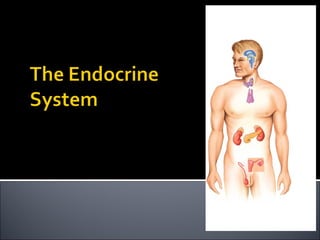
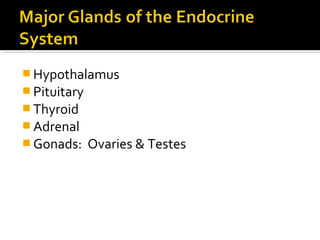
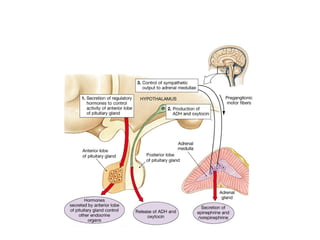
 Hypothalamus
 Pituitary
 Thyroid
 Adrenal
 Gonads: Ovaries & Testes
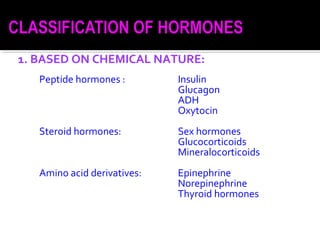
1. BASED ON CHEMICAL NATURE:
Peptide hormones : Insulin
Glucagon
ADH
Oxytocin
Steroid hormones: Sex hormones
Glucocorticoids
Mineralocorticoids
Amino acid derivatives: Epinephrine
Norepinephrine
Thyroid hormones
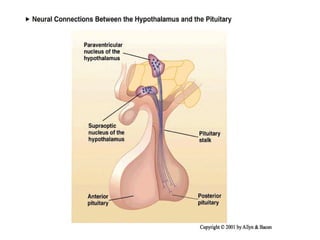
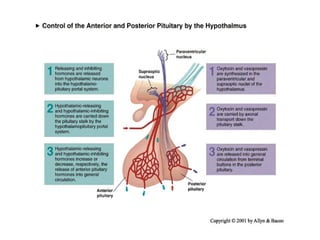
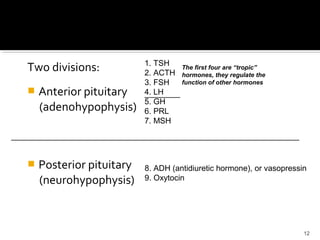
Two divisions:
 Anterior pituitary
(adenohypophysis)
 Posterior pituitary
(neurohypophysis)
12
Sits in hypophyseal fossa: depression in sella turcica of
sphenoid bone
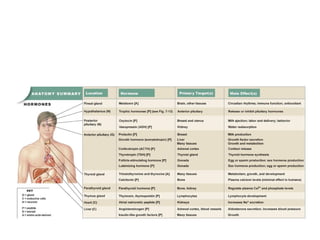
Pituitary secretes 9 hormones
The Pituitary
1. TSH
2. ACTH
3. FSH
4. LH
5. GH
6. PRL
7. MSH
8. ADH (antidiuretic hormone), or vasopressin
9. Oxytocin
_________________________________________________________________
The first four are “tropic”
hormones, they regulate the
function of other hormones
________
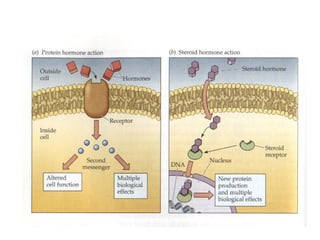
2. BASED ON MECHANISM OF ACTION
GROUP I: intracellular receptor (Lipophilic)
▪ Hormones bind to intracellular receptors (HRE in DNA)
to form receptor hormone complexes to carry out the
biochemical functions. They are derivatives of
cholesterol, lipophilic in nature and possess long half
lives.
GROUP II: surface receptor (Hydrophilic)
 These hormones bind to cell surface receptors and
stimulate the release of second messengers which in
turn perform the biochemical function. They are
hydrophilic in nature and possess short half lives.
Hormones bind with HRE in DNA
 Estrogens
 Progestins
 Androgens
 Glucocorticoids
 Mineralocorticoids
 Calcitriol
 Thyroid Hormones
(a)The second messenger is cAMP
 Adrenocorticotropic hormone (ACTH)
 Follicle stimulating hormone (FSH)
 Leuteinzing Hormone (LH)
 Thyroid stimulating hormone (TSH)
 Chorionic gonadotropins (hCG)
 β Endorphins & Enkephalins
 Anti diuretic hormone (ADH)
 Glucagon
 Parathyroid hormone (PTH)
 Calcitonin
 Epinephrine
 Nor-epinephrine
(b)The second messenger is cGMP
 Atrial natriuretic factor (ANF)
 Nitric oxide (NO)
(c)The second messenger is phosphotidyl
inositol/calcium (or both)
 Thyrotropin releasing hormone (TRH)
 Gonadotropin releasing hormone (GnRH)
 Gastrin
 Cholecystokinin (CCK)
(d)The second messenger is unknown/
unsettled (Kinase/Phosphatase cascade)
 Insulin
 Growth hormone (GH)
 Prolactin (PRL)
 Oxytocin
 Somatomedins (Insulin like growth factor) (IGF-
I, IGF-II)
Group I Hormones
 Lipophilic in nature → cross plasma membrane by
diffusion
 Act through intracellular receptors located either in
cytosol or nucleus
 Duration of action is hours to days
 Hormone first binds with receptor → forms HR-
complex → binds with the specific region on the DNA
called hormone responsive element (HRE) → causes
increased expression of specific genes →
transcription → translation → production of specific
proteins → carries biochemical action of hormone
HORMONE RESPONSE ELEMENT (HRE):-
 Specific sequence present in DNA which binds HR
complex during lipophilic hormone action
 HRE hormone specific
RESULT:-
 Binding of HR complex to HRE → transcription →
mRNA → Translation (specific protein) →
Biochemical response
STRUCTURE OF RECEPTOR MOLECULES
 Large, integral membrane proteins with
specificity & high affinity for hormones.
 Hormone & receptor binding is reversible.
 Initiate response without entering the cell.
 Rapid response/ shorter duration of action
(seconds to hours).
 Mediate effect through second messengers.
GROUP II HORMONES
 These hormones are considered as first
messenger
 Hormone binds to surface receptors
 Carry the action through mediatory molecules
(second messengers)
 Hormones → First messenger → Second
messenger → Activation of protein kinase →
phosphorylation of enzyme → biochemical
action.
 Cyclic adenosine 3’,5’-monophosphate (cAMP)
consists of adenine, ribose & a phosphate.
 Adenylate cyclase converts ATP to cAMP
 cAMP is a second messenger for majority of
polypeptide hormones
 cAMP binds with protein kinase and activates it to
carry out the phosphorylation for the biochemical
action of hormone
 cAMP degrades to 5’ AMP by phosphodiasterase
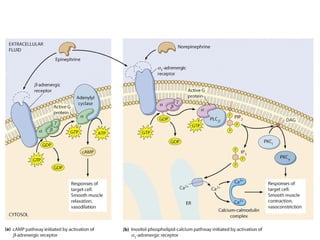
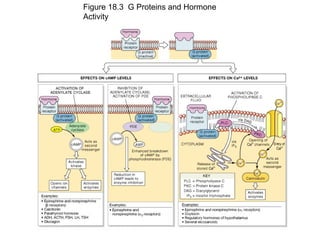
Figure 18.3 G Proteins and Hormone
Activity
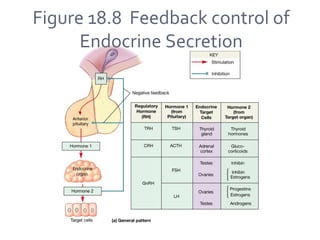
Figure 18.8 Feedback control of
Endocrine Secretion
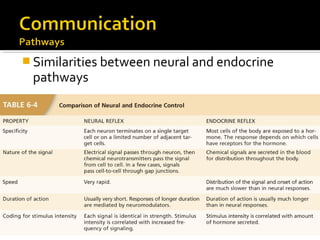
 Similarities between neural and endocrine
pathways
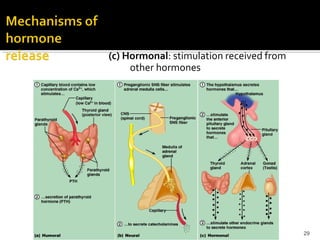
(a) Humoral: in response to changing levels of
ions or nutrients in the blood
(b) Neural: stimulation by nerves
(c) Hormonal: stimulation received from
other hormones
29

Endocrinology

  • 2.
     Hormones areorganic substances, produced in small amounts by specific tissues (endocrine glands), secreted into the blood stream to control the metabolic and biological activities in the target cells.  Hormones may be regarded as the chemical messengers involved in the transmission of information from one tissue to another and cell to cell.
  • 3.
     Endocrine hormones: produced by ductless endocrine glands  mix to blood  have target organs  e.g. TH, LH, FSH  Autocrine hormones:  act on the same cells where they are synthesized. e.g. interleukin-2  Paracrine hormones:  act on the cells adjacent/close to the cells from where they are synthesized e.g. prostaglandins
  • 4.
     Neurotransmitters:  releasedby nerve cells and usually act on the adjacent cells. e.g. Catecholamines
  • 5.
     Hypothalamus  Pituitary Thyroid  Adrenal  Gonads: Ovaries & Testes
  • 6.
    1. BASED ONCHEMICAL NATURE: Peptide hormones : Insulin Glucagon ADH Oxytocin Steroid hormones: Sex hormones Glucocorticoids Mineralocorticoids Amino acid derivatives: Epinephrine Norepinephrine Thyroid hormones
  • 12.
    Two divisions:  Anteriorpituitary (adenohypophysis)  Posterior pituitary (neurohypophysis) 12 Sits in hypophyseal fossa: depression in sella turcica of sphenoid bone Pituitary secretes 9 hormones The Pituitary 1. TSH 2. ACTH 3. FSH 4. LH 5. GH 6. PRL 7. MSH 8. ADH (antidiuretic hormone), or vasopressin 9. Oxytocin _________________________________________________________________ The first four are “tropic” hormones, they regulate the function of other hormones ________
  • 13.
    2. BASED ONMECHANISM OF ACTION GROUP I: intracellular receptor (Lipophilic) ▪ Hormones bind to intracellular receptors (HRE in DNA) to form receptor hormone complexes to carry out the biochemical functions. They are derivatives of cholesterol, lipophilic in nature and possess long half lives.
  • 14.
    GROUP II: surfacereceptor (Hydrophilic)  These hormones bind to cell surface receptors and stimulate the release of second messengers which in turn perform the biochemical function. They are hydrophilic in nature and possess short half lives.
  • 15.
    Hormones bind withHRE in DNA  Estrogens  Progestins  Androgens  Glucocorticoids  Mineralocorticoids  Calcitriol  Thyroid Hormones
  • 16.
    (a)The second messengeris cAMP  Adrenocorticotropic hormone (ACTH)  Follicle stimulating hormone (FSH)  Leuteinzing Hormone (LH)  Thyroid stimulating hormone (TSH)  Chorionic gonadotropins (hCG)  β Endorphins & Enkephalins  Anti diuretic hormone (ADH)  Glucagon  Parathyroid hormone (PTH)  Calcitonin  Epinephrine  Nor-epinephrine
  • 17.
    (b)The second messengeris cGMP  Atrial natriuretic factor (ANF)  Nitric oxide (NO) (c)The second messenger is phosphotidyl inositol/calcium (or both)  Thyrotropin releasing hormone (TRH)  Gonadotropin releasing hormone (GnRH)  Gastrin  Cholecystokinin (CCK)
  • 18.
    (d)The second messengeris unknown/ unsettled (Kinase/Phosphatase cascade)  Insulin  Growth hormone (GH)  Prolactin (PRL)  Oxytocin  Somatomedins (Insulin like growth factor) (IGF- I, IGF-II)
  • 19.
    Group I Hormones Lipophilic in nature → cross plasma membrane by diffusion  Act through intracellular receptors located either in cytosol or nucleus  Duration of action is hours to days  Hormone first binds with receptor → forms HR- complex → binds with the specific region on the DNA called hormone responsive element (HRE) → causes increased expression of specific genes → transcription → translation → production of specific proteins → carries biochemical action of hormone
  • 20.
    HORMONE RESPONSE ELEMENT(HRE):-  Specific sequence present in DNA which binds HR complex during lipophilic hormone action  HRE hormone specific RESULT:-  Binding of HR complex to HRE → transcription → mRNA → Translation (specific protein) → Biochemical response
  • 21.
    STRUCTURE OF RECEPTORMOLECULES  Large, integral membrane proteins with specificity & high affinity for hormones.  Hormone & receptor binding is reversible.  Initiate response without entering the cell.  Rapid response/ shorter duration of action (seconds to hours).  Mediate effect through second messengers.
  • 22.
    GROUP II HORMONES These hormones are considered as first messenger  Hormone binds to surface receptors  Carry the action through mediatory molecules (second messengers)  Hormones → First messenger → Second messenger → Activation of protein kinase → phosphorylation of enzyme → biochemical action.
  • 23.
     Cyclic adenosine3’,5’-monophosphate (cAMP) consists of adenine, ribose & a phosphate.  Adenylate cyclase converts ATP to cAMP  cAMP is a second messenger for majority of polypeptide hormones  cAMP binds with protein kinase and activates it to carry out the phosphorylation for the biochemical action of hormone  cAMP degrades to 5’ AMP by phosphodiasterase
  • 26.
    Figure 18.3 GProteins and Hormone Activity
  • 27.
    Figure 18.8 Feedbackcontrol of Endocrine Secretion
  • 28.
     Similarities betweenneural and endocrine pathways
  • 29.
    (a) Humoral: inresponse to changing levels of ions or nutrients in the blood (b) Neural: stimulation by nerves (c) Hormonal: stimulation received from other hormones 29