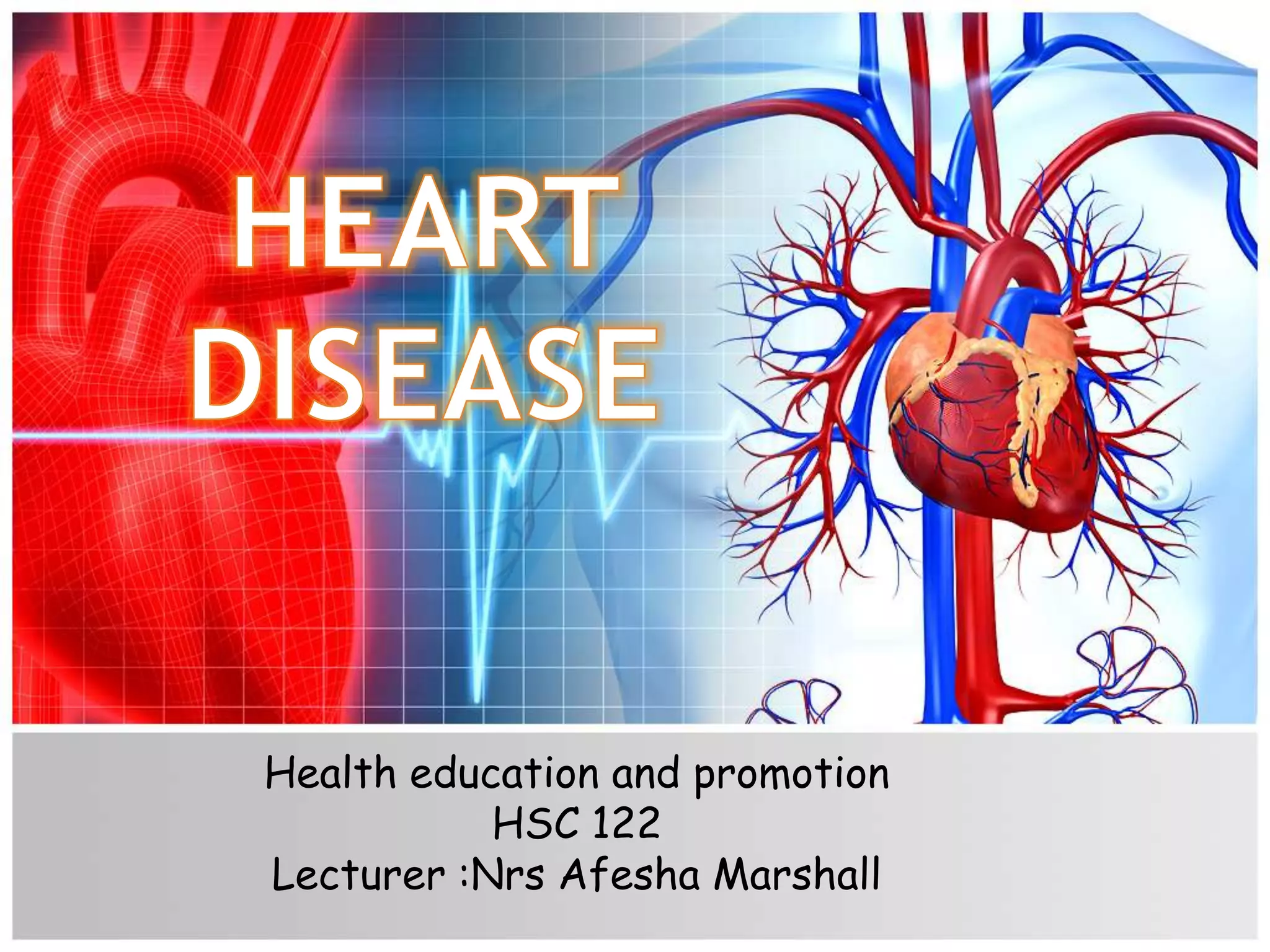
Health education and promotion
           HSC 122
Lecturer :Nrs Afesha Marshall
Group #3

         Group members

•   Ashley Adams
•   Luciean Andrews      •   Olly Perreira
•   Audit Arjun          •   Dominique Russel
•   Omesh Balmacoon      •   Leeann Sills
•   Kizzy Cooke-Mcrae    •   Gwen Tinnie
•   Stefon Dundas
•   Imran Khan
•   Samuel King
•   Monique Miller
•   Shavon Moses
Objectives


• Define the term heart disease

• Discuss the common types of heart diseases

• Identify risk factors of Heart disease.

• Describe the signs and symptoms of heart disease .

• Describe the common diagnostic measures used in heart disease.

• Describe the common treatment interventions

• Discuss the preventative measures .
What Is Heart
     Disease?
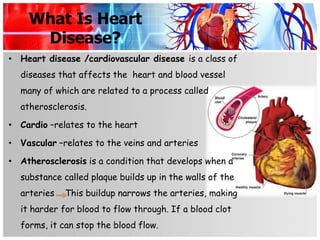
• Heart disease /cardiovascular disease is a class of
  diseases that affects the heart and blood vessel
  many of which are related to a process called
  atherosclerosis.

• Cardio –relates to the heart

• Vascular –relates to the veins and arteries

• Atherosclerosis is a condition that develops when a
  substance called plaque builds up in the walls of the
  arteries   This buildup narrows the arteries, making
  it harder for blood to flow through. If a blood clot
  forms, it can stop the blood flow.
Incidence
    and prevalence
                                      GLOBALLY
•   CVDs are the number one cause of death globally: more people die annually from
    CVDs than from any other cause.
•   An estimated 17.3 million people died from CVDs in 2008, representing 30% of all
    global deaths. Of these deaths, an estimated 7.3 million were due to coronary
    heart disease.
•   Over 80% of CVD deaths take place in low- and middle-income countries and occur
    almost equally in men and women.
•   By 2030, almost 23.6 million people will die from CVDs, mainly from heart disease
    and stroke(WHO ,20011)
                                       GUYANA
•   CVD is one of the leading causes of death in Guyana
•   SEX -Males are more affected than females with heart disease
•   AGE – greater prevalence of hypertensive diseases 45 and greater age group and
    the 4th amongst 15 -44 yrs old .
•   RACE -Most common cause of death among indo and afro-Guyanese ,Chinese and
    Portuguese .
•   REGION -Major cause of death in regions 2,3,6,10(MOH ,GUYANA,2008)
COMMON TYPES OF
     HEART DISEASE
Preventable –
•   Heart disease can affect the structure of the heart –valves ,muscles ,fibers and
    blood supply e.g. coronary heart disease – disease of the blood vessels supplying the
    heart muscle.

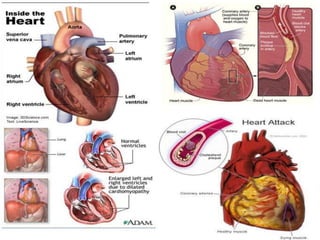
•   The common cause of coronary heart disease result from - Atherosclerosis –this is a
    condition that develops when a substance called plaque builds up in the walls of the
    arteries. Coronary arteries that supply the heart muscle become blocked And as a
    result can cause:

•   Hypertension (increased pressure )

•   Angina /Ischemic heart disease (partially blocked)

•   Heart attack /M.I(Fully blocked )

•   Heart failure (damaged valves and enlargement),arrythmias (damaged heart fibers)
COMMON TYPES OF
HEART DISEASE
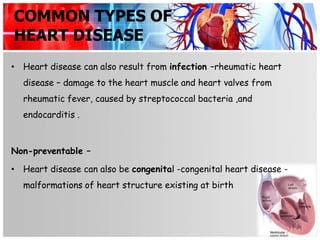
• Heart disease can also result from infection –rheumatic heart
  disease – damage to the heart muscle and heart valves from
  rheumatic fever, caused by streptococcal bacteria ,and
  endocarditis .


Non-preventable –

• Heart disease can also be congenital -congenital heart disease -
  malformations of heart structure existing at birth
Risk Factors
Modifiable risk factors-Some risk factors can be avoided or
    altered, potentially slowing the disease process or even reversing it. These
    factors include:

•   elevated serum lipid levels

•   hypertension

•   cigarette smoking

•   diabetes mellitus

•   sedentary lifestyle

•   stress

•   obesity—especially abdominal (waist measurement greater than 40″ [101.6
    cm] in men and greater than 35″ [88.9 cm] in women)

•   excessive intake of saturated fats, carbohydrates, and salt.
Risk Factors Con’t

Non-modifiable risk factors- there are four non-modifiable

  factors increase a person's risk of cardiovascular disease:

• age

• male gender

• family history

• race.
Common signs and
  symptoms
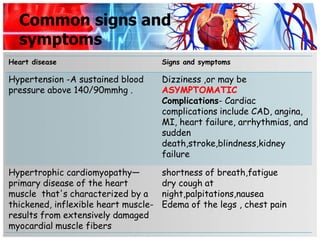
Heart disease                         Signs and symptoms

Hypertension -A sustained blood       Dizziness ,or may be
pressure above 140/90mmhg .           ASYMPTOMATIC
                                      Complications- Cardiac
                                      complications include CAD, angina,
                                      MI, heart failure, arrhythmias, and
                                      sudden
                                      death,stroke,blindness,kidney
                                      failure

Hypertrophic cardiomyopathy—          shortness of breath,fatigue
primary disease of the heart          dry cough at
muscle that's characterized by a      night,palpitations,nausea
thickened, inflexible heart muscle-   Edema of the legs , chest pain
results from extensively damaged
myocardial muscle fibers
Common signs
   and symptoms
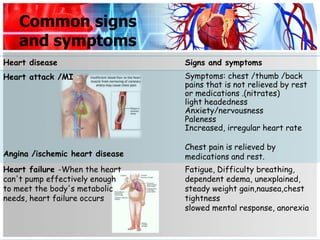
Heart disease                    Signs and symptoms
Heart attack /MI                 Symptoms: chest /thumb /back
                                 pains that is not relieved by rest
                                 or medications .(nitrates)
                                 light headedness
                                 Anxiety/nervousness
                                 Paleness
                                 Increased, irregular heart rate

                                 Chest pain is relieved by
Angina /ischemic heart disease   medications and rest.
Heart failure -When the heart    Fatigue, Difficulty breathing,
can't pump effectively enough    dependent edema, unexplained,
to meet the body's metabolic     steady weight gain,nausea,chest
needs, heart failure occurs      tightness
                                 slowed mental response, anorexia
How is heart disease
   diagnosed?
LABORATORY TESTING –measures heart enzymes/proteins and reveals the
  extent of damage and monitor healing.

       • Creatine kinase (CK)-Elevated levels indicate death to heart muscles.

       • Ischemia-modified albumin (IMA)-indicates lack of oxygen supply to
           the heart .

       •   Myoglobin- indicates damage to the heart muscle

       •    Troponin I and T-indicates heart damage

       • Cholesterol levels-detects cholesterol levels-LDL/HDL

GRAPHIC RECORDING STUDIES –used to detect heart disorders .

       • ECG- graphically records electrical current generated by the heart.

       • Exercise ECG(stress test)-assess heart response to an increased
           workload.
How is heart disease
diagnosed?
Imaging studies –

       • Chest X-ray-may detect enlargement or structural
         changes of the heart

       • Echo- visualize heart size and shape, heart wall thickness
         and motion, and cardiac valve structure and function

       • CT /MRI-detect changes in the structure of the heart

Interventional studies –

       • Cardiac catheterization and coronary angiography-
         determines location of blockage ,pressure and oxygen levels
         of the heart.
How is heart
   disease treated ?
Treatment of heart disease depends on the causative factor or
  the disorder present;

• Pharmacological –medications may be used to reduce blood
  pressure(anti –hypertensives),control heart rate(ant-
  arrythmias) ,reduce pain(anti –anginal) ,lower cholesterol(anti
  –lipidemics),dissolve or prevent blood clots (anti –platelet
  /thrombolytics)and reduce fluid accumulation(diuretics)
How is heart
disease treated ?
• Non –pharmacological -lifestyle changes-education,diet (DASH

  diet ),exercise

• Invasive interventions (surgery)

• Coronary artery with an autogenous graft-restores blood flow to

  the heart

• Bypass grafting -bypasses the obstruction resulting from

  arteriosclerosis

• Embolectomy- removes the blockage (blood clot)

   Valve repair
HOW CAN HEART DISEASE
   BE PREVENTED ?

DIETARY MEASURES-These are based on the DASH (Dietary
  Approaches to Stop Hypertension)
      • • Limiting use of salt to less than 2.4 grams of sodium (6 gm
        salt) per day i.e. no added salt in cooking or at table); avoid
        canned foods, salted meat, etc.
      • • Reducing excessive dietary fat (especially saturated fat and
        trans-fatty acids) to no more than 30% of calories. Saturated
        fat should not exceed 10% of total calories.
      • • Ensuring intake of fibre of at least 30-40 gm/day.
      • • Ensuring intake of potassium between 70-80 mmol/l daily. This
        can be achieved by a good selection of fruits and vegetables
        especially bananas,tomatoes and oranges as well as coconut
        water.
      • Avoiding red meat .
HOW CAN HEART DISEASE
  BE PREVENTED ?

Physical Exercise

• This should be undertaken for 30-60 minutes at least five times each
  week,but preferably daily. Walking is the easiest form of exercise for
  most people.

Weight Management

• This aims at the attainment and maintenance of desirable body weight
  i.e.

• BMI <25 or at least a significant reduction, if overweight or obese.
  There is a possibility of 5-20 mmHg decrease in systolic pressure for
  every 10kg (22lb) weight loss.
HOW CAN HEART DISEASE
 BE PREVENTED ?

Reduction of Alcohol Intake

      • Alcohol use should not exceed 2 drinks/day for men and 1
        drink/day for women. (1 drink = one ounce of spirits or 1
        bottle of beer or 1 glass of wine)

Cessation of Tobacco Use

      • Tobacco should be avoided.

Education

      • Every opportunity should be taken for education of the
        patient, with partner and relatives. The education should
        include diet, exercise and other lifestyle advice(stress
        reduction)
References
•   Statistical Bulletin 2007 - Ministry of Health
•   www.health.gov.gy/pub/moh_stats_bulletin_07.pdf
•   2.MINISTRY OF HEALTH ,GUYANA ,STATISTICAL BULLETIN ,2008
•   http://www.who.int/topics/cardiovascular_diseases/en/
•   http://www.heart.org/HEARTORG/Caregiver/Resources/WhatisCardiovasc
    ularDisease/What-is-Cardiovascular-Disease_UCM_301852_Article.jsp
•   http://www.mayoclinic.com/health/heart-disease/DS01120
•   http://www.ncbi.nlm.nih.gov/pubmedhealth/PMH0002091/
•   http://www.ncbi.nlm.nih.gov/pubmedhealth/PMH0001238/
•   http://www.mayoclinic.com/health/heart-
    disease/DS01120/DSECTION=causes

Heart disease

  • 1.
    Health education andpromotion HSC 122 Lecturer :Nrs Afesha Marshall
  • 2.
    Group #3 Group members • Ashley Adams • Luciean Andrews • Olly Perreira • Audit Arjun • Dominique Russel • Omesh Balmacoon • Leeann Sills • Kizzy Cooke-Mcrae • Gwen Tinnie • Stefon Dundas • Imran Khan • Samuel King • Monique Miller • Shavon Moses
  • 3.
    Objectives • Define theterm heart disease • Discuss the common types of heart diseases • Identify risk factors of Heart disease. • Describe the signs and symptoms of heart disease . • Describe the common diagnostic measures used in heart disease. • Describe the common treatment interventions • Discuss the preventative measures .
  • 4.
    What Is Heart Disease? • Heart disease /cardiovascular disease is a class of diseases that affects the heart and blood vessel many of which are related to a process called atherosclerosis. • Cardio –relates to the heart • Vascular –relates to the veins and arteries • Atherosclerosis is a condition that develops when a substance called plaque builds up in the walls of the arteries This buildup narrows the arteries, making it harder for blood to flow through. If a blood clot forms, it can stop the blood flow.
  • 5.
    Incidence and prevalence GLOBALLY • CVDs are the number one cause of death globally: more people die annually from CVDs than from any other cause. • An estimated 17.3 million people died from CVDs in 2008, representing 30% of all global deaths. Of these deaths, an estimated 7.3 million were due to coronary heart disease. • Over 80% of CVD deaths take place in low- and middle-income countries and occur almost equally in men and women. • By 2030, almost 23.6 million people will die from CVDs, mainly from heart disease and stroke(WHO ,20011) GUYANA • CVD is one of the leading causes of death in Guyana • SEX -Males are more affected than females with heart disease • AGE – greater prevalence of hypertensive diseases 45 and greater age group and the 4th amongst 15 -44 yrs old . • RACE -Most common cause of death among indo and afro-Guyanese ,Chinese and Portuguese . • REGION -Major cause of death in regions 2,3,6,10(MOH ,GUYANA,2008)
  • 6.
    COMMON TYPES OF HEART DISEASE Preventable – • Heart disease can affect the structure of the heart –valves ,muscles ,fibers and blood supply e.g. coronary heart disease – disease of the blood vessels supplying the heart muscle. • The common cause of coronary heart disease result from - Atherosclerosis –this is a condition that develops when a substance called plaque builds up in the walls of the arteries. Coronary arteries that supply the heart muscle become blocked And as a result can cause: • Hypertension (increased pressure ) • Angina /Ischemic heart disease (partially blocked) • Heart attack /M.I(Fully blocked ) • Heart failure (damaged valves and enlargement),arrythmias (damaged heart fibers)
  • 8.
    COMMON TYPES OF HEARTDISEASE • Heart disease can also result from infection –rheumatic heart disease – damage to the heart muscle and heart valves from rheumatic fever, caused by streptococcal bacteria ,and endocarditis . Non-preventable – • Heart disease can also be congenital -congenital heart disease - malformations of heart structure existing at birth
  • 9.
    Risk Factors Modifiable riskfactors-Some risk factors can be avoided or altered, potentially slowing the disease process or even reversing it. These factors include: • elevated serum lipid levels • hypertension • cigarette smoking • diabetes mellitus • sedentary lifestyle • stress • obesity—especially abdominal (waist measurement greater than 40″ [101.6 cm] in men and greater than 35″ [88.9 cm] in women) • excessive intake of saturated fats, carbohydrates, and salt.
  • 10.
    Risk Factors Con’t Non-modifiablerisk factors- there are four non-modifiable factors increase a person's risk of cardiovascular disease: • age • male gender • family history • race.
  • 11.
    Common signs and symptoms Heart disease Signs and symptoms Hypertension -A sustained blood Dizziness ,or may be pressure above 140/90mmhg . ASYMPTOMATIC Complications- Cardiac complications include CAD, angina, MI, heart failure, arrhythmias, and sudden death,stroke,blindness,kidney failure Hypertrophic cardiomyopathy— shortness of breath,fatigue primary disease of the heart dry cough at muscle that's characterized by a night,palpitations,nausea thickened, inflexible heart muscle- Edema of the legs , chest pain results from extensively damaged myocardial muscle fibers
  • 12.
    Common signs and symptoms Heart disease Signs and symptoms Heart attack /MI Symptoms: chest /thumb /back pains that is not relieved by rest or medications .(nitrates) light headedness Anxiety/nervousness Paleness Increased, irregular heart rate Chest pain is relieved by Angina /ischemic heart disease medications and rest. Heart failure -When the heart Fatigue, Difficulty breathing, can't pump effectively enough dependent edema, unexplained, to meet the body's metabolic steady weight gain,nausea,chest needs, heart failure occurs tightness slowed mental response, anorexia
  • 13.
    How is heartdisease diagnosed? LABORATORY TESTING –measures heart enzymes/proteins and reveals the extent of damage and monitor healing. • Creatine kinase (CK)-Elevated levels indicate death to heart muscles. • Ischemia-modified albumin (IMA)-indicates lack of oxygen supply to the heart . • Myoglobin- indicates damage to the heart muscle • Troponin I and T-indicates heart damage • Cholesterol levels-detects cholesterol levels-LDL/HDL GRAPHIC RECORDING STUDIES –used to detect heart disorders . • ECG- graphically records electrical current generated by the heart. • Exercise ECG(stress test)-assess heart response to an increased workload.
  • 14.
    How is heartdisease diagnosed? Imaging studies – • Chest X-ray-may detect enlargement or structural changes of the heart • Echo- visualize heart size and shape, heart wall thickness and motion, and cardiac valve structure and function • CT /MRI-detect changes in the structure of the heart Interventional studies – • Cardiac catheterization and coronary angiography- determines location of blockage ,pressure and oxygen levels of the heart.
  • 15.
    How is heart disease treated ? Treatment of heart disease depends on the causative factor or the disorder present; • Pharmacological –medications may be used to reduce blood pressure(anti –hypertensives),control heart rate(ant- arrythmias) ,reduce pain(anti –anginal) ,lower cholesterol(anti –lipidemics),dissolve or prevent blood clots (anti –platelet /thrombolytics)and reduce fluid accumulation(diuretics)
  • 16.
    How is heart diseasetreated ? • Non –pharmacological -lifestyle changes-education,diet (DASH diet ),exercise • Invasive interventions (surgery) • Coronary artery with an autogenous graft-restores blood flow to the heart • Bypass grafting -bypasses the obstruction resulting from arteriosclerosis • Embolectomy- removes the blockage (blood clot) Valve repair
  • 17.
    HOW CAN HEARTDISEASE BE PREVENTED ? DIETARY MEASURES-These are based on the DASH (Dietary Approaches to Stop Hypertension) • • Limiting use of salt to less than 2.4 grams of sodium (6 gm salt) per day i.e. no added salt in cooking or at table); avoid canned foods, salted meat, etc. • • Reducing excessive dietary fat (especially saturated fat and trans-fatty acids) to no more than 30% of calories. Saturated fat should not exceed 10% of total calories. • • Ensuring intake of fibre of at least 30-40 gm/day. • • Ensuring intake of potassium between 70-80 mmol/l daily. This can be achieved by a good selection of fruits and vegetables especially bananas,tomatoes and oranges as well as coconut water. • Avoiding red meat .
  • 18.
    HOW CAN HEARTDISEASE BE PREVENTED ? Physical Exercise • This should be undertaken for 30-60 minutes at least five times each week,but preferably daily. Walking is the easiest form of exercise for most people. Weight Management • This aims at the attainment and maintenance of desirable body weight i.e. • BMI <25 or at least a significant reduction, if overweight or obese. There is a possibility of 5-20 mmHg decrease in systolic pressure for every 10kg (22lb) weight loss.
  • 19.
    HOW CAN HEARTDISEASE BE PREVENTED ? Reduction of Alcohol Intake • Alcohol use should not exceed 2 drinks/day for men and 1 drink/day for women. (1 drink = one ounce of spirits or 1 bottle of beer or 1 glass of wine) Cessation of Tobacco Use • Tobacco should be avoided. Education • Every opportunity should be taken for education of the patient, with partner and relatives. The education should include diet, exercise and other lifestyle advice(stress reduction)
  • 20.
    References • Statistical Bulletin 2007 - Ministry of Health • www.health.gov.gy/pub/moh_stats_bulletin_07.pdf • 2.MINISTRY OF HEALTH ,GUYANA ,STATISTICAL BULLETIN ,2008 • http://www.who.int/topics/cardiovascular_diseases/en/ • http://www.heart.org/HEARTORG/Caregiver/Resources/WhatisCardiovasc ularDisease/What-is-Cardiovascular-Disease_UCM_301852_Article.jsp • http://www.mayoclinic.com/health/heart-disease/DS01120 • http://www.ncbi.nlm.nih.gov/pubmedhealth/PMH0002091/ • http://www.ncbi.nlm.nih.gov/pubmedhealth/PMH0001238/ • http://www.mayoclinic.com/health/heart- disease/DS01120/DSECTION=causes