Homeostasis www.ecosystema.ru/eng/ 1
The term ‘homeostasis’ is derived from two Greek words;  Homeo  which means ‘unchanging’ and  Stasis  which means ‘standing’ In its simplest form it means ‘staying the same’ It is an organism’s internal environment which ‘stays the same’ The ‘internal environment’ refers to the conditions inside an organism.  These conditions remain more or less constant despite changes such as  pH   or temperature  in the outside environment  In practice, it comes down to providing a stable environment  for the cells of the body  2
The living processes in the cells depend on the activity of  enzymes . These enzymes work best in specific conditions such as those of temperature and pH. Any change in these conditions affects the function of the enzymes and may lead to the death of the cells or, ultimately, the whole organism This is why the internal environment needs to be regulated and kept constant. In fact, the internal conditions are not absolutely constant,  but allowed to vary within very narrow limits. Human body temperature, for example, varies between 36.1 – 37.8  o  C.  The average temperature is usually expressed as 36.8 o  C 3
 
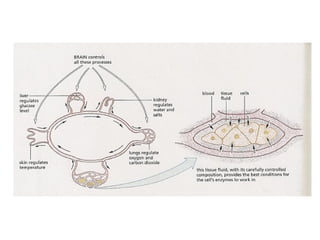
-To avoid making exceptions and qualifications, we will consider homeostasis as it applies to the  human body -There is no specific organ which controls homeostasis except, possibly, the brain -The  skin ,  kidneys, liver ,  endocrine system ,  nervous system  and  sensory system  all play a part in maintaining the internal environment within narrow limits -The  skin  is a homeostatic organ which helps  maintain the  body temperature  within the limits given in the previous slide Definition of ‘homeostasis ’ is  the maintenance of a constant internal environment. 4
-The external temperature varies during the day and from season to season, sometimes by as much as 40 o C, ( See  slide 1) but the human body temperature stays at about 37 o C -This is achieved by  sweating, vasodilation, vasoconstriction, and shivering. OVERHEATING : Sweating and vasodilation OVERCOOLING : Vasoconstriction, sweat production stops and shivering. SWEATING: -If the body temperature rises, the  sweat glands  in the skin are activated and secrete sweat on to the surface of the skin When the sweat evaporates, it takes heat from the body and cools it down 5
Sweat gland sweat pore evaporation epidermis dermis sweat duct sweat gland blood vessel Section through skin The sweat gland extracts sweat from the blood and passes it up the duct to the skin surface where it evaporates 0.25 mm 6
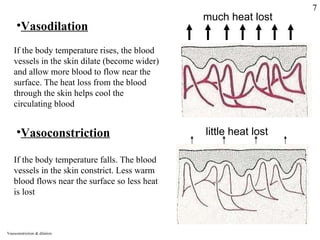
Vasoconstriction & dilation much heat lost Vasodilation If the body temperature rises, the blood vessels in the skin dilate (become wider) and allow more blood to flow near the surface. The heat loss from the blood through the skin helps cool the circulating blood Vasoconstriction little heat lost If the body temperature falls. The blood vessels in the skin constrict. Less warm blood flows near the surface so less heat is lost 7
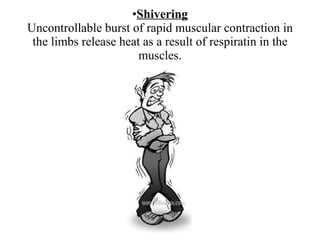
Shivering Uncontrollable burst of rapid muscular contraction in the limbs release heat as a result of respiratin in the muscles.
TISSUE FLUID AND BLOOD -To carry out its living processes, every cell in the body needs a supply of oxygen and food. Waste products such as carbon dioxide have to be removed before they reach harmful levels and damage the cell - These conditions are maintained by tissue fluid bathing the cells. Tissue fluid is derived from the blood -The tissue fluid contains oxygen and food which the cells can absorb, and also accepts the carbon dioxide and other waste products produced by the cells 8
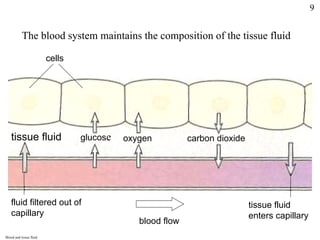
Blood and tissue fluid The blood system maintains the composition of the tissue fluid cells carbon dioxide glucos e oxygen carbon dioxide tissue fluid fluid filtered out of capillary tissue fluid  enters capillary blood flow 9
In the liver cells, the chemical breakdown of proteins produces the nitrogenous compound,  urea . If this were allowed to accumulate in the cells it would damage or kill them. The concentration of the blood and tissue fluids tends to vary. If water is lost through evaporation and sweating, the fluids become more concentrated. The intake of water dilutes the fluids It is important that the  concentration of  blood and tissue fluid is kept within narrow limits if the cells are to function properly These homeostatic functions are carried out by the  kidneys (osmoregulation). 10
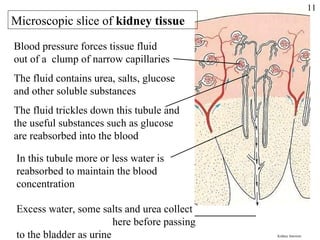
Kidney function Blood pressure forces tissue fluid out of a  clump of narrow capillaries The fluid trickles down this tubule and the useful substances such as glucose are reabsorbed into the blood The fluid contains urea, salts, glucose and other soluble substances Microscopic slice of  kidney tissue In this tubule more or less water is reabsorbed to maintain the blood concentration  Excess water, some salts and urea collect  here before passing to the bladder as urine 11
The glucose concentration in the blood is controlled by the  PANCREAS . The pancreas contains cells which produce digestive enzymes but it also contains cells (alpha and beta cells) which produce the hormones  insulin  and  glucagon -If the  glucose concentration rises , the beta cells release  insulin. -If the  glucose concentration falls , the alpha cells release  glucagon. - Insulin  stimulates the liver and muscles to  remove excess  glucose  from the blood and  store it as glycogen - Glucagon  stimulates the liver to convert its  stored glycogen into   glucose  which is then released into the bloodstream. 12 In this way, the  concentration of glucose in the blood is kept within narrow limits
-One important method of achieving homeostasis is  negative   feedback -It applies to many systems in the body. Temperature regulation is one  example  -If the  blood temperature rises , a ‘heat gain’ centre in the brain sends nerve impulses to the skin, which causes  vasodilation  and  sweating , which  cool the blood  (Slide 5) -If the  blood temperature falls , it stimulates a ‘heat loss’ centre in the brain which sends impulse to the skin  causing  vasoconstriction,  the  cessation of sweating  and  shivering . These changes  reduce heat loss from the skin 13 -The warmer or cooler blood provides negative feedback to the thermoregulatory centre in the brain
NEGATIVE FEEDBACK Is a system of control in which the outgoing impulses counteract the effects which produced the incoming impulses.
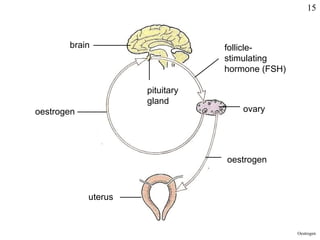
- Another example  of negative feedback is the control of the  hormone oestrogen The pituitary body produces follicle-stimulating hormone (FSH) which promotes the development of the ovarian follicles and  causes the ovaries to produce oestrogen Oestrogen also acts on the uterus and causes its lining to thicken When the oestrogen reaches a certain level in the blood, it acts on the pituitary and stops the production of more FSH If the oestrogen level in the blood falls, the pituitary begins to secrete FSH again In this case, oestrogen is exerting a  negative feedback  on the pituitary 14
Oestrogen brain pituitary gland follicle-stimulating hormone (FSH) ovary oestrogen oestrogen uterus 15

Powerpoint homeostasis

  • 1.
  • 2.
    The term ‘homeostasis’is derived from two Greek words; Homeo which means ‘unchanging’ and Stasis which means ‘standing’ In its simplest form it means ‘staying the same’ It is an organism’s internal environment which ‘stays the same’ The ‘internal environment’ refers to the conditions inside an organism. These conditions remain more or less constant despite changes such as pH or temperature in the outside environment In practice, it comes down to providing a stable environment for the cells of the body 2
  • 3.
    The living processesin the cells depend on the activity of enzymes . These enzymes work best in specific conditions such as those of temperature and pH. Any change in these conditions affects the function of the enzymes and may lead to the death of the cells or, ultimately, the whole organism This is why the internal environment needs to be regulated and kept constant. In fact, the internal conditions are not absolutely constant, but allowed to vary within very narrow limits. Human body temperature, for example, varies between 36.1 – 37.8 o C. The average temperature is usually expressed as 36.8 o C 3
  • 4.
  • 5.
    -To avoid makingexceptions and qualifications, we will consider homeostasis as it applies to the human body -There is no specific organ which controls homeostasis except, possibly, the brain -The skin , kidneys, liver , endocrine system , nervous system and sensory system all play a part in maintaining the internal environment within narrow limits -The skin is a homeostatic organ which helps maintain the body temperature within the limits given in the previous slide Definition of ‘homeostasis ’ is the maintenance of a constant internal environment. 4
  • 6.
    -The external temperaturevaries during the day and from season to season, sometimes by as much as 40 o C, ( See slide 1) but the human body temperature stays at about 37 o C -This is achieved by sweating, vasodilation, vasoconstriction, and shivering. OVERHEATING : Sweating and vasodilation OVERCOOLING : Vasoconstriction, sweat production stops and shivering. SWEATING: -If the body temperature rises, the sweat glands in the skin are activated and secrete sweat on to the surface of the skin When the sweat evaporates, it takes heat from the body and cools it down 5
  • 7.
    Sweat gland sweatpore evaporation epidermis dermis sweat duct sweat gland blood vessel Section through skin The sweat gland extracts sweat from the blood and passes it up the duct to the skin surface where it evaporates 0.25 mm 6
  • 8.
    Vasoconstriction & dilationmuch heat lost Vasodilation If the body temperature rises, the blood vessels in the skin dilate (become wider) and allow more blood to flow near the surface. The heat loss from the blood through the skin helps cool the circulating blood Vasoconstriction little heat lost If the body temperature falls. The blood vessels in the skin constrict. Less warm blood flows near the surface so less heat is lost 7
  • 9.
    Shivering Uncontrollable burstof rapid muscular contraction in the limbs release heat as a result of respiratin in the muscles.
  • 10.
    TISSUE FLUID ANDBLOOD -To carry out its living processes, every cell in the body needs a supply of oxygen and food. Waste products such as carbon dioxide have to be removed before they reach harmful levels and damage the cell - These conditions are maintained by tissue fluid bathing the cells. Tissue fluid is derived from the blood -The tissue fluid contains oxygen and food which the cells can absorb, and also accepts the carbon dioxide and other waste products produced by the cells 8
  • 11.
    Blood and tissuefluid The blood system maintains the composition of the tissue fluid cells carbon dioxide glucos e oxygen carbon dioxide tissue fluid fluid filtered out of capillary tissue fluid enters capillary blood flow 9
  • 12.
    In the livercells, the chemical breakdown of proteins produces the nitrogenous compound, urea . If this were allowed to accumulate in the cells it would damage or kill them. The concentration of the blood and tissue fluids tends to vary. If water is lost through evaporation and sweating, the fluids become more concentrated. The intake of water dilutes the fluids It is important that the concentration of blood and tissue fluid is kept within narrow limits if the cells are to function properly These homeostatic functions are carried out by the kidneys (osmoregulation). 10
  • 13.
    Kidney function Bloodpressure forces tissue fluid out of a clump of narrow capillaries The fluid trickles down this tubule and the useful substances such as glucose are reabsorbed into the blood The fluid contains urea, salts, glucose and other soluble substances Microscopic slice of kidney tissue In this tubule more or less water is reabsorbed to maintain the blood concentration Excess water, some salts and urea collect here before passing to the bladder as urine 11
  • 14.
    The glucose concentrationin the blood is controlled by the PANCREAS . The pancreas contains cells which produce digestive enzymes but it also contains cells (alpha and beta cells) which produce the hormones insulin and glucagon -If the glucose concentration rises , the beta cells release insulin. -If the glucose concentration falls , the alpha cells release glucagon. - Insulin stimulates the liver and muscles to remove excess glucose from the blood and store it as glycogen - Glucagon stimulates the liver to convert its stored glycogen into glucose which is then released into the bloodstream. 12 In this way, the concentration of glucose in the blood is kept within narrow limits
  • 15.
    -One important methodof achieving homeostasis is negative feedback -It applies to many systems in the body. Temperature regulation is one example -If the blood temperature rises , a ‘heat gain’ centre in the brain sends nerve impulses to the skin, which causes vasodilation and sweating , which cool the blood (Slide 5) -If the blood temperature falls , it stimulates a ‘heat loss’ centre in the brain which sends impulse to the skin causing vasoconstriction, the cessation of sweating and shivering . These changes reduce heat loss from the skin 13 -The warmer or cooler blood provides negative feedback to the thermoregulatory centre in the brain
  • 16.
    NEGATIVE FEEDBACK Isa system of control in which the outgoing impulses counteract the effects which produced the incoming impulses.
  • 17.
    - Another example of negative feedback is the control of the hormone oestrogen The pituitary body produces follicle-stimulating hormone (FSH) which promotes the development of the ovarian follicles and causes the ovaries to produce oestrogen Oestrogen also acts on the uterus and causes its lining to thicken When the oestrogen reaches a certain level in the blood, it acts on the pituitary and stops the production of more FSH If the oestrogen level in the blood falls, the pituitary begins to secrete FSH again In this case, oestrogen is exerting a negative feedback on the pituitary 14
  • 18.
    Oestrogen brain pituitarygland follicle-stimulating hormone (FSH) ovary oestrogen oestrogen uterus 15

Editor's Notes

  • #2 One function of homeostasis is to enable organisms to survive in extreme conditions
  • #16 The temperature regulatory centre is located in the hypothalamus, a region of the brain just above the pituitary gland , ( see slide No.15) with which it is closely associated. The hypothalamus exercises control of a number of regulatory systems.
  • #18 The temperature regulatory centre is located in the hypothalamus, a region of the brain just above the pituitary gland , ( see slide No.00)
  • #19 A follicle is a group of cells enclosing an ovum (egg cell). The follicle enlarges,and protrudes from the surface of the ovary before bursting and releasing its ovum