Maintain yourself!
What is it?
HOMEOSTASIS- this means a state of equilibrium
homeo--same stasis--standing still
A.The maintenance of a stable internal environment
Maintains conditions necessary to support life
A.A.Homeostasis is the regulation and maintenance ofHomeostasis is the regulation and maintenance of
the internal environment of the bodythe internal environment of the body
HOMEOSTASIS
It works in all levels of the body:
Cellular
Tissues
Organs
Organ Systems
Tell your table buddy what happens if your
homeostasis goes out of normal ranges and
the body cant bring it back.
HOMEOSTASIS
There are 100’s of monitored events in the
body that must be maintained in order to
function efficiently
A. these conditions are maintained by
feedback systems
There are negative and positive feedback
systems
HOMEOSTASIS
NEGATIVE FEEDBACK- this tells the body
to stop what it is doing when it goes outside
of the acceptable range.
NEGATIVE FEEDBACK EXAMPLES
EXAMPLE: when you are asked to give a report
in front of the class. You are sometimes stressed!
Your heart starts beating faster and your blood
pressure goes up
Little sensors called baroreceptors sense the
change, and the negative feedback systems will
stimulate the heart to decrease the force and
frequency of the heartbeat. Once this kicks in,
the body restores the normal blood pressure
POSITIVE FEEDBACK
POSITIVE FEEDBACK- this tells the body to
continue doing what it is doing
POSITIVE FEEDBACK
EXAMPLE OF POSITIVE FEEDBACK: when
contractions begin to push the baby into the birth
canal, the pressure of the baby stimulates
increased strength of contractions
The force of the contractions continue until the
pressure of the baby in the birth canal is
decreased
•Negative feedback loopNegative feedback loop
•original stimulus reversedoriginal stimulus reversed
•most feedback systems in the body are negativemost feedback systems in the body are negative
•used for conditions that need frequent adjustmentused for conditions that need frequent adjustment
•Positive feedback loopPositive feedback loop
•original stimulus intensifiedoriginal stimulus intensified
•seen during normal childbirthseen during normal childbirth
Feedback Loops: TypesFeedback Loops: Types
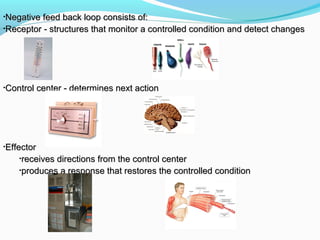
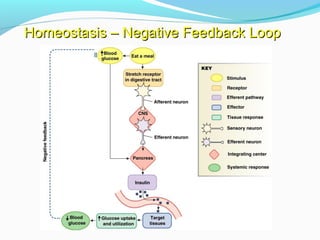
•Negative feed back loop consists of:Negative feed back loop consists of:
•Receptor - structures that monitor a controlled condition and detect changesReceptor - structures that monitor a controlled condition and detect changes
•Control center - determines next actionControl center - determines next action
•EffectorEffector
•receives directions from the control centerreceives directions from the control center
•produces a response that restores the controlled conditionproduces a response that restores the controlled condition
Homeostasis – Negative Feedback LoopHomeostasis – Negative Feedback Loop
•Stretch receptors in walls of uterus sendStretch receptors in walls of uterus send
signals to the brainsignals to the brain
•Brain induces release of hormone (oxytocin)Brain induces release of hormone (oxytocin)
into bloodstreaminto bloodstream
•Uterine smooth muscle contracts moreUterine smooth muscle contracts more
forcefullyforcefully
•More stretch, more hormone, moreMore stretch, more hormone, more
contraction etc.contraction etc.
•Cycle ends with birth of the baby & decreaseCycle ends with birth of the baby & decrease
in stretchin stretch
Positive Feedback during ChildbirthPositive Feedback during Childbirth
OTHER METHODS OF
HOMEOSTASIS
ENDOCRINE AND NERVOUS SYSTEMS-
These work together to maintain homeostasis,
and sometimes they work independently
Endocrine system delivers chemical messages
Nervous system delivers electrical messages
ENDOCRINE AND NERVOUS
Both of these systems are responsible for
blood sugar levels, electrolyte balance,
blood pressure, internal temperature, skin
temperature, blood O2 levels
BODY TEMPS
There are 2 ways of gaining heat in our
bodies
1. internal heat production:
 muscle contraction
other metabolic activities like digestion
2. environmental changes- outside
temperature
Heat loss
There are 4 different ways to loose heat from your
body:
1. Evaporation- this is heat loss from converting water
from a liquid to a vapor
2.Conduction- this is heat loss through direct contact
with something (like water)
3.Convection- the process of conduction where one
object is in motion
4.Radiation- loss of heat to the environment due to the
temperature gradient
Cool your body
1. sweating
2. Blood vessel dilation
Tell your table buddy why wearing heavy
clothes in summer heat is a bad idea.
Okay, if I’m cold, how do I warm
up?
Shivering- this is involuntary
Constriction of dermal blood vessels
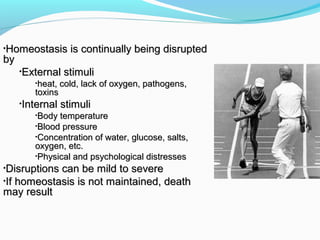
•Homeostasis is continually being disruptedHomeostasis is continually being disrupted
byby
•External stimuliExternal stimuli
•heat, cold, lack of oxygen, pathogens,heat, cold, lack of oxygen, pathogens,
toxinstoxins
•Internal stimuliInternal stimuli
•Body temperatureBody temperature
•Blood pressureBlood pressure
•Concentration of water, glucose, salts,Concentration of water, glucose, salts,
oxygen, etc.oxygen, etc.
•Physical and psychological distressesPhysical and psychological distresses
•Disruptions can be mild to severeDisruptions can be mild to severe
•If homeostasis is not maintained, deathIf homeostasis is not maintained, death
may resultmay result
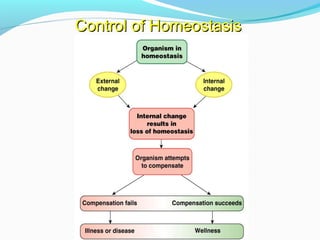
Control of HomeostasisControl of Homeostasis
tell your table buddy what is negative feedback
and positive feedback.

Homeostasi spate

  • 1.
  • 2.
    What is it? HOMEOSTASIS-this means a state of equilibrium homeo--same stasis--standing still A.The maintenance of a stable internal environment Maintains conditions necessary to support life A.A.Homeostasis is the regulation and maintenance ofHomeostasis is the regulation and maintenance of the internal environment of the bodythe internal environment of the body
  • 3.
    HOMEOSTASIS It works inall levels of the body: Cellular Tissues Organs Organ Systems
  • 4.
    Tell your tablebuddy what happens if your homeostasis goes out of normal ranges and the body cant bring it back.
  • 5.
    HOMEOSTASIS There are 100’sof monitored events in the body that must be maintained in order to function efficiently A. these conditions are maintained by feedback systems There are negative and positive feedback systems
  • 6.
    HOMEOSTASIS NEGATIVE FEEDBACK- thistells the body to stop what it is doing when it goes outside of the acceptable range.
  • 7.
    NEGATIVE FEEDBACK EXAMPLES EXAMPLE:when you are asked to give a report in front of the class. You are sometimes stressed! Your heart starts beating faster and your blood pressure goes up Little sensors called baroreceptors sense the change, and the negative feedback systems will stimulate the heart to decrease the force and frequency of the heartbeat. Once this kicks in, the body restores the normal blood pressure
  • 8.
    POSITIVE FEEDBACK POSITIVE FEEDBACK-this tells the body to continue doing what it is doing
  • 9.
    POSITIVE FEEDBACK EXAMPLE OFPOSITIVE FEEDBACK: when contractions begin to push the baby into the birth canal, the pressure of the baby stimulates increased strength of contractions The force of the contractions continue until the pressure of the baby in the birth canal is decreased
  • 10.
    •Negative feedback loopNegativefeedback loop •original stimulus reversedoriginal stimulus reversed •most feedback systems in the body are negativemost feedback systems in the body are negative •used for conditions that need frequent adjustmentused for conditions that need frequent adjustment •Positive feedback loopPositive feedback loop •original stimulus intensifiedoriginal stimulus intensified •seen during normal childbirthseen during normal childbirth Feedback Loops: TypesFeedback Loops: Types
  • 11.
    •Negative feed backloop consists of:Negative feed back loop consists of: •Receptor - structures that monitor a controlled condition and detect changesReceptor - structures that monitor a controlled condition and detect changes •Control center - determines next actionControl center - determines next action •EffectorEffector •receives directions from the control centerreceives directions from the control center •produces a response that restores the controlled conditionproduces a response that restores the controlled condition
  • 12.
    Homeostasis – NegativeFeedback LoopHomeostasis – Negative Feedback Loop
  • 13.
    •Stretch receptors inwalls of uterus sendStretch receptors in walls of uterus send signals to the brainsignals to the brain •Brain induces release of hormone (oxytocin)Brain induces release of hormone (oxytocin) into bloodstreaminto bloodstream •Uterine smooth muscle contracts moreUterine smooth muscle contracts more forcefullyforcefully •More stretch, more hormone, moreMore stretch, more hormone, more contraction etc.contraction etc. •Cycle ends with birth of the baby & decreaseCycle ends with birth of the baby & decrease in stretchin stretch Positive Feedback during ChildbirthPositive Feedback during Childbirth
  • 14.
    OTHER METHODS OF HOMEOSTASIS ENDOCRINEAND NERVOUS SYSTEMS- These work together to maintain homeostasis, and sometimes they work independently Endocrine system delivers chemical messages Nervous system delivers electrical messages
  • 15.
    ENDOCRINE AND NERVOUS Bothof these systems are responsible for blood sugar levels, electrolyte balance, blood pressure, internal temperature, skin temperature, blood O2 levels
  • 16.
    BODY TEMPS There are2 ways of gaining heat in our bodies 1. internal heat production:  muscle contraction other metabolic activities like digestion 2. environmental changes- outside temperature
  • 17.
    Heat loss There are4 different ways to loose heat from your body: 1. Evaporation- this is heat loss from converting water from a liquid to a vapor 2.Conduction- this is heat loss through direct contact with something (like water) 3.Convection- the process of conduction where one object is in motion 4.Radiation- loss of heat to the environment due to the temperature gradient
  • 18.
    Cool your body 1.sweating 2. Blood vessel dilation
  • 19.
    Tell your tablebuddy why wearing heavy clothes in summer heat is a bad idea.
  • 20.
    Okay, if I’mcold, how do I warm up? Shivering- this is involuntary Constriction of dermal blood vessels
  • 21.
    •Homeostasis is continuallybeing disruptedHomeostasis is continually being disrupted byby •External stimuliExternal stimuli •heat, cold, lack of oxygen, pathogens,heat, cold, lack of oxygen, pathogens, toxinstoxins •Internal stimuliInternal stimuli •Body temperatureBody temperature •Blood pressureBlood pressure •Concentration of water, glucose, salts,Concentration of water, glucose, salts, oxygen, etc.oxygen, etc. •Physical and psychological distressesPhysical and psychological distresses •Disruptions can be mild to severeDisruptions can be mild to severe •If homeostasis is not maintained, deathIf homeostasis is not maintained, death may resultmay result
  • 22.
  • 23.
    tell your tablebuddy what is negative feedback and positive feedback.