HOMEOSTASIS
BY: GROUP 7 (Roll No.76-88)
HOMEOSTASIS
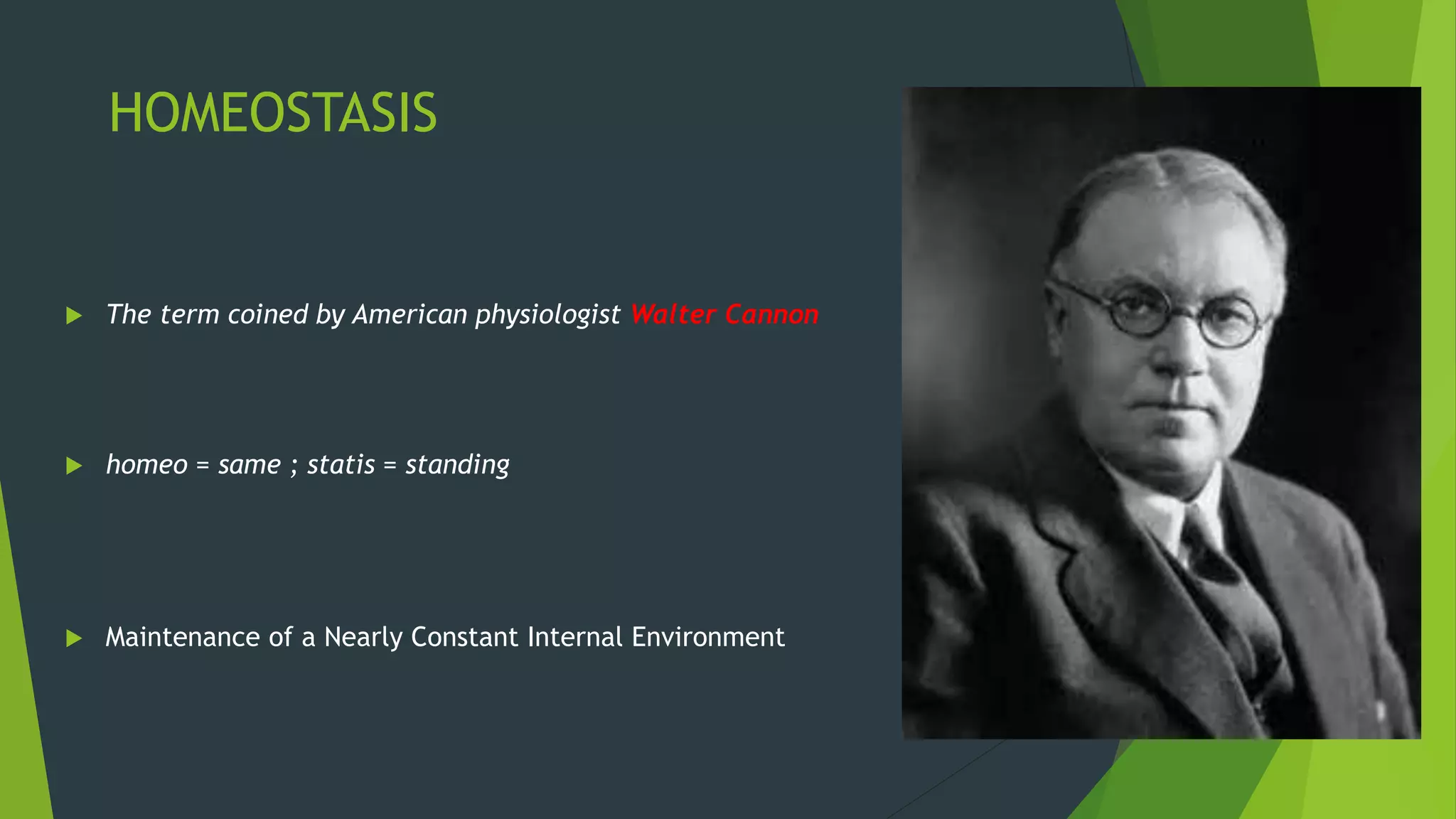
 The term coined by American physiologist Walter Cannon
 homeo = same ; statis = standing
 Maintenance of a Nearly Constant Internal Environment
WHAT IF THERE IS CHANGE IN OUR
INTERNAL ENVIRONMENT ?
 Depending upon the degree of change;
• Discomfort
• Disease
• Damage
• Death
 So any significant change in the environment is harmful to an organism.
Extracellular Fluid – The
“Internal Environment”
 In the ECF, there are the ions and nutrients needed by the cells to maintain
life.
 Thus, all cells live in essentially the same environment – the ECF.
 Claude Bernard – The Father of Physiology introduced the term
‘milieu interieur’ for the internal environment.
HOMEOSTATIC MECHANISMS
 The various physiological processes which serve to restore the normal state ,
once it has been disturbed.
 They maintain constant:
• Concentration of Oxygen and Carbon dioxide
• Concentration of nutrients and waste products
• Concentration of salts and other electrolytes
• Volume and pressure of ECF
ALL ORGANS AND ORGAN SYSTEMS OF BODY
HELP IN MAINTENANCE OF HOMEOSTASIS
 Cardiovascular System
 Respiratory System
 Nervous System
 Endocrine System
 GI System
 Excretory System
 Skeletal System
 Integumentary System
 Reproductive System
FEEDBACK MECHANISMS
 A feedback mechanism is a cycle in which some proportion of output signal is “fed back”
to the input in order to control behaviour of some system.
 A feedback mechanism may operate at:
• Tissue level
• Organ level
• Organ system level
• Body level, integrating with other organ systems.
• Feedback mechanism can be:
• Negative feedback (more common)
• Positive feedback
COMPONENTS OF A FEEDBACK SYSTEM
 SENSOR (RECEPTOR) : Detects specific changes
(stimuli) in the environment.
 INTEGRATOR : Act to direct impulses to the place
where a response can be made
 EFFECTOR : Performs the appropriate responses.
FEEDBACK LOOP
NEGATIVE FEEDBACK
 Mechanisms that maintain the factor at some mean value.
 Reverse a change.
 Restore abnormal values to normal.
NEGATIVE FEEDBACK LOOP
EXAMPLE:
 BLOOD PRESSURE
 HORMONE REGULATION
(Growth Hormone Regulation)
POSITIVE FEEDBACK
 Strengthens or reinforces a change.
 Makes abnormal values more abnormal.
 Produces ‘Vicious Cycle’.
 But in the body a mild degree of positive feedback can be overcome by the
negative feedback control mechanisms of the body, and the vicious cycle fails
to develop.
POSITIVE FEEDBACK LOOP
EXAMPLES:
 ACTION POTENTIAL
 BLOOD CLOTTING
 PARTURITION
 LACTATION
 LH SURGE
NEGATIVE vs POSITIVE FEEDBACK
EFFECTIVENESS OF FEEDBACK CONTROL-
THE PRINCIPLE OF GAIN
APPLIED PHYSIOLOGY
TYPE 1 DIABETES MELLITUS
 Blood Glucose Homeostat ceases to function.
 Beta cells of the pancreatic islets are destroyed.
 Glucose sensor is absent and thus the Insulin level
in the blood remains at zero.
 Results in gluconeogenesis by the liver.
 Fatal if not treated.
HYPERPARATHYROIDISM
 Plasma ionised Calcium homeostat ceases to function.
 Over production of parathyroid hormone (Collipse Hormone).
 Leads to spontaneous fractures.
 Conformational changes in many cell surface proteins (Ion channels and
hormone or Neurotransmitter receptors)
 Lethargy, muscle weakness, anorexia, constipation and labile emotions.
HYPERNATREMIA – HIGH LEVELS OF
SODIUM IONS IN THE BLOOD
 ADH homeostat ceases to function.
 Body water homeostat is compromised.
 Daily water losses via exhaled air, feces and insensible
sweating.
 Zero blood ADH signal.
 Kidneys produce huge unchanging volumes of very dilute
urine, causing dehydration and death if not treated.
Homeostasis

Homeostasis

  • 2.
    HOMEOSTASIS BY: GROUP 7(Roll No.76-88)
  • 4.
    HOMEOSTASIS  The termcoined by American physiologist Walter Cannon  homeo = same ; statis = standing  Maintenance of a Nearly Constant Internal Environment
  • 5.
    WHAT IF THEREIS CHANGE IN OUR INTERNAL ENVIRONMENT ?  Depending upon the degree of change; • Discomfort • Disease • Damage • Death  So any significant change in the environment is harmful to an organism.
  • 6.
    Extracellular Fluid –The “Internal Environment”  In the ECF, there are the ions and nutrients needed by the cells to maintain life.  Thus, all cells live in essentially the same environment – the ECF.  Claude Bernard – The Father of Physiology introduced the term ‘milieu interieur’ for the internal environment.
  • 7.
    HOMEOSTATIC MECHANISMS  Thevarious physiological processes which serve to restore the normal state , once it has been disturbed.  They maintain constant: • Concentration of Oxygen and Carbon dioxide • Concentration of nutrients and waste products • Concentration of salts and other electrolytes • Volume and pressure of ECF
  • 8.
    ALL ORGANS ANDORGAN SYSTEMS OF BODY HELP IN MAINTENANCE OF HOMEOSTASIS  Cardiovascular System  Respiratory System  Nervous System  Endocrine System  GI System  Excretory System  Skeletal System  Integumentary System  Reproductive System
  • 9.
    FEEDBACK MECHANISMS  Afeedback mechanism is a cycle in which some proportion of output signal is “fed back” to the input in order to control behaviour of some system.  A feedback mechanism may operate at: • Tissue level • Organ level • Organ system level • Body level, integrating with other organ systems. • Feedback mechanism can be: • Negative feedback (more common) • Positive feedback
  • 10.
    COMPONENTS OF AFEEDBACK SYSTEM  SENSOR (RECEPTOR) : Detects specific changes (stimuli) in the environment.  INTEGRATOR : Act to direct impulses to the place where a response can be made  EFFECTOR : Performs the appropriate responses. FEEDBACK LOOP
  • 11.
    NEGATIVE FEEDBACK  Mechanismsthat maintain the factor at some mean value.  Reverse a change.  Restore abnormal values to normal.
  • 12.
  • 13.
    EXAMPLE:  BLOOD PRESSURE HORMONE REGULATION (Growth Hormone Regulation)
  • 14.
    POSITIVE FEEDBACK  Strengthensor reinforces a change.  Makes abnormal values more abnormal.  Produces ‘Vicious Cycle’.  But in the body a mild degree of positive feedback can be overcome by the negative feedback control mechanisms of the body, and the vicious cycle fails to develop.
  • 15.
  • 16.
    EXAMPLES:  ACTION POTENTIAL BLOOD CLOTTING  PARTURITION  LACTATION  LH SURGE
  • 17.
  • 18.
    EFFECTIVENESS OF FEEDBACKCONTROL- THE PRINCIPLE OF GAIN
  • 19.
  • 20.
    TYPE 1 DIABETESMELLITUS  Blood Glucose Homeostat ceases to function.  Beta cells of the pancreatic islets are destroyed.  Glucose sensor is absent and thus the Insulin level in the blood remains at zero.  Results in gluconeogenesis by the liver.  Fatal if not treated.
  • 21.
    HYPERPARATHYROIDISM  Plasma ionisedCalcium homeostat ceases to function.  Over production of parathyroid hormone (Collipse Hormone).  Leads to spontaneous fractures.  Conformational changes in many cell surface proteins (Ion channels and hormone or Neurotransmitter receptors)  Lethargy, muscle weakness, anorexia, constipation and labile emotions.
  • 22.
    HYPERNATREMIA – HIGHLEVELS OF SODIUM IONS IN THE BLOOD  ADH homeostat ceases to function.  Body water homeostat is compromised.  Daily water losses via exhaled air, feces and insensible sweating.  Zero blood ADH signal.  Kidneys produce huge unchanging volumes of very dilute urine, causing dehydration and death if not treated.