11/02/2024
Body Fluids and Homeostasis
1
What is Body Fluid?
 The term refers to the body water + its dissolved substances
 BF comprises an average of 60% of total body weight
 The total body water in adult averages about 42 L
11/02/2024
Fluid Environment of the Cells
2
¨ In a 70kg man, there is 42 liters, distributed as:
1.Intracellular compartment: Fluid inside the cell (28L)
2.Extracellular compartment:(14 L)
 2 Subdivisions:
 Blood plasma 2L
 Interstitial fluid 12L
 Cells are bathed with the fluid called ECF.
 This fluid contains an optimum amount of nutrients, gasses, hormones, enzymes,
water and electrolytes
11/02/2024
Fluid Environment…
3
 The proper functioning of body cells depends on precise regulation of the
composition of the interstitial fluid surrounding them.
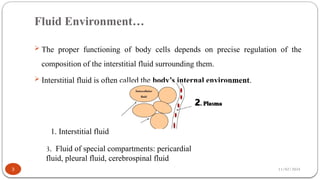
 Interstitial fluid is often called the body’s internal environment.
1. Interstitial fluid
3. Fluid of special compartments: pericardial
fluid, pleural fluid, cerebrospinal fluid
11/02/2024
Constituents of the Body Fluids
4
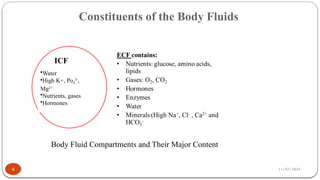
ICF
•Water
•High K+, Po4
3-
,
Mg2+
•Nutrients, gases
•Hormones
Body Fluid Compartments and Their Major Content
11/02/2024
HOMEOSTASIS AND FEEDBACK CONTROL
5
¨ Homeostasis refers to the maintenance of constant internal environment of the body
(homeo = same; stasis= standing)
¨ Dynamic mechanisms that detect and respond to deviations in physiological variables
from their “set point” values by initiating effector responses that restore the variables
to the optimal physiological range.
¨ Normal healthy living of large organisms including human beings depends upon the
constant maintenance of internal environment within the physiological limits.
¨ Essentially all organs of the body perform their functions to maintain constant
conditions in the ECF.
11/02/2024
Homeostasis cont’d…
6
o For example
¨ Lungs maintain the normal concentration of respiratory gases in blood.
¨ The CVS transports required substances and removes waste products.
¨ The kidneys maintain constant ionic concentration and
¨ The GIT provides nutrients
- Important variables within the body
11/02/2024
Homeostasis cont’d…
7
 Homeostatic regulation involves the ff. mechanisms:
The receptor (sensors or detectors)-receives information that something in the
environment is changing.
Control or integration center -receives and processes information from the
receptor.
Effector responds to the commands of the control center by either opposing or
enhancing the stimulus
11/02/2024
Homeostatic Control Mechanisms
8
imbalance
Variable(in homeostasis)
imbalance
Stimulus:
Produces
change
in variable
1
Change
detected
by receptor
2
Receptor (sensor)
Input:
Information
sent along
afferent
pathway to
3 Control
center
Output:
Information sent
along efferent
pathway to
4
Effector
Response of
effector feeds
back to influence
magnitude of
stimulus and
returns
variable to
homeostasis
5
11/02/2024
Homeostasis cont’d…
9
¨ Examples of homeostatically Regulated Variables include:
 Body Temperature
 Blood Composition (ions, sugars, proteins, etc)
 Concentrations of O2 and CO2 in the blood
 Acid-Base balance (pH)
 Blood osmolarity
 Blood pressure, cardiac output, cardiac rate
 Respiratory rate and depth
11/02/2024
Homeostasis cont’d…
10
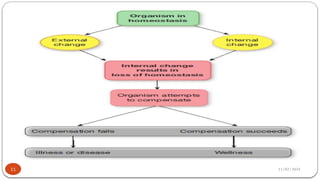
 To function optimally under a variety of conditions, the body must sense
departures from normal and then be able to activate mechanisms for restoring
physiologic conditions to normal.
 Disease is often considered to be a state of disrupted homeostasis.
 If the homeostatic imbalance is moderate, a disorder or disease may occur; if it
is severe, death may result.
11/02/2024
11
11/02/2024
Regulatory systems of homeostasis
12
¨ Body has many regulating systems that can usually bring the internal environment back
into balance.
¨ The endocrine and nervous systems are the major control systems for regulating
homeostasis.
¨ The nervous system regulates homeostasis by sending electrical signals known as nerve
impulses to organs that can counteract changes from the balanced state.
¨ The endocrine system includes many glands that secrete messenger molecules called
hormones into the blood.
11/02/2024
Homeostasis cont’d…
13
 Common Properties of Hormones and Neurotransmitters
– Both are released in small amount
– Both have receptors on the target organs
– Both act by altering their target organs
– Both work towards common goal →Homeostasis
11/02/2024
Homeostasis cont’d…
14
 But there are differences
That of the hormones is slower
Nervous regulation is faster
Nervous regulation effects are discrete.
That of the hormones is mostly diffused.
11/02/2024
Homeostasis regulation cont’d…
15
1.The nervous regulatory mechanism
¨ The nervous system regulates body functions through generation of action potential
and release of neurotransmitters.
¨ Neurotransmitters are chemicals released form nerve endings.
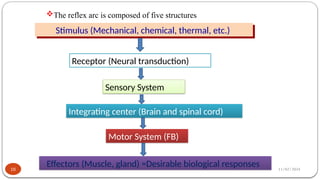
¨ To bring about complete communication among various structures of the body, there
should exist reflex arc.
¨ Reflex arc is a path of neural reflex
11/02/2024
16
The reflex arc is composed of five structures
Stimulus (Mechanical, chemical, thermal, etc.)
Receptor (Neural transduction)
Sensory System
Integrating center (Brain and spinal cord)
Motor System (FB)
Effectors (Muscle, gland) =Desirable biological responses
11/02/2024
Homeostasis regulation cont’d…
17
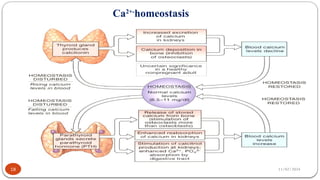
2.The hormonal regulatory mechanism
 Hormones are chemical messengers secreted by endocrine glands, and transported
via blood to the target organs including other glands.
Examples:
 Parathyroid glands secrete parathyroid hormone to the kidneys, bone
and small intestine = [Ca2+]
 Aldosterone from adrenal cortex  to the kidneys, intestine  [Na+]
 Anti-diuretic hormone (ADH) causes water retention from the kidneys and
intestine.
11/02/2024
18
Ca2+-
homeostasis
11/02/2024
19
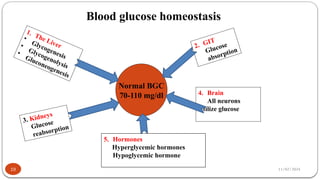
Blood glucose homeostasis
Normal BGC
70-110 mg/dl
1. The Liver
•
Glycogenesis
•
Glycogenolysis
•
Gluconeogenesis
2. GIT
Glucose
absorption
4. Brain
All neurons
Utilize glucose
5. Hormones
Hyperglycemic hormones
Hypoglycemic hormone
3. Kidneys
Glucose
reabsorption
11/02/2024
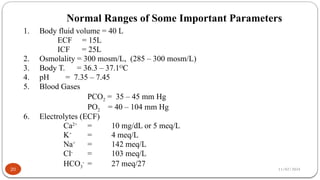
Normal Ranges of Some Important Parameters
20
1. Body fluid volume = 40 L
ECF = 15L
ICF = 25L
2. Osmolality = 300 mosm/L, (285 – 300 mosm/L)
3. Body T. = 36.3 – 37.1O
C
4. pH = 7.35 – 7.45
5. Blood Gases
PCO2 = 35 – 45 mm Hg
PO2 = 40 – 104 mm Hg
6. Electrolytes (ECF)
Ca2+
= 10 mg/dL or 5 meq/L
K+
= 4 meq/L
Na+
= 142 meq/L
Cl-
= 103 meq/L
HCO3
-
= 27 meq/27
11/02/2024
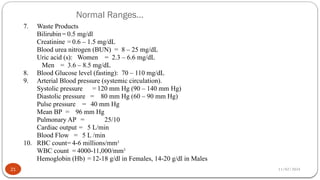
Normal Ranges…
21
7. Waste Products
Bilirubin= 0.5 mg/dl
Creatinine = 0.6 – 1.5 mg/dL
Blood urea nitrogen (BUN) = 8 – 25 mg/dL
Uric acid (s): Women = 2.3 – 6.6 mg/dL
Men = 3.6 – 8.5 mg/dL
8. Blood Glucose level (fasting): 70 – 110 mg/dL
9. Arterial Blood pressure (systemic circulation).
Systolic pressure = 120 mm Hg (90 – 140 mm Hg)
Diastolic pressure = 80 mm Hg (60 – 90 mm Hg)
Pulse pressure = 40 mm Hg
Mean BP = 96 mm Hg
Pulmonary AP = 25/10
Cardiac output = 5 L/min
Blood Flow = 5 L /min
10. RBC count= 4-6 millions/mm3
WBC count = 4000-11,000/mm3
Hemoglobin (Hb) = 12-18 g/dl in Females, 14-20 g/dl in Males
11/02/2024
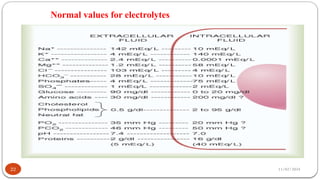
Normal values for electrolytes
22
11/02/2024
Feedback Control Mechanisms of the Homeostasis
23
¨ The body can regulate its internal environment through many feedback systems.
¨ A feedback system or feedback loop is a cycle of events in which the status of a body
condition is monitored, evaluated, changed, re monitored, reevaluated.
¨ There are three types of feed back mechanisms:-
The Negative Feedback Mechanism (NFM)
The Positive Feedback Mechanism (PFM)
 Feed-forward Mechanism.
11/02/2024
Negative Feedback Mechanism (NFM)
24
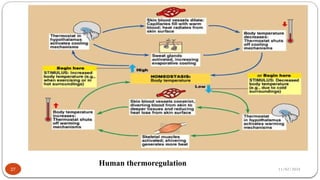
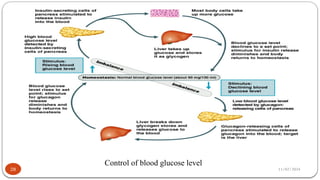
 Negative feedback is the initiation of responses that counter deviations of a
controlled variable from its normal range and it is the major control process used to
maintain a stable internal environment.
 Most control systems of the body.
 It works by producing an effect which opposes the previous condition (the
initiating stimulus) of the organ.
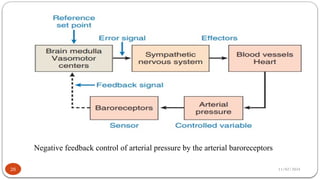
 The components of a simple negative-feedback control system include a regulated
variable, sensor (or detector), controller (or comparator), and effector.
11/02/2024
NFM…
25
¨ In general, if some factors (parameters) become excessive or too little, a control
system initiates the NFM, which consists of a series of changes that return the
factors toward certain mean values (set point or normal values), thus, maintaining
homeostasis.
¨ Most homeostatic values of the body are controlled by NFM.
¨ Variables controlled by negative feedback mechanism includes:
Control of Body temperature (BT)
Control of Arterial blood pressure (ABP)
Control of Blood glucose level (BGL)
Blood gases level and manControl of Blood glucose levely others
11/02/2024
26
Negative feedback control of arterial pressure by the arterial baroreceptors
11/02/2024
27
Human thermoregulation
11/02/2024
28
Control of blood glucose level
11/02/2024
The Positive Feedback Mechanism (PFM)
29
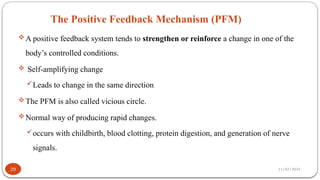
A positive feedback system tends to strengthen or reinforce a change in one of the
body’s controlled conditions.
 Self-amplifying change
Leads to change in the same direction
The PFM is also called vicious circle.
Normal way of producing rapid changes.
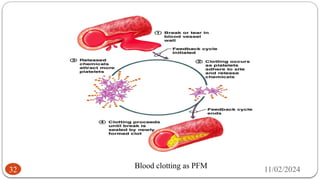
occurs with childbirth, blood clotting, protein digestion, and generation of nerve
signals.
11/02/2024
PFM…
30
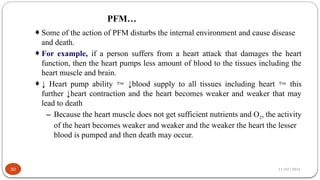
¨Some of the action of PFM disturbs the internal environment and cause disease
and death.
¨For example, if a person suffers from a heart attack that damages the heart
function, then the heart pumps less amount of blood to the tissues including the
heart muscle and brain.
¨↓ Heart pump ability  ↓blood supply to all tissues including heart  this
further ↓heart contraction and the heart becomes weaker and weaker that may
lead to death
– Because the heart muscle does not get sufficient nutrients and O2, the activity
of the heart becomes weaker and weaker and the weaker the heart the lesser
blood is pumped and then death may occur.
11/02/2024
Examples of the PFM…
31
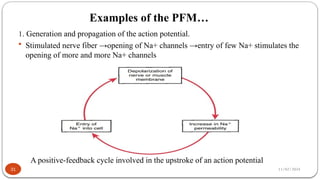
1. Generation and propagation of the action potential.
 Stimulated nerve fiber →opening of Na+ channels →entry of few Na+ stimulates the
opening of more and more Na+ channels
A positive-feedback cycle involved in the upstroke of an action potential
11/02/2024
32 Blood clotting as PFM
11/02/2024
Labor during child birth as PFM
33
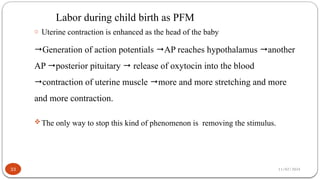
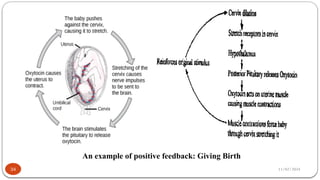
o Uterine contraction is enhanced as the head of the baby
Generation of action potentials AP reaches hypothalamus another
AP posterior pituitary  release of oxytocin into the blood
contraction of uterine muscle more and more stretching and more
and more contraction.
The only way to stop this kind of phenomenon is removing the stimulus.
11/02/2024
34
An example of positive feedback: Giving Birth
11/02/2024
Feedforward control mechanism
35
¨ Another strategy for regulating systems in the body, particularly when a change
with time is desired.
¨ Enables the body to anticipate a change and start a reflex loop .
¨ The regulated variable is not sensed –open loop.
¨ Sense a disturbance and take corrective action that anticipates change.
Example:-Heart rate and breathing increase even before a person has begun to
exercise.
>> Usually acts in combination with negative-feedback system.

1.Internal and external fluid 2. homeostasis

  • 1.
    11/02/2024 Body Fluids andHomeostasis 1 What is Body Fluid?  The term refers to the body water + its dissolved substances  BF comprises an average of 60% of total body weight  The total body water in adult averages about 42 L
  • 2.
    11/02/2024 Fluid Environment ofthe Cells 2 ¨ In a 70kg man, there is 42 liters, distributed as: 1.Intracellular compartment: Fluid inside the cell (28L) 2.Extracellular compartment:(14 L)  2 Subdivisions:  Blood plasma 2L  Interstitial fluid 12L  Cells are bathed with the fluid called ECF.  This fluid contains an optimum amount of nutrients, gasses, hormones, enzymes, water and electrolytes
  • 3.
    11/02/2024 Fluid Environment… 3  Theproper functioning of body cells depends on precise regulation of the composition of the interstitial fluid surrounding them.  Interstitial fluid is often called the body’s internal environment. 1. Interstitial fluid 3. Fluid of special compartments: pericardial fluid, pleural fluid, cerebrospinal fluid
  • 4.
    11/02/2024 Constituents of theBody Fluids 4 ICF •Water •High K+, Po4 3- , Mg2+ •Nutrients, gases •Hormones Body Fluid Compartments and Their Major Content
  • 5.
    11/02/2024 HOMEOSTASIS AND FEEDBACKCONTROL 5 ¨ Homeostasis refers to the maintenance of constant internal environment of the body (homeo = same; stasis= standing) ¨ Dynamic mechanisms that detect and respond to deviations in physiological variables from their “set point” values by initiating effector responses that restore the variables to the optimal physiological range. ¨ Normal healthy living of large organisms including human beings depends upon the constant maintenance of internal environment within the physiological limits. ¨ Essentially all organs of the body perform their functions to maintain constant conditions in the ECF.
  • 6.
    11/02/2024 Homeostasis cont’d… 6 o Forexample ¨ Lungs maintain the normal concentration of respiratory gases in blood. ¨ The CVS transports required substances and removes waste products. ¨ The kidneys maintain constant ionic concentration and ¨ The GIT provides nutrients - Important variables within the body
  • 7.
    11/02/2024 Homeostasis cont’d… 7  Homeostaticregulation involves the ff. mechanisms: The receptor (sensors or detectors)-receives information that something in the environment is changing. Control or integration center -receives and processes information from the receptor. Effector responds to the commands of the control center by either opposing or enhancing the stimulus
  • 8.
    11/02/2024 Homeostatic Control Mechanisms 8 imbalance Variable(inhomeostasis) imbalance Stimulus: Produces change in variable 1 Change detected by receptor 2 Receptor (sensor) Input: Information sent along afferent pathway to 3 Control center Output: Information sent along efferent pathway to 4 Effector Response of effector feeds back to influence magnitude of stimulus and returns variable to homeostasis 5
  • 9.
    11/02/2024 Homeostasis cont’d… 9 ¨ Examplesof homeostatically Regulated Variables include:  Body Temperature  Blood Composition (ions, sugars, proteins, etc)  Concentrations of O2 and CO2 in the blood  Acid-Base balance (pH)  Blood osmolarity  Blood pressure, cardiac output, cardiac rate  Respiratory rate and depth
  • 10.
    11/02/2024 Homeostasis cont’d… 10  Tofunction optimally under a variety of conditions, the body must sense departures from normal and then be able to activate mechanisms for restoring physiologic conditions to normal.  Disease is often considered to be a state of disrupted homeostasis.  If the homeostatic imbalance is moderate, a disorder or disease may occur; if it is severe, death may result.
  • 11.
  • 12.
    11/02/2024 Regulatory systems ofhomeostasis 12 ¨ Body has many regulating systems that can usually bring the internal environment back into balance. ¨ The endocrine and nervous systems are the major control systems for regulating homeostasis. ¨ The nervous system regulates homeostasis by sending electrical signals known as nerve impulses to organs that can counteract changes from the balanced state. ¨ The endocrine system includes many glands that secrete messenger molecules called hormones into the blood.
  • 13.
    11/02/2024 Homeostasis cont’d… 13  CommonProperties of Hormones and Neurotransmitters – Both are released in small amount – Both have receptors on the target organs – Both act by altering their target organs – Both work towards common goal →Homeostasis
  • 14.
    11/02/2024 Homeostasis cont’d… 14  Butthere are differences That of the hormones is slower Nervous regulation is faster Nervous regulation effects are discrete. That of the hormones is mostly diffused.
  • 15.
    11/02/2024 Homeostasis regulation cont’d… 15 1.Thenervous regulatory mechanism ¨ The nervous system regulates body functions through generation of action potential and release of neurotransmitters. ¨ Neurotransmitters are chemicals released form nerve endings. ¨ To bring about complete communication among various structures of the body, there should exist reflex arc. ¨ Reflex arc is a path of neural reflex
  • 16.
    11/02/2024 16 The reflex arcis composed of five structures Stimulus (Mechanical, chemical, thermal, etc.) Receptor (Neural transduction) Sensory System Integrating center (Brain and spinal cord) Motor System (FB) Effectors (Muscle, gland) =Desirable biological responses
  • 17.
    11/02/2024 Homeostasis regulation cont’d… 17 2.Thehormonal regulatory mechanism  Hormones are chemical messengers secreted by endocrine glands, and transported via blood to the target organs including other glands. Examples:  Parathyroid glands secrete parathyroid hormone to the kidneys, bone and small intestine = [Ca2+]  Aldosterone from adrenal cortex  to the kidneys, intestine  [Na+]  Anti-diuretic hormone (ADH) causes water retention from the kidneys and intestine.
  • 18.
  • 19.
    11/02/2024 19 Blood glucose homeostasis NormalBGC 70-110 mg/dl 1. The Liver • Glycogenesis • Glycogenolysis • Gluconeogenesis 2. GIT Glucose absorption 4. Brain All neurons Utilize glucose 5. Hormones Hyperglycemic hormones Hypoglycemic hormone 3. Kidneys Glucose reabsorption
  • 20.
    11/02/2024 Normal Ranges ofSome Important Parameters 20 1. Body fluid volume = 40 L ECF = 15L ICF = 25L 2. Osmolality = 300 mosm/L, (285 – 300 mosm/L) 3. Body T. = 36.3 – 37.1O C 4. pH = 7.35 – 7.45 5. Blood Gases PCO2 = 35 – 45 mm Hg PO2 = 40 – 104 mm Hg 6. Electrolytes (ECF) Ca2+ = 10 mg/dL or 5 meq/L K+ = 4 meq/L Na+ = 142 meq/L Cl- = 103 meq/L HCO3 - = 27 meq/27
  • 21.
    11/02/2024 Normal Ranges… 21 7. WasteProducts Bilirubin= 0.5 mg/dl Creatinine = 0.6 – 1.5 mg/dL Blood urea nitrogen (BUN) = 8 – 25 mg/dL Uric acid (s): Women = 2.3 – 6.6 mg/dL Men = 3.6 – 8.5 mg/dL 8. Blood Glucose level (fasting): 70 – 110 mg/dL 9. Arterial Blood pressure (systemic circulation). Systolic pressure = 120 mm Hg (90 – 140 mm Hg) Diastolic pressure = 80 mm Hg (60 – 90 mm Hg) Pulse pressure = 40 mm Hg Mean BP = 96 mm Hg Pulmonary AP = 25/10 Cardiac output = 5 L/min Blood Flow = 5 L /min 10. RBC count= 4-6 millions/mm3 WBC count = 4000-11,000/mm3 Hemoglobin (Hb) = 12-18 g/dl in Females, 14-20 g/dl in Males
  • 22.
  • 23.
    11/02/2024 Feedback Control Mechanismsof the Homeostasis 23 ¨ The body can regulate its internal environment through many feedback systems. ¨ A feedback system or feedback loop is a cycle of events in which the status of a body condition is monitored, evaluated, changed, re monitored, reevaluated. ¨ There are three types of feed back mechanisms:- The Negative Feedback Mechanism (NFM) The Positive Feedback Mechanism (PFM)  Feed-forward Mechanism.
  • 24.
    11/02/2024 Negative Feedback Mechanism(NFM) 24  Negative feedback is the initiation of responses that counter deviations of a controlled variable from its normal range and it is the major control process used to maintain a stable internal environment.  Most control systems of the body.  It works by producing an effect which opposes the previous condition (the initiating stimulus) of the organ.  The components of a simple negative-feedback control system include a regulated variable, sensor (or detector), controller (or comparator), and effector.
  • 25.
    11/02/2024 NFM… 25 ¨ In general,if some factors (parameters) become excessive or too little, a control system initiates the NFM, which consists of a series of changes that return the factors toward certain mean values (set point or normal values), thus, maintaining homeostasis. ¨ Most homeostatic values of the body are controlled by NFM. ¨ Variables controlled by negative feedback mechanism includes: Control of Body temperature (BT) Control of Arterial blood pressure (ABP) Control of Blood glucose level (BGL) Blood gases level and manControl of Blood glucose levely others
  • 26.
    11/02/2024 26 Negative feedback controlof arterial pressure by the arterial baroreceptors
  • 27.
  • 28.
  • 29.
    11/02/2024 The Positive FeedbackMechanism (PFM) 29 A positive feedback system tends to strengthen or reinforce a change in one of the body’s controlled conditions.  Self-amplifying change Leads to change in the same direction The PFM is also called vicious circle. Normal way of producing rapid changes. occurs with childbirth, blood clotting, protein digestion, and generation of nerve signals.
  • 30.
    11/02/2024 PFM… 30 ¨Some of theaction of PFM disturbs the internal environment and cause disease and death. ¨For example, if a person suffers from a heart attack that damages the heart function, then the heart pumps less amount of blood to the tissues including the heart muscle and brain. ¨↓ Heart pump ability  ↓blood supply to all tissues including heart  this further ↓heart contraction and the heart becomes weaker and weaker that may lead to death – Because the heart muscle does not get sufficient nutrients and O2, the activity of the heart becomes weaker and weaker and the weaker the heart the lesser blood is pumped and then death may occur.
  • 31.
    11/02/2024 Examples of thePFM… 31 1. Generation and propagation of the action potential.  Stimulated nerve fiber →opening of Na+ channels →entry of few Na+ stimulates the opening of more and more Na+ channels A positive-feedback cycle involved in the upstroke of an action potential
  • 32.
  • 33.
    11/02/2024 Labor during childbirth as PFM 33 o Uterine contraction is enhanced as the head of the baby Generation of action potentials AP reaches hypothalamus another AP posterior pituitary  release of oxytocin into the blood contraction of uterine muscle more and more stretching and more and more contraction. The only way to stop this kind of phenomenon is removing the stimulus.
  • 34.
    11/02/2024 34 An example ofpositive feedback: Giving Birth
  • 35.
    11/02/2024 Feedforward control mechanism 35 ¨Another strategy for regulating systems in the body, particularly when a change with time is desired. ¨ Enables the body to anticipate a change and start a reflex loop . ¨ The regulated variable is not sensed –open loop. ¨ Sense a disturbance and take corrective action that anticipates change. Example:-Heart rate and breathing increase even before a person has begun to exercise. >> Usually acts in combination with negative-feedback system.