SEMINAR ONSEMINAR ON
HIGH SPEED CNCHIGH SPEED CNC
Presented By
Satish Baburao Ligade
I st year M.Tech(CAD-CAM)
ContentsContents
 IntroductionIntroduction
 High Speed CNCHigh Speed CNC
 Typical High speed CNCTypical High speed CNC
 AdvantagesAdvantages
 Application areasApplication areas
 Demands of the machineDemands of the machine
 Cutting toolCutting tool
 ComparisonComparison
 DisadvantagesDisadvantages
 ConclusionsConclusions
IntroductionIntroduction
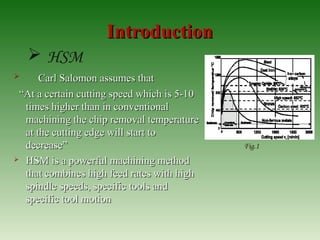
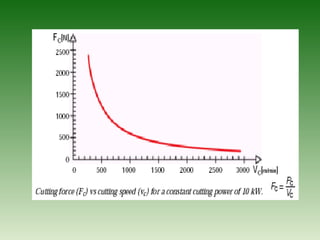
 Carl Salomon assumes thatCarl Salomon assumes that
““At a certain cutting speed which is 5-10At a certain cutting speed which is 5-10
times higher than in conventionaltimes higher than in conventional
machining the chip removal temperaturemachining the chip removal temperature
at the cutting edge will start toat the cutting edge will start to
decrease”decrease”
 HSM is a powerful machining methodHSM is a powerful machining method
that combines high feed rates with highthat combines high feed rates with high
spindle speeds, specific tools andspindle speeds, specific tools and
specific tool motionspecific tool motion
 HSM
Fig.1
High Speed CNCHigh Speed CNC
 Combine roughing and finishing passesCombine roughing and finishing passes
 Machining at resonant frequency of machineMachining at resonant frequency of machine
 Improved life of spindle, secure clamping ofImproved life of spindle, secure clamping of
tools & life of toolstools & life of tools
 Saving of 40% time in whole processSaving of 40% time in whole process
 It prefers smaller tools that moves fasterIt prefers smaller tools that moves faster
High Speed CNCHigh Speed CNC
Typical Datron High Speed CNCTypical Datron High Speed CNC
Intelligent ProbingIntelligent Probing
Spindle speed upto 60,000rpmSpindle speed upto 60,000rpm
Automatic tool managementAutomatic tool management
Spray-mist coolant systemSpray-mist coolant system
Integrated work holdingIntegrated work holding
Low power technologyLow power technology
ProbingProbing
 Probe recognizes irregular work-Probe recognizes irregular work-
piece topography and compensatespiece topography and compensates
for it dynamically.for it dynamically.
 job setup times reduced andjob setup times reduced and
workpiece rejection is minimized.workpiece rejection is minimized.
 Compensate for material variationCompensate for material variation
 Allow for reverse engineering ofAllow for reverse engineering of
many partsmany parts
Fig.2 Z correction probe
Spindle speedSpindle speed
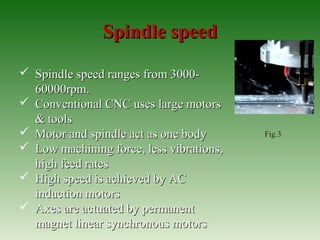
 Spindle speed ranges from 3000-Spindle speed ranges from 3000-
60000rpm.60000rpm.
 Conventional CNC uses large motorsConventional CNC uses large motors
& tools& tools
 Motor and spindle act as one bodyMotor and spindle act as one body
 Low machining force, less vibrations,Low machining force, less vibrations,
high feed rateshigh feed rates
 High speed is achieved by ACHigh speed is achieved by AC
induction motorsinduction motors
 Axes are actuated by permanentAxes are actuated by permanent
magnet linear synchronous motorsmagnet linear synchronous motors
Fig.3
Spray coolantSpray coolant
 Ethanol is used as ideal coolantEthanol is used as ideal coolant
 Spray technology & low viscositySpray technology & low viscosity
allows ethanol to cover more area &allows ethanol to cover more area &
cools fastercools faster
 Low evaporation point makesLow evaporation point makes
disposal easydisposal easy
 Used for non-ferrous materialUsed for non-ferrous material
Fig.4
Low-Power Technology
 Designed with smaller motorsDesigned with smaller motors
 Most of CNC runs on 440volt,20AMost of CNC runs on 440volt,20A
&3 phase supply&3 phase supply
 High speed CNC runs on 200High speed CNC runs on 200
volt,10A & 1phase supplyvolt,10A & 1phase supply
 Decrease energy consuptionDecrease energy consuption Fig.5
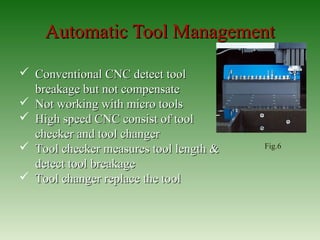
Automatic Tool ManagementAutomatic Tool Management
 Conventional CNC detect toolConventional CNC detect tool
breakage but not compensatebreakage but not compensate
 Not working with micro toolsNot working with micro tools
 High speed CNC consist of toolHigh speed CNC consist of tool
checker and tool changerchecker and tool changer
 Tool checker measures tool length &Tool checker measures tool length &
detect tool breakagedetect tool breakage
 Tool changer replace the toolTool changer replace the tool
Fig.6
AdvantagesAdvantages
 High material removal rateHigh material removal rate
 High surface finishHigh surface finish
 Increased productivityIncreased productivity
 Machining of any material using ultra-high performance toolsMachining of any material using ultra-high performance tools
 Reduction in lead timesReduction in lead times
 Low cutting force ,reduce cycle times & improve accuracy.Low cutting force ,reduce cycle times & improve accuracy.
 Cutting tool and work piece temperature are kept lowCutting tool and work piece temperature are kept low
 It eliminates the need of coolantIt eliminates the need of coolant
 High Speed CNC is experienced in various types of materialsHigh Speed CNC is experienced in various types of materials
such as aluminum, stainless steels and titanium as well assuch as aluminum, stainless steels and titanium as well as
inconels, hastelloys, copper, brass, plastic and moreinconels, hastelloys, copper, brass, plastic and more
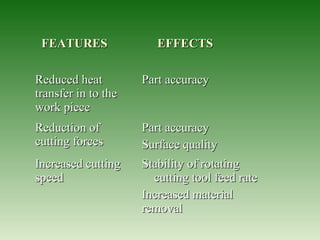
FEATURESFEATURES EFFECTSEFFECTS
Reduced heatReduced heat
transfer in to thetransfer in to the
work piecework piece
Part accuracyPart accuracy
Reduction ofReduction of
cutting forcescutting forces
Part accuracyPart accuracy
Surface qualitySurface quality
Increased cuttingIncreased cutting
speedspeed
Stability of rotatingStability of rotating
cutting tool feed ratecutting tool feed rate
Increased materialIncreased material
removalremoval
ApplicationsApplications
 Mostly used in milling hard mold and die steelsMostly used in milling hard mold and die steels
 Industry which deals with the machining of Al toIndustry which deals with the machining of Al to
produce automotive components, small computerproduce automotive components, small computer
parts or medical devicesparts or medical devices
 Aircraft industry involves machining of Al often withAircraft industry involves machining of Al often with
thin wallsthin walls
 Prototyping of dies and moldsPrototyping of dies and molds
 Semiconductor parts, microwave housingSemiconductor parts, microwave housing
Demands of the machineDemands of the machine
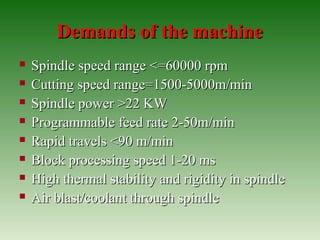
 Spindle speed range <=60000 rpmSpindle speed range <=60000 rpm
 Cutting speed range=1500-5000m/minCutting speed range=1500-5000m/min
 Spindle power >22 KWSpindle power >22 KW
 Programmable feed rate 2-50m/minProgrammable feed rate 2-50m/min
 Rapid travels <90 m/minRapid travels <90 m/min
 Block processing speed 1-20 msBlock processing speed 1-20 ms
 High thermal stability and rigidity in spindleHigh thermal stability and rigidity in spindle
 Air blast/coolant through spindleAir blast/coolant through spindle
HighSpeedCNC Mill-YouTube.webm
Cutting toolsCutting tools
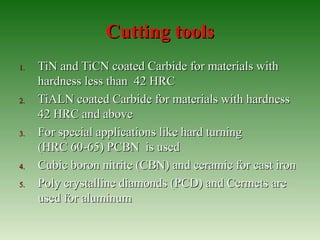
1.1. TiN and TiCN coated Carbide for materials withTiN and TiCN coated Carbide for materials with
hardness less than 42 HRChardness less than 42 HRC
2.2. TiALN coated Carbide for materials with hardnessTiALN coated Carbide for materials with hardness
42 HRC and above42 HRC and above
3.3. For special applications like hard turningFor special applications like hard turning
(HRC 60-65) PCBN is used(HRC 60-65) PCBN is used
4.4. Cubic boron nitrite (CBN) and ceramic for cast ironCubic boron nitrite (CBN) and ceramic for cast iron
5.5. Poly crystalline diamonds (PCD) and Cermets arePoly crystalline diamonds (PCD) and Cermets are
used for aluminumused for aluminum
ComparisonsComparisons
MODEL(HAAS) VF-2
Travel / Table X axis travel mm 763
Yaxis travel mm 406
Z axis travel mm 508
Spindle nose to table surface mm 102-610
Table size mm/mm 914x 356
Max. table loading kgs 1361
T slot (N x W x P) 3x 16 x
125
Spindle / Feed Speed (Std.) rpm 8000
Speed (Opt.) rpm 8100
Spindle taper BT40
Feed X 、 Y 、 Z(G00) 25.4/25.4/2
5.4 m/min
Cuting feed 16500
mm/min
Tool Magazine Taper BBT40
Tool length mm 300
Tool magazine capacity 20
Max. tool diameter 80
Max. tool weight kgs 7
Tool change time SEC 4.5
Machine Dimension Length mm 4395
Deepth mm 2250
Height mm 2900
Machine Weight N.W. kgs 3300
G.W. kgs 3500
MODEL(SAN EAGLE) SHD-600
Travel / Table X axis travel mm 600
Yaxis travel mm 550
Z axis travel mm 360
Spindle nose to table surface mm 360
Table size mm/mm 600 x 550
Max. table loading kgs 300
T slot (N x W x P) 4 x 14 x
100
Spindle / Feed Speed (Std.) rpm 30,000
Speed (Opt.) rpm 36,000
Spindle taper HSK-E40
Feed X 、 Y 、 Z(G00) 30/30/24
m/min
Cuting feed 20000
mm/min
Tool Magazine Taper HSK-E40
Tool length mm 150
Tool magazine capacity 20
Max. tool diameter 40
Max. tool weight kgs 3
Tool change time SEC 7
Machine Length mm 2080
Deepth mm 2180
Height mm 2550
Machine Weight N.W. kgs 4500
ComparisonsComparisons
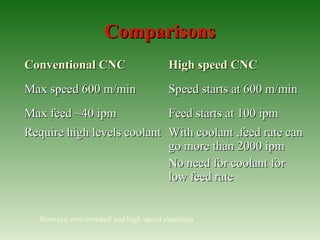
Conventional CNCConventional CNC High speed CNCHigh speed CNC
Max speed 600 m/minMax speed 600 m/min Speed starts at 600 m/minSpeed starts at 600 m/min
Max feed ~40 ipmMax feed ~40 ipm Feed starts at 100 ipmFeed starts at 100 ipm
Require high levels coolantRequire high levels coolant With coolant ,feed rate canWith coolant ,feed rate can
go more than 2000 ipmgo more than 2000 ipm
No need for coolant forNo need for coolant for
low feed ratelow feed rate
Between conventional and high speed machines
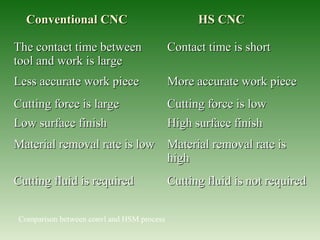
Conventional CNCConventional CNC HS CNCHS CNC
The contact time betweenThe contact time between
tool and work is largetool and work is large
Contact time is shortContact time is short
Less accurate work pieceLess accurate work piece More accurate work pieceMore accurate work piece
Cutting force is largeCutting force is large Cutting force is lowCutting force is low
Low surface finishLow surface finish High surface finishHigh surface finish
Material removal rate is lowMaterial removal rate is low Material removal rate isMaterial removal rate is
highhigh
Cutting fluid is requiredCutting fluid is required Cutting fluid is not requiredCutting fluid is not required
Comparison between convl and HSM process
DisadvantagesDisadvantages
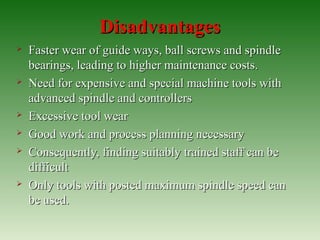
 Faster wear of guide ways, ball screws and spindleFaster wear of guide ways, ball screws and spindle
bearings, leading to higher maintenance costs.bearings, leading to higher maintenance costs.
 Need for expensive and special machine tools withNeed for expensive and special machine tools with
advanced spindle and controllersadvanced spindle and controllers
 Excessive tool wearExcessive tool wear
 Good work and process planning necessaryGood work and process planning necessary
 Consequently, finding suitably trained staff can beConsequently, finding suitably trained staff can be
difficultdifficult
 Only tools with posted maximum spindle speed canOnly tools with posted maximum spindle speed can
be used.be used.
ConclusionsConclusions
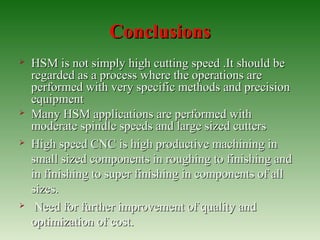
 HSM is not simply high cutting speed .It should beHSM is not simply high cutting speed .It should be
regarded as a process where the operations areregarded as a process where the operations are
performed with very specific methods and precisionperformed with very specific methods and precision
equipmentequipment
 Many HSM applications are performed withMany HSM applications are performed with
moderate spindle speeds and large sized cuttersmoderate spindle speeds and large sized cutters
 High speed CNC is high productive machining inHigh speed CNC is high productive machining in
small sized components in roughing to finishing andsmall sized components in roughing to finishing and
in finishing to super finishing in components of allin finishing to super finishing in components of all
sizes.sizes.
 Need for further improvement of quality andNeed for further improvement of quality and
optimization of cost.optimization of cost.
Questions
?

High speed cnc ppt

  • 1.
    SEMINAR ONSEMINAR ON HIGHSPEED CNCHIGH SPEED CNC Presented By Satish Baburao Ligade I st year M.Tech(CAD-CAM)
  • 2.
    ContentsContents  IntroductionIntroduction  HighSpeed CNCHigh Speed CNC  Typical High speed CNCTypical High speed CNC  AdvantagesAdvantages  Application areasApplication areas  Demands of the machineDemands of the machine  Cutting toolCutting tool  ComparisonComparison  DisadvantagesDisadvantages  ConclusionsConclusions
  • 3.
    IntroductionIntroduction  Carl Salomonassumes thatCarl Salomon assumes that ““At a certain cutting speed which is 5-10At a certain cutting speed which is 5-10 times higher than in conventionaltimes higher than in conventional machining the chip removal temperaturemachining the chip removal temperature at the cutting edge will start toat the cutting edge will start to decrease”decrease”  HSM is a powerful machining methodHSM is a powerful machining method that combines high feed rates with highthat combines high feed rates with high spindle speeds, specific tools andspindle speeds, specific tools and specific tool motionspecific tool motion  HSM Fig.1
  • 4.
    High Speed CNCHighSpeed CNC  Combine roughing and finishing passesCombine roughing and finishing passes  Machining at resonant frequency of machineMachining at resonant frequency of machine  Improved life of spindle, secure clamping ofImproved life of spindle, secure clamping of tools & life of toolstools & life of tools  Saving of 40% time in whole processSaving of 40% time in whole process  It prefers smaller tools that moves fasterIt prefers smaller tools that moves faster
  • 5.
    High Speed CNCHighSpeed CNC Typical Datron High Speed CNCTypical Datron High Speed CNC Intelligent ProbingIntelligent Probing Spindle speed upto 60,000rpmSpindle speed upto 60,000rpm Automatic tool managementAutomatic tool management Spray-mist coolant systemSpray-mist coolant system Integrated work holdingIntegrated work holding Low power technologyLow power technology
  • 6.
    ProbingProbing  Probe recognizesirregular work-Probe recognizes irregular work- piece topography and compensatespiece topography and compensates for it dynamically.for it dynamically.  job setup times reduced andjob setup times reduced and workpiece rejection is minimized.workpiece rejection is minimized.  Compensate for material variationCompensate for material variation  Allow for reverse engineering ofAllow for reverse engineering of many partsmany parts Fig.2 Z correction probe
  • 7.
    Spindle speedSpindle speed Spindle speed ranges from 3000-Spindle speed ranges from 3000- 60000rpm.60000rpm.  Conventional CNC uses large motorsConventional CNC uses large motors & tools& tools  Motor and spindle act as one bodyMotor and spindle act as one body  Low machining force, less vibrations,Low machining force, less vibrations, high feed rateshigh feed rates  High speed is achieved by ACHigh speed is achieved by AC induction motorsinduction motors  Axes are actuated by permanentAxes are actuated by permanent magnet linear synchronous motorsmagnet linear synchronous motors Fig.3
  • 8.
    Spray coolantSpray coolant Ethanol is used as ideal coolantEthanol is used as ideal coolant  Spray technology & low viscositySpray technology & low viscosity allows ethanol to cover more area &allows ethanol to cover more area & cools fastercools faster  Low evaporation point makesLow evaporation point makes disposal easydisposal easy  Used for non-ferrous materialUsed for non-ferrous material Fig.4
  • 9.
    Low-Power Technology  Designedwith smaller motorsDesigned with smaller motors  Most of CNC runs on 440volt,20AMost of CNC runs on 440volt,20A &3 phase supply&3 phase supply  High speed CNC runs on 200High speed CNC runs on 200 volt,10A & 1phase supplyvolt,10A & 1phase supply  Decrease energy consuptionDecrease energy consuption Fig.5
  • 10.
    Automatic Tool ManagementAutomaticTool Management  Conventional CNC detect toolConventional CNC detect tool breakage but not compensatebreakage but not compensate  Not working with micro toolsNot working with micro tools  High speed CNC consist of toolHigh speed CNC consist of tool checker and tool changerchecker and tool changer  Tool checker measures tool length &Tool checker measures tool length & detect tool breakagedetect tool breakage  Tool changer replace the toolTool changer replace the tool Fig.6
  • 11.
    AdvantagesAdvantages  High materialremoval rateHigh material removal rate  High surface finishHigh surface finish  Increased productivityIncreased productivity  Machining of any material using ultra-high performance toolsMachining of any material using ultra-high performance tools  Reduction in lead timesReduction in lead times  Low cutting force ,reduce cycle times & improve accuracy.Low cutting force ,reduce cycle times & improve accuracy.  Cutting tool and work piece temperature are kept lowCutting tool and work piece temperature are kept low  It eliminates the need of coolantIt eliminates the need of coolant  High Speed CNC is experienced in various types of materialsHigh Speed CNC is experienced in various types of materials such as aluminum, stainless steels and titanium as well assuch as aluminum, stainless steels and titanium as well as inconels, hastelloys, copper, brass, plastic and moreinconels, hastelloys, copper, brass, plastic and more
  • 12.
    FEATURESFEATURES EFFECTSEFFECTS Reduced heatReducedheat transfer in to thetransfer in to the work piecework piece Part accuracyPart accuracy Reduction ofReduction of cutting forcescutting forces Part accuracyPart accuracy Surface qualitySurface quality Increased cuttingIncreased cutting speedspeed Stability of rotatingStability of rotating cutting tool feed ratecutting tool feed rate Increased materialIncreased material removalremoval
  • 14.
    ApplicationsApplications  Mostly usedin milling hard mold and die steelsMostly used in milling hard mold and die steels  Industry which deals with the machining of Al toIndustry which deals with the machining of Al to produce automotive components, small computerproduce automotive components, small computer parts or medical devicesparts or medical devices  Aircraft industry involves machining of Al often withAircraft industry involves machining of Al often with thin wallsthin walls  Prototyping of dies and moldsPrototyping of dies and molds  Semiconductor parts, microwave housingSemiconductor parts, microwave housing
  • 15.
    Demands of themachineDemands of the machine  Spindle speed range <=60000 rpmSpindle speed range <=60000 rpm  Cutting speed range=1500-5000m/minCutting speed range=1500-5000m/min  Spindle power >22 KWSpindle power >22 KW  Programmable feed rate 2-50m/minProgrammable feed rate 2-50m/min  Rapid travels <90 m/minRapid travels <90 m/min  Block processing speed 1-20 msBlock processing speed 1-20 ms  High thermal stability and rigidity in spindleHigh thermal stability and rigidity in spindle  Air blast/coolant through spindleAir blast/coolant through spindle
  • 16.
  • 17.
    Cutting toolsCutting tools 1.1.TiN and TiCN coated Carbide for materials withTiN and TiCN coated Carbide for materials with hardness less than 42 HRChardness less than 42 HRC 2.2. TiALN coated Carbide for materials with hardnessTiALN coated Carbide for materials with hardness 42 HRC and above42 HRC and above 3.3. For special applications like hard turningFor special applications like hard turning (HRC 60-65) PCBN is used(HRC 60-65) PCBN is used 4.4. Cubic boron nitrite (CBN) and ceramic for cast ironCubic boron nitrite (CBN) and ceramic for cast iron 5.5. Poly crystalline diamonds (PCD) and Cermets arePoly crystalline diamonds (PCD) and Cermets are used for aluminumused for aluminum
  • 18.
    ComparisonsComparisons MODEL(HAAS) VF-2 Travel /Table X axis travel mm 763 Yaxis travel mm 406 Z axis travel mm 508 Spindle nose to table surface mm 102-610 Table size mm/mm 914x 356 Max. table loading kgs 1361 T slot (N x W x P) 3x 16 x 125 Spindle / Feed Speed (Std.) rpm 8000 Speed (Opt.) rpm 8100 Spindle taper BT40 Feed X 、 Y 、 Z(G00) 25.4/25.4/2 5.4 m/min Cuting feed 16500 mm/min Tool Magazine Taper BBT40 Tool length mm 300 Tool magazine capacity 20 Max. tool diameter 80 Max. tool weight kgs 7 Tool change time SEC 4.5 Machine Dimension Length mm 4395 Deepth mm 2250 Height mm 2900 Machine Weight N.W. kgs 3300 G.W. kgs 3500 MODEL(SAN EAGLE) SHD-600 Travel / Table X axis travel mm 600 Yaxis travel mm 550 Z axis travel mm 360 Spindle nose to table surface mm 360 Table size mm/mm 600 x 550 Max. table loading kgs 300 T slot (N x W x P) 4 x 14 x 100 Spindle / Feed Speed (Std.) rpm 30,000 Speed (Opt.) rpm 36,000 Spindle taper HSK-E40 Feed X 、 Y 、 Z(G00) 30/30/24 m/min Cuting feed 20000 mm/min Tool Magazine Taper HSK-E40 Tool length mm 150 Tool magazine capacity 20 Max. tool diameter 40 Max. tool weight kgs 3 Tool change time SEC 7 Machine Length mm 2080 Deepth mm 2180 Height mm 2550 Machine Weight N.W. kgs 4500
  • 19.
    ComparisonsComparisons Conventional CNCConventional CNCHigh speed CNCHigh speed CNC Max speed 600 m/minMax speed 600 m/min Speed starts at 600 m/minSpeed starts at 600 m/min Max feed ~40 ipmMax feed ~40 ipm Feed starts at 100 ipmFeed starts at 100 ipm Require high levels coolantRequire high levels coolant With coolant ,feed rate canWith coolant ,feed rate can go more than 2000 ipmgo more than 2000 ipm No need for coolant forNo need for coolant for low feed ratelow feed rate Between conventional and high speed machines
  • 20.
    Conventional CNCConventional CNCHS CNCHS CNC The contact time betweenThe contact time between tool and work is largetool and work is large Contact time is shortContact time is short Less accurate work pieceLess accurate work piece More accurate work pieceMore accurate work piece Cutting force is largeCutting force is large Cutting force is lowCutting force is low Low surface finishLow surface finish High surface finishHigh surface finish Material removal rate is lowMaterial removal rate is low Material removal rate isMaterial removal rate is highhigh Cutting fluid is requiredCutting fluid is required Cutting fluid is not requiredCutting fluid is not required Comparison between convl and HSM process
  • 21.
    DisadvantagesDisadvantages  Faster wearof guide ways, ball screws and spindleFaster wear of guide ways, ball screws and spindle bearings, leading to higher maintenance costs.bearings, leading to higher maintenance costs.  Need for expensive and special machine tools withNeed for expensive and special machine tools with advanced spindle and controllersadvanced spindle and controllers  Excessive tool wearExcessive tool wear  Good work and process planning necessaryGood work and process planning necessary  Consequently, finding suitably trained staff can beConsequently, finding suitably trained staff can be difficultdifficult  Only tools with posted maximum spindle speed canOnly tools with posted maximum spindle speed can be used.be used.
  • 22.
    ConclusionsConclusions  HSM isnot simply high cutting speed .It should beHSM is not simply high cutting speed .It should be regarded as a process where the operations areregarded as a process where the operations are performed with very specific methods and precisionperformed with very specific methods and precision equipmentequipment  Many HSM applications are performed withMany HSM applications are performed with moderate spindle speeds and large sized cuttersmoderate spindle speeds and large sized cutters  High speed CNC is high productive machining inHigh speed CNC is high productive machining in small sized components in roughing to finishing andsmall sized components in roughing to finishing and in finishing to super finishing in components of allin finishing to super finishing in components of all sizes.sizes.  Need for further improvement of quality andNeed for further improvement of quality and optimization of cost.optimization of cost.
  • 23.