A Presentation on,
By
NIKHIL R
CONTENTS:-
• History of High speed machining
• Comparison between conventional and high speed
machining
• Process parameters
• Machine details
• Advantages & Disadvantages
• Application areas of HSM
• Conclusion
• First tries were made in early twenties of the past
century.
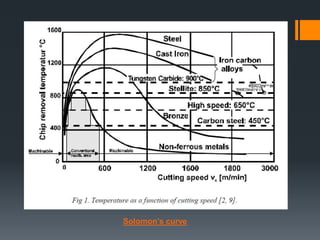
• The first definition of HSM was proposed by Carl
Salomon in 1931.
• He has assumed that at a certain cutting speed which is
5 –10 times higher then in conventional machining, the
chip tool interface temperature will start to decrease.
HISTORY OF HSM:-
Solomon’s curve
DEFINITIONS
• High cutting speed machining (Vc)
• High spindle speed machining (n)
• High feed machining (f)
• High speed and feed machining
• High productive machining
Finally,
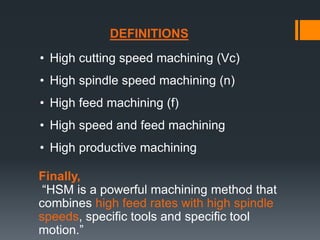
“HSM is a powerful machining method that
combines high feed rates with high spindle
speeds, specific tools and specific tool
motion.”
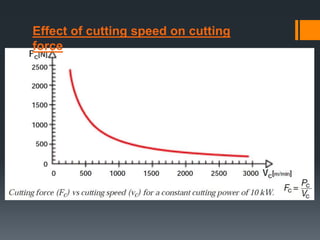
Effect of cutting speed on cutting
force
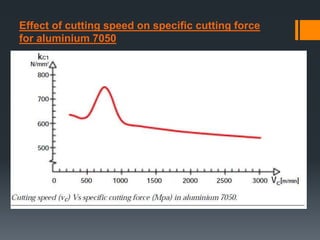
Effect of cutting speed on specific cutting force
for aluminium 7050
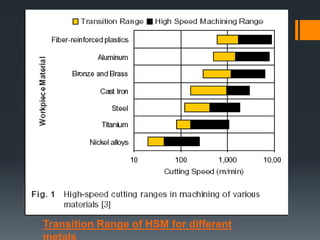
Transition Range of HSM for different
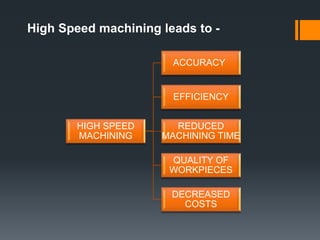
HIGH SPEED
MACHINING
ACCURACY
EFFICIENCY
REDUCED
MACHINING TIME
QUALITY OF
WORKPIECES
DECREASED
COSTS
High Speed machining leads to -
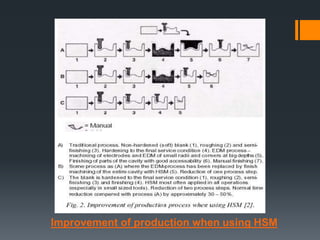
Improvement of production when using HSM
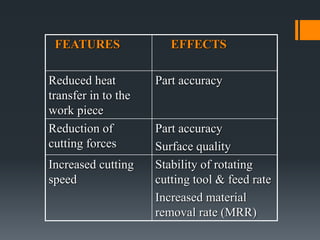
FEATURES EFFECTS
Reduced heat
transfer in to the
work piece
Part accuracy
Reduction of
cutting forces
Part accuracy
Surface quality
Increased cutting
speed
Stability of rotating
cutting tool & feed rate
Increased material
removal rate (MRR)
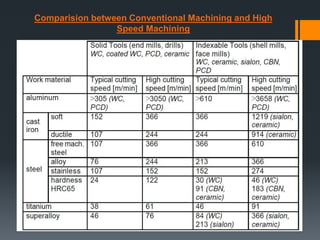
Comparision between Conventional Machining and High
Speed Machining
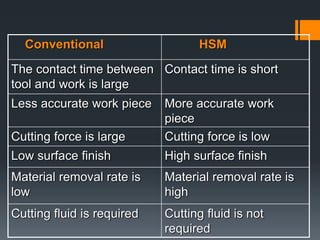
Conventional HSM
The contact time between
tool and work is large
Contact time is short
Less accurate work piece More accurate work
piece
Cutting force is large Cutting force is low
Poor surface finish Good surface finish
Material removal rate is
low
Material removal rate is
high
Cutting fluid is required Cutting fluid is not
required
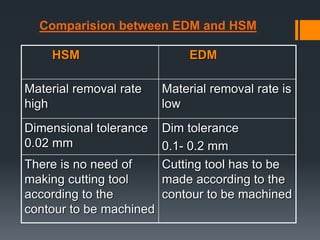
HSM EDM
Material removal rate
high
Material removal rate is
low
Dimensional tolerance
0.02 mm
Dim tolerance
0.1- 0.2 mm
There is no need of
making cutting tool
according to the
contour to be machined
Cutting tool has to be
made according to the
contour to be machined
Comparision between EDM and HSM
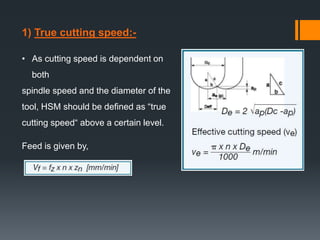
1) True cutting speed:-
• As cutting speed is dependent on
both
spindle speed and the diameter of the
tool, HSM should be defined as “true
cutting speed“ above a certain level.
Feed is given by,
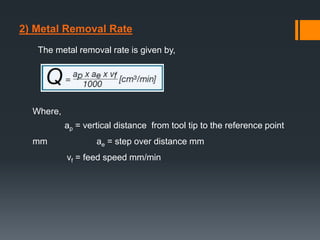
2) Metal Removal Rate
The metal removal rate is given by,
Where,
ap = vertical distance from tool tip to the reference point
mm ae = step over distance mm
vf = feed speed mm/min
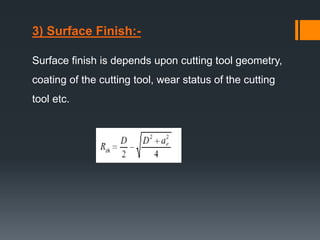
Surface finish is depends upon cutting tool geometry,
coating of the cutting tool, wear status of the cutting
tool etc.
3) Surface Finish:-
Machine tools available-
• 3-axis horizontal and vertical milling machines.
• CNC 4-axis milling machine offers the option
of tilting the milling cutters to improve the cutting
conditions.
• 5-axis machine with inter changeable spindle
units allow to rough, semi finish and finish with a
single set up.
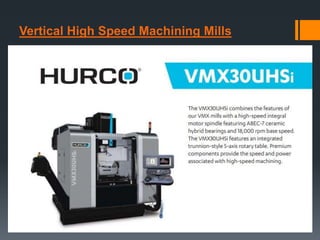
Vertical High Speed Machining Mills
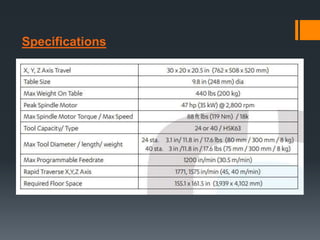
Specifications
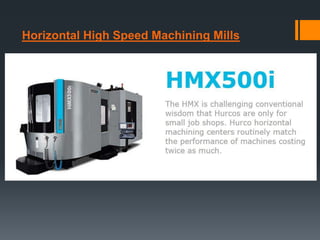
Horizontal High Speed Machining Mills
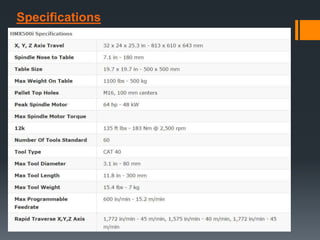
Specifications
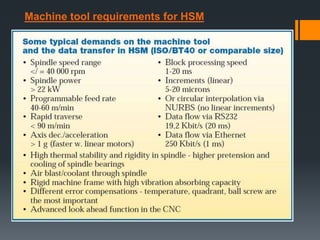
Machine tool requirements for HSM
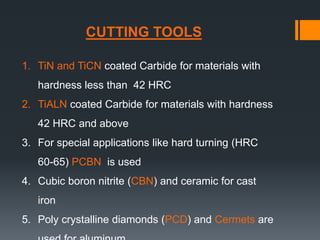
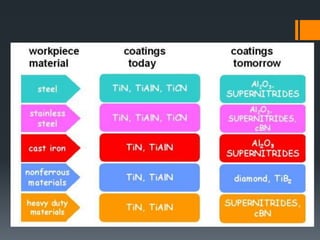
1. TiN and TiCN coated Carbide for materials with
hardness less than 42 HRC
2. TiALN coated Carbide for materials with hardness
42 HRC and above
3. For special applications like hard turning (HRC
60-65) PCBN is used
4. Cubic boron nitrite (CBN) and ceramic for cast
iron
5. Poly crystalline diamonds (PCD) and Cermets are
CUTTING TOOLS
ADVANTAGES
• High material removal rate
• High surface finish
• Increased productivity
• Possibility of machining of very thin walls
• Reduction in lead times
• Low cutting force
• Cutting tool and work piece temperature are kept low
• Connection time between the cutting edge and work piece is
short
• It eliminates the need of coolant
• Reduction of production process
• Need for expensive and special machine tools
with advanced spindle and controllers
• Excessive tool wear
• Good work and process planning necessary
• It can be difficult to find and recruit advanced
staff
DISADVANTAGES
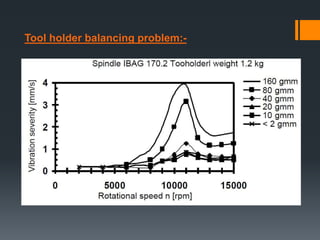
Tool holder balancing problem:-
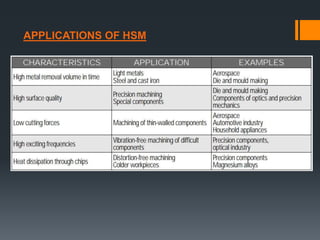
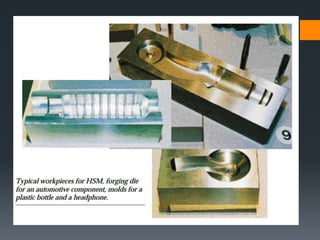
APPLICATIONS OF HSM
• HSM is not simply high cutting speed .It should be
regarded as a process where the operations are
performed with very specific methods and precision
equipment.
• HSM is not necessarily high spindle speed
machining. Many HSM applications are performed
with moderate spindle speeds and large sized
cutters.
• HSM is performed in finishing in hardened steel
with high speeds and high feeds often with 4-6
CONCLUSION
• HSM is high productive machining in small
sized components in roughing to finishing and
in finishing to super finishing in components of
all sizes.
• Even though HSM is known for a long time, the
research are still being developed for further
improvement of quality and optimization of cost.
The technical papers referred for this seminar are listed below.
[1] PASKO, R. - PRZYBYLSKI, L. & SLODKI, B, High Speed Machining
(HSM) – the effective way of modern cutting, Cracow University of
Technology.
[2] M.A. DAVIES, T. J. BURNS, T. L. SCHMITZ, High-Speed
Machining Processes: Dynamics on Multiple Scales, National Institute
of Standards and Technology, USA.
[3] J. KOPAC, Advanced tool materials for high-speed machining, 12th
international science conference paper, Faculty of Mechanical
Engineering, University of Ljubljana, Slovenia.
[4] HERBERT SCHULZ, The History of High-Speed Machining,
Darmstadt University of Technology, Germany.
REFERENCES
High speed machining (HSM)

High speed machining (HSM)

  • 1.
  • 2.
    CONTENTS:- • History ofHigh speed machining • Comparison between conventional and high speed machining • Process parameters • Machine details • Advantages & Disadvantages • Application areas of HSM • Conclusion
  • 3.
    • First trieswere made in early twenties of the past century. • The first definition of HSM was proposed by Carl Salomon in 1931. • He has assumed that at a certain cutting speed which is 5 –10 times higher then in conventional machining, the chip tool interface temperature will start to decrease. HISTORY OF HSM:-
  • 4.
  • 5.
    DEFINITIONS • High cuttingspeed machining (Vc) • High spindle speed machining (n) • High feed machining (f) • High speed and feed machining • High productive machining Finally, “HSM is a powerful machining method that combines high feed rates with high spindle speeds, specific tools and specific tool motion.”
  • 6.
    Effect of cuttingspeed on cutting force
  • 7.
    Effect of cuttingspeed on specific cutting force for aluminium 7050
  • 8.
    Transition Range ofHSM for different
  • 9.
    HIGH SPEED MACHINING ACCURACY EFFICIENCY REDUCED MACHINING TIME QUALITYOF WORKPIECES DECREASED COSTS High Speed machining leads to -
  • 10.
  • 11.
    FEATURES EFFECTS Reduced heat transferin to the work piece Part accuracy Reduction of cutting forces Part accuracy Surface quality Increased cutting speed Stability of rotating cutting tool & feed rate Increased material removal rate (MRR)
  • 13.
    Comparision between ConventionalMachining and High Speed Machining
  • 14.
    Conventional HSM The contacttime between tool and work is large Contact time is short Less accurate work piece More accurate work piece Cutting force is large Cutting force is low Poor surface finish Good surface finish Material removal rate is low Material removal rate is high Cutting fluid is required Cutting fluid is not required
  • 15.
    HSM EDM Material removalrate high Material removal rate is low Dimensional tolerance 0.02 mm Dim tolerance 0.1- 0.2 mm There is no need of making cutting tool according to the contour to be machined Cutting tool has to be made according to the contour to be machined Comparision between EDM and HSM
  • 17.
    1) True cuttingspeed:- • As cutting speed is dependent on both spindle speed and the diameter of the tool, HSM should be defined as “true cutting speed“ above a certain level. Feed is given by,
  • 18.
    2) Metal RemovalRate The metal removal rate is given by, Where, ap = vertical distance from tool tip to the reference point mm ae = step over distance mm vf = feed speed mm/min
  • 19.
    Surface finish isdepends upon cutting tool geometry, coating of the cutting tool, wear status of the cutting tool etc. 3) Surface Finish:-
  • 21.
    Machine tools available- •3-axis horizontal and vertical milling machines. • CNC 4-axis milling machine offers the option of tilting the milling cutters to improve the cutting conditions. • 5-axis machine with inter changeable spindle units allow to rough, semi finish and finish with a single set up.
  • 22.
    Vertical High SpeedMachining Mills
  • 23.
  • 24.
    Horizontal High SpeedMachining Mills
  • 25.
  • 26.
  • 27.
    1. TiN andTiCN coated Carbide for materials with hardness less than 42 HRC 2. TiALN coated Carbide for materials with hardness 42 HRC and above 3. For special applications like hard turning (HRC 60-65) PCBN is used 4. Cubic boron nitrite (CBN) and ceramic for cast iron 5. Poly crystalline diamonds (PCD) and Cermets are CUTTING TOOLS
  • 29.
    ADVANTAGES • High materialremoval rate • High surface finish • Increased productivity • Possibility of machining of very thin walls • Reduction in lead times • Low cutting force • Cutting tool and work piece temperature are kept low • Connection time between the cutting edge and work piece is short • It eliminates the need of coolant • Reduction of production process
  • 30.
    • Need forexpensive and special machine tools with advanced spindle and controllers • Excessive tool wear • Good work and process planning necessary • It can be difficult to find and recruit advanced staff DISADVANTAGES
  • 31.
  • 32.
  • 34.
    • HSM isnot simply high cutting speed .It should be regarded as a process where the operations are performed with very specific methods and precision equipment. • HSM is not necessarily high spindle speed machining. Many HSM applications are performed with moderate spindle speeds and large sized cutters. • HSM is performed in finishing in hardened steel with high speeds and high feeds often with 4-6 CONCLUSION
  • 35.
    • HSM ishigh productive machining in small sized components in roughing to finishing and in finishing to super finishing in components of all sizes. • Even though HSM is known for a long time, the research are still being developed for further improvement of quality and optimization of cost.
  • 36.
    The technical papersreferred for this seminar are listed below. [1] PASKO, R. - PRZYBYLSKI, L. & SLODKI, B, High Speed Machining (HSM) – the effective way of modern cutting, Cracow University of Technology. [2] M.A. DAVIES, T. J. BURNS, T. L. SCHMITZ, High-Speed Machining Processes: Dynamics on Multiple Scales, National Institute of Standards and Technology, USA. [3] J. KOPAC, Advanced tool materials for high-speed machining, 12th international science conference paper, Faculty of Mechanical Engineering, University of Ljubljana, Slovenia. [4] HERBERT SCHULZ, The History of High-Speed Machining, Darmstadt University of Technology, Germany. REFERENCES