 PRESENTATION ON
THE SOFTWARE CONFIGURATION OF A
GRAPHICS SYSTEM
Submitted to
Sushma Singh
Assistant professor(BUEST)
Submitted by
Parmjeet
10UME043
The graphics software :
is the collection of programs written to make it
convenient for a user to operate the computer graphics syste
m
 It includes Programmes to generate images on the CRT screen.
 To accomplish various types of interaction between the user and
the system.
 The graphics software for a particular computer graphics
system is very much a function of the type of hardware used in
the system.
◦ The software must be written specifically for the type of CRT
and the types of input devices used in the system.
◦ The differences between a storage tube and a refresh tube
would also influence the graphics software.
IN THE OPERATION OF THE GRAPHICS SYSTEM BY THE USER,
A VARIETY OF ACTIVITIES TAKE PLACE, WHICH CAN BE
DIVIDED INTO THREE CATEGORIES:
◦ 1. Interact with the graphics terminal to create and alter
images on the screen
◦ 2. Construct a model of something physical out of the
images on the screen. The models are sometimes called
application models.
◦ 3. Enter the model into computer memory and/or
secondary storage
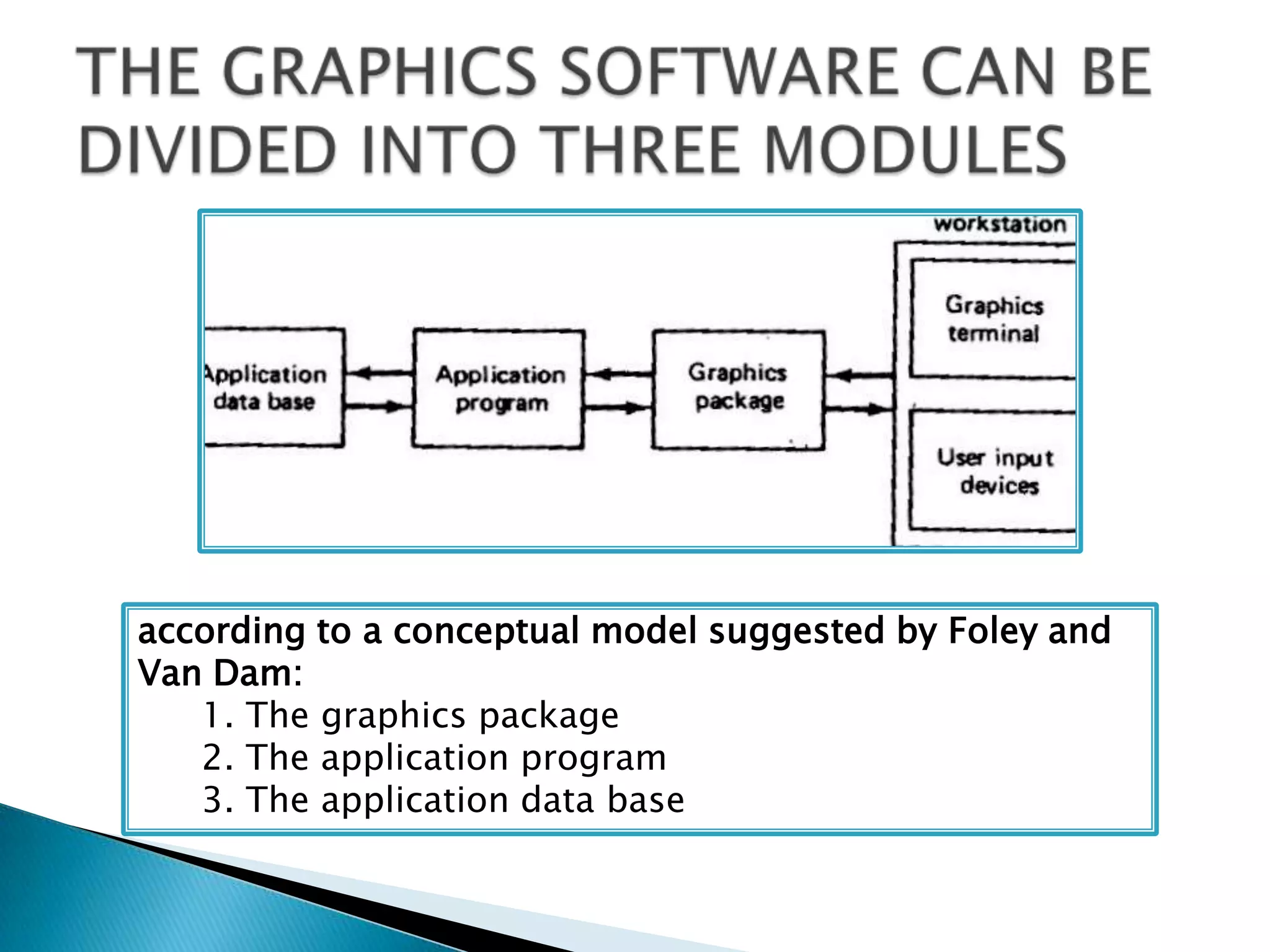
according to a conceptual model suggested by Foley and
Van Dam:
1. The graphics package
2. The application program
3. The application data base
 The central module is the application program.
 It controls the storage of data into and retrieves data out
of the application data base.
 The application program is implemented by the user to
construct the model of a physical entity whose image 'is to be
viewed on the graphics-screen
 Application programs are written for particular problem
areas. Problem areas in engineering design would include
architecture, construction, mechanical components,
electronics, chemical engineering, and aerospace
engineering.
 It is the software support between the user and the graphics
terminal
 It manages the graphical interaction between the user and the
system
 It also serves as the interface between the user and the
application software.
 The graphics package consists of input subroutines and
output subroutines.
◦ The input routines :accept input commands and data from
the user and forward them to the application program.
◦ The output subroutines: control the display terminal and
convert the application models into two-dimensional or
three-dimensional graphical pictures.
 The data base contains mathematical, numerical, and logical
definitions of the application models, such as electronic
circuits, mechanical components, automobile bodies, and so
forth.
 It also includes alphanumeric information associated with the
models, such as bills of materials, mass properties, and other
data.
 The contents of the data base can be readily displayed on the
CRT or plotted out in hard-copy form.
 To fulfil its role in the software configuration, the
graphics package must perform a variety of different
functions. These functions can be grouped into function
sets. Each set accomplishes a certain kind of interaction
between the user and the system.
 Some of the common function sets are:
◦ Generation of graphic
◦ Elements Transformations Display
◦ Control and windowing functions
◦ Segmenting functions
◦ User input functions

the software configuration of a graphic system

  • 1.
     PRESENTATION ON THESOFTWARE CONFIGURATION OF A GRAPHICS SYSTEM Submitted to Sushma Singh Assistant professor(BUEST) Submitted by Parmjeet 10UME043
  • 2.
    The graphics software: is the collection of programs written to make it convenient for a user to operate the computer graphics syste m  It includes Programmes to generate images on the CRT screen.  To accomplish various types of interaction between the user and the system.  The graphics software for a particular computer graphics system is very much a function of the type of hardware used in the system. ◦ The software must be written specifically for the type of CRT and the types of input devices used in the system. ◦ The differences between a storage tube and a refresh tube would also influence the graphics software.
  • 3.
    IN THE OPERATIONOF THE GRAPHICS SYSTEM BY THE USER, A VARIETY OF ACTIVITIES TAKE PLACE, WHICH CAN BE DIVIDED INTO THREE CATEGORIES: ◦ 1. Interact with the graphics terminal to create and alter images on the screen ◦ 2. Construct a model of something physical out of the images on the screen. The models are sometimes called application models. ◦ 3. Enter the model into computer memory and/or secondary storage
  • 4.
    according to aconceptual model suggested by Foley and Van Dam: 1. The graphics package 2. The application program 3. The application data base
  • 5.
     The centralmodule is the application program.  It controls the storage of data into and retrieves data out of the application data base.  The application program is implemented by the user to construct the model of a physical entity whose image 'is to be viewed on the graphics-screen  Application programs are written for particular problem areas. Problem areas in engineering design would include architecture, construction, mechanical components, electronics, chemical engineering, and aerospace engineering.
  • 6.
     It isthe software support between the user and the graphics terminal  It manages the graphical interaction between the user and the system  It also serves as the interface between the user and the application software.  The graphics package consists of input subroutines and output subroutines. ◦ The input routines :accept input commands and data from the user and forward them to the application program. ◦ The output subroutines: control the display terminal and convert the application models into two-dimensional or three-dimensional graphical pictures.
  • 7.
     The database contains mathematical, numerical, and logical definitions of the application models, such as electronic circuits, mechanical components, automobile bodies, and so forth.  It also includes alphanumeric information associated with the models, such as bills of materials, mass properties, and other data.  The contents of the data base can be readily displayed on the CRT or plotted out in hard-copy form.
  • 8.
     To fulfilits role in the software configuration, the graphics package must perform a variety of different functions. These functions can be grouped into function sets. Each set accomplishes a certain kind of interaction between the user and the system.  Some of the common function sets are: ◦ Generation of graphic ◦ Elements Transformations Display ◦ Control and windowing functions ◦ Segmenting functions ◦ User input functions