Dr. V.Chittaranjan Das
Professor ,
Department of Mechanical Engineering,Guntur
Computer assisted part programming
(APT, Automatically Programmed Tool)
Manual part programming is time-consuming, tedious, and
subject to human errors for complex jobs.
Machining instructions are written in English-like statements that
are translated by the computer into the low-level machine code
of the MCU.
It is used for more complex jobs.
APT (Automatically Programmed Tool)
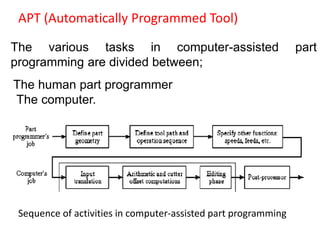
The various tasks in computer-assisted part
programming are divided between;
The human part programmer
The computer.
Sequence of activities in computer-assisted part programming
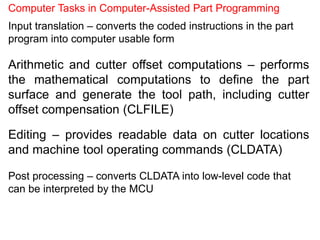
Computer Tasks in Computer-Assisted Part Programming
Input translation – converts the coded instructions in the part
program into computer usable form
Arithmetic and cutter offset computations – performs
the mathematical computations to define the part
surface and generate the tool path, including cutter
offset compensation (CLFILE)
Editing – provides readable data on cutter locations
and machine tool operating commands (CLDATA)
Post processing – converts CLDATA into low-level code that
can be interpreted by the MCU
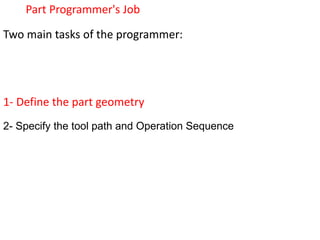
Part Programmer's Job
Two main tasks of the programmer:
1- Define the part geometry
2- Specify the tool path and Operation Sequence
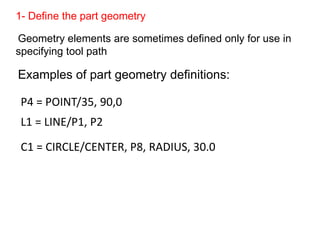
1- Define the part geometry
Geometry elements are sometimes defined only for use in
specifying tool path
Examples of part geometry definitions:
P4 = POINT/35, 90,0
L1 = LINE/P1, P2
C1 = CIRCLE/CENTER, P8, RADIUS, 30.0
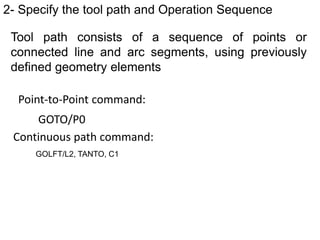
2- Specify the tool path and Operation Sequence
Tool path consists of a sequence of points or
connected line and arc segments, using previously
defined geometry elements
Point-to-Point command:
GOTO/P0
Continuous path command:
GOLFT/L2, TANTO, C1
Other Functions in Computer-Assisted Part Programming
Specifying cutting speeds and feed rates
Designating cutter size (for tool offset calculations)
Specifying tolerances in circular interpolation
Naming the program
Identifying the machine tool
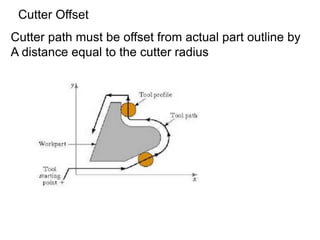
Cutter Offset
Cutter path must be offset from actual part outline by
A distance equal to the cutter radius
There are four basic types of statements in the APT language:
Geometry statements, also called definition statements; are used
to define the geometry elements that comprise the part.
Motion commands; are used to specify the tool path.
Postprocessor statements; control the machine tool operation,
for example, to specify speeds and feeds, set tolerance values
for circular interpolation, and actuate other capabilities of the
machine tool.
Auxiliary statements; a group of miscellaneous statements
used to name the part program, insert comments in the
program and accomplish similar functions.
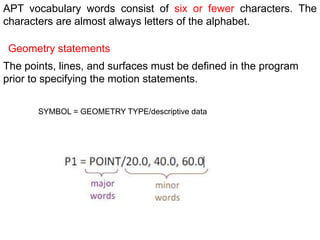
APT vocabulary words consist of six or fewer characters. The
characters are almost always letters of the alphabet.
Geometry statements
The points, lines, and surfaces must be defined in the program
prior to specifying the motion statements.
SYMBOL = GEOMETRY TYPE/descriptive data
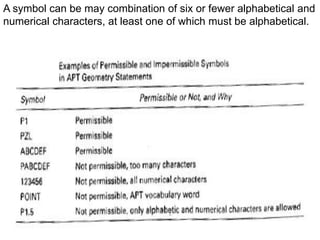
A symbol can be may combination of six or fewer alphabetical and
numerical characters, at least one of which must be alphabetical.
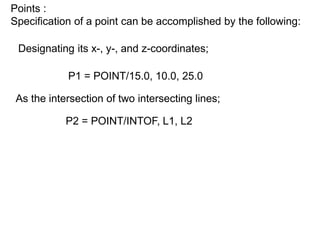
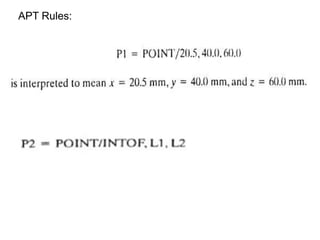
Points :
Specification of a point can be accomplished by the following:
Designating its x-, y-, and z-coordinates;
P1 = POINT/15.0, 10.0, 25.0
As the intersection of two intersecting lines;
P2 = POINT/INTOF, L1, L2
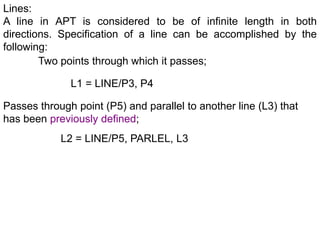
Lines:
A line in APT is considered to be of infinite length in both
directions. Specification of a line can be accomplished by the
following:
Two points through which it passes;
L1 = LINE/P3, P4
Passes through point (P5) and parallel to another line (L3) that
has been previously defined;
L2 = LINE/P5, PARLEL, L3
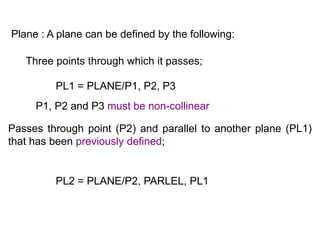
Plane : A plane can be defined by the following:
Three points through which it passes;
PL1 = PLANE/P1, P2, P3
P1, P2 and P3 must be non-collinear
Passes through point (P2) and parallel to another plane (PL1)
that has been previously defined;
PL2 = PLANE/P2, PARLEL, PL1
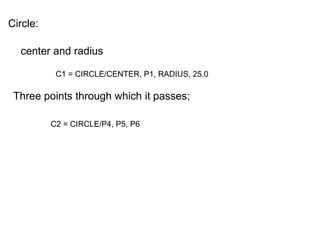
center and radius
C1 = CIRCLE/CENTER, P1, RADIUS, 25.0
Three points through which it passes;
C2 = CIRCLE/P4, P5, P6
Circle:
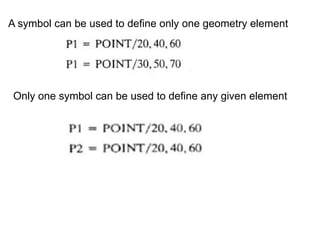
APT Rules:
A symbol can be used to define only one geometry element
Only one symbol can be used to define any given element
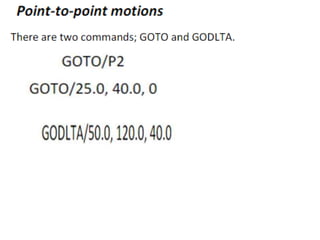
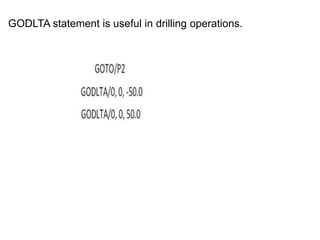
GODLTA statement is useful in drilling operations.
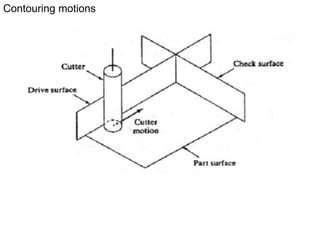
Contouring motions
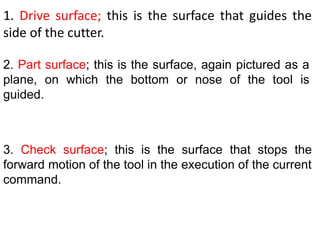
1. Drive surface; this is the surface that guides the
side of the cutter.
2. Part surface; this is the surface, again pictured as a
plane, on which the bottom or nose of the tool is
guided.
3. Check surface; this is the surface that stops the
forward motion of the tool in the execution of the current
command.
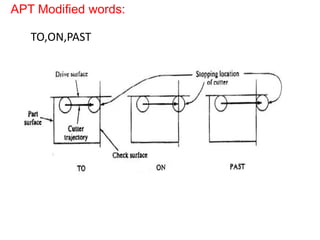
APT Modified words:
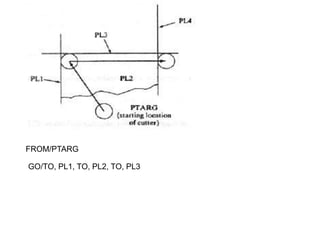
TO,ON,PAST
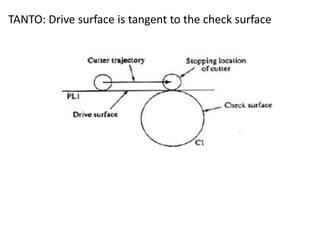
TANTO: Drive surface is tangent to the check surface
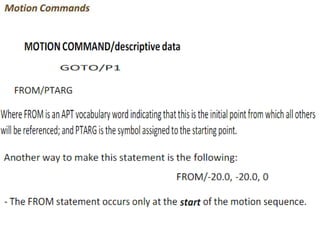
FROM/PTARG
GO/TO, PL1, TO, PL2, TO, PL3
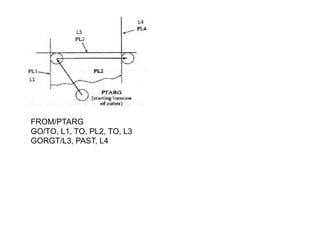
FROM/PTARG
GO/TO, L1, TO, PL2, TO, L3
GORGT/L3, PAST, L4
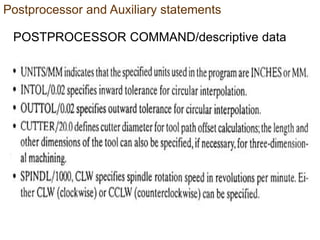
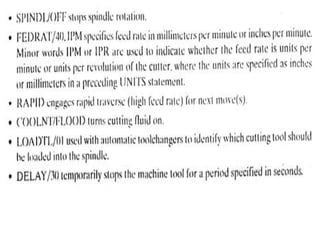
Postprocessor and Auxiliary statements
POSTPROCESSOR COMMAND/descriptive data
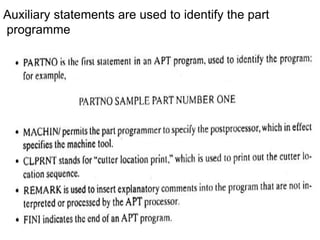
Auxiliary statements are used to identify the part
programme
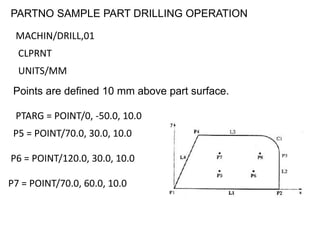
PARTNO SAMPLE PART DRILLING OPERATION
MACHIN/DRILL,01
CLPRNT
UNITS/MM
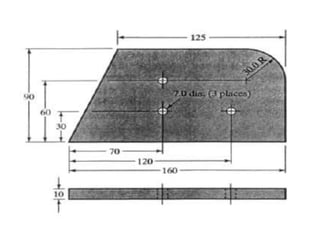
Points are defined 10 mm above part surface.
PTARG = POINT/0, -50.0, 10.0
P5 = POINT/70.0, 30.0, 10.0
P6 = POINT/120.0, 30.0, 10.0
P7 = POINT/70.0, 60.0, 10.0
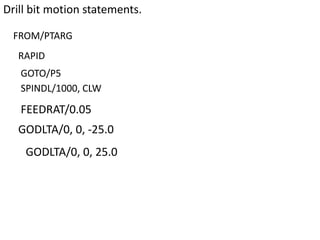
Drill bit motion statements.
FROM/PTARG
RAPID
GOTO/P5
SPINDL/1000, CLW
FEEDRAT/0.05
GODLTA/0, 0, -25.0
GODLTA/0, 0, 25.0
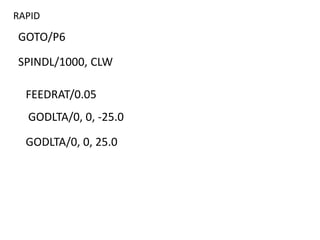
RAPID
GOTO/P6
GODLTA/0, 0, 25.0
SPINDL/1000, CLW
FEEDRAT/0.05
GODLTA/0, 0, -25.0
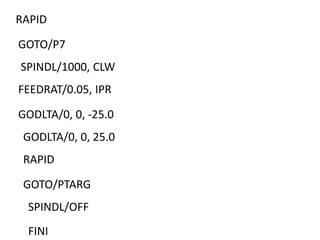
RAPID
GOTO/P7
SPINDL/1000, CLW
FEEDRAT/0.05, IPR
GODLTA/0, 0, -25.0
GODLTA/0, 0, 25.0
RAPID
GOTO/PTARG
SPINDL/OFF
FINI
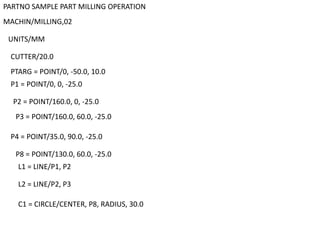
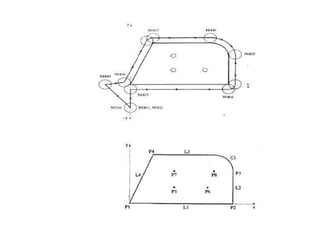
PARTNO SAMPLE PART MILLING OPERATION
MACHIN/MILLING,02
UNITS/MM
CUTTER/20.0
PTARG = POINT/0, -50.0, 10.0
P1 = POINT/0, 0, -25.0
P2 = POINT/160.0, 0, -25.0
P3 = POINT/160.0, 60.0, -25.0
P4 = POINT/35.0, 90.0, -25.0
P8 = POINT/130.0, 60.0, -25.0
L1 = LINE/P1, P2
L2 = LINE/P2, P3
C1 = CIRCLE/CENTER, P8, RADIUS, 30.0
L3 = LINE/P4, LEFT, TANTO, C1
L4 = LINE/P4, P1
PL1 = PLANE/P1, P2, P4
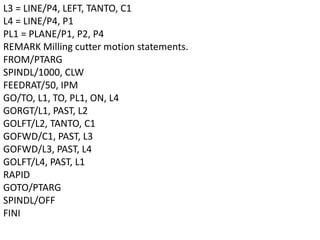
REMARK Milling cutter motion statements.
FROM/PTARG
SPINDL/1000, CLW
FEEDRAT/50, IPM
GO/TO, L1, TO, PL1, ON, L4
GORGT/L1, PAST, L2
GOLFT/L2, TANTO, C1
GOFWD/C1, PAST, L3
GOFWD/L3, PAST, L4
GOLFT/L4, PAST, L1
RAPID
GOTO/PTARG
SPINDL/OFF
FINI
Apt programming

Apt programming

  • 1.
    Dr. V.Chittaranjan Das Professor, Department of Mechanical Engineering,Guntur
  • 2.
    Computer assisted partprogramming (APT, Automatically Programmed Tool) Manual part programming is time-consuming, tedious, and subject to human errors for complex jobs. Machining instructions are written in English-like statements that are translated by the computer into the low-level machine code of the MCU. It is used for more complex jobs.
  • 3.
    APT (Automatically ProgrammedTool) The various tasks in computer-assisted part programming are divided between; The human part programmer The computer. Sequence of activities in computer-assisted part programming
  • 4.
    Computer Tasks inComputer-Assisted Part Programming Input translation – converts the coded instructions in the part program into computer usable form Arithmetic and cutter offset computations – performs the mathematical computations to define the part surface and generate the tool path, including cutter offset compensation (CLFILE) Editing – provides readable data on cutter locations and machine tool operating commands (CLDATA) Post processing – converts CLDATA into low-level code that can be interpreted by the MCU
  • 5.
    Part Programmer's Job Twomain tasks of the programmer: 1- Define the part geometry 2- Specify the tool path and Operation Sequence
  • 6.
    1- Define thepart geometry Geometry elements are sometimes defined only for use in specifying tool path Examples of part geometry definitions: P4 = POINT/35, 90,0 L1 = LINE/P1, P2 C1 = CIRCLE/CENTER, P8, RADIUS, 30.0
  • 7.
    2- Specify thetool path and Operation Sequence Tool path consists of a sequence of points or connected line and arc segments, using previously defined geometry elements Point-to-Point command: GOTO/P0 Continuous path command: GOLFT/L2, TANTO, C1
  • 8.
    Other Functions inComputer-Assisted Part Programming Specifying cutting speeds and feed rates Designating cutter size (for tool offset calculations) Specifying tolerances in circular interpolation Naming the program Identifying the machine tool
  • 9.
    Cutter Offset Cutter pathmust be offset from actual part outline by A distance equal to the cutter radius
  • 10.
    There are fourbasic types of statements in the APT language: Geometry statements, also called definition statements; are used to define the geometry elements that comprise the part. Motion commands; are used to specify the tool path. Postprocessor statements; control the machine tool operation, for example, to specify speeds and feeds, set tolerance values for circular interpolation, and actuate other capabilities of the machine tool. Auxiliary statements; a group of miscellaneous statements used to name the part program, insert comments in the program and accomplish similar functions.
  • 11.
    APT vocabulary wordsconsist of six or fewer characters. The characters are almost always letters of the alphabet. Geometry statements The points, lines, and surfaces must be defined in the program prior to specifying the motion statements. SYMBOL = GEOMETRY TYPE/descriptive data
  • 12.
    A symbol canbe may combination of six or fewer alphabetical and numerical characters, at least one of which must be alphabetical.
  • 13.
    Points : Specification ofa point can be accomplished by the following: Designating its x-, y-, and z-coordinates; P1 = POINT/15.0, 10.0, 25.0 As the intersection of two intersecting lines; P2 = POINT/INTOF, L1, L2
  • 14.
    Lines: A line inAPT is considered to be of infinite length in both directions. Specification of a line can be accomplished by the following: Two points through which it passes; L1 = LINE/P3, P4 Passes through point (P5) and parallel to another line (L3) that has been previously defined; L2 = LINE/P5, PARLEL, L3
  • 15.
    Plane : Aplane can be defined by the following: Three points through which it passes; PL1 = PLANE/P1, P2, P3 P1, P2 and P3 must be non-collinear Passes through point (P2) and parallel to another plane (PL1) that has been previously defined; PL2 = PLANE/P2, PARLEL, PL1
  • 16.
    center and radius C1= CIRCLE/CENTER, P1, RADIUS, 25.0 Three points through which it passes; C2 = CIRCLE/P4, P5, P6 Circle:
  • 17.
  • 18.
    A symbol canbe used to define only one geometry element Only one symbol can be used to define any given element
  • 21.
    GODLTA statement isuseful in drilling operations.
  • 22.
  • 23.
    1. Drive surface;this is the surface that guides the side of the cutter. 2. Part surface; this is the surface, again pictured as a plane, on which the bottom or nose of the tool is guided. 3. Check surface; this is the surface that stops the forward motion of the tool in the execution of the current command.
  • 24.
  • 25.
    TANTO: Drive surfaceis tangent to the check surface
  • 28.
  • 29.
    FROM/PTARG GO/TO, L1, TO,PL2, TO, L3 GORGT/L3, PAST, L4
  • 30.
    Postprocessor and Auxiliarystatements POSTPROCESSOR COMMAND/descriptive data
  • 32.
    Auxiliary statements areused to identify the part programme
  • 34.
    PARTNO SAMPLE PARTDRILLING OPERATION MACHIN/DRILL,01 CLPRNT UNITS/MM Points are defined 10 mm above part surface. PTARG = POINT/0, -50.0, 10.0 P5 = POINT/70.0, 30.0, 10.0 P6 = POINT/120.0, 30.0, 10.0 P7 = POINT/70.0, 60.0, 10.0
  • 35.
    Drill bit motionstatements. FROM/PTARG RAPID GOTO/P5 SPINDL/1000, CLW FEEDRAT/0.05 GODLTA/0, 0, -25.0 GODLTA/0, 0, 25.0
  • 36.
    RAPID GOTO/P6 GODLTA/0, 0, 25.0 SPINDL/1000,CLW FEEDRAT/0.05 GODLTA/0, 0, -25.0
  • 37.
    RAPID GOTO/P7 SPINDL/1000, CLW FEEDRAT/0.05, IPR GODLTA/0,0, -25.0 GODLTA/0, 0, 25.0 RAPID GOTO/PTARG SPINDL/OFF FINI
  • 39.
    PARTNO SAMPLE PARTMILLING OPERATION MACHIN/MILLING,02 UNITS/MM CUTTER/20.0 PTARG = POINT/0, -50.0, 10.0 P1 = POINT/0, 0, -25.0 P2 = POINT/160.0, 0, -25.0 P3 = POINT/160.0, 60.0, -25.0 P4 = POINT/35.0, 90.0, -25.0 P8 = POINT/130.0, 60.0, -25.0 L1 = LINE/P1, P2 L2 = LINE/P2, P3 C1 = CIRCLE/CENTER, P8, RADIUS, 30.0
  • 40.
    L3 = LINE/P4,LEFT, TANTO, C1 L4 = LINE/P4, P1 PL1 = PLANE/P1, P2, P4 REMARK Milling cutter motion statements. FROM/PTARG SPINDL/1000, CLW FEEDRAT/50, IPM GO/TO, L1, TO, PL1, ON, L4 GORGT/L1, PAST, L2 GOLFT/L2, TANTO, C1 GOFWD/C1, PAST, L3 GOFWD/L3, PAST, L4 GOLFT/L4, PAST, L1 RAPID GOTO/PTARG SPINDL/OFF FINI