CNC Hardware
              Arvind Deshpande


4/10/2012      Arvind Deshpande(VJTI)   1
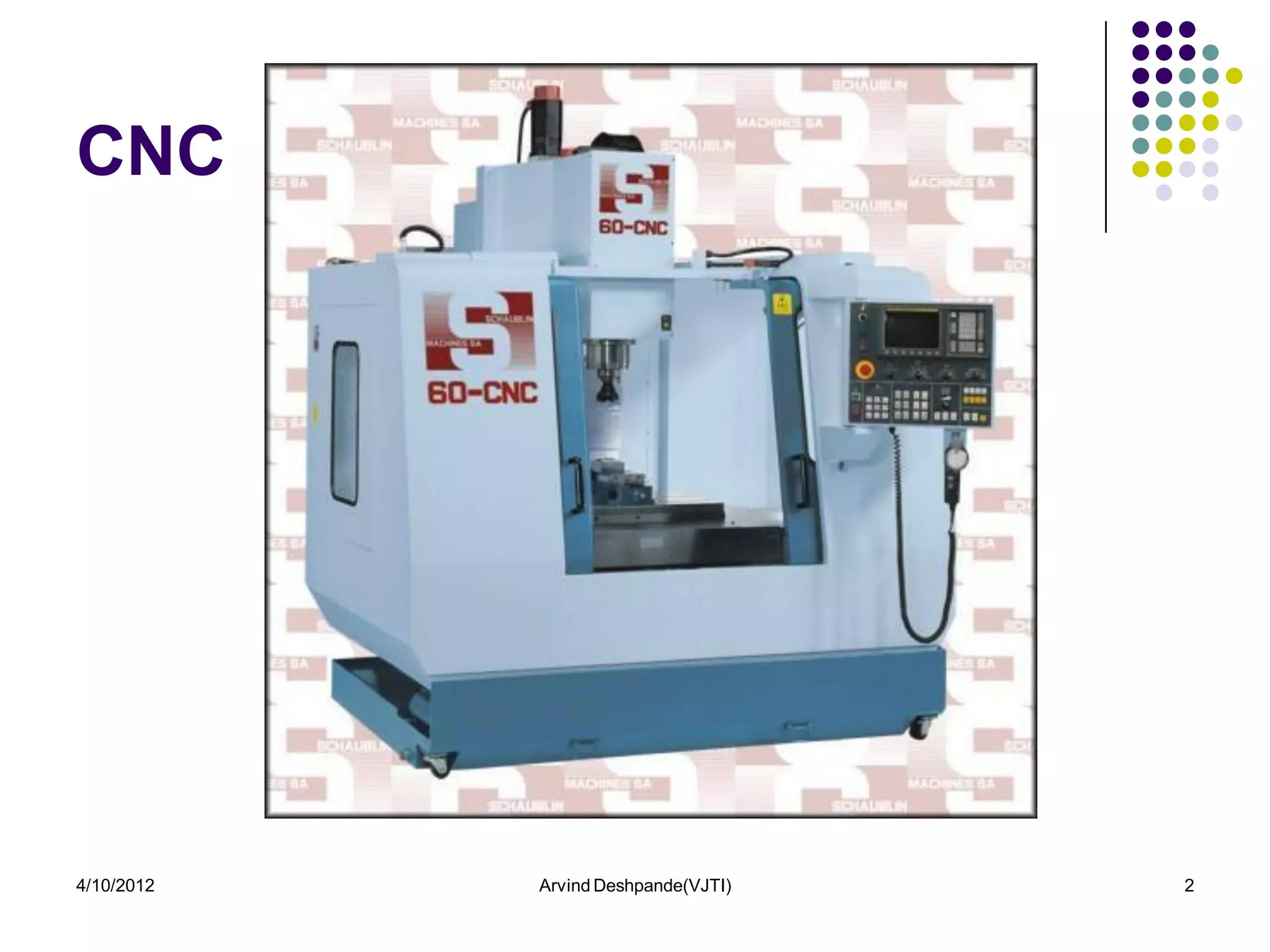
CNC


4/10/2012   Arvind Deshpande(VJTI)   2
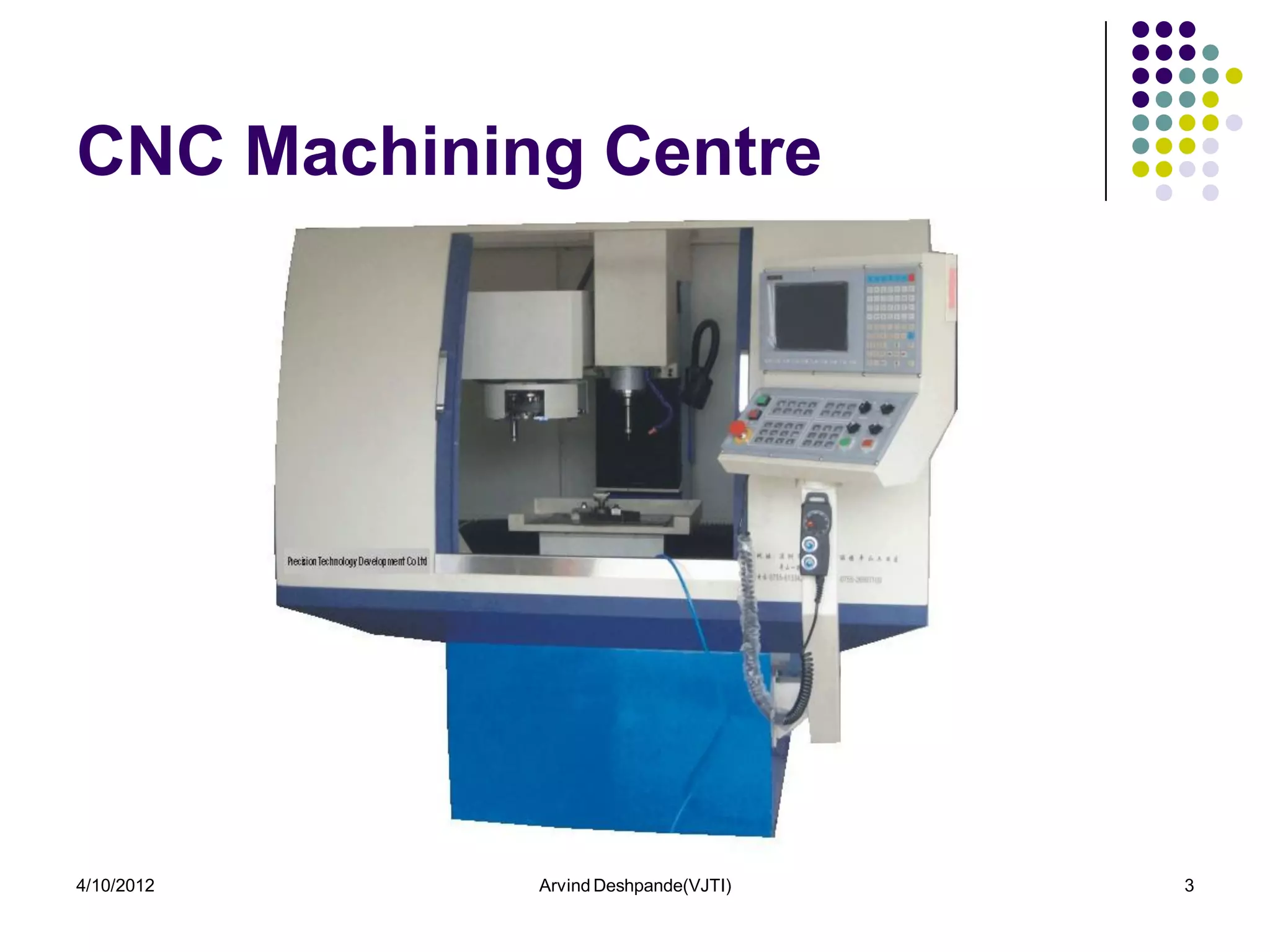
CNC Machining Centre


4/10/2012   Arvind Deshpande(VJTI)   3
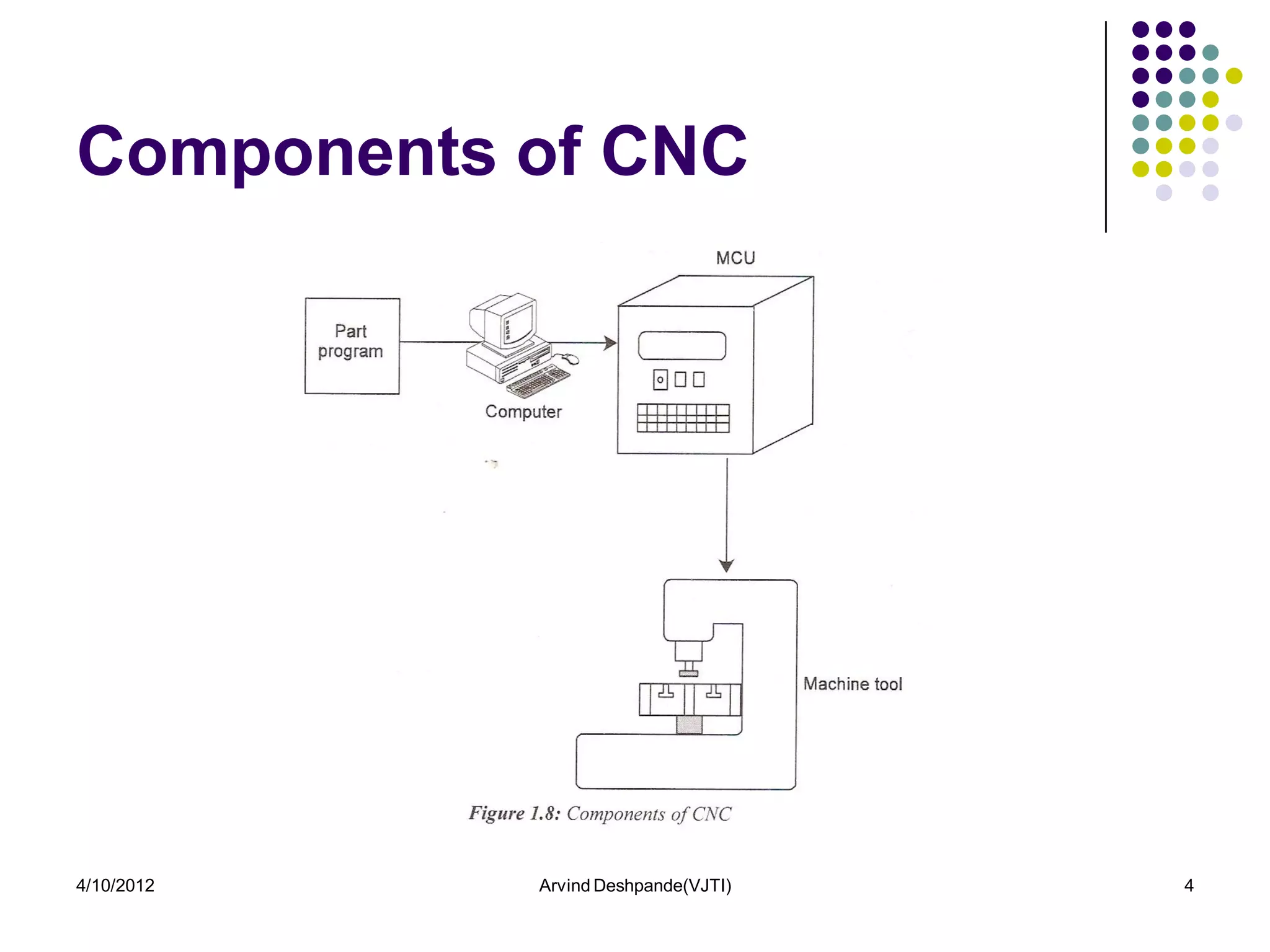
Components of CNC


4/10/2012   Arvind Deshpande(VJTI)   4
Structure of Machine Tool
    Continuous use
    Higher cutting speeds and feeds results in
     higher cutting forces
    High speed of movement
    High static stiffness - To reduce deflection
     under heavy load.
    High stiffness to weight ratio – Better
     dynamic response
4/10/2012              Arvind Deshpande(VJTI)       5
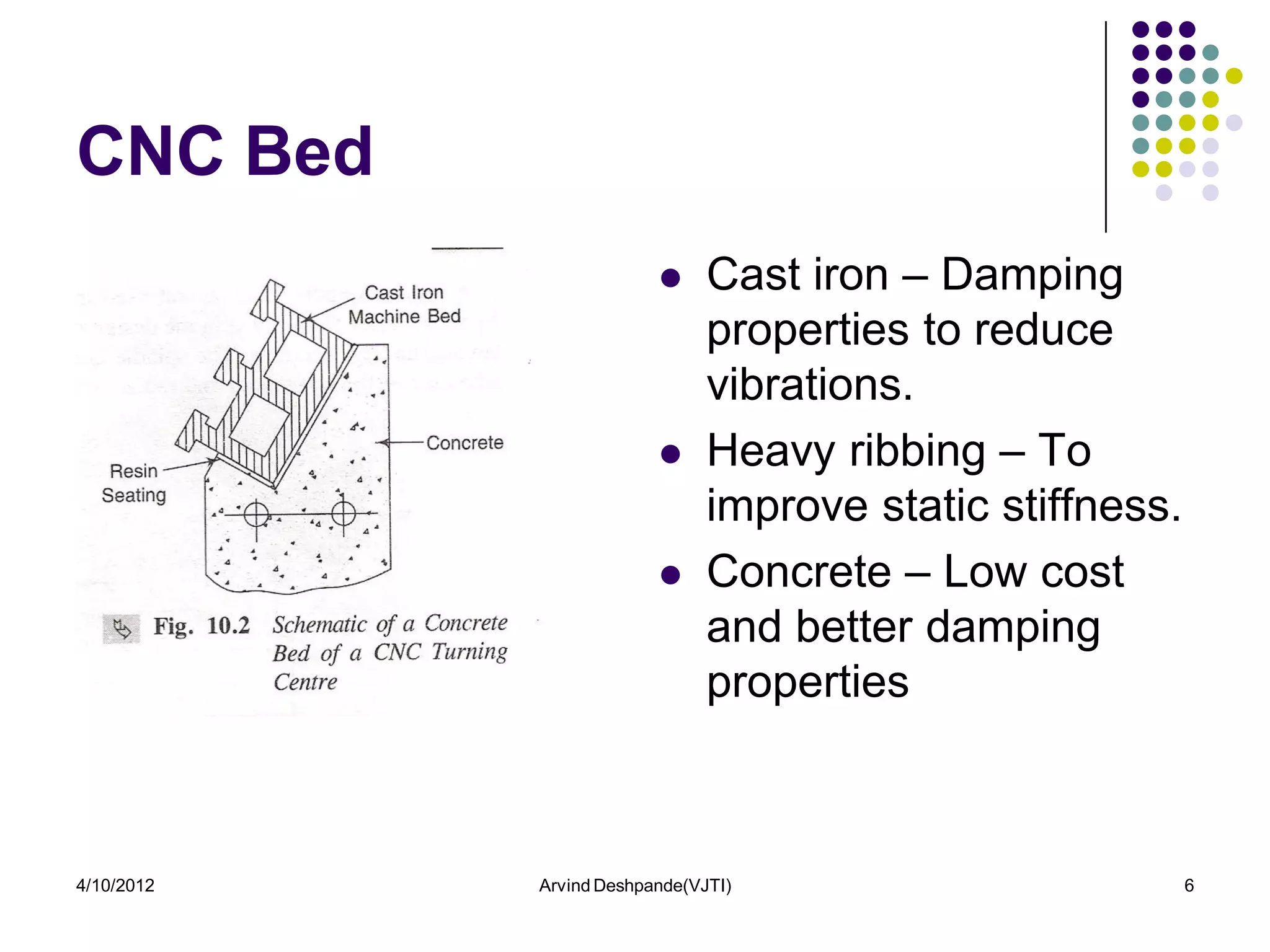
CNC Bed
                              Cast iron – Damping
                               properties to reduce
                               vibrations.
                              Heavy ribbing – To
                               improve static stiffness.
                              Concrete – Low cost
                               and better damping
                               properties


4/10/2012   Arvind Deshpande(VJTI)                         6
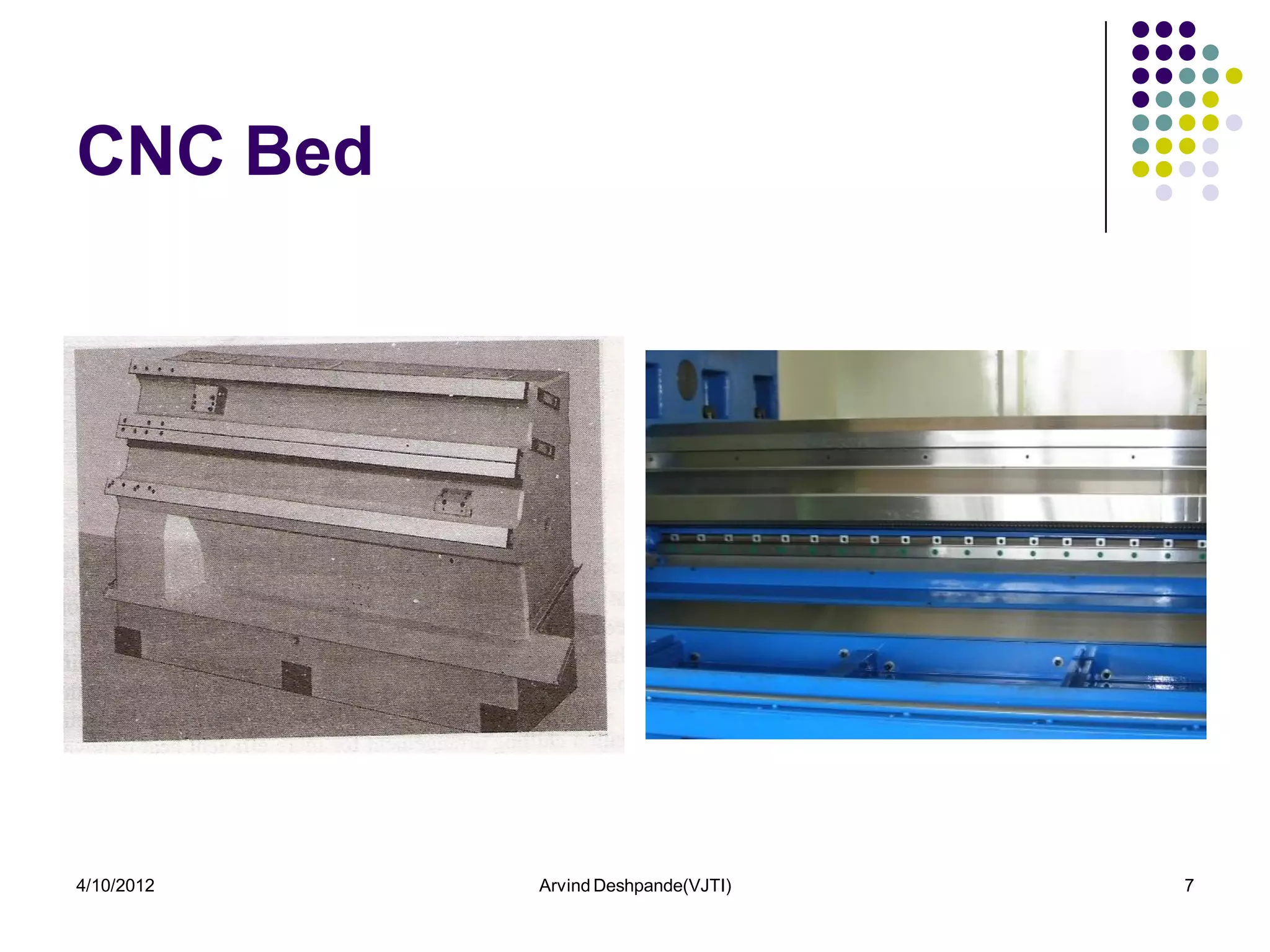
CNC Bed


4/10/2012   Arvind Deshpande(VJTI)   7
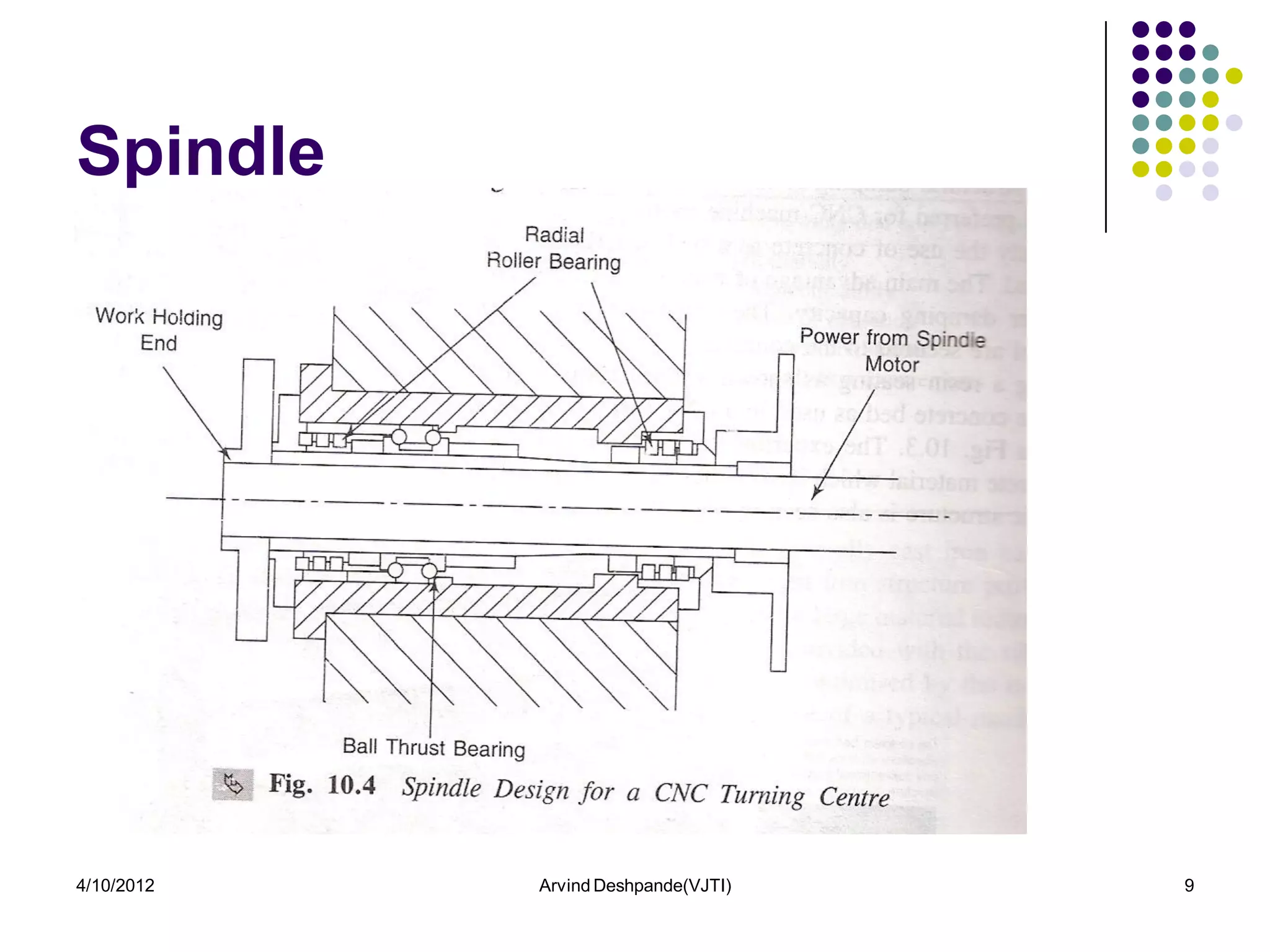
Spindle
    Very important element
    Subjected to higher cutting forces (radial and axial)
    Deflection to be minimized to get proper surface
     finish
    Proper supports with little overhang
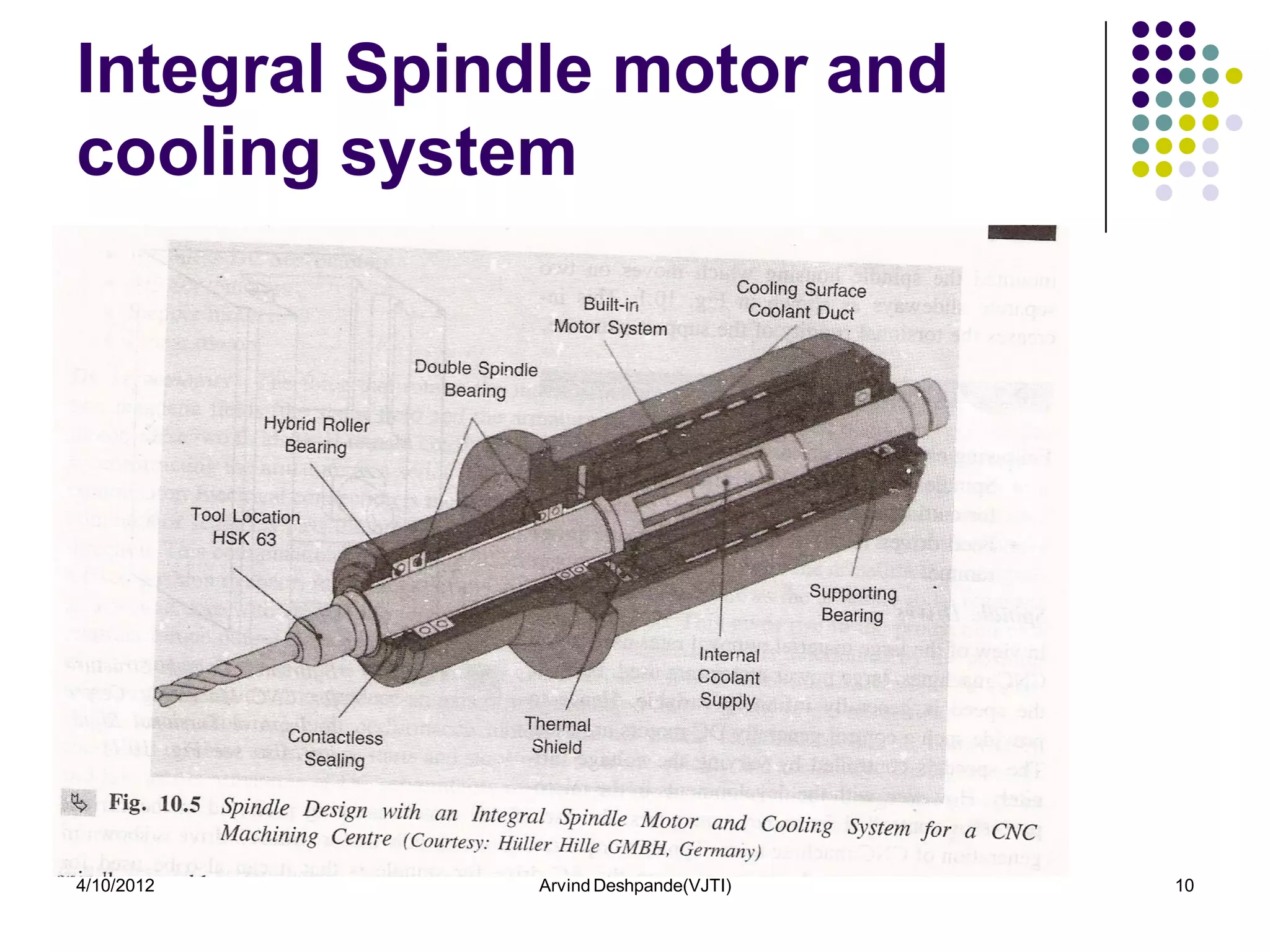
    Proper cooling to remove the heat generated
    Oil cooling with heat exchanger
    Spindle motor and gearbox can be isolated to avoid
     heat transmission to machine tool structure

4/10/2012                 Arvind Deshpande(VJTI)             8
Spindle


4/10/2012   Arvind Deshpande(VJTI)   9
Integral Spindle motor and
cooling system


4/10/2012    Arvind Deshpande(VJTI)   10
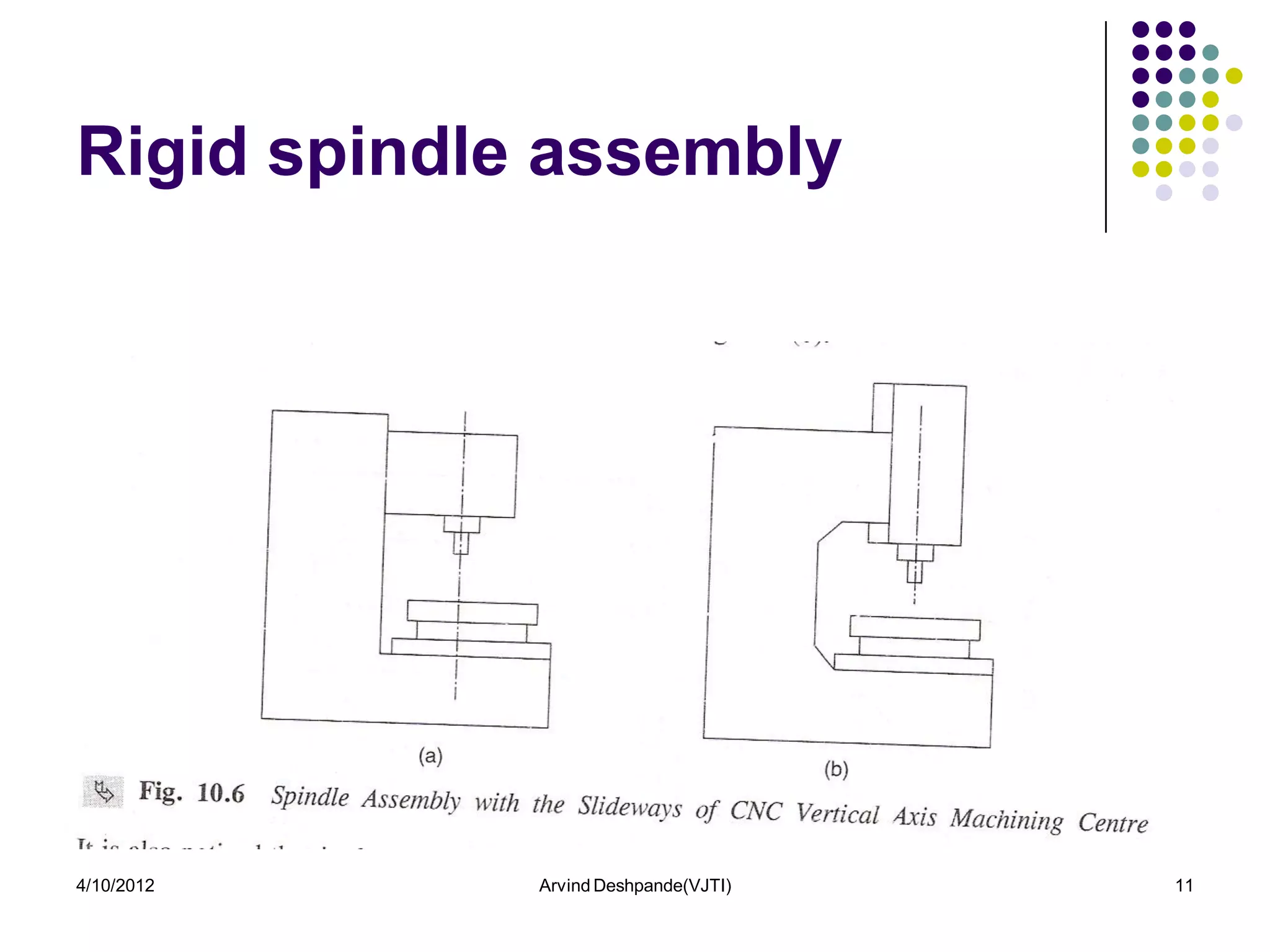
Rigid spindle assembly


4/10/2012    Arvind Deshpande(VJTI)   11
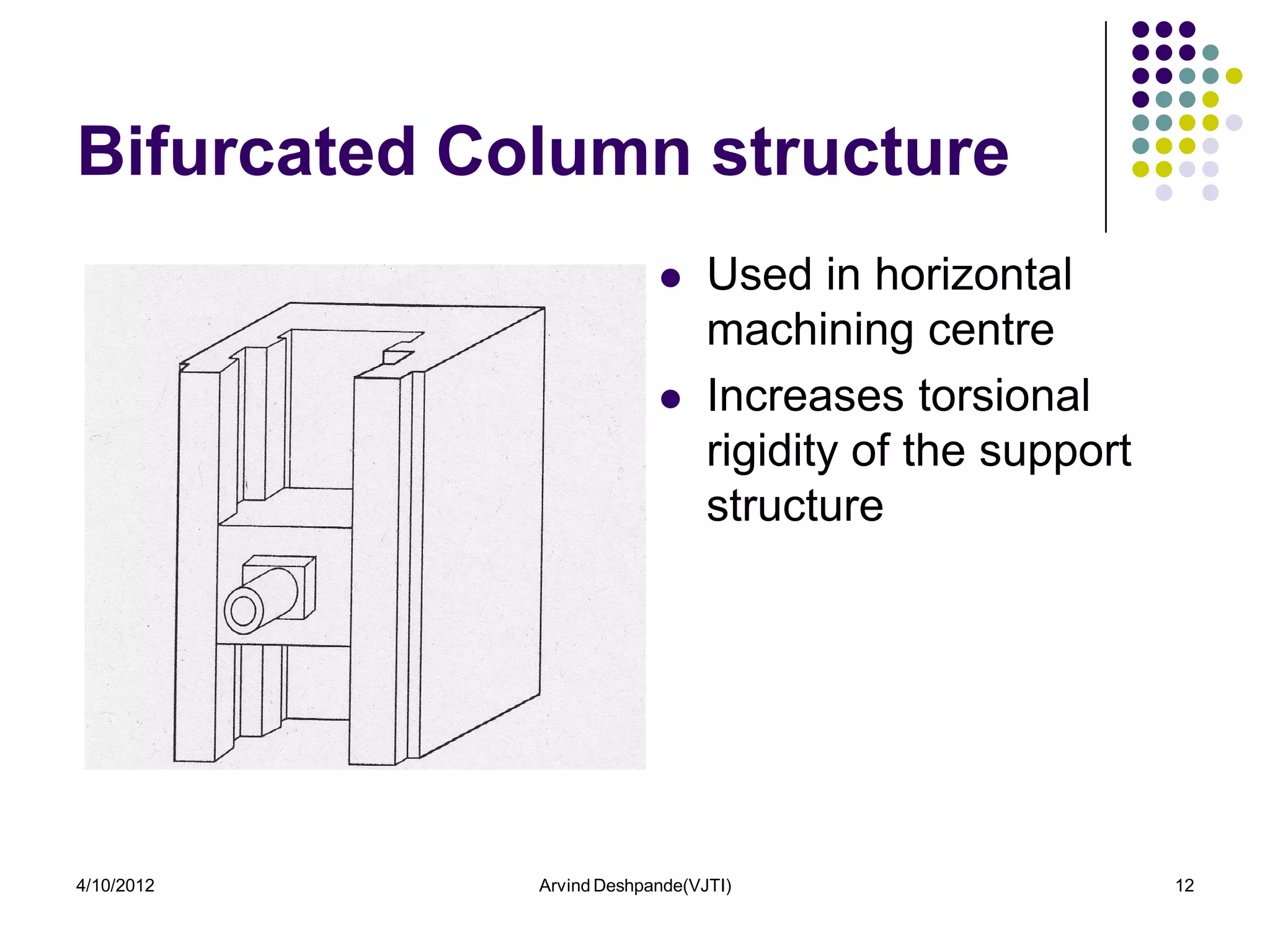
Bifurcated Column structure
                               Used in horizontal
                                machining centre
                               Increases torsional
                                rigidity of the support
                                structure


4/10/2012    Arvind Deshpande(VJTI)                       12
Spindle Drives
    Large power with infinite variation in speed
    DC motors were very popular with speed
     control using voltage variation
    Nowadays AC motors are used with speed
     control using frequency variation.


4/10/2012              Arvind Deshpande(VJTI)       13
Feed Drives
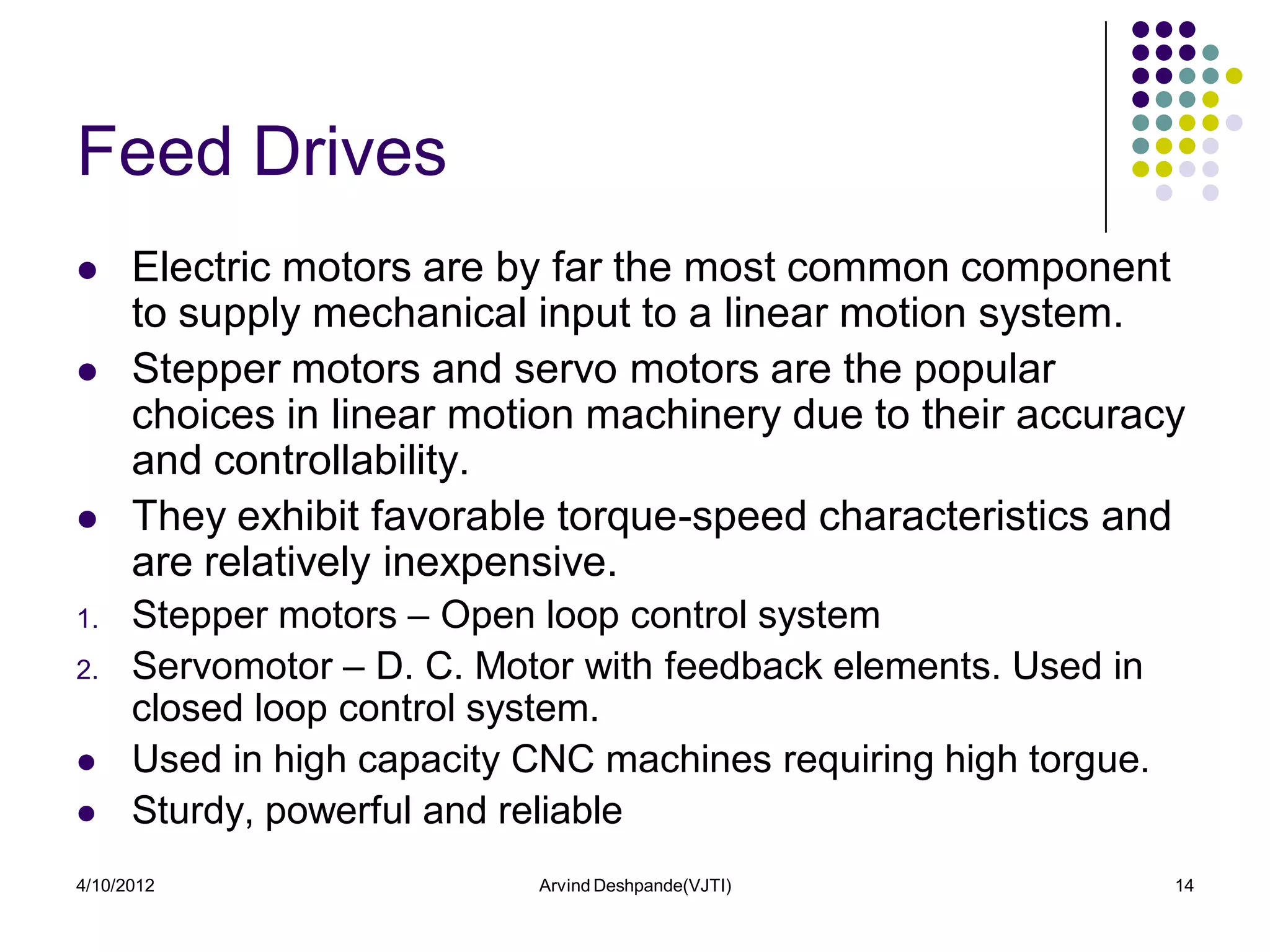
     Electric motors are by far the most common component
      to supply mechanical input to a linear motion system.
     Stepper motors and servo motors are the popular
      choices in linear motion machinery due to their accuracy
      and controllability.
     They exhibit favorable torque-speed characteristics and
      are relatively inexpensive.
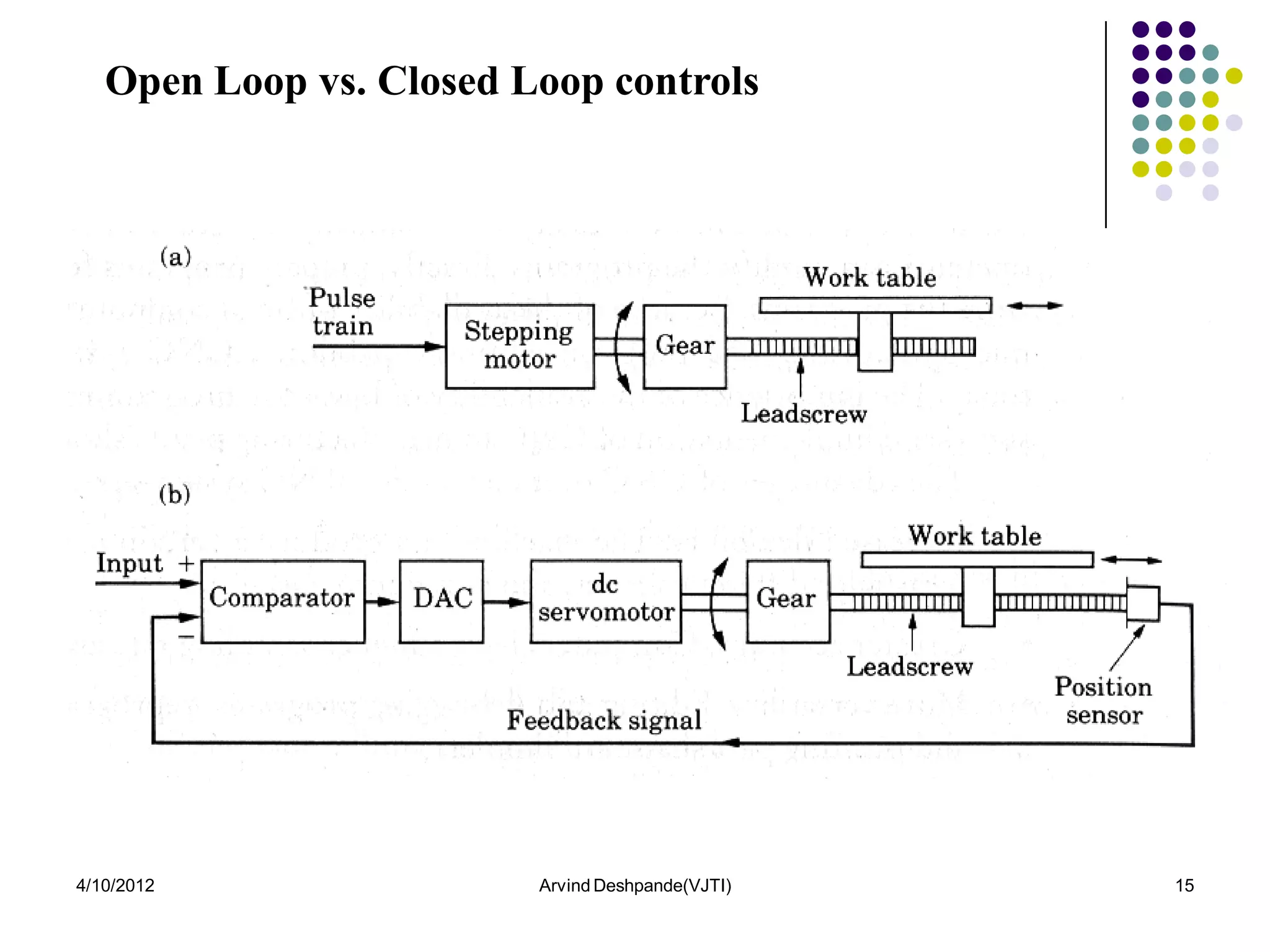
1.    Stepper motors – Open loop control system
2.    Servomotor – D. C. Motor with feedback elements. Used in
      closed loop control system.
     Used in high capacity CNC machines requiring high torgue.
     Sturdy, powerful and reliable
4/10/2012                   Arvind Deshpande(VJTI)                14
Open Loop vs. Closed Loop controls


4/10/2012                Arvind Deshpande(VJTI)   15
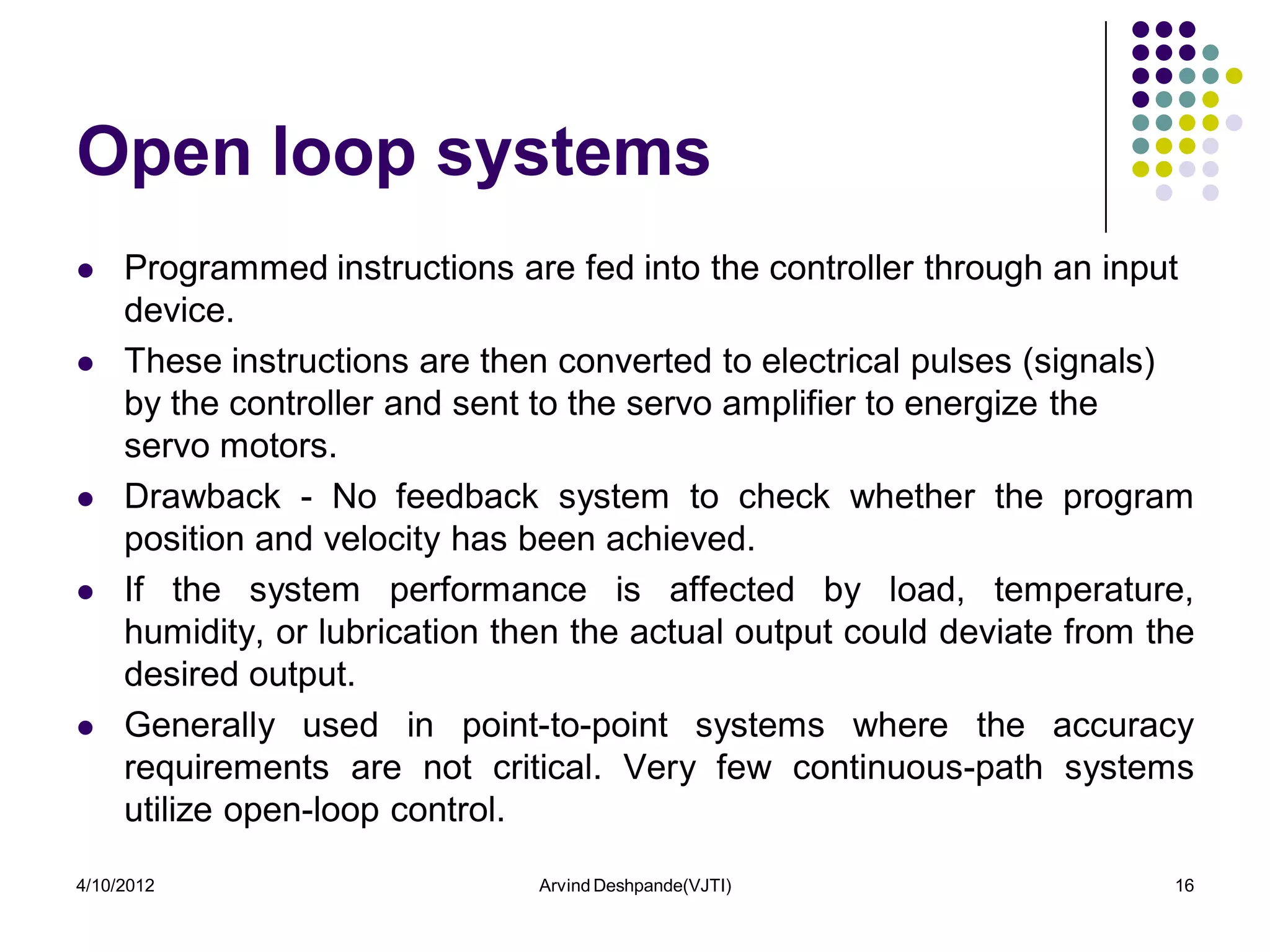
Open loop systems
    Programmed instructions are fed into the controller through an input
     device.
    These instructions are then converted to electrical pulses (signals)
     by the controller and sent to the servo amplifier to energize the
     servo motors.
    Drawback - No feedback system to check whether the program
     position and velocity has been achieved.
    If the system performance is affected by load, temperature,
     humidity, or lubrication then the actual output could deviate from the
     desired output.
    Generally used in point-to-point systems where the accuracy
     requirements are not critical. Very few continuous-path systems
     utilize open-loop control.
4/10/2012                       Arvind Deshpande(VJTI)                   16
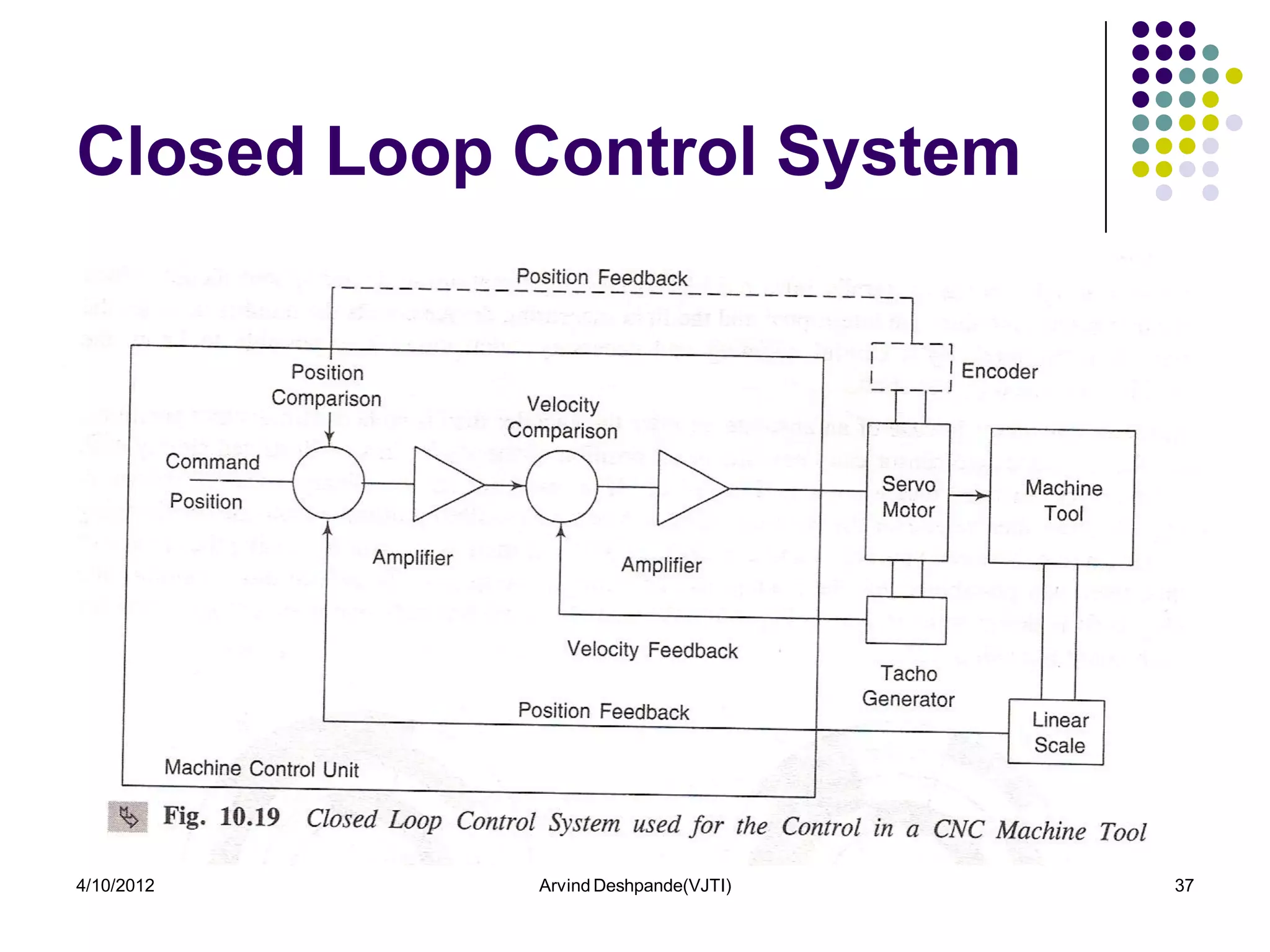
Closed loop systems
    Feedback subsystem to monitor the actual output and correct any
     discrepancy from the programmed input.
    Use position and velocity feed back.
    The feedback system could be either analog or digital. The analog systems
     measure the variation of physical variables such as position and velocity in
     terms of voltage levels. Digital systems monitor output variations by means
     of electrical pulses.
    To control the dynamic behavior and the final position of the machine slides,
     a variety of position transducers are employed.
    Majority of CNC systems operate on servo mechanism, a closed loop
     principle. If a discrepancy is revealed between where the machine element
     should be and where it actually is, the sensing device signals the driving
     unit to make an adjustment, bringing the movable component to the
     required location.
    Closed-loop systems are very powerful and accurate

4/10/2012                         Arvind Deshpande(VJTI)                        17
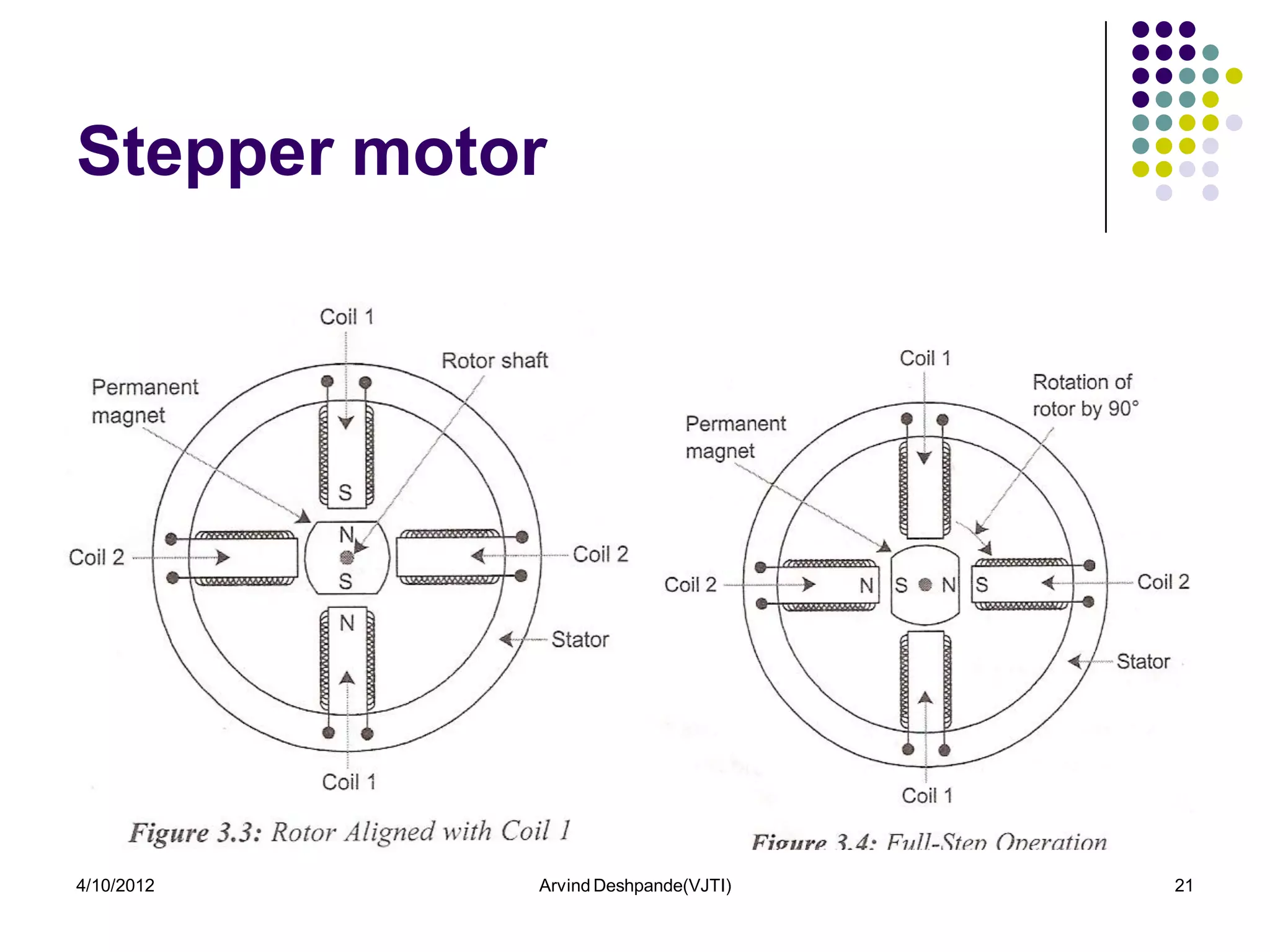
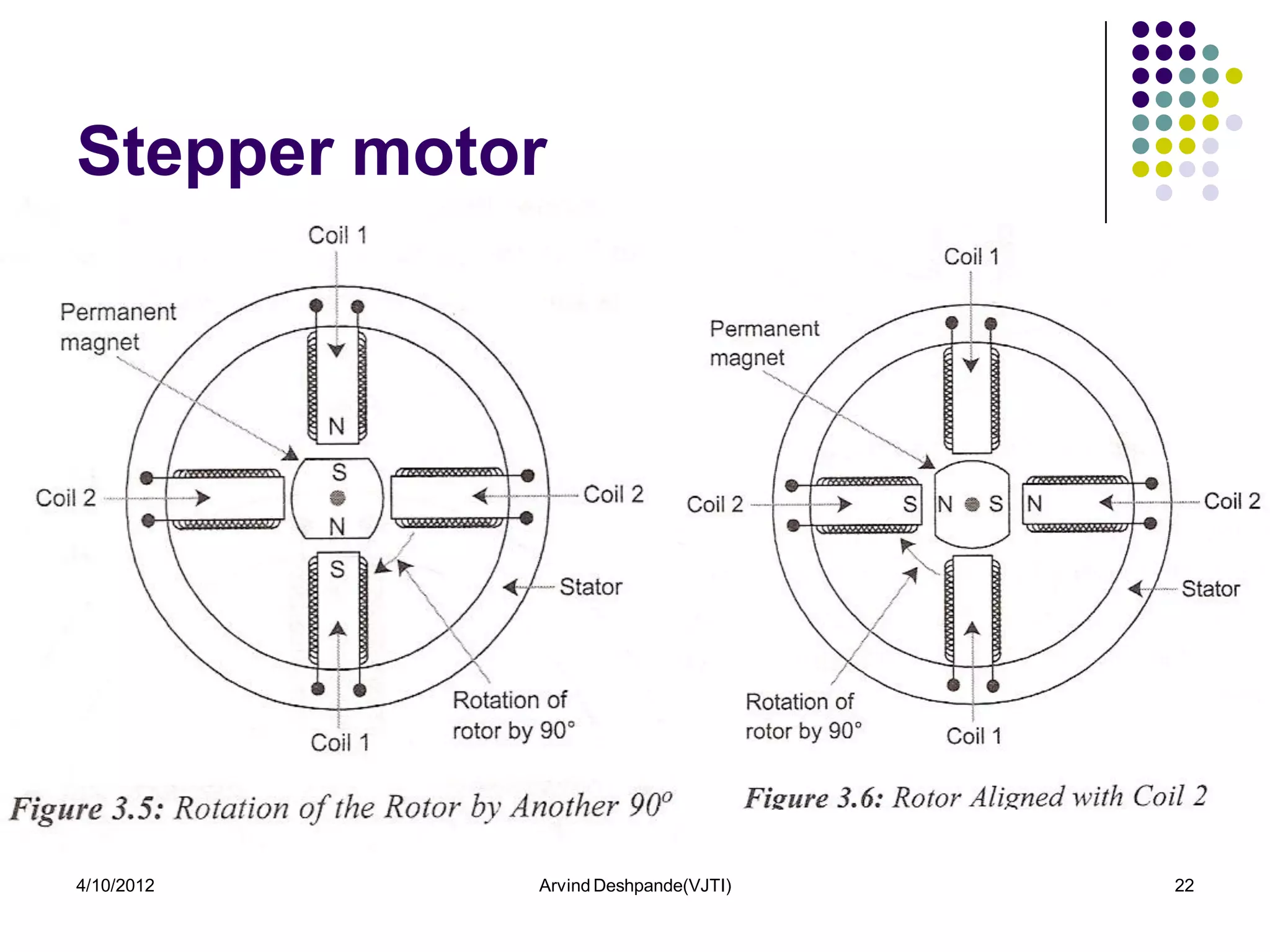
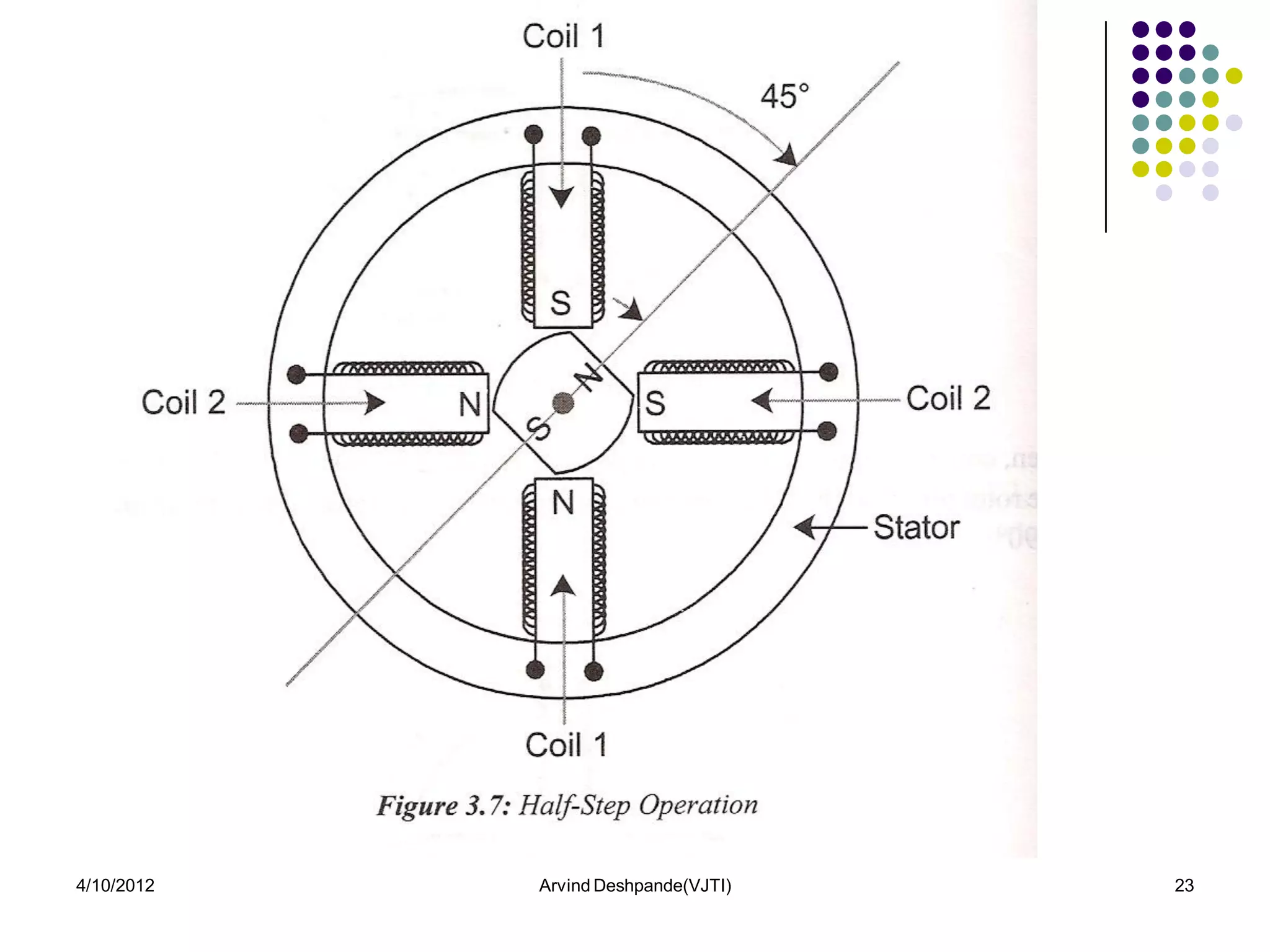
Stepper Motors
   Rotates in steps (fixed angular increments)
   200 steps per revolution i.e 1.80 per pulse
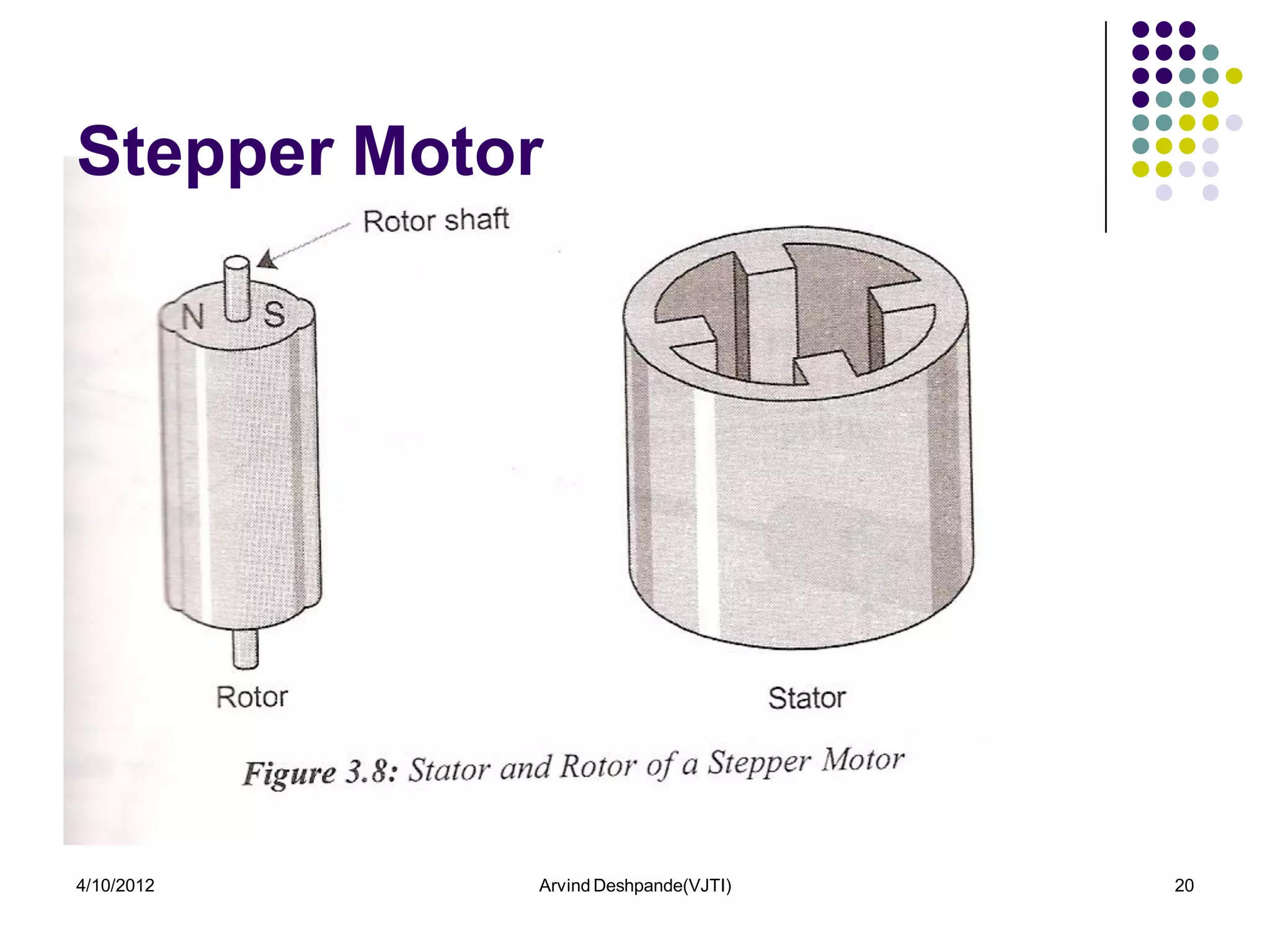
   Permanent magnet rotor
   Micro step motors – 25000 steps/rev
Advantages
1.  Low cost
2.  Compact
3.  Simple in construction
4.  High reliability
5.  No maintenance (no brushes)
6.  Excellent torgue at high speeds
7. Stepper motors can easily accelerate a load.
8. There is usually no need for clutches and brakes (unless a large
   external load is acting, such as gravity).
4/10/2012                    Arvind Deshpande(VJTI)                   18
Stepper Motors
9.  Stepper motors are inherently digital. The number of pulses
    determines position while the pulse frequency determines velocity.
10. Easily and accurately controlled.

11. They offer excellent heat dissipation

Disadvantages
1.   The motor can lose position if the load torque exceeds the motor's
     available torque.
2.   Open loop stepper motor systems should not be used for high-
     performance or high-load applications.
3.   Damping may be required when load inertia is very high to prevent
     motor shaft oscillation at resonance points.
4.   Stepper motors may perform poorly in high-speed applications.

4/10/2012                    Arvind Deshpande(VJTI)                       19
Stepper Motor


4/10/2012   Arvind Deshpande(VJTI)   20
Stepper motor


4/10/2012   Arvind Deshpande(VJTI)   21
Stepper motor


4/10/2012   Arvind Deshpande(VJTI)   22
4/10/2012   Arvind Deshpande(VJTI)   23
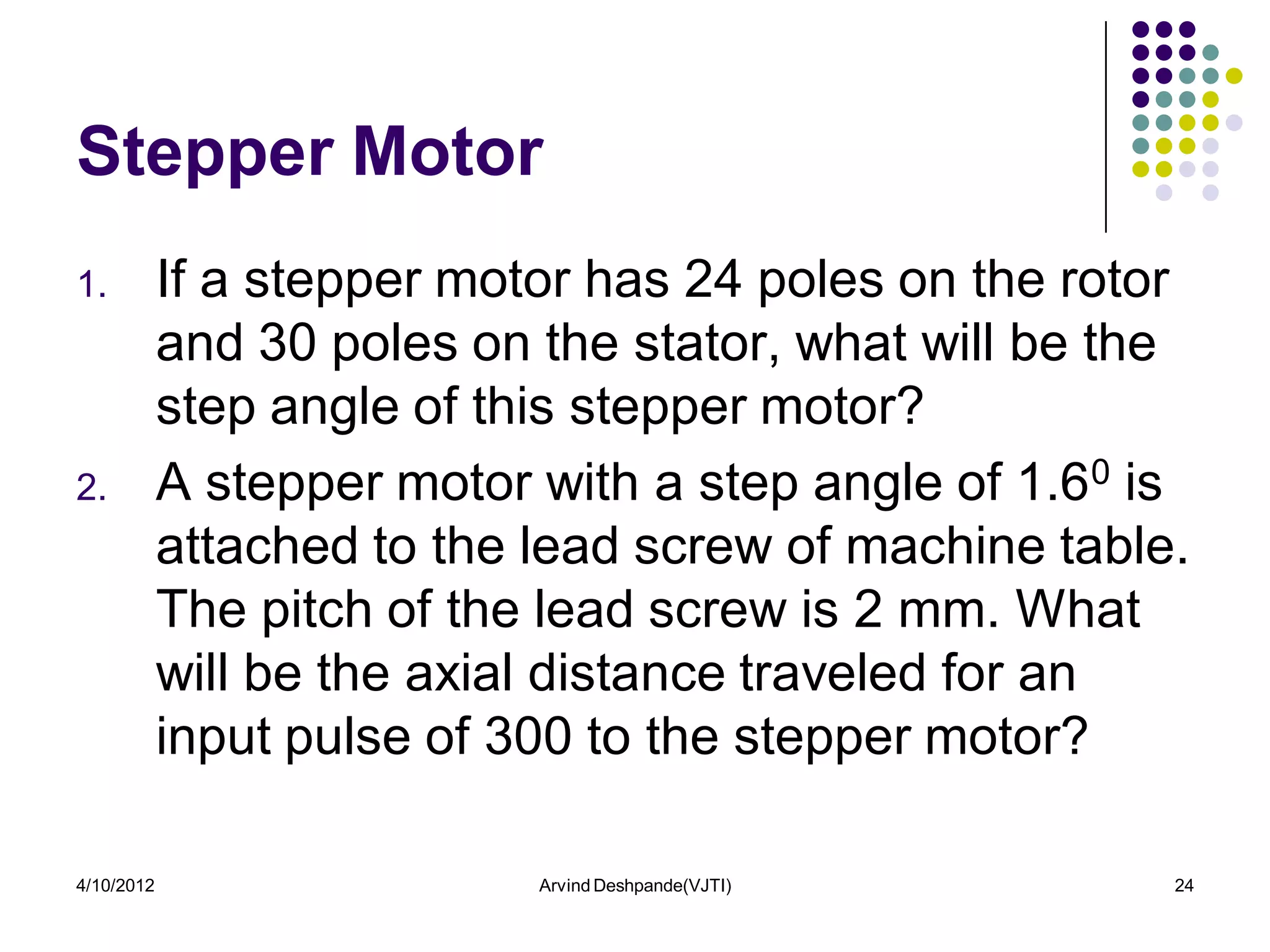
Stepper Motor
1.          If a stepper motor has 24 poles on the rotor
            and 30 poles on the stator, what will be the
            step angle of this stepper motor?
2.          A stepper motor with a step angle of 1.60 is
            attached to the lead screw of machine table.
            The pitch of the lead screw is 2 mm. What
            will be the axial distance traveled for an
            input pulse of 300 to the stepper motor?

4/10/2012                   Arvind Deshpande(VJTI)     24
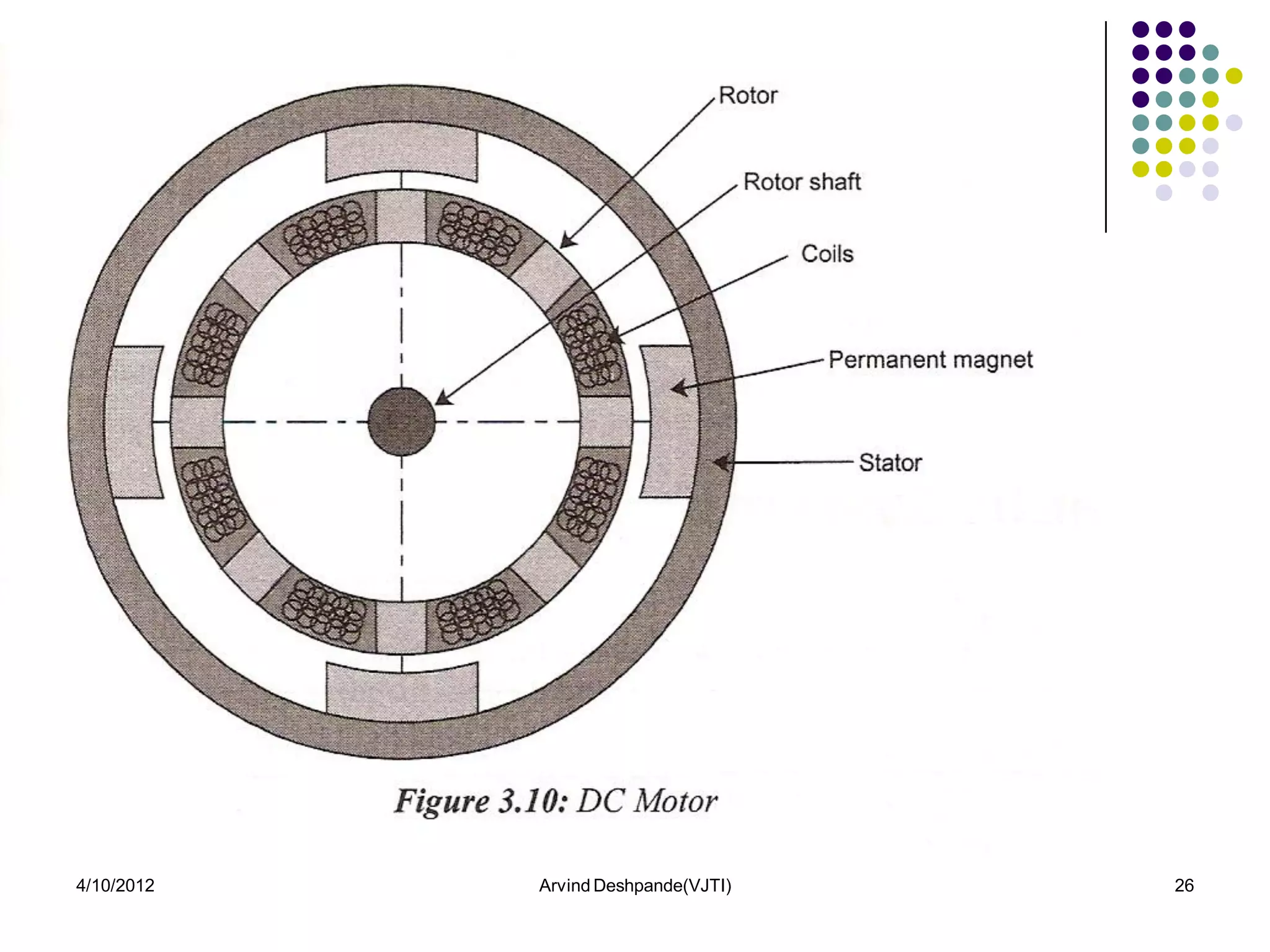
Servo Motors
    Servo motors are more robust than stepper motors, but pose a more
     difficult control problem.
    They are primarily used in applications where speed, power, noise
     level as well as velocity and positional accuracy are important.
    Servo motors are not functional without sensor feedback.
    3 common types
    The DC brush type servo motors are most commonly found in low-
     end to mid-range CNC machinery.
    The DC brushless type are typically applied to high-end CNC
     machinery.
    AC servo motors are another variety that offers high-end
     performance

4/10/2012                     Arvind Deshpande(VJTI)                 25
4/10/2012   Arvind Deshpande(VJTI)   26
Linear Motors
    Series of magnets attached to machine base
     and a set of electrical coils around a steel
     laminate attached to moving slide
    No mechanical parts in contact
    No wear or periodic maintenance required
    Not limited in travel like ball screws
    Can produce parts with higher accuracy and
     close tolerances at higher speeds and feeds
4/10/2012             Arvind Deshpande(VJTI)        27
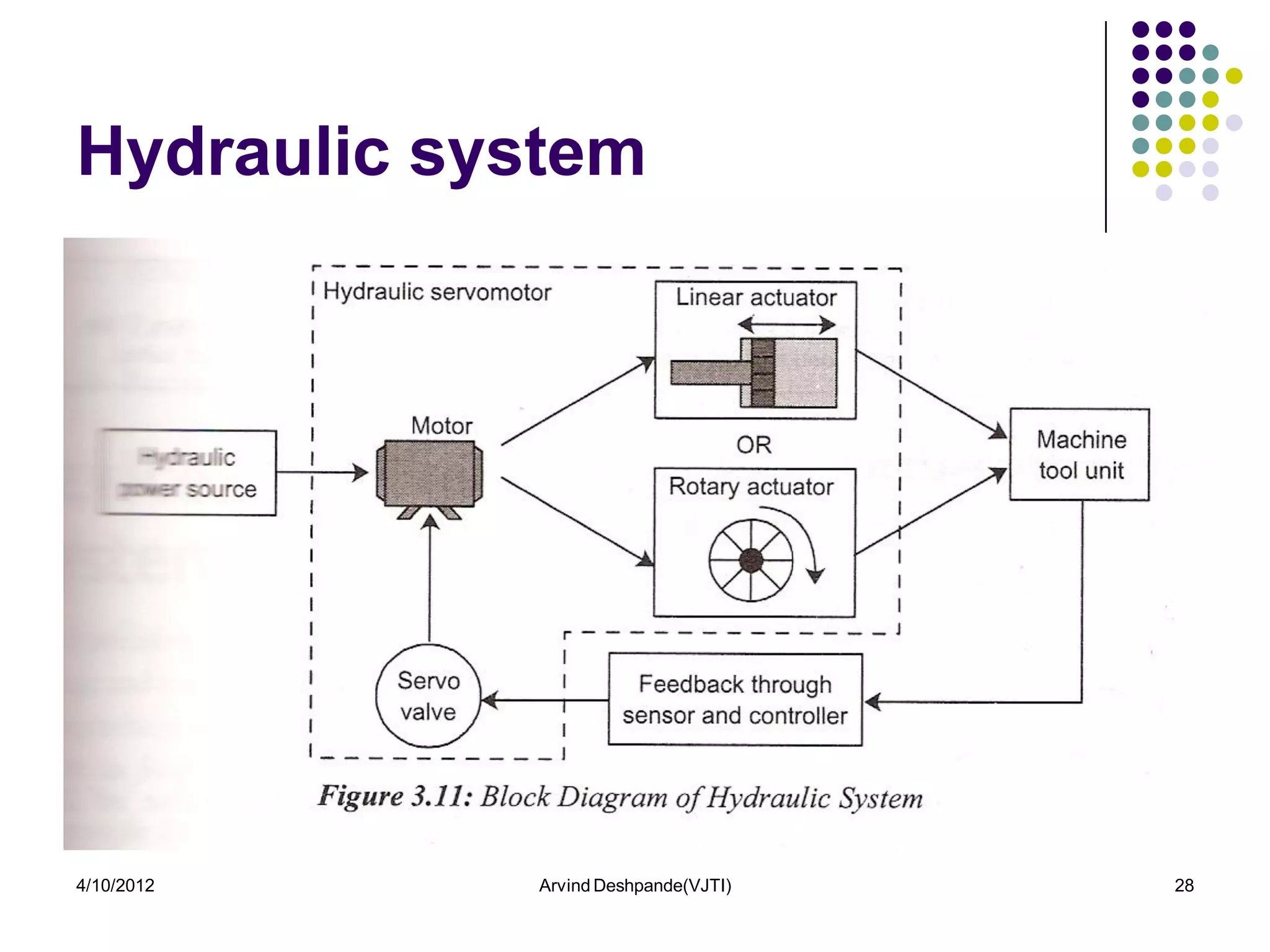
Hydraulic system


4/10/2012   Arvind Deshpande(VJTI)   28
Lead Screw
    To convert rotary motion from drive motor to
     linear motion of the slides
    Square threads
    Sliding contact results in higher friction
    Low efficiency (35-55%)
    Greater power requirement
    Backlash
    CNC requires high speed of movement
     where friction will be very high
4/10/2012             Arvind Deshpande(VJTI)        29
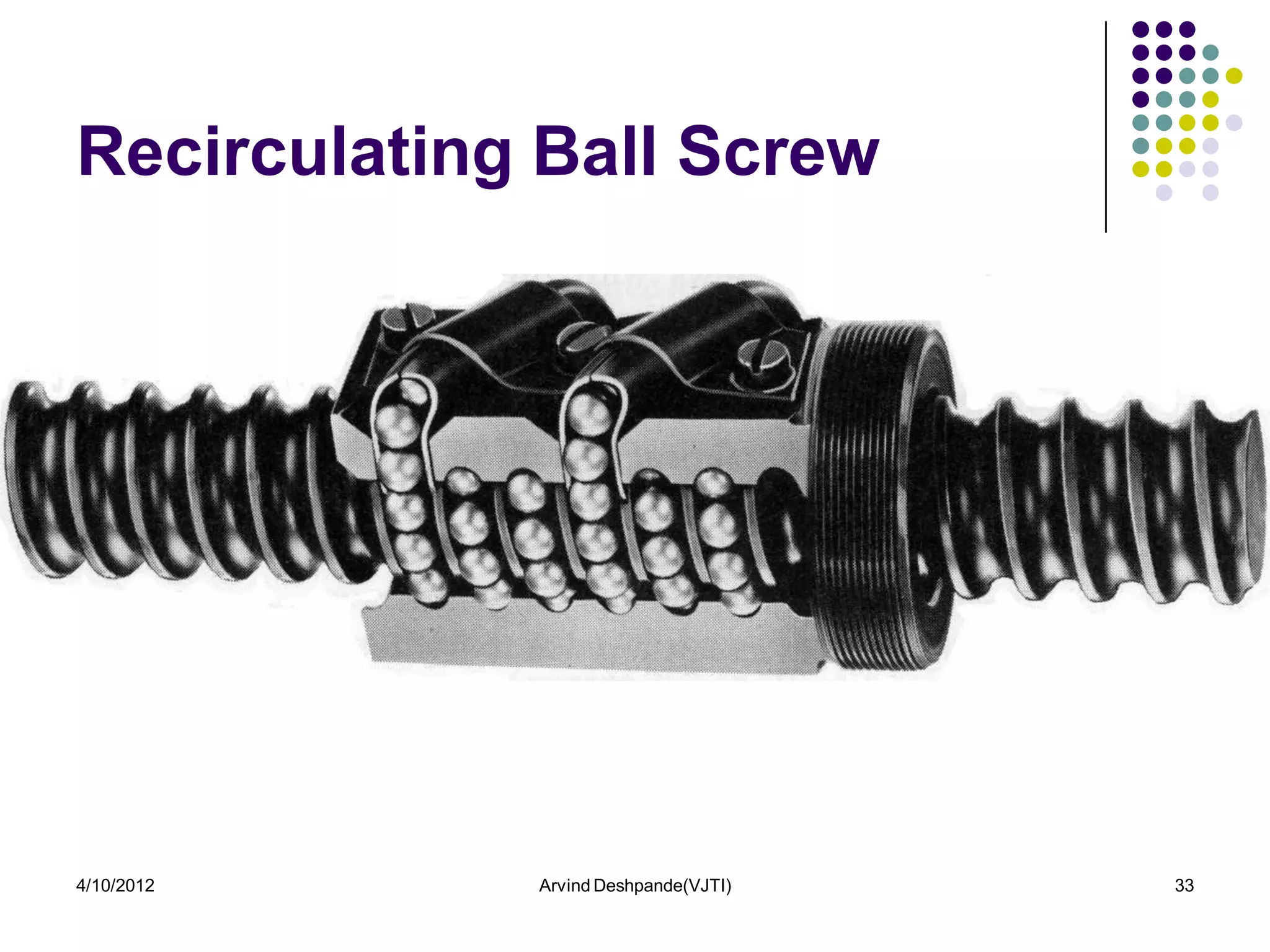
Recirculating Ball Screw
  Balls circulate between screw and but
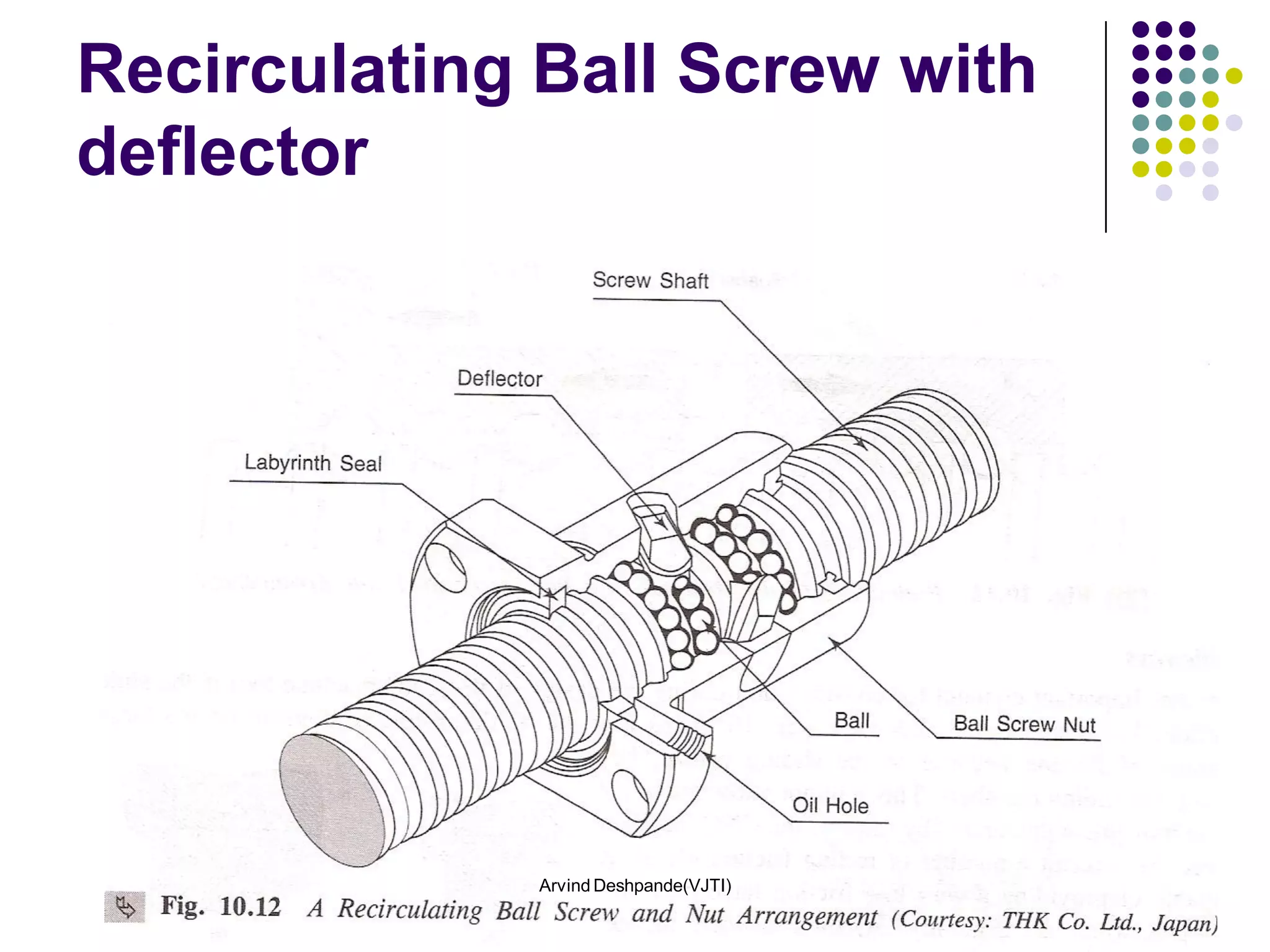
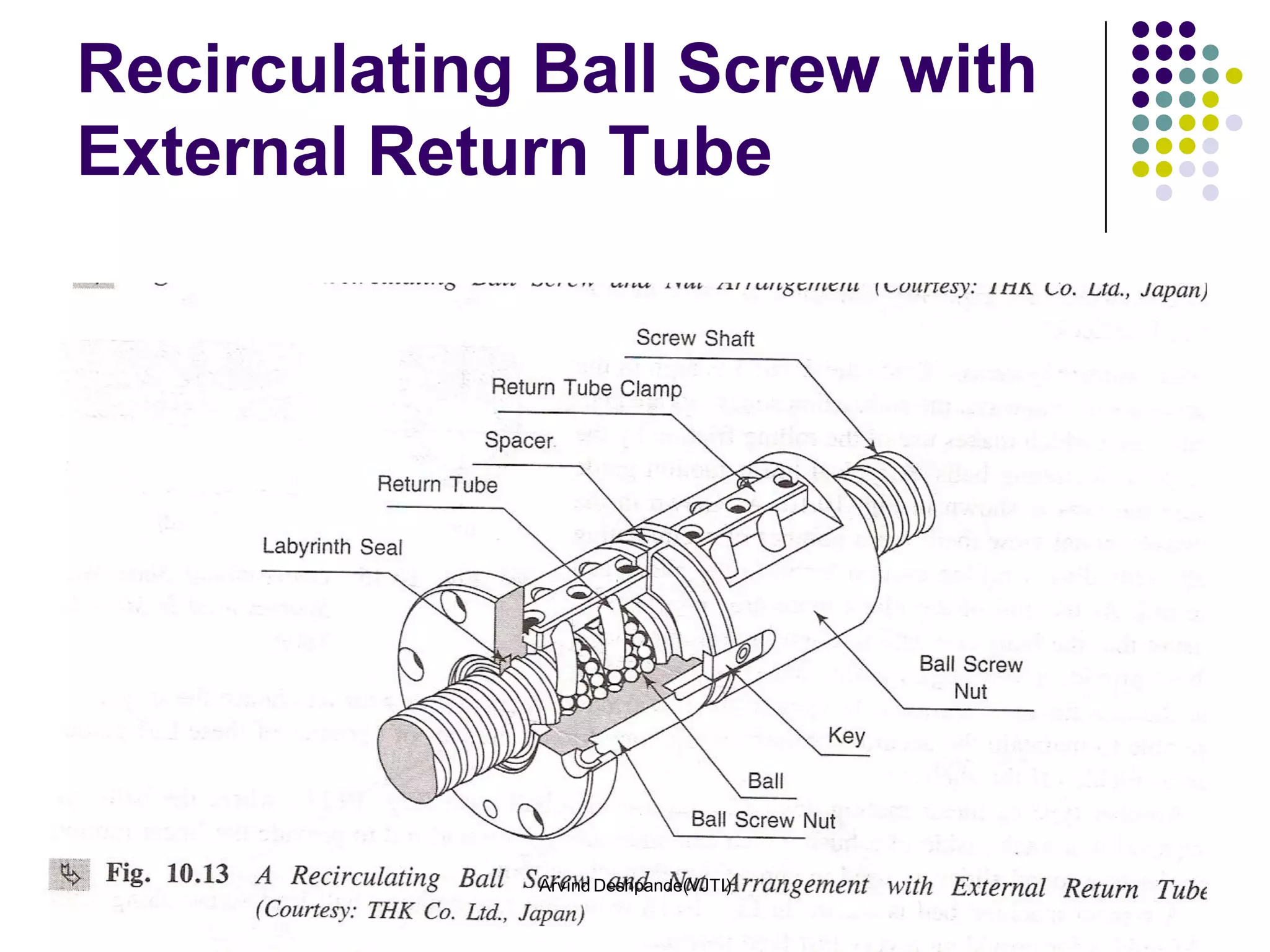
  Balls are recirculated using deflector or return tube
  Preloading to reduce backlash
Advantages
1. Longer life
2. Relatively small wear. Will maintain accuracy through
   entire life of the screw.
3. Rolling motion reduces friction considerably. Can be
   used for carrying heavier loads at faster speeds.
4. High efficiency(85-95%)
5. Small power requirement
4/10/2012               Arvind Deshpande(VJTI)             30
Recirculating Ball Screw with
deflector


4/10/2012    Arvind Deshpande(VJTI)   31
Recirculating Ball Screw with
External Return Tube


4/10/2012    Arvind Deshpande(VJTI)   32
Recirculating Ball Screw


4/10/2012    Arvind Deshpande(VJTI)   33
Recirculating Ball Screw
    A ball screw has lead of 0.125 in/rev. What is
     the distance the nut will travel if the screw is
     turned 15 degrees?


4/10/2012              Arvind Deshpande(VJTI)       34
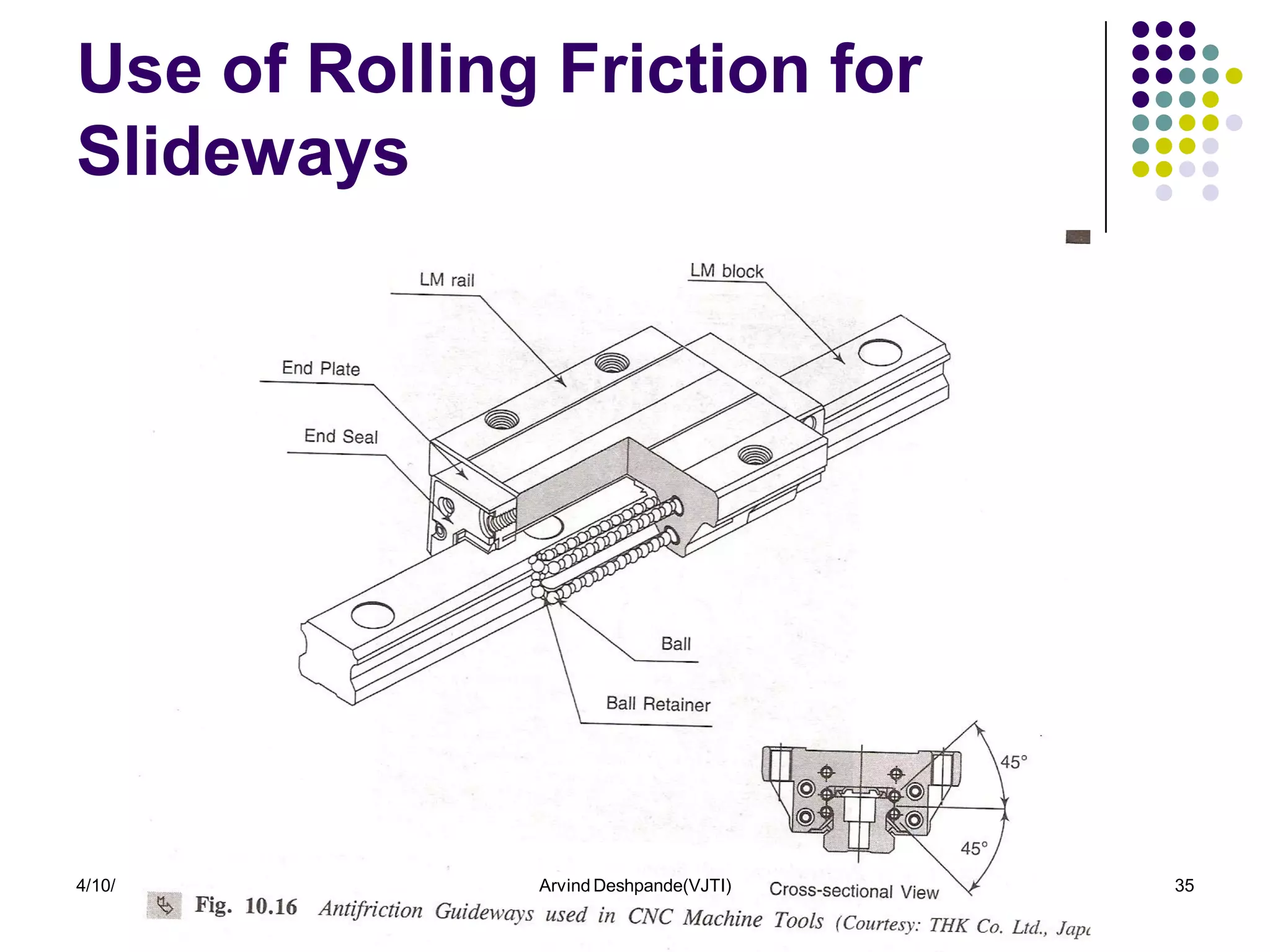
Use of Rolling Friction for
Slideways


4/10/2012     Arvind Deshpande(VJTI)   35
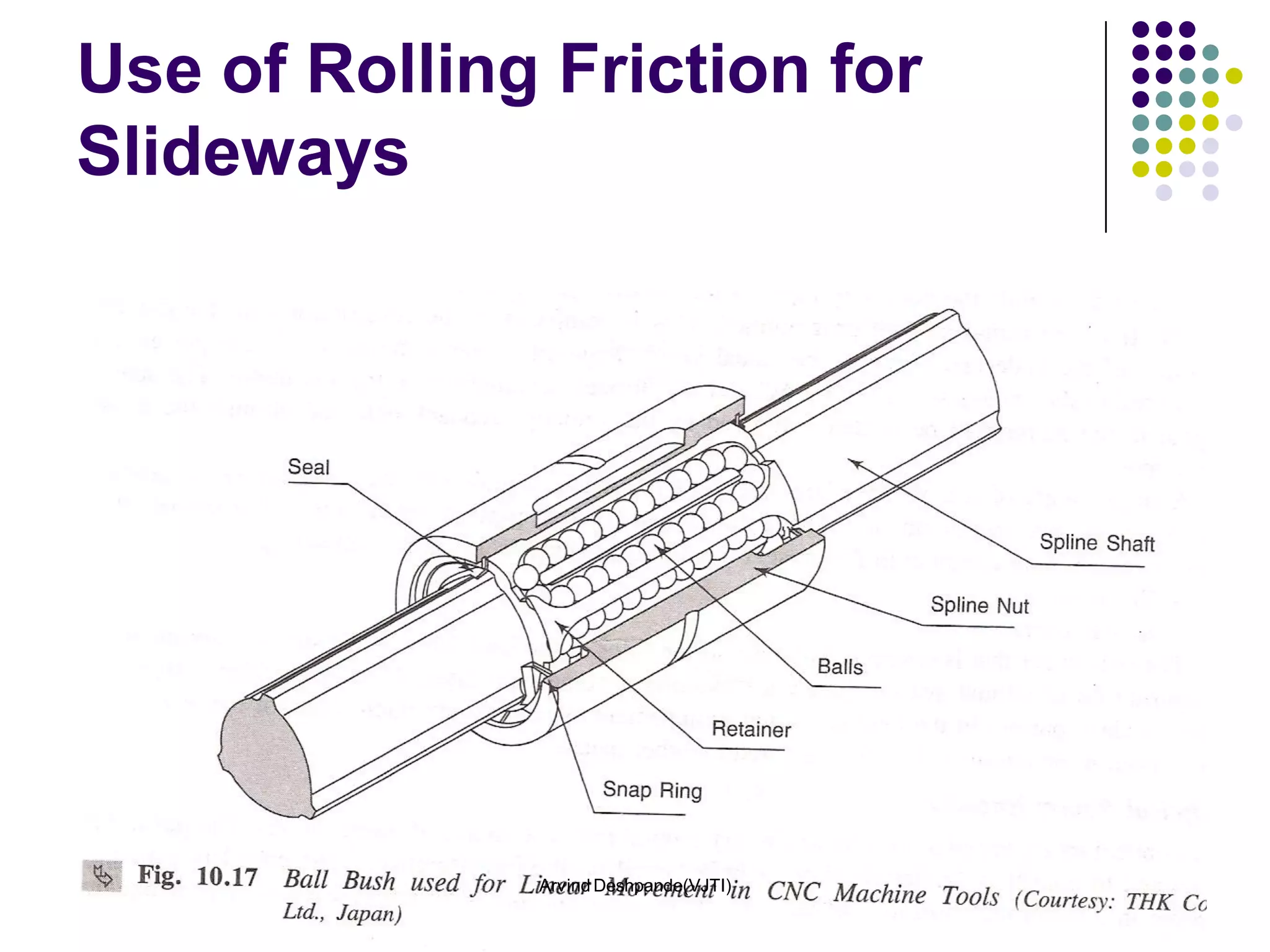
Use of Rolling Friction for
Slideways


4/10/2012     Arvind Deshpande(VJTI)   36
Closed Loop Control System


4/10/2012   Arvind Deshpande(VJTI)   37
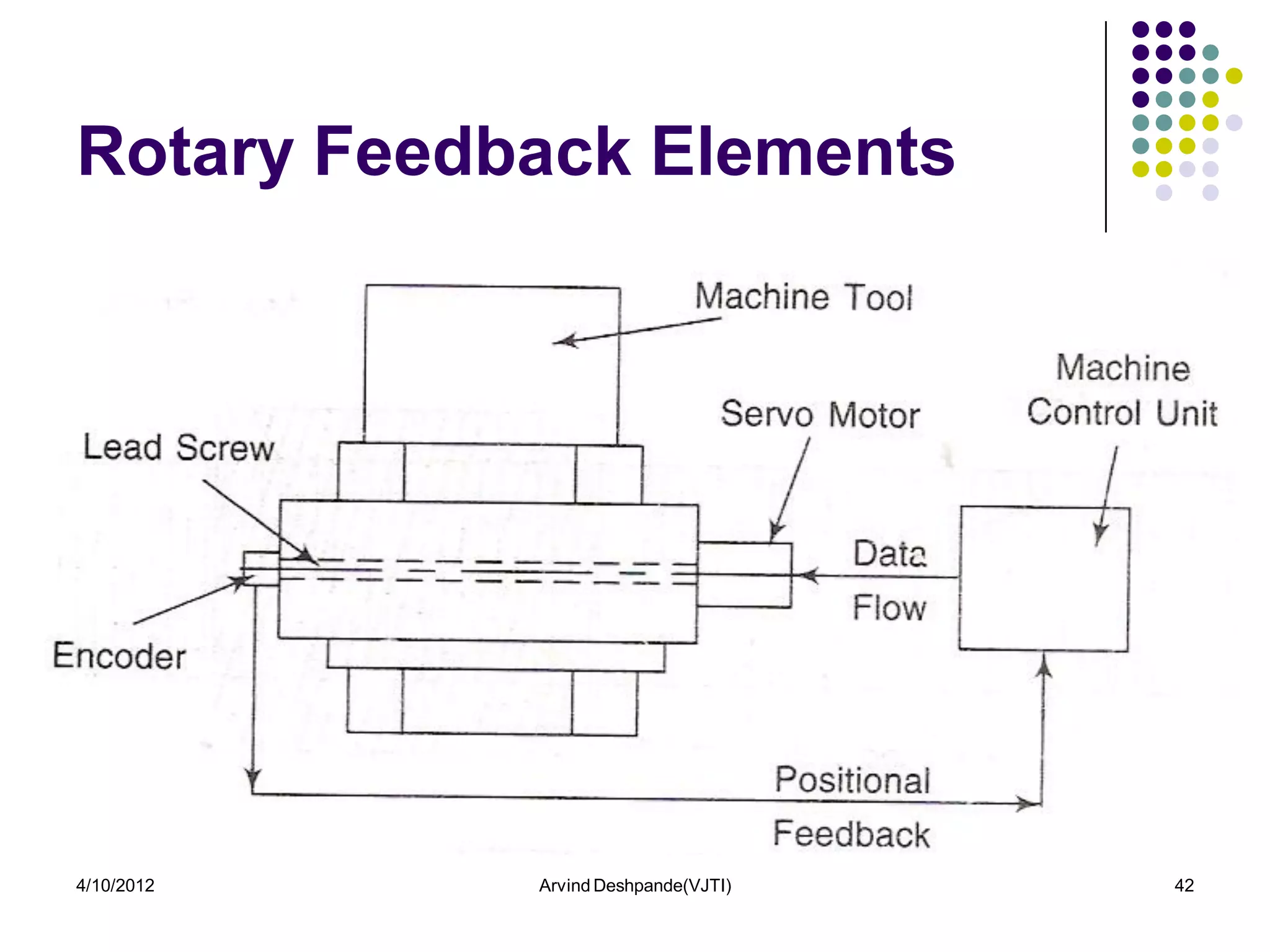
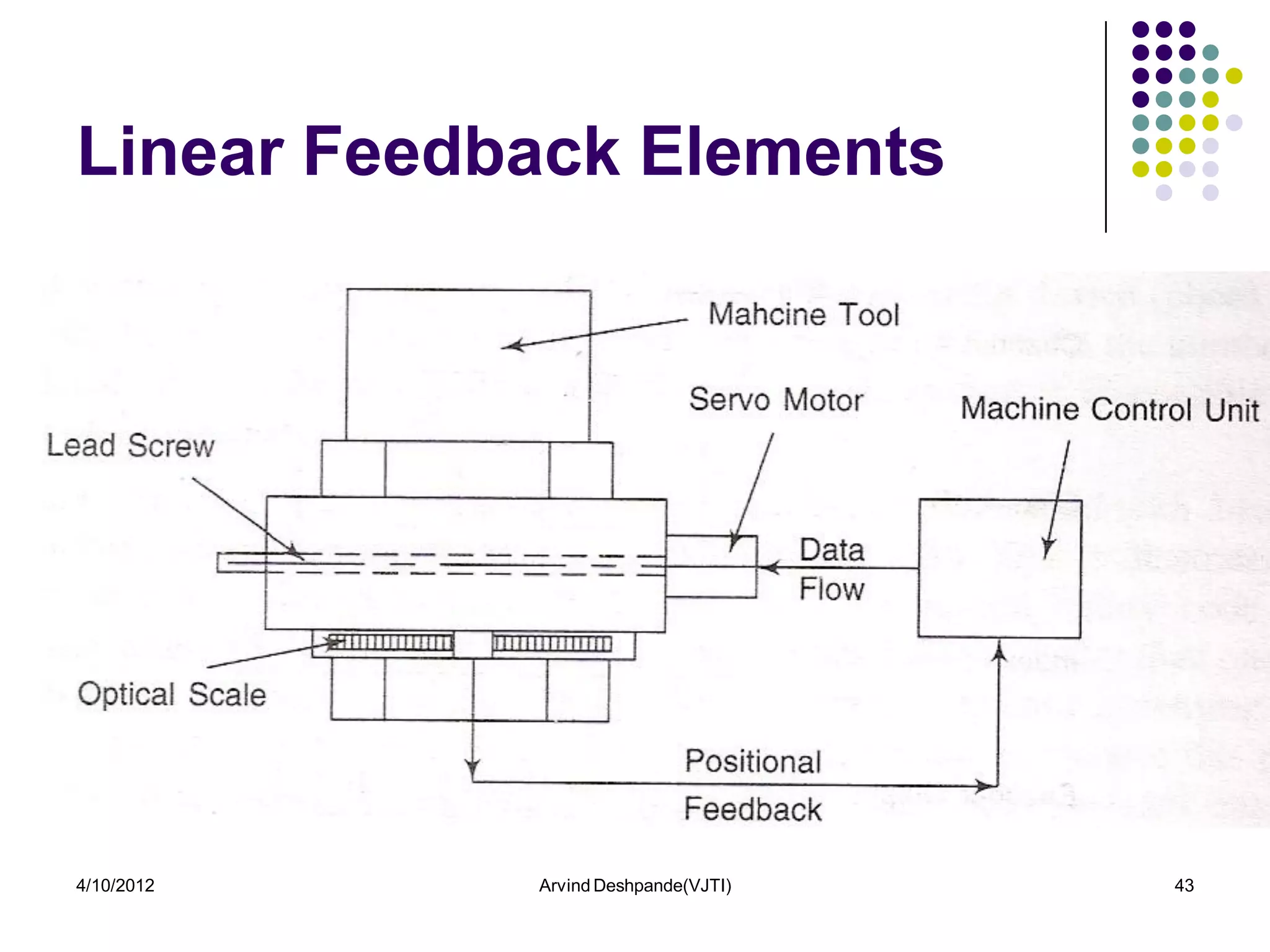
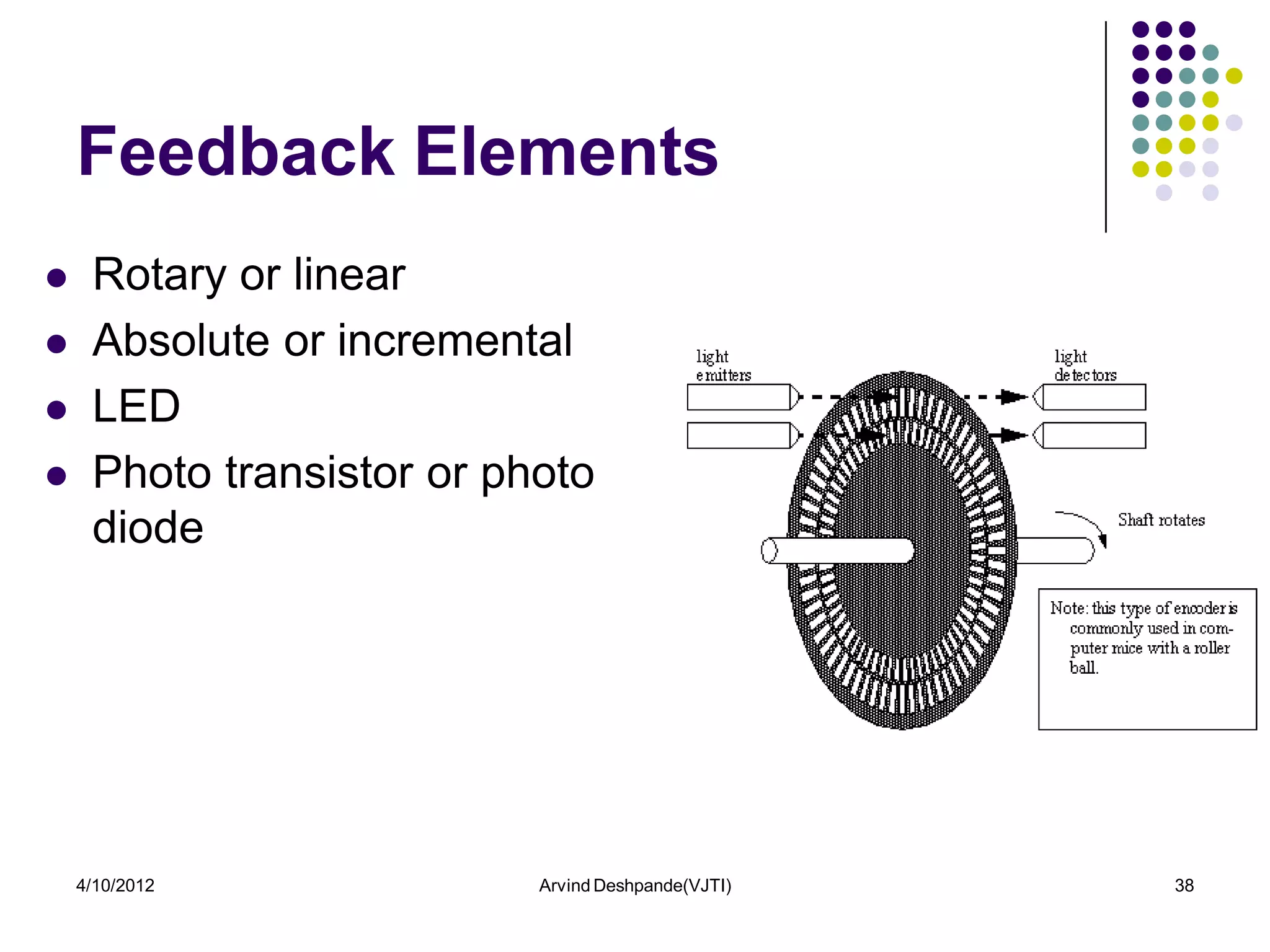
Feedback Elements
    Rotary or linear
    Absolute or incremental
    LED
    Photo transistor or photo
     diode


    4/10/2012              Arvind Deshpande(VJTI)   38
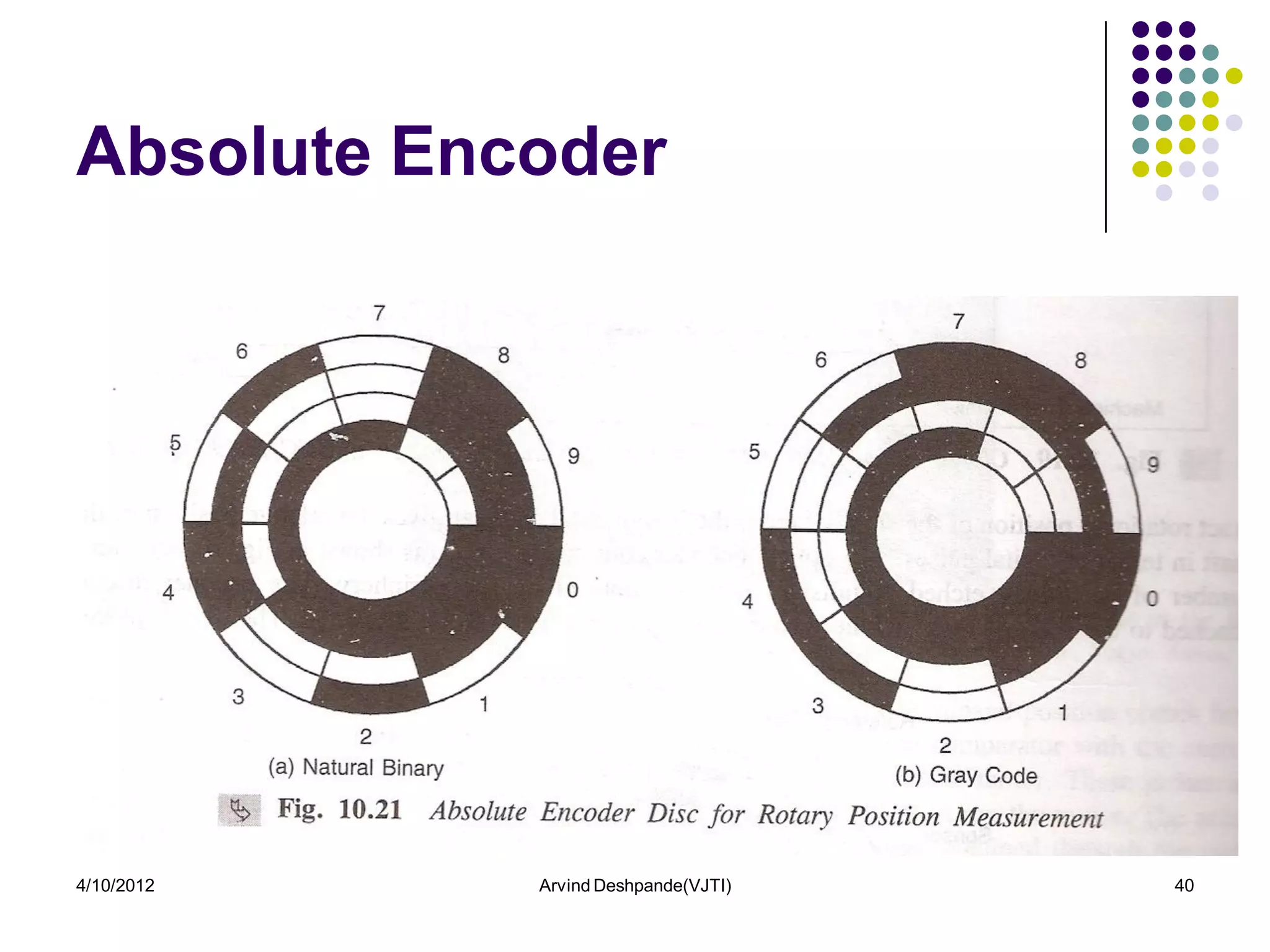
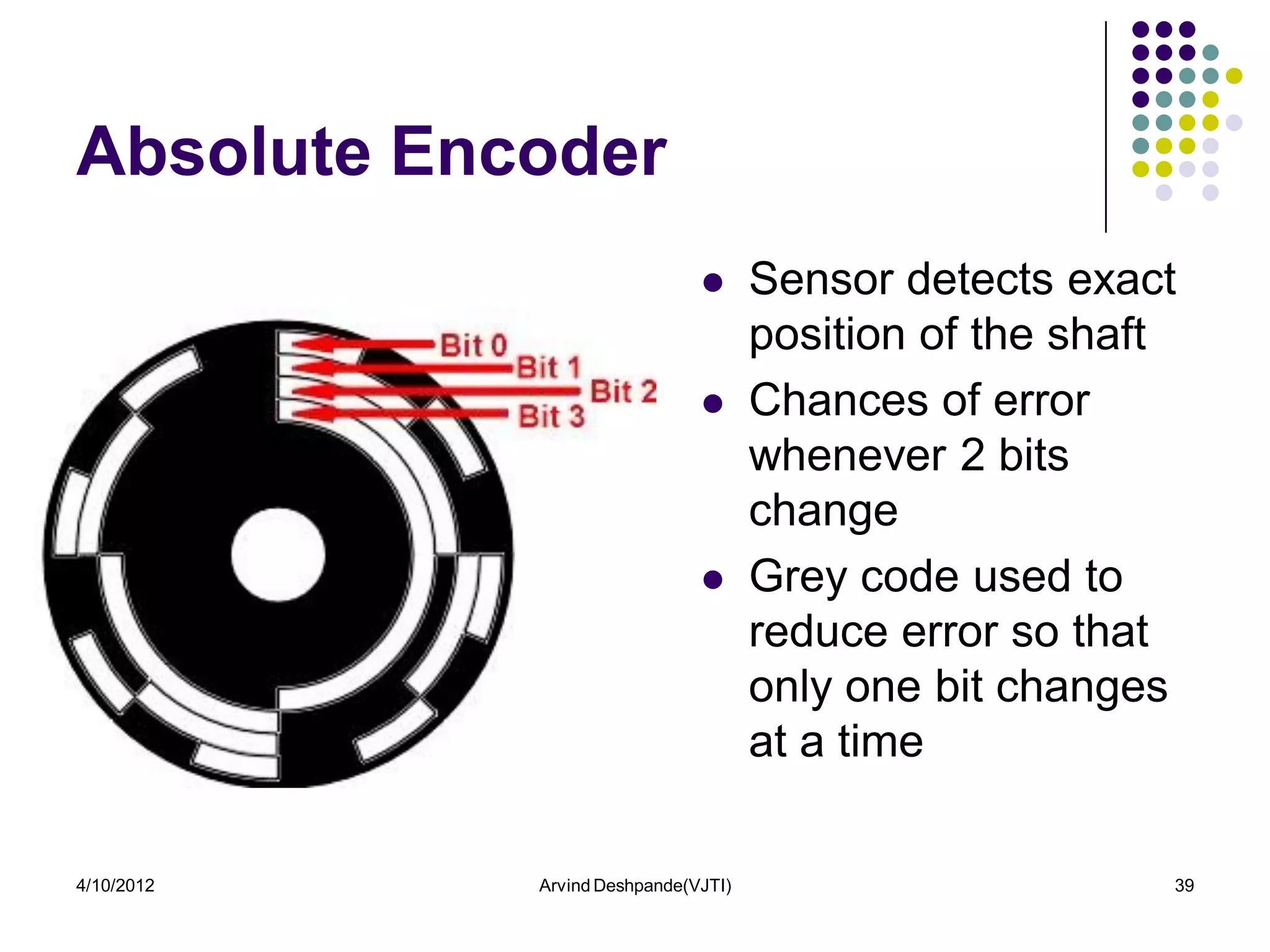
Absolute Encoder
                                    Sensor detects exact
                                     position of the shaft
                                    Chances of error
                                     whenever 2 bits
                                     change
                                    Grey code used to
                                     reduce error so that
                                     only one bit changes
                                     at a time

4/10/2012   Arvind Deshpande(VJTI)                       39
Absolute Encoder


4/10/2012   Arvind Deshpande(VJTI)   40
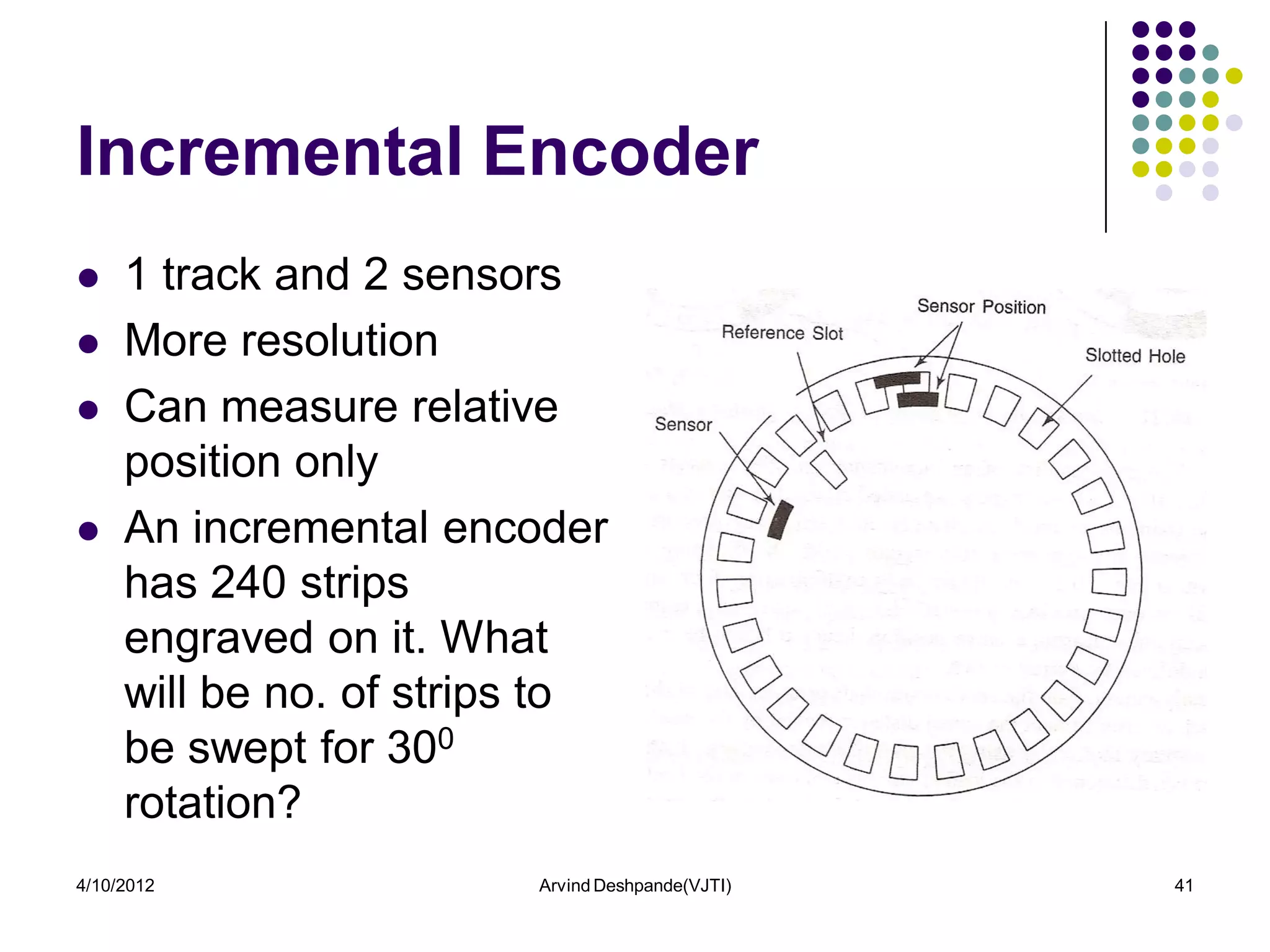
Incremental Encoder
    1 track and 2 sensors
    More resolution
    Can measure relative
     position only
    An incremental encoder
     has 240 strips
     engraved on it. What
     will be no. of strips to
     be swept for 300
     rotation?
4/10/2012                Arvind Deshpande(VJTI)   41
Rotary Feedback Elements


4/10/2012   Arvind Deshpande(VJTI)   42
Linear Feedback Elements


4/10/2012   Arvind Deshpande(VJTI)   43
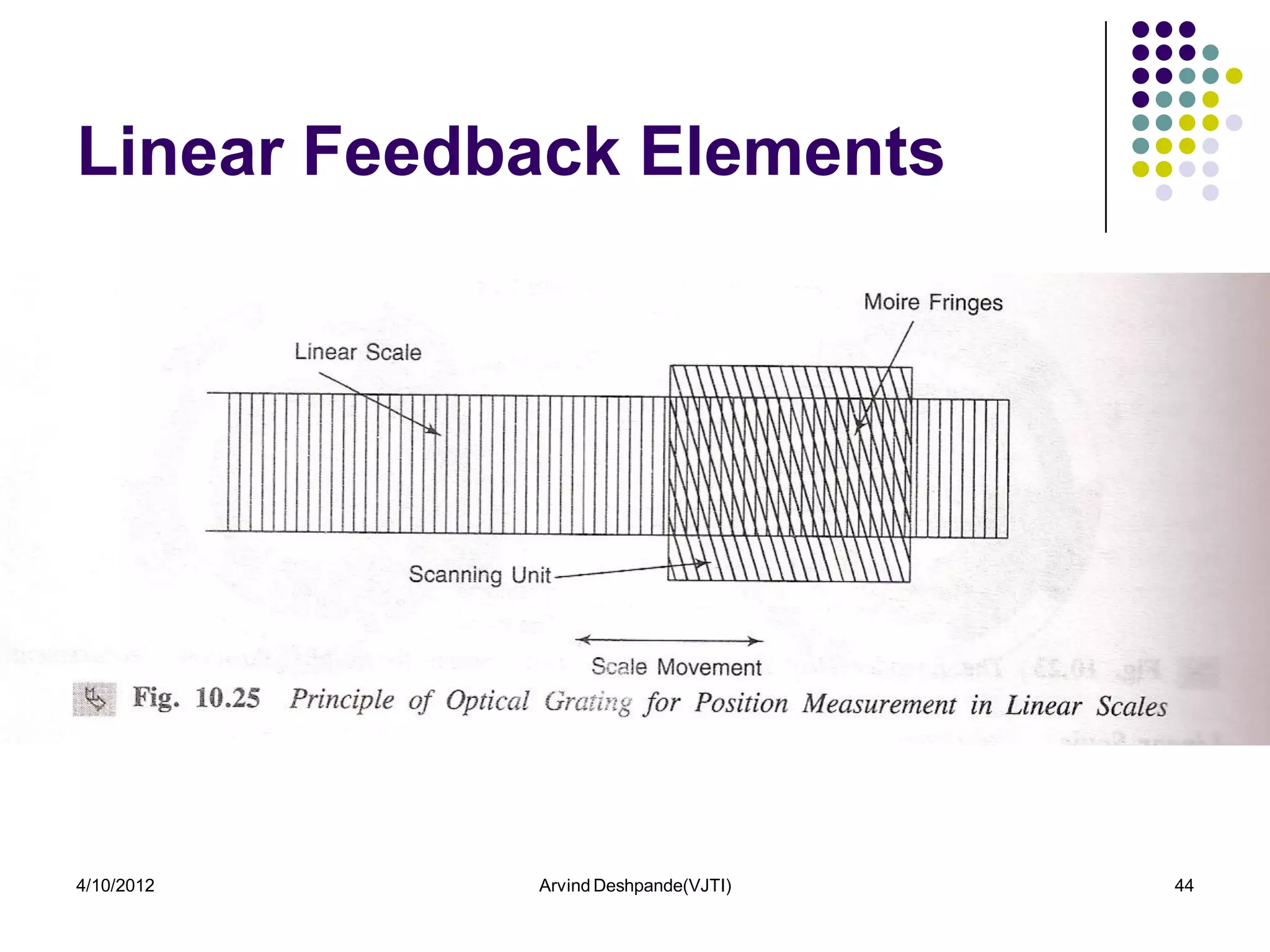
Linear Feedback Elements


4/10/2012   Arvind Deshpande(VJTI)   44
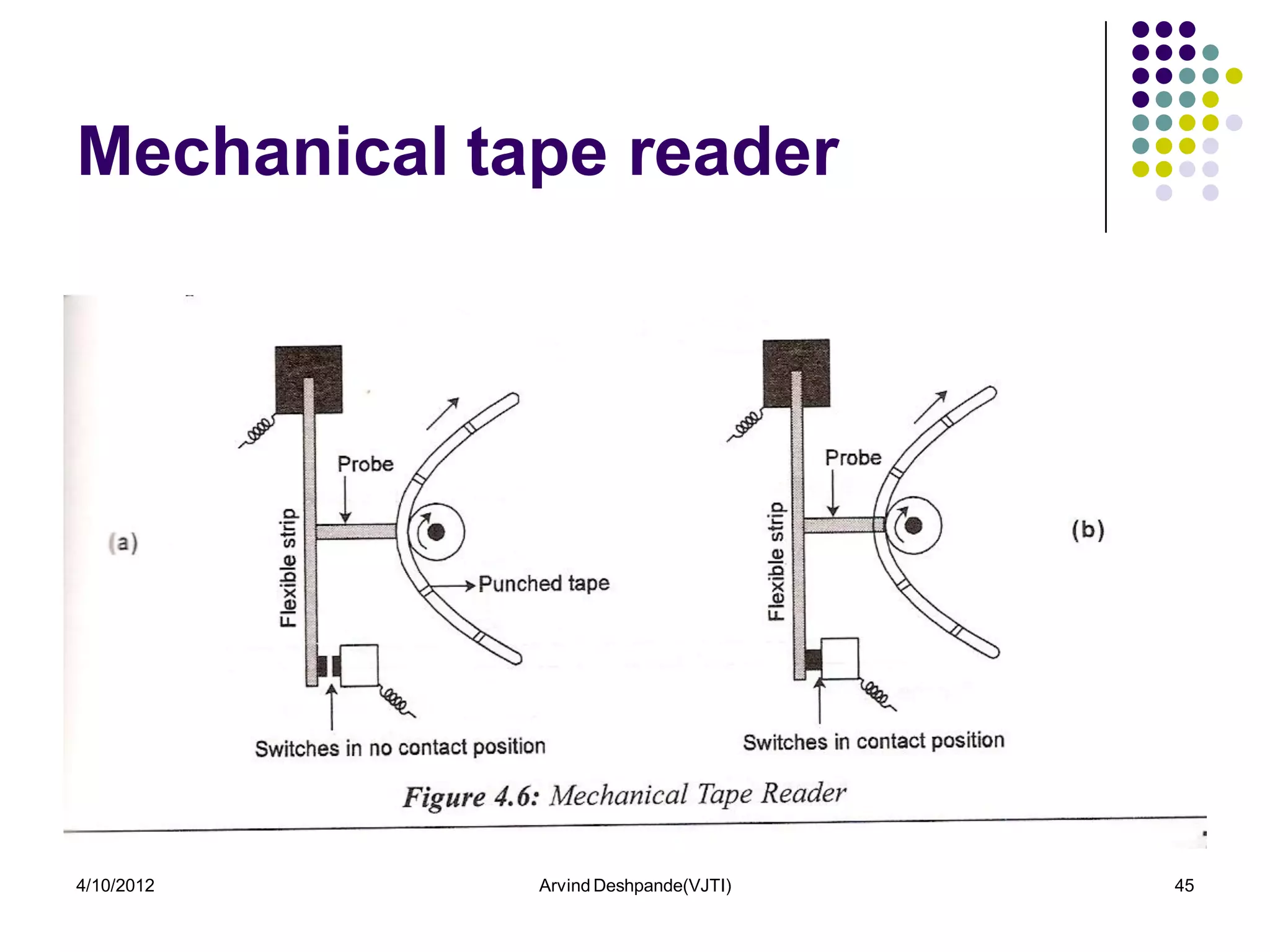
Mechanical tape reader


4/10/2012    Arvind Deshpande(VJTI)   45
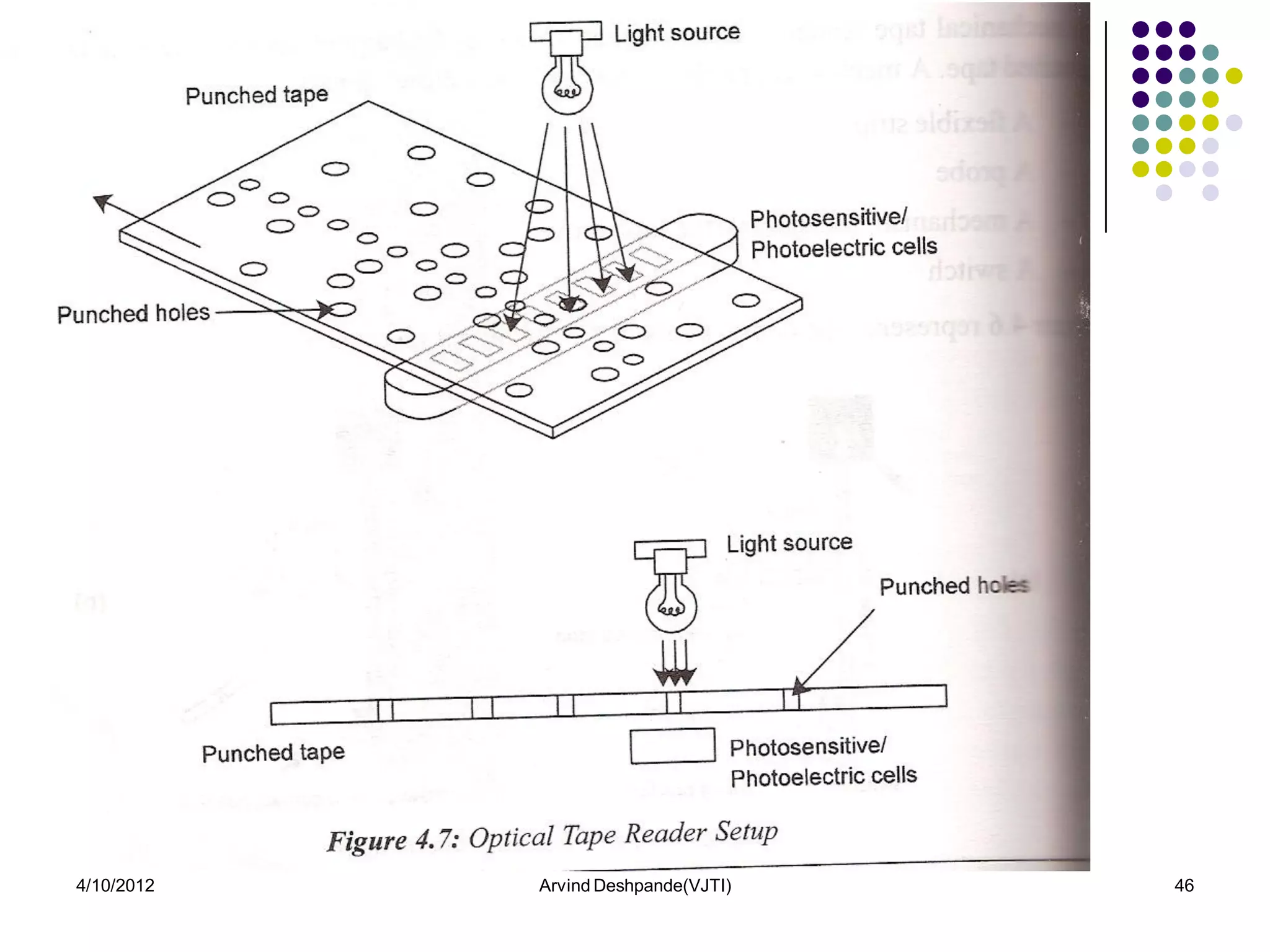
4/10/2012   Arvind Deshpande(VJTI)   46
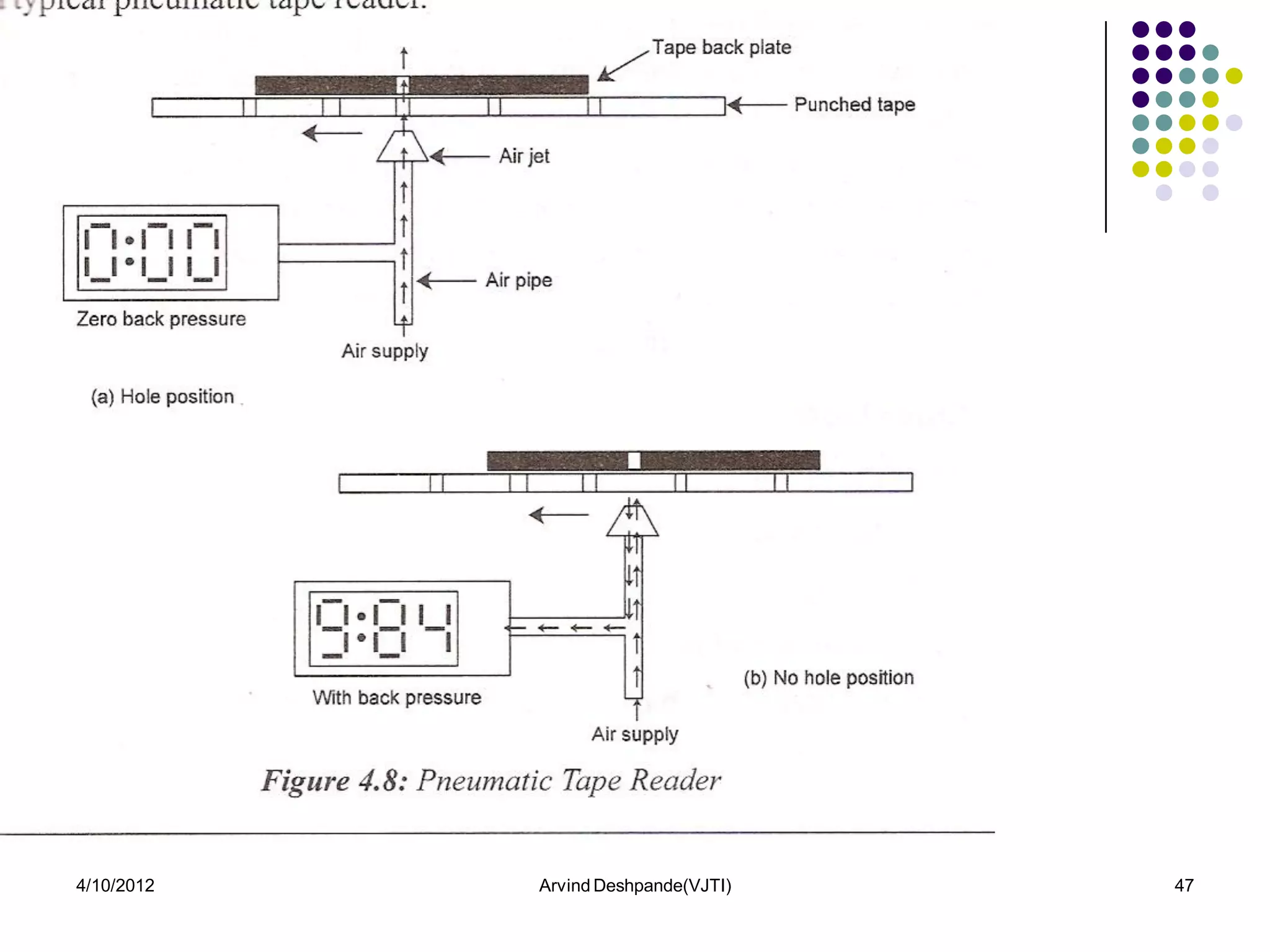
4/10/2012   Arvind Deshpande(VJTI)   47
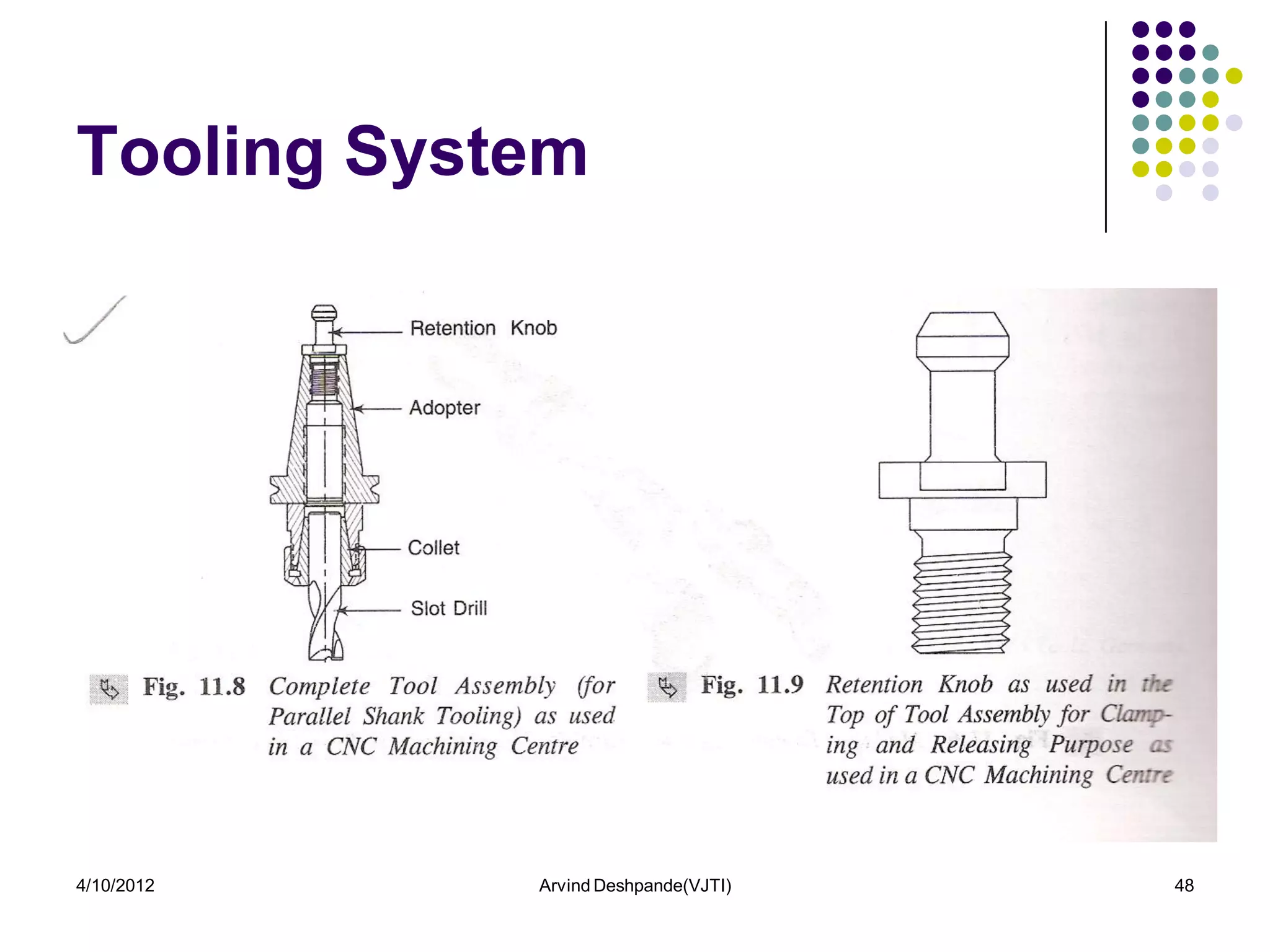
Tooling System


4/10/2012   Arvind Deshpande(VJTI)   48
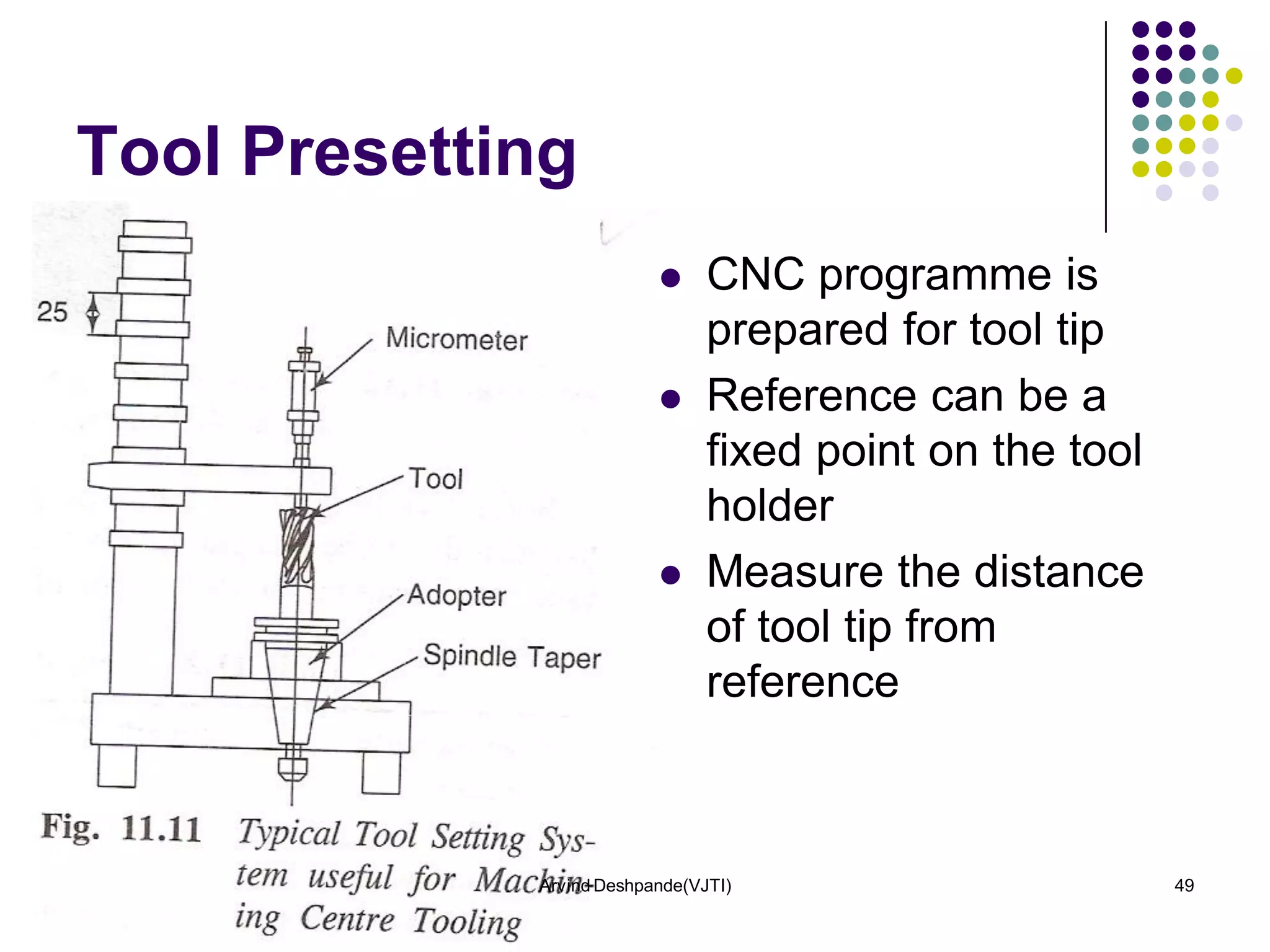
Tool Presetting
                               CNC programme is
                                prepared for tool tip
                               Reference can be a
                                fixed point on the tool
                                holder
                               Measure the distance
                                of tool tip from
                                reference


4/10/2012    Arvind Deshpande(VJTI)                       49
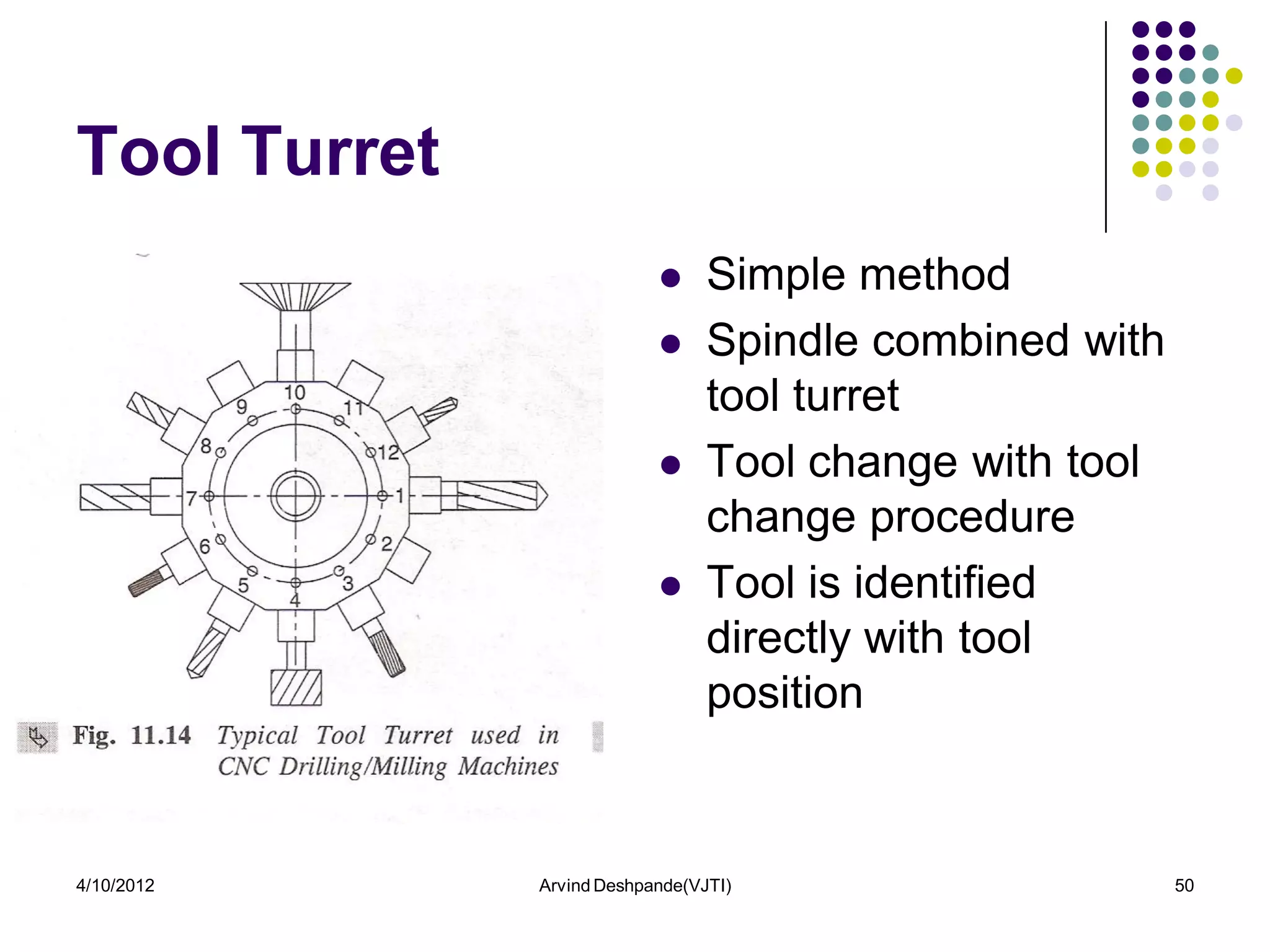
Tool Turret
                                Simple method
                                Spindle combined with
                                 tool turret
                                Tool change with tool
                                 change procedure
                                Tool is identified
                                 directly with tool
                                 position


4/10/2012     Arvind Deshpande(VJTI)                     50
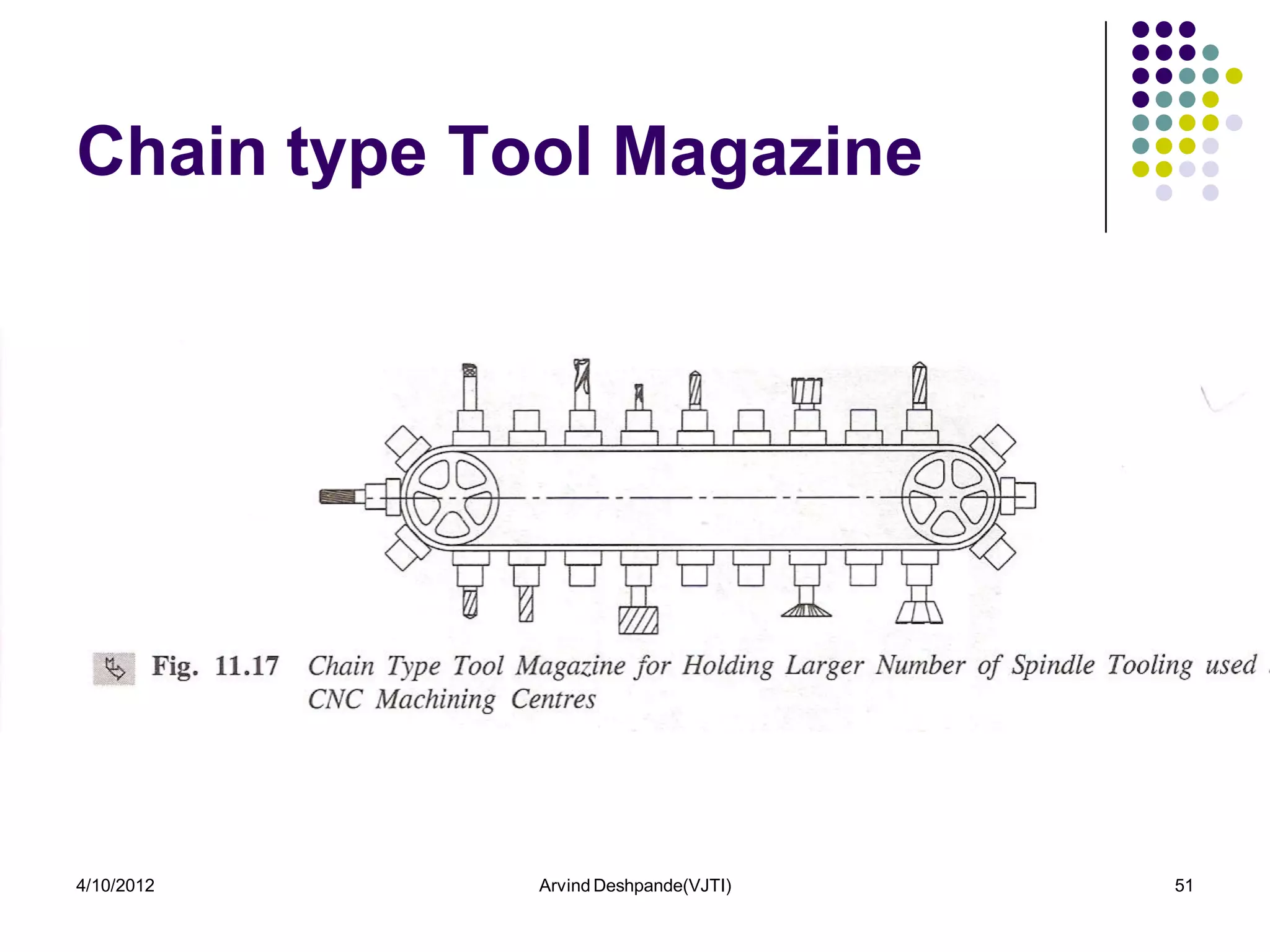
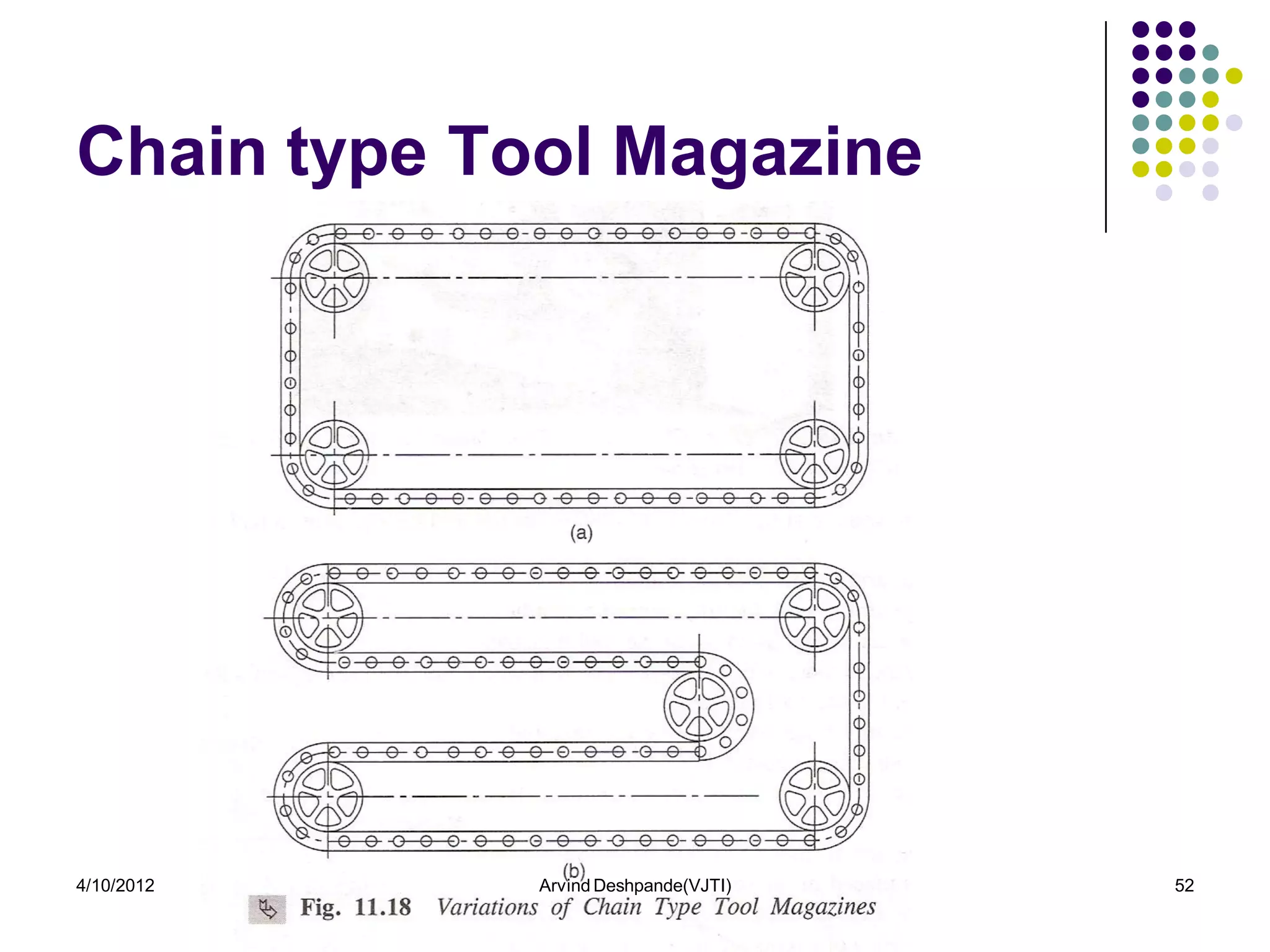
Chain type Tool Magazine


4/10/2012    Arvind Deshpande(VJTI)   51
Chain type Tool Magazine


4/10/2012    Arvind Deshpande(VJTI)   52

Cnc hardware

  • 1.
    CNC Hardware Arvind Deshpande 4/10/2012 Arvind Deshpande(VJTI) 1
  • 2.
    CNC 4/10/2012 Arvind Deshpande(VJTI) 2
  • 3.
    CNC Machining Centre 4/10/2012 Arvind Deshpande(VJTI) 3
  • 4.
    Components of CNC 4/10/2012 Arvind Deshpande(VJTI) 4
  • 5.
    Structure of MachineTool  Continuous use  Higher cutting speeds and feeds results in higher cutting forces  High speed of movement  High static stiffness - To reduce deflection under heavy load.  High stiffness to weight ratio – Better dynamic response 4/10/2012 Arvind Deshpande(VJTI) 5
  • 6.
    CNC Bed  Cast iron – Damping properties to reduce vibrations.  Heavy ribbing – To improve static stiffness.  Concrete – Low cost and better damping properties 4/10/2012 Arvind Deshpande(VJTI) 6
  • 7.
    CNC Bed 4/10/2012 Arvind Deshpande(VJTI) 7
  • 8.
    Spindle  Very important element  Subjected to higher cutting forces (radial and axial)  Deflection to be minimized to get proper surface finish  Proper supports with little overhang  Proper cooling to remove the heat generated  Oil cooling with heat exchanger  Spindle motor and gearbox can be isolated to avoid heat transmission to machine tool structure 4/10/2012 Arvind Deshpande(VJTI) 8
  • 9.
    Spindle 4/10/2012 Arvind Deshpande(VJTI) 9
  • 10.
    Integral Spindle motorand cooling system 4/10/2012 Arvind Deshpande(VJTI) 10
  • 11.
    Rigid spindle assembly 4/10/2012 Arvind Deshpande(VJTI) 11
  • 12.
    Bifurcated Column structure  Used in horizontal machining centre  Increases torsional rigidity of the support structure 4/10/2012 Arvind Deshpande(VJTI) 12
  • 13.
    Spindle Drives  Large power with infinite variation in speed  DC motors were very popular with speed control using voltage variation  Nowadays AC motors are used with speed control using frequency variation. 4/10/2012 Arvind Deshpande(VJTI) 13
  • 14.
    Feed Drives  Electric motors are by far the most common component to supply mechanical input to a linear motion system.  Stepper motors and servo motors are the popular choices in linear motion machinery due to their accuracy and controllability.  They exhibit favorable torque-speed characteristics and are relatively inexpensive. 1. Stepper motors – Open loop control system 2. Servomotor – D. C. Motor with feedback elements. Used in closed loop control system.  Used in high capacity CNC machines requiring high torgue.  Sturdy, powerful and reliable 4/10/2012 Arvind Deshpande(VJTI) 14
  • 15.
    Open Loop vs.Closed Loop controls 4/10/2012 Arvind Deshpande(VJTI) 15
  • 16.
    Open loop systems  Programmed instructions are fed into the controller through an input device.  These instructions are then converted to electrical pulses (signals) by the controller and sent to the servo amplifier to energize the servo motors.  Drawback - No feedback system to check whether the program position and velocity has been achieved.  If the system performance is affected by load, temperature, humidity, or lubrication then the actual output could deviate from the desired output.  Generally used in point-to-point systems where the accuracy requirements are not critical. Very few continuous-path systems utilize open-loop control. 4/10/2012 Arvind Deshpande(VJTI) 16
  • 17.
    Closed loop systems  Feedback subsystem to monitor the actual output and correct any discrepancy from the programmed input.  Use position and velocity feed back.  The feedback system could be either analog or digital. The analog systems measure the variation of physical variables such as position and velocity in terms of voltage levels. Digital systems monitor output variations by means of electrical pulses.  To control the dynamic behavior and the final position of the machine slides, a variety of position transducers are employed.  Majority of CNC systems operate on servo mechanism, a closed loop principle. If a discrepancy is revealed between where the machine element should be and where it actually is, the sensing device signals the driving unit to make an adjustment, bringing the movable component to the required location.  Closed-loop systems are very powerful and accurate 4/10/2012 Arvind Deshpande(VJTI) 17
  • 18.
    Stepper Motors  Rotates in steps (fixed angular increments)  200 steps per revolution i.e 1.80 per pulse  Permanent magnet rotor  Micro step motors – 25000 steps/rev Advantages 1. Low cost 2. Compact 3. Simple in construction 4. High reliability 5. No maintenance (no brushes) 6. Excellent torgue at high speeds 7. Stepper motors can easily accelerate a load. 8. There is usually no need for clutches and brakes (unless a large external load is acting, such as gravity). 4/10/2012 Arvind Deshpande(VJTI) 18
  • 19.
    Stepper Motors 9. Stepper motors are inherently digital. The number of pulses determines position while the pulse frequency determines velocity. 10. Easily and accurately controlled. 11. They offer excellent heat dissipation Disadvantages 1. The motor can lose position if the load torque exceeds the motor's available torque. 2. Open loop stepper motor systems should not be used for high- performance or high-load applications. 3. Damping may be required when load inertia is very high to prevent motor shaft oscillation at resonance points. 4. Stepper motors may perform poorly in high-speed applications. 4/10/2012 Arvind Deshpande(VJTI) 19
  • 20.
    Stepper Motor 4/10/2012 Arvind Deshpande(VJTI) 20
  • 21.
    Stepper motor 4/10/2012 Arvind Deshpande(VJTI) 21
  • 22.
    Stepper motor 4/10/2012 Arvind Deshpande(VJTI) 22
  • 23.
    4/10/2012 Arvind Deshpande(VJTI) 23
  • 24.
    Stepper Motor 1. If a stepper motor has 24 poles on the rotor and 30 poles on the stator, what will be the step angle of this stepper motor? 2. A stepper motor with a step angle of 1.60 is attached to the lead screw of machine table. The pitch of the lead screw is 2 mm. What will be the axial distance traveled for an input pulse of 300 to the stepper motor? 4/10/2012 Arvind Deshpande(VJTI) 24
  • 25.
    Servo Motors  Servo motors are more robust than stepper motors, but pose a more difficult control problem.  They are primarily used in applications where speed, power, noise level as well as velocity and positional accuracy are important.  Servo motors are not functional without sensor feedback.  3 common types  The DC brush type servo motors are most commonly found in low- end to mid-range CNC machinery.  The DC brushless type are typically applied to high-end CNC machinery.  AC servo motors are another variety that offers high-end performance 4/10/2012 Arvind Deshpande(VJTI) 25
  • 26.
    4/10/2012 Arvind Deshpande(VJTI) 26
  • 27.
    Linear Motors  Series of magnets attached to machine base and a set of electrical coils around a steel laminate attached to moving slide  No mechanical parts in contact  No wear or periodic maintenance required  Not limited in travel like ball screws  Can produce parts with higher accuracy and close tolerances at higher speeds and feeds 4/10/2012 Arvind Deshpande(VJTI) 27
  • 28.
    Hydraulic system 4/10/2012 Arvind Deshpande(VJTI) 28
  • 29.
    Lead Screw  To convert rotary motion from drive motor to linear motion of the slides  Square threads  Sliding contact results in higher friction  Low efficiency (35-55%)  Greater power requirement  Backlash  CNC requires high speed of movement where friction will be very high 4/10/2012 Arvind Deshpande(VJTI) 29
  • 30.
    Recirculating Ball Screw  Balls circulate between screw and but  Balls are recirculated using deflector or return tube  Preloading to reduce backlash Advantages 1. Longer life 2. Relatively small wear. Will maintain accuracy through entire life of the screw. 3. Rolling motion reduces friction considerably. Can be used for carrying heavier loads at faster speeds. 4. High efficiency(85-95%) 5. Small power requirement 4/10/2012 Arvind Deshpande(VJTI) 30
  • 31.
    Recirculating Ball Screwwith deflector 4/10/2012 Arvind Deshpande(VJTI) 31
  • 32.
    Recirculating Ball Screwwith External Return Tube 4/10/2012 Arvind Deshpande(VJTI) 32
  • 33.
    Recirculating Ball Screw 4/10/2012 Arvind Deshpande(VJTI) 33
  • 34.
    Recirculating Ball Screw  A ball screw has lead of 0.125 in/rev. What is the distance the nut will travel if the screw is turned 15 degrees? 4/10/2012 Arvind Deshpande(VJTI) 34
  • 35.
    Use of RollingFriction for Slideways 4/10/2012 Arvind Deshpande(VJTI) 35
  • 36.
    Use of RollingFriction for Slideways 4/10/2012 Arvind Deshpande(VJTI) 36
  • 37.
    Closed Loop ControlSystem 4/10/2012 Arvind Deshpande(VJTI) 37
  • 38.
    Feedback Elements  Rotary or linear  Absolute or incremental  LED  Photo transistor or photo diode 4/10/2012 Arvind Deshpande(VJTI) 38
  • 39.
    Absolute Encoder  Sensor detects exact position of the shaft  Chances of error whenever 2 bits change  Grey code used to reduce error so that only one bit changes at a time 4/10/2012 Arvind Deshpande(VJTI) 39
  • 40.
    Absolute Encoder 4/10/2012 Arvind Deshpande(VJTI) 40
  • 41.
    Incremental Encoder  1 track and 2 sensors  More resolution  Can measure relative position only  An incremental encoder has 240 strips engraved on it. What will be no. of strips to be swept for 300 rotation? 4/10/2012 Arvind Deshpande(VJTI) 41
  • 42.
    Rotary Feedback Elements 4/10/2012 Arvind Deshpande(VJTI) 42
  • 43.
    Linear Feedback Elements 4/10/2012 Arvind Deshpande(VJTI) 43
  • 44.
    Linear Feedback Elements 4/10/2012 Arvind Deshpande(VJTI) 44
  • 45.
    Mechanical tape reader 4/10/2012 Arvind Deshpande(VJTI) 45
  • 46.
    4/10/2012 Arvind Deshpande(VJTI) 46
  • 47.
    4/10/2012 Arvind Deshpande(VJTI) 47
  • 48.
    Tooling System 4/10/2012 Arvind Deshpande(VJTI) 48
  • 49.
    Tool Presetting  CNC programme is prepared for tool tip  Reference can be a fixed point on the tool holder  Measure the distance of tool tip from reference 4/10/2012 Arvind Deshpande(VJTI) 49
  • 50.
    Tool Turret  Simple method  Spindle combined with tool turret  Tool change with tool change procedure  Tool is identified directly with tool position 4/10/2012 Arvind Deshpande(VJTI) 50
  • 51.
    Chain type ToolMagazine 4/10/2012 Arvind Deshpande(VJTI) 51
  • 52.
    Chain type ToolMagazine 4/10/2012 Arvind Deshpande(VJTI) 52