Presentation
                         of
               Vocational Training on
               “COMPUTER NUMERICAL
                 CONTROL MACHINE”


                     BHARAT HEAVY
                      ELECTRICALS
                    LIMITED, JHANSI
UNDER THE GUIDENCE OF:                            BY:
Mr. VIJAY VERMA                             BHEEM SINGH
(Sr. ENGINEER, WEX)                   B. Tech. (E.C.E.) Final Year
BHEL, JHANSI                                B.I.E.T. Jhansi
                                              1004331903
CONTENTS
1. History
2. CNC Introduction
3. how they look like?
4. Elements of CNC
5. Block diagram of CNC
6. How CNC Works?
7. Features of CNC Machines
8. CNC Programming Basics
9. Common Format of a Block
10. Programming Key Letters
11. Table of important G-codes
12. Table of important M-codes
13. Advantages
14. Challenges
15. Conclusion
16. References
*

* The first NC machines were built in the 1940s
 and 1950s by Prof. John T Parson.
* CNC machine came into existence after
 evolution of computer around 1980.
* Modern CNC Machine are improving further as
 the technology is changing with a variety of
 functions according to applications.
*
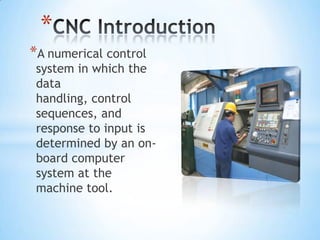
*A numerical control
 system in which the
 data
 handling, control
 sequences, and
 response to input is
 determined by an on-
 board computer
 system at the
 machine tool.
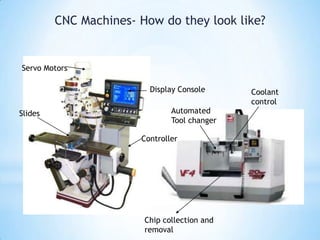
CNC Machines- How do they look like?


Servo Motors

                         Display Console                Coolant
                                                        control
Slides                         Automated
                               Tool changer

                       Controller
                                           Controller


                        Chip collection and
                        removal
*

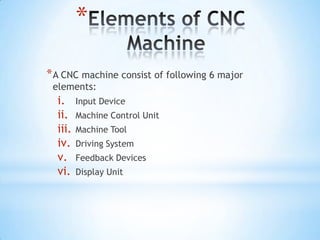
* A CNC machine consist of following 6 major
 elements:
  i.     Input Device
  ii.    Machine Control Unit
  iii.   Machine Tool
  iv.    Driving System
  v.     Feedback Devices
  vi.    Display Unit
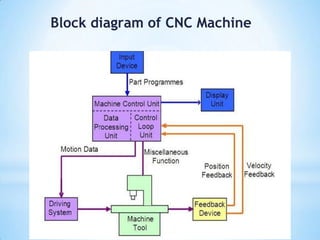
Block diagram of CNC Machine
*


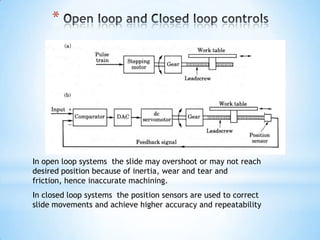
In open loop systems the slide may overshoot or may not reach
desired position because of inertia, wear and tear and
friction, hence inaccurate machining.
In closed loop systems the position sensors are used to correct
slide movements and achieve higher accuracy and repeatability
*
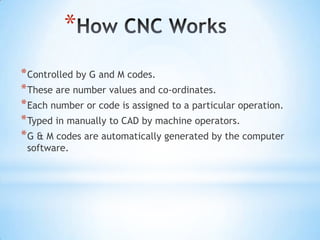
* Controlled by G and M codes.
* These are number values and co-ordinates.
* Each number or code is assigned to a particular operation.
* Typed in manually to CAD by machine operators.
* G & M codes are automatically generated by the computer
 software.
*

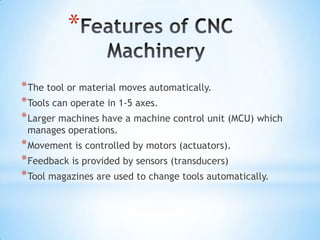
* The tool or material moves automatically.
* Tools can operate in 1-5 axes.
* Larger machines have a machine control unit (MCU) which
 manages operations.
* Movement is controlled by motors (actuators).
* Feedback is provided by sensors (transducers)
* Tool magazines are used to change tools automatically.
*

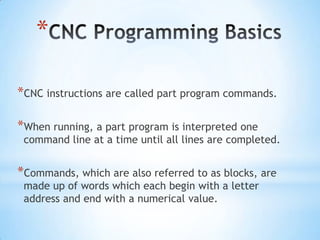
*CNC instructions are called part program commands.

*When running, a part program is interpreted one
 command line at a time until all lines are completed.


*Commands, which are also referred to as blocks, are
 made up of words which each begin with a letter
 address and end with a numerical value.
*
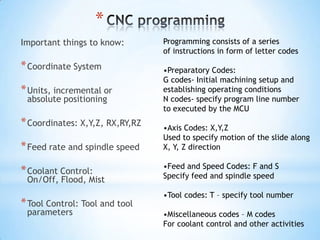
Important things to know:        Programming consists of a series
                                 of instructions in form of letter codes
* Coordinate System              •Preparatory Codes:
                                 G codes- Initial machining setup and
* Units, incremental or          establishing operating conditions
 absolute positioning            N codes- specify program line number
                                 to executed by the MCU
* Coordinates: X,Y,Z, RX,RY,RZ   •Axis Codes: X,Y,Z
                                 Used to specify motion of the slide along
* Feed rate and spindle speed    X, Y, Z direction

                                 •Feed and Speed Codes: F and S
* Coolant Control:               Specify feed and spindle speed
 On/Off, Flood, Mist
                                 •Tool codes: T – specify tool number
* Tool Control: Tool and tool
 parameters                      •Miscellaneous codes – M codes
                                 For coolant control and other activities
*

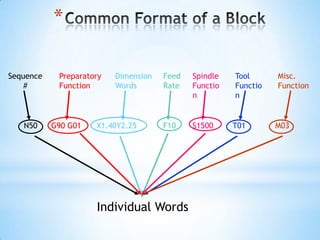
Sequence    Preparatory   Dimension   Feed   Spindle   Tool      Misc.
    #       Function      Words       Rate   Functio   Functio   Function
                                             n         n


   N50     G90 G01   X1.40Y2.25       F10    S1500     T01       M03


                     Individual Words
*
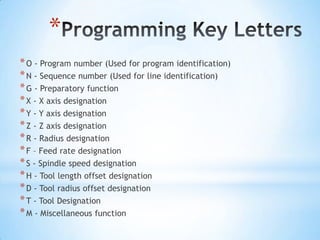
* O - Program number (Used for program identification)
* N - Sequence number (Used for line identification)
* G - Preparatory function
* X - X axis designation
* Y - Y axis designation
* Z - Z axis designation
* R - Radius designation
* F – Feed rate designation
* S - Spindle speed designation
* H - Tool length offset designation
* D - Tool radius offset designation
* T - Tool Designation
* M - Miscellaneous function
*
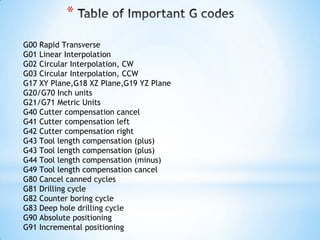
G00 Rapid Transverse
G01 Linear Interpolation
G02 Circular Interpolation, CW
G03 Circular Interpolation, CCW
G17 XY Plane,G18 XZ Plane,G19 YZ Plane
G20/G70 Inch units
G21/G71 Metric Units
G40 Cutter compensation cancel
G41 Cutter compensation left
G42 Cutter compensation right
G43 Tool length compensation (plus)
G44 Tool length compensation (minus)
G49 Tool length compensation cancel
G80 Cancel canned cycles
G81 Drilling cycle
G82 Counter boring cycle
G83 Deep hole drilling cycle
G90 Absolute positioning
G91 Incremental positioning
*
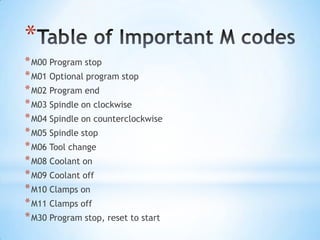
* M00 Program stop
* M01 Optional program stop
* M02 Program end
* M03 Spindle on clockwise
* M04 Spindle on counterclockwise
* M05 Spindle stop
* M06 Tool change
* M08 Coolant on
* M09 Coolant off
* M10 Clamps on
* M11 Clamps off
* M30 Program stop, reset to start
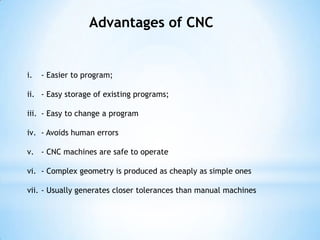
Advantages of CNC


i.   - Easier to program;

ii. - Easy storage of existing programs;

iii. - Easy to change a program

iv. - Avoids human errors

v. - CNC machines are safe to operate

vi. - Complex geometry is produced as cheaply as simple ones

vii. - Usually generates closer tolerances than manual machines
*


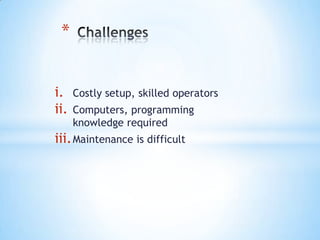
i.    Costly setup, skilled operators
ii.   Computers, programming
      knowledge required
iii. Maintenance is difficult
*
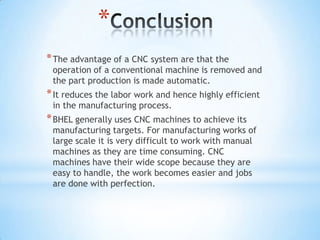
* The advantage of a CNC system are that the
 operation of a conventional machine is removed and
 the part production is made automatic.
* It reduces the labor work and hence highly efficient
 in the manufacturing process.
* BHEL generally uses CNC machines to achieve its
 manufacturing targets. For manufacturing works of
 large scale it is very difficult to work with manual
 machines as they are time consuming. CNC
 machines have their wide scope because they are
 easy to handle, the work becomes easier and jobs
 are done with perfection.
*

 Manual of CNC from BHEL Jhansi

 http://en.wikipedia.org/wiki/computer_numerical
  _control


 http://www.motioncontrol.com/articles/gearheads
  -modular-spindle-drives


 http://www.seminarprojects.com/cnc
*

CNC Seminar

  • 1.
    Presentation of Vocational Training on “COMPUTER NUMERICAL CONTROL MACHINE” BHARAT HEAVY ELECTRICALS LIMITED, JHANSI UNDER THE GUIDENCE OF: BY: Mr. VIJAY VERMA BHEEM SINGH (Sr. ENGINEER, WEX) B. Tech. (E.C.E.) Final Year BHEL, JHANSI B.I.E.T. Jhansi 1004331903
  • 2.
    CONTENTS 1. History 2. CNCIntroduction 3. how they look like? 4. Elements of CNC 5. Block diagram of CNC 6. How CNC Works? 7. Features of CNC Machines 8. CNC Programming Basics 9. Common Format of a Block 10. Programming Key Letters 11. Table of important G-codes 12. Table of important M-codes 13. Advantages 14. Challenges 15. Conclusion 16. References
  • 3.
    * * The firstNC machines were built in the 1940s and 1950s by Prof. John T Parson. * CNC machine came into existence after evolution of computer around 1980. * Modern CNC Machine are improving further as the technology is changing with a variety of functions according to applications.
  • 4.
    * *A numerical control system in which the data handling, control sequences, and response to input is determined by an on- board computer system at the machine tool.
  • 5.
    CNC Machines- Howdo they look like? Servo Motors Display Console Coolant control Slides Automated Tool changer Controller Controller Chip collection and removal
  • 6.
    * * A CNCmachine consist of following 6 major elements: i. Input Device ii. Machine Control Unit iii. Machine Tool iv. Driving System v. Feedback Devices vi. Display Unit
  • 7.
    Block diagram ofCNC Machine
  • 8.
    * In open loopsystems the slide may overshoot or may not reach desired position because of inertia, wear and tear and friction, hence inaccurate machining. In closed loop systems the position sensors are used to correct slide movements and achieve higher accuracy and repeatability
  • 9.
    * * Controlled byG and M codes. * These are number values and co-ordinates. * Each number or code is assigned to a particular operation. * Typed in manually to CAD by machine operators. * G & M codes are automatically generated by the computer software.
  • 10.
    * * The toolor material moves automatically. * Tools can operate in 1-5 axes. * Larger machines have a machine control unit (MCU) which manages operations. * Movement is controlled by motors (actuators). * Feedback is provided by sensors (transducers) * Tool magazines are used to change tools automatically.
  • 11.
    * *CNC instructions arecalled part program commands. *When running, a part program is interpreted one command line at a time until all lines are completed. *Commands, which are also referred to as blocks, are made up of words which each begin with a letter address and end with a numerical value.
  • 12.
    * Important things toknow: Programming consists of a series of instructions in form of letter codes * Coordinate System •Preparatory Codes: G codes- Initial machining setup and * Units, incremental or establishing operating conditions absolute positioning N codes- specify program line number to executed by the MCU * Coordinates: X,Y,Z, RX,RY,RZ •Axis Codes: X,Y,Z Used to specify motion of the slide along * Feed rate and spindle speed X, Y, Z direction •Feed and Speed Codes: F and S * Coolant Control: Specify feed and spindle speed On/Off, Flood, Mist •Tool codes: T – specify tool number * Tool Control: Tool and tool parameters •Miscellaneous codes – M codes For coolant control and other activities
  • 13.
    * Sequence Preparatory Dimension Feed Spindle Tool Misc. # Function Words Rate Functio Functio Function n n N50 G90 G01 X1.40Y2.25 F10 S1500 T01 M03 Individual Words
  • 14.
    * * O -Program number (Used for program identification) * N - Sequence number (Used for line identification) * G - Preparatory function * X - X axis designation * Y - Y axis designation * Z - Z axis designation * R - Radius designation * F – Feed rate designation * S - Spindle speed designation * H - Tool length offset designation * D - Tool radius offset designation * T - Tool Designation * M - Miscellaneous function
  • 15.
    * G00 Rapid Transverse G01Linear Interpolation G02 Circular Interpolation, CW G03 Circular Interpolation, CCW G17 XY Plane,G18 XZ Plane,G19 YZ Plane G20/G70 Inch units G21/G71 Metric Units G40 Cutter compensation cancel G41 Cutter compensation left G42 Cutter compensation right G43 Tool length compensation (plus) G43 Tool length compensation (plus) G44 Tool length compensation (minus) G49 Tool length compensation cancel G80 Cancel canned cycles G81 Drilling cycle G82 Counter boring cycle G83 Deep hole drilling cycle G90 Absolute positioning G91 Incremental positioning
  • 16.
    * * M00 Programstop * M01 Optional program stop * M02 Program end * M03 Spindle on clockwise * M04 Spindle on counterclockwise * M05 Spindle stop * M06 Tool change * M08 Coolant on * M09 Coolant off * M10 Clamps on * M11 Clamps off * M30 Program stop, reset to start
  • 17.
    Advantages of CNC i. - Easier to program; ii. - Easy storage of existing programs; iii. - Easy to change a program iv. - Avoids human errors v. - CNC machines are safe to operate vi. - Complex geometry is produced as cheaply as simple ones vii. - Usually generates closer tolerances than manual machines
  • 18.
    * i. Costly setup, skilled operators ii. Computers, programming knowledge required iii. Maintenance is difficult
  • 19.
    * * The advantageof a CNC system are that the operation of a conventional machine is removed and the part production is made automatic. * It reduces the labor work and hence highly efficient in the manufacturing process. * BHEL generally uses CNC machines to achieve its manufacturing targets. For manufacturing works of large scale it is very difficult to work with manual machines as they are time consuming. CNC machines have their wide scope because they are easy to handle, the work becomes easier and jobs are done with perfection.
  • 20.
    *  Manual ofCNC from BHEL Jhansi  http://en.wikipedia.org/wiki/computer_numerical _control  http://www.motioncontrol.com/articles/gearheads -modular-spindle-drives  http://www.seminarprojects.com/cnc
  • 21.