HEMOLYTIC
ANEMIA
DR SEHRISH AHMED
Anemia
Acute BloodLoss
Under production
Over destruction
Hemolytic Anemia
Intrinsic
Hb Defect
Sickle Cell
Membrane Defect
Spherocytosis
Enzyme Deficiency
G6PD
Extrinsic
Valve
Complement
Antibodies
CAUSES
Erythroid Hyperplasia
Reticulocytosis
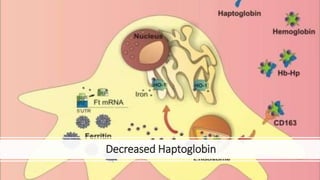
Decreased Haptoglobin
MECHANISM OF
HEMOLYSIS
• Extravascular
• Intra vascular
EXTRAVASCULAR
HEMOLYSIS
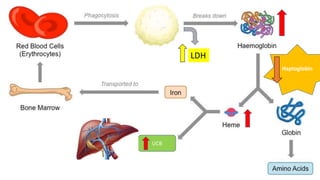
Destruction of Red Cell by Reticuloendothelial
cells in the liver, spleen and lymph node
UCB
LDH
Red Cell
Membrane
Defect
Hereditary SpherocytosisHowell-Jolly bodies
Disorder of
Hemoglobin
Synthesis
SICKLE CELL ANEMIA
• Autosomal recessive mutation in B
chain of Hb
• >90% HbS
• Increase risk of sickling
• Hypoxemia
• Dehydration
• Acidosis
Hydroxyurea increases level of HbF
Thalassemia
Anemia due to decrease synthesis of the globin chains of
hemoglobin
Decrease Globin Decrease Hb Microcytic
Anemia
Red Cell Enzyme Deficiency
Glucose-6-Phosphate Dehydrogenase
Deficiency
G6PD deficiency is associated with transient episodes of
intravascular hemolysis caused by exposure to an environmental
factor (usually infectious agents or drugs) that
produces oxidant stress.
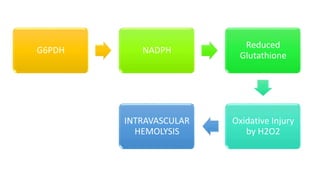
G6PDH NADPH
Reduced
Glutathione
Oxidative Injury
by H2O2
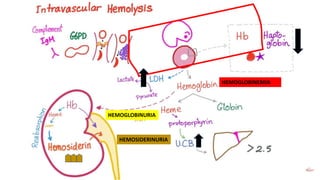
INTRAVASCULAR
HEMOLYSIS
Heinz Bodies
UCB
LDH
Haptoglobin
INTRAVASCULAR
HEMOLYSIS
HEMOGLOBINURIA
HEMOSIDERINURIA
HEMOGLOBINEMIA
How to read labs?
• Hemolysis “Both”
• Especially intravascularIf haptoglobin is Low
• Both
• Especially ExtravascularIncreased UCB
• BothIncreased LDH
• IntravascularUrine Hb & Hemosiderin
• ExtravascularSplenomegaly
Hereditary
Causes of
hemolytic
anemia:
• Abnormality in the cell membrane cytoskeleton
leads to spherocytosis and elliptocytosis.
RBC cell membrane defect:
• G-6-PD deficiency.
• Pyruvate kinase deficiency.
• Hexokinase deficiency
• Glutathione synthetase deficiency
Red cell enzyme deficiency:
• Hemoglobin synthesis defect like Thalassemia.
• Abnormal structure of the hemoglobin-like
Sickle cell anemia, Hb E
Disorders of hemoglobin synthesis:
Acquired Causes of hemolytic anemia:
Antibody-mediated
cytotoxic
reaction (Type II) like
ABO incompatibility.
Microangiopathic
hemolytic anemia
Infections: Hemolytic
anemia
Paroxysmal nocturnal
hemoglobinuria.
Hemolytic anemia

Hemolytic anemia

Editor's Notes

  • #15 Hydroxyurea makes your red blood cells bigger. It helps them stay rounder and more flexible — and makes them less likely to turn into a sickle shape. The medicine does this by increasing a special kind of hemoglobin called hemoglobin F. Hemoglobin F is also called fetal hemoglobin because newborn babies have it.