Hemolytic anemia


    By: TING LEE YING
1. Thalassaemias
a)B-Thalassaemia-> 1. Major
                    2. Intermedia
                    3. Minima and minor
                    4. Trait

b) A-Thalassaemia->1. Major
                    2. HbH
                    3. TraiT
                    4. Silent
Introduction
 1. Thalassemia comes from the Greek word
  "thalassemia" which means "anemia by-the-sea."

 2. The most common genetic disorder worldwide


 3.Children with thalassemia:
 a) shorter red cell life
 b) HbF until older age
 c) red cell prone to oxidative stress
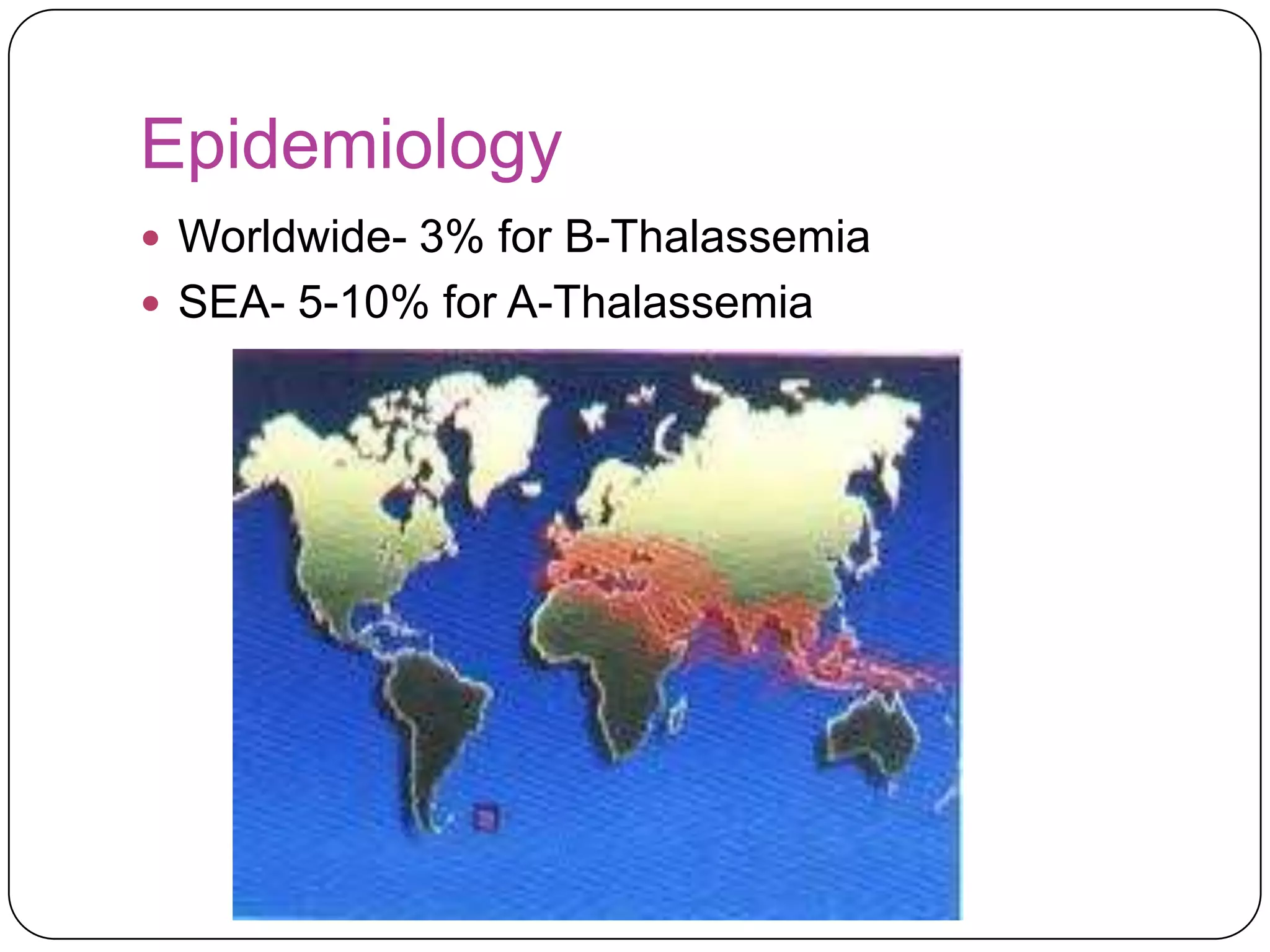
Epidemiology
 Worldwide- 3% for B-Thalassemia
 SEA- 5-10% for A-Thalassemia
Anaemia
 Neonate: Hb< 14g/dl
 1-12 months: Hb< 10g/dl
 1-12 years : Hb <11g/dl
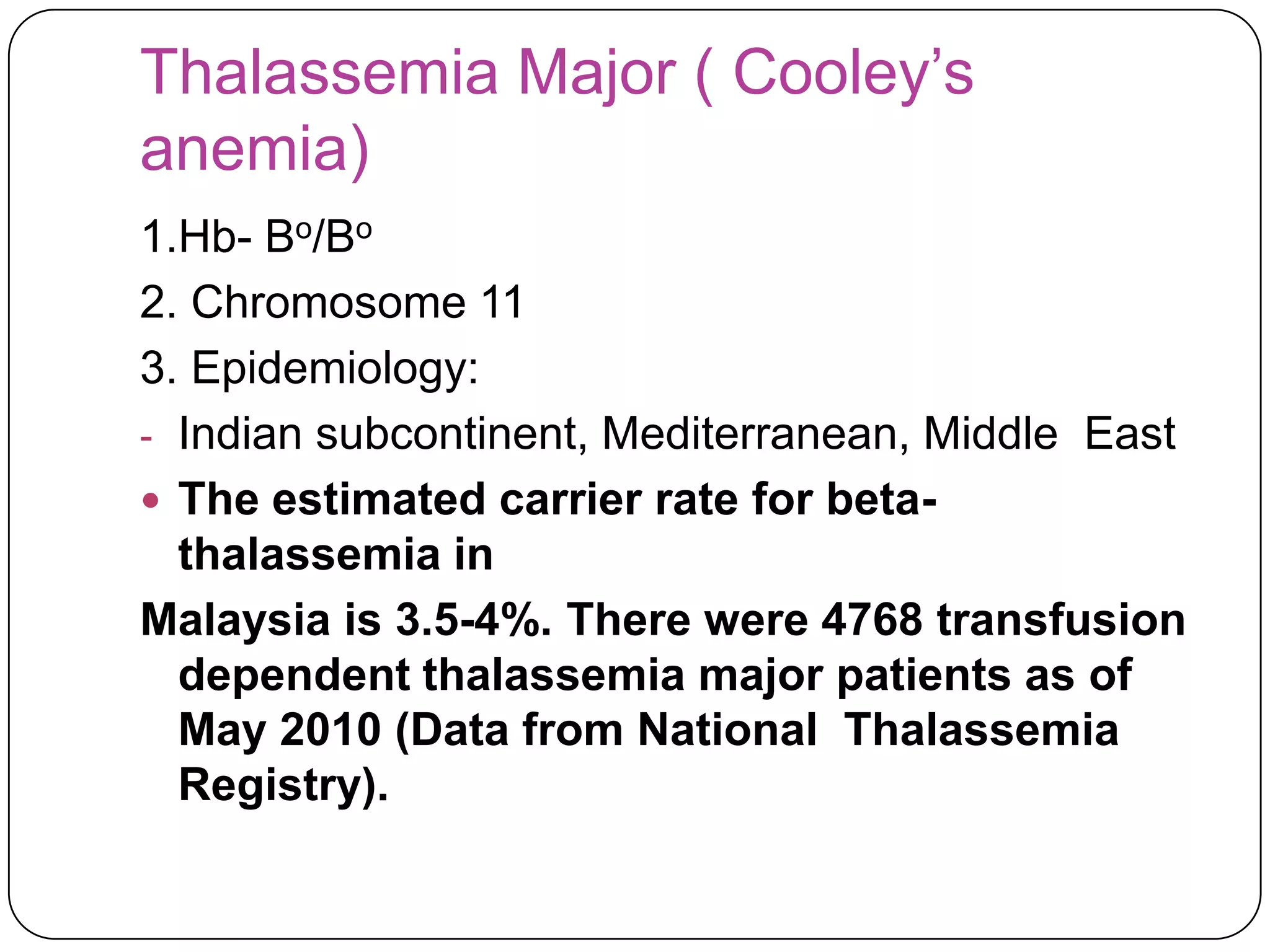
Thalassemia Major ( Cooley’s
anemia)
1.Hb- Bo/Bo
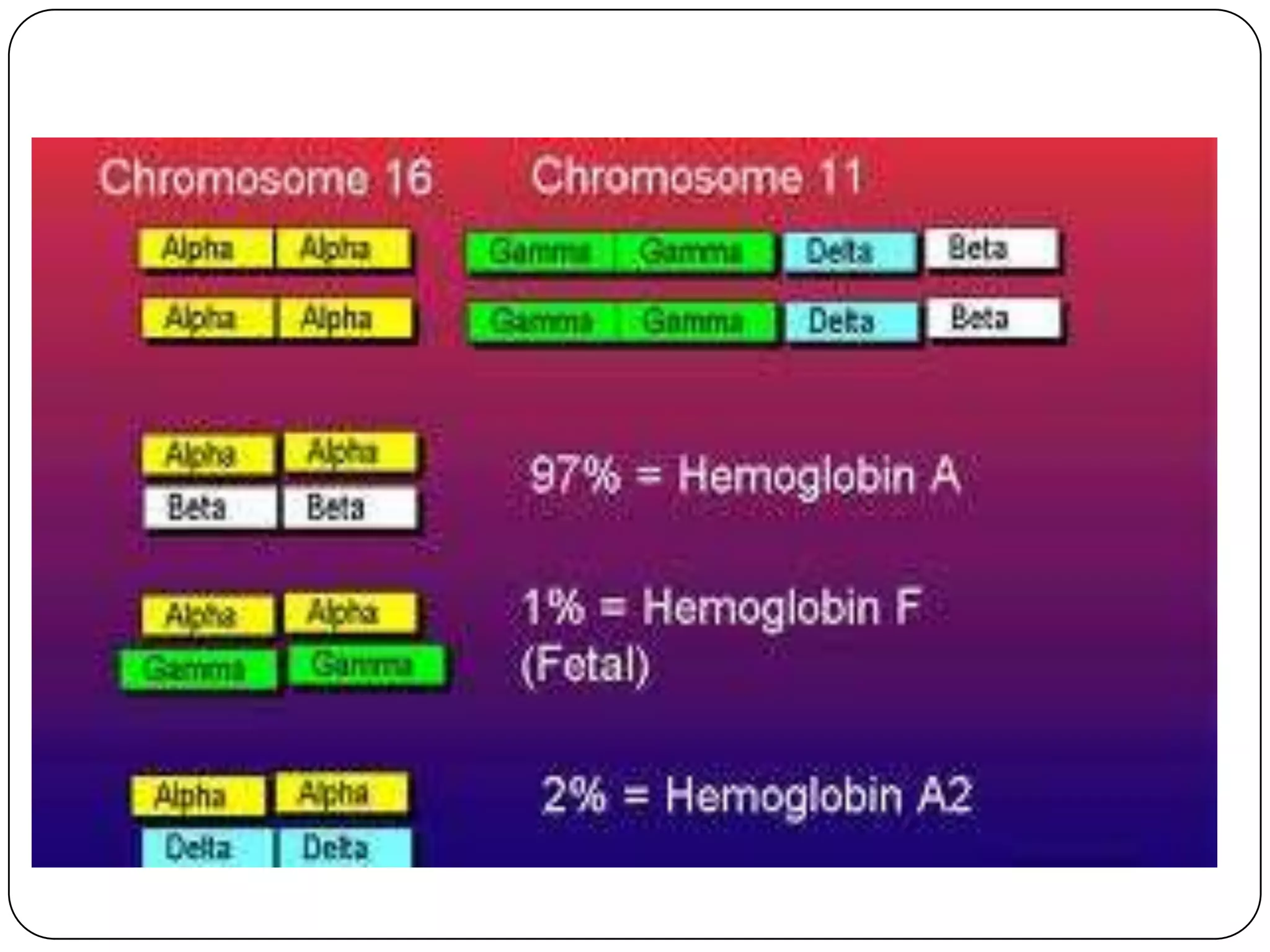
2. Chromosome 11
3. Epidemiology:
- Indian subcontinent, Mediterranean, Middle East
 The estimated carrier rate for beta-
  thalassemia in
Malaysia is 3.5-4%. There were 4768 transfusion
  dependent thalassemia major patients as of
  May 2010 (Data from National Thalassemia
  Registry).
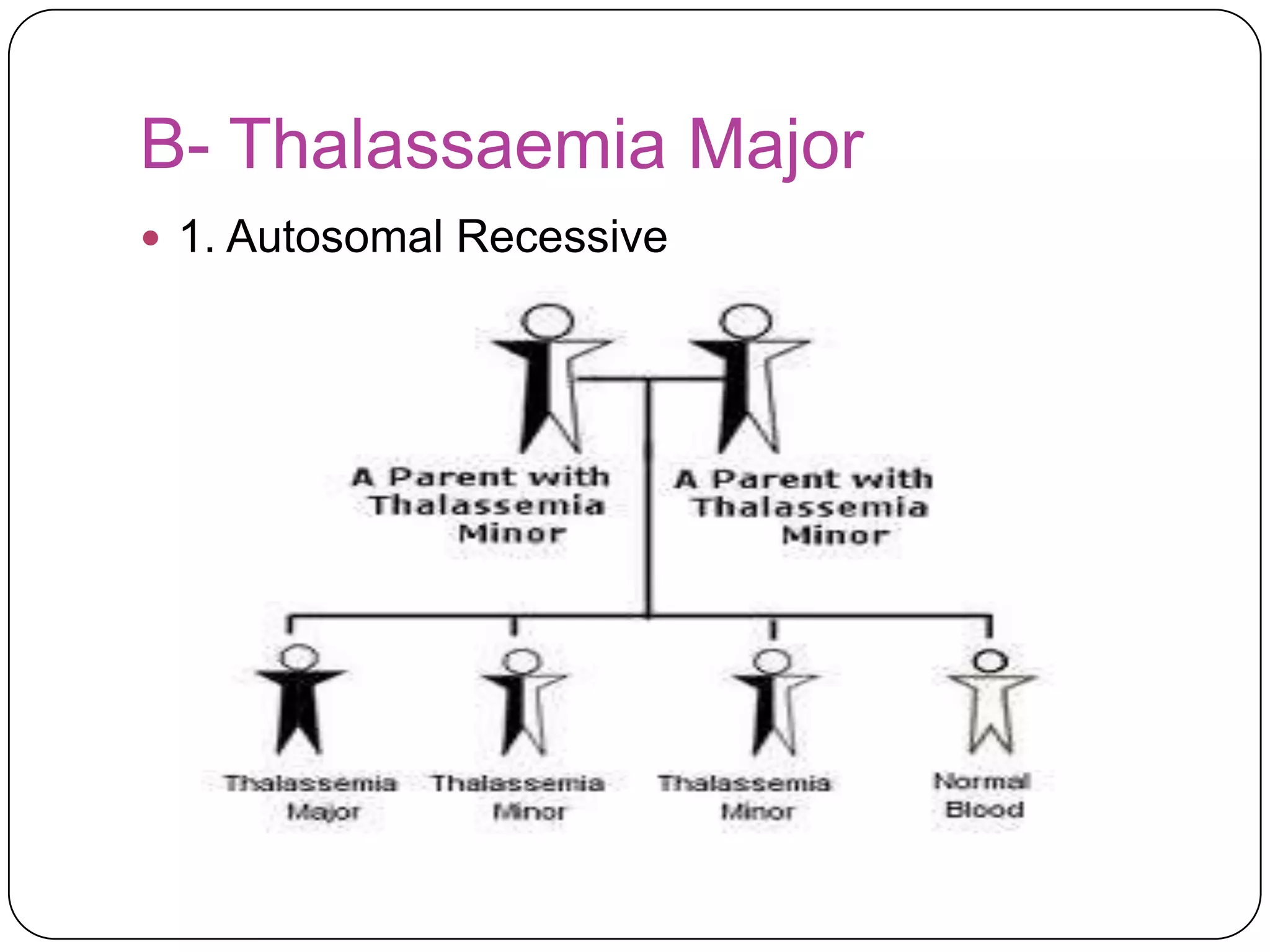
B- Thalassaemia Major
 1. Autosomal Recessive
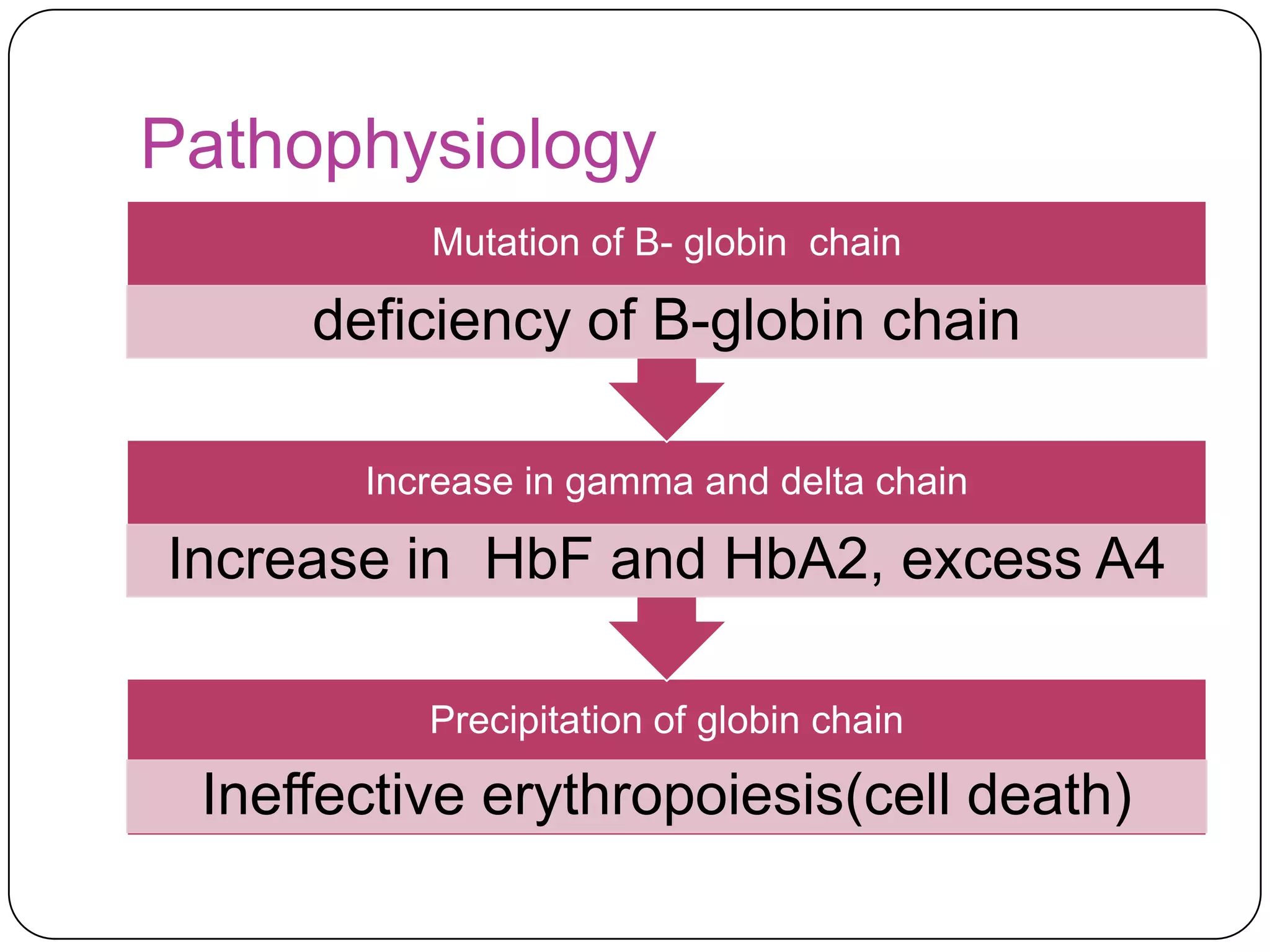
Pathophysiology
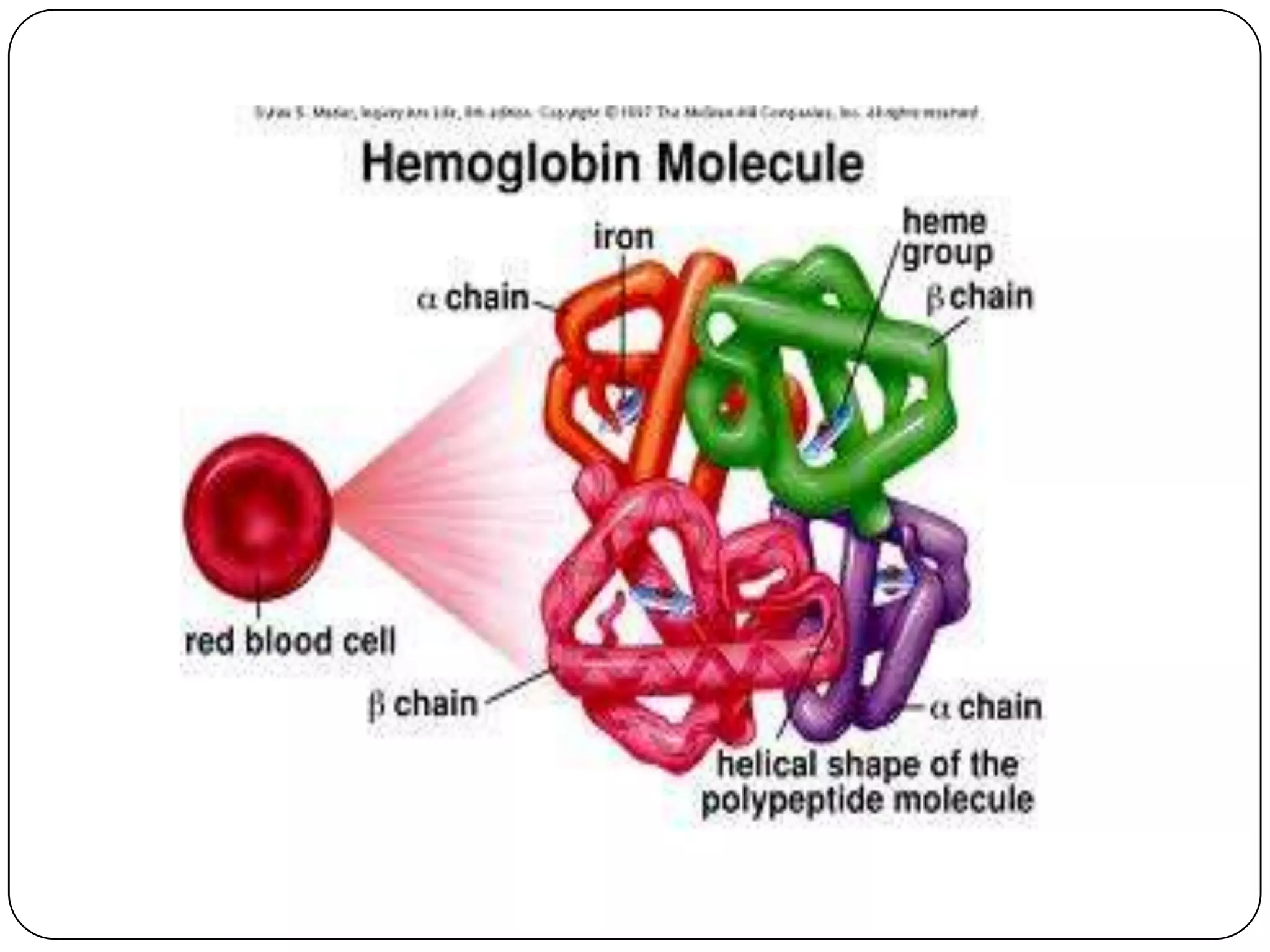
          Mutation of B- globin chain

     deficiency of B-globin chain

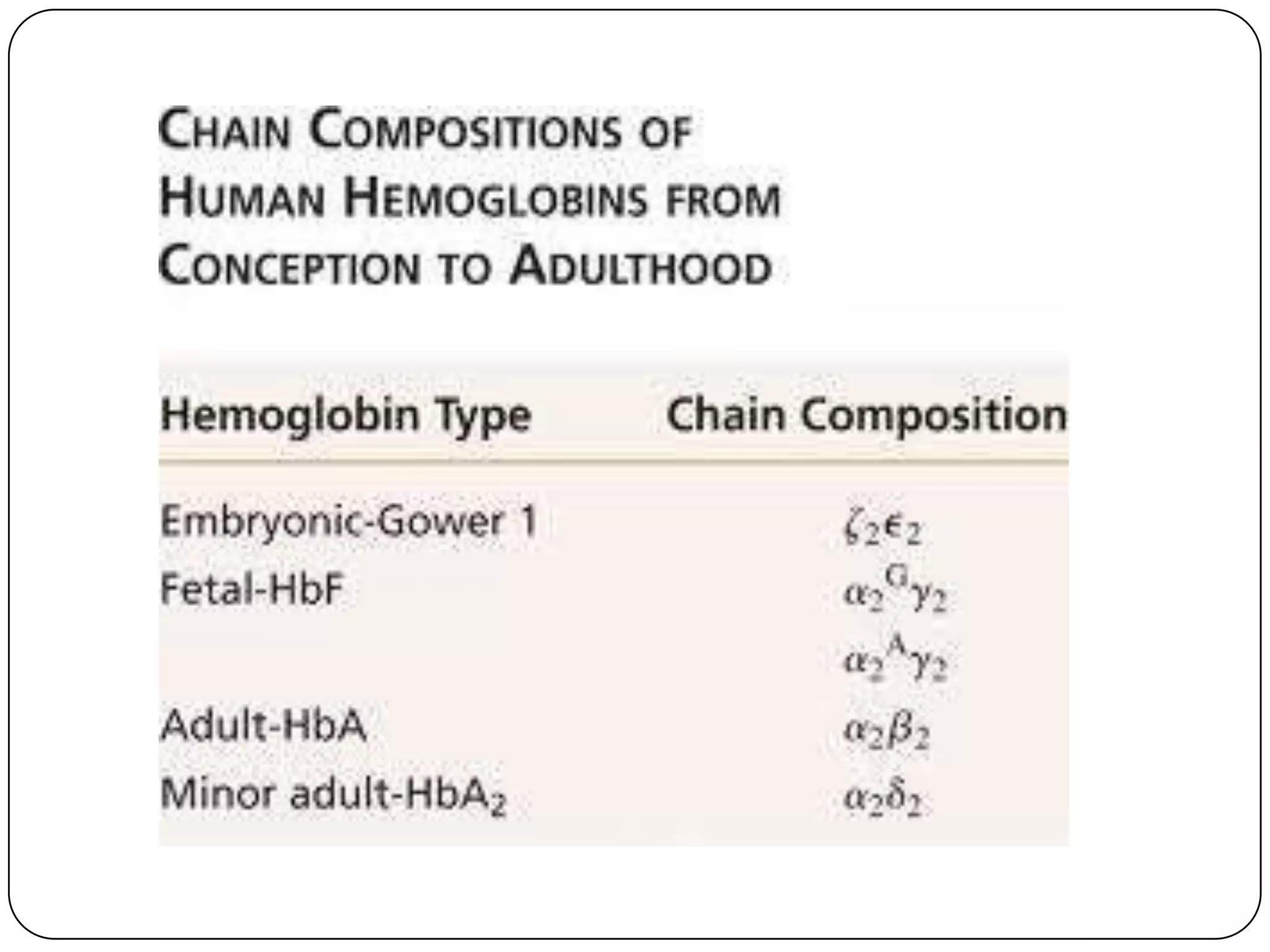
       Increase in gamma and delta chain

Increase in HbF and HbA2, excess A4

          Precipitation of globin chain

 Ineffective erythropoiesis(cell death)
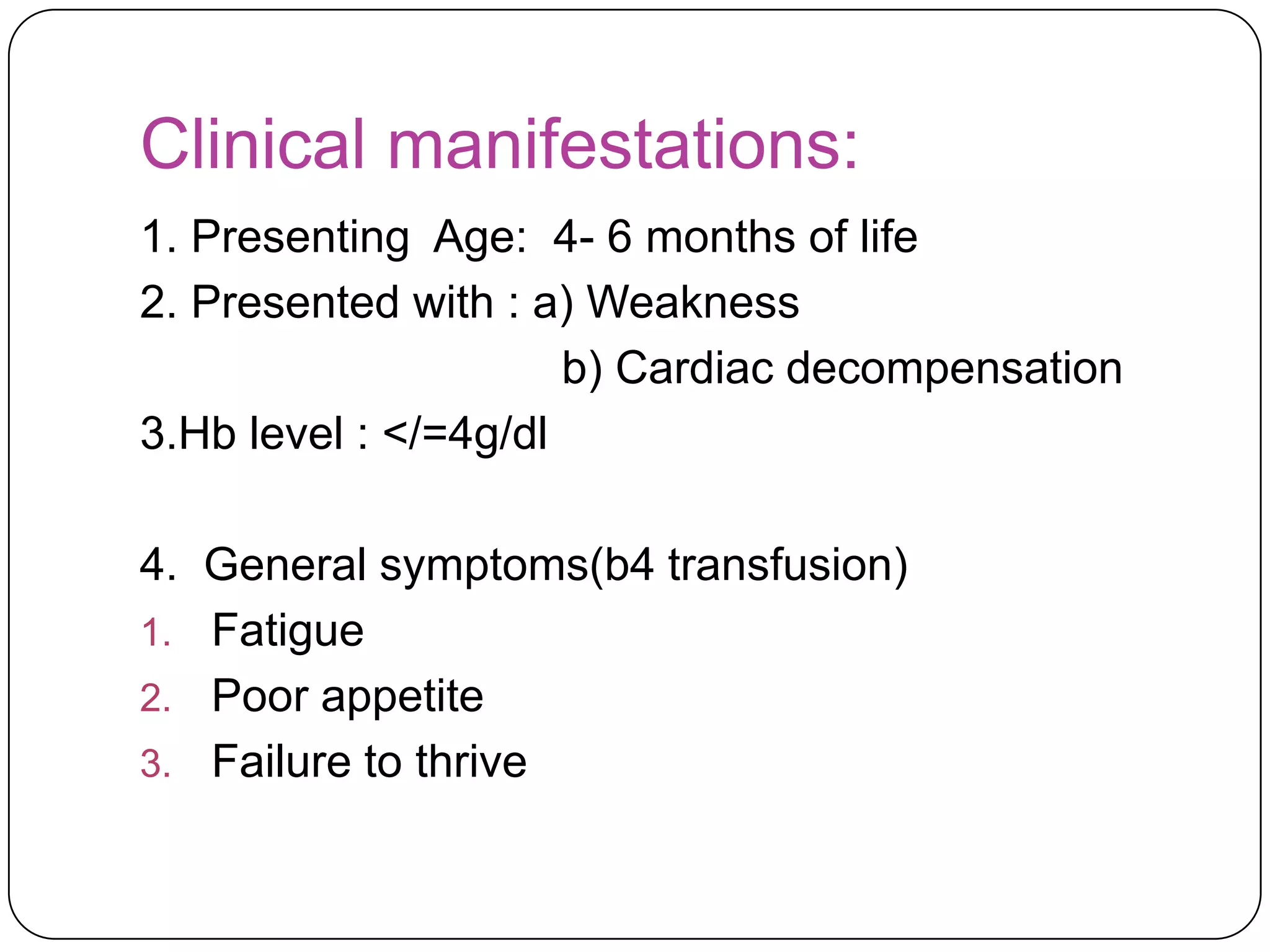
Clinical manifestations:
1. Presenting Age: 4- 6 months of life
2. Presented with : a) Weakness
                      b) Cardiac decompensation
3.Hb level : </=4g/dl

4. General symptoms(b4 transfusion)
1. Fatigue
2. Poor appetite
3. Failure to thrive
Classical presentations
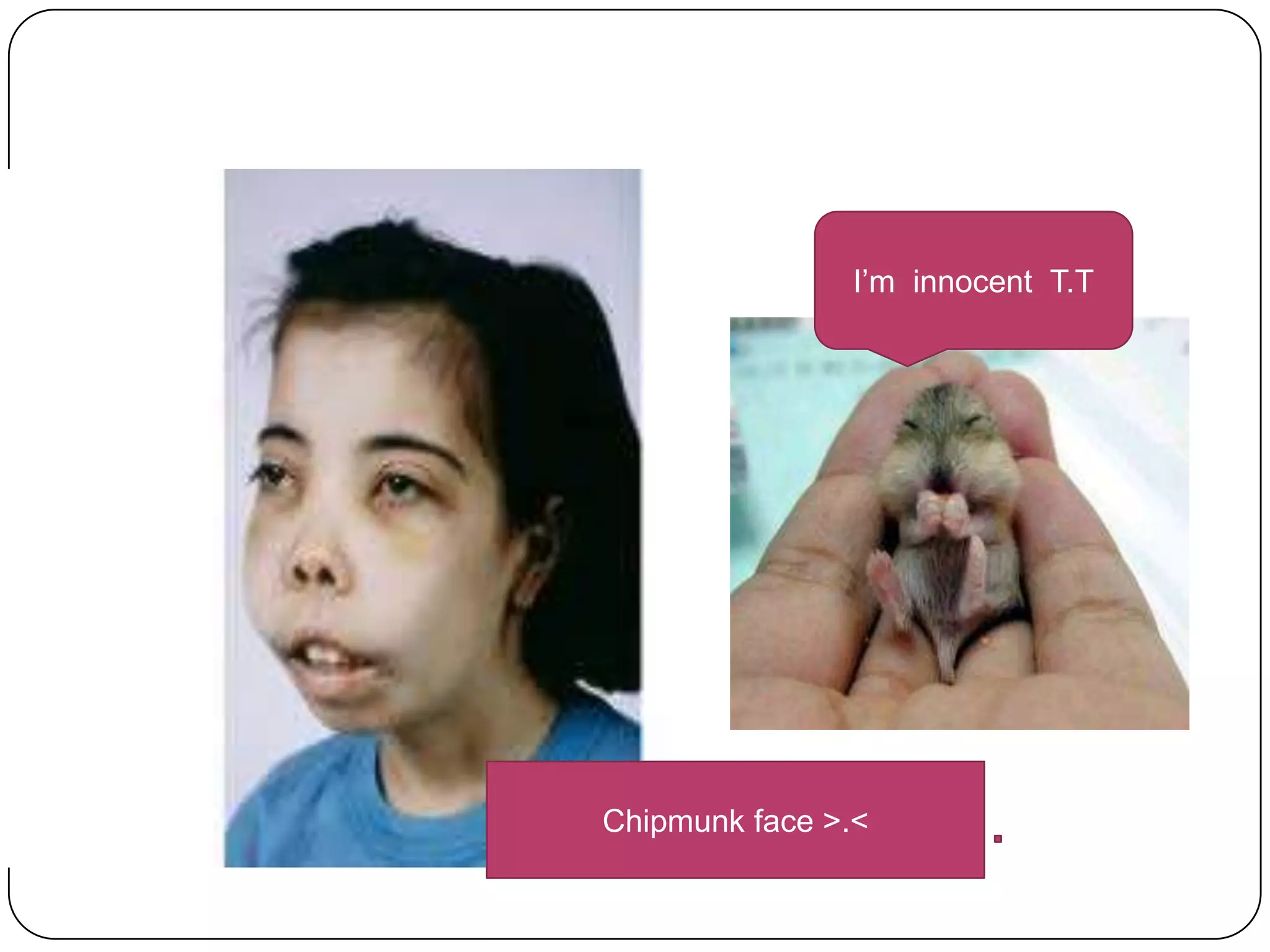
1. Thalassemic facies
2. Pathologic fractures
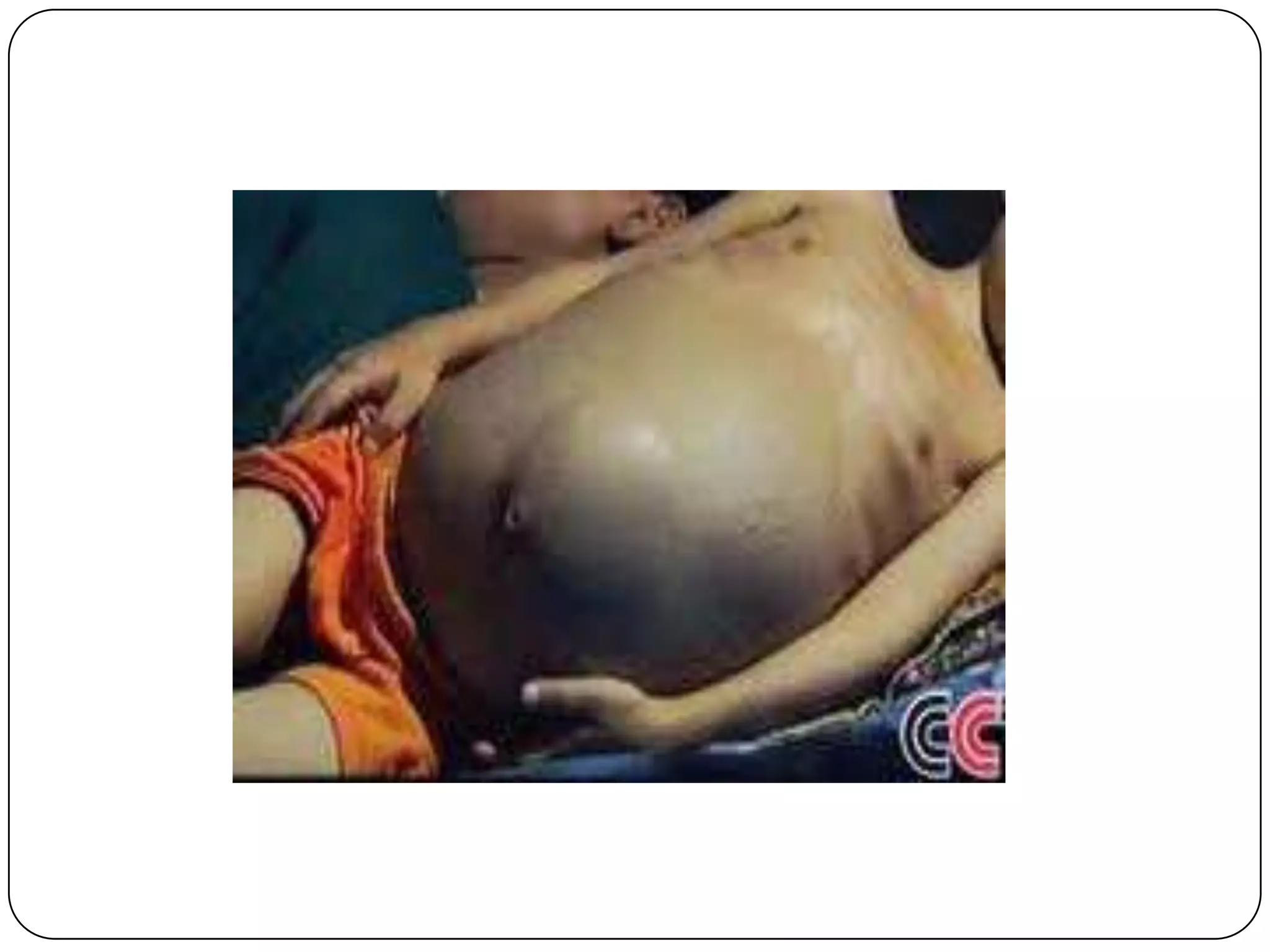
3. Marked hepatosplenomegaly
4. Cachexia
5.Greenish brown complexion
I’m innocent T.T


Chipmunk face >.<
Complications of hemosiderosis
 1. Hepatic- fibrosis and cirrhosis
 2. Pancreas- DM (beta cells)
 3. Pituitary, testis and ovaries- growth
  retardation, hypogonadotrophic hypogonadism
 4. Parathyroid- hypocalcemia, osteoporosis
 5. Heart- arrhythmias, myocarditis, cardiac failure.
Lab Findings and investigations
 1. Hb Electrophoresis/ HPLC- a) Increased HbF
                                     b)Decreased or
    absent HbA
                                      c) HbA2 variable
   2. FBC , peripheral blood film– anemia, high
    reticulocytes, numerous nucleated
    cell, microcytosis
   3. Unconjugated bilirubin- increased
   4. Serum ferritin and transferrin – elevated ( even
    b4 transfusion)
   5. Red cell phenotyping (ideal)–transfusion
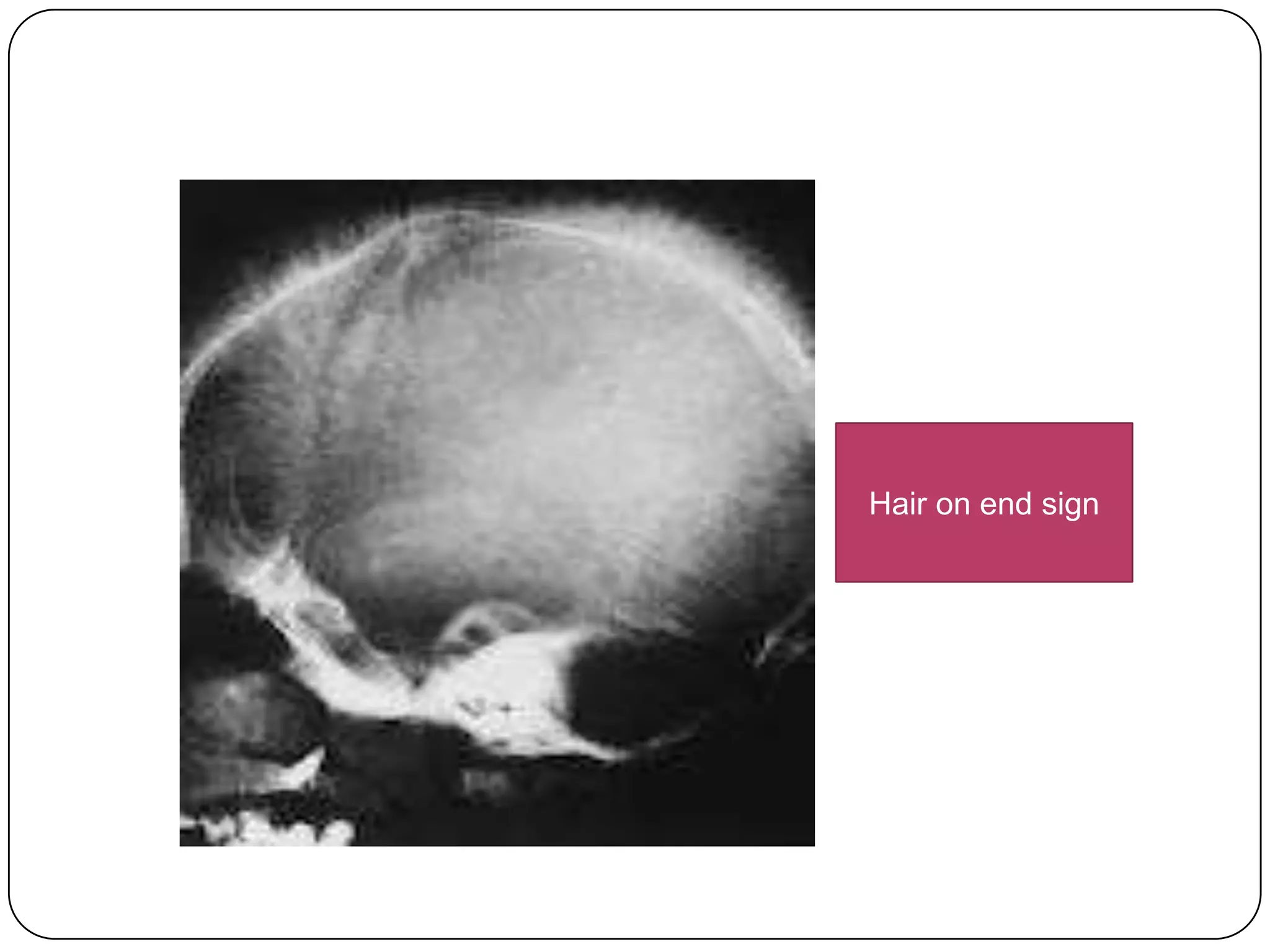
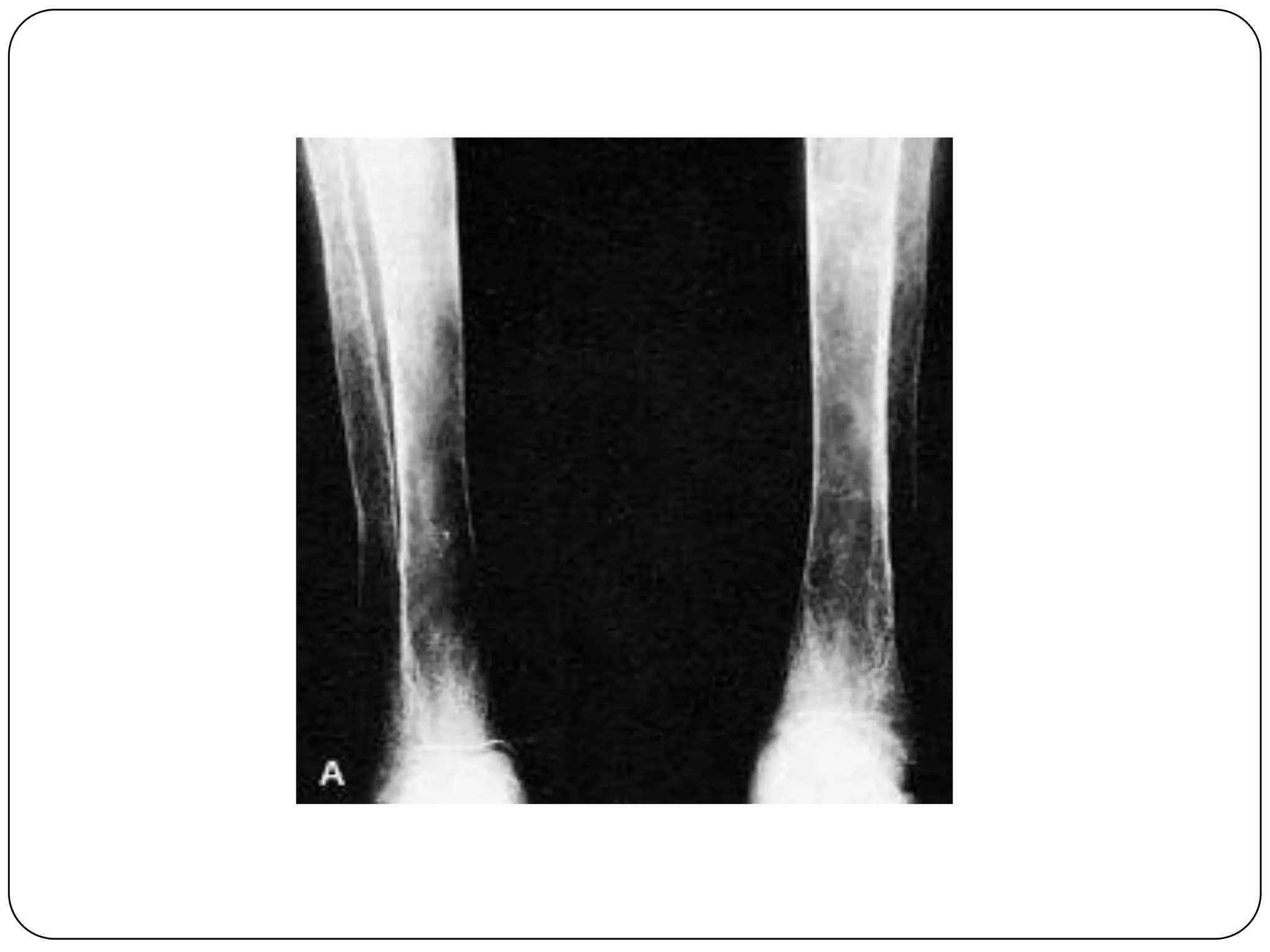
   6.X- ray- bone marrow hyperplasia
 7. DNA analysis (optional)- confirm, prenatal
  diagnosis, detection of carrier
 8.Liver function test
 9.Infection screen- HIV, Hepatitis B and C, VDRL
  (before first transfusion)
 10. HLA typing ( for all patient with unaffected
  siblings)
Hair on end sign
Treatment
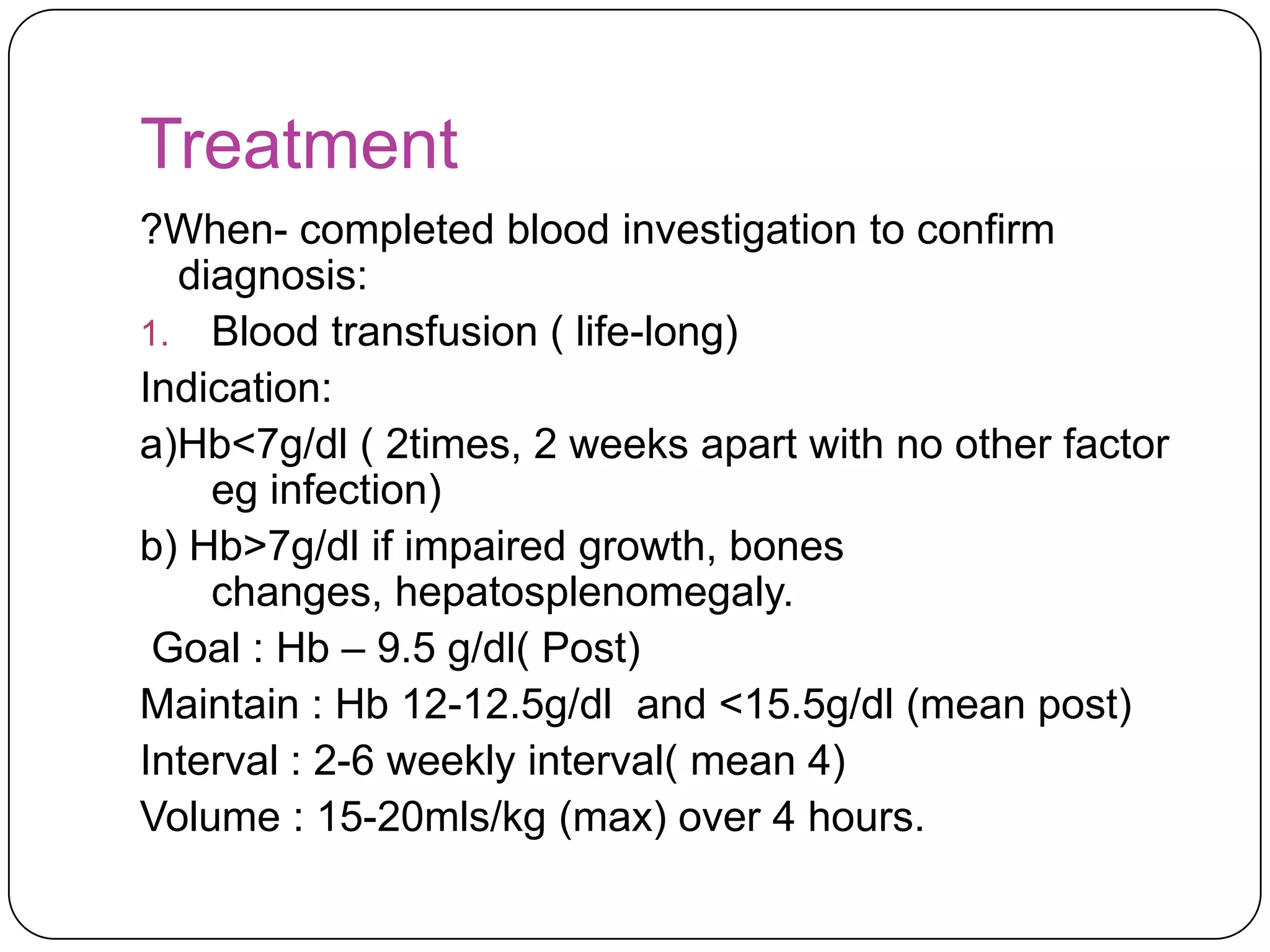
?When- completed blood investigation to confirm
  diagnosis:
1. Blood transfusion ( life-long)
Indication:
a)Hb<7g/dl ( 2times, 2 weeks apart with no other factor
    eg infection)
b) Hb>7g/dl if impaired growth, bones
    changes, hepatosplenomegaly.
 Goal : Hb – 9.5 g/dl( Post)
Maintain : Hb 12-12.5g/dl and <15.5g/dl (mean post)
Interval : 2-6 weekly interval( mean 4)
Volume : 15-20mls/kg (max) over 4 hours.
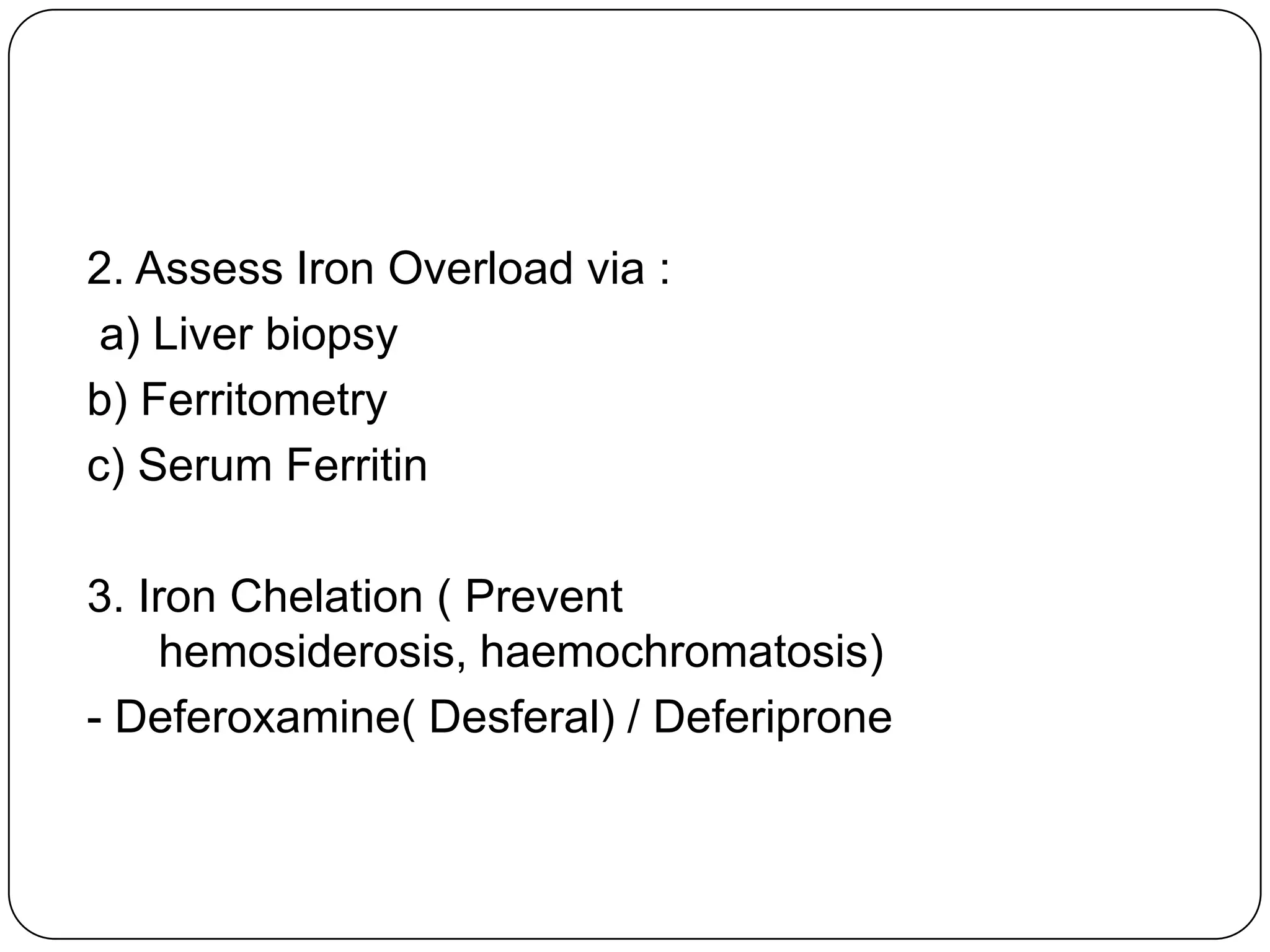
2. Assess Iron Overload via :
 a) Liver biopsy
b) Ferritometry
c) Serum Ferritin

3. Iron Chelation ( Prevent
     hemosiderosis, haemochromatosis)
- Deferoxamine( Desferal) / Deferiprone
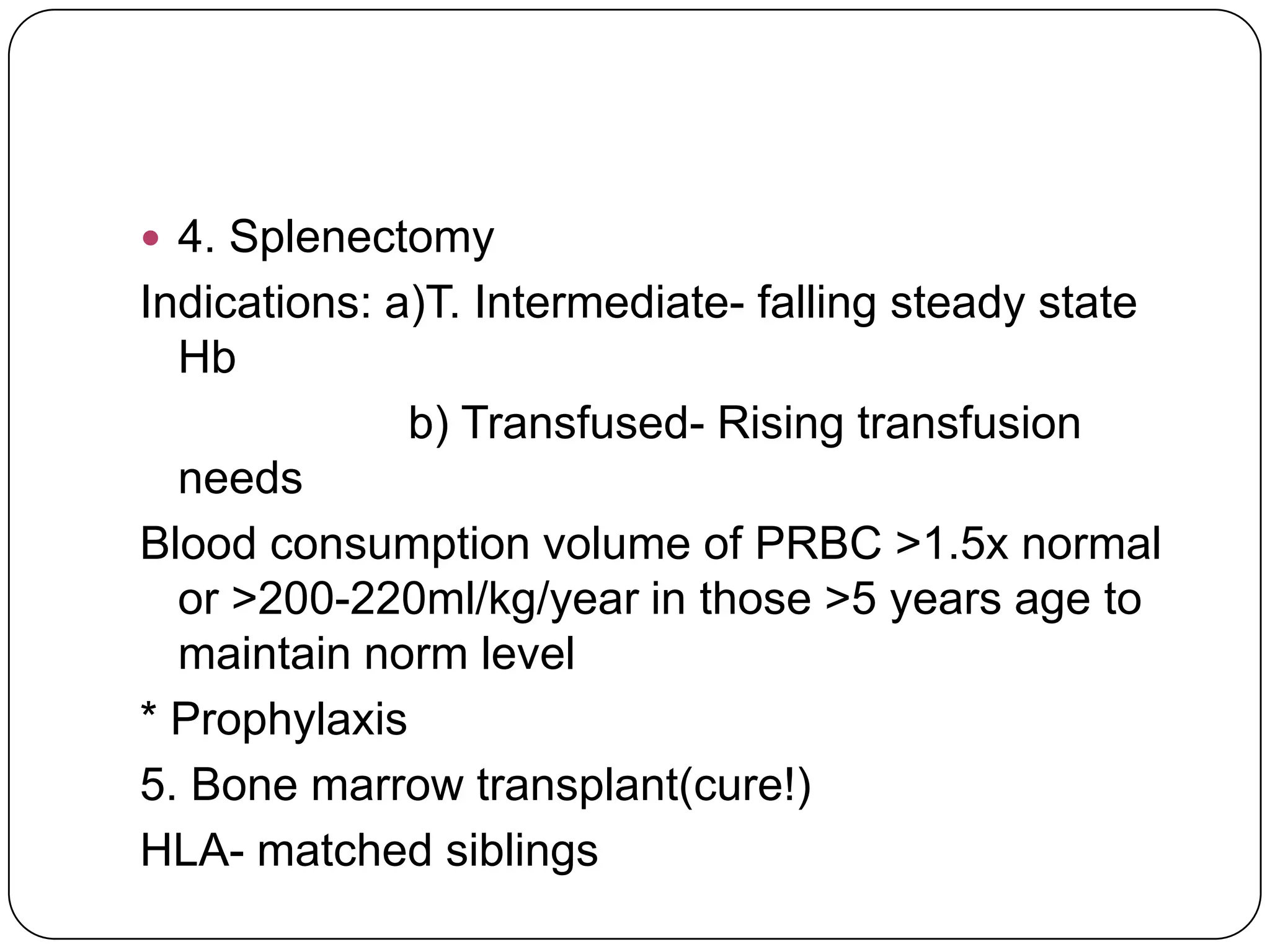
 4. Splenectomy
Indications: a)T. Intermediate- falling steady state
  Hb
              b) Transfused- Rising transfusion
  needs
Blood consumption volume of PRBC >1.5x normal
  or >200-220ml/kg/year in those >5 years age to
  maintain norm level
* Prophylaxis
5. Bone marrow transplant(cure!)
HLA- matched siblings
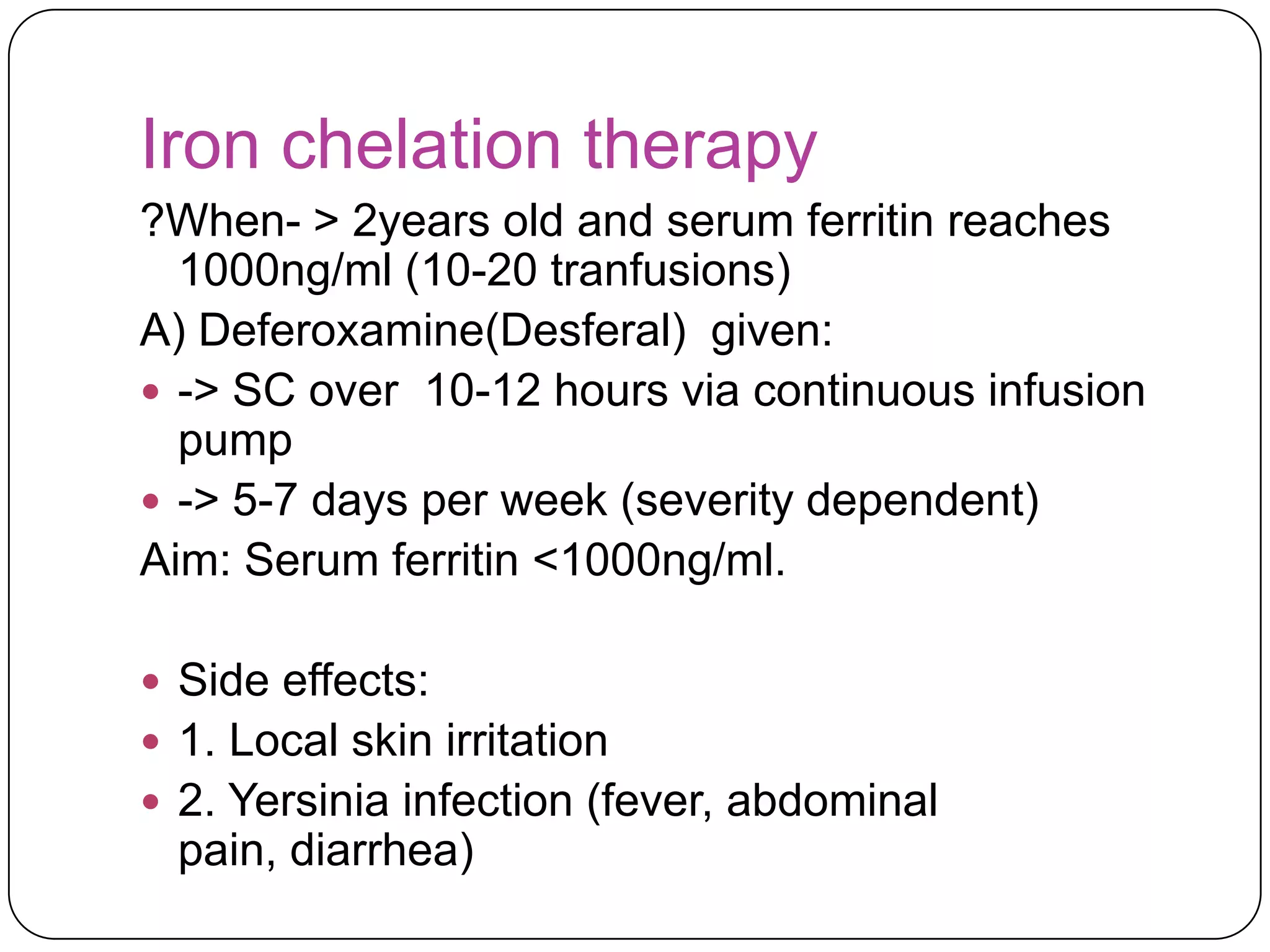
Iron chelation therapy
?When- > 2years old and serum ferritin reaches
  1000ng/ml (10-20 tranfusions)
A) Deferoxamine(Desferal) given:
 -> SC over 10-12 hours via continuous infusion
  pump
 -> 5-7 days per week (severity dependent)
Aim: Serum ferritin <1000ng/ml.

 Side effects:
 1. Local skin irritation
 2. Yersinia infection (fever, abdominal
  pain, diarrhea)
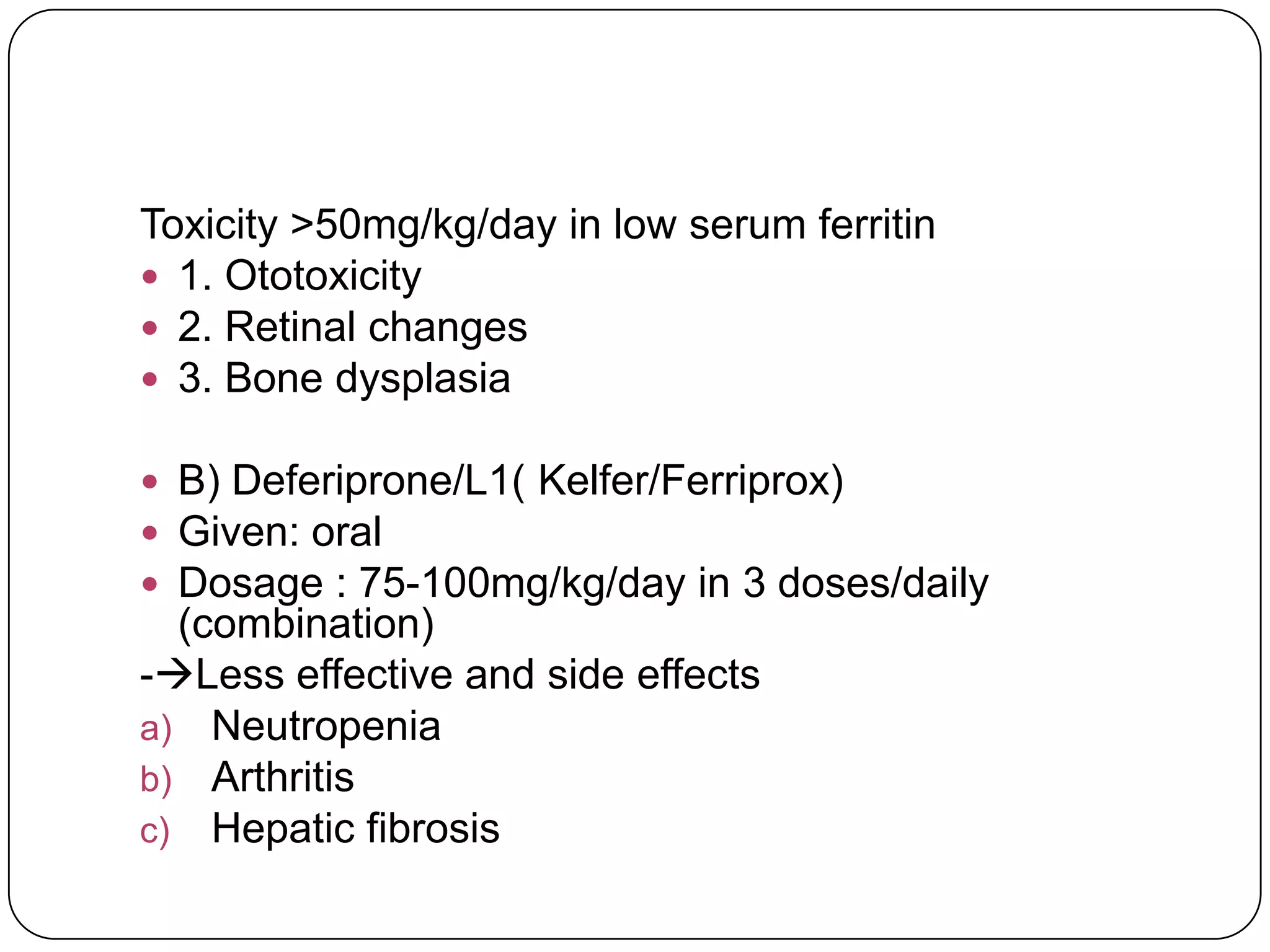
Toxicity >50mg/kg/day in low serum ferritin
 1. Ototoxicity
 2. Retinal changes
 3. Bone dysplasia

 B) Deferiprone/L1( Kelfer/Ferriprox)
 Given: oral
 Dosage : 75-100mg/kg/day in 3 doses/daily
  (combination)
-Less effective and side effects
a) Neutropenia
b) Arthritis
c) Hepatic fibrosis
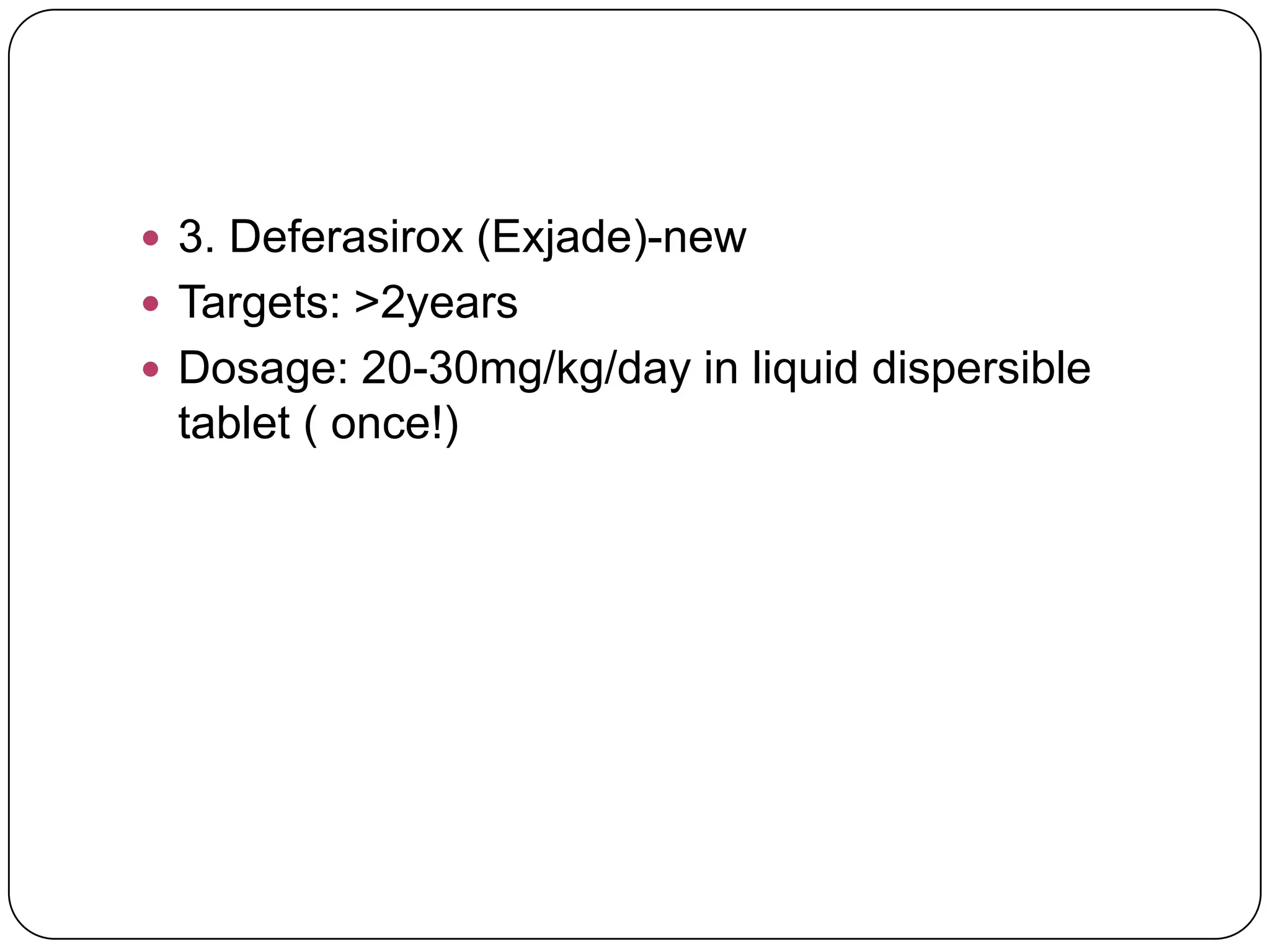
 3. Deferasirox (Exjade)-new
 Targets: >2years
 Dosage: 20-30mg/kg/day in liquid dispersible
 tablet ( once!)
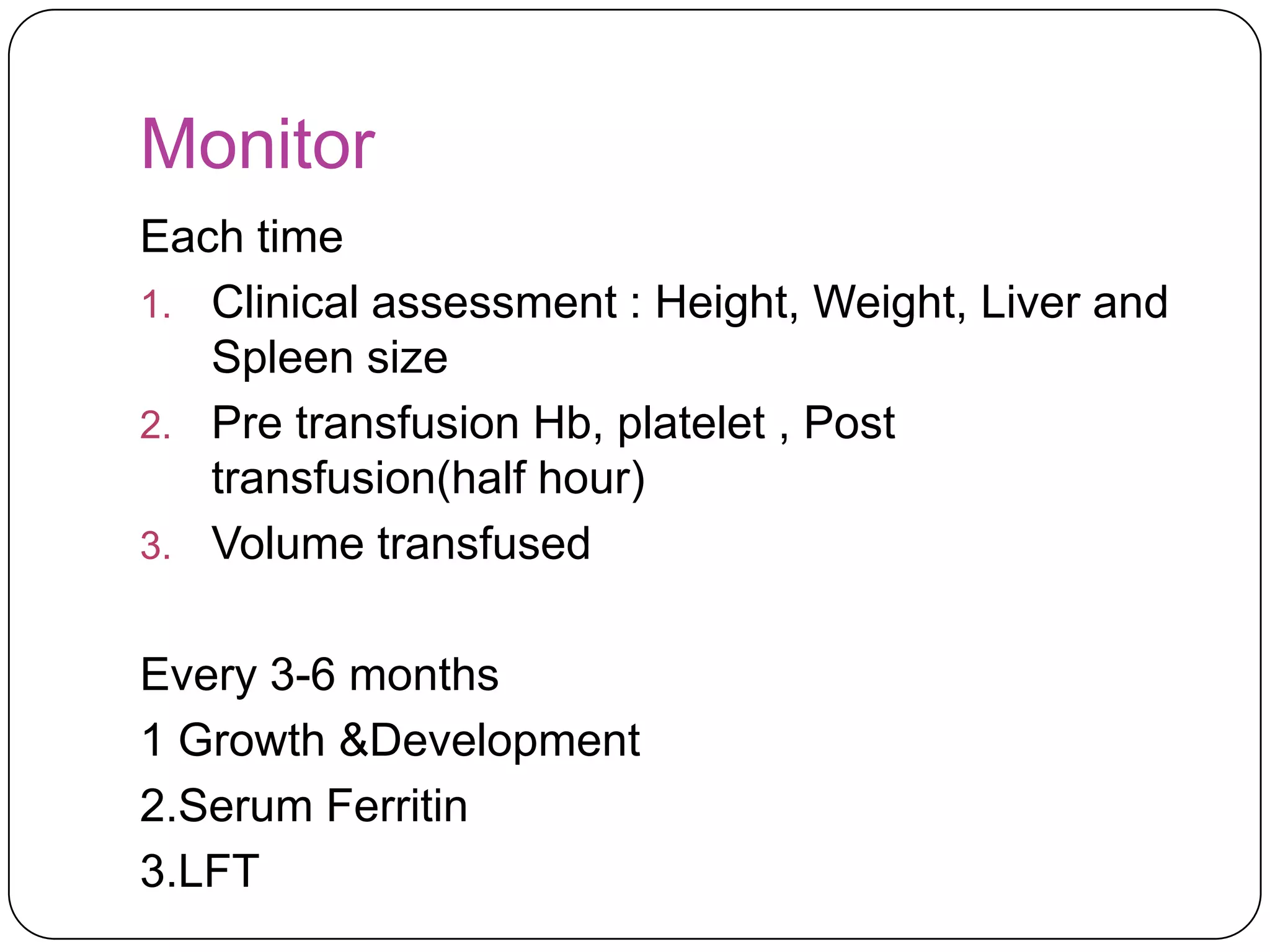
Monitor
Each time
1. Clinical assessment : Height, Weight, Liver and
   Spleen size
2. Pre transfusion Hb, platelet , Post
   transfusion(half hour)
3. Volume transfused


Every 3-6 months
1 Growth &Development
2.Serum Ferritin
3.LFT
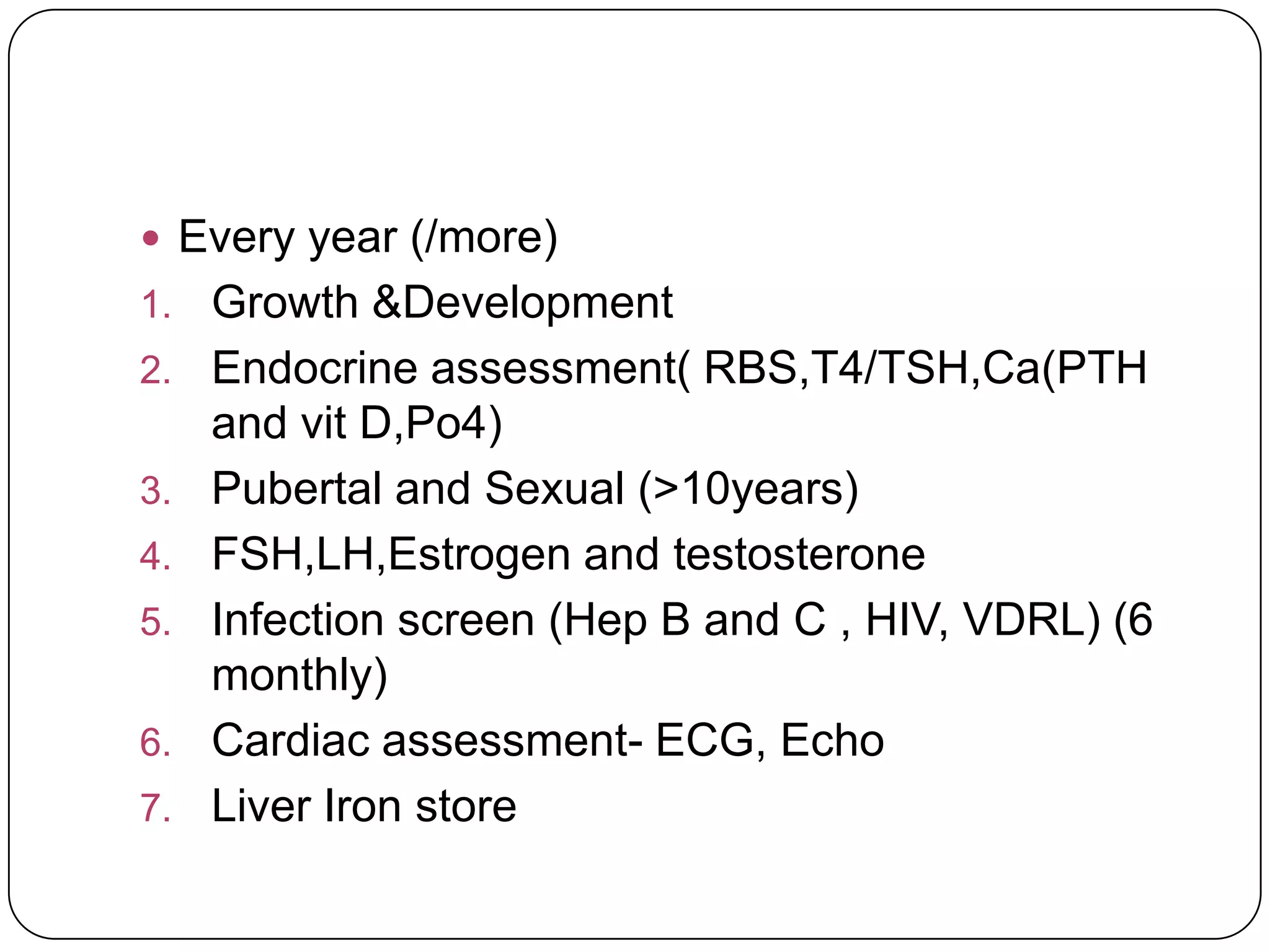
 Every year (/more)
1.   Growth &Development
2.   Endocrine assessment( RBS,T4/TSH,Ca(PTH
     and vit D,Po4)
3.   Pubertal and Sexual (>10years)
4.   FSH,LH,Estrogen and testosterone
5.   Infection screen (Hep B and C , HIV, VDRL) (6
     monthly)
6.   Cardiac assessment- ECG, Echo
7.   Liver Iron store
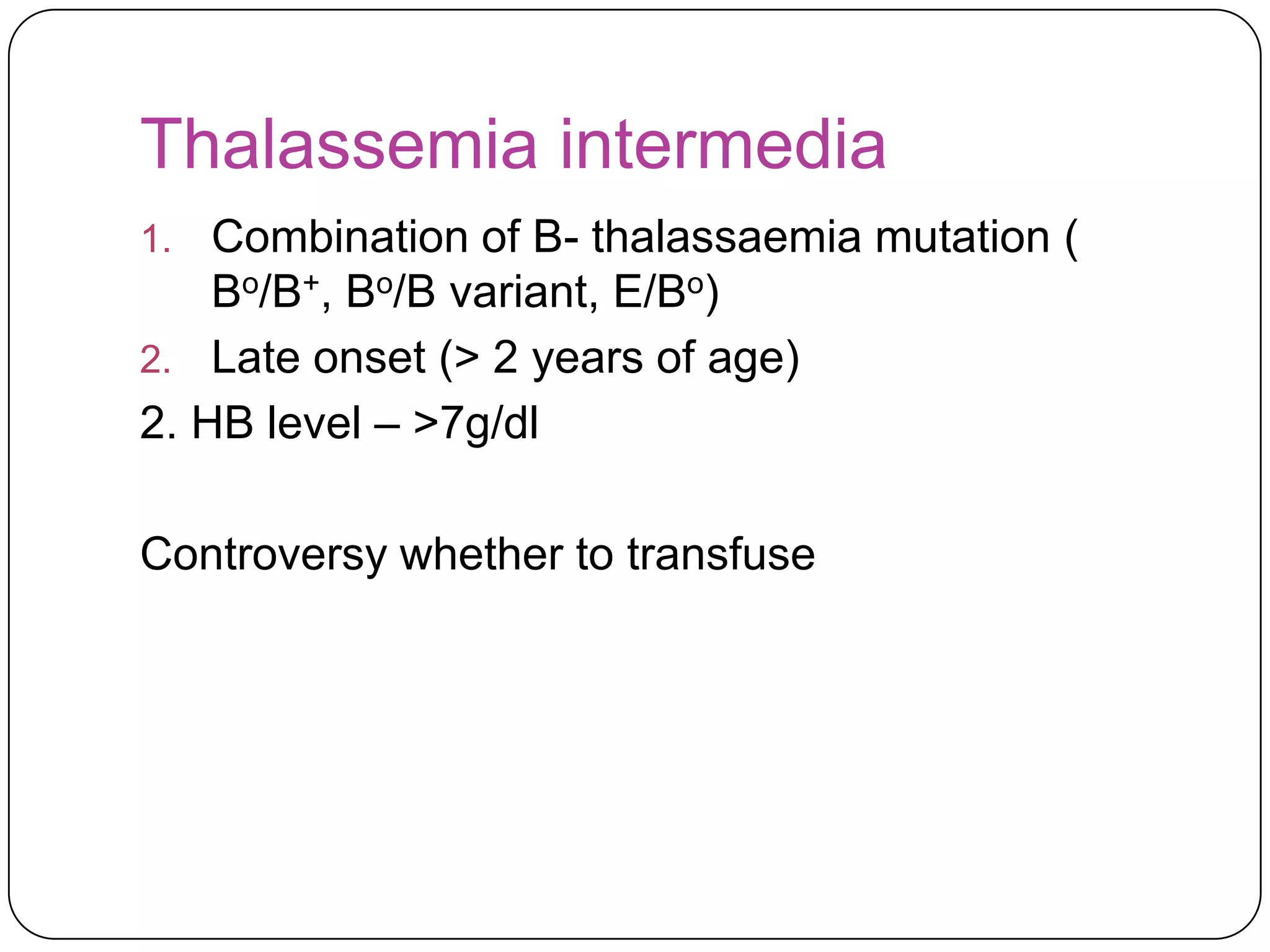
Thalassemia intermedia
1.  Combination of B- thalassaemia mutation (
    Bo/B+, Bo/B variant, E/Bo)
2. Late onset (> 2 years of age)
2. HB level – >7g/dl

Controversy whether to transfuse
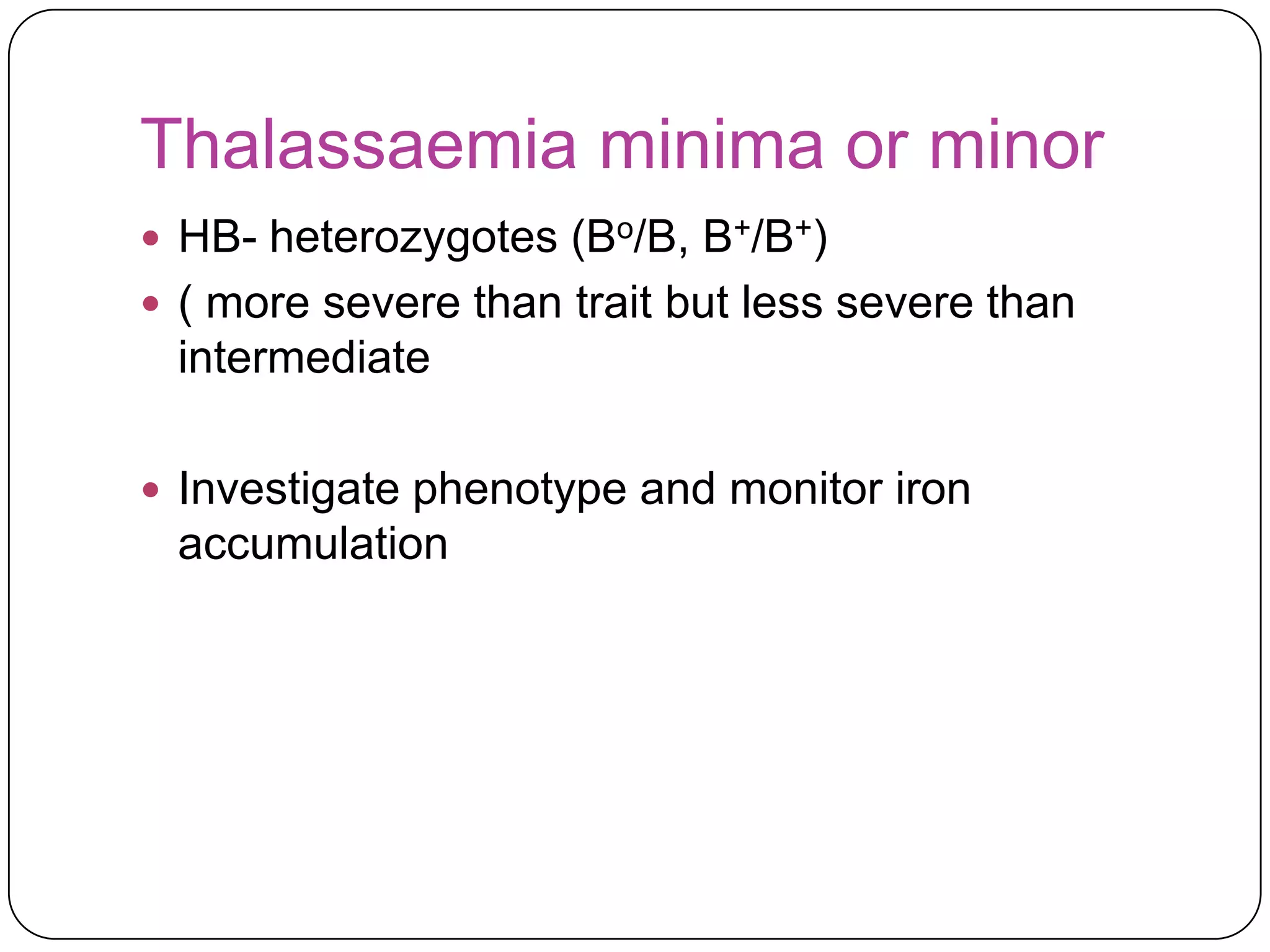
Thalassaemia minima or minor
 HB- heterozygotes (Bo/B, B+/B+)
 ( more severe than trait but less severe than
 intermediate

 Investigate phenotype and monitor iron
 accumulation
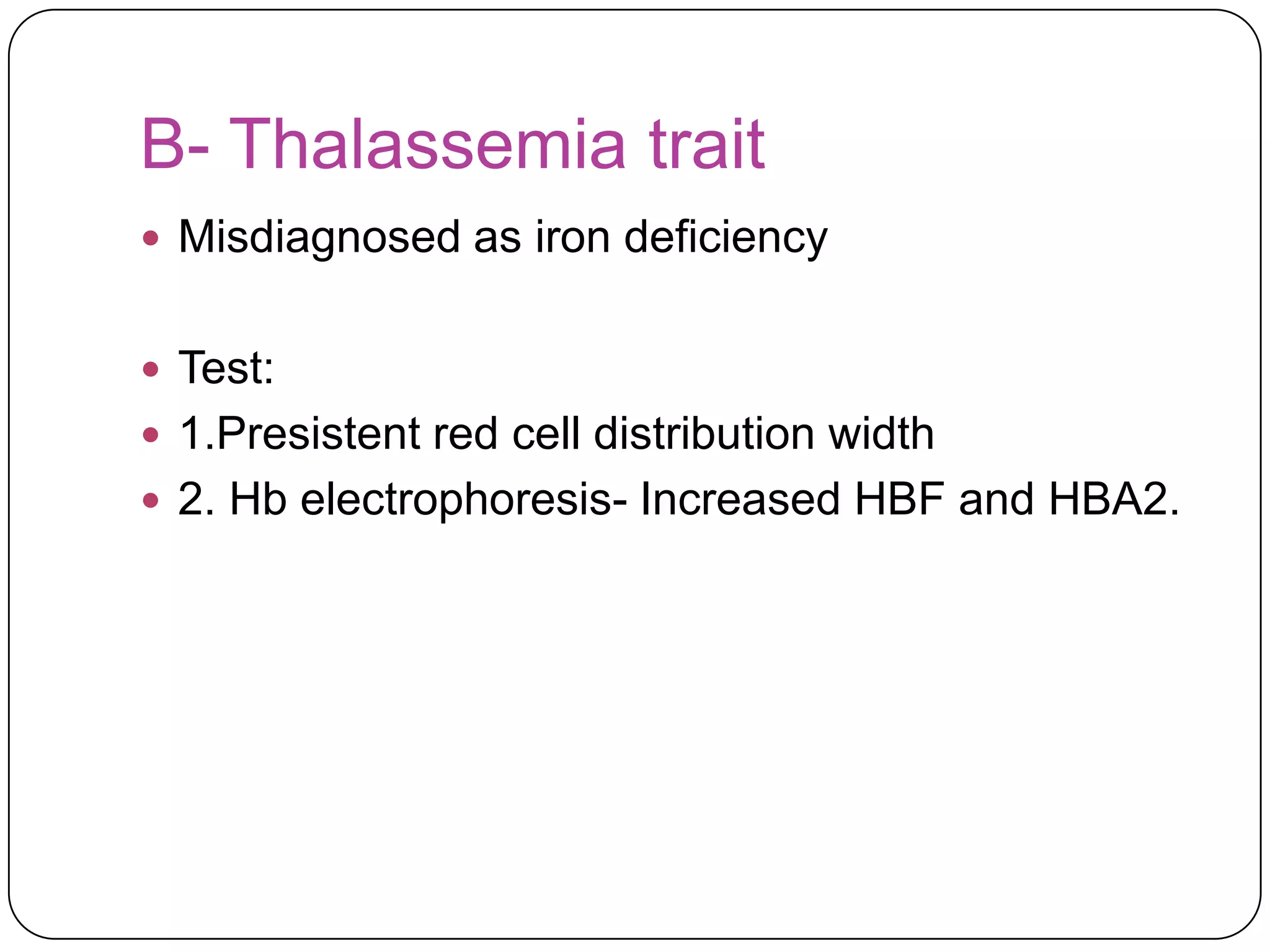
B- Thalassemia trait
 Misdiagnosed as iron deficiency


 Test:
 1.Presistent red cell distribution width
 2. Hb electrophoresis- Increased HBF and HBA2.
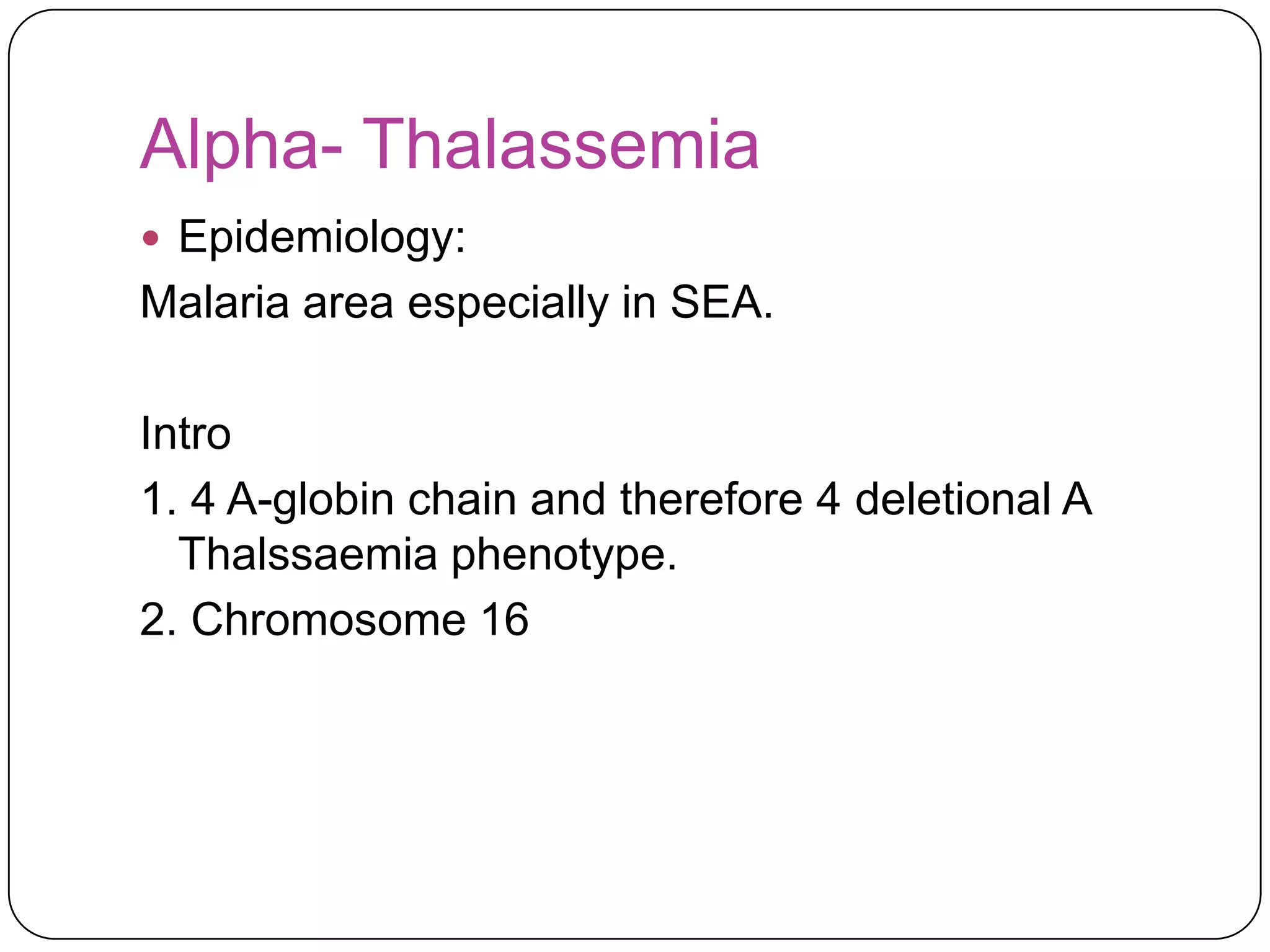
Alpha- Thalassemia
 Epidemiology:
Malaria area especially in SEA.

Intro
1. 4 A-globin chain and therefore 4 deletional A
  Thalssaemia phenotype.
2. Chromosome 16
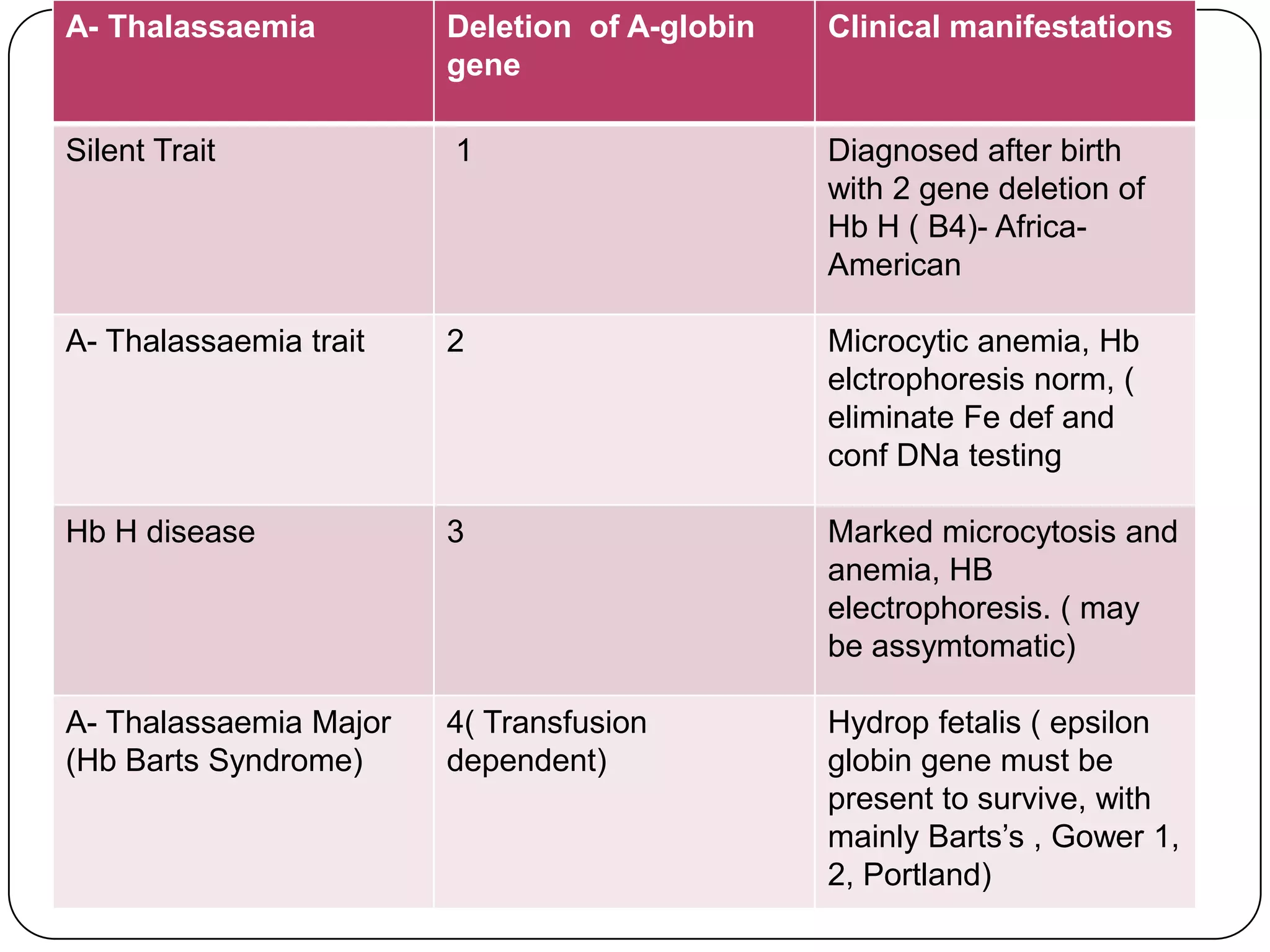
A- Thalassaemia         Deletion of A-globin   Clinical manifestations
                        gene

Silent Trait            1                      Diagnosed after birth
                                               with 2 gene deletion of
                                               Hb H ( B4)- Africa-
                                               American

A- Thalassaemia trait   2                      Microcytic anemia, Hb
                                               elctrophoresis norm, (
                                               eliminate Fe def and
                                               conf DNa testing

Hb H disease            3                      Marked microcytosis and
                                               anemia, HB
                                               electrophoresis. ( may
                                               be assymtomatic)

A- Thalassaemia Major   4( Transfusion         Hydrop fetalis ( epsilon
(Hb Barts Syndrome)     dependent)             globin gene must be
                                               present to survive, with
                                               mainly Barts’s , Gower 1,
                                               2, Portland)
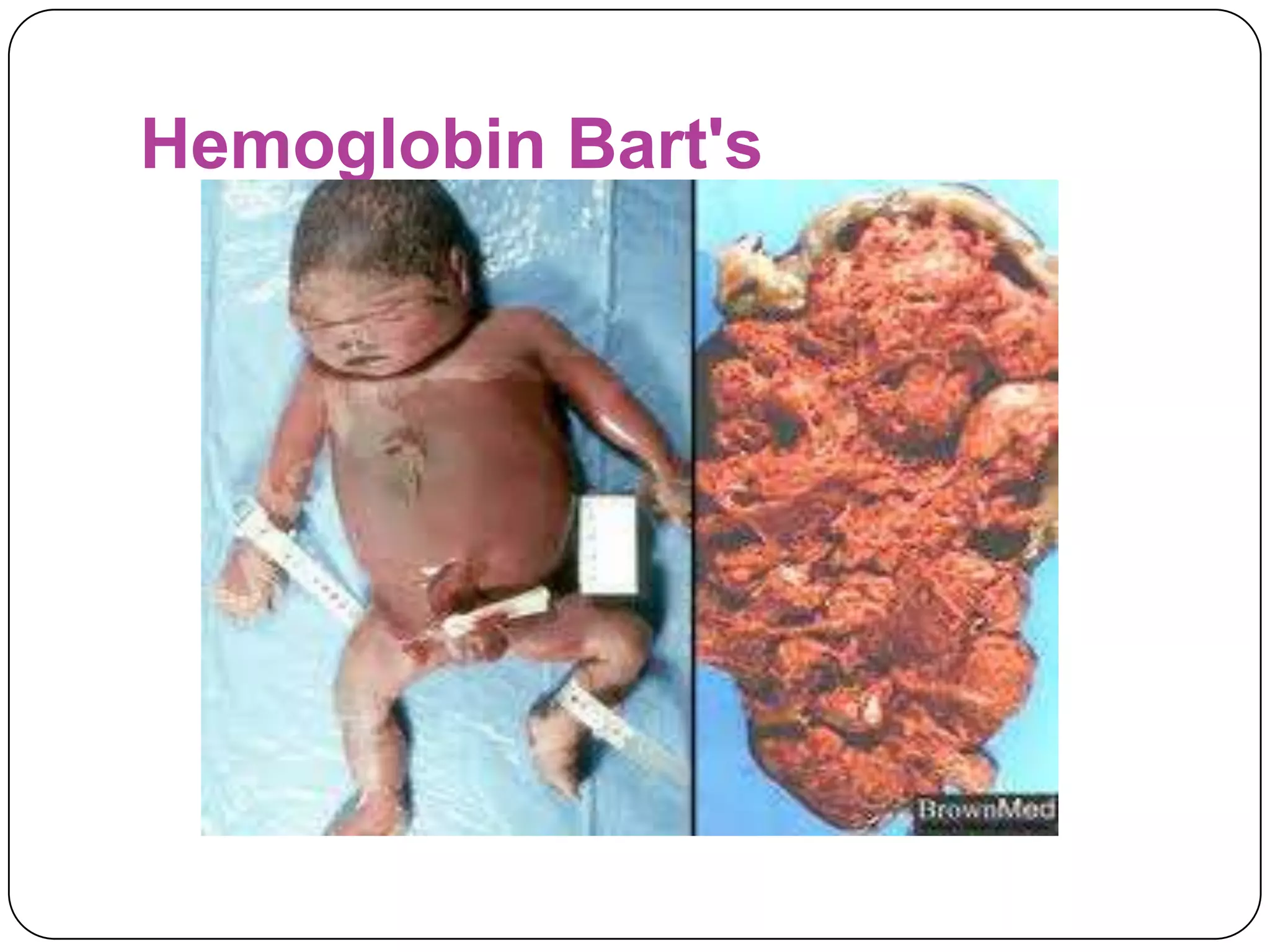
Hemoglobin Bart's
Hb B -mild to moderate
 anaemia, hepatosplenomegaly, and jaundice. Some
 affected individuals also have bone
 changes(overgrowth of the upper jaw and an
 unusually prominent forehead).

Alpha Thalassaemia Major

 Additional signs and symptoms:
severe anaemia, hepatosplenomegaly, heart
  defects, and abnormalities of the urinary system or
  genitalia.
 serious complications for women during pregnancy:
  preeclampsia) premature delivery, and abnormal
  bleeding.
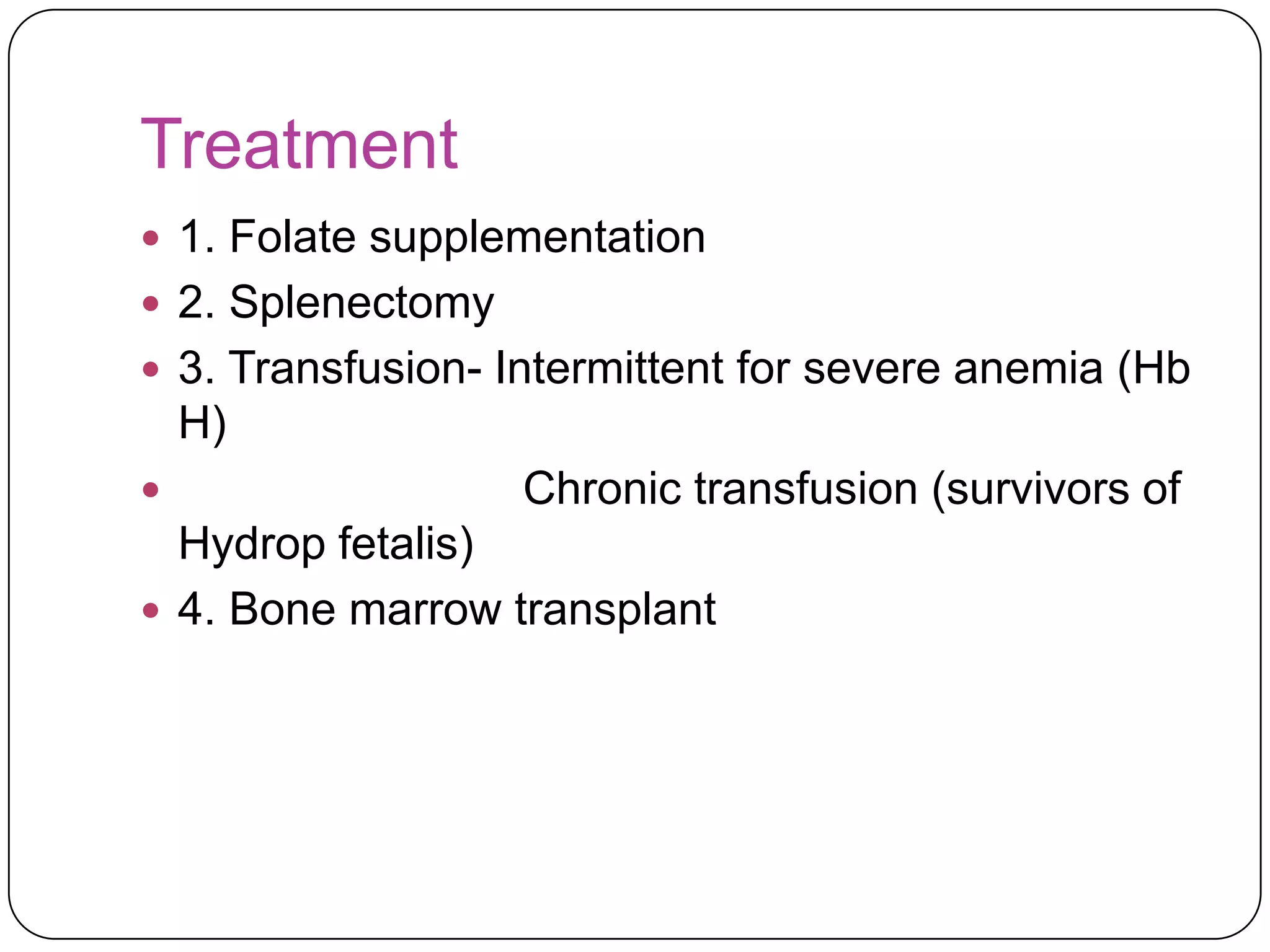
Treatment
 1. Folate supplementation
 2. Splenectomy
 3. Transfusion- Intermittent for severe anemia (Hb
    H)
                  Chronic transfusion (survivors of
  Hydrop fetalis)
 4. Bone marrow transplant
Reference
 Nelson Textbook for Paediatrics, 17th Edition
 Illustrated Paediatrics, 3rd edition, Lissauer
  Clayden.
 Paediatric Protocols Malaysia, 2nd Edition
 CPG Malaysia
 www.Emedicine.com

Hemolytic anemia

  • 1.
    Hemolytic anemia By: TING LEE YING
  • 2.
    1. Thalassaemias a)B-Thalassaemia-> 1.Major 2. Intermedia 3. Minima and minor 4. Trait b) A-Thalassaemia->1. Major 2. HbH 3. TraiT 4. Silent
  • 3.
    Introduction  1. Thalassemiacomes from the Greek word "thalassemia" which means "anemia by-the-sea."  2. The most common genetic disorder worldwide  3.Children with thalassemia:  a) shorter red cell life  b) HbF until older age  c) red cell prone to oxidative stress
  • 4.
    Epidemiology  Worldwide- 3%for B-Thalassemia  SEA- 5-10% for A-Thalassemia
  • 5.
    Anaemia  Neonate: Hb<14g/dl  1-12 months: Hb< 10g/dl  1-12 years : Hb <11g/dl
  • 9.
    Thalassemia Major (Cooley’s anemia) 1.Hb- Bo/Bo 2. Chromosome 11 3. Epidemiology: - Indian subcontinent, Mediterranean, Middle East  The estimated carrier rate for beta- thalassemia in Malaysia is 3.5-4%. There were 4768 transfusion dependent thalassemia major patients as of May 2010 (Data from National Thalassemia Registry).
  • 10.
    B- Thalassaemia Major 1. Autosomal Recessive
  • 11.
    Pathophysiology Mutation of B- globin chain deficiency of B-globin chain Increase in gamma and delta chain Increase in HbF and HbA2, excess A4 Precipitation of globin chain Ineffective erythropoiesis(cell death)
  • 12.
    Clinical manifestations: 1. PresentingAge: 4- 6 months of life 2. Presented with : a) Weakness b) Cardiac decompensation 3.Hb level : </=4g/dl 4. General symptoms(b4 transfusion) 1. Fatigue 2. Poor appetite 3. Failure to thrive
  • 13.
    Classical presentations 1. Thalassemicfacies 2. Pathologic fractures 3. Marked hepatosplenomegaly 4. Cachexia 5.Greenish brown complexion
  • 14.
  • 16.
    Complications of hemosiderosis 1. Hepatic- fibrosis and cirrhosis  2. Pancreas- DM (beta cells)  3. Pituitary, testis and ovaries- growth retardation, hypogonadotrophic hypogonadism  4. Parathyroid- hypocalcemia, osteoporosis  5. Heart- arrhythmias, myocarditis, cardiac failure.
  • 17.
    Lab Findings andinvestigations  1. Hb Electrophoresis/ HPLC- a) Increased HbF b)Decreased or absent HbA c) HbA2 variable  2. FBC , peripheral blood film– anemia, high reticulocytes, numerous nucleated cell, microcytosis  3. Unconjugated bilirubin- increased  4. Serum ferritin and transferrin – elevated ( even b4 transfusion)  5. Red cell phenotyping (ideal)–transfusion  6.X- ray- bone marrow hyperplasia
  • 18.
     7. DNAanalysis (optional)- confirm, prenatal diagnosis, detection of carrier  8.Liver function test  9.Infection screen- HIV, Hepatitis B and C, VDRL (before first transfusion)  10. HLA typing ( for all patient with unaffected siblings)
  • 19.
  • 21.
    Treatment ?When- completed bloodinvestigation to confirm diagnosis: 1. Blood transfusion ( life-long) Indication: a)Hb<7g/dl ( 2times, 2 weeks apart with no other factor eg infection) b) Hb>7g/dl if impaired growth, bones changes, hepatosplenomegaly. Goal : Hb – 9.5 g/dl( Post) Maintain : Hb 12-12.5g/dl and <15.5g/dl (mean post) Interval : 2-6 weekly interval( mean 4) Volume : 15-20mls/kg (max) over 4 hours.
  • 22.
    2. Assess IronOverload via : a) Liver biopsy b) Ferritometry c) Serum Ferritin 3. Iron Chelation ( Prevent hemosiderosis, haemochromatosis) - Deferoxamine( Desferal) / Deferiprone
  • 23.
     4. Splenectomy Indications:a)T. Intermediate- falling steady state Hb b) Transfused- Rising transfusion needs Blood consumption volume of PRBC >1.5x normal or >200-220ml/kg/year in those >5 years age to maintain norm level * Prophylaxis 5. Bone marrow transplant(cure!) HLA- matched siblings
  • 24.
    Iron chelation therapy ?When-> 2years old and serum ferritin reaches 1000ng/ml (10-20 tranfusions) A) Deferoxamine(Desferal) given:  -> SC over 10-12 hours via continuous infusion pump  -> 5-7 days per week (severity dependent) Aim: Serum ferritin <1000ng/ml.  Side effects:  1. Local skin irritation  2. Yersinia infection (fever, abdominal pain, diarrhea)
  • 25.
    Toxicity >50mg/kg/day inlow serum ferritin  1. Ototoxicity  2. Retinal changes  3. Bone dysplasia  B) Deferiprone/L1( Kelfer/Ferriprox)  Given: oral  Dosage : 75-100mg/kg/day in 3 doses/daily (combination) -Less effective and side effects a) Neutropenia b) Arthritis c) Hepatic fibrosis
  • 26.
     3. Deferasirox(Exjade)-new  Targets: >2years  Dosage: 20-30mg/kg/day in liquid dispersible tablet ( once!)
  • 27.
    Monitor Each time 1. Clinicalassessment : Height, Weight, Liver and Spleen size 2. Pre transfusion Hb, platelet , Post transfusion(half hour) 3. Volume transfused Every 3-6 months 1 Growth &Development 2.Serum Ferritin 3.LFT
  • 28.
     Every year(/more) 1. Growth &Development 2. Endocrine assessment( RBS,T4/TSH,Ca(PTH and vit D,Po4) 3. Pubertal and Sexual (>10years) 4. FSH,LH,Estrogen and testosterone 5. Infection screen (Hep B and C , HIV, VDRL) (6 monthly) 6. Cardiac assessment- ECG, Echo 7. Liver Iron store
  • 29.
    Thalassemia intermedia 1. Combination of B- thalassaemia mutation ( Bo/B+, Bo/B variant, E/Bo) 2. Late onset (> 2 years of age) 2. HB level – >7g/dl Controversy whether to transfuse
  • 30.
    Thalassaemia minima orminor  HB- heterozygotes (Bo/B, B+/B+)  ( more severe than trait but less severe than intermediate  Investigate phenotype and monitor iron accumulation
  • 31.
    B- Thalassemia trait Misdiagnosed as iron deficiency  Test:  1.Presistent red cell distribution width  2. Hb electrophoresis- Increased HBF and HBA2.
  • 32.
    Alpha- Thalassemia  Epidemiology: Malariaarea especially in SEA. Intro 1. 4 A-globin chain and therefore 4 deletional A Thalssaemia phenotype. 2. Chromosome 16
  • 33.
    A- Thalassaemia Deletion of A-globin Clinical manifestations gene Silent Trait 1 Diagnosed after birth with 2 gene deletion of Hb H ( B4)- Africa- American A- Thalassaemia trait 2 Microcytic anemia, Hb elctrophoresis norm, ( eliminate Fe def and conf DNa testing Hb H disease 3 Marked microcytosis and anemia, HB electrophoresis. ( may be assymtomatic) A- Thalassaemia Major 4( Transfusion Hydrop fetalis ( epsilon (Hb Barts Syndrome) dependent) globin gene must be present to survive, with mainly Barts’s , Gower 1, 2, Portland)
  • 34.
  • 35.
    Hb B -mildto moderate anaemia, hepatosplenomegaly, and jaundice. Some affected individuals also have bone changes(overgrowth of the upper jaw and an unusually prominent forehead). Alpha Thalassaemia Major  Additional signs and symptoms: severe anaemia, hepatosplenomegaly, heart defects, and abnormalities of the urinary system or genitalia.  serious complications for women during pregnancy: preeclampsia) premature delivery, and abnormal bleeding.
  • 36.
    Treatment  1. Folatesupplementation  2. Splenectomy  3. Transfusion- Intermittent for severe anemia (Hb H)  Chronic transfusion (survivors of Hydrop fetalis)  4. Bone marrow transplant
  • 37.
    Reference  Nelson Textbookfor Paediatrics, 17th Edition  Illustrated Paediatrics, 3rd edition, Lissauer Clayden.  Paediatric Protocols Malaysia, 2nd Edition  CPG Malaysia  www.Emedicine.com