
LAB WORKUP FOR
HEMOLYTIC ANAEMIA
Common investigation
•Complete blood cell count
•Peripheral blood smear
•Serum lactate dehydrogenase (LDH) study
•Serum haptoglobin
•Indirect bilirubin
•Changes in the LDH and serum haptoglobin levels are
the most sensitive general tests because the indirect
bilirubin is not always increased.
GENERAL FEATURES
OF HEMOLYTIC DISORDERS
 GENERAL EXAMINATION - JAUNDICE, PALLOR
BOSSING OF SKULL
 PHYSICAL FINDINGS - ENLARGED SPLEEN
 HEMOGLOBIN - FROM NORMAL TO SEVERELY REDUCED
 MCV - USUALLY INCREASED
 RETICULOCYTES - INCREASED
 BILIRUBIN - INCREASED[MOSTLY UNCONJUGATED]
 LDH - INCREASED
 HAPTOGLOBULIN - REDUCED TO ABSENT
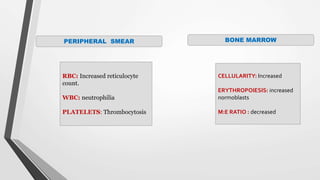
RBC: Increased reticulocyte
count.
WBC: neutrophilia
PLATELETS: Thrombocytosis
CELLULARITY: Increased
ERYTHROPOIESIS: increased
normoblasts
M:E RATIO : decreased
PERIPHERAL SMEAR BONE MARROW
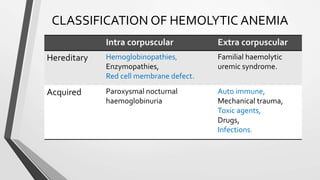
CLASSIFICATION OF HEMOLYTIC ANEMIA
Intra corpuscular Extra corpuscular
Hereditary Hemoglobinopathies,
Enzym0pathies,
Red cell membrane defect.
Familial haemolytic
uremic syndrome.
Acquired Paroxysmal nocturnal
haemoglobinuria
Auto immune,
Mechanical trauma,
Toxic agents,
Drugs,
Infections.
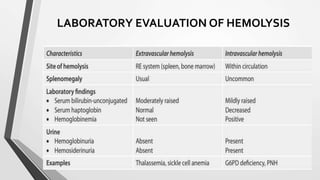
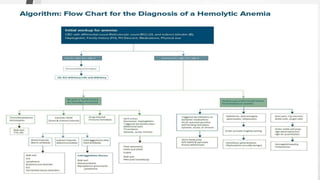
LABORATORY EVALUATION OF HEMOLYSIS
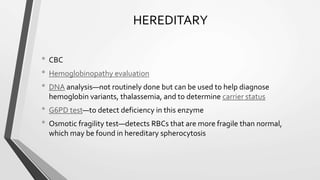
HEREDITARY
• CBC
• Hemoglobinopathy evaluation
• DNA analysis—not routinely done but can be used to help diagnose
hemoglobin variants, thalassemia, and to determine carrier status
• G6PD test—to detect deficiency in this enzyme
• Osmotic fragility test—detects RBCs that are more fragile than normal,
which may be found in hereditary spherocytosis
ACQUIRED
• Tests for autoantibodies for suspected autoimmune disorders
• Direct antiglobulin test (DAT) in the case of transfusion reaction, mother-
baby blood type incompatibility, or autoimmune hemolytic anemia
• Haptoglobin—usually low
• Reticulocyte count—typically high
• Flow cytometry for suspected PNH
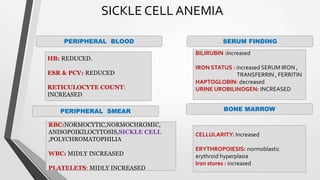
SICKLE CELL ANEMIA
PERIPHERAL BLOOD SERUM FINDING
PERIPHERAL SMEAR BONE MARROW
HB: REDUCED.
ESR & PCV: REDUCED
RETICULOCYTE COUNT:
INCREASED
BILIRUBIN :Increased
IRON STATUS : increased SERUM IRON ,
TRANSFERRIN , FERRITIN
HAPTOGLOBIN: decreased
URINE UROBILINOGEN: INCREASED
RBC:NORMOCYTIC,NORMOCHROMIC,
ANISOPOIKILOCYTOSIS,SICKLE CELL
,POLYCHROMATOPHILIA
WBC: MIDLY INCREASED
PLATELETS: MIDLY INCREASED
CELLULARITY: Increased
ERYTHROPOIESIS: normoblastic
erythroid hyperplasia
Iron stores : increased
Diagnosis
• Sickling test
• Hb electrophoresis
• Estimation of HBF
• Solubility test for HBs
• Confirmatory test : HPLC (High Performance Liquid Chromatography)
• Prenatal genetic testing
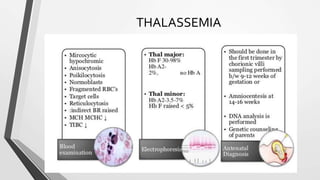
THALASSEMIA
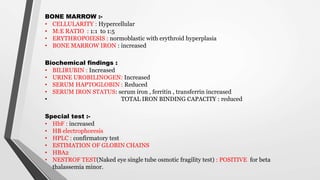
BONE MARROW :-
• CELLULARITY : Hypercellular
• M:E RATIO : 1:1 to 1:5
• ERYTHROPOIESIS : normoblastic with erythroid hyperplasia
• BONE MARROW IRON : increased
Biochemical findings :
• BILIRUBIN : Increased
• URINE UROBILINOGEN: Increased
• SERUM HAPTOGLOBIN : Reduced
• SERUM IRON STATUS: serum iron , ferritin , transferrin increased
• TOTAL IRON BINDING CAPACITY : reduced
Special test :-
• HbF : increased
• HB electrophoresis
• HPLC : confirmatory test
• ESTIMATION OF GLOBIN CHAINS
• HBA2
• NESTROF TEST(Naked eye single tube osmotic fragility test) : POSITIVE for beta
thalassemia minor.
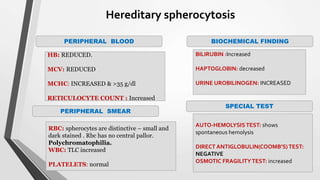
PERIPHERAL BLOOD BIOCHEMICAL FINDING
PERIPHERAL SMEAR
SPECIAL TEST
HB: REDUCED.
MCV: REDUCED
MCHC: INCREASED & >35 g/dl
RETICULOCYTE COUNT : Increased
BILIRUBIN :Increased
HAPTOGLOBIN: decreased
URINE UROBILINOGEN: INCREASED
RBC: spherocytes are distinctive – small and
dark stained . Rbc has no central pallor.
Polychromatophilia.
WBC: TLC increased
PLATELETS: normal
AUTO-HEMOLYSISTEST: shows
spontaneous hemolysis
DIRECT ANTIGLOBULIN(COOMB’S) TEST:
NEGATIVE
OSMOTIC FRAGILITYTEST: increased
Hereditary spherocytosis
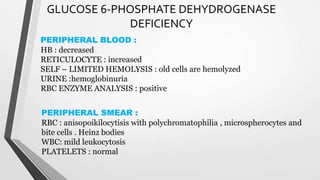
GLUCOSE 6-PHOSPHATE DEHYDROGENASE
DEFICIENCY
PERIPHERAL BLOOD :
HB : decreased
RETICULOCYTE : increased
SELF – LIMITED HEMOLYSIS : old cells are hemolyzed
URINE :hemoglobinuria
RBC ENZYME ANALYSIS : positive
PERIPHERAL SMEAR :
RBC : anisopoikilocytisis with polychromatophilia , microspherocytes and
bite cells . Heinz bodies
WBC: mild leukocytosis
PLATELETS : normal
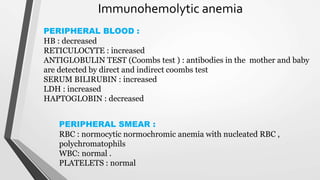
Immunohemolytic anemia
PERIPHERAL BLOOD :
HB : decreased
RETICULOCYTE : increased
ANTIGLOBULIN TEST (Coombs test ) : antibodies in the mother and baby
are detected by direct and indirect coombs test
SERUM BILIRUBIN : increased
LDH : increased
HAPTOGLOBIN : decreased
PERIPHERAL SMEAR :
RBC : normocytic normochromic anemia with nucleated RBC ,
polychromatophils
WBC: normal .
PLATELETS : normal
PAROXYSMAL NOCTURNAL HEMOGLOBINURIA
• HAM’S ACIDIFIED SERUM TEST AND DUCROUS HEMOLYSIS TEST
• FLOW CYTOMETRY
lab work up for hemolytic anemia

lab work up for hemolytic anemia

  • 1.
  • 2.
    Common investigation •Complete bloodcell count •Peripheral blood smear •Serum lactate dehydrogenase (LDH) study •Serum haptoglobin •Indirect bilirubin •Changes in the LDH and serum haptoglobin levels are the most sensitive general tests because the indirect bilirubin is not always increased.
  • 3.
    GENERAL FEATURES OF HEMOLYTICDISORDERS  GENERAL EXAMINATION - JAUNDICE, PALLOR BOSSING OF SKULL  PHYSICAL FINDINGS - ENLARGED SPLEEN  HEMOGLOBIN - FROM NORMAL TO SEVERELY REDUCED  MCV - USUALLY INCREASED  RETICULOCYTES - INCREASED  BILIRUBIN - INCREASED[MOSTLY UNCONJUGATED]  LDH - INCREASED  HAPTOGLOBULIN - REDUCED TO ABSENT
  • 4.
    RBC: Increased reticulocyte count. WBC:neutrophilia PLATELETS: Thrombocytosis CELLULARITY: Increased ERYTHROPOIESIS: increased normoblasts M:E RATIO : decreased PERIPHERAL SMEAR BONE MARROW
  • 5.
    CLASSIFICATION OF HEMOLYTICANEMIA Intra corpuscular Extra corpuscular Hereditary Hemoglobinopathies, Enzym0pathies, Red cell membrane defect. Familial haemolytic uremic syndrome. Acquired Paroxysmal nocturnal haemoglobinuria Auto immune, Mechanical trauma, Toxic agents, Drugs, Infections.
  • 6.
  • 7.
    HEREDITARY • CBC • Hemoglobinopathyevaluation • DNA analysis—not routinely done but can be used to help diagnose hemoglobin variants, thalassemia, and to determine carrier status • G6PD test—to detect deficiency in this enzyme • Osmotic fragility test—detects RBCs that are more fragile than normal, which may be found in hereditary spherocytosis
  • 8.
    ACQUIRED • Tests forautoantibodies for suspected autoimmune disorders • Direct antiglobulin test (DAT) in the case of transfusion reaction, mother- baby blood type incompatibility, or autoimmune hemolytic anemia • Haptoglobin—usually low • Reticulocyte count—typically high • Flow cytometry for suspected PNH
  • 9.
    SICKLE CELL ANEMIA PERIPHERALBLOOD SERUM FINDING PERIPHERAL SMEAR BONE MARROW HB: REDUCED. ESR & PCV: REDUCED RETICULOCYTE COUNT: INCREASED BILIRUBIN :Increased IRON STATUS : increased SERUM IRON , TRANSFERRIN , FERRITIN HAPTOGLOBIN: decreased URINE UROBILINOGEN: INCREASED RBC:NORMOCYTIC,NORMOCHROMIC, ANISOPOIKILOCYTOSIS,SICKLE CELL ,POLYCHROMATOPHILIA WBC: MIDLY INCREASED PLATELETS: MIDLY INCREASED CELLULARITY: Increased ERYTHROPOIESIS: normoblastic erythroid hyperplasia Iron stores : increased
  • 10.
    Diagnosis • Sickling test •Hb electrophoresis • Estimation of HBF • Solubility test for HBs • Confirmatory test : HPLC (High Performance Liquid Chromatography) • Prenatal genetic testing
  • 11.
  • 12.
    BONE MARROW :- •CELLULARITY : Hypercellular • M:E RATIO : 1:1 to 1:5 • ERYTHROPOIESIS : normoblastic with erythroid hyperplasia • BONE MARROW IRON : increased Biochemical findings : • BILIRUBIN : Increased • URINE UROBILINOGEN: Increased • SERUM HAPTOGLOBIN : Reduced • SERUM IRON STATUS: serum iron , ferritin , transferrin increased • TOTAL IRON BINDING CAPACITY : reduced Special test :- • HbF : increased • HB electrophoresis • HPLC : confirmatory test • ESTIMATION OF GLOBIN CHAINS • HBA2 • NESTROF TEST(Naked eye single tube osmotic fragility test) : POSITIVE for beta thalassemia minor.
  • 13.
    PERIPHERAL BLOOD BIOCHEMICALFINDING PERIPHERAL SMEAR SPECIAL TEST HB: REDUCED. MCV: REDUCED MCHC: INCREASED & >35 g/dl RETICULOCYTE COUNT : Increased BILIRUBIN :Increased HAPTOGLOBIN: decreased URINE UROBILINOGEN: INCREASED RBC: spherocytes are distinctive – small and dark stained . Rbc has no central pallor. Polychromatophilia. WBC: TLC increased PLATELETS: normal AUTO-HEMOLYSISTEST: shows spontaneous hemolysis DIRECT ANTIGLOBULIN(COOMB’S) TEST: NEGATIVE OSMOTIC FRAGILITYTEST: increased Hereditary spherocytosis
  • 14.
    GLUCOSE 6-PHOSPHATE DEHYDROGENASE DEFICIENCY PERIPHERALBLOOD : HB : decreased RETICULOCYTE : increased SELF – LIMITED HEMOLYSIS : old cells are hemolyzed URINE :hemoglobinuria RBC ENZYME ANALYSIS : positive PERIPHERAL SMEAR : RBC : anisopoikilocytisis with polychromatophilia , microspherocytes and bite cells . Heinz bodies WBC: mild leukocytosis PLATELETS : normal
  • 15.
    Immunohemolytic anemia PERIPHERAL BLOOD: HB : decreased RETICULOCYTE : increased ANTIGLOBULIN TEST (Coombs test ) : antibodies in the mother and baby are detected by direct and indirect coombs test SERUM BILIRUBIN : increased LDH : increased HAPTOGLOBIN : decreased PERIPHERAL SMEAR : RBC : normocytic normochromic anemia with nucleated RBC , polychromatophils WBC: normal . PLATELETS : normal
  • 16.
    PAROXYSMAL NOCTURNAL HEMOGLOBINURIA •HAM’S ACIDIFIED SERUM TEST AND DUCROUS HEMOLYSIS TEST • FLOW CYTOMETRY