Mr. Binu Babu
Asst. Professor
Mrs. Jincy Ealias
Asst. Professor
Pulse
• The pulse is a wave of blood created
by alternate expansion and recoil of
elastic arteries after each contraction
of the left ventricle of the heart.
• The pulse may be felt in any artery
that lies near the surface of the body
that can be compressed against a
bone or other firm structure.
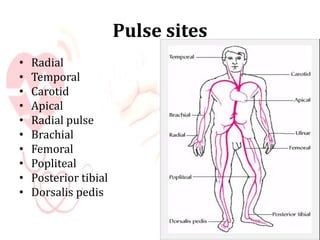
Pulse sites
• Radial
• Temporal
• Carotid
• Apical
• Radial pulse
• Brachial
• Femoral
• Popliteal
• Posterior tibial
• Dorsalis pedis
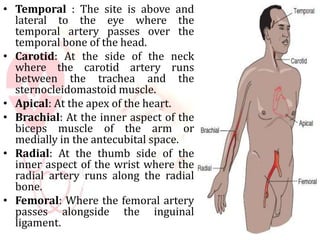
• Temporal : The site is above and
lateral to the eye where the
temporal artery passes over the
temporal bone of the head.
• Carotid: At the side of the neck
where the carotid artery runs
between the trachea and the
sternocleidomastoid muscle.
• Apical: At the apex of the heart.
• Brachial: At the inner aspect of the
biceps muscle of the arm or
medially in the antecubital space.
• Radial: At the thumb side of the
inner aspect of the wrist where the
radial artery runs along the radial
bone.
• Femoral: Where the femoral artery
passes alongside the inguinal
ligament.
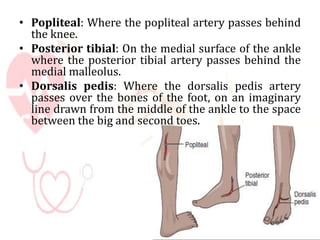
• Popliteal: Where the popliteal artery passes behind
the knee.
• Posterior tibial: On the medial surface of the ankle
where the posterior tibial artery passes behind the
medial malleolus.
• Dorsalis pedis: Where the dorsalis pedis artery
passes over the bones of the foot, on an imaginary
line drawn from the middle of the ankle to the space
between the big and second toes.
• A peripheral pulse is a pulse located away
from the heart, for example, in the foot or
wrist.
• The apical pulse is the central pulse as it is
located at the apex of the heart. It is also
referred to as the point of maximal impulse
(PMI).
Assessment of pulse
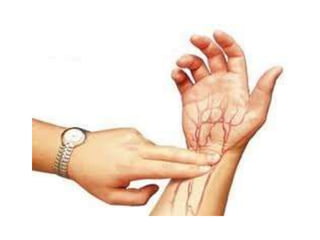
• The radial site is most commonly used in
adults as it is readily accessible.
• A pulse is commonly assessed by palpation
(feeling) or auscultation using stethoscope.
• The middle three fingertips are used for
palpating all pulse sites except the apex of
the heart. A stethoscope is used for
assessing apical pulse.
• Pulse is expressed in beats per minute.
• Average pulse of an healthy adult is 72
beats/minute and it ranges from 60-100
beats/minute.
• Tachycardia is the pulse rate above 100
beats/minute.
• Bradycardia is the pulse below 60 beats/minute.
• In a healthy person, the pulse reflects the
heartbeat; that is, the pulse rate is the same as
the rate of the ventricular contractions of the
heart.
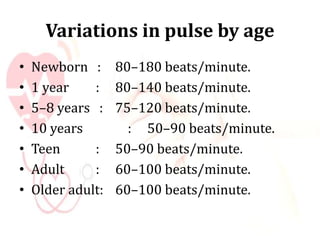
• In some types of cardiovascular disease, the
heartbeat and pulse rates can differ.
• A client’s heart may produce very weak or
small pulse waves that are not detectable in
a peripheral pulse far from the heart. In
these cases the heartbeat and the peripheral
pulse should be assessed.
• The apical pulse rate may be higher than the
radial pulse rate and the difference is known
as pulse deficit.
Variations in pulse by age
• Newborn : 80–180 beats/minute.
• 1 year : 80–140 beats/minute.
• 5–8 years : 75–120 beats/minute.
• 10 years : 50–90 beats/minute.
• Teen : 50–90 beats/minute.
• Adult : 60–100 beats/minute.
• Older adult: 60–100 beats/minute.
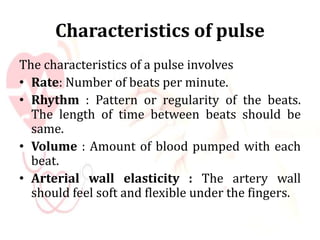
Characteristics of pulse
The characteristics of a pulse involves
• Rate: Number of beats per minute.
• Rhythm : Pattern or regularity of the beats.
The length of time between beats should be
same.
• Volume : Amount of blood pumped with each
beat.
• Arterial wall elasticity : The artery wall
should feel soft and flexible under the fingers.
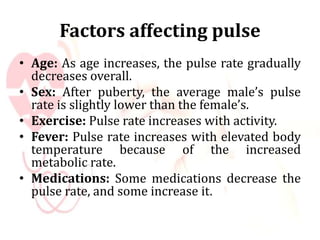
Factors affecting pulse
• Age: As age increases, the pulse rate gradually
decreases overall.
• Sex: After puberty, the average male’s pulse
rate is slightly lower than the female’s.
• Exercise: Pulse rate increases with activity.
• Fever: Pulse rate increases with elevated body
temperature because of the increased
metabolic rate.
• Medications: Some medications decrease the
pulse rate, and some increase it.
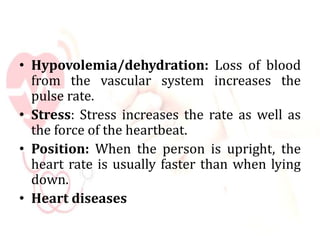
• Hypovolemia/dehydration: Loss of blood
from the vascular system increases the
pulse rate.
• Stress: Stress increases the rate as well as
the force of the heartbeat.
• Position: When the person is upright, the
heart rate is usually faster than when lying
down.
• Heart diseases
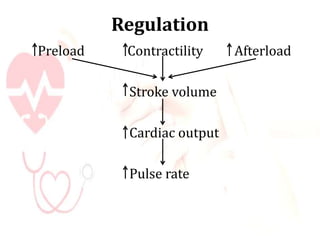
Regulation
Preload Contractility Afterload
Stroke volume
Cardiac output
Pulse rate
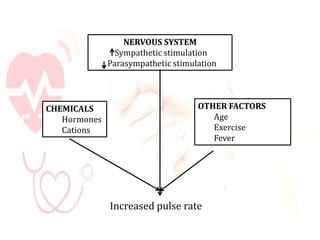
NERVOUS SYSTEM
Sympathetic stimulation
Parasympathetic stimulation
CHEMICALS
Hormones
Cations
OTHER FACTORS
Age
Exercise
Fever
Increased pulse rate
Heart Sound
• In a normal heart, during each cardiac cycle, the heart
sounds are produced due to the closure of heart valves.
• Heart sounds provide valuable information about the
mechanical operation of the heart.
• The heart sounds are described as S1 and S2, which is
commonly termed as 'lub dup'.
• The first sound, S1 is fairly loud and is due to the closure
of the atrioventricular valves. This corresponds with
ventricular systole.
• The second sound, S2 is softer and is due to the closure
of the aortic and pulmonary valves. This corresponds
with atrial systole.
• Stethoscope is used to listen the heart sounds.
Locations
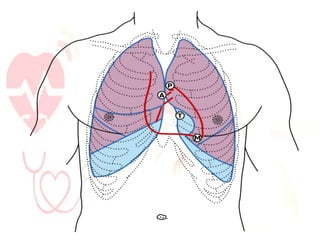
The locations of best auscultation for
each heart valve are labeled with "M", "T", "A",
and "P". First heart sound: caused by
atrioventricular valves - Mitral (M) and
Tricuspid (T). Second heart sound caused by
semilunar valves -- Aortic (A) and
Pulmonary/Pulmonic (P).
Pulse and heart sound

Pulse and heart sound

  • 1.
    Mr. Binu Babu Asst.Professor Mrs. Jincy Ealias Asst. Professor
  • 2.
    Pulse • The pulseis a wave of blood created by alternate expansion and recoil of elastic arteries after each contraction of the left ventricle of the heart. • The pulse may be felt in any artery that lies near the surface of the body that can be compressed against a bone or other firm structure.
  • 3.
    Pulse sites • Radial •Temporal • Carotid • Apical • Radial pulse • Brachial • Femoral • Popliteal • Posterior tibial • Dorsalis pedis
  • 4.
    • Temporal :The site is above and lateral to the eye where the temporal artery passes over the temporal bone of the head. • Carotid: At the side of the neck where the carotid artery runs between the trachea and the sternocleidomastoid muscle. • Apical: At the apex of the heart. • Brachial: At the inner aspect of the biceps muscle of the arm or medially in the antecubital space. • Radial: At the thumb side of the inner aspect of the wrist where the radial artery runs along the radial bone. • Femoral: Where the femoral artery passes alongside the inguinal ligament.
  • 5.
    • Popliteal: Wherethe popliteal artery passes behind the knee. • Posterior tibial: On the medial surface of the ankle where the posterior tibial artery passes behind the medial malleolus. • Dorsalis pedis: Where the dorsalis pedis artery passes over the bones of the foot, on an imaginary line drawn from the middle of the ankle to the space between the big and second toes.
  • 6.
    • A peripheralpulse is a pulse located away from the heart, for example, in the foot or wrist. • The apical pulse is the central pulse as it is located at the apex of the heart. It is also referred to as the point of maximal impulse (PMI).
  • 7.
    Assessment of pulse •The radial site is most commonly used in adults as it is readily accessible. • A pulse is commonly assessed by palpation (feeling) or auscultation using stethoscope. • The middle three fingertips are used for palpating all pulse sites except the apex of the heart. A stethoscope is used for assessing apical pulse.
  • 9.
    • Pulse isexpressed in beats per minute. • Average pulse of an healthy adult is 72 beats/minute and it ranges from 60-100 beats/minute. • Tachycardia is the pulse rate above 100 beats/minute. • Bradycardia is the pulse below 60 beats/minute. • In a healthy person, the pulse reflects the heartbeat; that is, the pulse rate is the same as the rate of the ventricular contractions of the heart.
  • 10.
    • In sometypes of cardiovascular disease, the heartbeat and pulse rates can differ. • A client’s heart may produce very weak or small pulse waves that are not detectable in a peripheral pulse far from the heart. In these cases the heartbeat and the peripheral pulse should be assessed. • The apical pulse rate may be higher than the radial pulse rate and the difference is known as pulse deficit.
  • 11.
    Variations in pulseby age • Newborn : 80–180 beats/minute. • 1 year : 80–140 beats/minute. • 5–8 years : 75–120 beats/minute. • 10 years : 50–90 beats/minute. • Teen : 50–90 beats/minute. • Adult : 60–100 beats/minute. • Older adult: 60–100 beats/minute.
  • 12.
    Characteristics of pulse Thecharacteristics of a pulse involves • Rate: Number of beats per minute. • Rhythm : Pattern or regularity of the beats. The length of time between beats should be same. • Volume : Amount of blood pumped with each beat. • Arterial wall elasticity : The artery wall should feel soft and flexible under the fingers.
  • 13.
    Factors affecting pulse •Age: As age increases, the pulse rate gradually decreases overall. • Sex: After puberty, the average male’s pulse rate is slightly lower than the female’s. • Exercise: Pulse rate increases with activity. • Fever: Pulse rate increases with elevated body temperature because of the increased metabolic rate. • Medications: Some medications decrease the pulse rate, and some increase it.
  • 14.
    • Hypovolemia/dehydration: Lossof blood from the vascular system increases the pulse rate. • Stress: Stress increases the rate as well as the force of the heartbeat. • Position: When the person is upright, the heart rate is usually faster than when lying down. • Heart diseases
  • 15.
    Regulation Preload Contractility Afterload Strokevolume Cardiac output Pulse rate
  • 16.
    NERVOUS SYSTEM Sympathetic stimulation Parasympatheticstimulation CHEMICALS Hormones Cations OTHER FACTORS Age Exercise Fever Increased pulse rate
  • 18.
    Heart Sound • Ina normal heart, during each cardiac cycle, the heart sounds are produced due to the closure of heart valves. • Heart sounds provide valuable information about the mechanical operation of the heart. • The heart sounds are described as S1 and S2, which is commonly termed as 'lub dup'. • The first sound, S1 is fairly loud and is due to the closure of the atrioventricular valves. This corresponds with ventricular systole. • The second sound, S2 is softer and is due to the closure of the aortic and pulmonary valves. This corresponds with atrial systole.
  • 19.
    • Stethoscope isused to listen the heart sounds. Locations The locations of best auscultation for each heart valve are labeled with "M", "T", "A", and "P". First heart sound: caused by atrioventricular valves - Mitral (M) and Tricuspid (T). Second heart sound caused by semilunar valves -- Aortic (A) and Pulmonary/Pulmonic (P).