HEMATOXYLIN AND EOSIN
STAINING
Dr Aarthiprabha K R
DNB Resident
Dept of Pathology
HISTORY OF HEMATOXYLIN
• It was independently introduced in 1865 and 1875, by
Böhmer and Fischer respectively.
• Primary diagnostic technique in the histo-pathology
laboratory.
• Waldeyer established the use of
hematoxylin in histology in 1862.
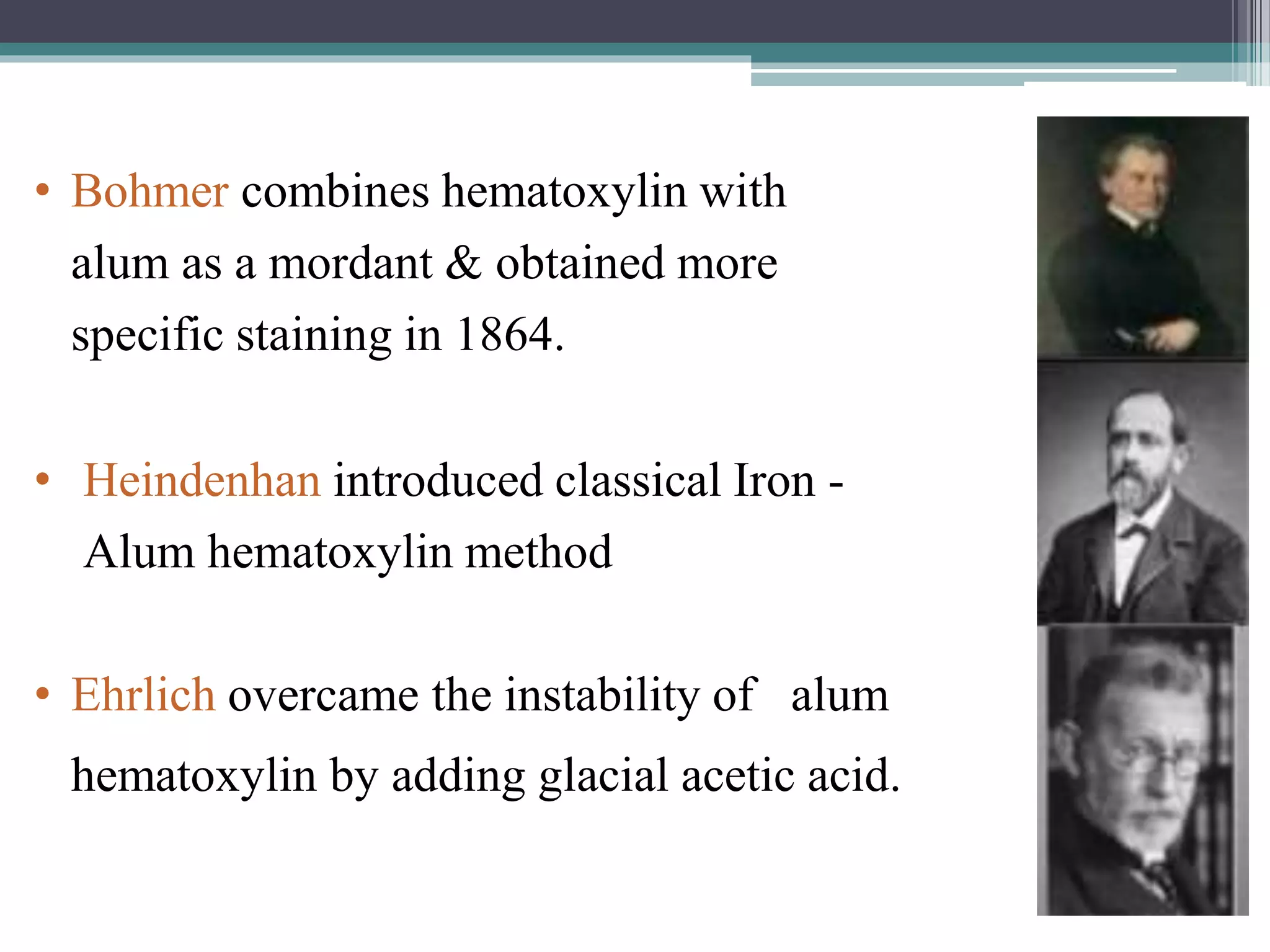
• Bohmer combines hematoxylin with
alum as a mordant & obtained more
specific staining in 1864.
• Heindenhan introduced classical Iron -
Alum hematoxylin method
• Ehrlich overcame the instability of alum
hematoxylin by adding glacial acetic acid.
HEMATOXYLIN
• The word hematoxylin is derived from old Greek word
Haimato (blood) & Xylon (wood) , referring to its dark red
colour in natural state.
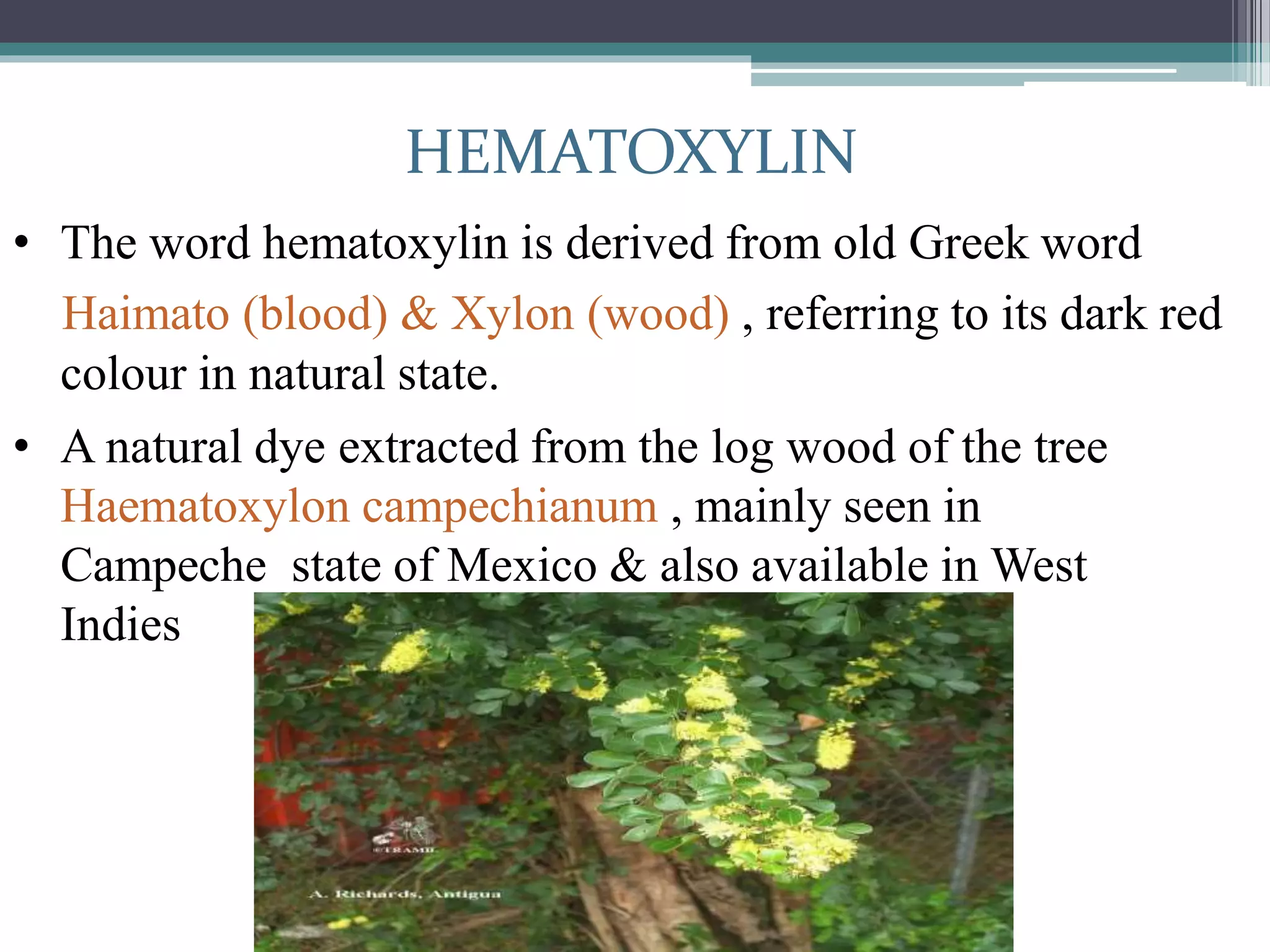
• A natural dye extracted from the log wood of the tree
Haematoxylon campechianum , mainly seen in
Campeche state of Mexico & also available in West
Indies
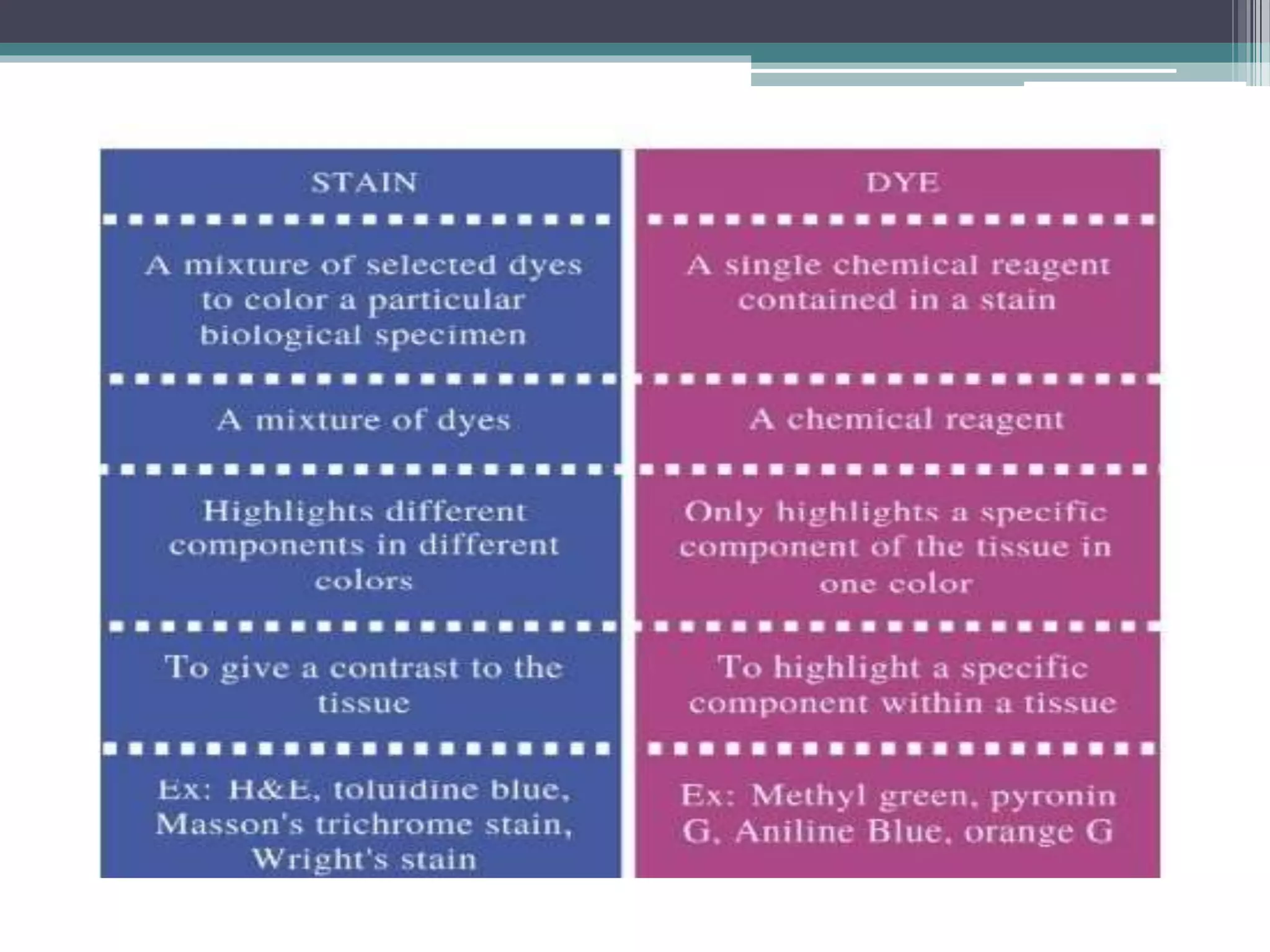
• Hematoxylin itself is not a stain
• On oxidation it produces hematein (poor dye).
• Commonly used dye in histopathology, cytology,
immuno histochemistry.
• Best nuclear stain.
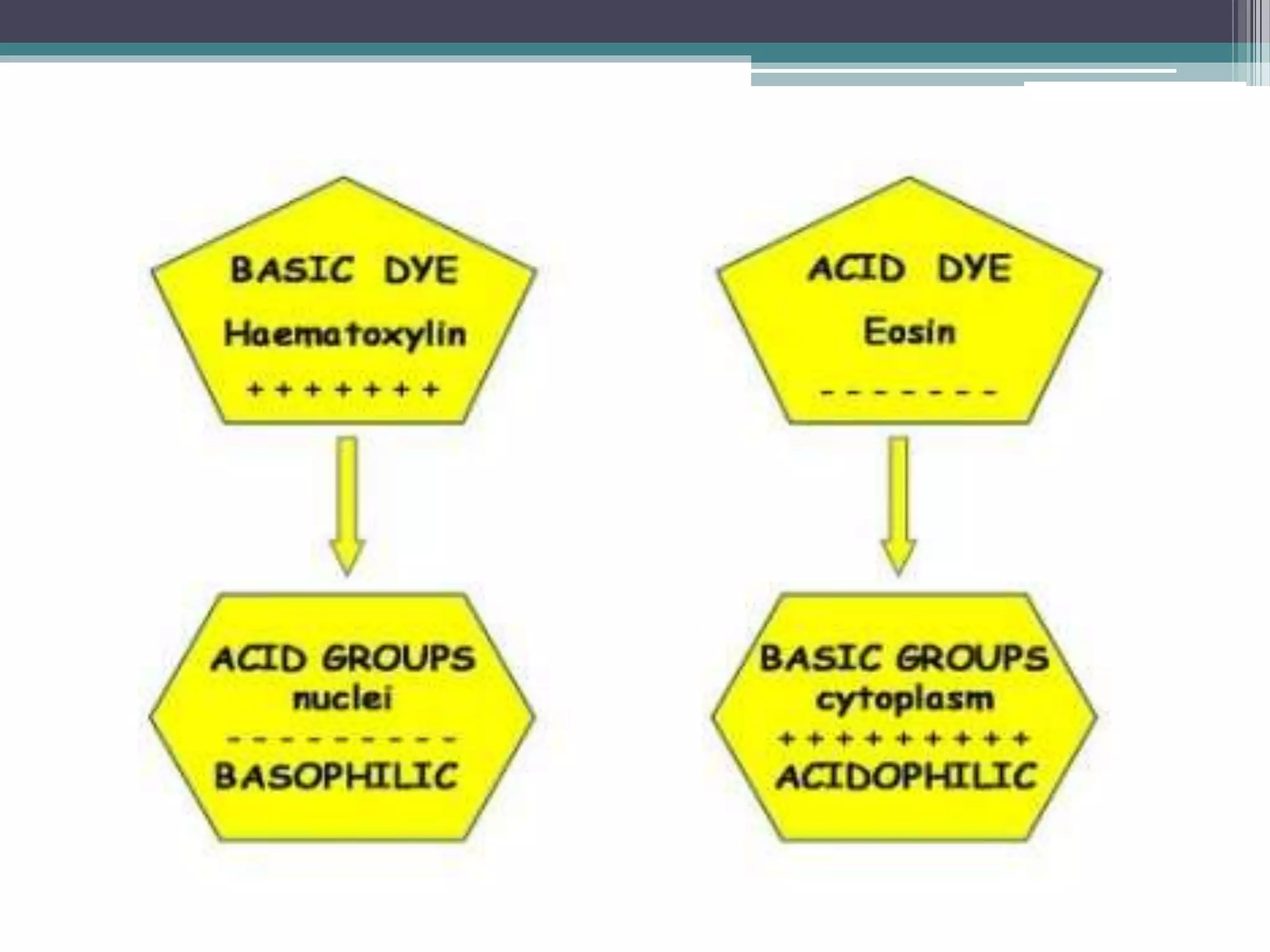
• Basic in nature, stains acidic component of the
tissue, nucleus, mitochondria etc.
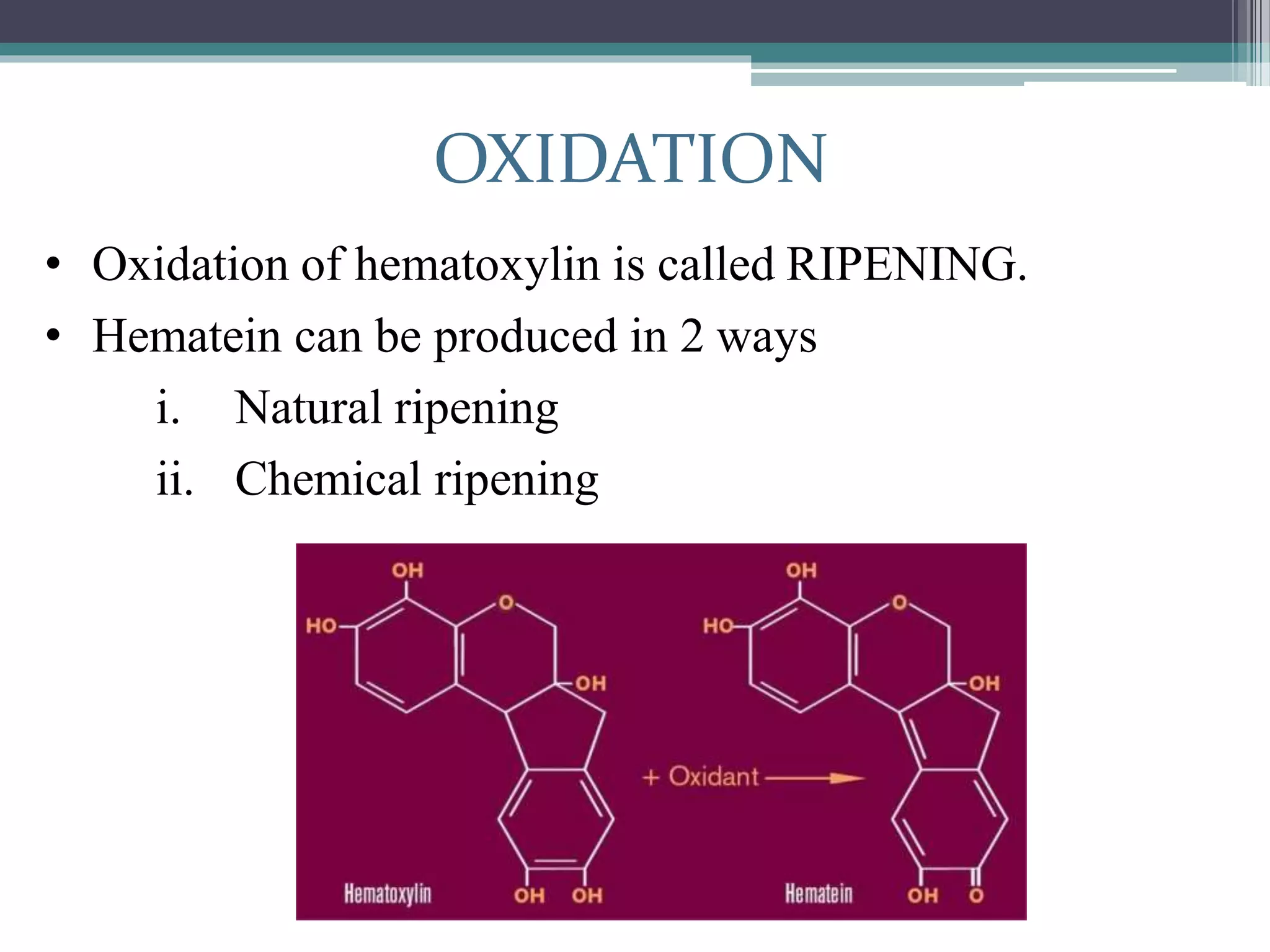
OXIDATION
• Oxidation of hematoxylin is called RIPENING.
• Hematein can be produced in 2 ways
i. Natural ripening
ii. Chemical ripening
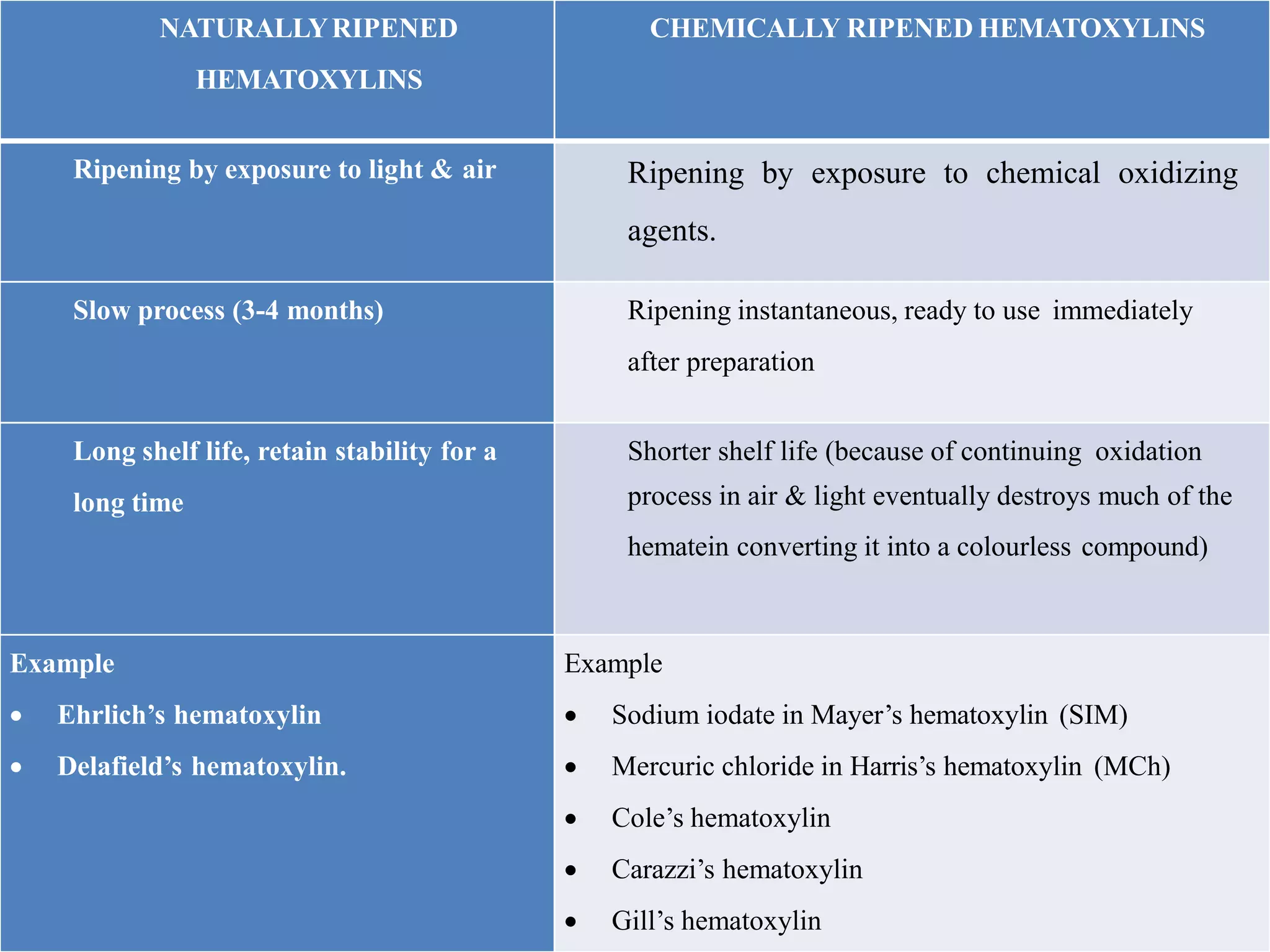
NATURALLYRIPENED
HEMATOXYLINS
CHEMICALLY RIPENED HEMATOXYLINS
Ripening by exposure to light & air Ripening by exposure to chemical oxidizing
agents.
Slow process (3-4 months) Ripening instantaneous, ready to use immediately
after preparation
Long shelf life, retain stability for a
long time
Shorter shelf life (because of continuing oxidation
process in air & light eventually destroys much of the
hematein converting it into a colourless compound)
Example
 Ehrlich’s hematoxylin
 Delafield’s hematoxylin.
Example
 Sodium iodate in Mayer’s hematoxylin (SIM)
 Mercuric chloride in Harris’s hematoxylin (MCh)
 Cole’s hematoxylin
 Carazzi’s hematoxylin
 Gill’s hematoxylin
DIFFRENTIATION
• Provides a more controllable method in removing excess
stain from tissue component and glass slide.
• Traditional HCl/alcohol acts quickly and indiscriminately, is
more difficult to control, and can result in light nuclearstain.
• 1ml of 5 – 10% solution of acetic acid in 99ml of 70 – 95%
alcohol detaches dye molecules from the
cytoplasm/nucleoplasm while keeping nucleic acid
complexes intact.
BLUEING
• Blueing is the process of shifting the color from
reddish to purple blue by the application of a weak
alkaline solution
• Blueing is utilized in both progressive and
regressive techniques
Alkaline solutions used for bluing
 Tap water is alkaline enough to produce this
colour change
 Scott’s tap water substitute
 Saturated Lithium carbonate (disadvantage –
lithium has a tendency to form crystalline
deposits unless the slides are agitated in it and
well washed afterwards)
 Ammonia in distilled water (disadvantage –
ammonia is “hard” on delicate tissues and will
loosen sections from theslide)
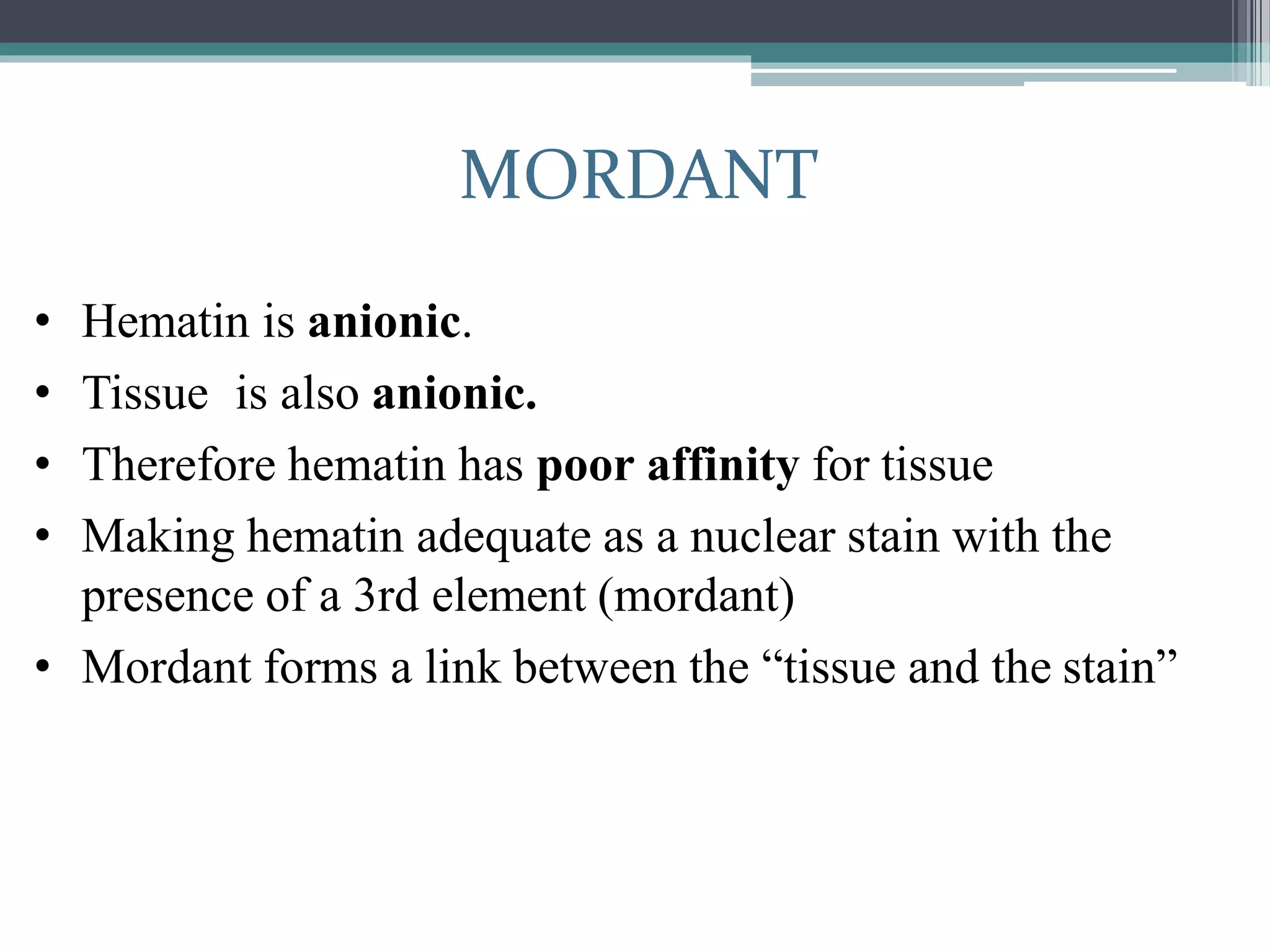
MORDANT
• Hematin is anionic.
• Tissue is also anionic.
• Therefore hematin has poor affinity for tissue
• Making hematin adequate as a nuclear stain with the
presence of a 3rd element (mordant)
• Mordant forms a link between the “tissue and the stain”
• The chelate formed from a mordant dye and a metal is
called a lake
MORDANT-DYE APPLICATION
• Mordant is applied first, followed by the dye.
e.g Heidenhain’s iron hematoxylin
• Mordant and dye are mixed together and then applied.
Commonly done in histotechnology
e.g Alum hematoxylin solutions
• Dye applied first, followed by the mordant.
Hardly done in histotechnology
TYPES OF HEMATOXYLIN
According to the mordant used
• Alum hematoxylin
• Iron hematoxylin
• Tungsten hematoxylin
• Molybdenum hematoxylin
• Lead hematoxylin
• Hematoxylin with out mordant
ALUM HEMATOXYLIN
• Mordant used are aluminum salts
1. aluminum potassium sulphate (potash alum) or
2. aluminum ammonium sulphate (ammonium
alum).
• Mainly used in routine H and E staining.
• Has different types but all of them stain the nuclei blue-
black.
• These are used when counter stain does not contain an
acid.
• Can be used progressively or regressively.
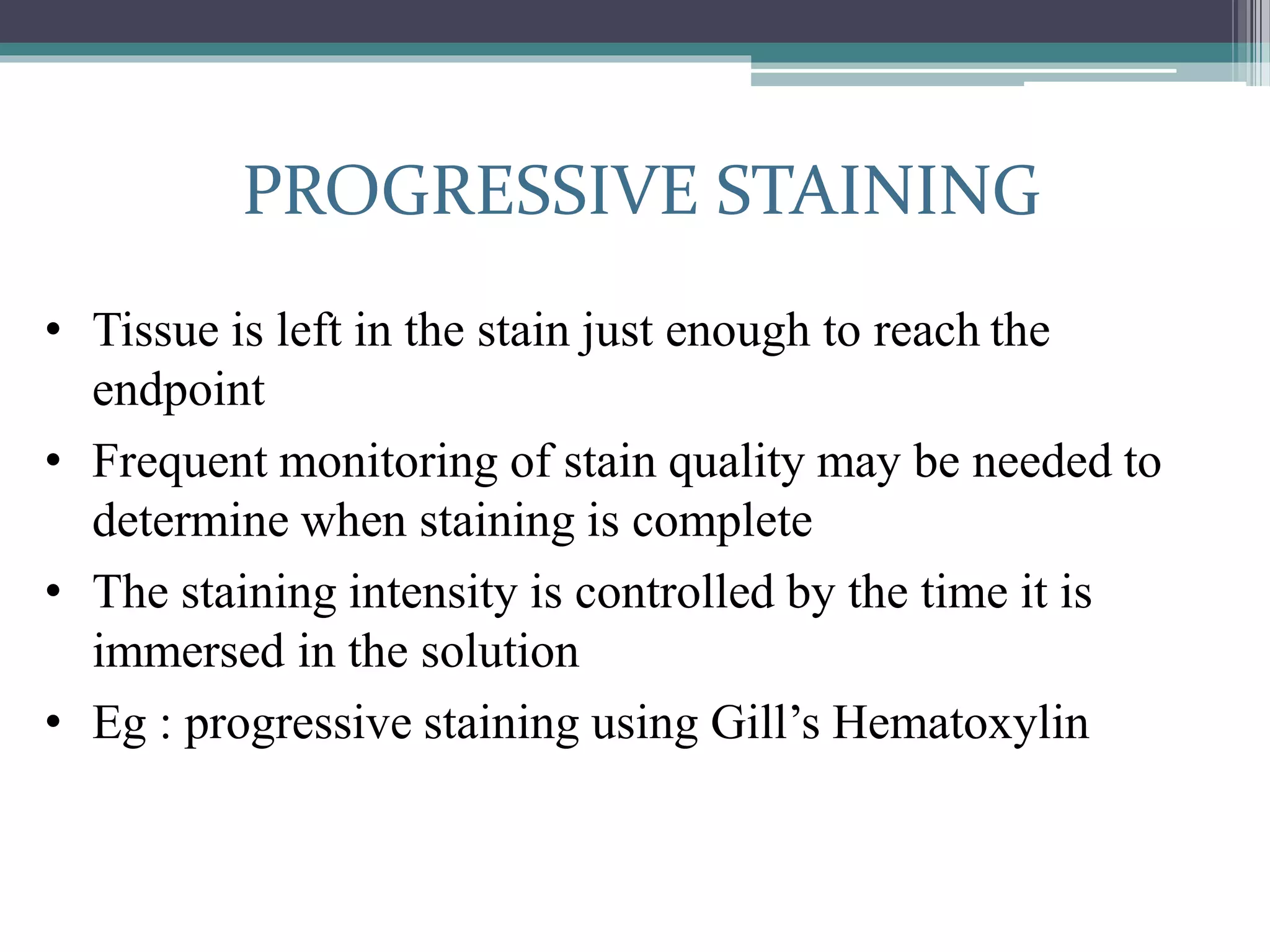
PROGRESSIVE STAINING
• Tissue is left in the stain just enough to reach the
endpoint
• Frequent monitoring of stain quality may be needed to
determine when staining is complete
• The staining intensity is controlled by the time it is
immersed in the solution
• Eg : progressive staining using Gill’s Hematoxylin
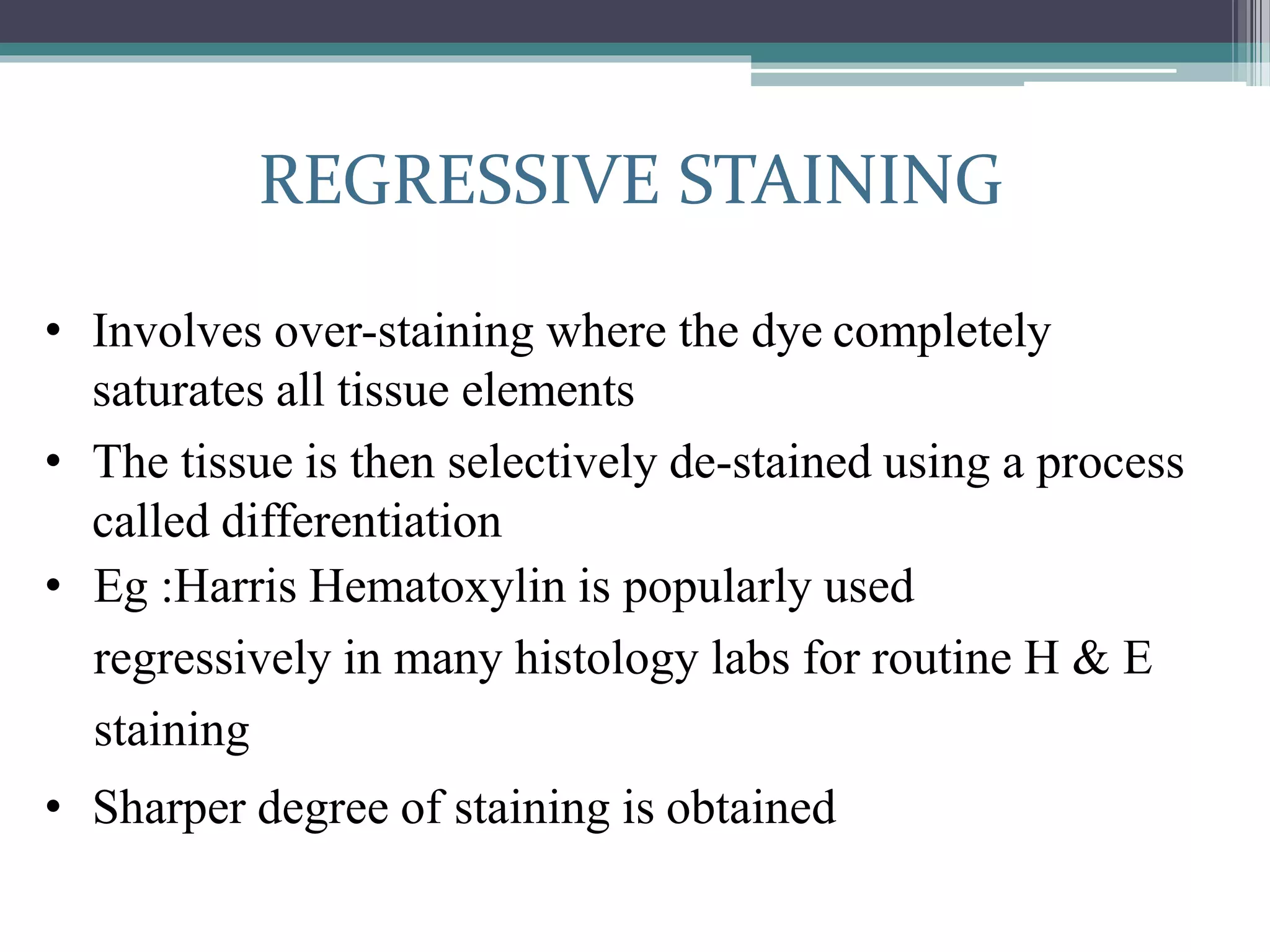
REGRESSIVE STAINING
• Involves over-staining where the dye completely
saturates all tissue elements
• The tissue is then selectively de-stained using a process
called differentiation
• Eg :Harris Hematoxylin is popularly used
regressively in many histology labs for routine H & E
staining
• Sharper degree of staining is obtained
TYPES OF ALUM HAEMATOXYLIN
Ehrilch’s haematoxylin
Mayer’s haematoxylin
Harris’s haematoxylin
Gill’s haematoxylin
Cole’s haematoxylin
Delafield’s haematoxylin
Carazzi’s haematoxylin
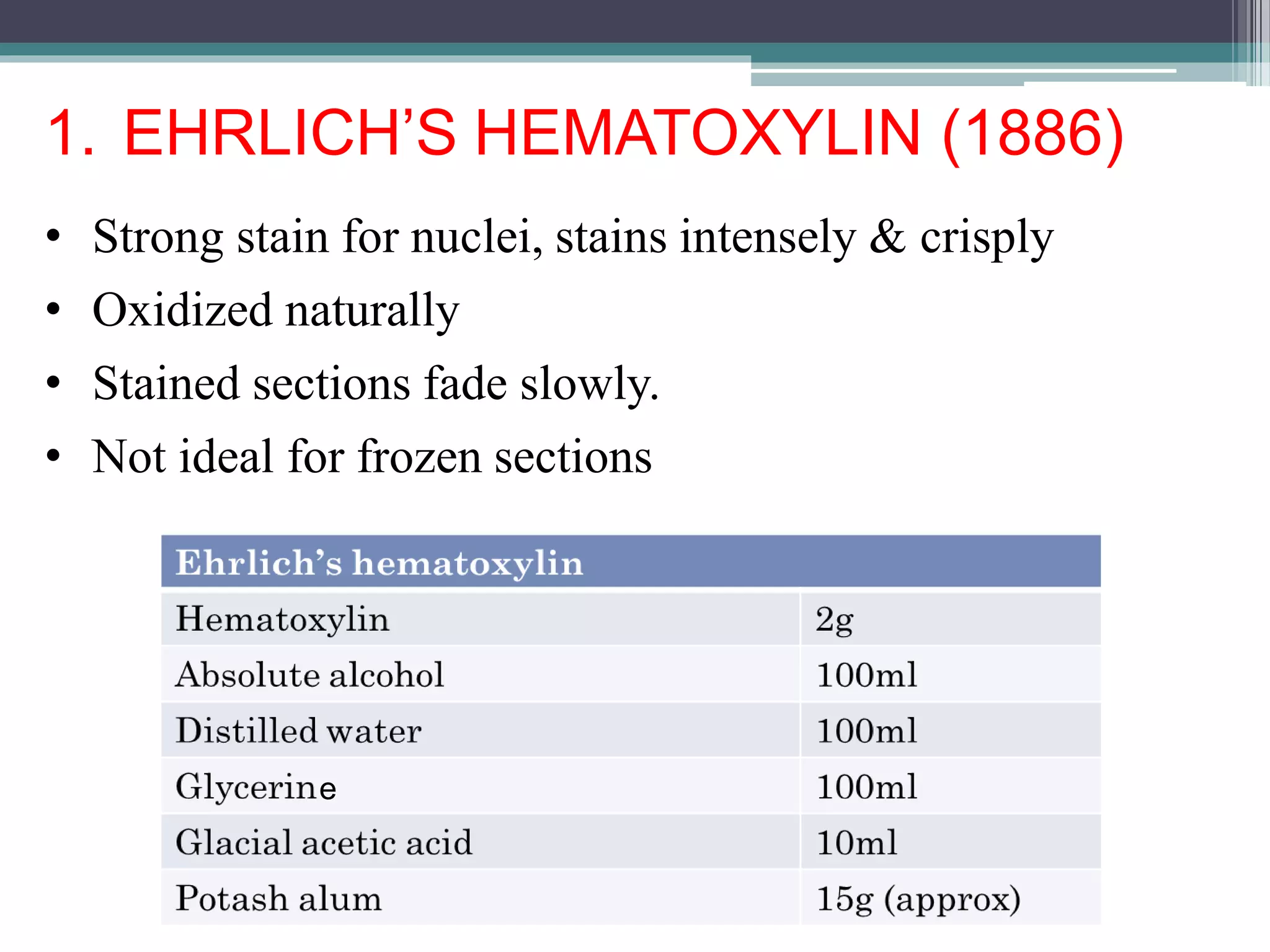
1. EHRLICH’S HEMATOXYLIN (1886)
• Strong stain for nuclei, stains intensely & crisply
• Oxidized naturally
• Stained sections fade slowly.
• Not ideal for frozen sections
e
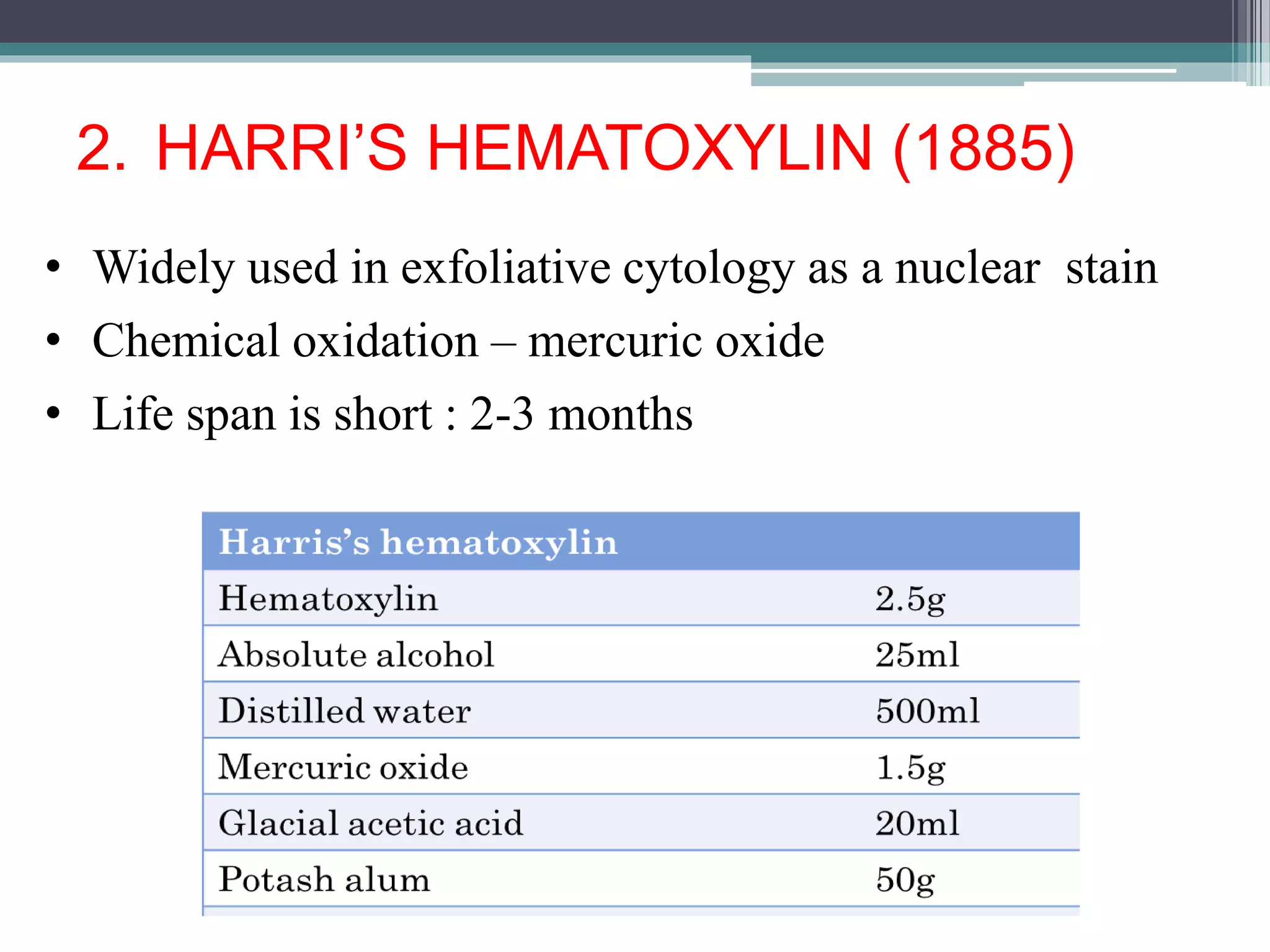
2. HARRI’S HEMATOXYLIN (1885)
• Widely used in exfoliative cytology as a nuclear stain
• Chemical oxidation – mercuric oxide
• Life span is short : 2-3 months
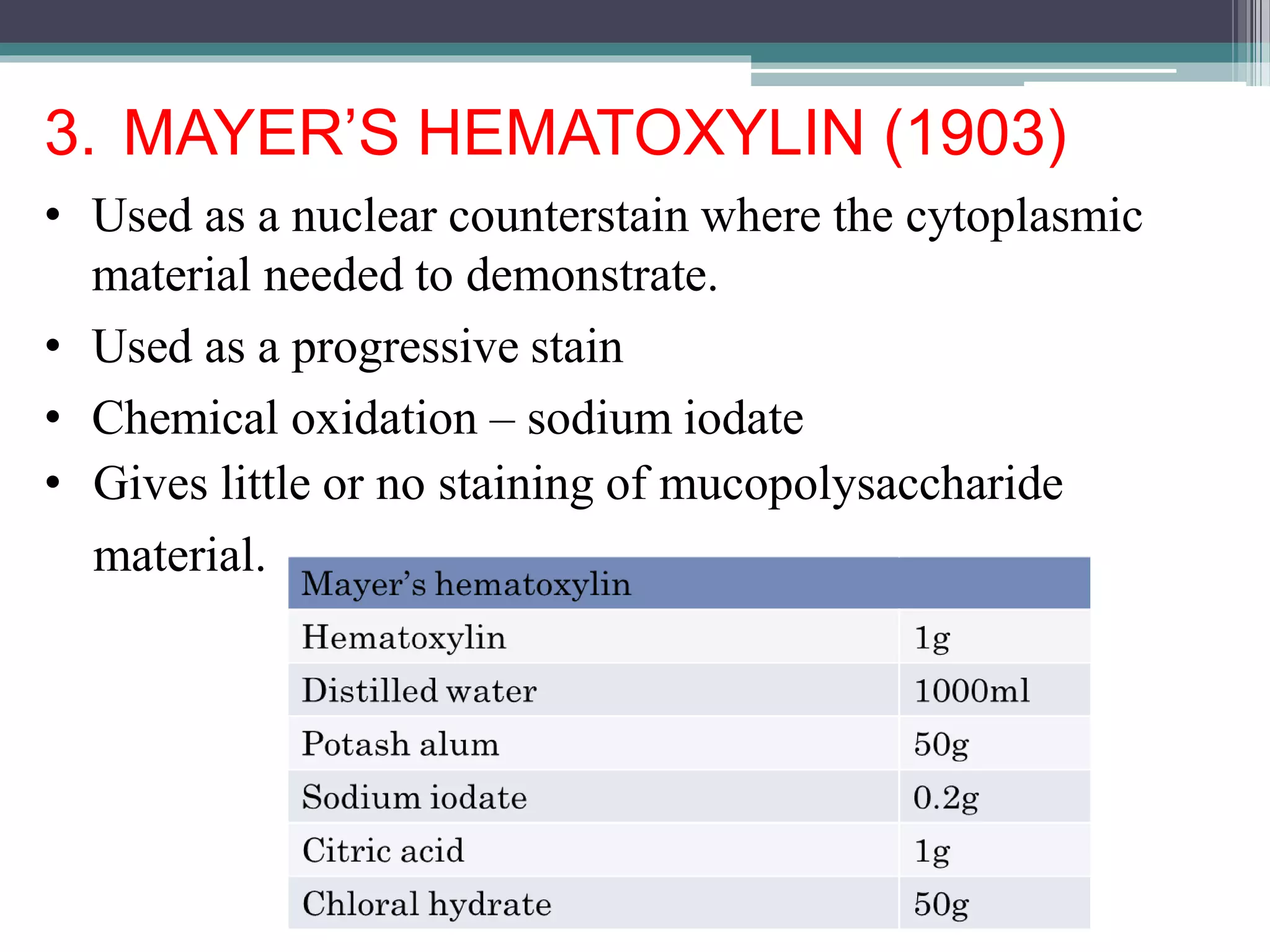
3. MAYER’S HEMATOXYLIN (1903)
• Used as a nuclear counterstain where the cytoplasmic
material needed to demonstrate.
• Used as a progressive stain
• Chemical oxidation – sodium iodate
• Gives little or no staining of mucopolysaccharide
material.
4. DELAFIELD’S HEMATOXYLIN (1900)
• Naturally ripened
• Similar properies of Ehrlich’s hematoxylin
5. COLE’S HEMATOXYLIN (1943)
• Chemically ripened with alcoholic iodine solution
6. CARAZZI’S HEMATOXYLIN (1991)
• Chemically ripened with potassium iodate
• Used as a progressive nuclear stain.
• Largely confined to use with frozen sections
STAINING TIMES WITH ALUM
HEMATOXYLIN
Time varies according to the factors such as
1.Type of hematoxylin used
• Erhlcih’s  20 – 45 mins
• Mayer’s  10 – 20 mins
2. Age of stain
• As the stain ages  staining time has to be increased.
3. Intensity of use of stain
• Heavily used hematoxylin will lose its staining power more rapidly
and longer staining times will be necessary.
4. Method of use of stain
• When used progressively  Mayer’s hematoxylin  5 – 10mins
• When used regressively  Mayer’s hematoxylin  10 – 20mins.
5. Pre treatment of tissues or sections - Length of time
• In fixative
• In acid decalcifying solution or
• Whether paraffin or frozen sections
6. Post treatment of sections – subsequent acid stains such as van
Geison.
7. Personal preference.
8. General rule – Time
• Shortened  for frozen sections
• Increased  for decalcified tissues
• Increased for those that have been stored for a long time in
non buffered formalin.
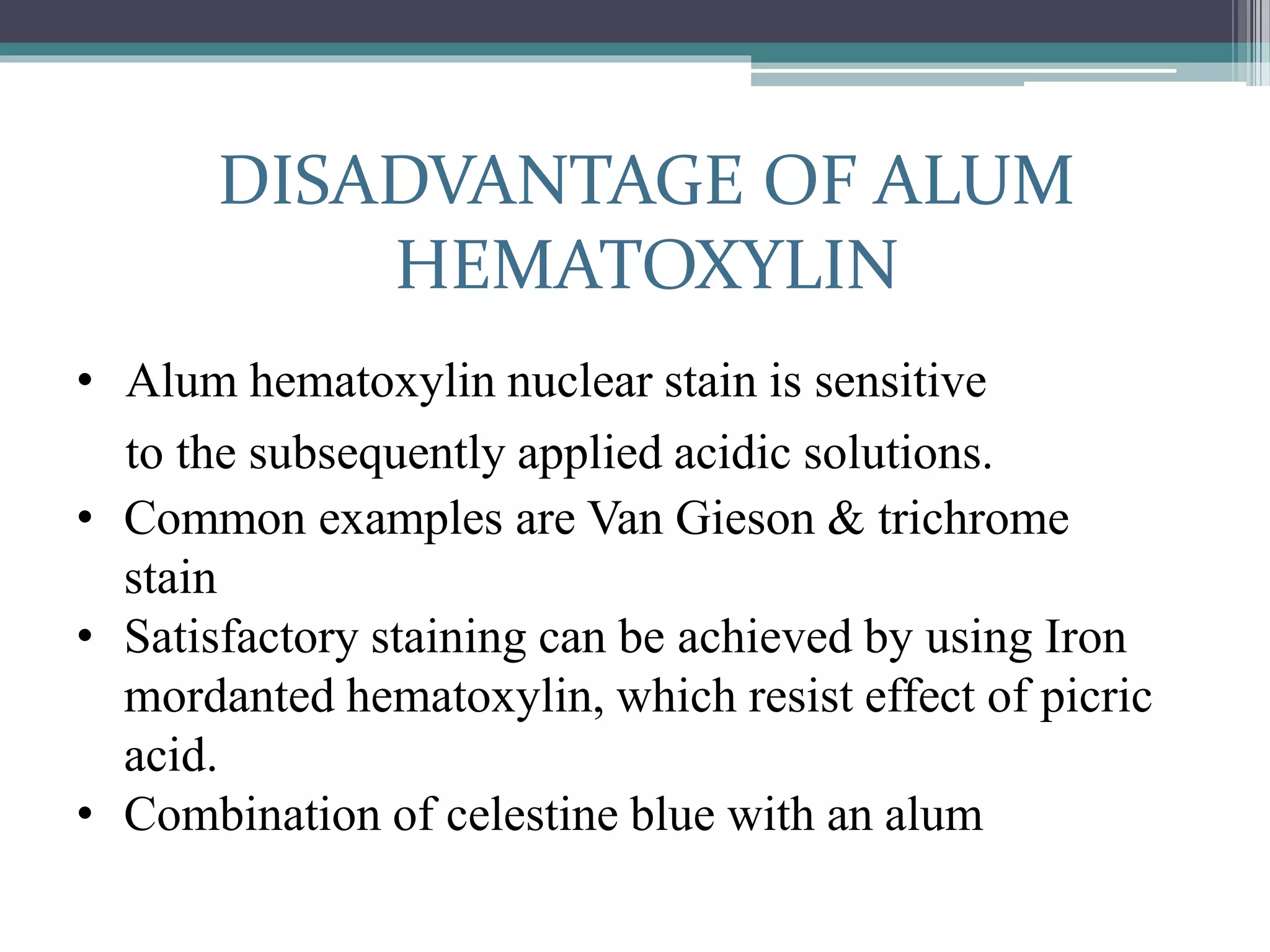
DISADVANTAGE OF ALUM
HEMATOXYLIN
• Alum hematoxylin nuclear stain is sensitive
to the subsequently applied acidic solutions.
• Common examples are Van Gieson & trichrome
stain
• Satisfactory staining can be achieved by using Iron
mordanted hematoxylin, which resist effect of picric
acid.
• Combination of celestine blue with an alum
CELESTINE BLUE
• Oxazine Dye
• Has little useful coloring property of its own
• It forms an additional strong mordant with certain
hematoxylins.
• Used as a preliminary to alum hematoxylin staining.
• Resistant to the effects of acid.
• Ferric salt in the celestine blue solution strengthens the
bond between the nucleus and the alum hematoxylin to
provide a strong nuclear stain which is reasonably
resistant to acid.
• Celestine blue B
• Ferric ammonium suphate
• Glycerine
• Distilled water
: 2.5g
: 25g
: 70ml
: 500ml
Procedure
 Ferric ammonium sulphate is dissolved in cold distilled water with
stirring.
 The celestine blue B is added to this solution and the mixture is
boiled for few minutes.
 Filtered
 Glycerine is added, filter
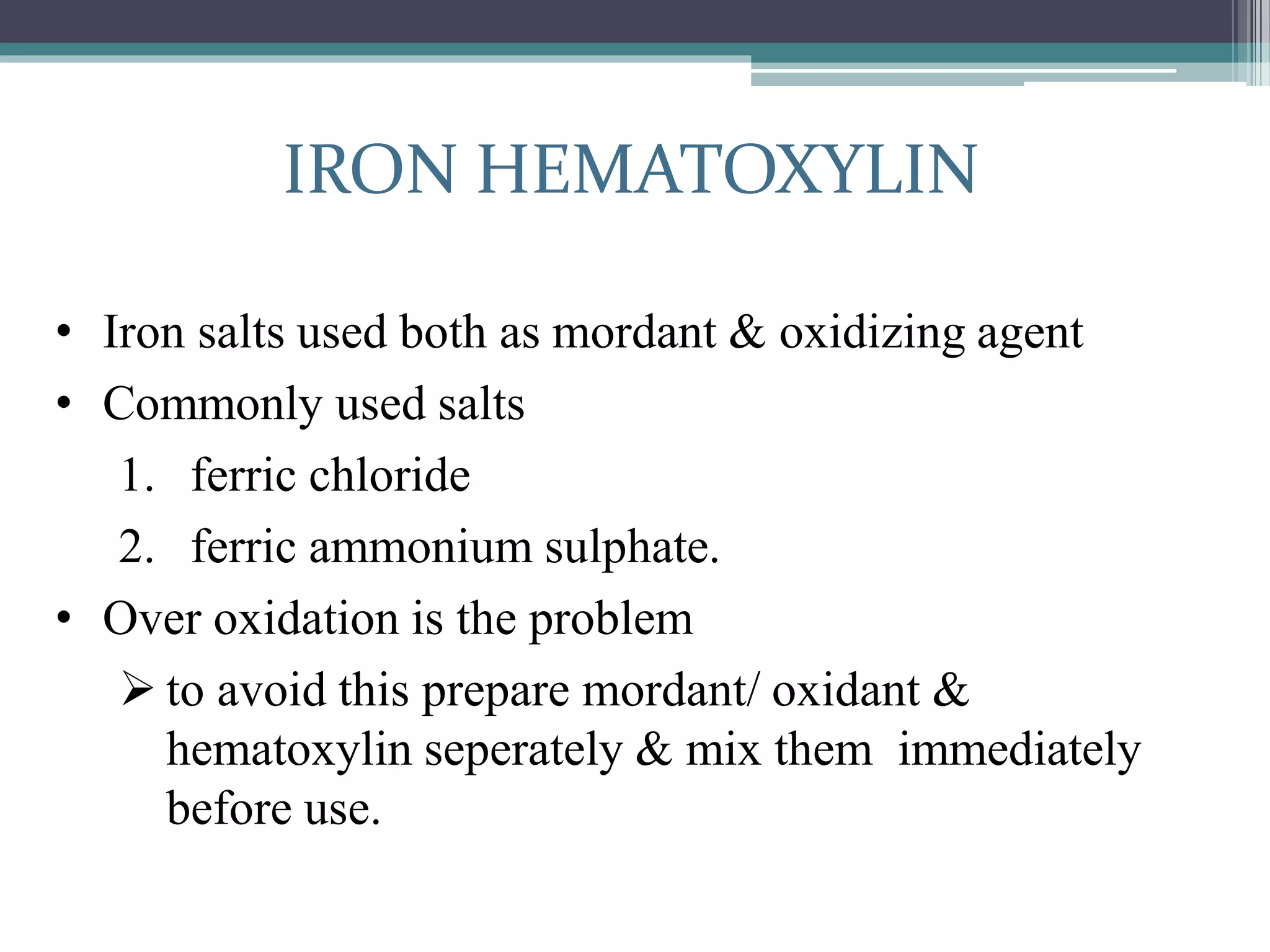
IRON HEMATOXYLIN
• Iron salts used both as mordant & oxidizing agent
• Commonly used salts
1. ferric chloride
2. ferric ammonium sulphate.
• Over oxidation is the problem
 to avoid this prepare mordant/ oxidant &
hematoxylin seperately & mix them immediately
before use.
TUNGSTEN HEMATOXYLIN
• Mallory phosphotungstic acid hematoxylin (PTAH) is an
example
• Phosphotungstic acid is used as mordant.
• Possible to prepare a staining solution using hematein ;
instead of hematoxylin. Oxidation not required, can be
used immediately , but short lived.
• Can be naturally oxidized, takes months to ripen
• Usable for many years
• Can be oxidized chemically using potassium
permanganate
• Used to stain
 Nervous tissue
 Muscle striations
 Fibers
MOLYBDENUM HEMATOXYLIN
• Molybdic acid as the mordant.
• For the demonstration of collagen, coarse reticulin&
granules in endocrine cells.
• Hydrogen per oxide is used for oxidation.
LEAD HEMATOXYLIN
• Lead salts act as the mordant.
• Identification of endocrine cells in some in tumors.
ALTERNATIVES TO
HEMATOXYLIN
• Celestine blue
• Gallo cyanine
• Solochrome cyanine
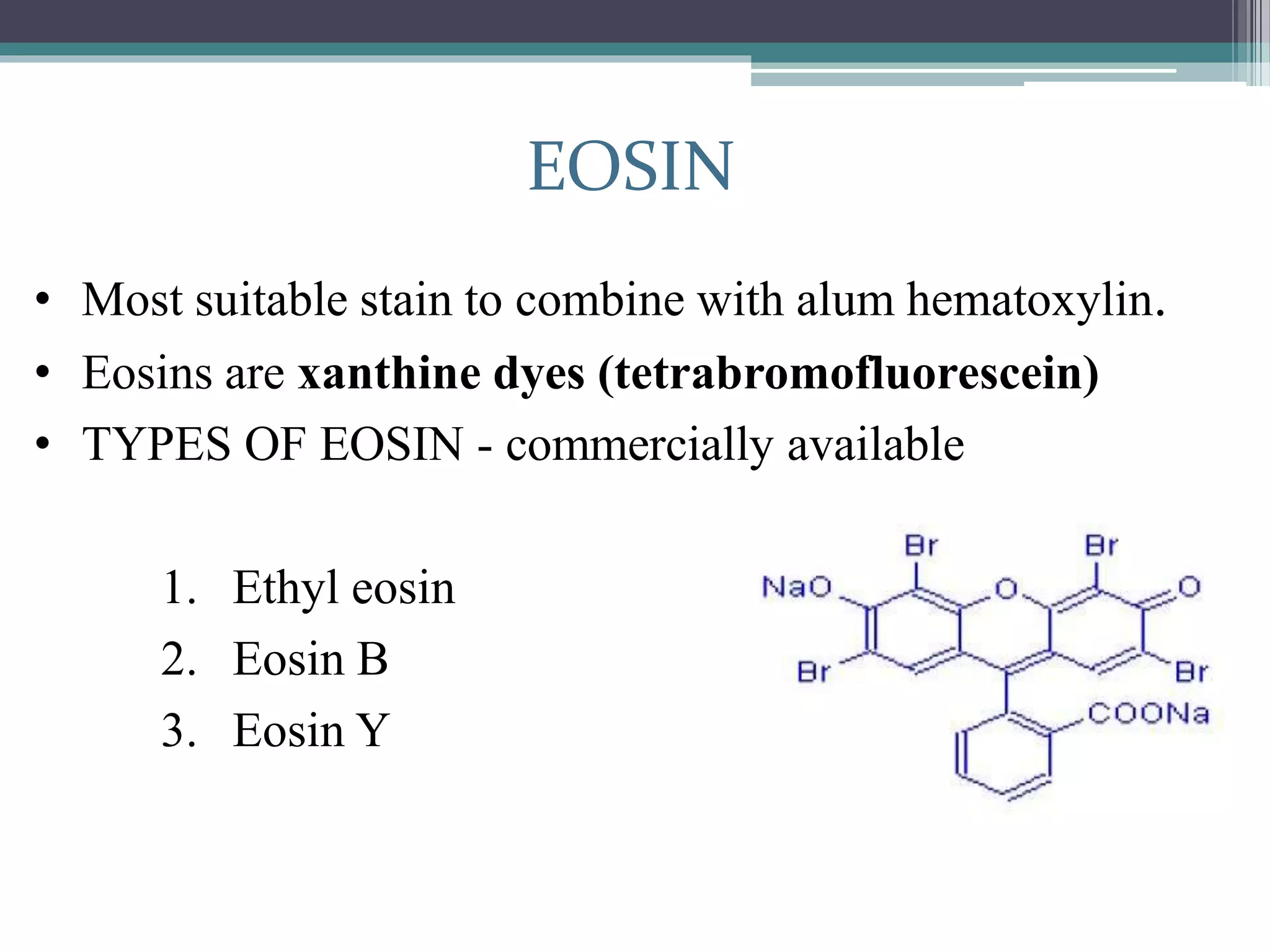
EOSIN
• Most suitable stain to combine with alum hematoxylin.
• Eosins are xanthine dyes (tetrabromofluorescein)
• TYPES OF EOSIN - commercially available
1. Ethyl eosin
2. Eosin B
3. Eosin Y
EOSINY
• Eosin yellowish
• Most widely used
• It is water & alcohol soluble.
• Used as a cytoplasmic stain - 0.5-1% solution in distilled
water with a Crystal of thymol - prevent fungal growth.
• Addition of Acetic acid sharpens the staining
ETHYL EOSIN (eosin alcohol-soluble)
EOSIN B (eosin bluish, erythrosine B)
ALTERNATIVES FOR EOSIN
• Phloxine
• Bierbrich scarlet
• saffranine
DIFFERENTIATION OF EOSIN
• Occurs in the subsequent tap water wash
• Further differentiation occurs during the dehydration
through the alcohols
BASIC STEPS OF STAINING
RESULT
WEIGERT-PAL TECHNIQUE
• For demonstration of myelin
• Is a hematoxylin method in which the tissue block is
mordanted
in a chromate solution before embedding and sectioning
• Further mordanting of the section in a copper acetate
solution is often performed before the hematoxylin is
applied.
• The major mordant is chromium compound.
How does H & E staining relate to an ‘ ideal routine histological
stain’’?
TROUBLESHOOTING IN
H&E STAINING
Problems Possible causes
1. Too much differentiation
2. Too less time in
haematoxylin
3. Due to excessive
decalcification
4. Haematoxylin is over
oxidized
Remedies
1.Stain in haematoxylin
again
2.Keep in haematoxylin for
longer duration
3. Not possible to correct
4. Change the haematoxylin
solution
Darkly stained nuclei
1. Too short differentiation
2. Too much time in
haematoxylin
3. Thick section
1. Decolorize and do
optimum differentiation
2. Decolorize and give
appropriate time in
haematoxylin
3. Recut thin section
Nuclei looks reddish brown
1. Insufficient bluing
2. Haematoxylin is
degenerating
1.Restain by giving more
time in bluing step
2.Check the oxidation status
of haematoxylin
Pale stained nuclei
Problems
Pale coloured cytoplasm
by eosin
1. Too thin section
2. The eosin solution has
pH more than 5
3. Too much dehydration
of the section in alcohol
1. Recut the section
properly
2. May be due to dilution
of eosin by the
carryover bluing
solution.Check pH of
eosin solution
3. Do not keep the slide in
alcohol for a long time
Incomplete dehydration Remove the mounting
medium and coverslip.
Keep the section in
absolute alcohol
Water bubbles in the
section
Possible causes Remedies
Bluish-black precipitate
Staining is irregular and
spotty
May be due to precipitation
of haematoxylin
Improper deparaffinization
Due to heating artefact for
using electrocautery
Filter the haematoxylin
staining solution
Keep the slide in xylene for
longer time to remove
the paraffin
No solutionDark-blue stain at
the edge of the
tissue sections
Problems Possible causes Remedies
Pale stained nuclei Too dark nuclear stain
Incomplete deparaffinization Cytoplasmic staining is dark
Weak staining of eosin Uneven staining
Hematoxylin and eosin staining

Hematoxylin and eosin staining

  • 1.
    HEMATOXYLIN AND EOSIN STAINING DrAarthiprabha K R DNB Resident Dept of Pathology
  • 4.
    HISTORY OF HEMATOXYLIN •It was independently introduced in 1865 and 1875, by Böhmer and Fischer respectively. • Primary diagnostic technique in the histo-pathology laboratory. • Waldeyer established the use of hematoxylin in histology in 1862.
  • 5.
    • Bohmer combineshematoxylin with alum as a mordant & obtained more specific staining in 1864. • Heindenhan introduced classical Iron - Alum hematoxylin method • Ehrlich overcame the instability of alum hematoxylin by adding glacial acetic acid.
  • 6.
    HEMATOXYLIN • The wordhematoxylin is derived from old Greek word Haimato (blood) & Xylon (wood) , referring to its dark red colour in natural state. • A natural dye extracted from the log wood of the tree Haematoxylon campechianum , mainly seen in Campeche state of Mexico & also available in West Indies
  • 7.
    • Hematoxylin itselfis not a stain • On oxidation it produces hematein (poor dye). • Commonly used dye in histopathology, cytology, immuno histochemistry. • Best nuclear stain. • Basic in nature, stains acidic component of the tissue, nucleus, mitochondria etc.
  • 8.
    OXIDATION • Oxidation ofhematoxylin is called RIPENING. • Hematein can be produced in 2 ways i. Natural ripening ii. Chemical ripening
  • 9.
    NATURALLYRIPENED HEMATOXYLINS CHEMICALLY RIPENED HEMATOXYLINS Ripeningby exposure to light & air Ripening by exposure to chemical oxidizing agents. Slow process (3-4 months) Ripening instantaneous, ready to use immediately after preparation Long shelf life, retain stability for a long time Shorter shelf life (because of continuing oxidation process in air & light eventually destroys much of the hematein converting it into a colourless compound) Example  Ehrlich’s hematoxylin  Delafield’s hematoxylin. Example  Sodium iodate in Mayer’s hematoxylin (SIM)  Mercuric chloride in Harris’s hematoxylin (MCh)  Cole’s hematoxylin  Carazzi’s hematoxylin  Gill’s hematoxylin
  • 10.
    DIFFRENTIATION • Provides amore controllable method in removing excess stain from tissue component and glass slide. • Traditional HCl/alcohol acts quickly and indiscriminately, is more difficult to control, and can result in light nuclearstain. • 1ml of 5 – 10% solution of acetic acid in 99ml of 70 – 95% alcohol detaches dye molecules from the cytoplasm/nucleoplasm while keeping nucleic acid complexes intact.
  • 11.
    BLUEING • Blueing isthe process of shifting the color from reddish to purple blue by the application of a weak alkaline solution • Blueing is utilized in both progressive and regressive techniques
  • 12.
    Alkaline solutions usedfor bluing  Tap water is alkaline enough to produce this colour change  Scott’s tap water substitute  Saturated Lithium carbonate (disadvantage – lithium has a tendency to form crystalline deposits unless the slides are agitated in it and well washed afterwards)  Ammonia in distilled water (disadvantage – ammonia is “hard” on delicate tissues and will loosen sections from theslide)
  • 13.
    MORDANT • Hematin isanionic. • Tissue is also anionic. • Therefore hematin has poor affinity for tissue • Making hematin adequate as a nuclear stain with the presence of a 3rd element (mordant) • Mordant forms a link between the “tissue and the stain”
  • 14.
    • The chelateformed from a mordant dye and a metal is called a lake
  • 15.
    MORDANT-DYE APPLICATION • Mordantis applied first, followed by the dye. e.g Heidenhain’s iron hematoxylin • Mordant and dye are mixed together and then applied. Commonly done in histotechnology e.g Alum hematoxylin solutions • Dye applied first, followed by the mordant. Hardly done in histotechnology
  • 17.
    TYPES OF HEMATOXYLIN Accordingto the mordant used • Alum hematoxylin • Iron hematoxylin • Tungsten hematoxylin • Molybdenum hematoxylin • Lead hematoxylin • Hematoxylin with out mordant
  • 18.
    ALUM HEMATOXYLIN • Mordantused are aluminum salts 1. aluminum potassium sulphate (potash alum) or 2. aluminum ammonium sulphate (ammonium alum). • Mainly used in routine H and E staining. • Has different types but all of them stain the nuclei blue- black. • These are used when counter stain does not contain an acid. • Can be used progressively or regressively.
  • 19.
    PROGRESSIVE STAINING • Tissueis left in the stain just enough to reach the endpoint • Frequent monitoring of stain quality may be needed to determine when staining is complete • The staining intensity is controlled by the time it is immersed in the solution • Eg : progressive staining using Gill’s Hematoxylin
  • 20.
    REGRESSIVE STAINING • Involvesover-staining where the dye completely saturates all tissue elements • The tissue is then selectively de-stained using a process called differentiation • Eg :Harris Hematoxylin is popularly used regressively in many histology labs for routine H & E staining • Sharper degree of staining is obtained
  • 21.
    TYPES OF ALUMHAEMATOXYLIN Ehrilch’s haematoxylin Mayer’s haematoxylin Harris’s haematoxylin Gill’s haematoxylin Cole’s haematoxylin Delafield’s haematoxylin Carazzi’s haematoxylin
  • 22.
    1. EHRLICH’S HEMATOXYLIN(1886) • Strong stain for nuclei, stains intensely & crisply • Oxidized naturally • Stained sections fade slowly. • Not ideal for frozen sections e
  • 23.
    2. HARRI’S HEMATOXYLIN(1885) • Widely used in exfoliative cytology as a nuclear stain • Chemical oxidation – mercuric oxide • Life span is short : 2-3 months
  • 24.
    3. MAYER’S HEMATOXYLIN(1903) • Used as a nuclear counterstain where the cytoplasmic material needed to demonstrate. • Used as a progressive stain • Chemical oxidation – sodium iodate • Gives little or no staining of mucopolysaccharide material.
  • 25.
    4. DELAFIELD’S HEMATOXYLIN(1900) • Naturally ripened • Similar properies of Ehrlich’s hematoxylin
  • 26.
    5. COLE’S HEMATOXYLIN(1943) • Chemically ripened with alcoholic iodine solution
  • 27.
    6. CARAZZI’S HEMATOXYLIN(1991) • Chemically ripened with potassium iodate • Used as a progressive nuclear stain. • Largely confined to use with frozen sections
  • 32.
    STAINING TIMES WITHALUM HEMATOXYLIN Time varies according to the factors such as 1.Type of hematoxylin used • Erhlcih’s  20 – 45 mins • Mayer’s  10 – 20 mins 2. Age of stain • As the stain ages  staining time has to be increased. 3. Intensity of use of stain • Heavily used hematoxylin will lose its staining power more rapidly and longer staining times will be necessary. 4. Method of use of stain • When used progressively  Mayer’s hematoxylin  5 – 10mins • When used regressively  Mayer’s hematoxylin  10 – 20mins.
  • 33.
    5. Pre treatmentof tissues or sections - Length of time • In fixative • In acid decalcifying solution or • Whether paraffin or frozen sections 6. Post treatment of sections – subsequent acid stains such as van Geison. 7. Personal preference. 8. General rule – Time • Shortened  for frozen sections • Increased  for decalcified tissues • Increased for those that have been stored for a long time in non buffered formalin.
  • 34.
    DISADVANTAGE OF ALUM HEMATOXYLIN •Alum hematoxylin nuclear stain is sensitive to the subsequently applied acidic solutions. • Common examples are Van Gieson & trichrome stain • Satisfactory staining can be achieved by using Iron mordanted hematoxylin, which resist effect of picric acid. • Combination of celestine blue with an alum
  • 35.
    CELESTINE BLUE • OxazineDye • Has little useful coloring property of its own • It forms an additional strong mordant with certain hematoxylins. • Used as a preliminary to alum hematoxylin staining. • Resistant to the effects of acid. • Ferric salt in the celestine blue solution strengthens the bond between the nucleus and the alum hematoxylin to provide a strong nuclear stain which is reasonably resistant to acid.
  • 36.
    • Celestine blueB • Ferric ammonium suphate • Glycerine • Distilled water : 2.5g : 25g : 70ml : 500ml Procedure  Ferric ammonium sulphate is dissolved in cold distilled water with stirring.  The celestine blue B is added to this solution and the mixture is boiled for few minutes.  Filtered  Glycerine is added, filter
  • 37.
    IRON HEMATOXYLIN • Ironsalts used both as mordant & oxidizing agent • Commonly used salts 1. ferric chloride 2. ferric ammonium sulphate. • Over oxidation is the problem  to avoid this prepare mordant/ oxidant & hematoxylin seperately & mix them immediately before use.
  • 41.
    TUNGSTEN HEMATOXYLIN • Malloryphosphotungstic acid hematoxylin (PTAH) is an example • Phosphotungstic acid is used as mordant. • Possible to prepare a staining solution using hematein ; instead of hematoxylin. Oxidation not required, can be used immediately , but short lived.
  • 42.
    • Can benaturally oxidized, takes months to ripen • Usable for many years • Can be oxidized chemically using potassium permanganate • Used to stain  Nervous tissue  Muscle striations  Fibers
  • 43.
    MOLYBDENUM HEMATOXYLIN • Molybdicacid as the mordant. • For the demonstration of collagen, coarse reticulin& granules in endocrine cells. • Hydrogen per oxide is used for oxidation.
  • 44.
    LEAD HEMATOXYLIN • Leadsalts act as the mordant. • Identification of endocrine cells in some in tumors.
  • 47.
    ALTERNATIVES TO HEMATOXYLIN • Celestineblue • Gallo cyanine • Solochrome cyanine
  • 48.
    EOSIN • Most suitablestain to combine with alum hematoxylin. • Eosins are xanthine dyes (tetrabromofluorescein) • TYPES OF EOSIN - commercially available 1. Ethyl eosin 2. Eosin B 3. Eosin Y
  • 49.
    EOSINY • Eosin yellowish •Most widely used • It is water & alcohol soluble. • Used as a cytoplasmic stain - 0.5-1% solution in distilled water with a Crystal of thymol - prevent fungal growth. • Addition of Acetic acid sharpens the staining ETHYL EOSIN (eosin alcohol-soluble) EOSIN B (eosin bluish, erythrosine B)
  • 50.
    ALTERNATIVES FOR EOSIN •Phloxine • Bierbrich scarlet • saffranine
  • 51.
    DIFFERENTIATION OF EOSIN •Occurs in the subsequent tap water wash • Further differentiation occurs during the dehydration through the alcohols
  • 52.
  • 53.
  • 54.
    WEIGERT-PAL TECHNIQUE • Fordemonstration of myelin • Is a hematoxylin method in which the tissue block is mordanted in a chromate solution before embedding and sectioning • Further mordanting of the section in a copper acetate solution is often performed before the hematoxylin is applied. • The major mordant is chromium compound.
  • 56.
    How does H& E staining relate to an ‘ ideal routine histological stain’’?
  • 57.
  • 58.
    Problems Possible causes 1.Too much differentiation 2. Too less time in haematoxylin 3. Due to excessive decalcification 4. Haematoxylin is over oxidized Remedies 1.Stain in haematoxylin again 2.Keep in haematoxylin for longer duration 3. Not possible to correct 4. Change the haematoxylin solution Darkly stained nuclei 1. Too short differentiation 2. Too much time in haematoxylin 3. Thick section 1. Decolorize and do optimum differentiation 2. Decolorize and give appropriate time in haematoxylin 3. Recut thin section Nuclei looks reddish brown 1. Insufficient bluing 2. Haematoxylin is degenerating 1.Restain by giving more time in bluing step 2.Check the oxidation status of haematoxylin Pale stained nuclei
  • 59.
    Problems Pale coloured cytoplasm byeosin 1. Too thin section 2. The eosin solution has pH more than 5 3. Too much dehydration of the section in alcohol 1. Recut the section properly 2. May be due to dilution of eosin by the carryover bluing solution.Check pH of eosin solution 3. Do not keep the slide in alcohol for a long time Incomplete dehydration Remove the mounting medium and coverslip. Keep the section in absolute alcohol Water bubbles in the section Possible causes Remedies
  • 60.
    Bluish-black precipitate Staining isirregular and spotty May be due to precipitation of haematoxylin Improper deparaffinization Due to heating artefact for using electrocautery Filter the haematoxylin staining solution Keep the slide in xylene for longer time to remove the paraffin No solutionDark-blue stain at the edge of the tissue sections Problems Possible causes Remedies
  • 61.
    Pale stained nucleiToo dark nuclear stain
  • 62.
  • 63.
    Weak staining ofeosin Uneven staining