By
Dr.Varughese George
The Hematoxylin and Eosin stain (H&E) is the most widely used
histological stain because :
 comparative simplicity
 Ability to demonstrate clearly an enormous number of different tissue
structures.
 Hematoxylin stains cell nuclei blue black  shows good intranuclear detail.
 Eosin stains cell cytoplasm and most connective tissue fibers in varying
shades and intensities of pink, orange, and red.
 Outlines tissues and cellular components.
 Identification of tissues.
 Establishes the presence or absence of
disease processes.
 Most commonly used staining methods are –
 Hematoxylin and Eosin staining in Histopathology
 Gram’s Stain and Ziehl-Neelson staining in Microbiology.
 Romanowsky staining in Hematology.
 Papanicoloau staining in Cytology
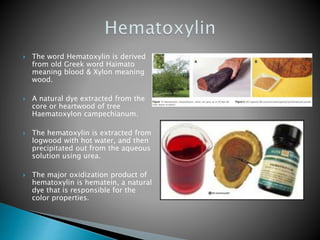
 The word Hematoxylin is derived
from old Greek word Haimato
meaning blood & Xylon meaning
wood.
 A natural dye extracted from the
core or heartwood of tree
Haematoxylon campechianum.
 The hematoxylin is extracted from
logwood with hot water, and then
precipitated out from the aqueous
solution using urea.
 The major oxidization product of
hematoxylin is hematein, a natural
dye that is responsible for the
color properties.
 Hematoxylin solutions can be arbitrarily classified
according to which mordant is used:
 Alum hematoxylins
 Iron hematoxylins
 Tungsten hematoxylins
 Molybdenum hematoxylins
 Lead hematoxylins
 Hematoxylin without mordant.
 Xanthine dyes which stains connective tissue and cytoplasm in
varying intensity and shades (red to pink).
 Available in the following types :
 Eosin Y ( Eosin Yellowish, Eosin water soluble) – most widely available.
 Ethyl Eosin (Eosin S, eosin alcohol soluble).
 Eosin B ( Eosin Bluish, Erythrosine B).
 Ethyl eosin and eosin B are now rarely used, although occasional old
methods specify their use – e.g the Harris stain for Negri bodies.
Eosin Y
 Most commonly used eosin.
 Readily soluble in water.
 Satisfactorily soluble in alcohol.
 Preparation
 Eosin Y, water soluble 5 gm
 Distilled water 1000 ml
 Crystals of Thymol added to inhibit fungal growth.
 Addition of little acetic acid (0.5 -1000 ml stain) sharpens the
staining.
Principle
 Hematoxylin and Eosin are principle stains used for
demonstration of nucleus and cytoplasm.
 Alum acts as a mordant and the hematoxylin containing alum
stains the nucleus light blue which turns red in the presence
of acid.
 The cell differentiation is achieved by treating the tissue with
acid solution.
 The counterstaining is performed using eosin which imparts
pink color to cytoplasm.
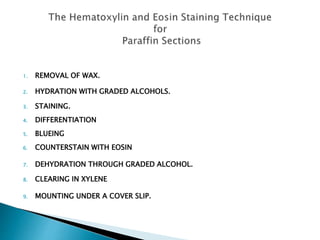
1. REMOVAL OF WAX.
2. HYDRATION WITH GRADED ALCOHOLS.
3. STAINING.
4. DIFFERENTIATION
5. BLUEING
6. COUNTERSTAIN WITH EOSIN
7. DEHYDRATION THROUGH GRADED ALCOHOL.
8. CLEARING IN XYLENE
9. MOUNTING UNDER A COVER SLIP.
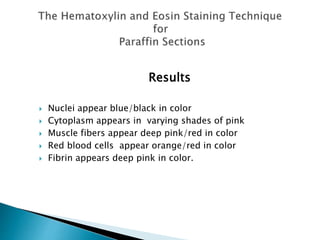
Results
 Nuclei appear blue/black in color
 Cytoplasm appears in varying shades of pink
 Muscle fibers appear deep pink/red in color
 Red blood cells appear orange/red in color
 Fibrin appears deep pink in color.
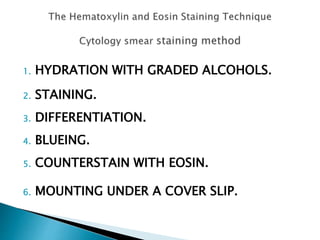
1. HYDRATION WITH GRADED ALCOHOLS.
2. STAINING.
3. DIFFERENTIATION.
4. BLUEING.
5. COUNTERSTAIN WITH EOSIN.
6. MOUNTING UNDER A COVER SLIP.
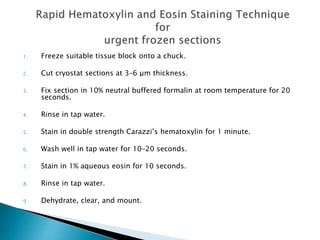
1. Freeze suitable tissue block onto a chuck.
2. Cut cryostat sections at 3–6 μm thickness.
3. Fix section in 10% neutral buffered formalin at room temperature for 20
seconds.
4. Rinse in tap water.
5. Stain in double strength Carazzi’s hematoxylin for 1 minute.
6. Wash well in tap water for 10–20 seconds.
7. Stain in 1% aqueous eosin for 10 seconds.
8. Rinse in tap water.
9. Dehydrate, clear, and mount.
Hematoxylin and Eosin staining for UGs

Hematoxylin and Eosin staining for UGs

  • 1.
  • 2.
    The Hematoxylin andEosin stain (H&E) is the most widely used histological stain because :  comparative simplicity  Ability to demonstrate clearly an enormous number of different tissue structures.  Hematoxylin stains cell nuclei blue black  shows good intranuclear detail.  Eosin stains cell cytoplasm and most connective tissue fibers in varying shades and intensities of pink, orange, and red.
  • 3.
     Outlines tissuesand cellular components.  Identification of tissues.  Establishes the presence or absence of disease processes.
  • 4.
     Most commonlyused staining methods are –  Hematoxylin and Eosin staining in Histopathology  Gram’s Stain and Ziehl-Neelson staining in Microbiology.  Romanowsky staining in Hematology.  Papanicoloau staining in Cytology
  • 5.
     The wordHematoxylin is derived from old Greek word Haimato meaning blood & Xylon meaning wood.  A natural dye extracted from the core or heartwood of tree Haematoxylon campechianum.  The hematoxylin is extracted from logwood with hot water, and then precipitated out from the aqueous solution using urea.  The major oxidization product of hematoxylin is hematein, a natural dye that is responsible for the color properties.
  • 6.
     Hematoxylin solutionscan be arbitrarily classified according to which mordant is used:  Alum hematoxylins  Iron hematoxylins  Tungsten hematoxylins  Molybdenum hematoxylins  Lead hematoxylins  Hematoxylin without mordant.
  • 7.
     Xanthine dyeswhich stains connective tissue and cytoplasm in varying intensity and shades (red to pink).  Available in the following types :  Eosin Y ( Eosin Yellowish, Eosin water soluble) – most widely available.  Ethyl Eosin (Eosin S, eosin alcohol soluble).  Eosin B ( Eosin Bluish, Erythrosine B).  Ethyl eosin and eosin B are now rarely used, although occasional old methods specify their use – e.g the Harris stain for Negri bodies.
  • 8.
    Eosin Y  Mostcommonly used eosin.  Readily soluble in water.  Satisfactorily soluble in alcohol.  Preparation  Eosin Y, water soluble 5 gm  Distilled water 1000 ml  Crystals of Thymol added to inhibit fungal growth.  Addition of little acetic acid (0.5 -1000 ml stain) sharpens the staining.
  • 9.
    Principle  Hematoxylin andEosin are principle stains used for demonstration of nucleus and cytoplasm.  Alum acts as a mordant and the hematoxylin containing alum stains the nucleus light blue which turns red in the presence of acid.  The cell differentiation is achieved by treating the tissue with acid solution.  The counterstaining is performed using eosin which imparts pink color to cytoplasm.
  • 10.
    1. REMOVAL OFWAX. 2. HYDRATION WITH GRADED ALCOHOLS. 3. STAINING. 4. DIFFERENTIATION 5. BLUEING 6. COUNTERSTAIN WITH EOSIN 7. DEHYDRATION THROUGH GRADED ALCOHOL. 8. CLEARING IN XYLENE 9. MOUNTING UNDER A COVER SLIP.
  • 11.
    Results  Nuclei appearblue/black in color  Cytoplasm appears in varying shades of pink  Muscle fibers appear deep pink/red in color  Red blood cells appear orange/red in color  Fibrin appears deep pink in color.
  • 12.
    1. HYDRATION WITHGRADED ALCOHOLS. 2. STAINING. 3. DIFFERENTIATION. 4. BLUEING. 5. COUNTERSTAIN WITH EOSIN. 6. MOUNTING UNDER A COVER SLIP.
  • 13.
    1. Freeze suitabletissue block onto a chuck. 2. Cut cryostat sections at 3–6 μm thickness. 3. Fix section in 10% neutral buffered formalin at room temperature for 20 seconds. 4. Rinse in tap water. 5. Stain in double strength Carazzi’s hematoxylin for 1 minute. 6. Wash well in tap water for 10–20 seconds. 7. Stain in 1% aqueous eosin for 10 seconds. 8. Rinse in tap water. 9. Dehydrate, clear, and mount.