


DECALCIFICATION
SUNIL KUMAR.P
ST.JOHN’S MEDICAL COLLEGE
BANGALORE
4/14/2018 1SUNIL KUMAR.P
4/14/2018 2SUNIL KUMAR.P
4/14/2018 SUNIL KUMAR.P 3
Contents……………….
• - Introduction
• -Definition
• - Properties of ideal Decalcifi…. agents
• - Methods of Decalcification
• - principle
• -Types of decalcifying agents
• - Compositions, Action, Advantages
• -procedure of Decalcification
4/14/2018 4SUNIL KUMAR.P
INTRODUCTION
• Decalcification is necessary in order to facilitate
smooth cutting of bone and other calcified tissue
during the preparation of sections.
• Calcium is generally present in bones, teeth and
tissues removed from glands such as tubercular
and lymphatic.
• The calcified hard tissue is cut into small pieces.
• The tissue should be thoroughly washed, to
remove excess of fixative before the specimen is
subjected to decalcification.
4/14/2018 5SUNIL KUMAR.P
DECALCIFICATION
Definition :
Decalcification is the process of removing inorganic
calcium (mineral) content of the bone /tissue
before processing the specimen after fixation.
Criteria of a good decalcifying Agent
1. Complete removal of calcium
2. Absence of damage to tissue cells or fibres
3. Non impairment of subsequent staining
technique
4. Reasonable speed of decalcification
FACTORS AFFECTING THE RATE OF
DECALCIFICATION
• 1. Concentration of decalcifying agent
• 2. Temperature
• 3. Agitation
• 4. Suspension
4/14/2018 SUNIL KUMAR.P 8
FACTORS AFFECTING THE RATE OF
DECALCIFICATION
Concentration of decalcifying agent
• Large volume of the fluid compared with the volume of tissue- 20 to 1 is
recommended to avoid total depletion of the acid or chelator by their
reaction with calcium.
• Fluid should be changed several times during the decalcificationprocess
Temperature
• Increased temperature accelerates decalcification but also increases
the damaging effects of acids on tissue. 18º C -30º C is
acceptable.
Agitation
Gentle agitation may increase the rate slightly by influencing
fluid exchange within as well as around tissues.
Suspension
Fresh decalcifier should have ready access to all surfaces of the
specimen. enhance diffusion and penetration into the specimen
and facilitate solution, ionization and removal of calcium.
METHODS OF DECALCIFICATION
1. Acids
2. Ion exchange resins
3. Electrical ionization
4. Histochemical methods
 Buffer mixtures
 Chelating agents
5. Surface decalcification
METHOD
Acid Decalcification method
4/14/2018 12SUNIL KUMAR.P
PRINCIPLE
• The acid present in the decalcifying fluid
removes the calcium salt present in the hard
tissue and makes the tissue soft enough for
sectioning.
4/14/2018 13SUNIL KUMAR.P
REAGENT
• Any suitable acid reagent can be used a…..
• - Nitric Acid
• - Formic Acid
• - Jenkin’s fluid
• Citrate – citric acid buffer
4/14/2018 14SUNIL KUMAR.P
TYPES
• Two types
• Strong Inorganic Acids
• Weak Organic Acids
4/14/2018 15SUNIL KUMAR.P
Strongacids
• It Is An InorganicAcid
• Eg: Nitric Acid, HydrochloricAcid
• Recommended Concentration - 5-10%
• They Decalcify Rapidly By Dissolving Calcium
4/14/2018 16SUNIL KUMAR.P
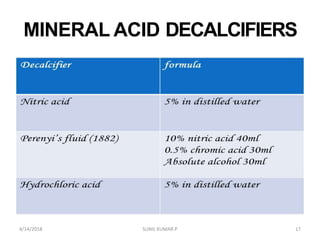
MINERAL ACID DECALCIFIERS
4/14/2018 17SUNIL KUMAR.P
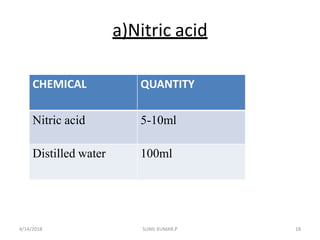
a)Nitric acid
CHEMICAL QUANTITY
Nitric acid 5-10ml
Distilled water 100ml
4/14/2018 18SUNIL KUMAR.P
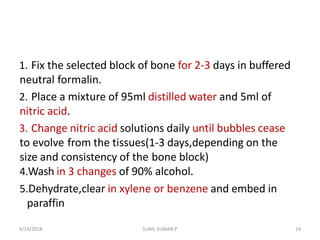
1. Fix the selected block of bone for 2-3 days in buffered
neutral formalin.
2. Place a mixture of 95ml distilled water and 5ml of
nitric acid.
3. Change nitric acid solutions daily until bubbles cease
to evolve from the tissues(1-3 days,depending on the
size and consistency of the bone block)
4.Wash in 3 changes of 90% alcohol.
5.Dehydrate,clear in xylene or benzene and embed in
paraffin
4/14/2018 19SUNIL KUMAR.P
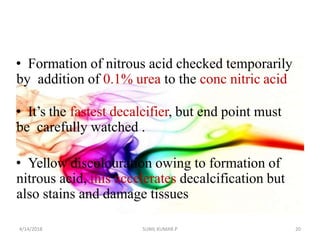
• Formation of nitrous acid checked temporarily
by addition of 0.1% urea to the conc nitric acid
• It’s the fastest decalcifier, but end point must
be carefully watched .
• Yellow discolouration owing to formation of
nitrous acid, this accelerates decalcification but
also stains and damage tissues
4/14/2018 20SUNIL KUMAR.P
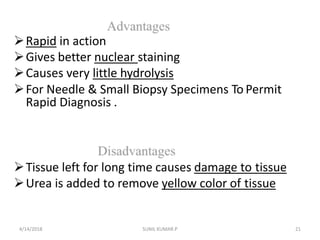
Rapid in action
Gives better nuclear staining
Causes very little hydrolysis
For Needle & Small Biopsy Specimens To Permit
Rapid Diagnosis .
Tissue left for long time causes damage to tissue
Urea is added to remove yellow color of tissue
4/14/2018 21SUNIL KUMAR.P
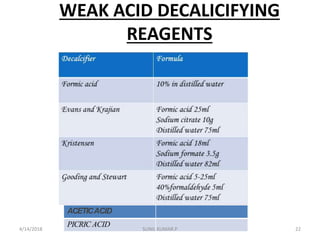
WEAK ACID DECALICIFYING
REAGENTS
ACETICACID
PICRIC ACID4/14/2018 22SUNIL KUMAR.P
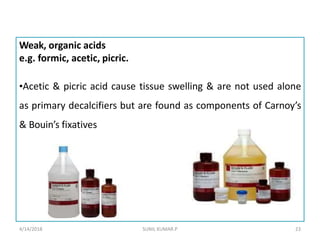
Weak, organic acids
e.g. formic, acetic, picric.
•Acetic & picric acid cause tissue swelling & are not used alone
as primary decalcifiers but are found as components of Carnoy’s
& Bouin’s fixatives
4/14/2018 23SUNIL KUMAR.P
•Formicacidis the only weak acid used extensively
as a decalcifier
•Formic acid solutions are either
•aqueous (5-10%)
•buffered or combined with formalin.
4/14/2018 24SUNIL KUMAR.P
The formalin/10% formic acid mixture simultaneously fixes & decalcifies.
• Recommended for –
• Very small bone pieces
• Jamshidi needle biopsies.
• Formic acid gentle & slower than Hcl or nitric acid
• suitable for most routine surgical specimens, particularly for
immuno histochemistry.
• Decalcification usually complete within 2-7days.
4/14/2018 25SUNIL KUMAR.P
a)AQUEOUS FORMICACID
1.Well fixed 2-5mm thick blocks are placedin
– concentrated formic acid
– Distilled water
– 40% formaldehyde (optional)
5-25ml
100ml
5 ml
2.Change daily until decalcification is complete.
( 1-7 days for an average blocks depending on concentration ofacid.)
3.Replace fluid with 5% sodium sulfate overnight
4.Wash 12 -24 hrs in running tap water.
5.Dehydrate in graded alcohols ,clear in chloroform or toluene and embed in
wax
4/14/2018 26SUNIL KUMAR.P
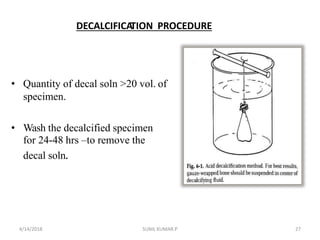
DECALCIFICATION PROCEDURE
• Quantity of decal soln >20 vol. of
specimen.
• Wash the decalcified specimen
for 24-48 hrs –to remove the
decal soln.
4/14/2018 27SUNIL KUMAR.P
PROCEDURE
• 1. Suspend the sliced tissue in the decalcifying
solution by means of gauze bag, tied with a
string.
• 2.Stir the fluid occasionally and change the
fluid daily till calcium is completely removed
from the tissue section.
• 3.It is tested as follows…….
4/14/2018 28SUNIL KUMAR.P
• - take about 5.0 ml of decalcifying solution in a test
tube
• - Add conc. Ammonia solution drop by drop until it
becomes alkaline ( test by litmus paper)
• - If the solution becomes turbid, continue
decalcification ( since it contains calcium)
• - if it is clear add 0.5 ml saturated ammonium oxalate
solution
• - If calcium is present the solution will become turbid,
then continue decalcification.
• If there is no turbidity , the specimen is free of calcium
and ready for further processing.
4/14/2018 29SUNIL KUMAR.P
• 4. Wash the decalcified specimen in running
tap water for 24-48 hours.
• 5.The decalcifying solution should be
completely removed before dehydration and
embedding.
4/14/2018 30SUNIL KUMAR.P
THANKS
4/14/2018 31SUNIL KUMAR.P

Decalcificaion

  • 1.
    DECALCIFICATION SUNIL KUMAR.P ST.JOHN’S MEDICALCOLLEGE BANGALORE 4/14/2018 1SUNIL KUMAR.P
  • 2.
  • 3.
  • 4.
    Contents………………. • - Introduction •-Definition • - Properties of ideal Decalcifi…. agents • - Methods of Decalcification • - principle • -Types of decalcifying agents • - Compositions, Action, Advantages • -procedure of Decalcification 4/14/2018 4SUNIL KUMAR.P
  • 5.
    INTRODUCTION • Decalcification isnecessary in order to facilitate smooth cutting of bone and other calcified tissue during the preparation of sections. • Calcium is generally present in bones, teeth and tissues removed from glands such as tubercular and lymphatic. • The calcified hard tissue is cut into small pieces. • The tissue should be thoroughly washed, to remove excess of fixative before the specimen is subjected to decalcification. 4/14/2018 5SUNIL KUMAR.P
  • 6.
    DECALCIFICATION Definition : Decalcification isthe process of removing inorganic calcium (mineral) content of the bone /tissue before processing the specimen after fixation.
  • 7.
    Criteria of agood decalcifying Agent 1. Complete removal of calcium 2. Absence of damage to tissue cells or fibres 3. Non impairment of subsequent staining technique 4. Reasonable speed of decalcification
  • 8.
    FACTORS AFFECTING THERATE OF DECALCIFICATION • 1. Concentration of decalcifying agent • 2. Temperature • 3. Agitation • 4. Suspension 4/14/2018 SUNIL KUMAR.P 8
  • 9.
    FACTORS AFFECTING THERATE OF DECALCIFICATION Concentration of decalcifying agent • Large volume of the fluid compared with the volume of tissue- 20 to 1 is recommended to avoid total depletion of the acid or chelator by their reaction with calcium. • Fluid should be changed several times during the decalcificationprocess Temperature • Increased temperature accelerates decalcification but also increases the damaging effects of acids on tissue. 18º C -30º C is acceptable.
  • 10.
    Agitation Gentle agitation mayincrease the rate slightly by influencing fluid exchange within as well as around tissues. Suspension Fresh decalcifier should have ready access to all surfaces of the specimen. enhance diffusion and penetration into the specimen and facilitate solution, ionization and removal of calcium.
  • 11.
    METHODS OF DECALCIFICATION 1.Acids 2. Ion exchange resins 3. Electrical ionization 4. Histochemical methods  Buffer mixtures  Chelating agents 5. Surface decalcification
  • 12.
  • 13.
    PRINCIPLE • The acidpresent in the decalcifying fluid removes the calcium salt present in the hard tissue and makes the tissue soft enough for sectioning. 4/14/2018 13SUNIL KUMAR.P
  • 14.
    REAGENT • Any suitableacid reagent can be used a….. • - Nitric Acid • - Formic Acid • - Jenkin’s fluid • Citrate – citric acid buffer 4/14/2018 14SUNIL KUMAR.P
  • 15.
    TYPES • Two types •Strong Inorganic Acids • Weak Organic Acids 4/14/2018 15SUNIL KUMAR.P
  • 16.
    Strongacids • It IsAn InorganicAcid • Eg: Nitric Acid, HydrochloricAcid • Recommended Concentration - 5-10% • They Decalcify Rapidly By Dissolving Calcium 4/14/2018 16SUNIL KUMAR.P
  • 17.
  • 18.
    a)Nitric acid CHEMICAL QUANTITY Nitricacid 5-10ml Distilled water 100ml 4/14/2018 18SUNIL KUMAR.P
  • 19.
    1. Fix theselected block of bone for 2-3 days in buffered neutral formalin. 2. Place a mixture of 95ml distilled water and 5ml of nitric acid. 3. Change nitric acid solutions daily until bubbles cease to evolve from the tissues(1-3 days,depending on the size and consistency of the bone block) 4.Wash in 3 changes of 90% alcohol. 5.Dehydrate,clear in xylene or benzene and embed in paraffin 4/14/2018 19SUNIL KUMAR.P
  • 20.
    • Formation ofnitrous acid checked temporarily by addition of 0.1% urea to the conc nitric acid • It’s the fastest decalcifier, but end point must be carefully watched . • Yellow discolouration owing to formation of nitrous acid, this accelerates decalcification but also stains and damage tissues 4/14/2018 20SUNIL KUMAR.P
  • 21.
    Rapid in action Givesbetter nuclear staining Causes very little hydrolysis For Needle & Small Biopsy Specimens To Permit Rapid Diagnosis . Tissue left for long time causes damage to tissue Urea is added to remove yellow color of tissue 4/14/2018 21SUNIL KUMAR.P
  • 22.
  • 23.
    Weak, organic acids e.g.formic, acetic, picric. •Acetic & picric acid cause tissue swelling & are not used alone as primary decalcifiers but are found as components of Carnoy’s & Bouin’s fixatives 4/14/2018 23SUNIL KUMAR.P
  • 24.
    •Formicacidis the onlyweak acid used extensively as a decalcifier •Formic acid solutions are either •aqueous (5-10%) •buffered or combined with formalin. 4/14/2018 24SUNIL KUMAR.P
  • 25.
    The formalin/10% formicacid mixture simultaneously fixes & decalcifies. • Recommended for – • Very small bone pieces • Jamshidi needle biopsies. • Formic acid gentle & slower than Hcl or nitric acid • suitable for most routine surgical specimens, particularly for immuno histochemistry. • Decalcification usually complete within 2-7days. 4/14/2018 25SUNIL KUMAR.P
  • 26.
    a)AQUEOUS FORMICACID 1.Well fixed2-5mm thick blocks are placedin – concentrated formic acid – Distilled water – 40% formaldehyde (optional) 5-25ml 100ml 5 ml 2.Change daily until decalcification is complete. ( 1-7 days for an average blocks depending on concentration ofacid.) 3.Replace fluid with 5% sodium sulfate overnight 4.Wash 12 -24 hrs in running tap water. 5.Dehydrate in graded alcohols ,clear in chloroform or toluene and embed in wax 4/14/2018 26SUNIL KUMAR.P
  • 27.
    DECALCIFICATION PROCEDURE • Quantityof decal soln >20 vol. of specimen. • Wash the decalcified specimen for 24-48 hrs –to remove the decal soln. 4/14/2018 27SUNIL KUMAR.P
  • 28.
    PROCEDURE • 1. Suspendthe sliced tissue in the decalcifying solution by means of gauze bag, tied with a string. • 2.Stir the fluid occasionally and change the fluid daily till calcium is completely removed from the tissue section. • 3.It is tested as follows……. 4/14/2018 28SUNIL KUMAR.P
  • 29.
    • - takeabout 5.0 ml of decalcifying solution in a test tube • - Add conc. Ammonia solution drop by drop until it becomes alkaline ( test by litmus paper) • - If the solution becomes turbid, continue decalcification ( since it contains calcium) • - if it is clear add 0.5 ml saturated ammonium oxalate solution • - If calcium is present the solution will become turbid, then continue decalcification. • If there is no turbidity , the specimen is free of calcium and ready for further processing. 4/14/2018 29SUNIL KUMAR.P
  • 30.
    • 4. Washthe decalcified specimen in running tap water for 24-48 hours. • 5.The decalcifying solution should be completely removed before dehydration and embedding. 4/14/2018 30SUNIL KUMAR.P
  • 31.