HEMATOXYLIN AND EOSIN
STAINING
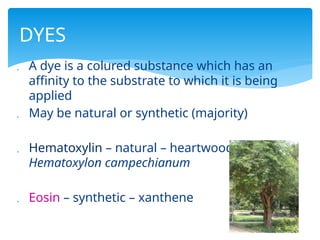
 A dye is a colured substance which has an
affinity to the substrate to which it is being
applied
 May be natural or synthetic (majority)
 Hematoxylin – natural – heartwood of tree
Hematoxylon campechianum
 Eosin – synthetic – xanthene
DYES
 Chemically, dyes are classified as acidic or basic
 Which combine with basic or acidic
components respectively
 All ordinary stains used are salts and are
composed of an acid and a base, the action
depends on pH of solution in which they are
employed
ACIDIC–anionic
acid component is coloured, base colourless
eg : eosin
BASIC- cationic
base has colouring substance
eg :hematoxylin, basic fuschin
NEUTRAL- mixtures of acidic and basic dyes
-eg: Romanowsky stains
AMPHOTERIC – both anionic and cationic groups,
but on same ion
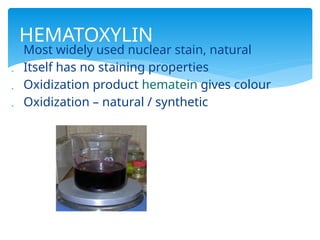
 Most widely used nuclear stain, natural
 Itself has no staining properties
 Oxidization product hematein gives colour
 Oxidization – natural / synthetic
HEMATOXYLIN
 NATURAL (RIPENING)- exposure of
prepared solutions to sunlight and air
eg: Erhlich’s hematoxylin
Adv – Long shelf life
Disadv – slow process – 6 to 8 weeks
(sometimes 3-4 months)
 CHEMICAL- oxidising agents
sodium iodate – Mayer’s hematoxylin
KMnO4 or mercuric oxide – Harri’s hematoxylin
ADV- Rapid process, can be used immediately after
preparation
DISADV – Shorter useful life because of the
continuing natural process of oxidation
GLYCEROL – stabilizer, prevents over oxidation and
evaporation
-- improves and keep qualities of staining
solution
MORDANTS
 Hematein has poor affinity to tissues- improved
by using mordants ( non dyeing compound
which acts as a link between dye and tissue)
 Metal with two valencies
 MC used for hematoxylin – aluminium, iron,
tungsten
CLASSIFICATION BASED ON MORDANT
(1) Alum H
(2) Iron H
(3) Tungsten H
(4) Molybdenum H
(5) Lead H
(6) H without mordant
Most mordants are incorporated into the H
But in few, they are used before staining
eg- Heidenhain’s iron H
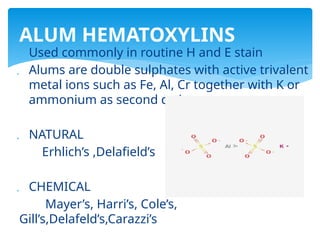
 Used commonly in routine H and E stain
 Alums are double sulphates with active trivalent
metal ions such as Fe, Al, Cr together with K or
ammonium as second cation
 NATURAL
Erhlich’s ,Delafield’s
 CHEMICAL
Mayer’s, Harri’s, Cole’s,
Gill’s,Delafeld’s,Carazzi’s
ALUM HEMATOXYLINS
 Mordant used – aluminium as alum. Pot.
Sulphate or alum. Ammon. Sulphate
 Produces good nuclear staining
 It stains nucleus red – converted to blue black
when washed in a weak alkali solution –blueing
 Regressive or progressive stain
 Time required depends type and age of alum H
and type of tissue
1.ERHLICH’S HEMATOXYLIN
 Erhlich in 1886
 Naturally ripened, 2months(emergency – add
sodium iodate), last for years
ADV AND USES
 Stains nuclei intensely and crisply
 Staining bone and cartilage
 For tissues exposed to acid (fixed long in
formalin)
 Stains mucin in salivary gland & goblet cells
 Fades much more slowly
 Used for regressive staining
 DISADV – Not ideal for frozen sections
- staining time 20 to 30min
 Composition
hematoxylin – 6g
absolute alcohol – 300 ml
glyecrin/glycerol- 300ml
distilled water – 300 ml
glacial acetic acid- 30 ml
pot alum – 10 to 14 g
2.DELAFIELD’S HEMATOXYLIN
 Naturally ripened alum H
 USE – For decalcified (acid treated) tissue, long
stored and Bouin’s fixed tissues
 COMPOSITION
hematoxylin-4g
95% alcohol-125 ml
saturated aqueous ammon. Alum ( 15g/100 ml ) –
400 ml
glycerin - 100ml
3. MAYER’S HEMATOXYLIN
 Chemically ripened using sodium iodate
 USES
1.both as regressive and progressive stain. As
progressive stain, they are suitable for automated
procedures
2.as a nuclear counterstain in the
demonstration of glycogen and in many enzyme
histochemical procedures
3.as a counterstain in immunohistochemistry
COMPOSITION
Hematoxylin – 1 g
distilled water – 1000 ml
pot or ammonium alum – 50 g
Na. iodate – 0.2 g
citric acid – 1g
chloral hydrat SLR – 50 g OR
chloral hydrate AR- 30 g
Staining time – progressive : 10 to 20 min
regressive : 5 to 10 min
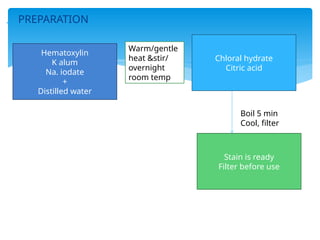
 PREPARATION
Hematoxylin
K alum
Na. iodate
+
Distilled water
Chloral hydrate
Citric acid
Stain is ready
Filter before use
Warm/gentle
heat &stir/
overnight
room temp
Boil 5 min
Cool, filter
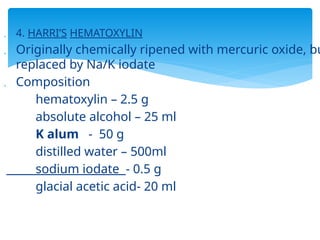
 4. HARRI’S HEMATOXYLIN
 Originally chemically ripened with mercuric oxide, bu
replaced by Na/K iodate
 Composition
hematoxylin – 2.5 g
absolute alcohol – 25 ml
K alum - 50 g
distilled water – 500ml
sodium iodate - 0.5 g
glacial acetic acid- 20 ml
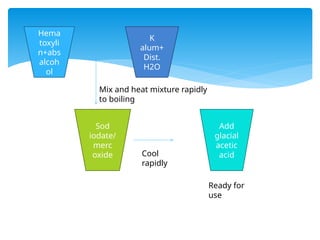
Hema
toxyli
n+abs
alcoh
ol
K
alum+
Dist.
H2O
Mix and heat mixture rapidly
to boiling
Sod
iodate/
merc
oxide Cool
rapidly
Add
glacial
acetic
acid
Ready for
use
USES
1. Good hematoxylin stain for routine use.
Gives clear nuclear staining.
routinely used as regressive stain
when used progressively , produces a light
nuclear stain
2. Used as progressive nuclear stain in diagnostic
exfoliative cytology
 Staining time - 10 min
 Disadvantage
quality of nuclear stain and speed
of staining deteriorates after few months –
formation of precipitate in stored solution
should be filtered and also increase
the staining time
hence, preparation of a fresh
batch of stain every month is advised
 5.COLE’S HEMATOXYLIN
 alum H , artificially ripened with alcoholic
iodine solution
 Staining time – 20-45 min
 Composition
hematoxylin – 1.5 g
aquous K/Ammon alum- 700 ml
1% iodine in 95% alcohol- 50 ml
distilled water – 250 ml
6 CARAZZI’S HEMATOXYLIN
Chemically ripened by pot iodate
Staining time 1-2min
USES :
progressive nuclear counterstain- pale and
precise nuclear staining and doesn’t stain any
cytoplasmic components
COMPOSITION
hematoxylin – 5g k. alum – 25g
glycerol- 100 ml distilled H2O- 400 ml
potassium iodate – 0.1 g
 7. GILL’S HEMATOXYLIN
 Chemically ripened by sodium iodate
 ADV :-
1.Fast in action
2.stable for 12 months , more stable than
Harri’s
3.little or no surface precipitation
Staining time regressive – 5 to 15 min
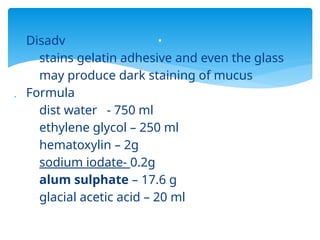
 Disadv
stains gelatin adhesive and even the glass
may produce dark staining of mucus
 Formula
dist water - 750 ml
ethylene glycol – 250 ml
hematoxylin – 2g
sodium iodate- 0.2g
alum sulphate – 17.6 g
glacial acetic acid – 20 ml
.
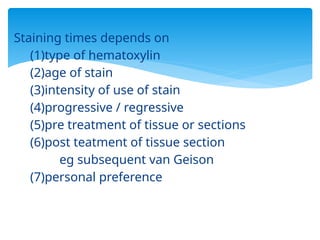
Staining times depends on
(1)type of hematoxylin
(2)age of stain
(3)intensity of use of stain
(4)progressive / regressive
(5)pre treatment of tissue or sections
(6)post teatment of tissue section
eg subsequent van Geison
(7)personal preference
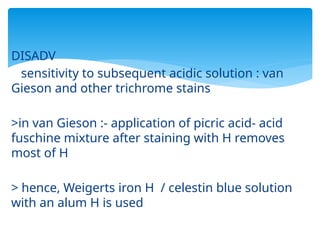
DISADV
sensitivity to subsequent acidic solution : van
Gieson and other trichrome stains
>in van Gieson :- application of picric acid- acid
fuschine mixture after staining with H removes
most of H
> hence, Weigerts iron H / celestin blue solution
with an alum H is used
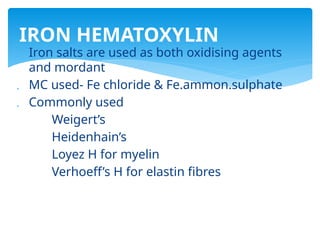
 Iron salts are used as both oxidising agents
and mordant
 MC used- Fe chloride & Fe.ammon.sulphate
 Commonly used
Weigert’s
Heidenhain’s
Loyez H for myelin
Verhoeff’s H for elastin fibres
IRON HEMATOXYLIN
PRECAUTION :
Over oxidation of H – hence H and Fe
solutions are prepared separately and
either mix immediately before use/ use
consecutively
 1.WEIGERT’S HEMATOXYLIN
 Fe.Cl3 – mordent and oxidising agent
 Fe and H prepared separately and mixed
immediately before use
 Staining time 15 to 30 min
 USE – as nuclear stain where acidic solutions are
to be applied to the sections subsequently
(eg- van Gieson stain)
PREPARATION
SOL A : Hematoxylin 1 g
absolute alcohol – 100 mL
Use gentle heat to dissolve. And allowed to
ripen naturally for 4 weeks before use
SOL B : 30% aquous FeCl3 – 4mL
conc. HCl – 1 mL
distilled H2O – 100 mL
MIX EQUAL VOL. JUST BEFORE USE
HAVE A VIOLET BLACK COLOUR
BROWN - DISCARD
 2.CELESTIN BLUE ALUM HEMATOXYLIN
 Oxazine dye with little colouring property on its
own
 USE – when acid counterstain is to be used
 Largely replaced Weigert’s H in van Gieson
 Composition
celestin blue B – 2.5g
fe.ammon.sulphate – 25g
glycerin/glycerol- 70ml
distilled H2O- 500 ml
 3.HEIDENHAIN’S IRON HEMATOXYLIN
 FE. AMMON. SULPHATE mordant and oxidising agent
 Used as regressive stain and same solution used as
differentiating fluid
 Good cellular details and good photomicrography
 SOL A – hematoxylin – 0.5 g
abs alcohol – 10 ml
distilled water- 90 ml
 SOL B – fe. ammon.sulphate- 5 g
dist water- 100ml
HERE, IRON ALUM APPLIED FIRST, F/B HEMATOXYLIN
 mitochondria, chromosomes, muscle striation,
myelin, nuclear chromatin – GREY BLACK
 Time reqd in mordant – varies acc to fixative
formalin, formalin sublimtes, Bouin’, carnoy-
1hr
Helly’s or Zenker’s- 3 hrs
osmium tetroxide, flemings fluid – upto 24hrs
 Differentiation – difficult to judge. So, dip
slide in and out of mordant until slide is
clear & check under microscope
 Cytoplasmic counterstains usually not
needed
 Fading – resistant to fading only if washed
well after differentiation
 Staining time :- reduced at 60 deg C
 4.LOYEZ HEMATOXYLIN
 Fe.ammon.SO4
 Use – to demonstrate myelin , and may be
applied to paraffin, frozen or nitrocellulose
section
 5. VERHOEFF’S HEMATOXYLIN
 for demonstarting elastin fibres
 Stains coarse elastic fibres black
 FeCl3 – differentiator
 Provides excellent contrast
 But requires careful differentiation
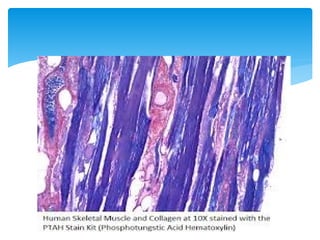
 Termed as Mallory PTAH which may be
used with (1) hematin
(2)chemical oxdn,
(3)Natural oxdn
FIXATIVE – Zenker’s – preferred
10% BNF
TUNGSTEN HEMATOXYLIN
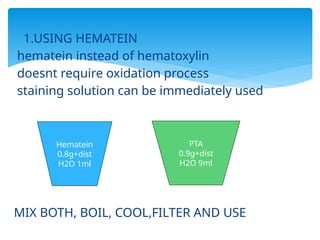
 1.USING HEMATEIN
hematein instead of hematoxylin
doesnt require oxidation process
staining solution can be immediately used
MIX BOTH, BOIL, COOL,FILTER AND USE
Hematein
0.8g+dist
H2O 1ml
PTA
0.9g+dist
H2O 9ml
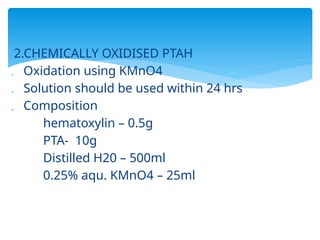
2.CHEMICALLY OXIDISED PTAH
 Oxidation using KMnO4
 Solution should be used within 24 hrs
 Composition
hematoxylin – 0.5g
PTA- 10g
Distilled H20 – 500ml
0.25% aqu. KMnO4 – 25ml
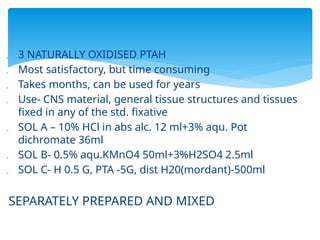
 3 NATURALLY OXIDISED PTAH
 Most satisfactory, but time consuming
 Takes months, can be used for years
 Use- CNS material, general tissue structures and tissues
fixed in any of the std. fixative
 SOL A – 10% HCl in abs alc. 12 ml+3% aqu. Pot
dichromate 36ml
 SOL B- 0.5% aqu.KMnO4 50ml+3%H2SO4 2.5ml
 SOL C- H 0.5 G, PTA -5G, dist H20(mordant)-500ml
SEPARATELY PREPARED AND MIXED
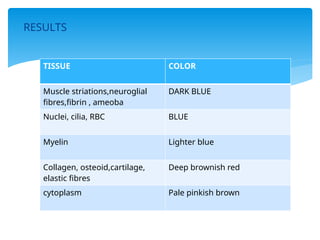
 RESULTS
TISSUE COLOR
Muscle striations,neuroglial
fibres,fibrin , ameoba
DARK BLUE
Nuclei, cilia, RBC BLUE
Myelin Lighter blue
Collagen, osteoid,cartilage,
elastic fibres
Deep brownish red
cytoplasm Pale pinkish brown
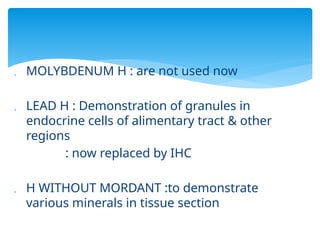
 MOLYBDENUM H : are not used now
 LEAD H : Demonstration of granules in
endocrine cells of alimentary tract & other
regions
: now replaced by IHC
 H WITHOUT MORDANT :to demonstrate
various minerals in tissue section
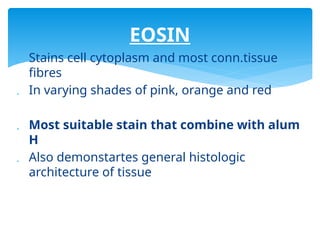
 Stains cell cytoplasm and most conn.tissue
fibres
 In varying shades of pink, orange and red
 Most suitable stain that combine with alum
H
 Also demonstartes general histologic
architecture of tissue
EOSIN
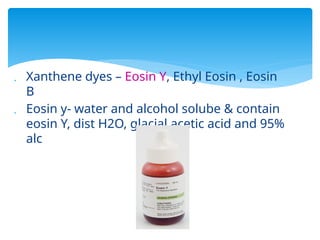
 Xanthene dyes – Eosin Y, Ethyl Eosin , Eosin
B
 Eosin y- water and alcohol solube & contain
eosin Y, dist H2O, glacial acetic acid and 95%
alc
 USES
 Counterstain in routine H & E – pink – orange
colour to cytoplasm
 RBC – intensley red
 To distinguish b/w cytoplasm of diff types of
cells and conn tissue
PHLOXINE & BIEBRICH SCARLET – SUBSTITUTES
FOR EOSIN
 Glasswares should be clean &dry
 Weigh accurately & use correct solvent
 Keep silver & osmic acid stains in dark bottles
 Dilute ammonia should be freshly prepared
 Alcoholic solutions to be kept in glass stoppered
bottle-to prevent evaporation of alcohol
PREPARATION OF STAINS
SOLVENTS
1. Distilled water –MC
2. Ethanol
3. Methanol
4. Acetone
5. Phenol
Should allow easy flow of work from one
procedure to another without any crossover
Staining bench should face window &well
illuminated
Sinks –atleast 2 in number with atleast 2 cold
water taps -1 for routine and 1 for special stain
Staining rack
Adequate supply of distilled water
Microscope
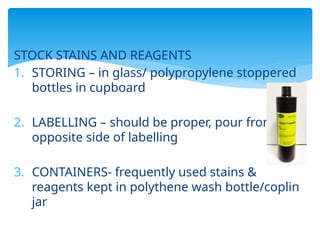
STOCK STAINS AND REAGENTS
1. STORING – in glass/ polypropylene stoppered
bottles in cupboard
2. LABELLING – should be proper, pour from
opposite side of labelling
3. CONTAINERS- frequently used stains &
reagents kept in polythene wash bottle/coplin
jar
 MANUAL/ AUTOMATIC
 MANUAL
Basic staining equipments :
*glass troughs and racks of 12,25 or 50
slides
*xylene-at start and end of staining
STAINING PROCEDURE
ROUTINE H & E
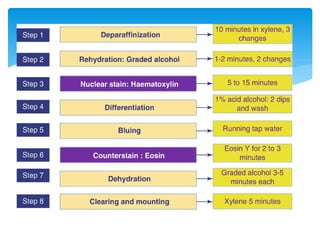
1. REMOVAL OF PARAFFIN WAX WITH XYLENE-
sections to be placed in xylene( Xylene I for 3
min & xylene II for 3 min) to dissolve wax
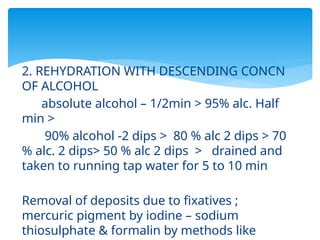
2. REHYDRATION WITH DESCENDING CONCN
OF ALCOHOL
absolute alcohol – 1/2min > 95% alc. Half
min >
90% alcohol -2 dips > 80 % alc 2 dips > 70
% alc. 2 dips> 50 % alc 2 dips > drained and
taken to running tap water for 5 to 10 min
Removal of deposits due to fixatives ;
mercuric pigment by iodine – sodium
thiosulphate & formalin by methods like
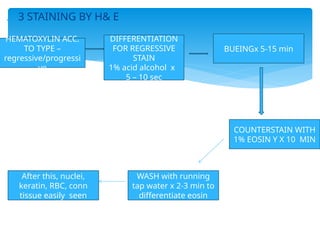
 3 STAINING BY H& E
DIFFERENTIATION
FOR REGRESSIVE
STAIN
1% acid alcohol x
5 – 10 sec
HEMATOXYLIN ACC.
TO TYPE –
regressive/progressi
ve
BUEINGx 5-15 min
COUNTERSTAIN WITH
1% EOSIN Y X 10 MIN
WASH with running
tap water x 2-3 min to
differentiate eosin
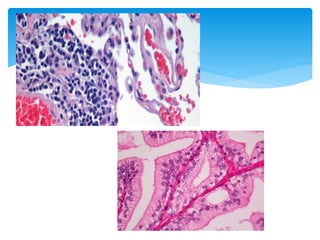
After this, nuclei,
keratin, RBC, conn
tissue easily seen
4.DEHYDRATION THROUGH GRADED ALCOHOL
 ascending grades of alcohol
 2-4 dips in 95% & 2-4 dips in absolute alcohol
5 CLEARING WITH XYLENE/XYLOL
 Sections are transferred to 2 xylene bath
 Xylene 1 – 1 to 2 min, xylene II – 2 min
 Clearing tested by holding against watch
 Incomplete clearing => return to last alcohol
and agitate for 30 sec , then to xylene
6. MOUNTING
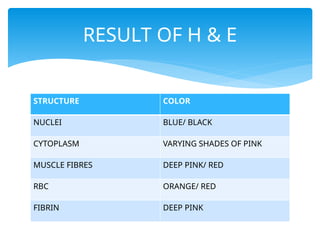
STRUCTURE COLOR
NUCLEI BLUE/ BLACK
CYTOPLASM VARYING SHADES OF PINK
MUSCLE FIBRES DEEP PINK/ RED
RBC ORANGE/ RED
FIBRIN DEEP PINK
RESULT OF H & E
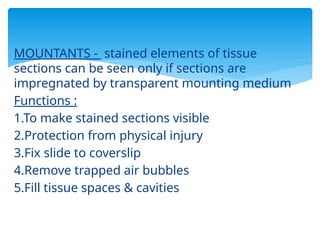
MOUNTANTS - stained elements of tissue
sections can be seen only if sections are
impregnated by transparent mounting medium
Functions :
1.To make stained sections visible
2.Protection from physical injury
3.Fix slide to coverslip
4.Remove trapped air bubbles
5.Fill tissue spaces & cavities
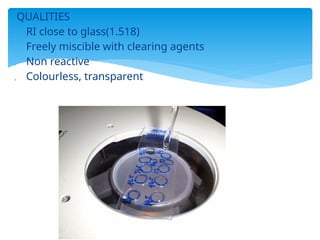
QUALITIES
 RI close to glass(1.518)
 Freely miscible with clearing agents
 Non reactive
 Colourless, transparent
AQUEOUS RESINOUS
glycerine jelly Natural –canada
balsam
Apathy’s medium Dammar
balsam
Farrant’s medium
colophonium resin
Fructose syrup terpene
resin
Polyvinyl alcohol synthetic – euparal
Highman’s mod. Of
polystyrene
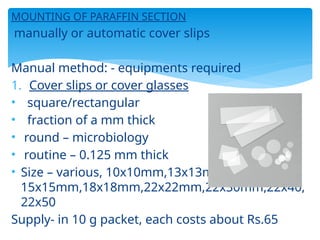
MOUNTING OF PARAFFIN SECTION
manually or automatic cover slips
Manual method: - equipments required
1. Cover slips or cover glasses
• square/rectangular
• fraction of a mm thick
• round – microbiology
• routine – 0.125 mm thick
• Size – various, 10x10mm,13x13mm,
15x15mm,18x18mm,22x22mm,22x30mm,22x40,
22x50
Supply- in 10 g packet, each costs about Rs.65
2.DISSECTING NEEDLES
to adjust coverslip during & after mounting
3.MOUNTANTS
depends on the type of section
MOUNTING PROCEDURE
1. clean the coverslips
2.lay coverslips in a row
3.bring sections to xylene
4.removal of excess xylene
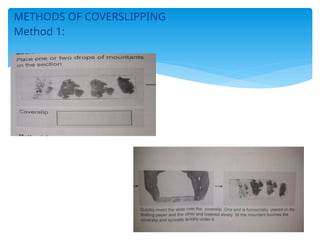
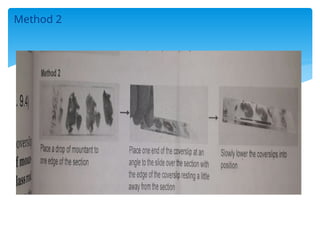
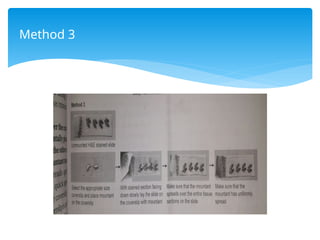
METHODS OF COVERSLIPPING
Method 1:
Method 2
Method 3
 FOR URGENT FROZEN SECTIONS – RAPID H & E
 Procedure
1.Freeze the required tissue block in freezing
microtome/ cryostat.
cut sections 3-6 micometre
2.Fix sections in AAF x 30 -60 sec
alternative – 10% BNF x 20 sec
3.Rinse rapidly in water
4.Hematoxylin – harri’s x 2min/ carazzi’s x 1min
 5.rinse in LiCO3/ scott’s/alkaline tap
water
 6.counterstain in 1% aq.eosin 10-25sec
 7.rinse rapidly in tap water
 8.dehydrate with alcohol
 9.clear with xylene
 10.mount in DPX
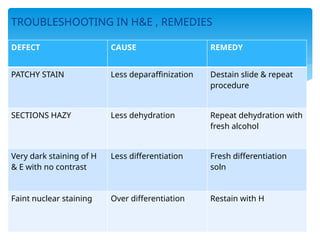
TROUBLESHOOTING IN H&E , REMEDIES
DEFECT CAUSE REMEDY
PATCHY STAIN Less deparaffinization Destain slide & repeat
procedure
SECTIONS HAZY Less dehydration Repeat dehydration with
fresh alcohol
Very dark staining of H
& E with no contrast
Less differentiation Fresh differentiation
soln
Faint nuclear staining Over differentiation Restain with H
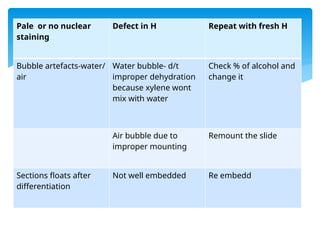
Pale or no nuclear
staining
Defect in H Repeat with fresh H
Bubble artefacts-water/
air
Water bubble- d/t
improper dehydration
because xylene wont
mix with water
Check % of alcohol and
change it
Air bubble due to
improper mounting
Remount the slide
Sections floats after
differentiation
Not well embedded Re embedd
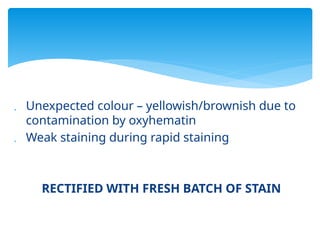
 Unexpected colour – yellowish/brownish due to
contamination by oxyhematin
 Weak staining during rapid staining
RECTIFIED WITH FRESH BATCH OF STAIN
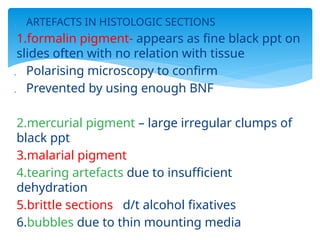
 ARTEFACTS IN HISTOLOGIC SECTIONS
1.formalin pigment- appears as fine black ppt on
slides often with no relation with tissue
 Polarising microscopy to confirm
 Prevented by using enough BNF
2.mercurial pigment – large irregular clumps of
black ppt
3.malarial pigment
4.tearing artefacts due to insufficient
dehydration
5.brittle sections d/t alcohol fixatives
6.bubbles due to thin mounting media
THANK YOU

HEMATOXYLIN AND EOSIN STAINING a brief discription

  • 1.
  • 3.
     A dyeis a colured substance which has an affinity to the substrate to which it is being applied  May be natural or synthetic (majority)  Hematoxylin – natural – heartwood of tree Hematoxylon campechianum  Eosin – synthetic – xanthene DYES
  • 4.
     Chemically, dyesare classified as acidic or basic  Which combine with basic or acidic components respectively  All ordinary stains used are salts and are composed of an acid and a base, the action depends on pH of solution in which they are employed
  • 5.
    ACIDIC–anionic acid component iscoloured, base colourless eg : eosin BASIC- cationic base has colouring substance eg :hematoxylin, basic fuschin NEUTRAL- mixtures of acidic and basic dyes -eg: Romanowsky stains AMPHOTERIC – both anionic and cationic groups, but on same ion
  • 6.
     Most widelyused nuclear stain, natural  Itself has no staining properties  Oxidization product hematein gives colour  Oxidization – natural / synthetic HEMATOXYLIN
  • 7.
     NATURAL (RIPENING)-exposure of prepared solutions to sunlight and air eg: Erhlich’s hematoxylin Adv – Long shelf life Disadv – slow process – 6 to 8 weeks (sometimes 3-4 months)
  • 8.
     CHEMICAL- oxidisingagents sodium iodate – Mayer’s hematoxylin KMnO4 or mercuric oxide – Harri’s hematoxylin ADV- Rapid process, can be used immediately after preparation DISADV – Shorter useful life because of the continuing natural process of oxidation GLYCEROL – stabilizer, prevents over oxidation and evaporation -- improves and keep qualities of staining solution
  • 9.
    MORDANTS  Hematein haspoor affinity to tissues- improved by using mordants ( non dyeing compound which acts as a link between dye and tissue)  Metal with two valencies  MC used for hematoxylin – aluminium, iron, tungsten
  • 10.
    CLASSIFICATION BASED ONMORDANT (1) Alum H (2) Iron H (3) Tungsten H (4) Molybdenum H (5) Lead H (6) H without mordant Most mordants are incorporated into the H But in few, they are used before staining eg- Heidenhain’s iron H
  • 11.
     Used commonlyin routine H and E stain  Alums are double sulphates with active trivalent metal ions such as Fe, Al, Cr together with K or ammonium as second cation  NATURAL Erhlich’s ,Delafield’s  CHEMICAL Mayer’s, Harri’s, Cole’s, Gill’s,Delafeld’s,Carazzi’s ALUM HEMATOXYLINS
  • 12.
     Mordant used– aluminium as alum. Pot. Sulphate or alum. Ammon. Sulphate  Produces good nuclear staining  It stains nucleus red – converted to blue black when washed in a weak alkali solution –blueing  Regressive or progressive stain  Time required depends type and age of alum H and type of tissue
  • 13.
    1.ERHLICH’S HEMATOXYLIN  Erhlichin 1886  Naturally ripened, 2months(emergency – add sodium iodate), last for years ADV AND USES  Stains nuclei intensely and crisply  Staining bone and cartilage  For tissues exposed to acid (fixed long in formalin)  Stains mucin in salivary gland & goblet cells  Fades much more slowly  Used for regressive staining
  • 14.
     DISADV –Not ideal for frozen sections - staining time 20 to 30min  Composition hematoxylin – 6g absolute alcohol – 300 ml glyecrin/glycerol- 300ml distilled water – 300 ml glacial acetic acid- 30 ml pot alum – 10 to 14 g
  • 15.
    2.DELAFIELD’S HEMATOXYLIN  Naturallyripened alum H  USE – For decalcified (acid treated) tissue, long stored and Bouin’s fixed tissues  COMPOSITION hematoxylin-4g 95% alcohol-125 ml saturated aqueous ammon. Alum ( 15g/100 ml ) – 400 ml glycerin - 100ml
  • 16.
    3. MAYER’S HEMATOXYLIN Chemically ripened using sodium iodate  USES 1.both as regressive and progressive stain. As progressive stain, they are suitable for automated procedures 2.as a nuclear counterstain in the demonstration of glycogen and in many enzyme histochemical procedures 3.as a counterstain in immunohistochemistry
  • 17.
    COMPOSITION Hematoxylin – 1g distilled water – 1000 ml pot or ammonium alum – 50 g Na. iodate – 0.2 g citric acid – 1g chloral hydrat SLR – 50 g OR chloral hydrate AR- 30 g Staining time – progressive : 10 to 20 min regressive : 5 to 10 min
  • 18.
     PREPARATION Hematoxylin K alum Na.iodate + Distilled water Chloral hydrate Citric acid Stain is ready Filter before use Warm/gentle heat &stir/ overnight room temp Boil 5 min Cool, filter
  • 19.
     4. HARRI’SHEMATOXYLIN  Originally chemically ripened with mercuric oxide, bu replaced by Na/K iodate  Composition hematoxylin – 2.5 g absolute alcohol – 25 ml K alum - 50 g distilled water – 500ml sodium iodate - 0.5 g glacial acetic acid- 20 ml
  • 20.
    Hema toxyli n+abs alcoh ol K alum+ Dist. H2O Mix and heatmixture rapidly to boiling Sod iodate/ merc oxide Cool rapidly Add glacial acetic acid Ready for use
  • 21.
    USES 1. Good hematoxylinstain for routine use. Gives clear nuclear staining. routinely used as regressive stain when used progressively , produces a light nuclear stain 2. Used as progressive nuclear stain in diagnostic exfoliative cytology
  • 22.
     Staining time- 10 min  Disadvantage quality of nuclear stain and speed of staining deteriorates after few months – formation of precipitate in stored solution should be filtered and also increase the staining time hence, preparation of a fresh batch of stain every month is advised
  • 23.
     5.COLE’S HEMATOXYLIN alum H , artificially ripened with alcoholic iodine solution  Staining time – 20-45 min  Composition hematoxylin – 1.5 g aquous K/Ammon alum- 700 ml 1% iodine in 95% alcohol- 50 ml distilled water – 250 ml
  • 24.
    6 CARAZZI’S HEMATOXYLIN Chemicallyripened by pot iodate Staining time 1-2min USES : progressive nuclear counterstain- pale and precise nuclear staining and doesn’t stain any cytoplasmic components COMPOSITION hematoxylin – 5g k. alum – 25g glycerol- 100 ml distilled H2O- 400 ml potassium iodate – 0.1 g
  • 25.
     7. GILL’SHEMATOXYLIN  Chemically ripened by sodium iodate  ADV :- 1.Fast in action 2.stable for 12 months , more stable than Harri’s 3.little or no surface precipitation Staining time regressive – 5 to 15 min
  • 26.
     Disadv stains gelatinadhesive and even the glass may produce dark staining of mucus  Formula dist water - 750 ml ethylene glycol – 250 ml hematoxylin – 2g sodium iodate- 0.2g alum sulphate – 17.6 g glacial acetic acid – 20 ml .
  • 27.
    Staining times dependson (1)type of hematoxylin (2)age of stain (3)intensity of use of stain (4)progressive / regressive (5)pre treatment of tissue or sections (6)post teatment of tissue section eg subsequent van Geison (7)personal preference
  • 28.
    DISADV sensitivity to subsequentacidic solution : van Gieson and other trichrome stains >in van Gieson :- application of picric acid- acid fuschine mixture after staining with H removes most of H > hence, Weigerts iron H / celestin blue solution with an alum H is used
  • 29.
     Iron saltsare used as both oxidising agents and mordant  MC used- Fe chloride & Fe.ammon.sulphate  Commonly used Weigert’s Heidenhain’s Loyez H for myelin Verhoeff’s H for elastin fibres IRON HEMATOXYLIN
  • 30.
    PRECAUTION : Over oxidationof H – hence H and Fe solutions are prepared separately and either mix immediately before use/ use consecutively
  • 31.
     1.WEIGERT’S HEMATOXYLIN Fe.Cl3 – mordent and oxidising agent  Fe and H prepared separately and mixed immediately before use  Staining time 15 to 30 min  USE – as nuclear stain where acidic solutions are to be applied to the sections subsequently (eg- van Gieson stain)
  • 32.
    PREPARATION SOL A :Hematoxylin 1 g absolute alcohol – 100 mL Use gentle heat to dissolve. And allowed to ripen naturally for 4 weeks before use SOL B : 30% aquous FeCl3 – 4mL conc. HCl – 1 mL distilled H2O – 100 mL MIX EQUAL VOL. JUST BEFORE USE HAVE A VIOLET BLACK COLOUR BROWN - DISCARD
  • 33.
     2.CELESTIN BLUEALUM HEMATOXYLIN  Oxazine dye with little colouring property on its own  USE – when acid counterstain is to be used  Largely replaced Weigert’s H in van Gieson  Composition celestin blue B – 2.5g fe.ammon.sulphate – 25g glycerin/glycerol- 70ml distilled H2O- 500 ml
  • 34.
     3.HEIDENHAIN’S IRONHEMATOXYLIN  FE. AMMON. SULPHATE mordant and oxidising agent  Used as regressive stain and same solution used as differentiating fluid  Good cellular details and good photomicrography  SOL A – hematoxylin – 0.5 g abs alcohol – 10 ml distilled water- 90 ml  SOL B – fe. ammon.sulphate- 5 g dist water- 100ml HERE, IRON ALUM APPLIED FIRST, F/B HEMATOXYLIN
  • 35.
     mitochondria, chromosomes,muscle striation, myelin, nuclear chromatin – GREY BLACK  Time reqd in mordant – varies acc to fixative formalin, formalin sublimtes, Bouin’, carnoy- 1hr Helly’s or Zenker’s- 3 hrs osmium tetroxide, flemings fluid – upto 24hrs
  • 36.
     Differentiation –difficult to judge. So, dip slide in and out of mordant until slide is clear & check under microscope  Cytoplasmic counterstains usually not needed  Fading – resistant to fading only if washed well after differentiation  Staining time :- reduced at 60 deg C
  • 37.
     4.LOYEZ HEMATOXYLIN Fe.ammon.SO4  Use – to demonstrate myelin , and may be applied to paraffin, frozen or nitrocellulose section  5. VERHOEFF’S HEMATOXYLIN  for demonstarting elastin fibres  Stains coarse elastic fibres black  FeCl3 – differentiator  Provides excellent contrast  But requires careful differentiation
  • 38.
     Termed asMallory PTAH which may be used with (1) hematin (2)chemical oxdn, (3)Natural oxdn FIXATIVE – Zenker’s – preferred 10% BNF TUNGSTEN HEMATOXYLIN
  • 39.
     1.USING HEMATEIN hemateininstead of hematoxylin doesnt require oxidation process staining solution can be immediately used MIX BOTH, BOIL, COOL,FILTER AND USE Hematein 0.8g+dist H2O 1ml PTA 0.9g+dist H2O 9ml
  • 40.
    2.CHEMICALLY OXIDISED PTAH Oxidation using KMnO4  Solution should be used within 24 hrs  Composition hematoxylin – 0.5g PTA- 10g Distilled H20 – 500ml 0.25% aqu. KMnO4 – 25ml
  • 41.
     3 NATURALLYOXIDISED PTAH  Most satisfactory, but time consuming  Takes months, can be used for years  Use- CNS material, general tissue structures and tissues fixed in any of the std. fixative  SOL A – 10% HCl in abs alc. 12 ml+3% aqu. Pot dichromate 36ml  SOL B- 0.5% aqu.KMnO4 50ml+3%H2SO4 2.5ml  SOL C- H 0.5 G, PTA -5G, dist H20(mordant)-500ml SEPARATELY PREPARED AND MIXED
  • 42.
     RESULTS TISSUE COLOR Musclestriations,neuroglial fibres,fibrin , ameoba DARK BLUE Nuclei, cilia, RBC BLUE Myelin Lighter blue Collagen, osteoid,cartilage, elastic fibres Deep brownish red cytoplasm Pale pinkish brown
  • 44.
     MOLYBDENUM H: are not used now  LEAD H : Demonstration of granules in endocrine cells of alimentary tract & other regions : now replaced by IHC  H WITHOUT MORDANT :to demonstrate various minerals in tissue section
  • 45.
     Stains cellcytoplasm and most conn.tissue fibres  In varying shades of pink, orange and red  Most suitable stain that combine with alum H  Also demonstartes general histologic architecture of tissue EOSIN
  • 46.
     Xanthene dyes– Eosin Y, Ethyl Eosin , Eosin B  Eosin y- water and alcohol solube & contain eosin Y, dist H2O, glacial acetic acid and 95% alc
  • 47.
     USES  Counterstainin routine H & E – pink – orange colour to cytoplasm  RBC – intensley red  To distinguish b/w cytoplasm of diff types of cells and conn tissue PHLOXINE & BIEBRICH SCARLET – SUBSTITUTES FOR EOSIN
  • 48.
     Glasswares shouldbe clean &dry  Weigh accurately & use correct solvent  Keep silver & osmic acid stains in dark bottles  Dilute ammonia should be freshly prepared  Alcoholic solutions to be kept in glass stoppered bottle-to prevent evaporation of alcohol PREPARATION OF STAINS
  • 49.
    SOLVENTS 1. Distilled water–MC 2. Ethanol 3. Methanol 4. Acetone 5. Phenol
  • 50.
    Should allow easyflow of work from one procedure to another without any crossover Staining bench should face window &well illuminated Sinks –atleast 2 in number with atleast 2 cold water taps -1 for routine and 1 for special stain Staining rack Adequate supply of distilled water Microscope
  • 51.
    STOCK STAINS ANDREAGENTS 1. STORING – in glass/ polypropylene stoppered bottles in cupboard 2. LABELLING – should be proper, pour from opposite side of labelling 3. CONTAINERS- frequently used stains & reagents kept in polythene wash bottle/coplin jar
  • 52.
     MANUAL/ AUTOMATIC MANUAL Basic staining equipments : *glass troughs and racks of 12,25 or 50 slides *xylene-at start and end of staining STAINING PROCEDURE
  • 54.
    ROUTINE H &E 1. REMOVAL OF PARAFFIN WAX WITH XYLENE- sections to be placed in xylene( Xylene I for 3 min & xylene II for 3 min) to dissolve wax
  • 55.
    2. REHYDRATION WITHDESCENDING CONCN OF ALCOHOL absolute alcohol – 1/2min > 95% alc. Half min > 90% alcohol -2 dips > 80 % alc 2 dips > 70 % alc. 2 dips> 50 % alc 2 dips > drained and taken to running tap water for 5 to 10 min Removal of deposits due to fixatives ; mercuric pigment by iodine – sodium thiosulphate & formalin by methods like
  • 56.
     3 STAININGBY H& E DIFFERENTIATION FOR REGRESSIVE STAIN 1% acid alcohol x 5 – 10 sec HEMATOXYLIN ACC. TO TYPE – regressive/progressi ve BUEINGx 5-15 min COUNTERSTAIN WITH 1% EOSIN Y X 10 MIN WASH with running tap water x 2-3 min to differentiate eosin After this, nuclei, keratin, RBC, conn tissue easily seen
  • 57.
    4.DEHYDRATION THROUGH GRADEDALCOHOL  ascending grades of alcohol  2-4 dips in 95% & 2-4 dips in absolute alcohol 5 CLEARING WITH XYLENE/XYLOL  Sections are transferred to 2 xylene bath  Xylene 1 – 1 to 2 min, xylene II – 2 min  Clearing tested by holding against watch  Incomplete clearing => return to last alcohol and agitate for 30 sec , then to xylene 6. MOUNTING
  • 58.
    STRUCTURE COLOR NUCLEI BLUE/BLACK CYTOPLASM VARYING SHADES OF PINK MUSCLE FIBRES DEEP PINK/ RED RBC ORANGE/ RED FIBRIN DEEP PINK RESULT OF H & E
  • 60.
    MOUNTANTS - stainedelements of tissue sections can be seen only if sections are impregnated by transparent mounting medium Functions : 1.To make stained sections visible 2.Protection from physical injury 3.Fix slide to coverslip 4.Remove trapped air bubbles 5.Fill tissue spaces & cavities
  • 61.
    QUALITIES  RI closeto glass(1.518)  Freely miscible with clearing agents  Non reactive  Colourless, transparent
  • 62.
    AQUEOUS RESINOUS glycerine jellyNatural –canada balsam Apathy’s medium Dammar balsam Farrant’s medium colophonium resin Fructose syrup terpene resin Polyvinyl alcohol synthetic – euparal Highman’s mod. Of polystyrene
  • 63.
    MOUNTING OF PARAFFINSECTION manually or automatic cover slips Manual method: - equipments required 1. Cover slips or cover glasses • square/rectangular • fraction of a mm thick • round – microbiology • routine – 0.125 mm thick • Size – various, 10x10mm,13x13mm, 15x15mm,18x18mm,22x22mm,22x30mm,22x40, 22x50 Supply- in 10 g packet, each costs about Rs.65
  • 64.
    2.DISSECTING NEEDLES to adjustcoverslip during & after mounting 3.MOUNTANTS depends on the type of section MOUNTING PROCEDURE 1. clean the coverslips 2.lay coverslips in a row 3.bring sections to xylene 4.removal of excess xylene
  • 65.
  • 66.
  • 67.
  • 68.
     FOR URGENTFROZEN SECTIONS – RAPID H & E  Procedure 1.Freeze the required tissue block in freezing microtome/ cryostat. cut sections 3-6 micometre 2.Fix sections in AAF x 30 -60 sec alternative – 10% BNF x 20 sec 3.Rinse rapidly in water 4.Hematoxylin – harri’s x 2min/ carazzi’s x 1min
  • 69.
     5.rinse inLiCO3/ scott’s/alkaline tap water  6.counterstain in 1% aq.eosin 10-25sec  7.rinse rapidly in tap water  8.dehydrate with alcohol  9.clear with xylene  10.mount in DPX
  • 70.
    TROUBLESHOOTING IN H&E, REMEDIES DEFECT CAUSE REMEDY PATCHY STAIN Less deparaffinization Destain slide & repeat procedure SECTIONS HAZY Less dehydration Repeat dehydration with fresh alcohol Very dark staining of H & E with no contrast Less differentiation Fresh differentiation soln Faint nuclear staining Over differentiation Restain with H
  • 71.
    Pale or nonuclear staining Defect in H Repeat with fresh H Bubble artefacts-water/ air Water bubble- d/t improper dehydration because xylene wont mix with water Check % of alcohol and change it Air bubble due to improper mounting Remount the slide Sections floats after differentiation Not well embedded Re embedd
  • 72.
     Unexpected colour– yellowish/brownish due to contamination by oxyhematin  Weak staining during rapid staining RECTIFIED WITH FRESH BATCH OF STAIN
  • 73.
     ARTEFACTS INHISTOLOGIC SECTIONS 1.formalin pigment- appears as fine black ppt on slides often with no relation with tissue  Polarising microscopy to confirm  Prevented by using enough BNF 2.mercurial pigment – large irregular clumps of black ppt 3.malarial pigment 4.tearing artefacts due to insufficient dehydration 5.brittle sections d/t alcohol fixatives 6.bubbles due to thin mounting media
  • 74.