z
Honing And
Stropping
z
Honing
 It is a process in which all the nicks and irregularities
in the cutting edge of the knife are removed to make
the cutting edge straight and sharp.
z
 After prolonged use or after cutting very hard
tissue, the cutting edge will have become so
damaged that stropping will not resharpen it;
small pieces of metal may have been
removed which will give a jagged edge,
causing lines or tears in section cutting. A
straight cutting edge and the correct bevel
must be restored by grinding the knife on a
hone.
z
 Taking care of a hone
 a. The hone is to be kept covered when not in use to prevent
dirt and grit from gaining access to the surface.
 b. It is to be wrapped in soft cloth and stored in a shallow
wooden box with a lid.
 Lubricants:
 Lubricants are used in sharpening knives. Lubricants acts as
coolant and protects the temper of extreme edge. Lubricants
allow the flow away of fine metal particles from the knife edge
& movement of fresh abrasive particles towards the knife
edge.
z
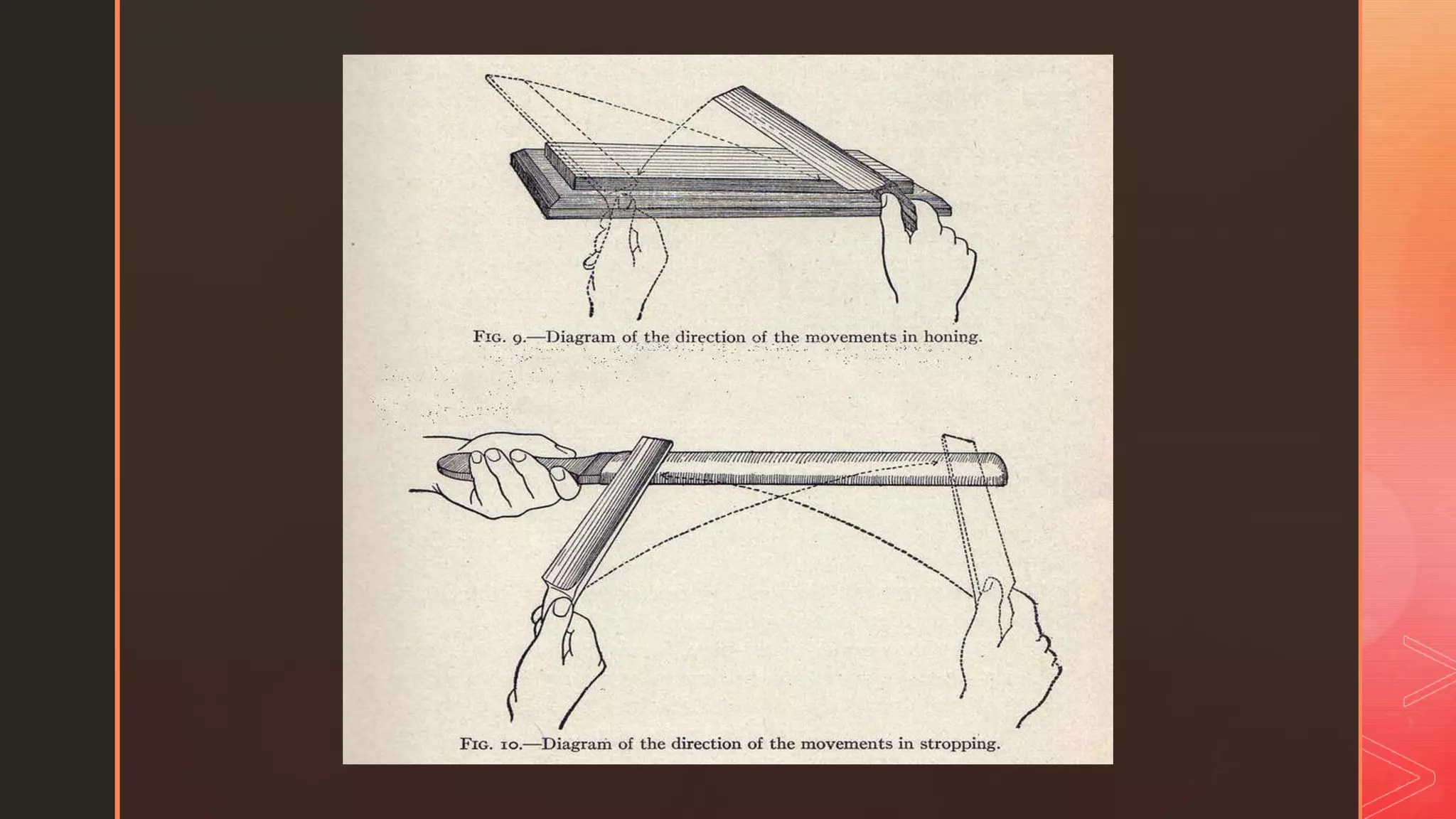
 Method of honing:
 1. keep the hone on a clean non skid surface
 2. Small quantity of lubricants oil is applied and smeared on the
surface.
 3. Knife with handle and back sheath, cutting edge facing away from
operator, is placed heel near the center of the nearest end of the hone.
 4. Hold the knife at either ends between thumb and fore finger
 5. Place the knife at one end of the hone and push diagonally forward
with the cutting edge leading. This is called head to toe motion.
 6. when the knife reaches the other end of the hone, it is pushed over
on its back and pulled back steadily towards the operator.
 7. The process is repeated 10 – 20 strokes or until the ragged edges
are removed.
 8. Put the knife in its box.
•
z
Stropping
 Process of polishing the already fairly sharpened
edge after honing.
 Stropping removes the last imperfections of the cut.
With even greater sharpness as a result. It also has
an aesthetic goal: stropping makes the cut shine like
a mirror. This is also called “mirror-edge”.
z
 What is the purpose of stropping?
 You must remember that the main purpose of stropping is not to
remove material but to straighten and align the microscopic
teeth that are at the edge of the blade.
 The purpose of stropping is to remove the “burr” formed
during honing and to polish cutting edge.
Honing And Stropping.pptx

Honing And Stropping.pptx

  • 1.
  • 3.
    z Honing  It isa process in which all the nicks and irregularities in the cutting edge of the knife are removed to make the cutting edge straight and sharp.
  • 4.
    z  After prolongeduse or after cutting very hard tissue, the cutting edge will have become so damaged that stropping will not resharpen it; small pieces of metal may have been removed which will give a jagged edge, causing lines or tears in section cutting. A straight cutting edge and the correct bevel must be restored by grinding the knife on a hone.
  • 5.
    z  Taking careof a hone  a. The hone is to be kept covered when not in use to prevent dirt and grit from gaining access to the surface.  b. It is to be wrapped in soft cloth and stored in a shallow wooden box with a lid.  Lubricants:  Lubricants are used in sharpening knives. Lubricants acts as coolant and protects the temper of extreme edge. Lubricants allow the flow away of fine metal particles from the knife edge & movement of fresh abrasive particles towards the knife edge.
  • 7.
    z  Method ofhoning:  1. keep the hone on a clean non skid surface  2. Small quantity of lubricants oil is applied and smeared on the surface.  3. Knife with handle and back sheath, cutting edge facing away from operator, is placed heel near the center of the nearest end of the hone.  4. Hold the knife at either ends between thumb and fore finger  5. Place the knife at one end of the hone and push diagonally forward with the cutting edge leading. This is called head to toe motion.  6. when the knife reaches the other end of the hone, it is pushed over on its back and pulled back steadily towards the operator.  7. The process is repeated 10 – 20 strokes or until the ragged edges are removed.  8. Put the knife in its box. •
  • 8.
    z Stropping  Process ofpolishing the already fairly sharpened edge after honing.  Stropping removes the last imperfections of the cut. With even greater sharpness as a result. It also has an aesthetic goal: stropping makes the cut shine like a mirror. This is also called “mirror-edge”.
  • 9.
    z  What isthe purpose of stropping?  You must remember that the main purpose of stropping is not to remove material but to straighten and align the microscopic teeth that are at the edge of the blade.  The purpose of stropping is to remove the “burr” formed during honing and to polish cutting edge.