+ ?
GOOD AFTERNOON
TISSUE PROCESSING
. . . . . . . . . . . . . . .
-A
histotechnique.............
INTRODUCTION
DEFINITION
AIM
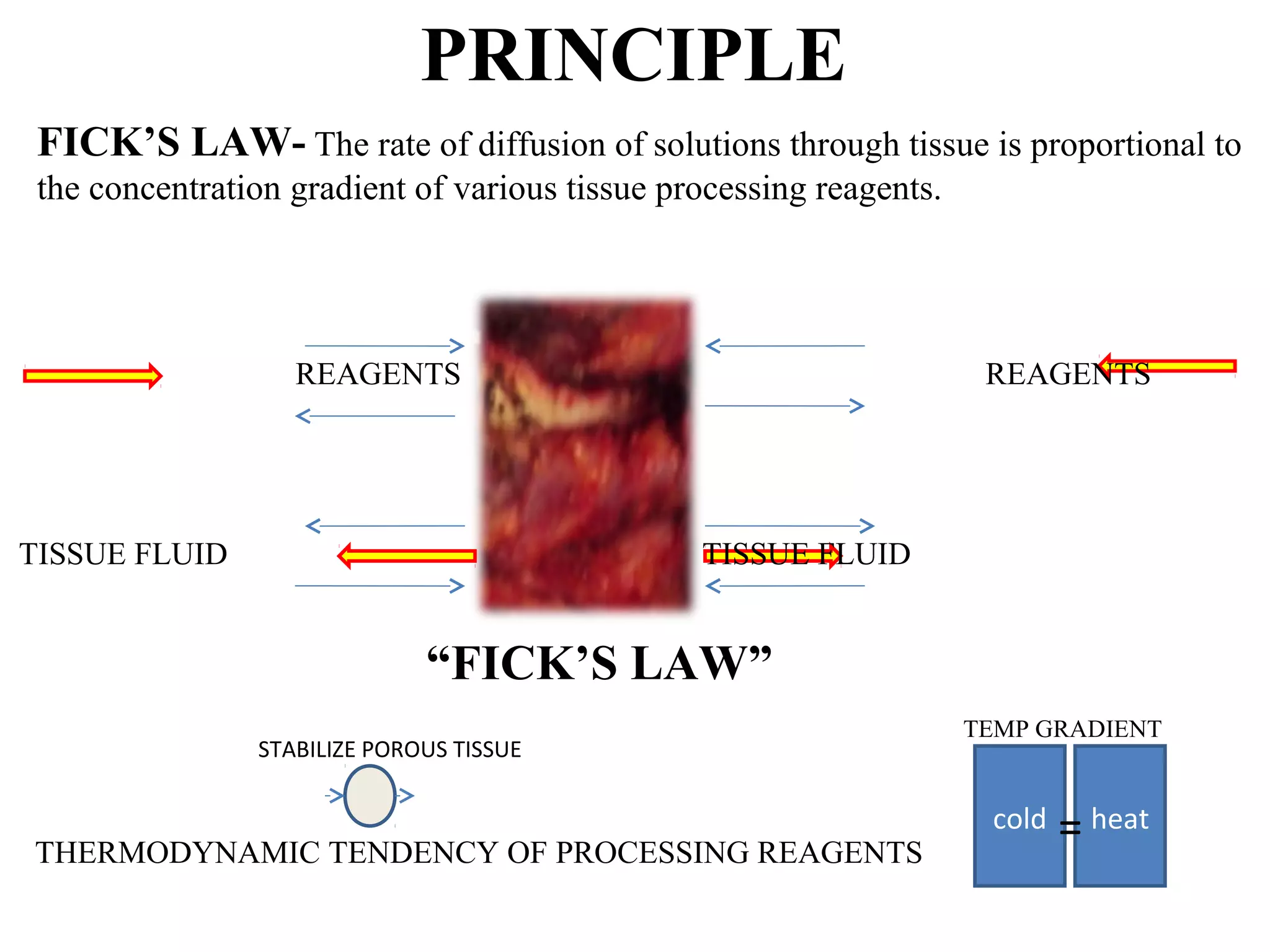
PRINCIPLE
STEPS
CONCLUSION
CONTENTS
INTRODUCTION
• History of tissue processing
• Histology
• Histopathology
• Histotechnologist
?
?
?
?
• SECTIONING
•EMBEDING
ALEXANDER BUTLEROV, 1859
MICROTOME
GROSS EXAMINATION
SPECIMEN ACCESSIONING
•REQUEST FORM
• NUMBER
•COLOUR
•CONSISTENCY
•TEXTURE
SPECIMEN LABELLING
• Should be insoluble
• Should not contaminate
• Should not penetrate
• Should not react
• Clearly identifiable
• Eg:India ink, silver nitrate, alcian blue
SOFT LEAD PENCIL
DEFINITION
The tissue must undergo preparatory treatment
before being sectioned, entailing to impregnation of
specimen with an embedding medium to provide support
and suitable consistency for microtome is tissue
processing.
FORMALIN ALCOHOLS XYLENE PARAFIN
10% WAX
PREPARATORY TREATMENT
FIXATION DEHYDRATION CLEARING IMPREGNATION
To remove water from tissue and replace with a
medium that solidifies to allow the thin sections of the tissue to
be cut.
AIM
FIXATION DEHYDRATION
4-6mm
HCT-2-3mm
LC-10-20mm
PRINCIPLE
“FICK’S LAW”
REAGENTS REAGENTS
TISSUE FLUID TISSUE FLUID
cold heat=
TEMP GRADIENT
STABILIZE POROUS TISSUE
THERMODYNAMIC TENDENCY OF PROCESSING REAGENTS
FICK’S LAW- The rate of diffusion of solutions through tissue is proportional to
the concentration gradient of various tissue processing reagents.
FACTORS EFFCTING THE RATE
OF TISSUE PROCESSING(TP)
Vacuum-
Fixation-
Viscosity-
Agitation-
Heat-
(45oc
)
(TP)
TPf Highly flammable
r
V-E-O
Reduced
pressure
15 inches of hg
Removes air trapped,
doesn’t make hard tissueMolten parafin
wax
Temp-hardens, shrinkage
CEDAR WOOD OIL, MOLTEN WAX
STEPS
1.FIXATION-
2.DEHYDRATION-
3.CLEARING
4.IMPREGNATION
5.EMBEDDING
Mini-6hrs, max-12hrs to 24hrs,
25times
AIM, washed in running h2o
types
ACTION, ARTIFACTS,FACTORS, TECHNIQUE
DEHYDRATION
Removal of unbound water & aqueous fixatives from tissue
components is called Dehydration.
DEHYDRATING AGENTS
Ethanol- fast acting, electron microscopy specimen, clear colourless, flamable liquid
Industrial Methylated Spirit-methonol 1%+IPA, Same physical property as
ethanol
Methanol- subsituted for ethanol,toxic, inflammable
Propan-2-01,Isopropylealcohol- Microwave processing schedule,
Butyl alcohol- plant and animal histology, slow dehydrant
Acetone-Rapid in action with poor penetration, clear colorless & Inflammable
liquid,
Removes lipids & causes brittleness of the tissue
Universal Solvents-Tertiary butanol, Tetra hydro furan, Dioxane,
dehydrate+clear, not for delicate tissues.
No shrinkage &
hardness of the tissue
TECHNIQUE
70% 80%
50%
90% 100% 100%
THE GRADUAL INCREASING CONCENTRATIONS OF ALCOHOL
2- 4 hrs
7-8hrs
•In celloidin embedding after
dehydration ,tissue is transferred to
a mixture of equal parts of absolute
alcohol & ether.
USE OF COPPER SULPHATE IN FINAL ALCOHOLS
.
.....
.....
.....
.....
.....
.....
.....
.....
.....
white white
.....
.....
.....
BLUE BLUE
CLEARING
•Intermediate step
•Refractive index
•Boiling point
•Short chain aliphatic hydrocarbons
CRITERIA FOR
CHOOSING
CLEARING
AGENTS
Rapid removal of dehydrating agent
Ease of removal
by melting
paraffin
Minimal tissue damageToxicity
Flammability Tim
e Cost
viscocity
Storage
Disposal
CRITERIA FOR CHOOSING CLEARING AGENTS
TECHNIQUE OF CLEARING
Volume of clearing agent should be 50-100 times the volume of
tissue.
In chloroform or carbon tetrachloride tissues are left over night for
clearing .
In Xylene,benzene,toluene tissues are given one change after 30 to 60
minutes.
Technique for cedar wood oil is different.
CEDAR WOOD OIL
TECHNIQUE:-
Cedar wood oil poured into specimen jar & same quantity of
absolute alcohol superimposed on it .
The specimen is placed into alcohol , it floats at the interface of two
fluids.
As tissue is cleared it sinks into cedar wood oil.
The alcohol is removed & specimen is transferred to fresh cedar
wood oil
Cedar wood oil
Absolute alcohol
Cedar wood oil
In processing for electron microscopy clearing is done in
1,2 epoxy propane,2 changes 15 min in each.
15mins 15mins
ELECTRON MICROSCOPY
1,2 epoxy propane
1,2 epoxy propane
CLEARING AGENTS
•Chloroform
•Toluene , Xylene , Benzene
•Carbon Tetrachloride
•Cedar Wood oil
•Methyl Benzoate , Methyl Salicylate
•Citrus Fruit Oil
CHLOROFORM
•Most common reagent used in processing of CNS
specimens.
•DIS ADV:-
Slower in action, Highly toxic.
Does not effect refractive index of tissue.
End point of clearing can not be determined.
Expensive compared to other clearing agents.
Tissue can be left in this with out any damage for longer
time, non-flammable.
•ADV:-
CARBON TETRACHLORIDE
•Similar action as chloroform.
•Much cheaper.
•Non inflamable.
•Is toxic.
IMPREGNATION
•Impregnation with paraffin wax is carried out in a oven heated
to 54-56 degree.
•The temperature depends up on the melting point of wax used
for impregnation.
•Types of impregnation oven:
Electric heated oven.
Vacuum embedding oven.
Gas heated oven.
•Permeating the tissue with a supporting medium is called
Impregnation.
FACTORS EFFECTING
IMPREGNATION
•Size & type of tissue.
•Clearing agent employed.
•Use of vacuum embedding oven.
IMPREGNATION OVEN
TECHNIQUE OF
IMPREGNATION
•After clearing the tissue is transferred to oven maintained at 56
degree temperature.
•Volume of wax should be 25-50 times the volume of tissue.
•Wax must be changed at least once during the process.
PARAFFIN WAX
•Should be free from dust & foreign particles.
•Should not contain water.
•Melting point should be 54degrees.
•Soft wax(45 dg) for foetal & areolar tissue.
•Hard wax (60 dg) for hard & fibrous tissue
PARAPLAST
•Mixture of purified paraffin & plastic polymers.
•Greater elasticity than paraffin .
•Wrinkle free serial sections can be cut.
•Does not need ice application while sectioning
ESTER WAX
•From clearing agent transfer to mixture of clearing agent & wax.
CELLOIDIN EMBEDDING
2% celloidin:- 5-7 dayS.
4% celloidin:-5-7 days.
8% celloidin:-2-3 days.
L.V.N
•5% L.V.N:- 3-5days.
•10%L.V.N:-2-3days.
•20%L.V.N:-1 day.
DOUBLE EMBEDDING
Tissue is impregnated in a mixture of celloidin& methyle benzoate.
ARTIFACTS
•In adequate impregnation leads to loss of architectural details.
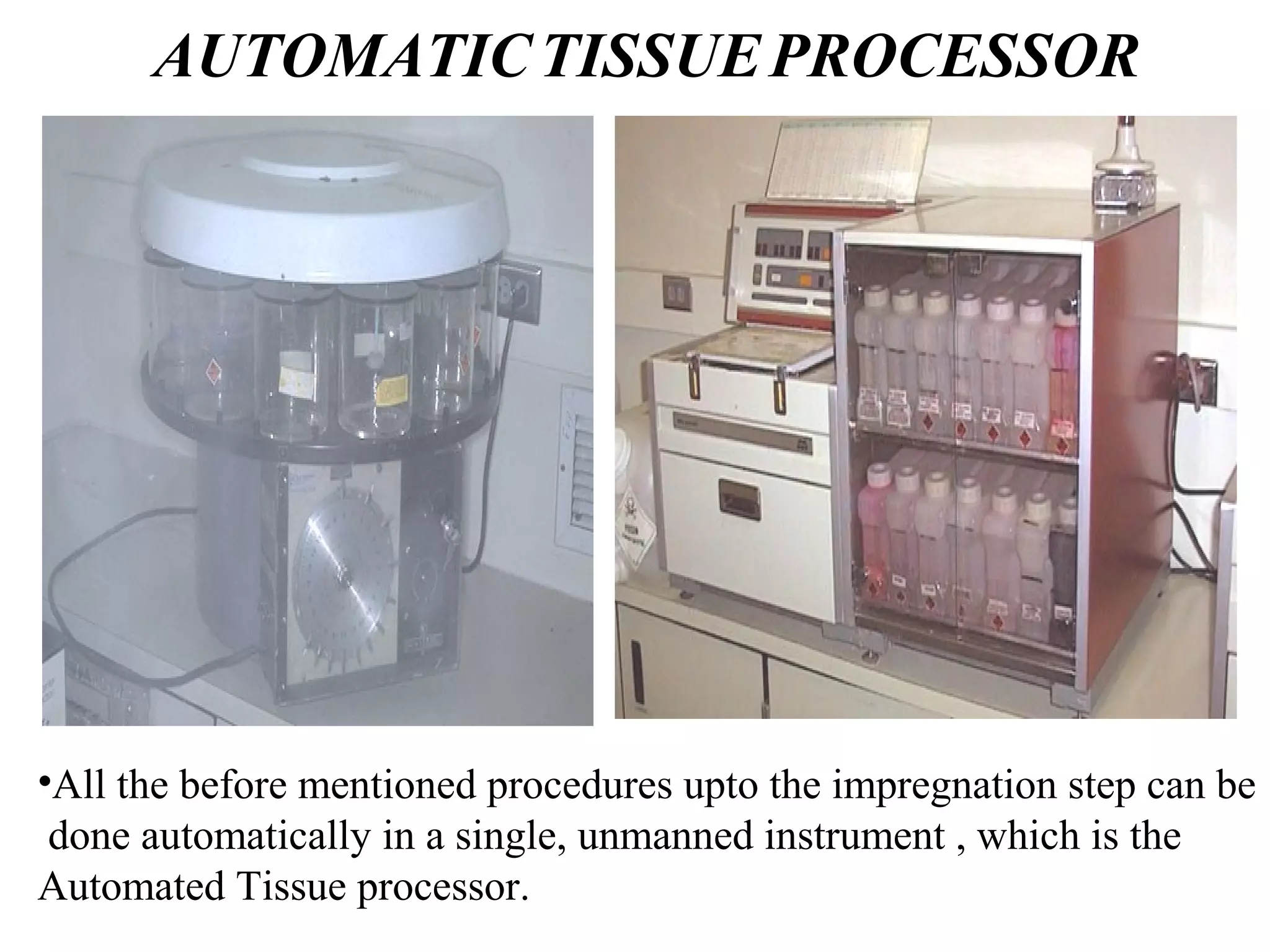
AUTOMATICTISSUEPROCESSOR
•All the before mentioned procedures upto the impregnation step can be
done automatically in a single, unmanned instrument , which is the
Automated Tissue processor.
AUTOMATIC TISSUE
PROCESSOR
•Transfer tissue both by day & night.
•Reduce time in each fluid by continual agitation.
•The 24hr clock is provided.
•Allows rapid processing.
•Racks to carry 25 cassettes.
•Eliminates human error.
•Tissue containers:
Has 24 containers subdivided into 2
Compartments.
•Beakers &Wax baths:
Provided with 10 beakers for reagents & 2
wax baths maintained at 56 degree temp.
.
•Stirring Mechanism: One arm supports stirring mechanism.
• Time Mechanism: Consists of 1hr,24hr or 7-day electric
Clock which has a time disc.
•Disc revolves once in 24hrs.
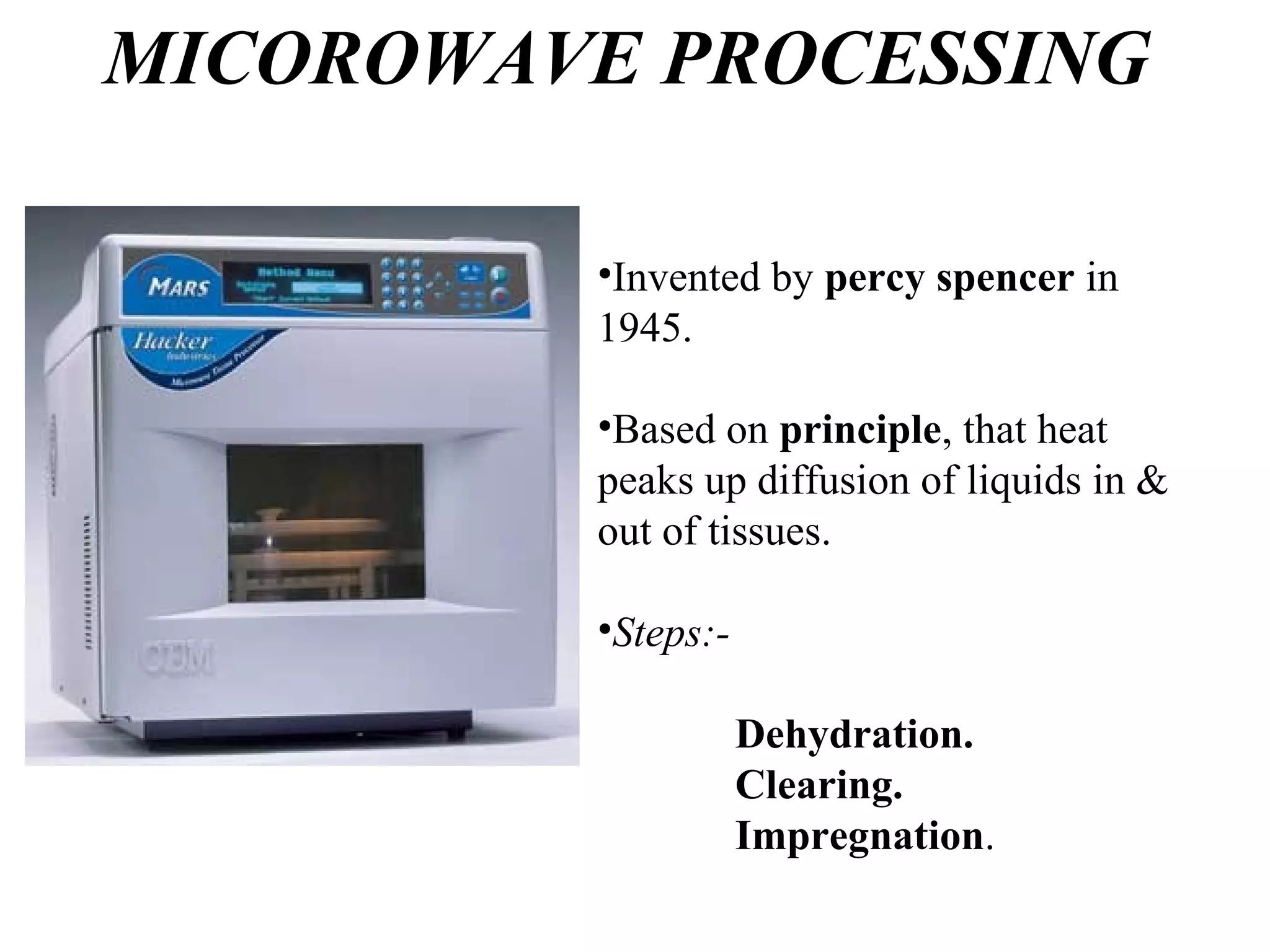
MICOROWAVE PROCESSING
•Invented by percy spencer in
1945.
•Based on principle, that heat
peaks up diffusion of liquids in &
out of tissues.
•Steps:-
Dehydration.
Clearing.
Impregnation.
PROCESSING SCHEDULES
-Thin sections less than 1mm -- 25 min.
-For medium sections 1-2mm -- 60 min.
-For thick sections 2-5mm --165 min.
•Isopropanol is used as clearing agents in microwave processing
instead of xylene.
PROCESSING SCHEDULE FOR MICROWAVE
PROCESSING
•Dehydration with ethyl alcohol at 67 d-centigrade for 5 min.
•Clearing with isopropyl alcohol at 74 d-centigrade for 3 min.
•Impregnation with paraffin at 65 d-centigrade for 2 min.
•Followed by 80 d-centigrade for 5 min.
• Tissue processing is a very much critical step that needs to be
monitored with utmost care.
• Since it takes longer time to process the tissue, any mistakes
alters the tissues requiring repetition.
• The tissues should not be under processed or over processed
that may hamper the tissue details.
• It is essential that the tissues are processed with proper
techniques and rendered them for subsequent steps.
CONCLUSION
•To get sections of diagnostic value,
processing of tissue should be done with
appropriate reagents & embedded in suitable
embedding medium depending upon type of
tissue.
Thank You!!!
REFERENCES
•Hand book of histopathologic techniques:
C.F.A. CULLING.
•Theory & practice of histological techniques:
JHON.D.BANCROT
•Internet source, W.W.W.histotechniques.com, youtube.com

Tissue Processing

  • 1.
  • 2.
    TISSUE PROCESSING . .. . . . . . . . . . . . . -A histotechnique.............
  • 3.
  • 4.
    INTRODUCTION • History oftissue processing • Histology • Histopathology • Histotechnologist ? ? ? ? • SECTIONING •EMBEDING ALEXANDER BUTLEROV, 1859 MICROTOME
  • 5.
    GROSS EXAMINATION SPECIMEN ACCESSIONING •REQUESTFORM • NUMBER •COLOUR •CONSISTENCY •TEXTURE
  • 6.
    SPECIMEN LABELLING • Shouldbe insoluble • Should not contaminate • Should not penetrate • Should not react • Clearly identifiable • Eg:India ink, silver nitrate, alcian blue SOFT LEAD PENCIL
  • 7.
    DEFINITION The tissue mustundergo preparatory treatment before being sectioned, entailing to impregnation of specimen with an embedding medium to provide support and suitable consistency for microtome is tissue processing. FORMALIN ALCOHOLS XYLENE PARAFIN 10% WAX PREPARATORY TREATMENT FIXATION DEHYDRATION CLEARING IMPREGNATION
  • 8.
    To remove waterfrom tissue and replace with a medium that solidifies to allow the thin sections of the tissue to be cut. AIM FIXATION DEHYDRATION 4-6mm HCT-2-3mm LC-10-20mm
  • 9.
    PRINCIPLE “FICK’S LAW” REAGENTS REAGENTS TISSUEFLUID TISSUE FLUID cold heat= TEMP GRADIENT STABILIZE POROUS TISSUE THERMODYNAMIC TENDENCY OF PROCESSING REAGENTS FICK’S LAW- The rate of diffusion of solutions through tissue is proportional to the concentration gradient of various tissue processing reagents.
  • 10.
    FACTORS EFFCTING THERATE OF TISSUE PROCESSING(TP) Vacuum- Fixation- Viscosity- Agitation- Heat- (45oc ) (TP) TPf Highly flammable r V-E-O Reduced pressure 15 inches of hg Removes air trapped, doesn’t make hard tissueMolten parafin wax Temp-hardens, shrinkage CEDAR WOOD OIL, MOLTEN WAX
  • 11.
    STEPS 1.FIXATION- 2.DEHYDRATION- 3.CLEARING 4.IMPREGNATION 5.EMBEDDING Mini-6hrs, max-12hrs to24hrs, 25times AIM, washed in running h2o types ACTION, ARTIFACTS,FACTORS, TECHNIQUE
  • 12.
    DEHYDRATION Removal of unboundwater & aqueous fixatives from tissue components is called Dehydration. DEHYDRATING AGENTS Ethanol- fast acting, electron microscopy specimen, clear colourless, flamable liquid Industrial Methylated Spirit-methonol 1%+IPA, Same physical property as ethanol Methanol- subsituted for ethanol,toxic, inflammable Propan-2-01,Isopropylealcohol- Microwave processing schedule, Butyl alcohol- plant and animal histology, slow dehydrant Acetone-Rapid in action with poor penetration, clear colorless & Inflammable liquid, Removes lipids & causes brittleness of the tissue Universal Solvents-Tertiary butanol, Tetra hydro furan, Dioxane, dehydrate+clear, not for delicate tissues. No shrinkage & hardness of the tissue
  • 13.
    TECHNIQUE 70% 80% 50% 90% 100%100% THE GRADUAL INCREASING CONCENTRATIONS OF ALCOHOL 2- 4 hrs 7-8hrs
  • 14.
    •In celloidin embeddingafter dehydration ,tissue is transferred to a mixture of equal parts of absolute alcohol & ether.
  • 15.
    USE OF COPPERSULPHATE IN FINAL ALCOHOLS . ..... ..... ..... ..... ..... ..... ..... ..... ..... white white ..... ..... ..... BLUE BLUE
  • 16.
    CLEARING •Intermediate step •Refractive index •Boilingpoint •Short chain aliphatic hydrocarbons
  • 17.
    CRITERIA FOR CHOOSING CLEARING AGENTS Rapid removalof dehydrating agent Ease of removal by melting paraffin Minimal tissue damageToxicity Flammability Tim e Cost viscocity Storage Disposal CRITERIA FOR CHOOSING CLEARING AGENTS
  • 18.
    TECHNIQUE OF CLEARING Volumeof clearing agent should be 50-100 times the volume of tissue. In chloroform or carbon tetrachloride tissues are left over night for clearing . In Xylene,benzene,toluene tissues are given one change after 30 to 60 minutes. Technique for cedar wood oil is different.
  • 19.
    CEDAR WOOD OIL TECHNIQUE:- Cedarwood oil poured into specimen jar & same quantity of absolute alcohol superimposed on it . The specimen is placed into alcohol , it floats at the interface of two fluids. As tissue is cleared it sinks into cedar wood oil. The alcohol is removed & specimen is transferred to fresh cedar wood oil Cedar wood oil Absolute alcohol Cedar wood oil
  • 20.
    In processing forelectron microscopy clearing is done in 1,2 epoxy propane,2 changes 15 min in each. 15mins 15mins ELECTRON MICROSCOPY 1,2 epoxy propane 1,2 epoxy propane
  • 21.
    CLEARING AGENTS •Chloroform •Toluene ,Xylene , Benzene •Carbon Tetrachloride •Cedar Wood oil •Methyl Benzoate , Methyl Salicylate •Citrus Fruit Oil
  • 22.
    CHLOROFORM •Most common reagentused in processing of CNS specimens. •DIS ADV:- Slower in action, Highly toxic. Does not effect refractive index of tissue. End point of clearing can not be determined. Expensive compared to other clearing agents. Tissue can be left in this with out any damage for longer time, non-flammable. •ADV:-
  • 23.
    CARBON TETRACHLORIDE •Similar actionas chloroform. •Much cheaper. •Non inflamable. •Is toxic.
  • 24.
    IMPREGNATION •Impregnation with paraffinwax is carried out in a oven heated to 54-56 degree. •The temperature depends up on the melting point of wax used for impregnation. •Types of impregnation oven: Electric heated oven. Vacuum embedding oven. Gas heated oven. •Permeating the tissue with a supporting medium is called Impregnation.
  • 25.
    FACTORS EFFECTING IMPREGNATION •Size &type of tissue. •Clearing agent employed. •Use of vacuum embedding oven.
  • 26.
  • 27.
    TECHNIQUE OF IMPREGNATION •After clearingthe tissue is transferred to oven maintained at 56 degree temperature. •Volume of wax should be 25-50 times the volume of tissue. •Wax must be changed at least once during the process.
  • 28.
    PARAFFIN WAX •Should befree from dust & foreign particles. •Should not contain water. •Melting point should be 54degrees. •Soft wax(45 dg) for foetal & areolar tissue. •Hard wax (60 dg) for hard & fibrous tissue
  • 29.
    PARAPLAST •Mixture of purifiedparaffin & plastic polymers. •Greater elasticity than paraffin . •Wrinkle free serial sections can be cut. •Does not need ice application while sectioning
  • 30.
    ESTER WAX •From clearingagent transfer to mixture of clearing agent & wax.
  • 31.
    CELLOIDIN EMBEDDING 2% celloidin:-5-7 dayS. 4% celloidin:-5-7 days. 8% celloidin:-2-3 days.
  • 32.
  • 33.
    DOUBLE EMBEDDING Tissue isimpregnated in a mixture of celloidin& methyle benzoate.
  • 34.
    ARTIFACTS •In adequate impregnationleads to loss of architectural details.
  • 35.
    AUTOMATICTISSUEPROCESSOR •All the beforementioned procedures upto the impregnation step can be done automatically in a single, unmanned instrument , which is the Automated Tissue processor.
  • 36.
    AUTOMATIC TISSUE PROCESSOR •Transfer tissueboth by day & night. •Reduce time in each fluid by continual agitation. •The 24hr clock is provided. •Allows rapid processing. •Racks to carry 25 cassettes. •Eliminates human error.
  • 37.
    •Tissue containers: Has 24containers subdivided into 2 Compartments. •Beakers &Wax baths: Provided with 10 beakers for reagents & 2 wax baths maintained at 56 degree temp. . •Stirring Mechanism: One arm supports stirring mechanism.
  • 38.
    • Time Mechanism:Consists of 1hr,24hr or 7-day electric Clock which has a time disc. •Disc revolves once in 24hrs.
  • 39.
    MICOROWAVE PROCESSING •Invented bypercy spencer in 1945. •Based on principle, that heat peaks up diffusion of liquids in & out of tissues. •Steps:- Dehydration. Clearing. Impregnation.
  • 40.
    PROCESSING SCHEDULES -Thin sectionsless than 1mm -- 25 min. -For medium sections 1-2mm -- 60 min. -For thick sections 2-5mm --165 min. •Isopropanol is used as clearing agents in microwave processing instead of xylene. PROCESSING SCHEDULE FOR MICROWAVE PROCESSING •Dehydration with ethyl alcohol at 67 d-centigrade for 5 min. •Clearing with isopropyl alcohol at 74 d-centigrade for 3 min. •Impregnation with paraffin at 65 d-centigrade for 2 min. •Followed by 80 d-centigrade for 5 min.
  • 43.
    • Tissue processingis a very much critical step that needs to be monitored with utmost care. • Since it takes longer time to process the tissue, any mistakes alters the tissues requiring repetition. • The tissues should not be under processed or over processed that may hamper the tissue details. • It is essential that the tissues are processed with proper techniques and rendered them for subsequent steps. CONCLUSION
  • 44.
    •To get sectionsof diagnostic value, processing of tissue should be done with appropriate reagents & embedded in suitable embedding medium depending upon type of tissue.
  • 45.
    Thank You!!! REFERENCES •Hand bookof histopathologic techniques: C.F.A. CULLING. •Theory & practice of histological techniques: JHON.D.BANCROT •Internet source, W.W.W.histotechniques.com, youtube.com